
Top Outbound Experts: Who to Trust When Your ToFU Sales Pipeline is Broken


In this post:
Every time we talk to a team lead who thinks they need an outbound expert or that their pipeline is broken and that they need someone who can fix the cold email piece, they’re almost all the time wrong about the problem they have.
I mean, the conversation opens up and the picture changes.
The cold email is broken, sure. So is the inbound qualification flow, the meeting booking process, the way the CRM tracks deals, and the report your head of sales sends the CFO on what the pipeline is actually worth.
Outbound is the visible part of the iceberg. What lies underneath it is a revenue org working off manual spreadsheets, half-finished automations, and meetings that nobody can attribute back to a source.
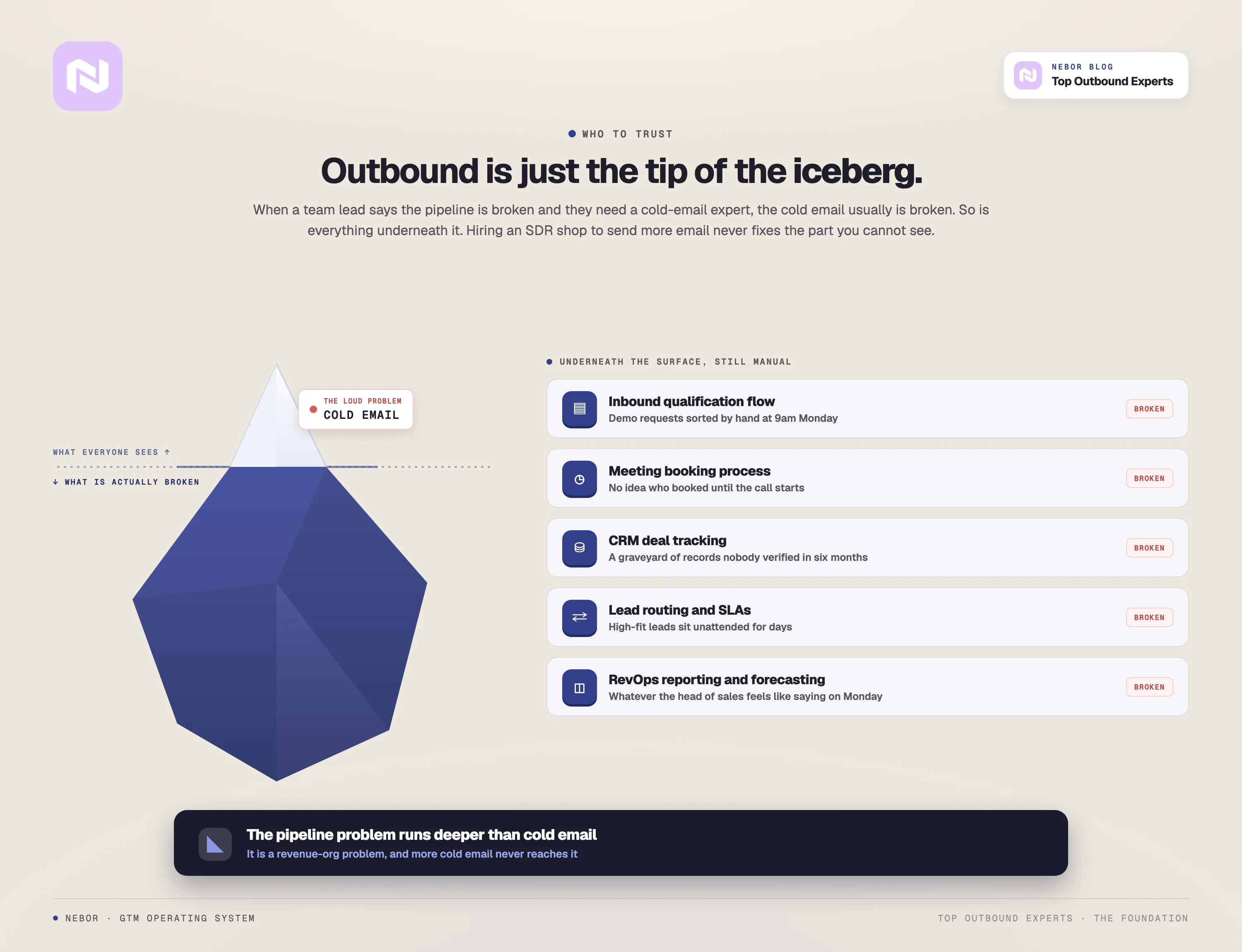
That's the real reason the pipeline feels broken. And it's why hiring an SDR shop to send more cold emails almost never fixes it.
Most companies don't notice this until they hire help. The SDR shop comes in, sends cold email for six months, blames deliverability when it stalls, and quietly hands the problem back.
Or the Clay agency builds a beautiful 14-table workflow, charges five figures a month to maintain it, and the rest of the revenue org keeps working off the same Google Sheets it always did.
The pattern repeats. Companies hire specialists for the loud problem, and the quiet problems behind the loud one stay broken.
Here's the part most companies miss when they go shopping for an outbound expert in 2026.
The same automation logic that powers a good outbound flow already covers most of what your revenue org needs.
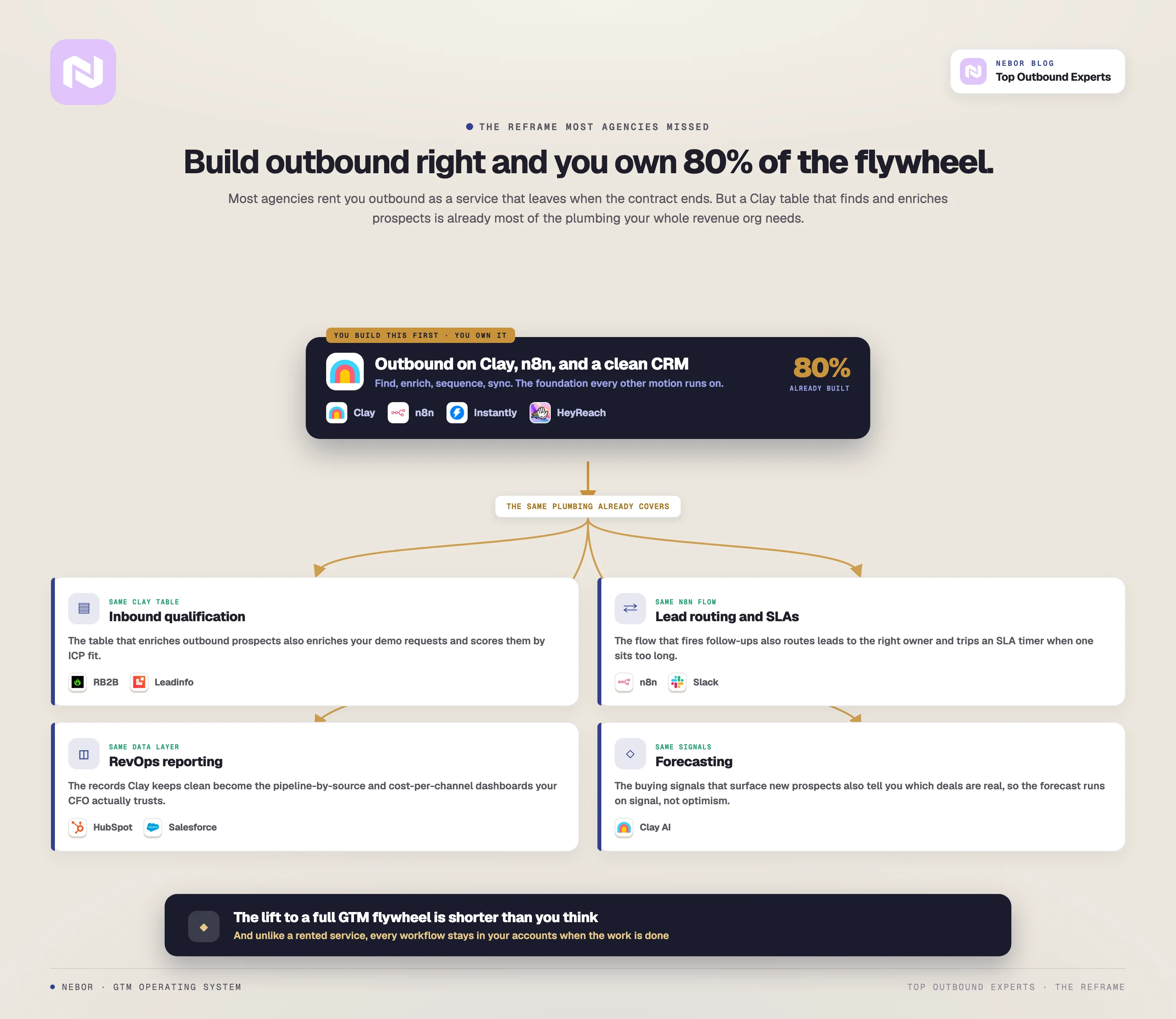
If you have a Clay table that finds the right prospects, enriches them with Findymail and LeadMagic, and pushes them into Instantly for sequencing, you have already built 80% of the plumbing for everything else.
Once a Clay table is finding and enriching prospects for outbound, the same table can also enrich your inbound demo requests when someone fills out your form.
Through n8n, the workflow sending follow-up emails can push deal updates into your CRM at the same time. The buyer signals that surface new prospects also tell your customer success team which accounts are about to expand or churn.
The lift from "we have outbound flows" to "we have a full GTM flywheel" is shorter than most people think.
Once outbound is humming on Clay, n8n, and a clean CRM, the same plumbing already covers inbound qualification, lead routing, RevOps reporting, and forecasting.
The same eight workflows that find the prospect can also clean the CRM record, score the deal, and tell your CFO what next quarter looks like.
Which means the right outbound expert today is the partner who can take the outbound flows you build and extend them across your whole revenue org so the rest of the team stops doing manual work.
We've written before about why most B2B companies don't actually need to outsource lead generation in 2026, and the GTM flywheel argument is the natural extension of that piece.
This is the reframe most agencies haven't caught up to. They still sell outbound as if it's a service you rent. Most of them are good at one channel and bad at everything around it.
The reader looking for an outbound expert today is usually a head of sales or RevOps lead who already suspects the pipeline problem goes deeper than cold email but hasn't found anyone who solves the bigger picture.
This guide works through the question one expert at a time. We start with us at Nebor because we built the company to do exactly this work, and we want to make the case for what a GTM flywheel partner actually looks like in 2026.
Then we walk through ten other partners worth considering. For each one, we describe what the agency actually is, who it's best for, and where it breaks down.
The at-a-glance table below is for the reader who wants the answer in 60 seconds. The rest of the article is for the reader who wants to make a real decision they won't regret in six months.
The at-a-glance comparison
Agency | Best for | Where they break down |
Nebor | Teams that want outbound to become the foundation of a full GTM flywheel they own afterward | Companies with no in-house revenue team yet, or buyers who want a meetings-only retainer |
CIENCE Technologies | High-volume outsourced SDR ops with AI plus human reps across phone, email, and LinkedIn | When you need to own the workflows, not rent the labor |
Belkins | Appointment-setting in niche or technical markets where ICP fit matters more than volume | When you want a system you keep, not a managed service you stay on |
SocialBloom | Pay-per-SQL economics with eventual ownership transfer for B2B agencies, SaaS, and consulting firms | When you need GTM systems thinking past cold email and booked meetings |
SalesRoads | US-based cold-call-heavy outbound delivered by experienced native-speaking SDRs | When your ICP is global, technical, or LinkedIn-first |
ColdIQ | SaaS companies that already know they want a Clay-built outbound and ABM motion | When you need RevOps depth, full CRM rebuilds, or workflows past outbound and ABM |
memoryBlue | Outsourced SDR teams for SaaS firms that want to skip in-house hiring | When you have AEs already and just need pipeline coordination, not bodies |
ClosedIn | Cold-email-only motions delivered by Clay and Instantly specialists | When you want multi-channel coverage or anything past meeting bookings |
Sopro | Multi-channel managed prospecting at European scale with 300 staff and 22,000+ campaigns delivered | When you want a system you own, not a long-term outsourced engagement |
Martal Group | Complex enterprise B2B with multi-stakeholder buying cycles backed by their AI SDR platform | When you want infrastructure independent of someone else's proprietary tooling |
Growth Engine X | Cold-email niche shops focused on deliverability and ICP work | When the rest of your stack (LinkedIn, calls, CRM, RevOps) needs work too |
Why most outbound efforts fail in 2026
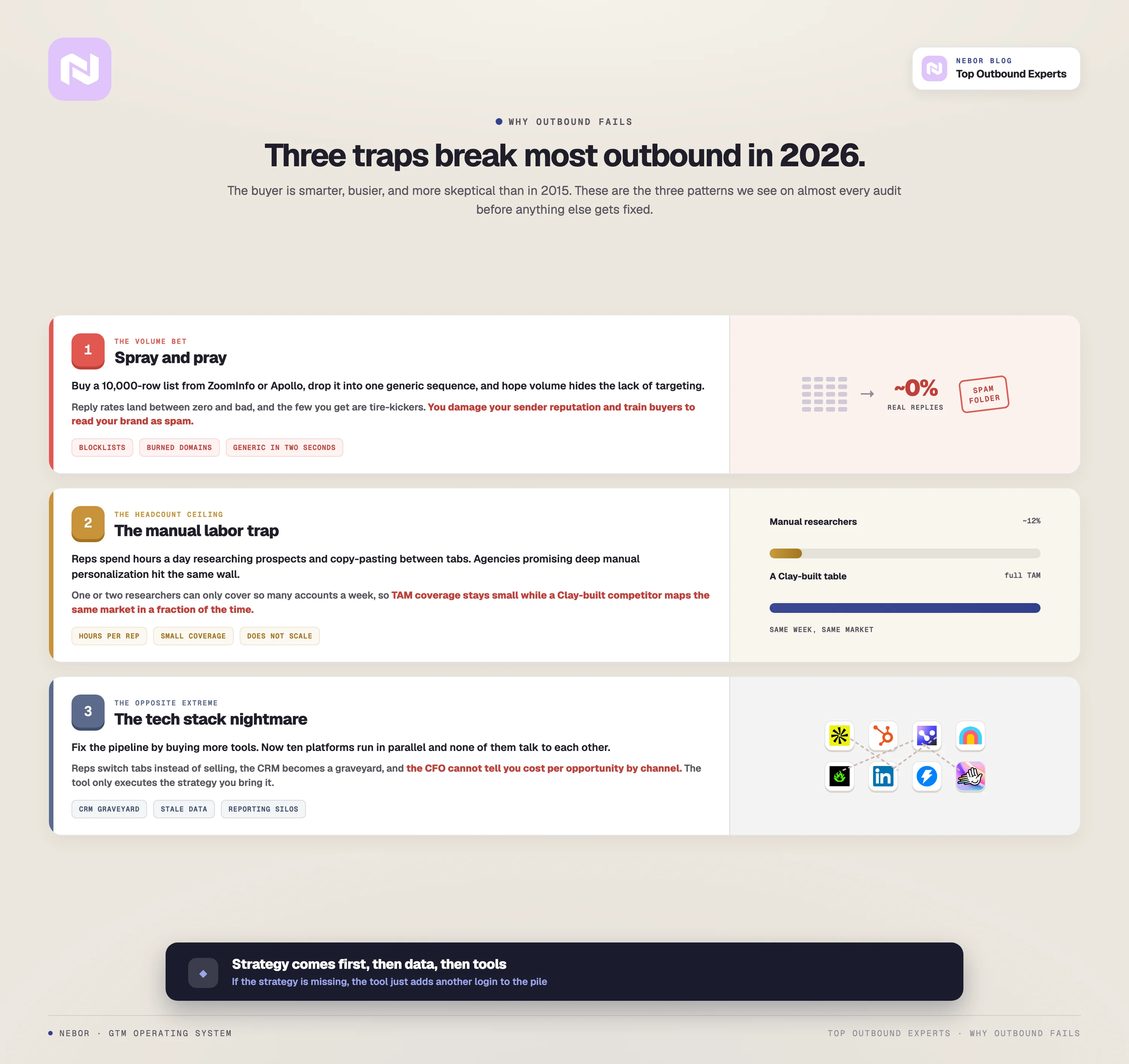
Before we get into who the real partners are, here is what is actually breaking your pipeline.
The spray-and-pray problem
Most agencies still do outbound the way they did in 2015. They buy a 10,000-row list from ZoomInfo or Apollo, drop it into one generic sequence, and hope volume hides the lack of targeting.
Reply rates land somewhere between zero and bad. The few replies they do get are tire-kickers or out-of-office responses.
The buyer in 2026 is smarter, busier, and more skeptical than the buyer in 2015. They can spot a generic mass email in two seconds.
The cost of looking generic goes way past a lost reply. You damage your sender reputation, end up on blocklists, and train buyers to associate your brand with spam over time.
The manual labor trap
Even teams that try to personalize get stuck doing everything manually. Sales reps spend hours each day researching prospects, copy-pasting between tabs, and tracking follow-ups in spreadsheets.
Most sales teams waste a meaningful chunk of their week on activities that don't actually move revenue.
The funny part is that most agencies promising "deep manual personalization" hit the same trap. They hire one or two researchers, those researchers can only process so many accounts a week, and the agency's TAM coverage stays small.
Meanwhile a competitor with a properly built Clay table can map and target the same TAM in a fraction of the time, with better data, and at higher volume. We covered the full automation pattern in our piece on automating sales prospecting from scratch.
The deeper problem is that manual processes don't scale into the rest of your revenue org either.
If your outbound is manual, your inbound qualification is probably also manual, your CRM data hygiene is held together with weekly cleanup days, and your forecasting is whatever the head of sales feels like saying on Monday morning.
The whole revenue motion rests on human effort, and human effort gets expensive fast.
The tech stack nightmare
The other failure pattern is the opposite extreme. Some companies try to fix the broken pipeline by buying more tools.
They end up with Outreach, Salesloft, HubSpot, Apollo, Clay, RB2B, Cognism, LinkedIn Sales Navigator, and four other platforms working in parallel.
Each tool does its narrow job and none of them talk to each other. The CRM becomes a graveyard of records nobody verified in six months.
Reps stop selling and spend their days switching between tabs to keep up with all the platforms. Data goes stale faster than anyone can refresh it.
The sales ops person dreads Monday standups, and the CFO can't tell you cost per opportunity by channel because the channels live in separate reporting silos.
We've written before about why most Clay implementations fail, and the pattern is almost always the same. Buyers think a tool will fix the system.
The tool can only execute the strategy you bring to it. If the strategy is missing, the tool just adds another login to the pile.
The real partner you're looking for understands that strategy comes first, then the data layer that supports it, then the tools that execute against it.
How Nebor builds your GTM flywheel and RevOps spine
Most of the agencies in this article are good at one part of the picture. We've built Nebor to do the work that connects the parts.
The pipeline problem you're trying to fix is rarely just an outbound problem, so the work we do for our clients is rarely just outbound work.
We started Nebor (originally Utmost) because we were the salespeople watching businesses get burned by agencies that cared more about retainers than results. Andrew and Yannick lead the team out of Amsterdam.
Yannick brings over a decade of corporate SaaS sales experience to the table. We built outbound for our own businesses for years before we ever sold the work to clients. Salespeople first, automation experts second.
The way we work comes down to one rule. Ownership over rental.
When we are done, the Clay tables, the n8n flows, the CRM views, and the dashboards live in your accounts, on your data, with the names your team uses for everything else. You can keep paying us to keep building. Or you can take the keys and go.
Most clients keep us for the next stage of work, but the choice stays yours.
Here is what the build looks like.
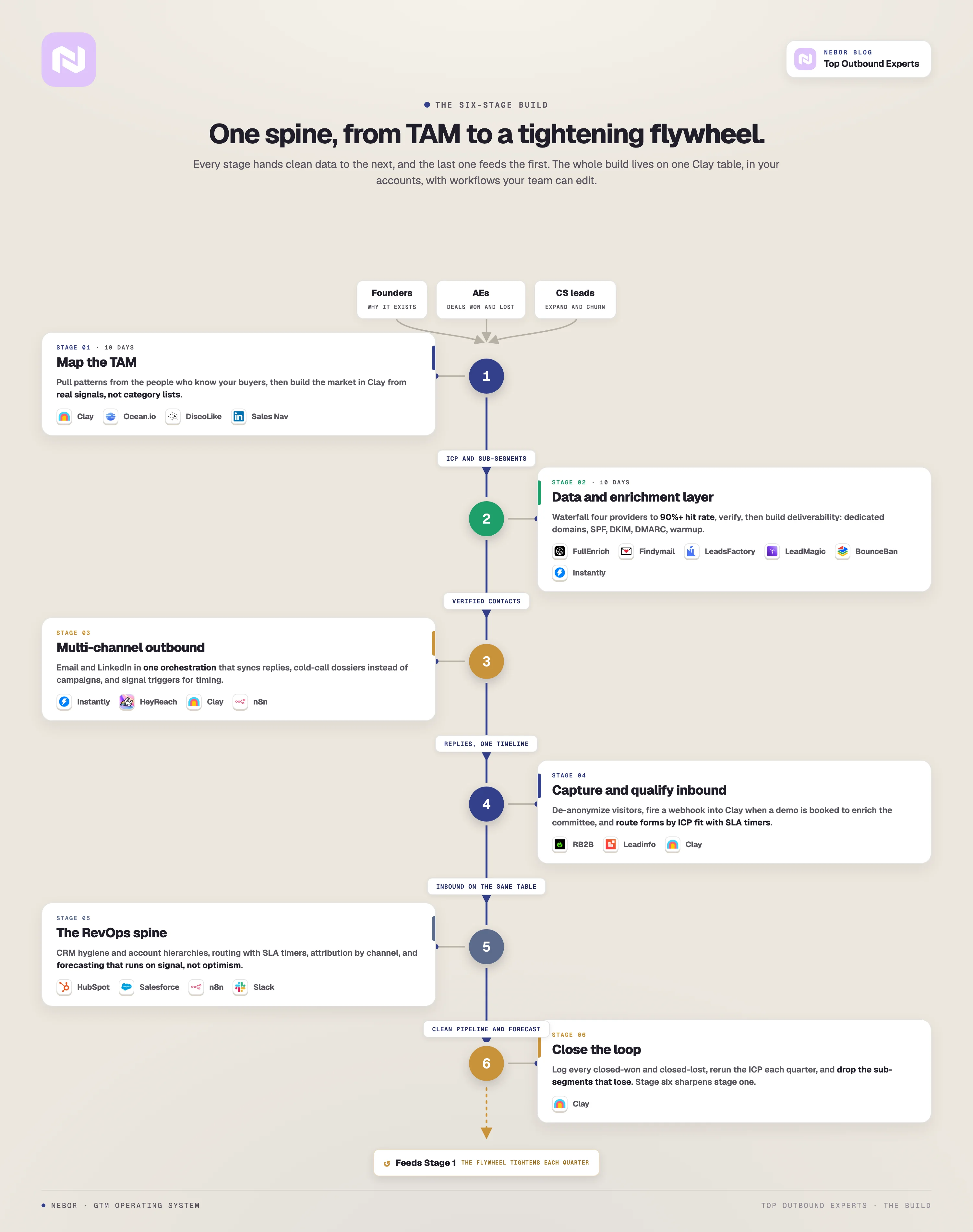
Stage 1: We start by mapping your addressable market
Most agencies skip this and jump straight to outreach. We spend the first 10 days building the map.
We sit with your founders, AEs, and customer success leads first
Before we build any list, we sit with the people who actually know your buyers.
Founders explain why the company exists in the first place, AEs walk us through the deals they've closed and the ones that died on them, and customer success leads pull up the accounts that expanded and the ones that churned for the why behind each.
We pull patterns out of those conversations, not out of the ICP slide that lives in your sales deck.
The questions we ask are concrete. What triggered your last 10 closed deals? Which customers cost you the most to serve? What objections come up in the second meeting that didn't come up in the first?
We turn the answers into a working ICP and a sub-segment list before we touch any tool. We covered the full version of this exercise in our piece on building your TAM for B2B sales and go-to-market.
We build the TAM in Clay using real signals, not category lists
Clay is where the TAM lives. We pull companies from category sources where they make sense (LinkedIn Sales Navigator, ZoomInfo) and from signal sources where they don't (event directories, hiring boards, funding announcements, RSS feeds, scraped industry sites).
We use Ocean.io and DiscoLike to surface accounts that look like your best customers but don't show up in the obvious tools.
For a recent client selling AI design software to property developers, the obvious tools missed close to 60% of their TAM because the buyers don't carry the right job titles.
We built the TAM off Multi-Housing News and Chicago Yimby announcement feeds instead. The same logic applies in any vertical where the buying signal lives outside the category data.
We define sub-segments and the data sources behind each one
The TAM splits into sub-segments your team can actually work plays against. Each sub-segment gets its own data source, its own enrichment recipe, and its own messaging angle.
When the sub-segment behaves differently in the data, the workflow handles it differently. We never send "spray the whole TAM with one sequence" campaigns.
Stage 2: We build the data and enrichment layer in Clay
Once we have the TAM defined, the next 10 days go to the data layer. This is where most Clay implementations fall apart, and we've written about that pattern in detail.
Clay is the central system, not just a list builder
Most agencies use Clay as a smarter ZoomInfo. We use it as the central system for every contact record that enters your business.
The Clay tables that enrich outbound prospects also enrich your inbound demo submissions and the customer success accounts showing expansion signals.
The result is one enrichment layer instead of three, and a contact record that gets richer with every system event your business handles. Your CRM stays clean because Clay is the layer keeping it clean.
We layer enrichment from FullEnrich, Findymail, LeadsFactory.io, and LeadMagic
Single-source enrichment misses 30 to 40% of contact data. We waterfall through FullEnrich, Findymail, LeadsFactory.io, and LeadMagic, with conditional fallbacks based on what each source returns.
The hit rate lands above 90% on most ICPs. BounceBan catches bounced emails before they ever reach your sender domain.
We build the deliverability infrastructure on top
Cleaning the list is half of deliverability. The sending infrastructure is the other half.
We provision dedicated sending domains separate from your main business domain, configure the SPF, DKIM, and DMARC records, warm the mailboxes through Instantly, and monitor sender reputation in real time.
If a sending domain starts looking suspicious, the workflow throttles the sends and rotates content automatically before the reputation damage compounds.
Stage 3: We build multi-channel outbound from one system
Email alone is not outbound in 2026. The inbox is too crowded, the open rate is too unreliable, and the buyer who matters is rarely on email at the moment your message lands.
Email through Instantly, LinkedIn through HeyReach
HeyReach handles LinkedIn at scale, with multiple senders working in parallel through your team's accounts.
Instantly handles email, with the deliverability infrastructure from stage 2 doing the heavy lifting.
The two live in one orchestration layer (Clay tables triggering n8n flows) so a prospect who replies to a LinkedIn message stops getting the email sequence, and a reply on email stops the LinkedIn outreach.
We covered the prospecting automation pattern in detail in our piece on automating sales prospecting from scratch.
Cold-call dossiers, not call campaigns
We don't send cold-call campaigns. Calls work when the rep doing the call knows the prospect cold.
Instead of making calls, we generate prospect dossiers your AEs use when they pick up the phone.
Each dossier has the buying signals that triggered the outreach, the prospect's last 90 days of LinkedIn activity, the company's last earnings call summary if public, and a one-paragraph opener your rep can riff off.
Signal triggers control the timing
The hardest part of outbound is timing, and signal triggers solve most of it.
Hiring posts, funding rounds, leadership changes, expansion announcements, and competitor interactions all trigger tailored sequences in the right channel within hours of the signal showing up.
A prospect who just posted a job for a Head of Sales gets a different message than one whose company just raised a Series B.
We covered the signal-driven workflow in our piece on finding decision-makers automatically with Clay, LeadsFactory, and LinkedIn Sales Navigator.
Stage 4: We capture and qualify your inbound
If outbound is working, inbound starts climbing too. Brand searches climb, direct traffic climbs, and demo requests start showing up at higher volume.
Most companies waste that lift because their inbound machine never had to absorb it before.
RB2B and Leadinfo for de-anonymizing visitors
RB2B gives you names against US visitors. Leadinfo gives you company-level resolution against EU visitors.
Both tools feed Clay, enrich into your CRM, and kick off a tailored outbound sequence when the visitor matches your ICP without filling a form.
The visitor who looked at your pricing page twice last week and never submitted now gets a relevant LinkedIn message from your AE 24 hours later.
Your meeting booking platform plus Clay for buying-committee enrichment on inbound calls
When a prospect books a demo, we don't wait for the call to find out who they are. We set up your meeting booking platform to send a webhook into Clay the moment a prospect books the meeting.
Clay enriches the booker, identifies the rest of the buying committee at the company, pulls relevant LinkedIn activity from the last 90 days, and pushes a one-page brief into your AE's calendar before the meeting starts.
We documented the full inbound meeting workflow with Clay, HeyReach, and Instantly on the blog.
Demo-form workflows that route by ICP fit
The form on your homepage gets the same treatment. We score every submission for ICP fit the moment it lands.
High-fit submissions go to your AE bench with priority routing and SLA timers. Low-fit submissions route to a nurture sequence with content that matches their buying stage.
Nobody on your team manually sorts the inbox at 9 AM Monday morning.
Stage 5: We build the RevOps spine
This is the work that separates a GTM flywheel partner from an outbound shop.
Outbound brings the prospect in, and the RevOps spine keeps the prospect from falling out of the system between the demo and the close.
CRM hygiene and data unification
At this stage, we work on your CRM (HubSpot, Salesforce, or whichever you use) to make it the source of truth that drives your business growth.
We enrich every record that enters the system, dedupe it, and assign the right owner before it lands.
Parent companies show up as one account in your CRM, not nine, because we build the account hierarchies behind them. Stale records refresh on a rolling schedule, so the data your reps act on is current, not three quarters out of date.
Lead routing and SLA timers
We define MQL and SQL together with your team, not in a vacuum.
Round-robin routing, weighted distribution by territory, deal size, or product fit, all live in n8n flows that read from your CRM and assign in real time.
SLA timers go off if a high-fit lead waits unattended for more than four hours. Your AEs see the timers in Slack, your sales leader sees the misses in a weekly report.
Attribution and reporting dashboards
Pipeline reports break down by source so you can see what outbound, inbound, paid, and referral are each contributing.
Channel ROI lands in a single dashboard with cost-per-meeting, cost-per-opportunity, and cost-per-closed-won across every channel.
Deal velocity tracks stage by stage in the same dashboard, so you spot the bottleneck before the quarter ends. Most clients see the channel mix change once they can actually measure it for the first time.
Forecasting and sales ops tooling
We layer deal scoring on top of stage progression so your forecast is built on signal, not on AE optimism.
Quota tracking, AE productivity dashboards, and pipeline coverage views live in the same RevOps layer. Your CFO can ask "what is the next quarter's pipeline worth" and get a real answer in under a minute.
The RevOps spine is what makes the flywheel a flywheel. Without it, every other stage is a feeder into a leaky bucket.
Stage 6: We close the loop back to your TAM
The last stage is the one most agencies skip. It is also the one that compounds the value of every other stage over time.
Closed-won analysis feeds ICP refinement
We log every closed-won deal with the full enrichment, signal, and channel history. Every quarter we rerun the ICP definition against the actual closed-won data.
The TAM gets sharper, the sub-segments cleaner, and the signals that predicted the close take priority for the next quarter's outbound.
Closed-lost analysis tells us what to drop
Closed-lost deals get the same treatment, and AEs capture reason codes at the deal level.
If a sub-segment is closing-lost more than 80% of the time on a specific objection, we kill the sub-segment or rework the messaging before we burn another month of outbound on it.
The flywheel keeps tightening
The output of stage 6 feeds stage 1.
Each quarter the TAM gets sharper as we drop dead sub-segments and add new ones, the data layer gets richer because every closed deal teaches the next quarter's enrichment, and outbound and inbound aim better because both ICP and signal definitions are tighter.
The RevOps spine catches more of what comes through. The flywheel tightens, and the system needs less manual work to keep producing.
This is the difference between a partner who handles your outbound for a year and a partner who builds the system that carries the rest of your revenue org afterward.
Most clients we work with see a measurable improvement in pipeline within the first 90 days. The flywheel itself takes 6 to 9 months to fully tighten.
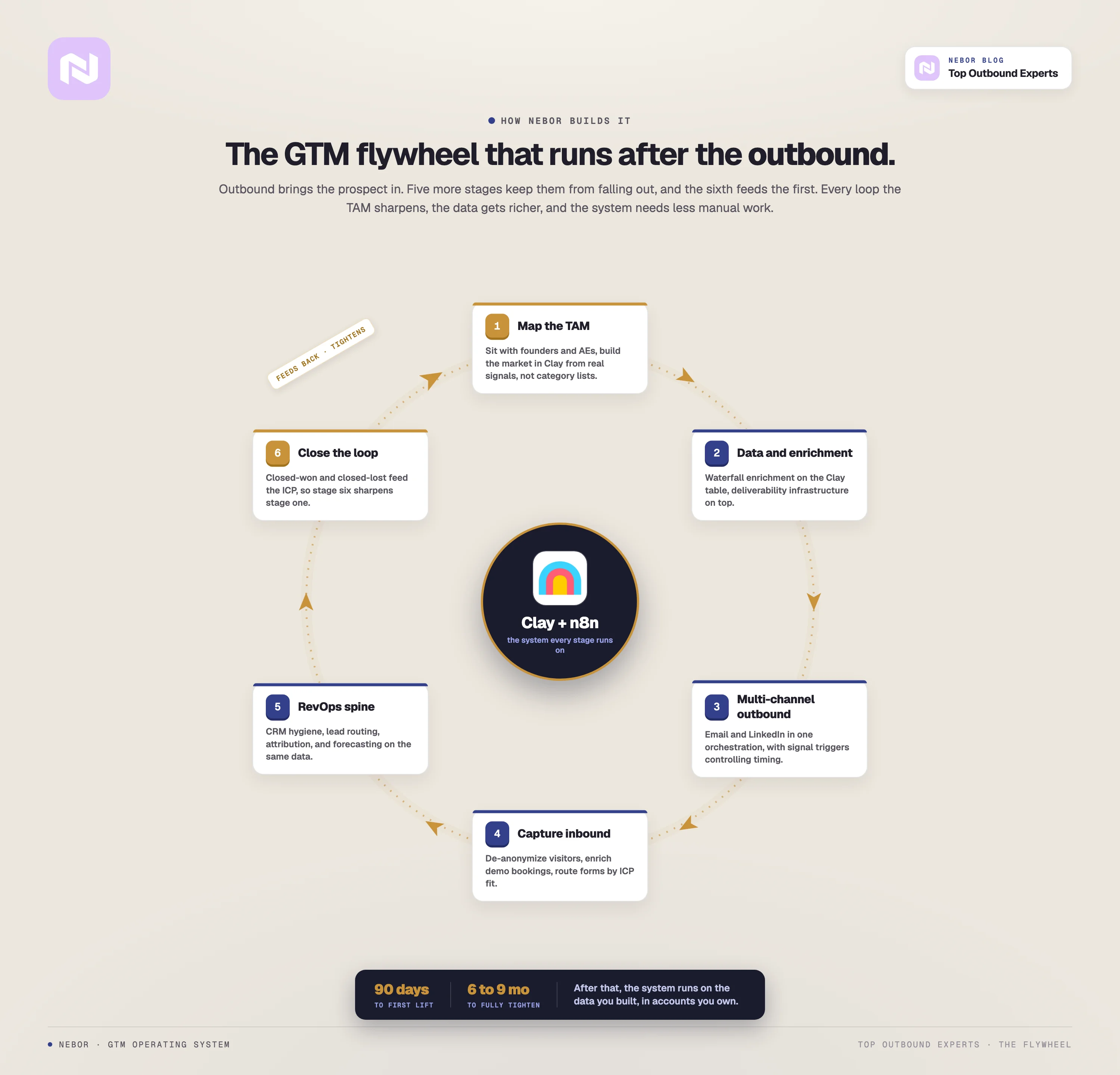
After that, the system works off the data you have built, in the accounts you own, with workflows your team can edit. We've written about why we set out to be the best growth agency and what that looks like in practice.
10 outbound experts and GTM partners worth considering in 2026
1. CIENCE Technologies
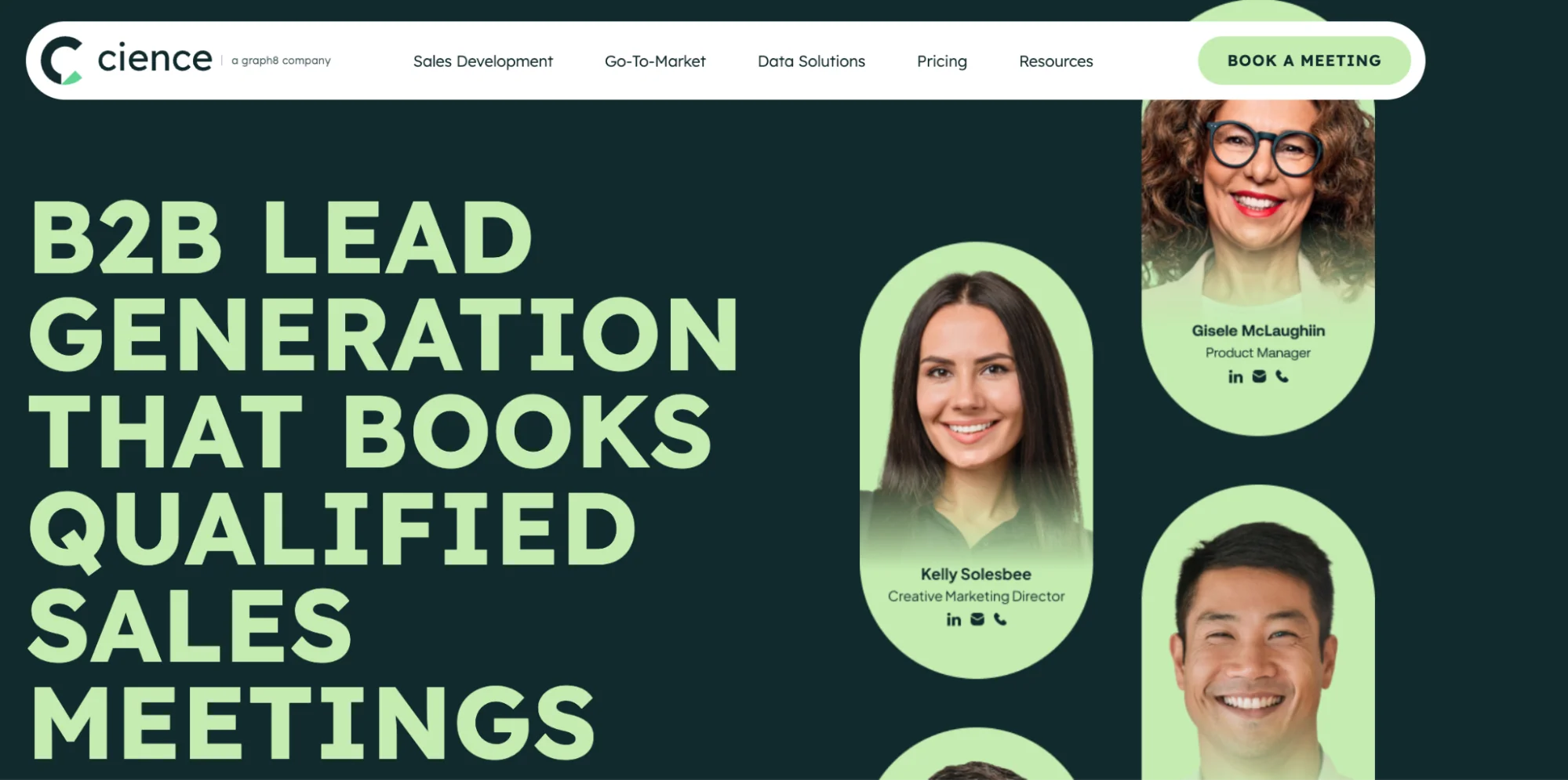
CIENCE operates one of the largest outsourced sales development operations in the B2B world. They blend trained human SDRs with AI-powered outreach across phone, email, LinkedIn, and chat, and they deliver multi-channel campaigns at volume.
The company has worked with over 1,500 clients across nearly 200 industries, with a model that pairs AI handling top-of-funnel volume and human reps nurturing the conversations that warm up.
They're best for high-volume B2B operations that need outsourced SDR coverage right now, with AI orchestration layered on top of a real human team.
If your business model is closer to enterprise volume than to founder-led ABM, CIENCE has the operational depth to absorb your TAM at scale. We've covered the broader category of SDR agencies in detail for the longer comparison.
Where they break down is the same place every traditional outsourced SDR shop does. The workflows live in CIENCE's accounts, not yours.
You rent the labor and the tooling, and when the contract ends, the system goes with them. If your goal is to build something you own, CIENCE is the wrong fit by design.
2. Belkins
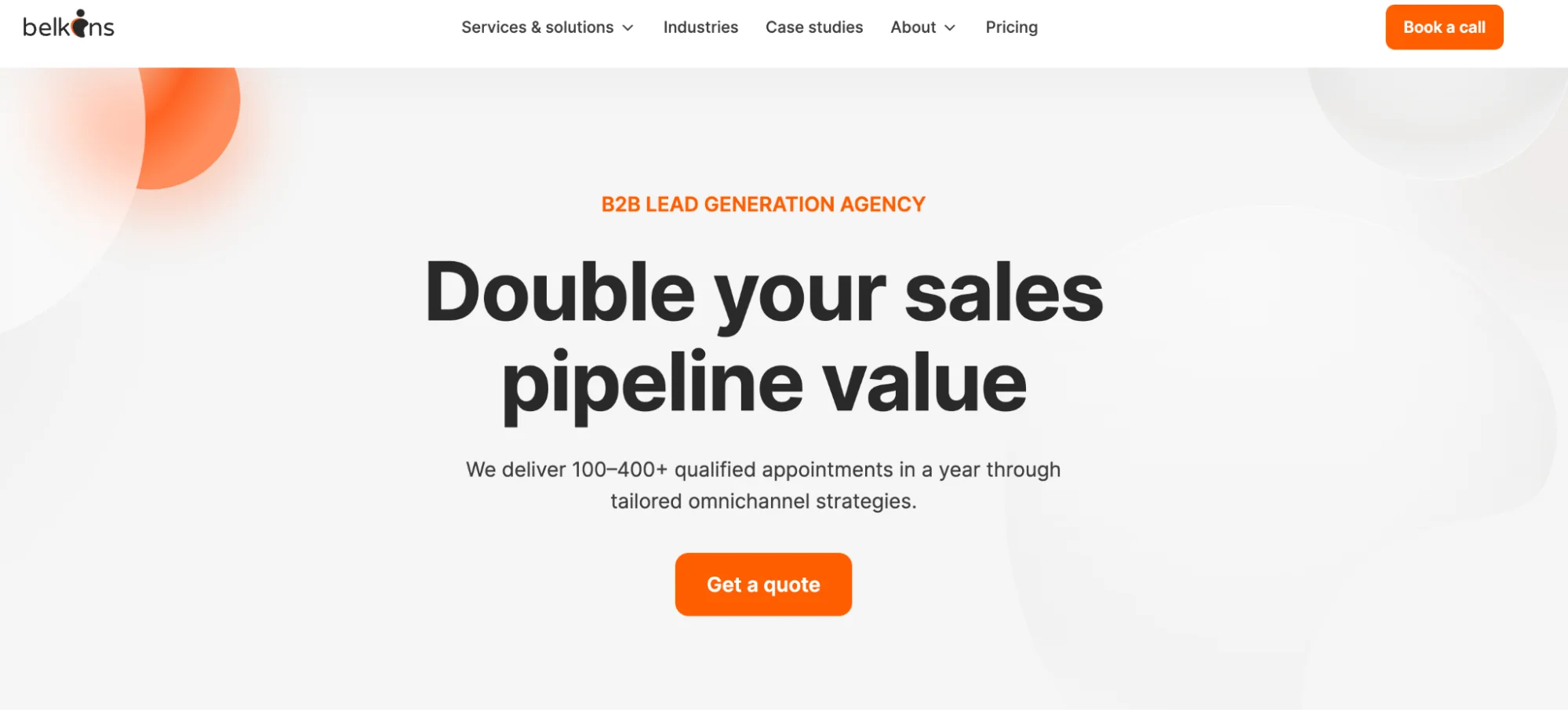
Belkins ranks consistently among the top appointment-setting and lead generation agencies in the B2B space.
Their model leans hands-on and consultative. They tailor cold email and LinkedIn outreach to specific personas, with strong ICP mapping before any sequence goes out. They report open rates around 30% and reply rates near 12% on their campaigns.
They're best for companies in niche or technical markets where ICP fit matters more than raw volume.
If your buyer is a specific persona at a specific stage of company growth, Belkins's consultative approach surfaces those buyers better than a high-volume shop will.
The team treats engagements like partnerships rather than vendor contracts, which works well if you want a thoughtful outside collaborator on your messaging.
Where they break down is the system question. Belkins delivers the campaigns. Your team rarely sees the workflow underneath, and when the engagement ends, the workflow does too.
If you want the playbook to live in your accounts after the work, you'll be having a different conversation with a different agency.
3. SocialBloom.io
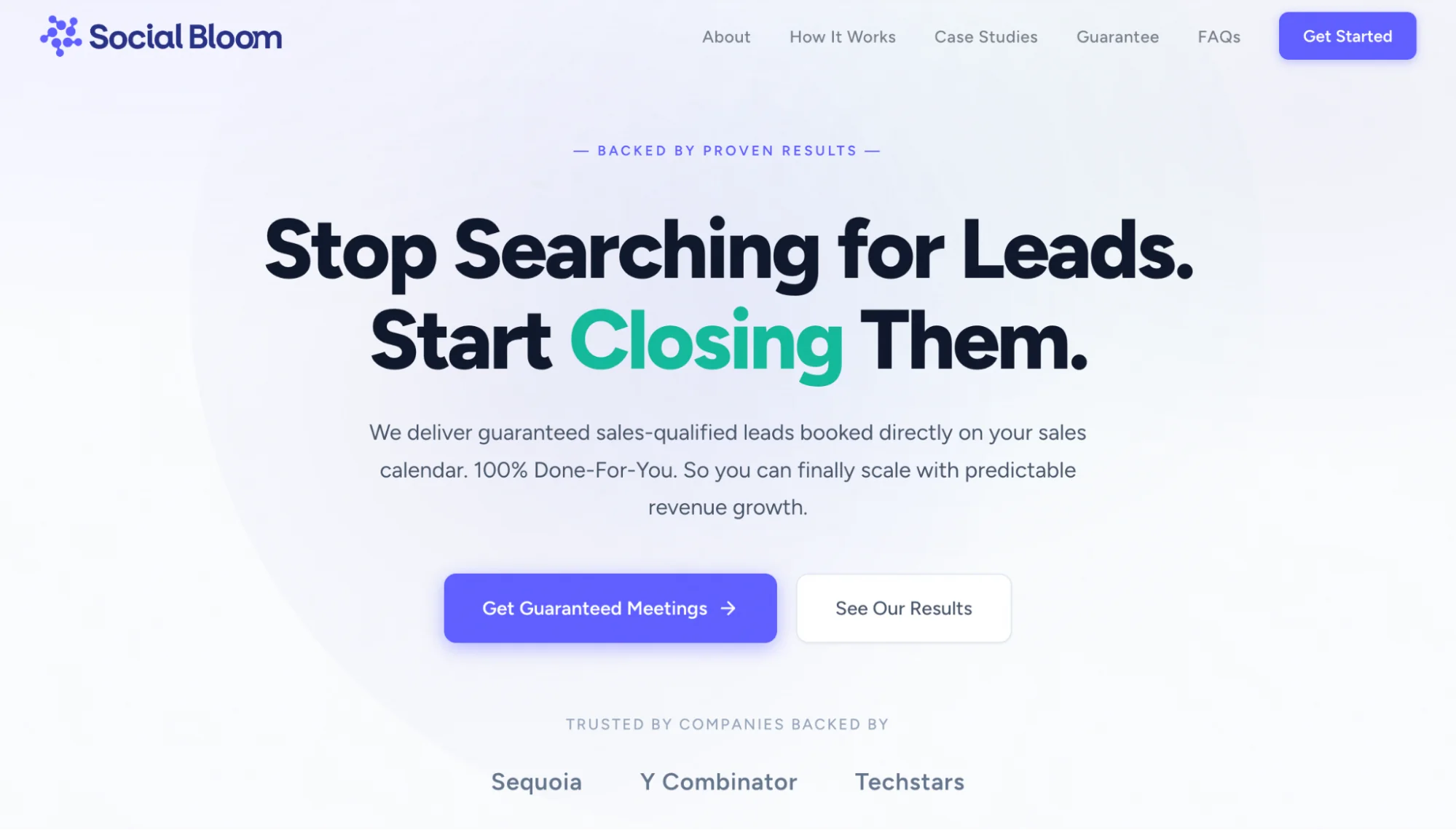
SocialBloom is a self-owned outbound shop out of Rochester, Minnesota, founded in 2020, with one of the most pricing-transparent models in the space.
They charge $250 per sales-qualified lead and guarantee at least a 100% ROI in the first 180 days or refund the difference.
The core service is a 100% done-for-you outbound engine that pulls leads from five different channels into one orchestrated motion. Their target clients are B2B agencies, SaaS, consulting firms, IT services, and executive recruiting.
They're best for B2B teams that want pay-per-SQL economics with eventual ownership transfer baked into the contract.
SocialBloom's stated model is to build the engine, prove it works, then hand the keys over, which is closer to the ownership-over-rental philosophy than most agencies on this list will admit to in writing.
Where they break down is the depth of the build. The transferred engine is an outbound engine, not a full GTM flywheel.
If your pipeline problem is wider than cold email and booked meetings (CRM hygiene, RevOps reporting, inbound qualification, forecasting), SocialBloom hands you a clean outbound machine and stops there.
4. SalesRoads
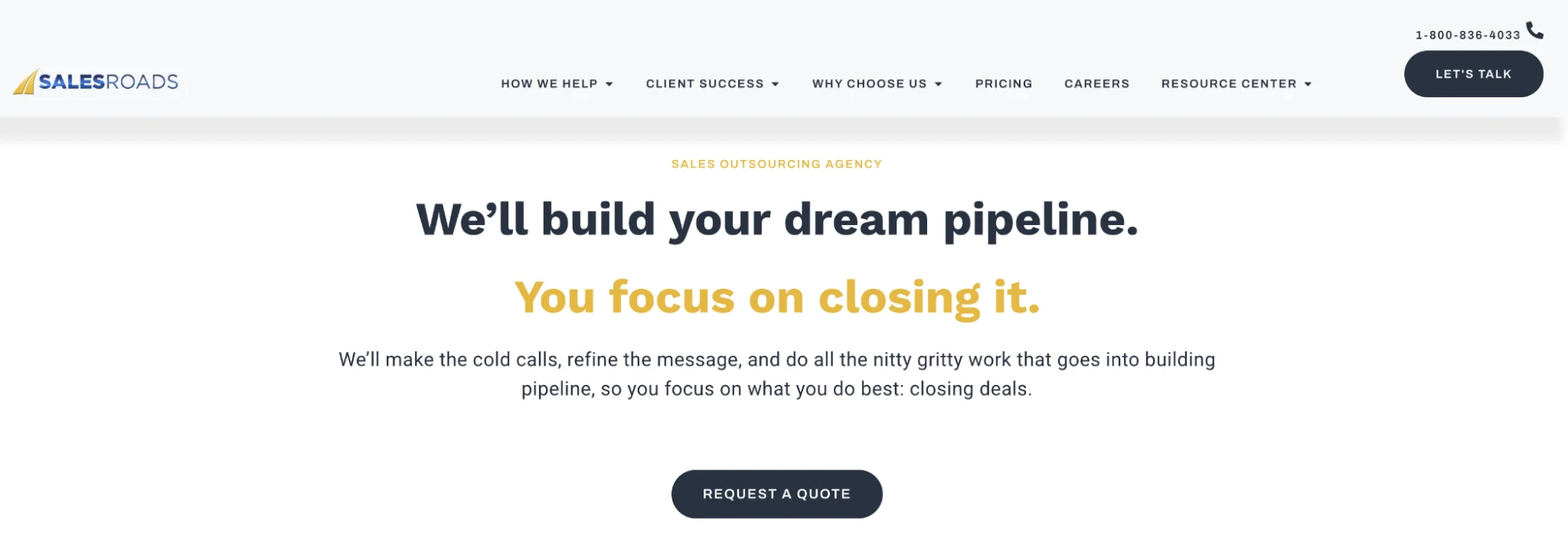
SalesRoads is a US-based outbound calling and appointment-setting agency, founded in 2007, that emphasizes real human conversations led by experienced native-speaking SDRs.
Their process starts with deep discovery calls, builds a custom outreach strategy, tries a small test, and then scales what works. The team treats clients more like partners than typical outsourced sales vendors.
They're best for companies with a US-centric ICP and a sales motion that benefits from outbound calls.
If your buyer is the kind of person who answers a phone and respects a well-prepared call opener, SalesRoads has the operational muscle to deliver that motion at volume.
Their cold-call-heavy approach also works well for industries where email saturation is high and the phone is still a viable channel.
Where they break down is the scope of the channel mix. SalesRoads is a phone-first shop.
If your ICP lives on LinkedIn or your product lifecycle is too technical for a 30-second opener, the model strains.
The same is true if your buyers are global. Native English speakers calling US numbers don't translate cleanly to a German enterprise or a Singaporean SaaS founder.
5. ColdIQ
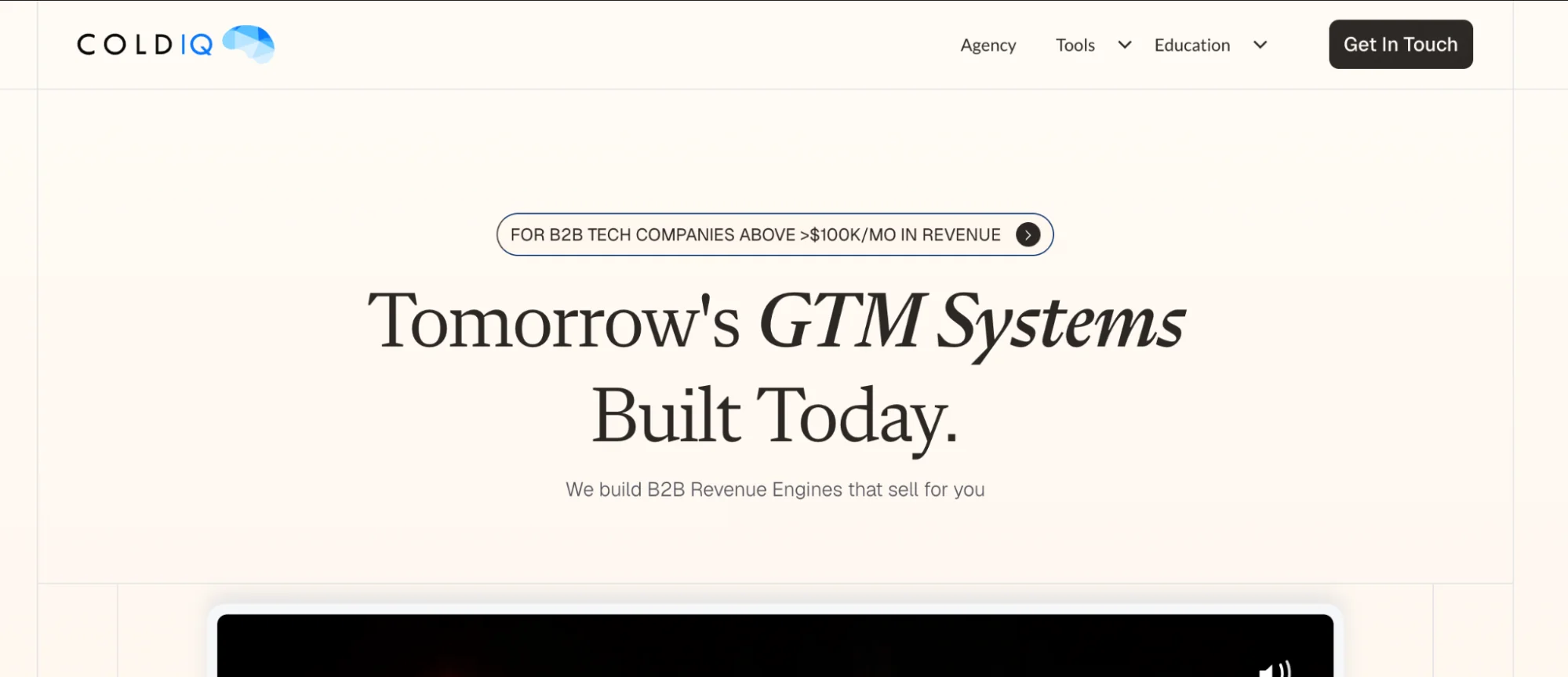
ColdIQ is a GTM engineering agency founded by Michel Lieben and Alex Vacca, deeply tied to Clay and built around AI-driven outbound and ABM systems.
ColdIQ holds Elite Studio status, one of only four such designations from Clay globally, and the team has scaled the business to $6M ARR with 300+ clients worldwide.
They've used 250+ Clay sheets and over 1 million Clay credits, and they manage all 80+ active client campaigns from a single master Clay table.
They're best for B2B SaaS and tech companies (typically $100K+ in revenue) that already know they want a Clay-built outbound and ABM motion and want to work with one of the most experienced Clay shops on the planet.
If your problem is "we want world-class signal-driven outbound and ABM," ColdIQ is on the short list.
Where they break down is everything outside outbound and ABM. RevOps depth, CRM rebuilds, inbound qualification systems, and forecasting layers all fall outside the ColdIQ specialty.
If your problem is the full GTM flywheel rather than just the outbound layer, you'll need a different partner for the rest.
6. memoryBlue
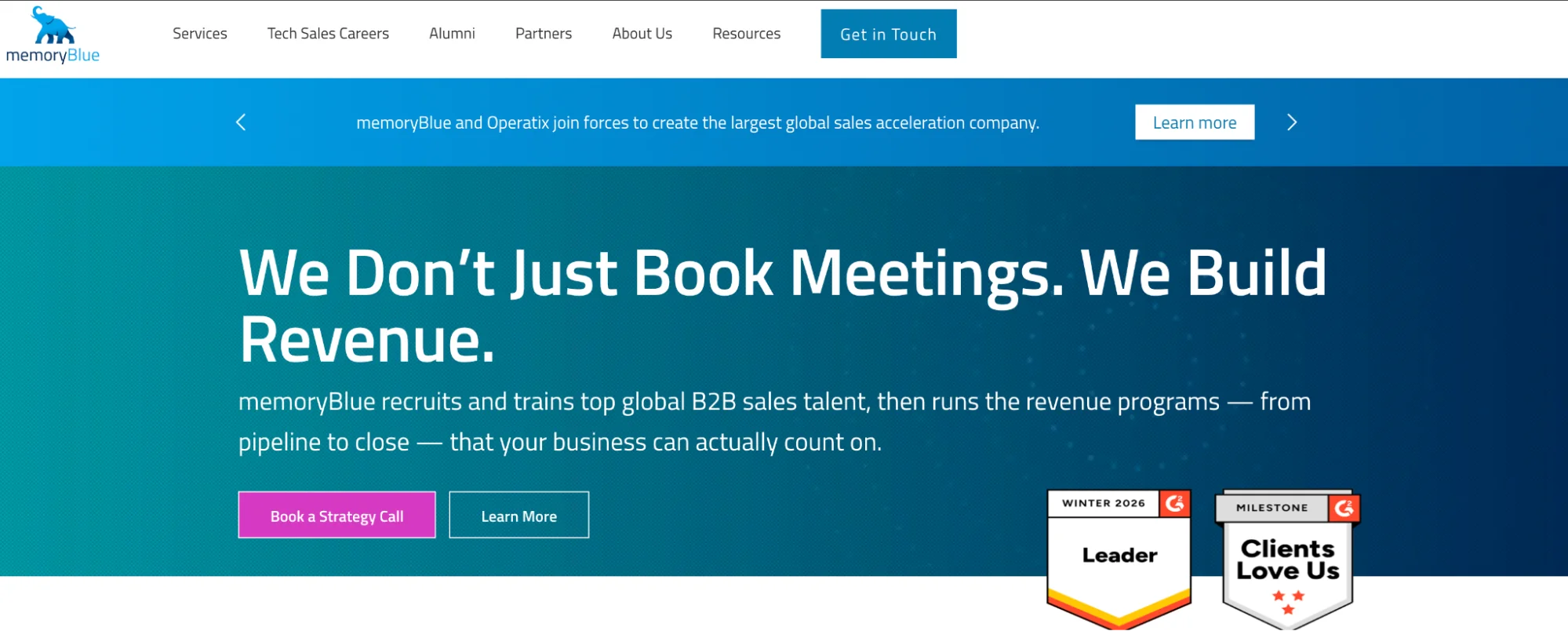
memoryBlue provides outsourced SDR teams for tech and SaaS firms that don't want to hire and manage SDRs in-house.
Their teams handle outbound prospecting through cold calls and emails, with a strong focus on training and structured pipeline execution.
The culture leans energetic and growth-focused, and the company has built a reputation for developing junior SDRs into competent practitioners over the course of an engagement.
They're best for tech and SaaS companies that need outsourced bodies working a known playbook, and that don't have the internal hiring or training infrastructure to do it cheaper themselves.
If you've made the decision to outsource SDR work and you want a known operator with a clear training process, memoryBlue is a defensible choice. We've laid out the deeper comparison in our piece on outsourced versus in-house SDRs.
Where they break down is the system question, again. memoryBlue rents you the SDR labor and the playbook. The workflows, the data, and the institutional learning all live with the agency.
When the engagement ends, your AEs go back to a calendar that nobody is filling. If you have AEs already and what you actually need is pipeline coordination across channels, you're hiring the wrong layer of the stack.
7. closed:in
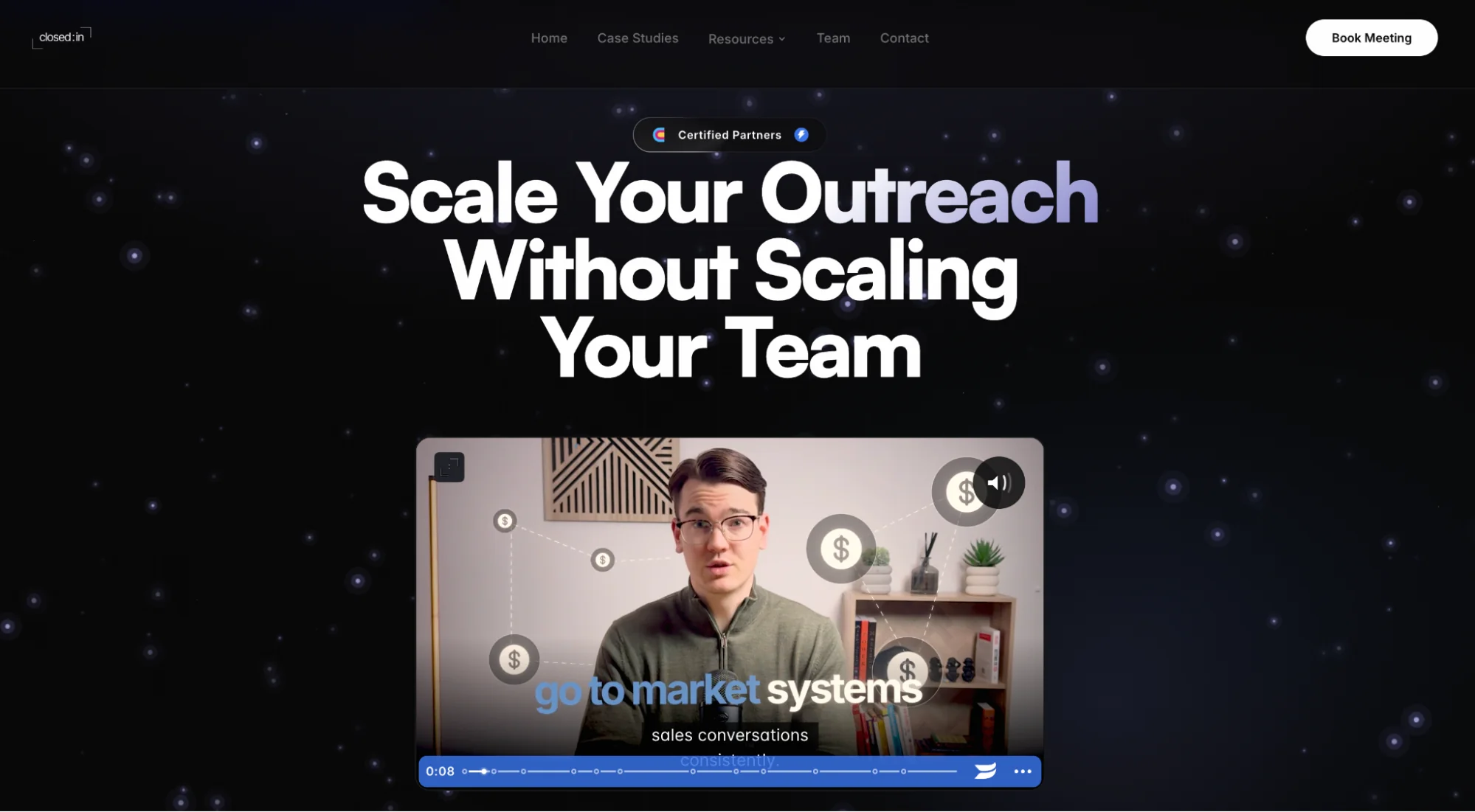
closed:in is a cold-email specialist agency that sends hyper-personalized outbound on the Clay and Instantly stack.
The pitch is to take the pain out of outbound for B2B teams by handling targeted lead lists, personalized cold email campaigns, and deliverability infrastructure end to end.
The reported output lands around 20 qualified meetings per client per month for the engagements that match their model.
They're best for companies that want a cold-email-only motion delivered by specialists, with the Clay enrichment and Instantly deliverability layers handled by a team that lives inside both tools.
If your strategy is "we want better cold email, full stop," ClosedIn focuses on exactly that and doesn't try to be more than they are.
Where they break down is the breadth of the channel mix. ClosedIn focuses tightly on cold email and nothing else.
They don't do LinkedIn at scale or build cold-call dossiers, and the inbound machine that catches the lift from outbound isn't part of their scope.
If you want a multi-channel motion or anything past the meeting booking, you'll be stitching together two or three providers around them.
8. Sopro
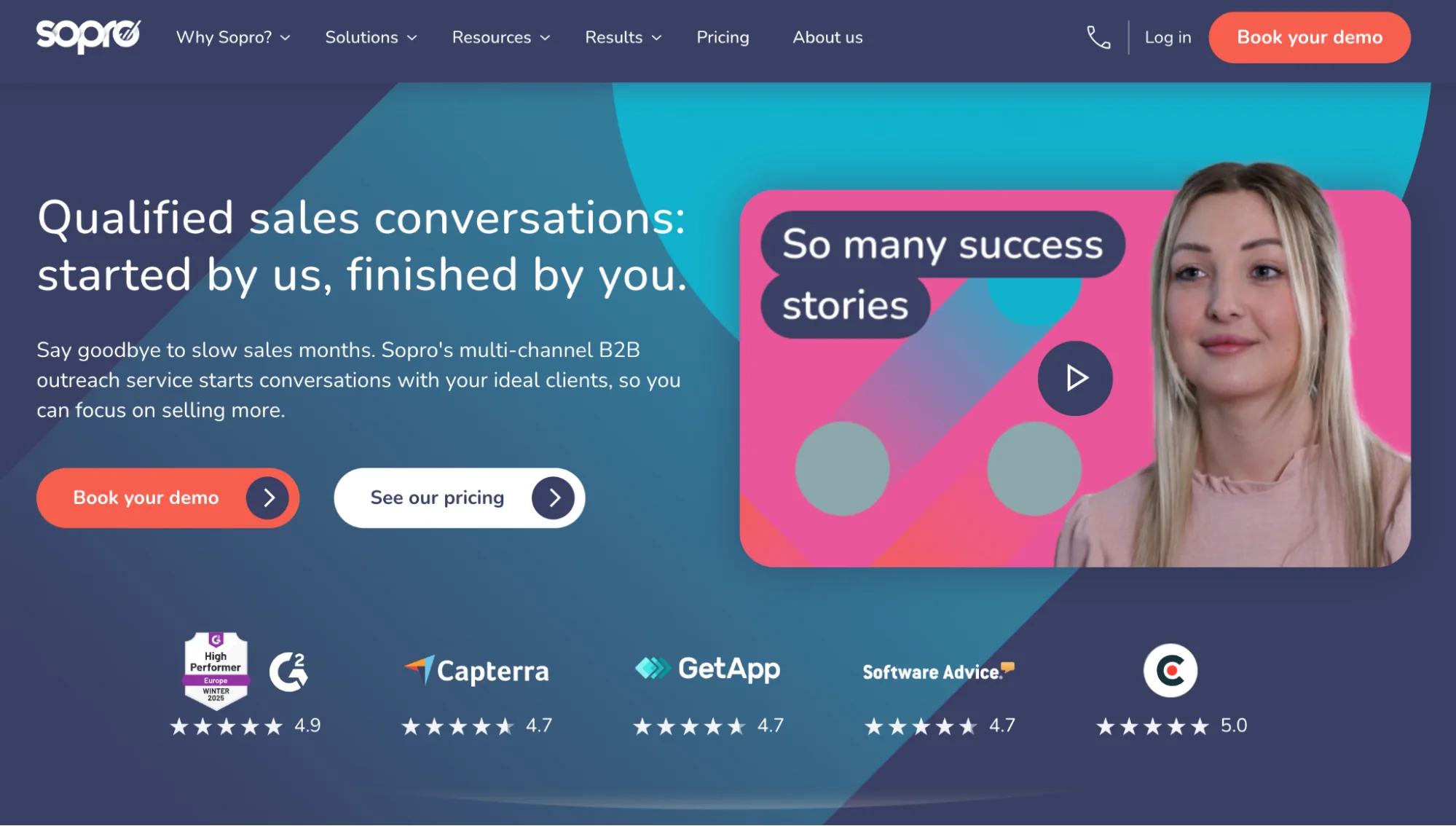
Sopro is a UK-headquartered B2B prospecting service with over 10 years in the business, more than 22,000 campaigns delivered, and 2 million+ meetings booked across their client base.
The company employs over 300 people and delivers sophisticated multi-channel campaigns across email, LinkedIn, and other channels.
They also offer real-time intent notifications and personalized web chat, which puts them closer to a managed lead generation suite than a pure outbound shop.
They're best for European mid-market and enterprise B2B teams that want managed multi-channel prospecting at scale, with the operational maturity that comes from 300 staff and a decade of campaign data.
Sopro's model works particularly well for companies that don't want to build a Clay stack themselves and are comfortable with a long-term outsourced engagement.
Where they break down is the ownership question. Sopro handles the prospecting. The data, the tooling, and the campaign infrastructure live with them.
If your goal is to own the system at the end, this is not the right partner for the long term.
9. Martal Group
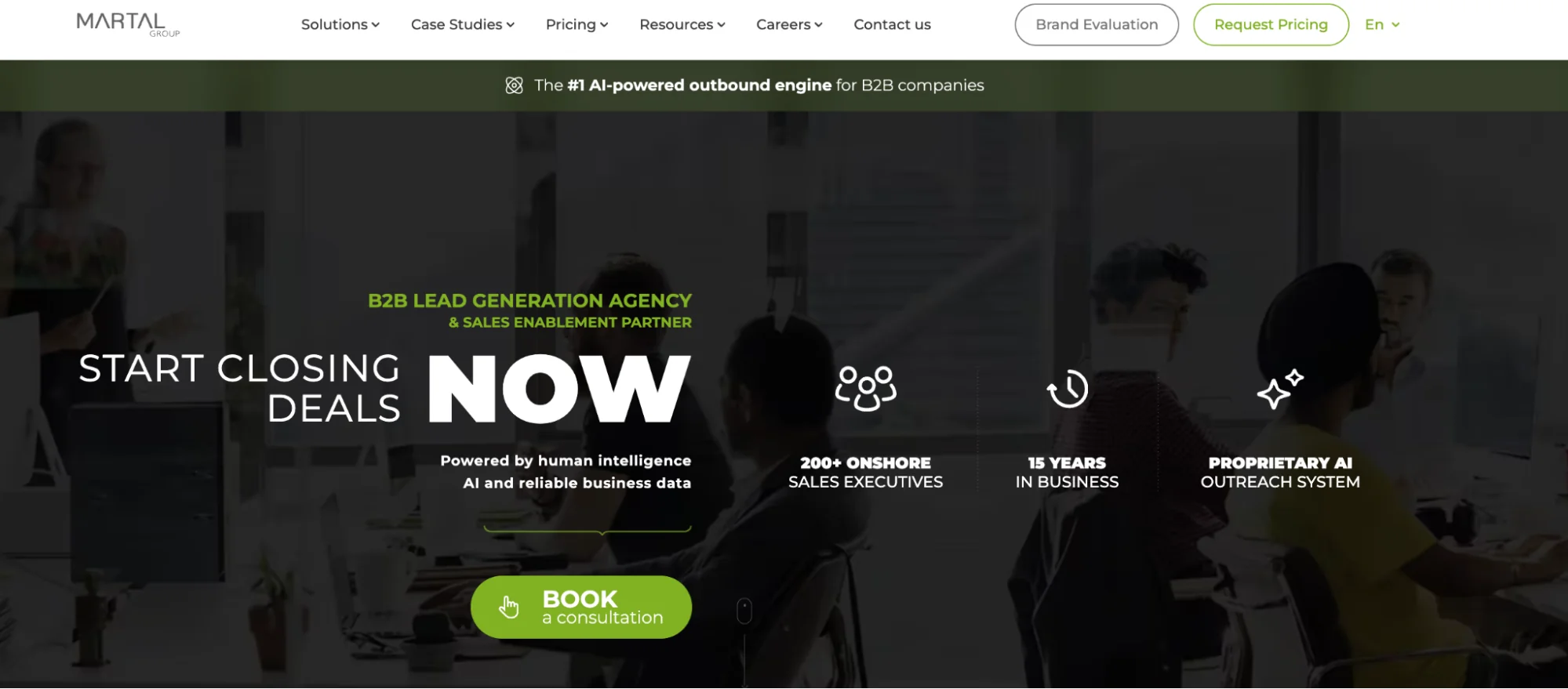
Martal Group is a North American B2B lead generation and sales outsourcing agency with 15+ years of operating history and over 2,000 clients including Fortune 500 enterprises.
The model blends onshore SDR teams with a proprietary AI SDR platform that includes a large B2B contact database, intent and technographic data, AI-enhanced copywriting, omnichannel sequencing, and built-in deliverability management.
They specialize in industries with multi-stakeholder buying cycles like B2B SaaS, IT services, cybersecurity, manufacturing, healthcare, and fintech. We've also covered the broader category in our piece on the end of SDR-as-a-Service in 2026.
They're best for complex enterprise B2B teams selling into multi-stakeholder buying committees, where industry depth and onshore SDR experience matter.
Martal's vertical specialization is real, and the AI SDR platform handles a lot of the orchestration that a Clay-native shop would do manually.
Where they break down is the proprietary tooling. The Martal AI SDR platform is theirs, not yours. The intent data, the contact database, and the orchestration layer all live inside their infrastructure.
If you want the GTM system to live in your own accounts on tools you can edit, Martal's all-in-one platform is the wrong starting point.
10. Growth Engine X
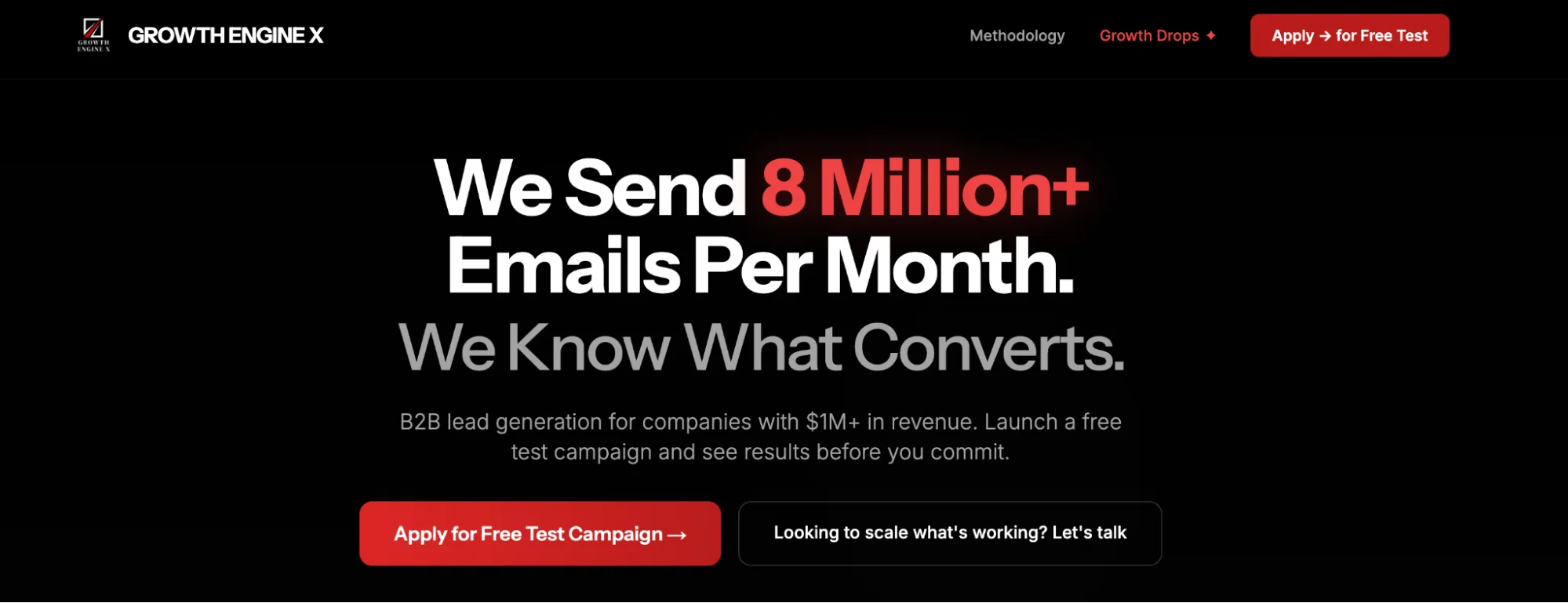
Growth Engine X is a niche outbound shop built around cold-email excellence, data-first personalization, deliverability infrastructure, and pipeline strategy.
They walk clients through ICP design, email setup (SPF, DKIM, DMARC, domain warming), LinkedIn data enrichment, and automated sequences integrated with call follow-ups and a CRM handoff.
The team is smaller than the volume operators on this list, which works in their favor when the engagement matches their depth.
They're best for B2B companies that want a focused cold-email operation with strong deliverability hygiene and a clean ICP-to-sequence handoff.
If your previous outbound failed because your domain landed on a blocklist or your ICP definition was too loose, Growth Engine X solves the specific failure mode that those deliverability and ICP gaps create.
Where they break down is the same place ColdIQ and ClosedIn do. Cold email is one channel out of many your GTM motion needs.
The rest (LinkedIn, calls, inbound qualification, CRM hygiene, RevOps reporting) needs to live somewhere, and Growth Engine X isn't where it lives. If your stack is broken in more than the email layer, this isn't the engagement that fixes it.
Hire Nebor.ai to fix your outbound and build the GTM flywheel that carries on after it
Pipeline problems almost never come from one source alone. Outbound is the one most companies notice first, and outbound is usually the one we fix first too.
But the engagement rarely stops there. Once outbound is working on Clay, n8n, and the right CRM, the same plumbing already covers most of the rest of your revenue motion.
We extend it across inbound capture, lead routing, RevOps reporting, and forecasting until the whole flywheel is moving on automation.
We do this work as a partner. The system we build lives in your accounts on tools your team can edit.
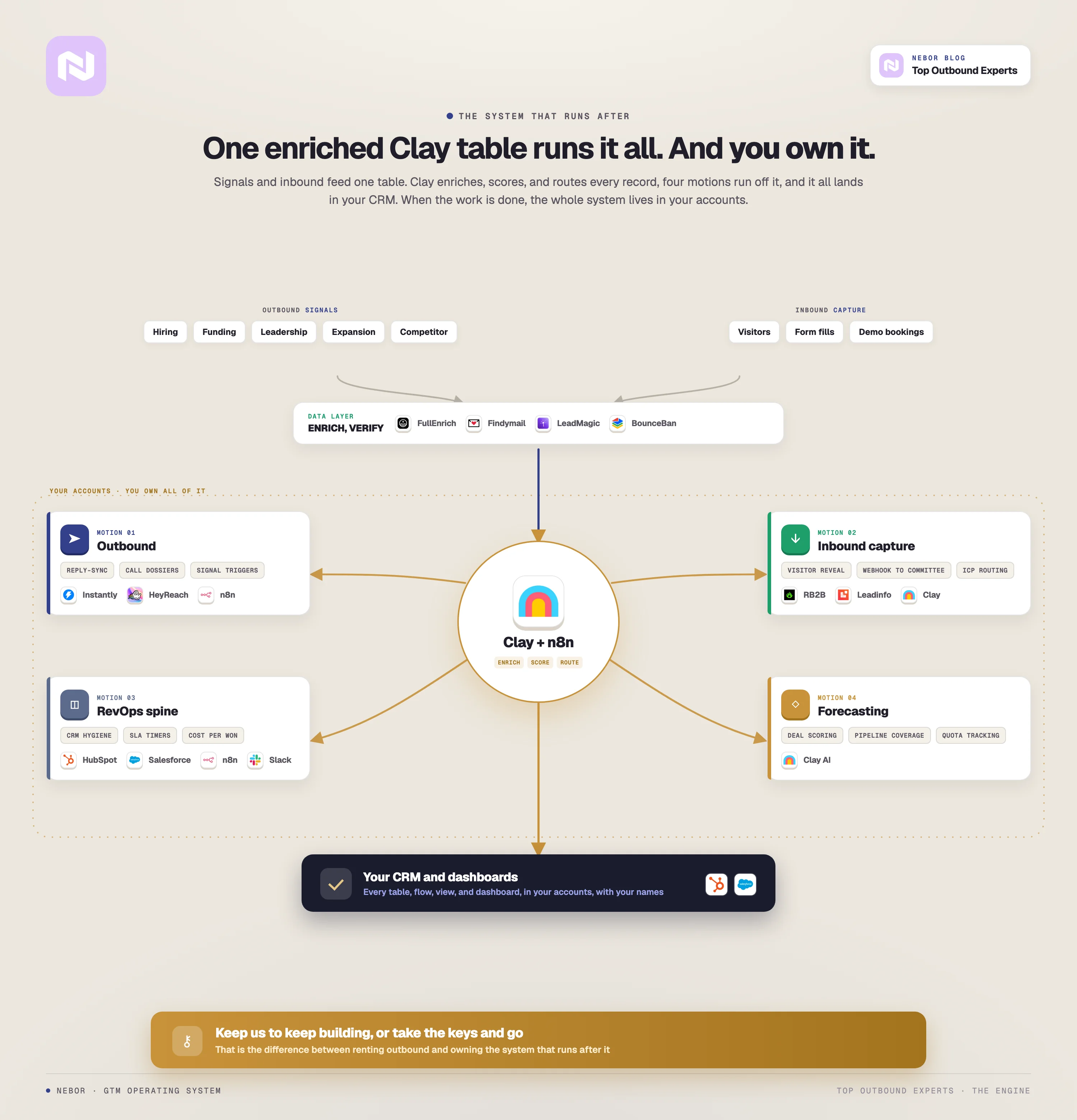
The workflows carry the names your team gave them. When the engagement ends, you keep the build.
Most clients keep us for the next stage of work because the next problem to solve is always more interesting than the one we just finished, but the choice stays with you.
If you've read this far and the GTM flywheel argument resonates, the next step is a conversation.
We do a 15-minute scoping call where we look at your current pipeline numbers, the tools you're already paying for, and the gap between where you are and where the flywheel should be.
If we're the right partner, we'll say so. If we're not, we'll point you at the agency on this list that fits your specific problem better.


Related Articles


By clicking Sign Up you're confirming that you agree with our Terms and Conditions.