
What Is Intent Data and How Can It Improve Your Outbound Sales and Lead Generation?


In this post:
Intent data tells you exactly which companies are looking for, showing signs that they need or moving towards needing what you offer, right when it’s happening, so that you can reach out to them right then.
That’s the value of buyer intent data.
Throughout our years of experience in the GTM engineering and outbound sales landscape, we’ve seen many uses of intent data and read opinions about what it’s supposed to be.
Most of what you’ll read about intent data online treats it like a magic list of accounts ready to buy.
The reality is closer to a set of signals about which companies are moving toward needing what you offer, where the entire game is acting on those signals before your competitors do.
That gap between seeing a signal and acting on it is where most outbound campaigns fall off, and the pipeline numbers show it.
Sales teams keep building lists from Apollo.io or Lusha, sending the same email to everyone on the list, and treating intent data as a feature on the dashboard of a tool they already pay for.
We have spent the last few years building intent-driven systems for our own outbound at Nebor and for our clients, and the gap is structural. The data is available, but the reaction time and the working definition of intent are both holding most teams back.
This post covers what intent data is, where it actually comes from, why most lead generation companies still get it wrong, and how we build signal-based outbound systems that act on the data the moment it shows up.
Let’s get started.
TL,DR: what the intent data workflow actually looks like
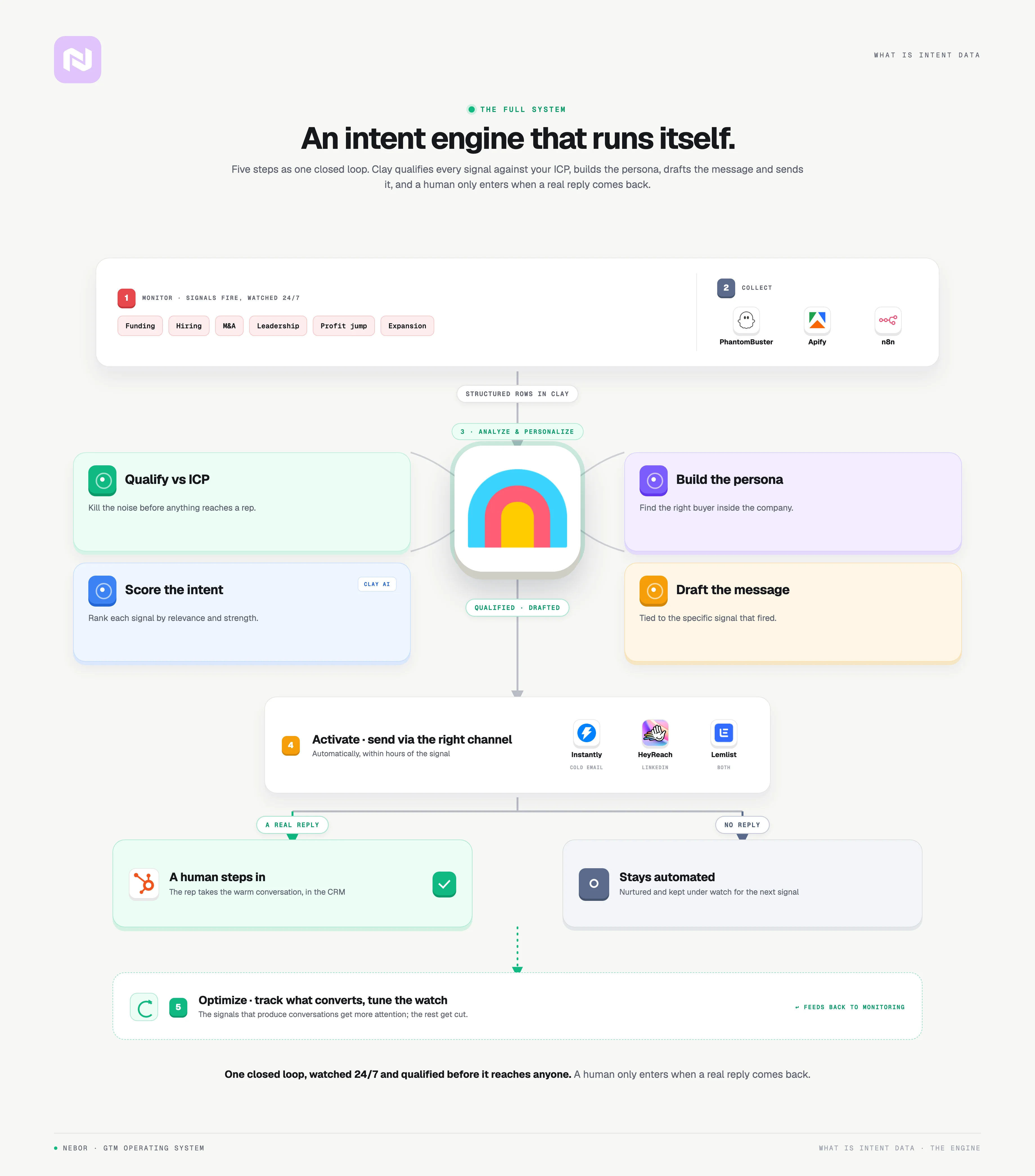
Here is what the intent data workflow actually looks like from signal capture to outreach and sales handoff. Keep in mind that what we track and how we reach out always changes based on the business, but here what the workflow looks like generally.
What is intent data and how do most sales and marketing teams get it wrong?
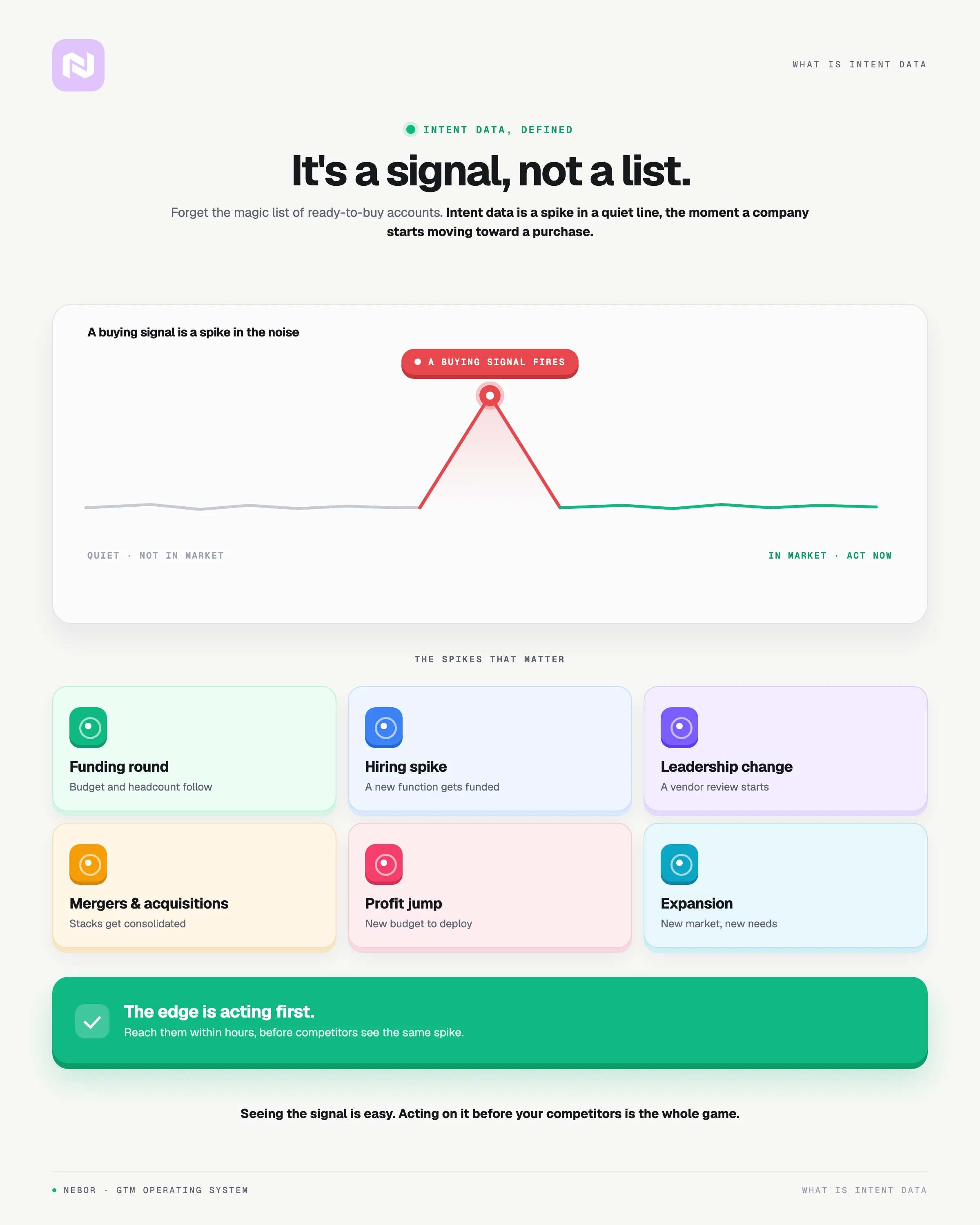
Intent data is information about how web users consume content and behave online that points to what they need, what they’re researching, and when they’re moving toward a purchase.
It tells you about a prospect or their company’s buying intentions before they ever fill out a contact form or talk to a sales rep.
The category gets read flat though. Buyers hear intent data and picture a magic list of accounts ready to buy. The reality is messier.
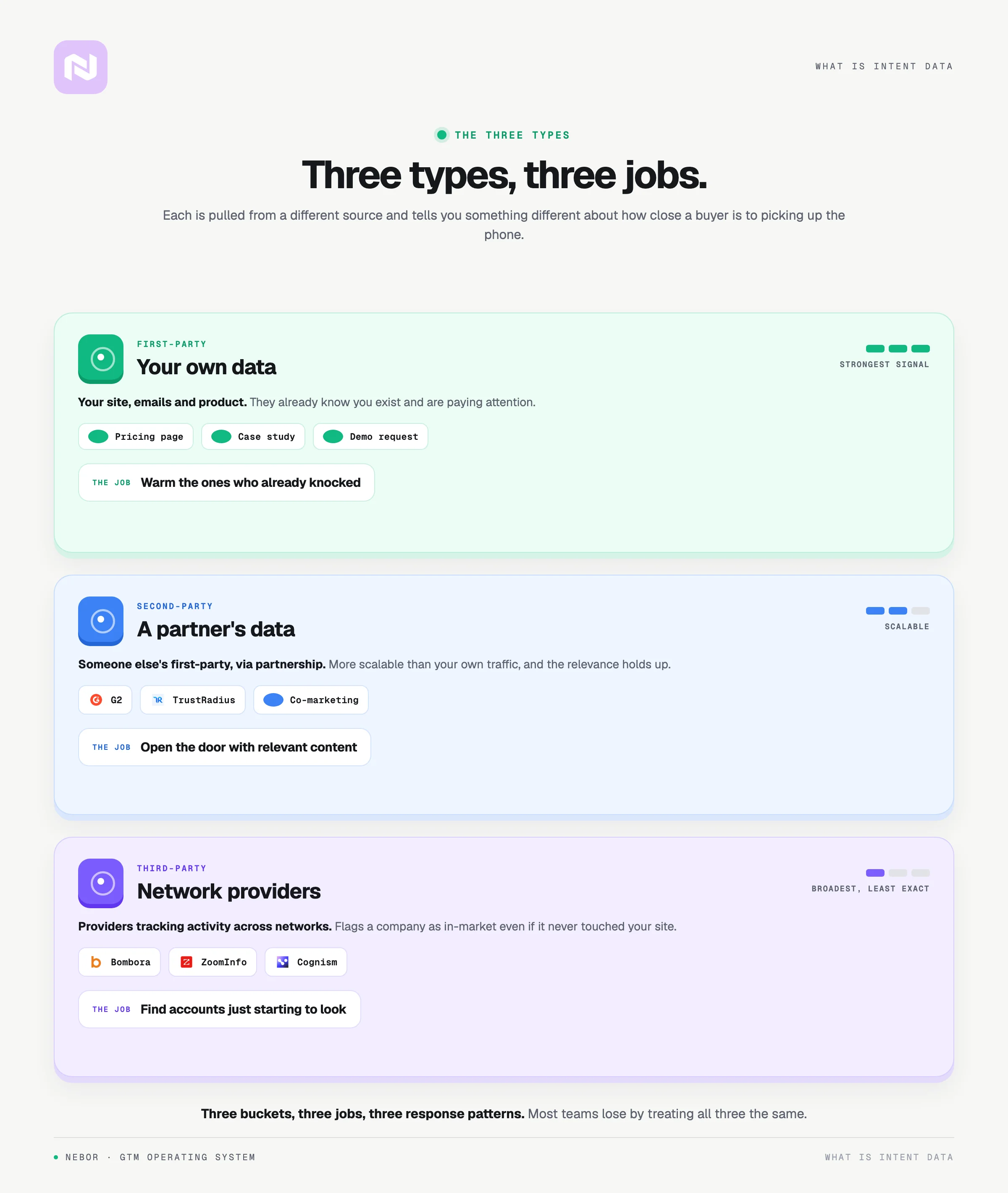
There are three different types, each pulled from a different source, each telling you something different about how close a buyer is to picking up the phone.
Different types of intent data: first-party, second-party, and third-party
First-party intent data
First-party intent data is the stuff you collect on your own. It is the clearest signal you will ever get because it comes straight from how someone interacts with your website, your emails, or your product itself.
If a contact is reading your case studies, visiting your pricing page twice in one week, or downloading your sales deck, that is intent. It is the strongest kind you can get because the person already knows you exist and is paying attention.
The catch is that first-party only appears when someone is already engaging. You are not finding net-new accounts here, you are warming the ones who already knocked on your door.
Second-party intent data
Second-party intent data is someone else’s first-party data that you get through a partnership or integration.
The classic example is review sites like G2 or TrustRadius. If a buyer is comparing tools in your category on G2 and your product shows up in that comparison, you can sometimes access that behavioral data once you have signed up for a premium tier.
Co-marketing campaigns are another good source. You host a webinar with another company, their audience engages with your content, and the engagement data is second-party. It is more scalable than your own site traffic, and the relevance holds up.
Third-party intent data
Third-party intent data comes from specialized intent providers that track activity across networks of websites and platforms. This is the type most people picture when they hear intent data, and it is at the heart of most signal-based outbound programs.
Providers like Bombora or ZoomInfo use cookies, IP tracking, and data partnerships to monitor which companies are researching specific topics online.
So if someone at a mid-sized SaaS company is reading articles about automated sales prospecting across ten different sites, the third-party tool will flag that company as “in market” even though they have never been to your website.
Third-party data is the only type that surfaces demand you would not see otherwise. It is also the broadest and the least accurate of the three, which means you are getting signals rather than certainty.
Where most teams trip across all three
Where most teams trip is treating all three types as the same thing. They buy a list from a vendor and expect it to convert like warm leads.
Or they over-index on first-party behavior and miss the early signals from the broader market.
The teams that win at this treat first-party signals like hot leads, use second-party data to open the door with relevant content, and lean on third-party data to find accounts that are just starting to look. Three buckets, three jobs, three response patterns.
How we define intent data at Nebor
The version above is a fair industry definition. It is also not what we mean when we talk about intent data internally.
At Nebor we treat intent data as any specific event, piece of news, or company-level action that signals a business is now in the market for a solution like our client’s.
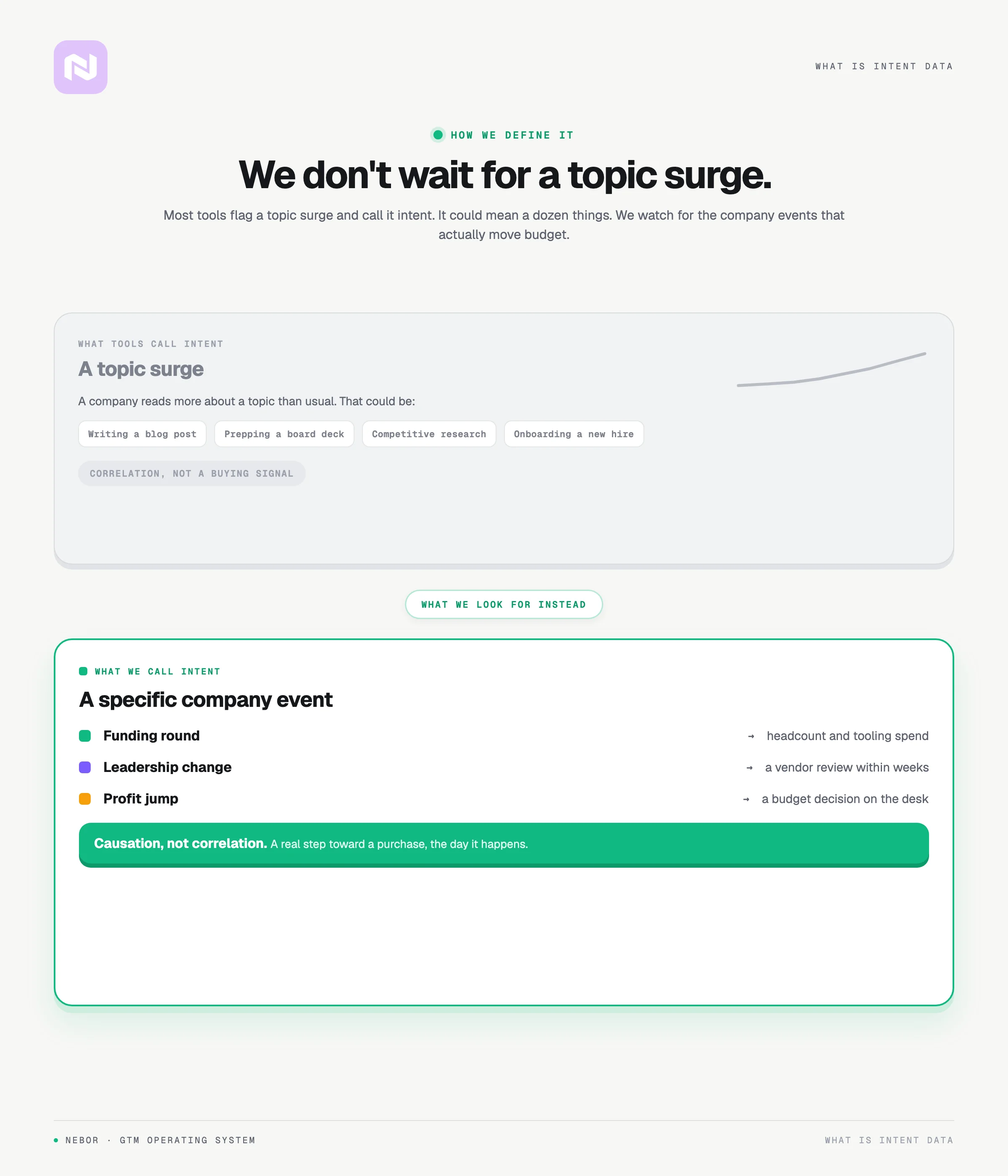
Think funding rounds, leadership changes, hiring patterns, M&A, profit jumps, product launches, and geographic expansion all qualify. None of those things show up as a “topic surge” on Bombora, but every one of them moves a company closer to a purchase.
Most marketing and sales teams are not set up to see those signals, let alone act on them. The signals do not announce themselves on a dashboard. You have to go and find them, scrape them, structure them, and route them into outbound the day they happen.
That gap between what tools call intent and what actually predicts a buying conversation is where most outbound programs are losing real pipeline.
The problem with traditional outbound and why intent data matters
Most B2B sales teams are still doing outbound the way it was done in 2018, and the math no longer works. The list-and-blast model assumes that broad targeting plus high volume equals pipeline.
With reply rates collapsing across every channel, it does not. The teams getting outbound to work today have stopped picking accounts based purely on firmographic fit and started picking them based on signals.
The list-and-blast model breaks because it ignores timing
The traditional outbound flow looks the same in almost every B2B org we walk into.
Build a list of companies that match basic firmographic criteria like industry, headcount, and geography.
Find contact information for the people who could plausibly be decision-makers.
Send the same outreach to everyone on the list.
Hope a small percentage replies.
Repeat next quarter.
The model breaks because it treats fit as the deciding factor in a purchase, when timing is what actually closes deals.
Even a perfect-fit account will not buy if they have no current need or are not actively looking.
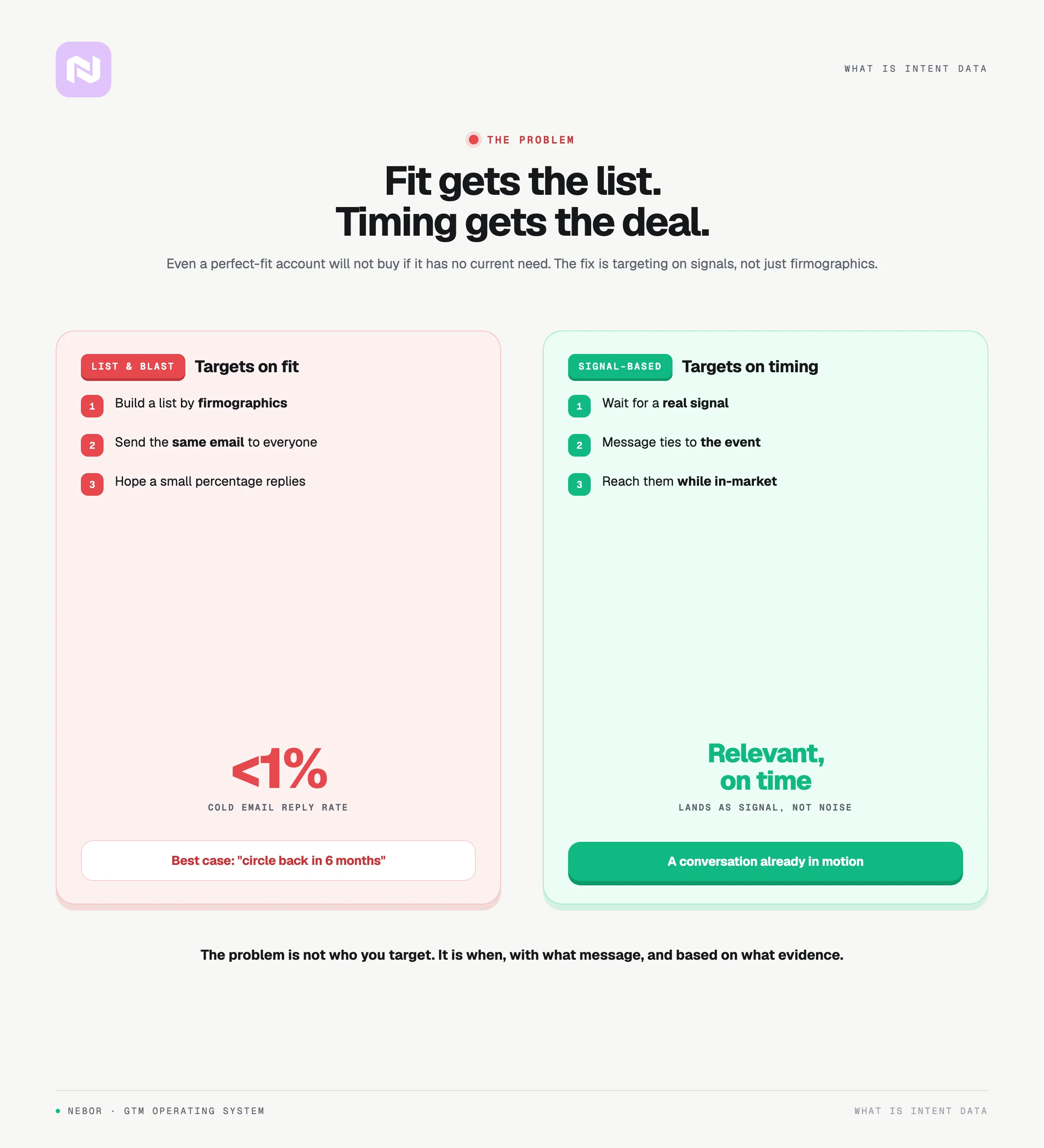
The best outcome from blasting a perfect-fit cold list is a “circle back in six months”, and the realistic outcome is silence on most of the names.
That dynamic is the structural reason the GTM agency model is replacing the lead-gen agency model for B2B teams that take pipeline math seriously.
Cold messages to cold prospects produce cold response rates
Industry studies put cold email response rates below 1%. Conversion rates from those replies are lower still. The numbers stop being surprising once you think about what is actually happening on the other side of those messages.
A cold message reaches a busy professional about a problem they did not say they had, from a vendor they did not ask to hear from, on a day when a hundred other things are demanding their attention.
The result is the same on both sides. The prospect feels interrupted, the rep wastes hours, and the spend on lists, sending tools, and SDR salaries returns almost nothing.
Adding intent data into the mix changes what those messages can actually say. Instead of guessing the prospect’s situation, your outreach message ties to a real event in their world, which means the outreach lands as relevant rather than as noise.
The target list shrinks because most accounts at any given moment are not in market. The hit rate on the accounts that are in market goes up by enough to more than make up for it.
What list-and-blast actually costs in rep hours and tool spend
The deeper cost of the traditional approach shows up in three places most leaders never properly attribute back to the model itself.
Sales reps spend most of their week researching and chasing accounts that have no current interest, which is the structural reason hiring more SDRs tends to scale cost faster than pipeline.
Tool budgets get spent on enrichment, sequencing, and dialer infrastructure that move the needle very little because the underlying targeting is wrong.
And sales cycles stretch out because reps are forced to manufacture interest from a cold start instead of meeting buyers who are already in motion.
The fundamental problem is not who you are targeting. It is when you are targeting them, with what message, and based on what evidence about their current priorities.
Without intent, every rep is throwing darts at a wall in the dark. With intent, you walk into the room when the conversation is already happening, and the job becomes being in the right place at the right time with the right thing to say.
Why standalone tools cannot do intent data on their own
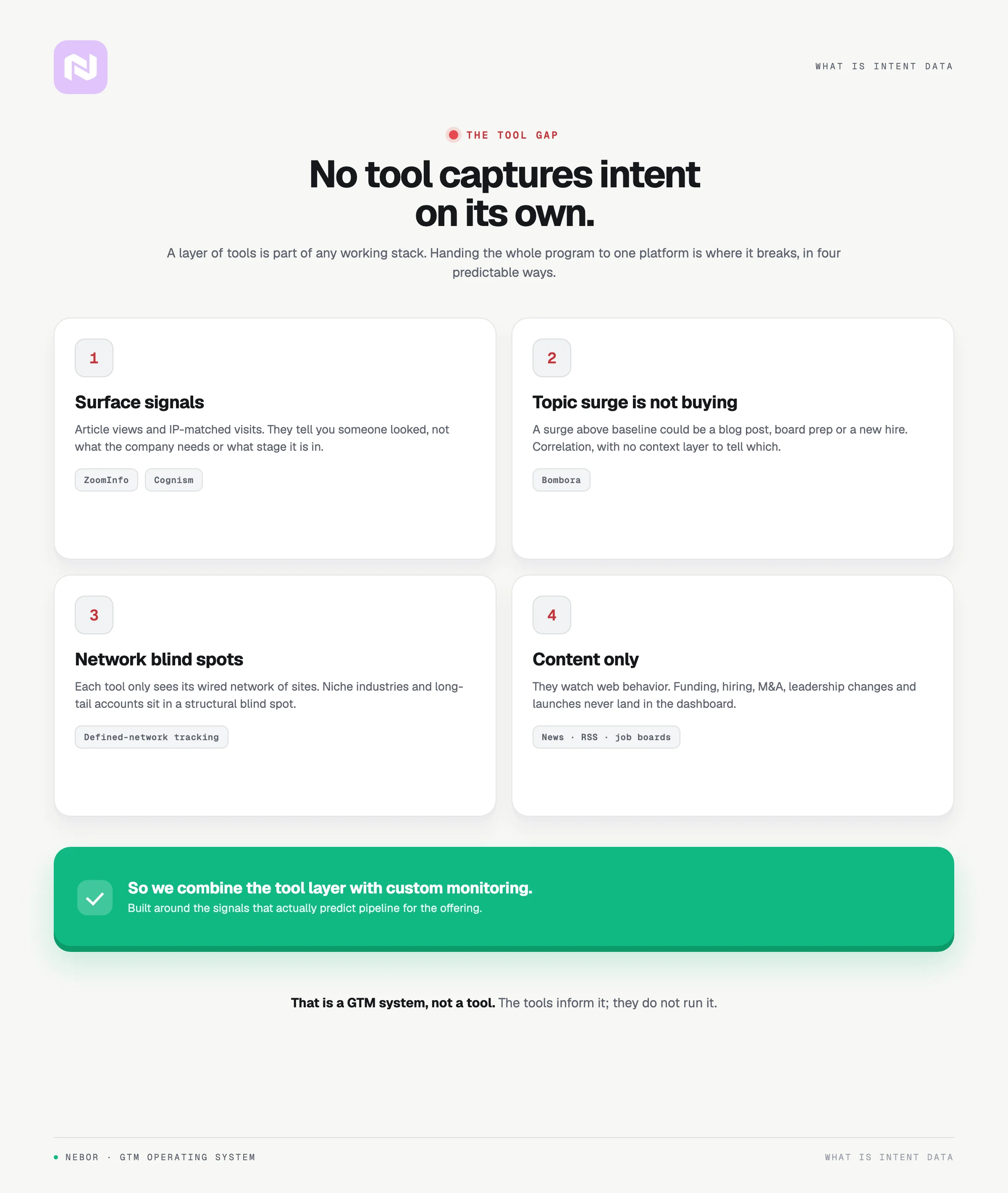
Tools are part of any working intent stack. If you have a signal-based outbound program right now, you should be using a layer of them to collect data, identify accounts, and inform messaging so the outreach lands as relevant and timely.
What you should not do is hand the entire intent program to a single platform and call it done.
There is no standalone B2B intent tool on the market today that captures intent the way an outbound team actually needs it captured.
Leadfeeder, Bombora, ZoomInfo, and Cognism each do part of the job for third-party intent, but none of them do all of it.
The reason ties straight back to how we define intent data internally, and it shows up in four predictable ways once you start using these platforms in production. Here they are:
Tool intent is mostly article views and IP visits, which is surface-level
Legacy sales intelligence platforms like ZoomInfo and Cognism flag article views and IP-matched website visits as intent.
Those are signals, but they are not deep ones. They tell you that someone from a certain company looked at something. They do not tell you what that company actually needs, what stage of evaluation they are in, or whether a buying committee has formed.
The intent signals an outbound team can actually act on look more like the following.
Research patterns across multiple sites in your industry, not a single article view
Engagement with bottom-of-funnel content like pricing pages and product comparisons
Consumption of competitor analysis and vendor evaluation material
Behavior that suggests a buying committee has formed and is in motion
A surge in research volume from multiple stakeholders at the same account in a short window
Real intent data tells you they are looking to buy and shows you what is driving the search. Most tools stop at the first half of that equation.
Intent in a tool often means topic surge, which is not the same thing
Platforms like Bombora operate by establishing a baseline of normal content consumption for each company in its dataset. When a company reads more about a topic than its baseline predicts, the tool flags it as intent.
That methodology is actually interesting, but it is not a buying signal on its own. I mean, a team reading more about a topic than usual could be evaluating vendors.
They could also be writing a blog post, prepping a board presentation, doing competitive research, or onboarding a new hire who is brushing up on the space.
Topic surge is correlation, not an intent signal. Intent is the part where you find out which kind of correlation you are looking at, and that contextual layer is the part the tool does not give you.
Tool networks only see signals on the sites they have wired into their tracking
Privacy regulation in Europe and data-governance policies in most B2B markets force every intent platform to operate on a defined network of partner sites.
Intent data tool vendors publish big numbers about how many sites they cover. The number is the wrong unit to evaluate them on. The unit that matters is whether your buyers do their research inside or outside that network.
We see three structural problems follow from defined-network tracking.
The buying signals that happen outside the network never reach the dataset.
Niche industries often live in the outside parts of the web.
Even inside covered industries, data quality drops on long-tail accounts.
The result is a meaningful slice of your target market stuck in a blind spot the tool cannot fix, because the blind spot is structural to the model.
Most tools see content consumption and nothing else
The most serious limitation is that these platforms only watch web behavior.
Job postings, funding announcements, leadership changes, M&A activity, profit jumps, regulatory filings, expansion announcements, and product launches do not land in a Bombora or ZoomInfo dashboard.
Those live in news feeds, RSS, LinkedIn, regulator databases, job boards, and the crawlable corners of the web that intent platforms were never built to monitor.
We know from experience that those signals are often the most predictive of pipeline.
A funding round usually triggers headcount expansion before the round even closes.
A leadership change kicks off a vendor review of the prior leader's stack within weeks.
A profit jump in a Fortune 500 company puts immediate tax optimization decisions on the CFO’s desk.
A job posting for “Director of Data Analytics” tells you the data infrastructure is about to get serious budget.
The teams that make intent data work for outbound combine the third-party tool layer with custom monitoring built around the specific signals that predict pipeline for their offering. That is a GTM system rather than a tool, and building those systems is what we do at Nebor.
How we handle automated intent data capture and outreach at Nebor
The version of intent data most teams actually need is closer to a system than a feed.
Imagine an AI-driven workflow that watches the signals that matter for your offering, qualifies the company against your ICP the moment a signal lands, builds the right buyer persona inside the company, drafts a message tied to the specific signal, sends it through the right channel, and only puts a human in the loop when a real reply comes back.
That is what we build for clients at Nebor and use for ourselves on our own pipeline. The signals get watched twenty-four hours a day. The qualification step kills the noise before anything reaches a rep.
The outreach goes out within hours of the signal landing. The team only spends time on the conversations that are already worth having.
Most companies still rely on the basic tracking that ZoomInfo or Cognism ship out of the box.
We build systems by combining Clay with PhantomBuster, n8n, Apify, and a layer of custom scraping for whichever sources matter to a given client.
The systems live in the client’s accounts after the build, which is the ownership-over-rental piece we talk about across the rest of the blog.
The team stays salespeople first, automation experts second, because nothing about this works if the people designing the workflows have not actually had to do outbound themselves.
The focus is on business dynamics rather than surface-level website behavior. We are watching for the specific triggers that suggest a buying conversation is about to start.
How we identify sales-qualified leads from intent signals
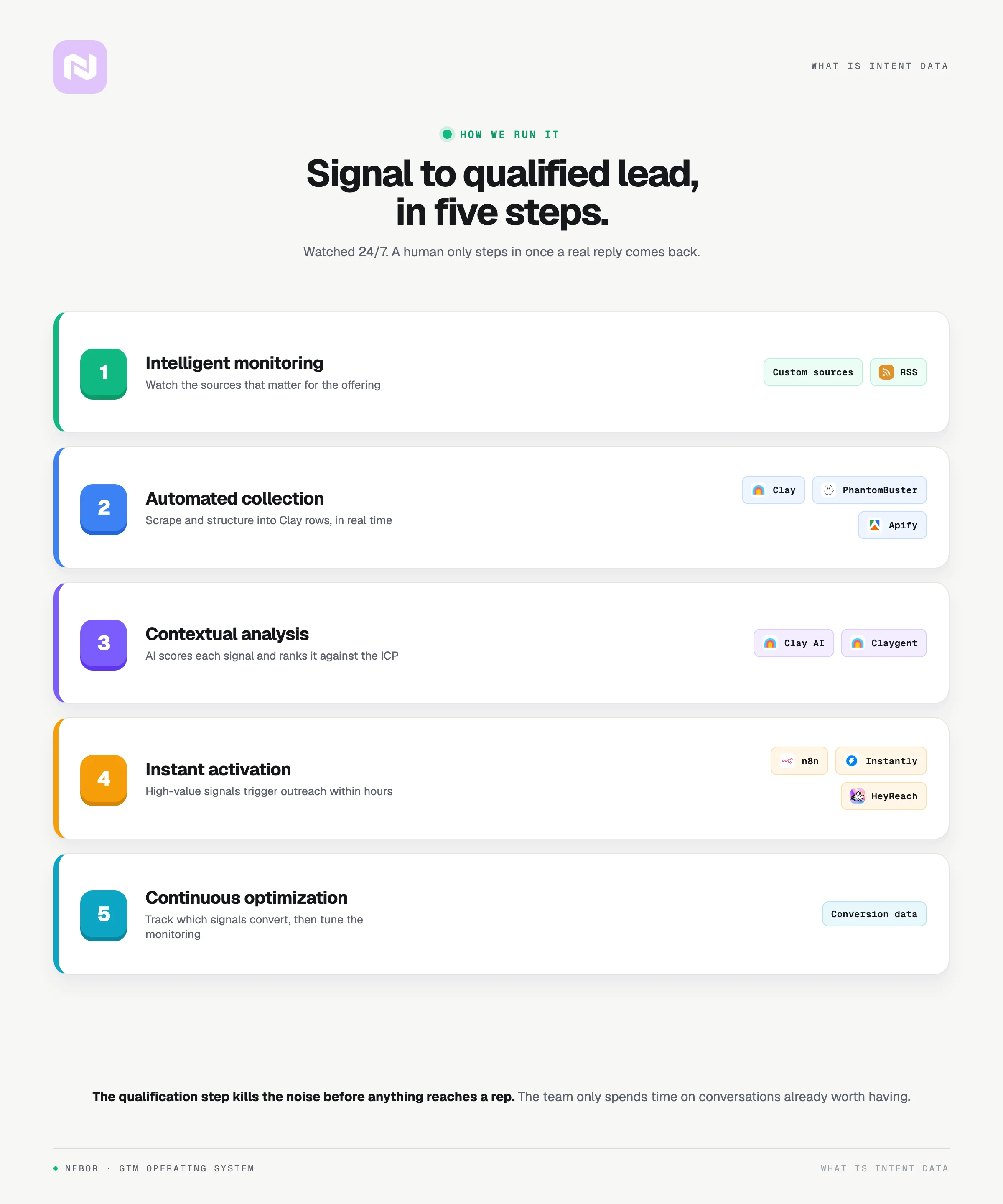
The system is built on five steps that hold consistent across clients, even when the underlying signal sources change.
Intelligent monitoring. We identify and continuously monitor the most relevant sources of buying signals for each client's industry and offering, with examples below.
Automated data collection. Our systems scrape and process the signals in real time, around the clock, and turn them into structured rows in Clay.
Contextual analysis. We use AI to score each signal on relevance and buying intent strength, then prioritize it against the client’s ICP.
Instant activation. High-value signals trigger personalized outreach within hours of the signal landing.
Continuous optimization. We track which signals produce qualified conversations and tune the monitoring accordingly.
Replies route into the inbound qualification workflow on the other side, which is the part of the system that decides whether a meeting actually gets booked.
The five examples below are real workflows we have built and used, four of them for clients and one we use on ourselves.
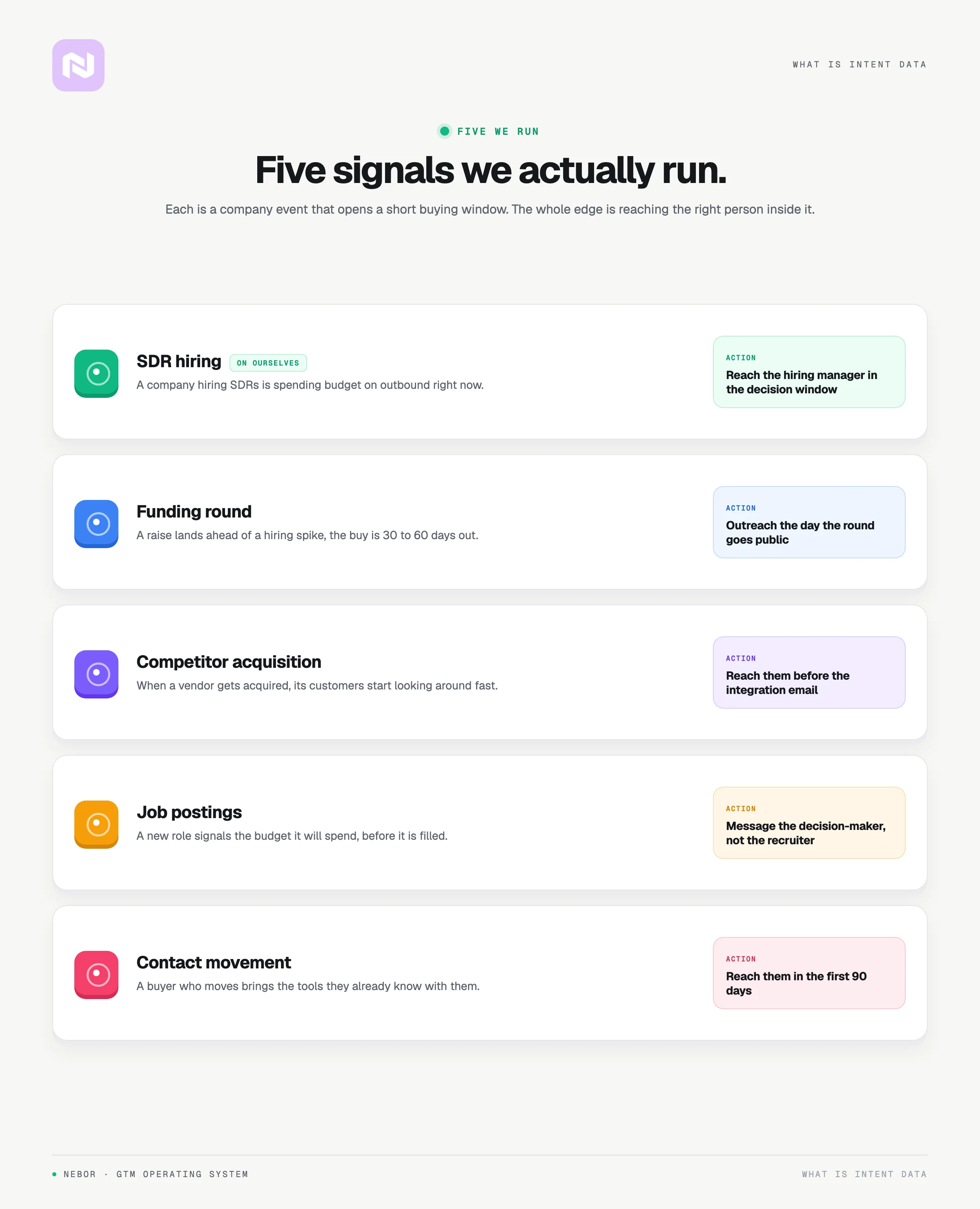
Example 1: SDR hiring signals (the system we use on ourselves)
Every day at 9am, our system scrapes LinkedIn for new SDR job posts in the Netherlands that match the company profiles we sell into.
The post lands in Clay, where we auto-enrich the hiring manager and the department manager, and send each of them a message tied to the specific role they just opened.
Companies that are hiring SDRs right now are by definition spending budget on outbound and sales capacity. The hiring manager is the person making the call on how that capacity gets built.
Reaching them inside that decision window beats reaching them eight months later when the program has already plateaued and the budget is locked.
Example 2: Funding round triggers
When we handle intent for a cybersecurity client and an IT company in their target segment raises capital, the funding round is the buying signal.
A capital raise in this segment almost always lands ahead of a hiring spike on the security side. The new analysts and engineers need tools, and the buying conversation is happening in the next thirty to sixty days.
Our system pulls funding announcements, identifies the right contacts inside the funded company, and triggers personalized outreach the day the round goes public.
A sales team trying to do this manually is reading press releases all morning and reaching out late.
Example 3: Competitor acquisition alerts
When a competitor in your category gets acquired, a portion of their customer base starts looking around within weeks of the announcement.
Roadmap uncertainty makes the existing customer base nervous, support quality typically drops once the acquirer integrates the team, and pricing changes arrive with the new owner.
Those three forces together are why customers churn out of acquired vendors, and the buying window for a replacement vendor is short.
Our system flags acquisition announcements in the categories our clients sell into, identifies the acquired company's customer base where we can infer it, and triggers outreach to those accounts before the acquirer has sent the first integration email.
Example 4: Job posting intelligence
A new hire often signals an underlying purchase decision. A company posting for a Director of Data Analytics is staffing the function before or alongside the budget that will fund the data stack.
The first Head of RevOps hire usually arrives just before a tooling decision lands. Four security analyst roles opened in one month tells you a security infrastructure investment is happening, and one of those analysts is going to end up choosing the vendor.
Our system monitors job boards across the categories our clients sell into, classifies each posting by the buying signal it implies, and triggers outreach to the decision-makers around the role rather than only to the hiring manager.
Most outbound teams reach out to the wrong person on this signal. They message the recruiter rather than the executive whose budget the new hire will be spending.
Example 5: Contact movement tracking
When a former buyer or current customer moves to a new company, they tend to bring the tools they already know with them.
A VP of Sales who used your platform at their last role is the cheapest possible meeting at their new role, and the window to reach them is the first ninety days, while they are auditing the existing stack.
Our Clay setup tracks job changes across customers and warm contacts, flags the moment a move shows up on LinkedIn or in the news, and gets the right message to them inside that audit window.
Two case studies showing how we build custom intent systems
The intent sources for any given client are not predetermined. They depend on what the company sells and who qualifies as its ICP.
Each Nebor engagement starts with a custom mapping of the signals that actually predict pipeline for the offering, and the monitoring stack gets built around those sources rather than the other way around.
Case study 1: AI-powered furnishing solutions
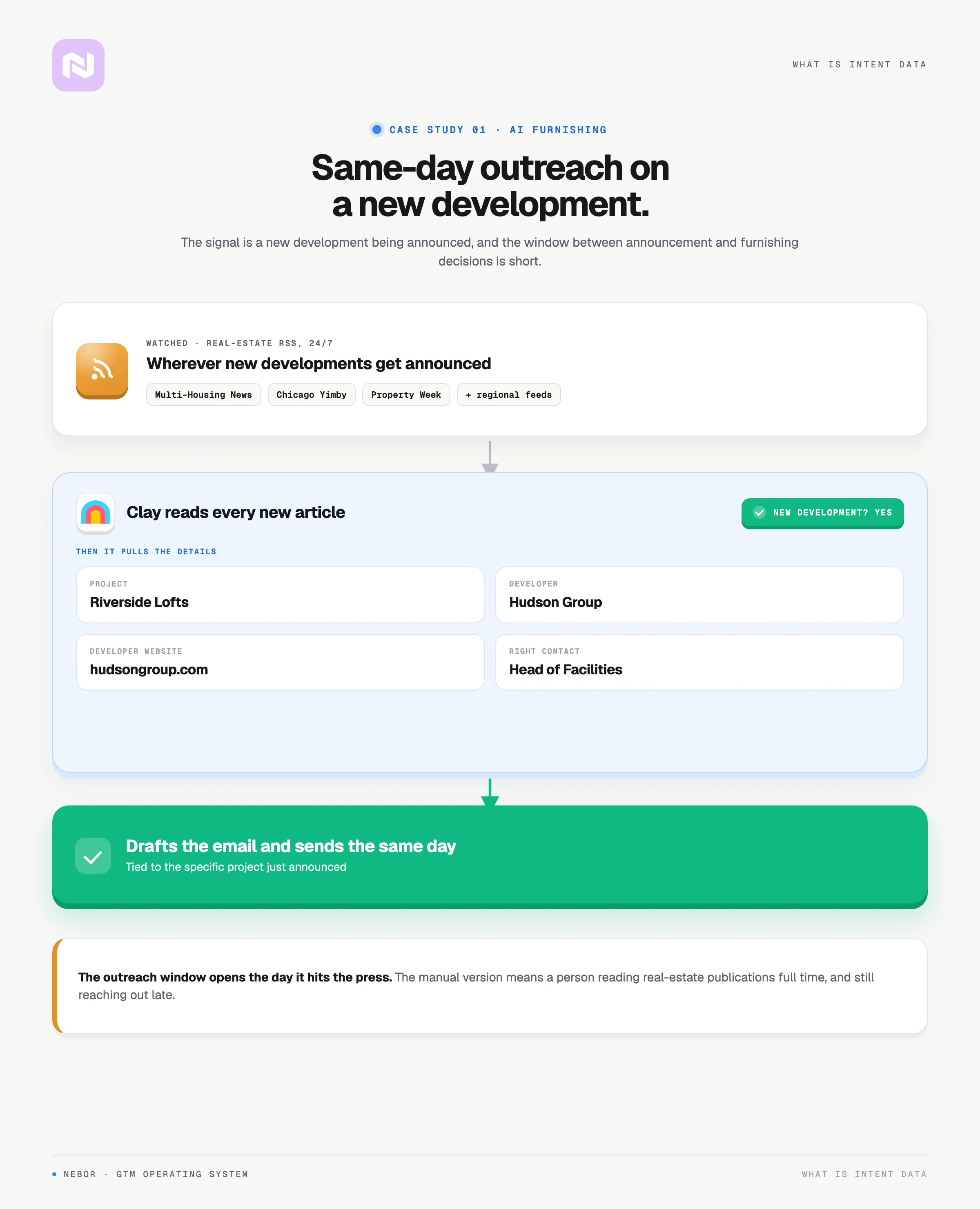
One of our clients sells AI-powered furnishing solutions for new property developments. The buying signal that matters for them is a new development project being announced, and the window between announcement and furnishing decisions is short.
We monitor and scrape RSS feeds from sites like Multi-Housing News, Chicago Yimby, Property Week, and a long tail of regional and topical real estate publications.
Every new article lands in Clay, where the system parses it to determine whether it announces a new development. If it does, the workflow pulls the project name, the developer, the developer's website, and the right contact person.
From there, the system finds contact details, drafts an email tied to the specific project just announced, and sends it the same day.
This works because the relevant outreach window opens the day the development hits the press. The manual version of this work would mean a person reading real estate publications full time and still reaching out late.
Case study 2: Enterprise tax incentive solutions
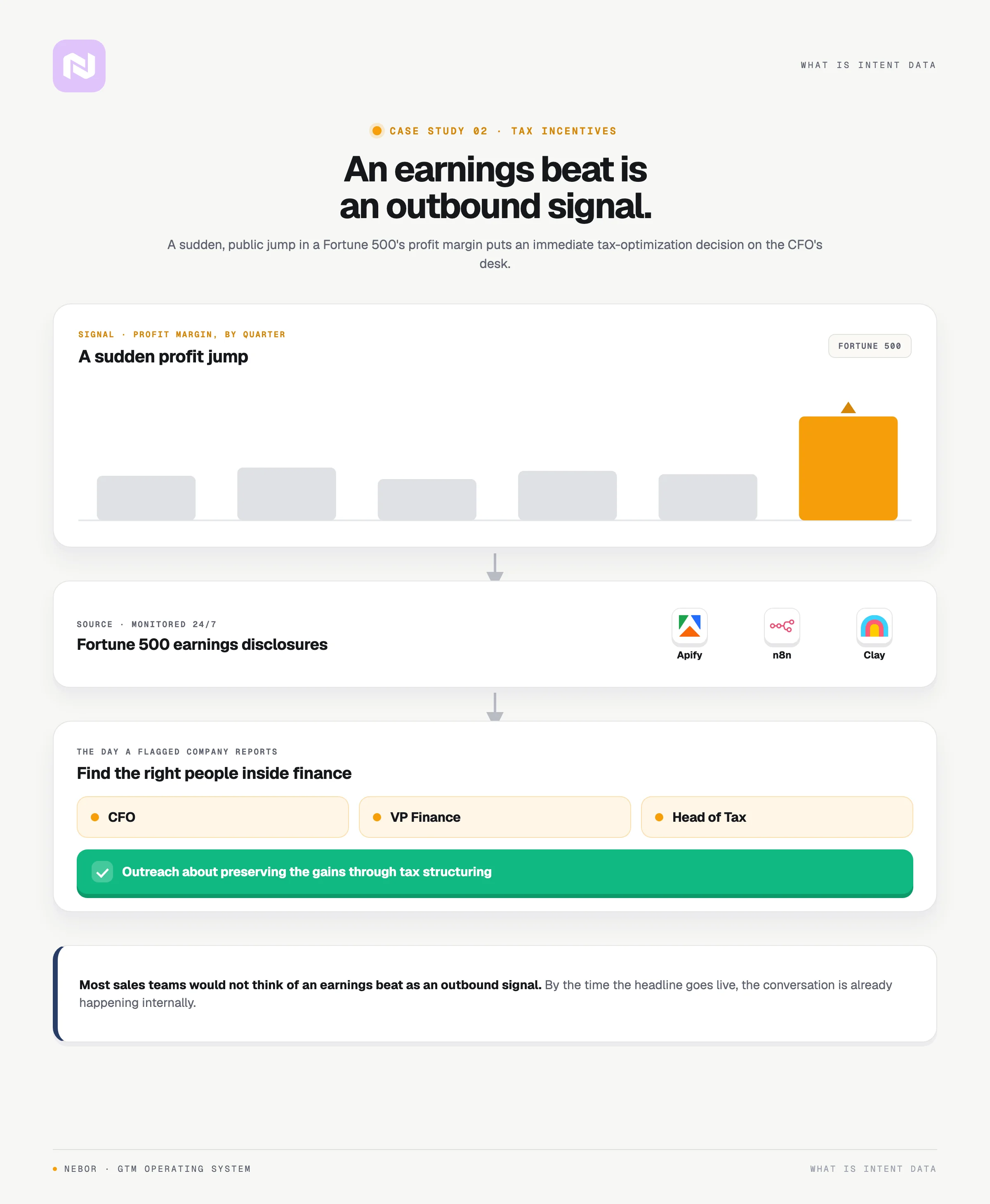
Another Nebor client sells solutions that help enterprise businesses use tax incentives more effectively and reduce their effective tax burden. The buying signal that matters for them is a sudden, public jump in a Fortune 500 company's profit margins.
We set up Trigify to monitor Fortune 500 earnings disclosures and flag profit margin spikes. The day a flagged company reports an unusual jump, our system finds the right contacts inside the finance organization and triggers automated outreach about preserving those gains through tax structuring.
Most sales teams would not think of an earnings beat as an outbound signal. We treat it as one of the highest-quality intent signals available in this category.
Companies with sudden profit increases have an immediate tax optimization decision waiting on the CFO’s desk, and the conversation is already happening internally by the time the headline goes live.
How to build your intent data strategy
If you are integrating intent data into the way your sales team works, six things matter more than the others.
1. Understand your offering, your ICP, and the signals that actually predict pipeline for you
The starting point is a clear-eyed read on what you sell and on the events at a company that move them toward needing it. That read tells you which signals are worth monitoring, which tools and data sources to plug in, and what data quality you can tolerate.
Listing topics buyers research is the easy version. The harder version is mapping the specific events, news items, hiring patterns, and corporate actions that have historically preceded a buying conversation for your offering.
Those become the priority monitoring targets your stack gets built around.
2. Use the right tools, not the most tools
Plenty of vendors will sell you something called intent data. Most of the time, what you actually need is a stack of monitoring and scraping tools wired up to the right sources, not another standalone "intent" platform parked beside the ones you already pay for.
The right stack depends on the signals you mapped in step one. If funding rounds matter for your offering, you need a feed of funding announcements and a way to identify the right contacts inside funded companies.
Job posting signals require job board scraping plus role classification on top. RSS-driven signals need monitoring with parsing logic applied to every new article that lands.
3. Build the automation upstream of the outreach
Intent data is time-bound, which is the part most teams underestimate. The value of any signal collapses fast once your competitors see it too, and the meaningful gap between you and them is measured in hours and days, not weeks.
The automation has to start where the signal lands. Monitoring, structuring, qualifying, and routing all need to happen without a human in the loop until the moment a real prospect is on the line.
Manual review at any of those steps is how outbound teams end up reading press releases all morning instead of taking meetings.
4. Wire the signal into both who you contact and what you say
Intent data is supposed to change who you contact and what you say to them. Most teams use it for the first half and ignore the second half.
The outreach should reference the specific event that triggered it, in language that sounds like a person who was paying attention rather than a sequence that went out automatically.
5. Track which signals actually produce conversations, then cut the rest
Nothing about intent data stays static across an engagement. The signals that look strongest on paper often underperform once you use them, and the signals that look like noise sometimes turn out to be the highest-quality leading indicators.
Track which signals produce qualified conversations and which produce silence, and tune the monitoring accordingly. Half the value of keeping an intent program for a few months is finding out which signals you should have been watching all along.
6. Decide whether to build this capability in-house or hire it in
The technical knowledge to build effective intent systems is real, and the people who have it tend to also have the outbound experience to know what to do with the signals once they land.
Both halves are required, and the failure modes are predictable when one is missing. A great engineer building this without an outbound background tends to over-monitor and under-message.
A great SDR trying to build this without an engineer tends to under-monitor and over-message.
The honest call is whether you have both halves on your team or whether you need to hire a partner who has built this before.
If you have an in-house revenue team that is already doing outbound and an engineer who can ship a working Clay implementation, n8n, and custom scrapers, you can build it. If not, the timeline to learn it from zero usually costs more than the build.
Hire Nebor to build intent data workflows for you so you can dominate your business industry
The bigger picture is that markets are getting more competitive and AI is widening the gap fast between teams that can sense and act on demand in real time and teams that cannot.
The teams winning at outbound right now are building automated intent systems around their specific offering, not bigger lists through faster sequencers. Buyers do not respond to volume the way they used to.
Building those systems is what we do at Nebor, end to end. The work covers signal mapping, monitoring, outreach, and routing into the inbound qualification flow on the back end.
Our clients see fewer wasted touches because the targeting is right, faster sales cycles because conversations start with prospects already in motion, and a system that keeps producing pipeline once we hand it over because the system lives in their accounts rather than ours.
The whole model is built on ownership over rental, not on dependence. After a Nebor engagement, the workflows, the enrichment logic, the scrapers, the automation sequences, and the routing rules all live in the client’s Clay, n8n, HubSpot, and Salesforce instances.
We are not the indispensable middleman, and the design choices reflect that. The team that designed the system is also the team that uses it day to day, which is the only way intent systems compound year over year instead of breaking the moment the agency gets paused.
If you have an in-house revenue team and outbound is part of how you grow, this is what we do. If you do not, this post is probably the wrong starting point and the right next step is building the GTM system before layering intent on top of it.


Related Articles


By clicking Sign Up you're confirming that you agree with our Terms and Conditions.