
How to Hire SDRs and Outbound Experts That Succeed (+Why Most Companies Face a Bad SDR Hiring Turnover)

In this post:
Most companies don’t know how to hire SDRs and outbound experts.
We know that because we scrape LinkedIn for SDR job posts every day. It’s an automation we built for our own outbound, and one we still use. Fun fact, it's how we get a good deal of our clients at Nebor.
The thing is, the SDR role has one of the highest turnover rates in B2B sales. Founders and heads of sales hire a hot-shot who pulled big numbers at a name-brand company.
A few months in, they can’t repeat any of it. A few weeks after that, they either burn out or jump ship, and the role goes back on LinkedIn while the founder is months further from where the pipeline needed to be.
You’ve spent budget on a hire that didn’t work. You’ve spent management hours on it that you weren't going to get back. You promised the leadership team things would change this quarter, and now you're back at square one and not sure you can do this right on the second try.
We’ve heard this story too many times to keep calling it bad luck.
Hiring practices for outbound roles haven't caught up to what outbound work actually looks like in 2026. Most SDR job descriptions still describe what the role was when it ran on Apollo, dial lists, and a generic email cadence.
The interview process still tests for those same skills. The training plan still assumes the new hire spends their week sourcing accounts by hand and writing five-paragraph cold emails one at a time. None of that matches what good SDRs actually do now.
In this post we walk through the three pitfalls we see kill SDR hires before the first interview. Then we share the qualifying framework we use ourselves to talk to candidates beyond their CV.
At the end, we make the case for when you're better off building the system with a partner like Nebor and skipping the hire altogether, or hiring fewer SDRs who only do the part that actually matters.
Let’s get started.
TL,DR
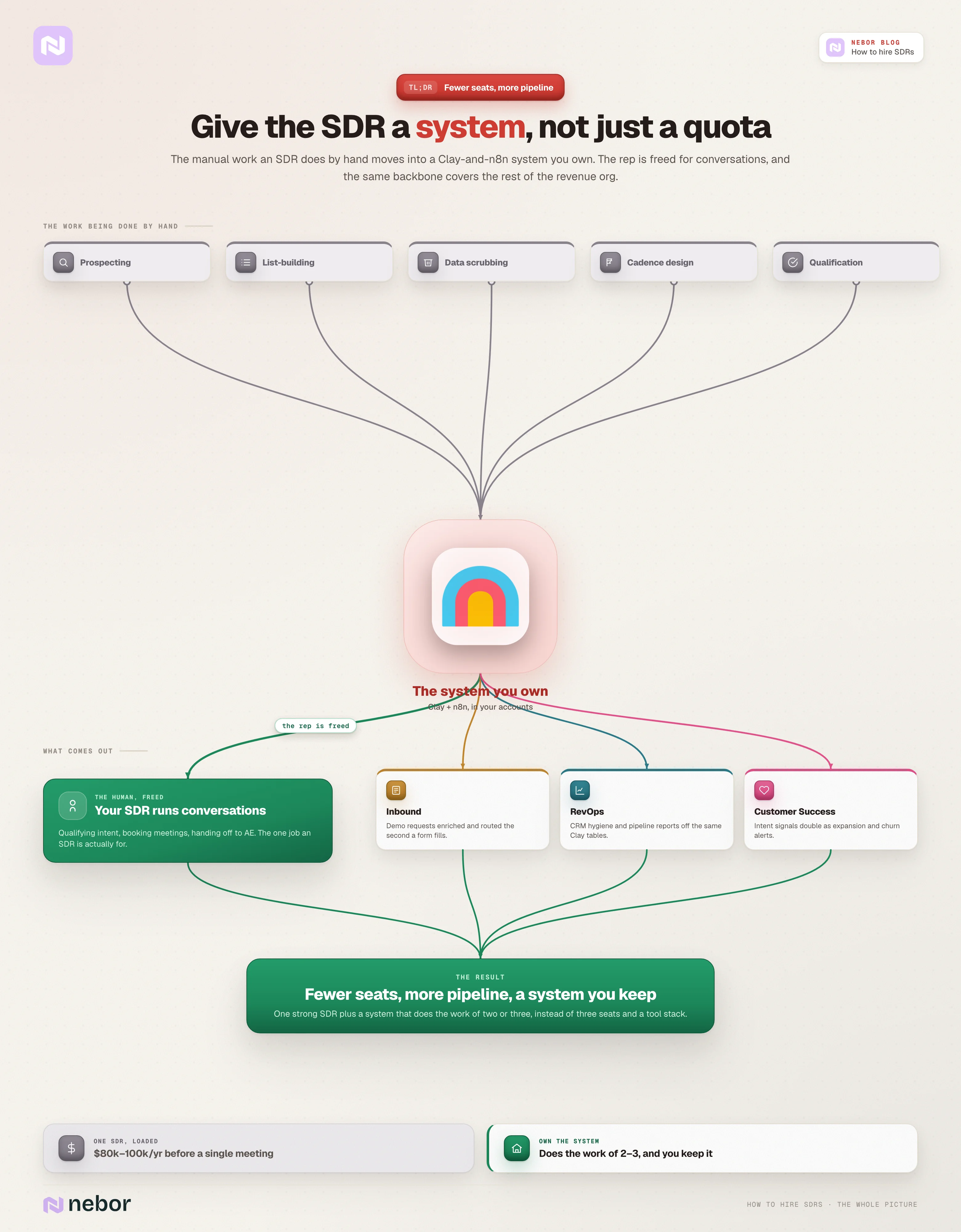
Don’t just hire an SDR and leave them to do the work. Give them a system that enables them to worry less about the hassles of the job and focus on having sales conversations and winning you deals.
Three hiring pitfalls that kill the role before the role starts
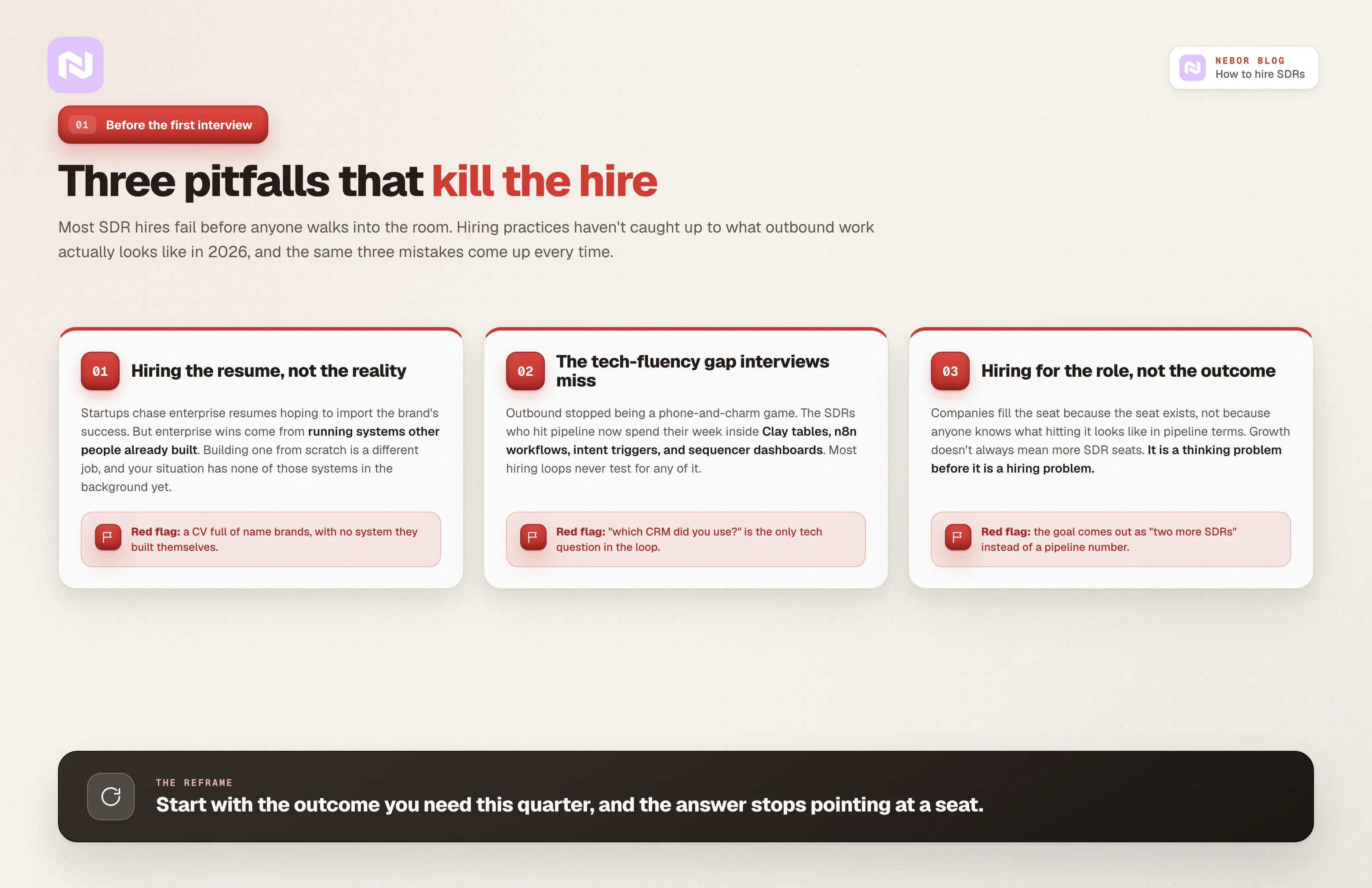
These are the three patterns we keep watching kill SDR hires before they get a fair shot.
Misalignment between what you need, what the JD says, and who you hire
Most SDR job descriptions don't reflect the actual skills or mindset the role needs to succeed in your company. They reflect what you wish the role was, or what the last company you worked at said the role was.
When we talk to sales or RevOps leaders and dig into this, the gap is almost always between what they think they need and what they actually need. That gap practically sets the hire up to fail before the first interview.
This pattern shows up at startups more than anywhere else. They target candidates with strong enterprise resumes, hoping to import the brand's success along with the person.
That logic doesn't hold, and we're not the only ones saying it. Below is a Reddit thread from a couple of years back where the same point made the rounds.
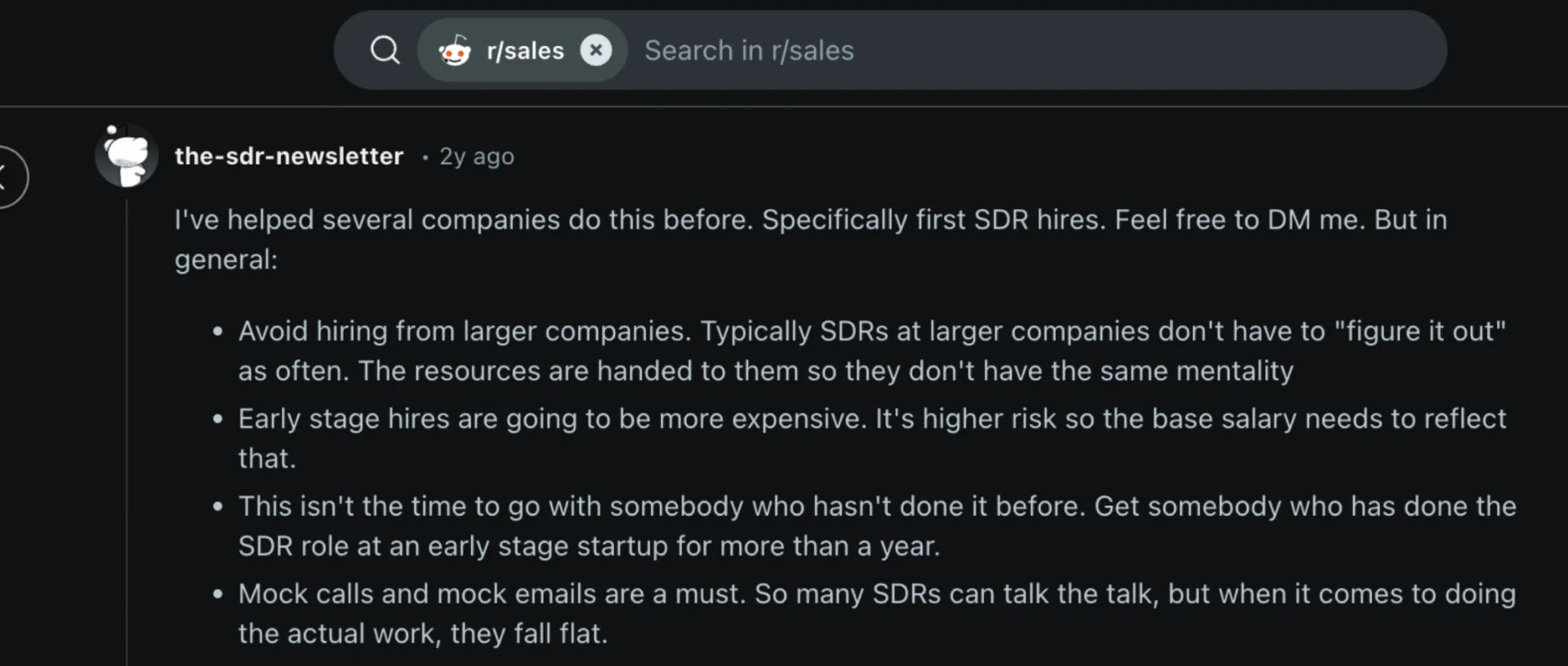
Hire a chief sales officer who managed a million-dollar budget at Oracle, or a regular SDR from a 20-rep vertical pod at Salesforce, and watch both struggle in a seed-stage startup. Enterprise success comes from working systems other people already built. Building modern sales systems from scratch is a different job.
Your situation has none of those systems already in the background. The CV won't tell you how the candidate performs when nothing is in place yet.
Most large-org execs lose their edge the moment the resources, brand recognition, and process documentation they relied on aren't there.
Writing email copy, texting prospects manually, and rebuilding a campaign on a Tuesday morning because Monday's data was bad don't get rehearsed inside an enablement-heavy organization.
The tech fluency gap most interviews miss
Tech fluency in an SDR means two things at the same time. The candidate needs to use tools well, and the candidate needs to know how to build a sales tech stack that fits the company they're joining. Most hiring loops we see test for neither.
The shift behind this is that outbound work isn't a phone-and-charm game anymore. The find-contacts-smile-dial-and-cutesy-your-way-in playbook still gets taught at sales bootcamps, but the SDRs who actually hit pipeline numbers in 2026 spend most of their week inside Clay tables, n8n workflows, intent triggers, and sequencer dashboards.
Most of the value in a strong SDR's day comes from what gets built in the system, not what gets typed in the Gmail tab.
The same automation we built to scrape LinkedIn job posts is the kind of routine outbound work an SDR should be designing themselves. Building a solid sales tech stack is the underlying skill that makes the rest of the SDR's job possible.
Hiring managers, especially non-technical founders, almost never test for this. Most of them don't know to ask the candidate about anything beyond the CRM the candidate has used.
So the seat gets filled by someone who sounds great, has closed deals, and has zero idea how to set up a multi-channel sequence with logic branching, or how to make a Clay table push enriched leads into HubSpot on a weekly trigger.
That gap shows up later as missed pipeline, missed signals, and an SDR who burns through their list in three weeks because they have no system to keep refreshing it.
Here's what the SDRs who win in 2026 actually do.
Map the ICP into a Clay table and enrich it with verified contact data via Findymail and LeadMagic
Design a multi-channel sequence with rules for what happens on opens, replies, link clicks, and meetings booked
Spot a buying signal in intent data and trigger the right action without waiting for someone else to write the playbook
Pick the right AI sales tools for each part of the day instead of working with whatever the CRM came packaged with
Plug new automation into the rest of the revenue stack without breaking what already works
Now, here’s what it looks like:
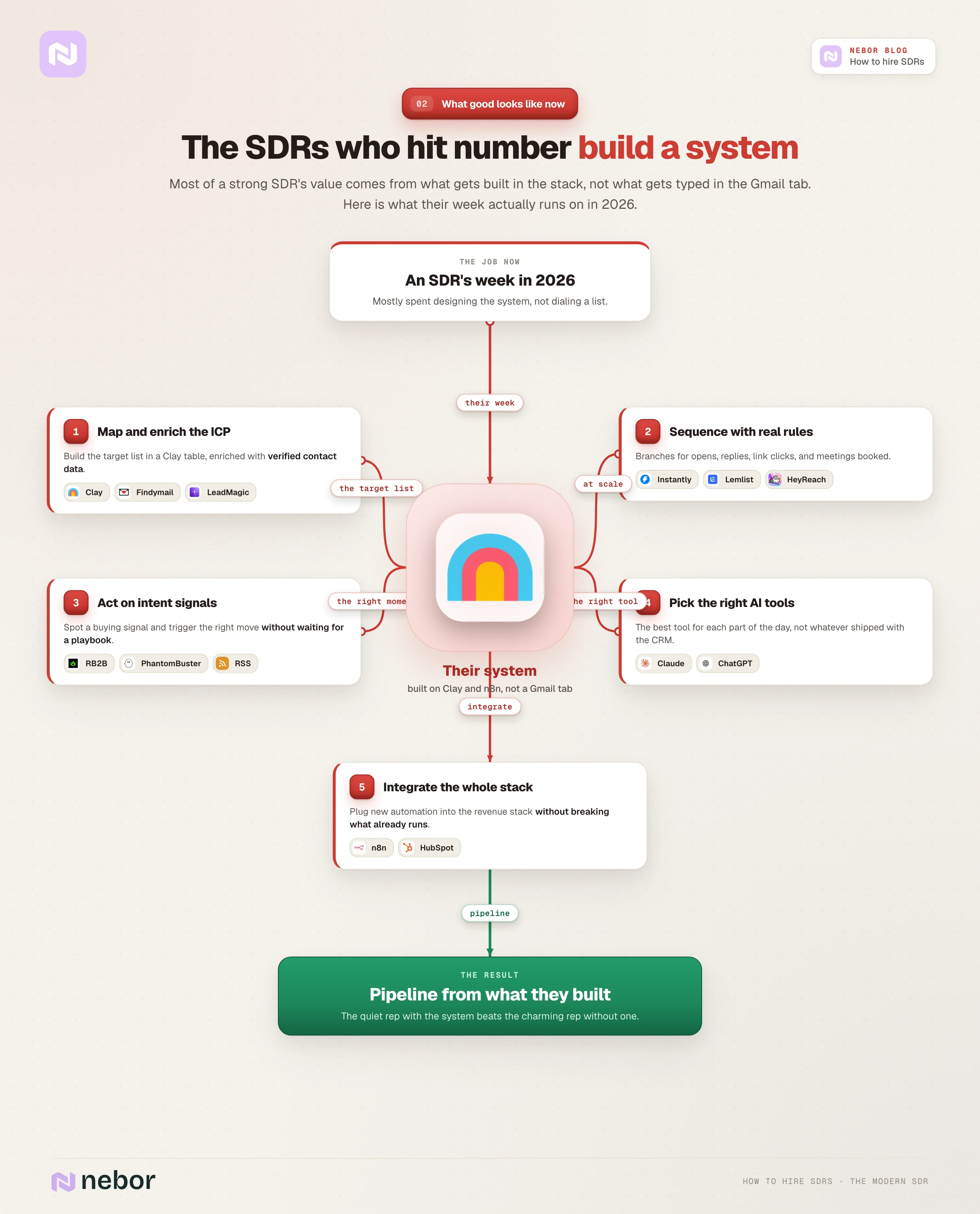
Without that foundation, even the most charming rep in the room will lose to a quieter rep who has the system.
Hiring for the role instead of the outcome
Most companies hire people to do a job, not to deliver a specific outcome. Companies fill the seat because the seat exists, not because anyone in the room knows what hitting that seat's job actually looks like in pipeline terms.
This is a thinking problem before it's a hiring problem. Growth doesn't always translate into more SDR seats. Most of the time we ask a head of sales what they want, the answer comes out as "two more SDRs," when the real goal is something more specific.
The reframe is to drop the headcount question and start with the outcome question. Ask what good would actually look like this quarter.
How do we get to five qualified sales meetings per week from accounts that match the ICP?
How much of the current SDR team's week is going to manual list-building, scrubbing CRM data, and writing one-off LinkedIn messages?
Where would an extra hour a day in front of qualified prospects come from for the reps already on the team?
Can we get there without a single new hire?
Once the question changes, the answers stop pointing at SDR seats. One systems thinker who knows how to build automation in Clay and n8n can outperform three traditional SDRs and cost less.
Or the team you already have hits its number again because the manual work (the list-building, the enrichment, the qualification ping-pong) happens inside a system instead of a person.
Hiring more SDRs is one path you can take. The argument we keep making in our headcount-versus-systems writeups is that systems usually win that comparison once you cost out the SDR's loaded year, the ramp, and the turnover.
A four-part framework for qualifying SDR candidates beyond the standard interview
Once you've ruled out the three pitfalls above, the next problem is the interview itself. Most interview loops for SDR roles don't actually test for the skills that decide whether a hire works or fails.
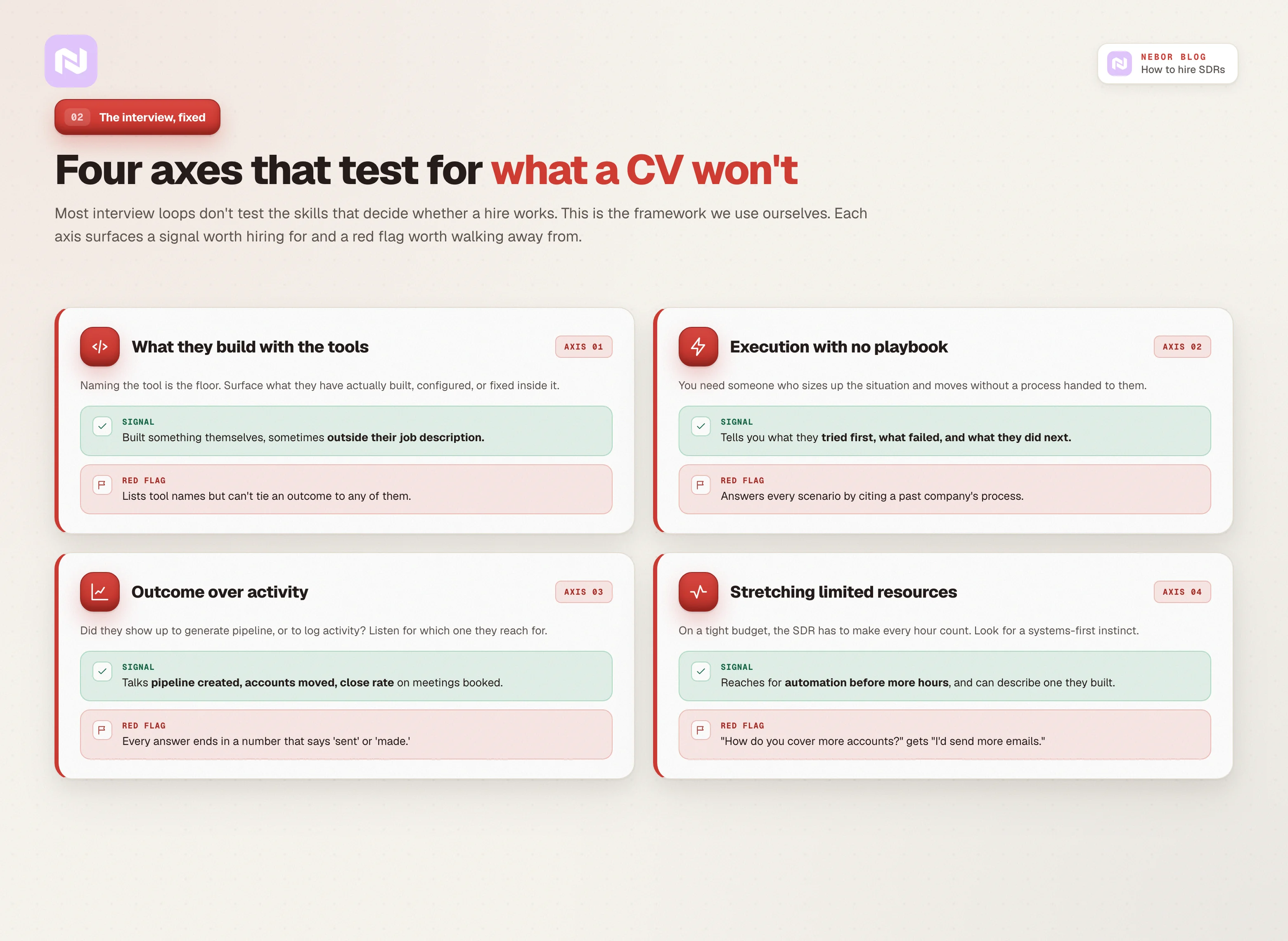
The framework we use ourselves has four axes. Each axis has a few questions that surface what a CV won't tell you, and each one points at a red flag worth walking away from.
Test or ask about what the candidate actually does with the outbound tools, not just which ones they've heard of
What you're trying to surface is what the candidate has actually built, configured, or fixed inside the tools they list on the CV. Naming the tool is the floor, not the bar.
The strongest candidates have built something themselves, sometimes outside their job description, because they got curious about a workflow that wasn't working well.
The weakest answer the same question by listing the CRM brand and a couple of sequencers and stopping there.
The red flag here is the candidate who can list tool names but can't say what specific outcome they produced from any of them. They've worked next to the stack, not inside it.
Here are the questions worth asking.
Walk me through how you'd set up a multi-channel outreach sequence using our tech stack.
What tools have you used to automate repetitive tasks in your previous role, and what was the impact in time or pipeline?
If our CRM data was incomplete, what steps would you take to enrich it before starting outreach?
Show me a Clay table or sequencer dashboard you've built and walk me through what it does and why.
Test the execution mindset with scenarios that have no defined playbook
This one matters more the earlier-stage you are. You need someone who walks in, sizes up the situation, and starts moving without a playbook handed to them.
The candidate who needs three weeks of onboarding and a defined process for everything is going to struggle in a 12-person company that hasn't built any of those processes yet.
The red flag here is the candidate who answers every situational question by referencing a process they followed at a previous company.
The signal you want is the candidate who answers with how they figured something out, what they tried first, what didn't work, and what they did instead.
The questions that surface this fastest are situational ones.
Tell me about a time when you had to build a process from scratch with minimal direction.
Describe how you'd approach prospecting if you had no defined ICP and limited market data.
What's your process for testing new messaging when the current approach stops working?
How do you manage your day when you're dealing with competing priorities and limited resources?
Filter for outcome orientation instead of activity orientation
The question this axis answers is whether the candidate showed up to generate pipeline or to log activity. Activity-oriented SDRs talk about call volume, sequence size, and meetings dialed.
Outcome-oriented SDRs talk about pipeline created, accounts moved into a real conversation, and what the close rate looked like for the meetings they actually booked.
The red flag is the candidate who answers every “what did you achieve” question with a number that ends in 'sent' or 'made.'
Hundreds of calls made, thousands of emails sent, no follow-up about what actually landed, and you're hearing an activity report instead of an outcome.
The questions worth asking on this axis.
What specific business outcome were you responsible for in your last role, and how did you achieve it?
If we needed to generate five more qualified meetings per month, what approaches would you consider beyond turning the activity dial up?
Tell me about a time when you shifted your approach to achieve a goal when the original plan wasn't working.
How do you decide which prospects deserve more of your time?
Find out how the candidate stretches limited resources
If you're hiring with a tight budget, the SDR you bring on has to make every hour count. The signal you're looking for is a candidate who instinctively reaches for systems and automation before reaching for more time.
They talk about doing more with the same hour, not about working a longer day to make up for a thin process.
What this looks like in practice is a candidate who can describe an automation they built or asked someone else to build, the lead-qualification workflow they put in place to stop chasing bad-fit prospects, and the way they decide which 50 accounts in a 500-account list deserve real outreach this week.
The opposite signal is a candidate who answers "how do you cover more accounts" with "I'd send more emails."
Here are the questions worth asking on this axis.
How do you decide when to use automation versus personal outreach in your prospecting process?
Where have you improved efficiency in a previous role, and what was the impact in time saved or accounts covered?
What's your approach to qualifying prospects quickly to avoid wasting time on poor-fit opportunities?
Why you’re better off hiring a partner like Nebor instead of (or alongside) hiring SDRs
Building an SDR team in-house looks like the natural next step in growing pipeline. The way the cost actually breaks down once you add up everything around the seat is where this idea falls apart for most companies.
The cost of an SDR is not the salary. The cost is the entire system you have to build and maintain around the seat to make the salary worth paying. That part almost never gets accounted for at the planning stage.
Here's how the costs add up when you actually count the whole picture.
Base salary. Per Glassdoor, the average SDR earns between $52,000 and $60,000 a year before any of the rest of this list.
Benefits and employment taxes. Add another 20% to 30% on top of the base.
Sales tech stack. Expect $500 to $1,500 a month per rep for the working stack of Salesforce, Apollo, Outreach, and the enrichment and dialer tools the SDR uses every day.
Ramp-up time. SDRs need 3 to 6 months to become fully productive depending on industry and sales cycle, and you carry the salary the entire ramp.
Managerial overhead. You or someone else spends real hours every week training, coaching, and reviewing performance.
Attrition and replacement. SDR roles have one of the highest turnover rates in B2B sales. Every time someone leaves, the seat goes back to zero, the institutional knowledge walks out, and the cycle restarts.
Add the whole list up and you're looking at $80,000 to $100,000 a year per SDR before you've seen a single qualified meeting from them.
The ROI math only works if the SDR performs the way you need them to, fast enough to matter, in a market where outbound is still working.
What you actually get when you hire a partner like Nebor instead of an SDR
Hiring Nebor is a different purchase than hiring an SDR. The SDR is one person doing one role, and the loaded cost above is what you're betting on a single seat.
With Nebor, you're paying for a team that has built and operated the system the SDR was supposed to manage, in our own outbound first and across other clients hundreds of times after that.
You're paying for the build, the operation, the handoff, and the parts of the revenue org that the build ends up touching on its way through.
We handle the entire outbound function, and we bring tech expertise an SDR rarely has
Most SDRs know how to send emails and make cold calls. That's where their training stops, and it's also the part of the work with the least pull on pipeline.
The skill that decides whether outbound actually produces meetings comes earlier in the sequence, in finding the right accounts, enriching them with verified data, designing the cadence, picking up the right intent signals, and making sure none of it breaks when something upstream changes.
HubSpot's research is the cleanest snapshot of where outbound usually lands. 52% of outbound marketers report seeing no results from their efforts, and only 16% report seeing successful results.
The middle of that distribution is a lot of teams generating real activity without producing pipeline.
In-house SDRs tend to send short, linear campaigns that end when the list is exhausted or the quarter does, and the team starts the next one from scratch. That stop-start rhythm is what kills the momentum the previous quarter built up.
At Nebor, we do the outbound work so your team can talk to the prospects who are ready to talk back. The SDR goes back to the seat that does what an SDR is actually for, which is having conversations, qualifying intent, booking meetings, and handing off to AE.
The rest of the sequence works around them, not on top of them.
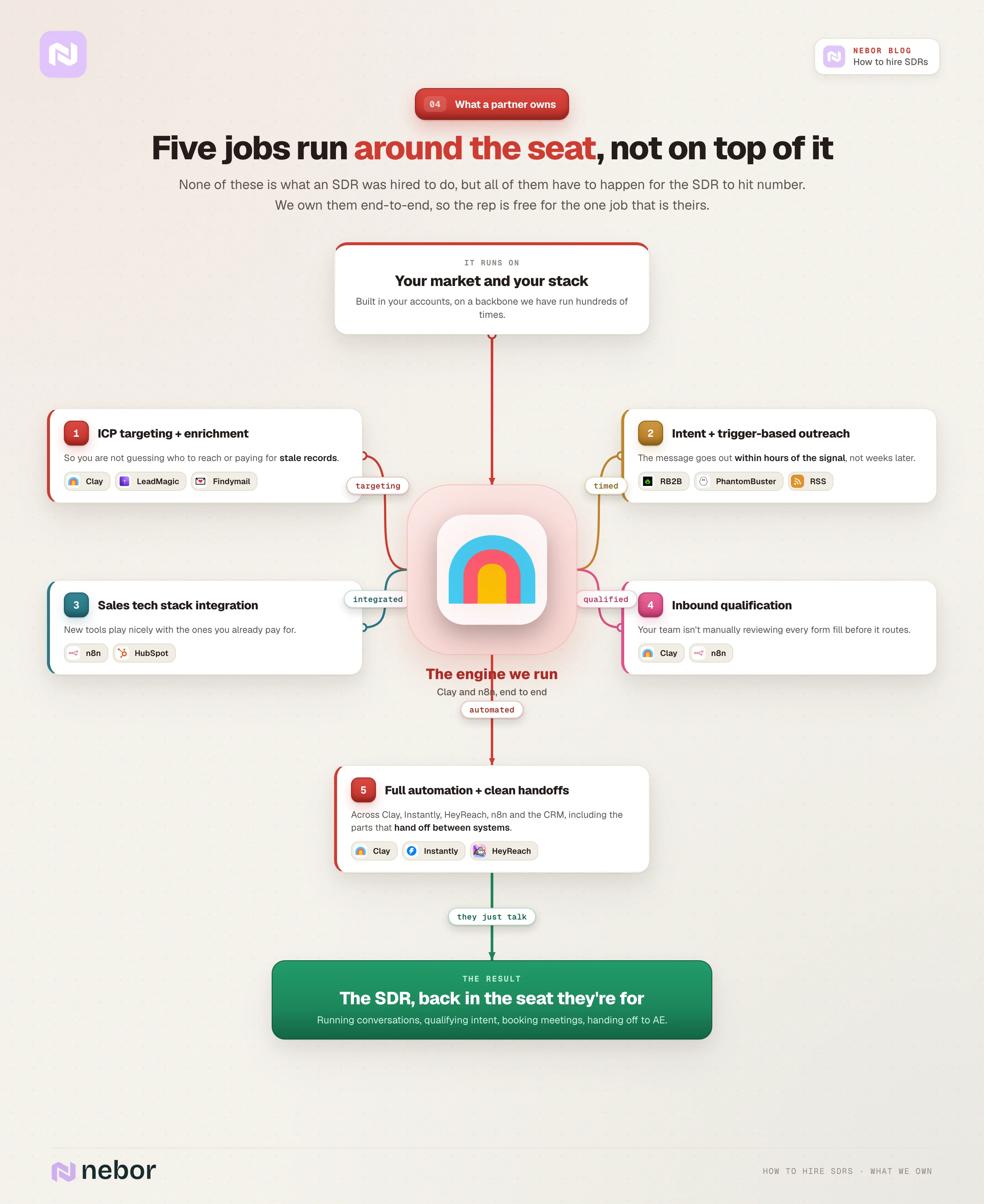
Here's what we own end-to-end.
ICP targeting and data enrichment, so you're not guessing who to reach out to or paying for stale records
The full automation across Clay, Instantly, HeyReach, n8n, and the CRM, including the parts that hand off cleanly between systems
Intent signal tracking and trigger-based outreach, so the message goes out within hours of the buying signal instead of weeks later
Sales tech stack integration, so the new tools play nicely with the ones you already pay for
Inbound qualification automation, so your team isn't manually reviewing every form fill before it gets routed
Each one of those is a job in its own right. None of them is what an SDR was hired to do, but all of them have to happen for the SDR to hit number. That's the part of the math that breaks when you try to load it onto one new hire and a CRM.
The same automation behind your outbound covers the rest of your GTM motion
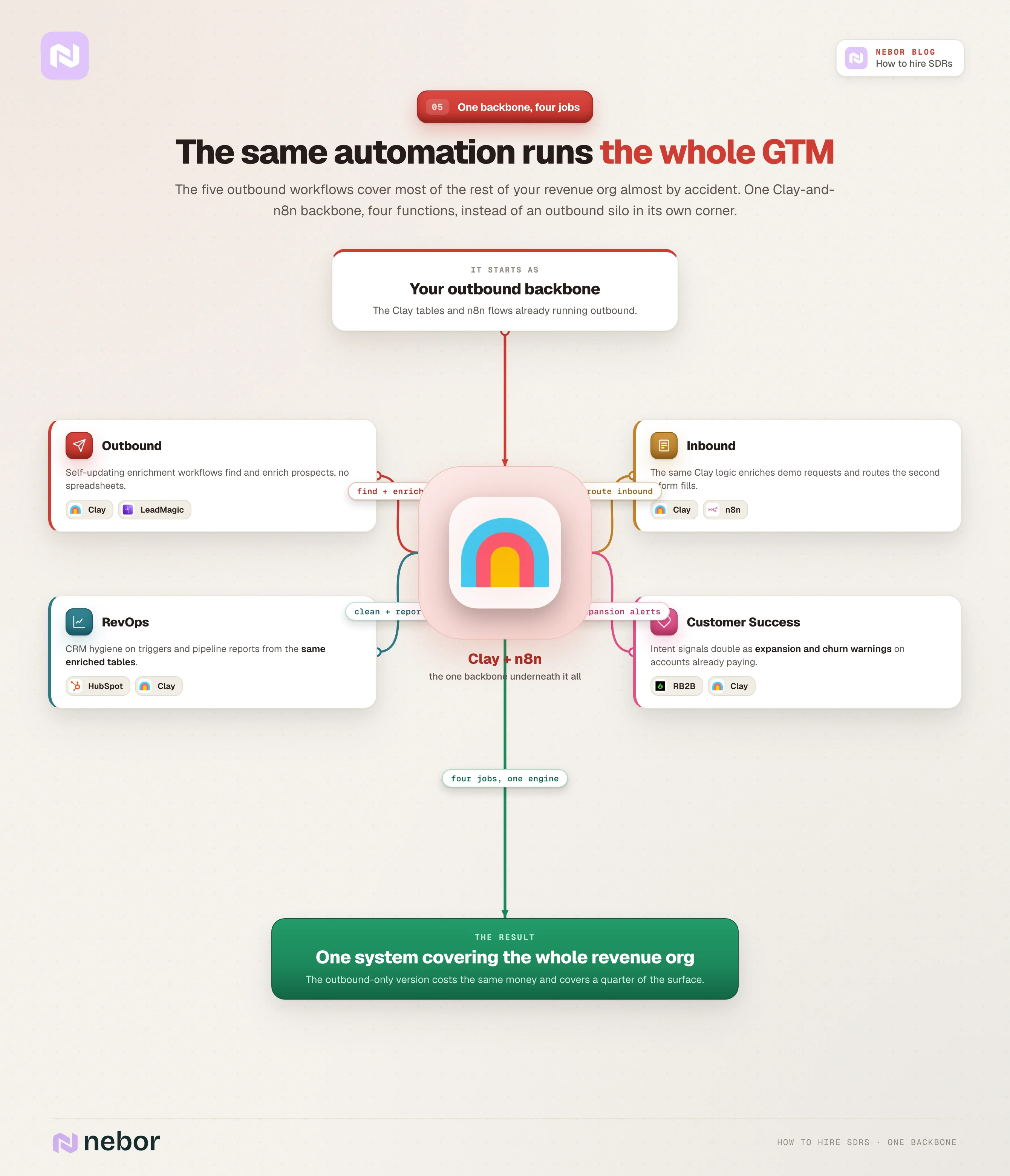
The five workflows above aren't specific to outbound. They cover most of the rest of your revenue org almost by accident.
The Clay table that finds and enriches outbound prospects also enriches the inbound demo requests when someone fills out a form. The same Clay logic decides if the lead is fit-worthy and routes it accordingly.
The n8n workflow sending outbound follow-ups can push deal updates into the CRM at the same time, so the AE never has to chase status manually.
The intent signals that surface a cold account for outbound double as expansion and churn warnings for customer success on the accounts that are already paying.
Once you have outbound working on a clean Clay-and-n8n backbone, that backbone covers most of what the rest of your revenue org has been doing by hand.
List-building moves from spreadsheets and Apollo lists into enrichment workflows that update themselves, lead routing stops needing a Slack DM at 9pm because a workflow kicks in the second a form fills, and the same intent triggers that catch cold-prospect signals double as expansion alerts on the accounts already paying you.
The case for owning a GTM system that crosses every team instead of an outbound function that lives in its own corner is that the outbound-only version costs the same money and covers a quarter of the surface area.
RevOps without hiring a RevOps team
Most companies hit a point where the CRM is dirty, the deal stages are inconsistent, the forecast is more story than data, and the head of sales has to manually pull a pipeline report every end of week.
The standard answer is to hire a RevOps lead. Loaded cost is comparable to an SDR, the role is hard to fill, and the work is mostly automation work that lives in the same Clay-and-n8n backbone you already have in place.
What we mean by RevOps in this context is concrete.
CRM hygiene that happens on triggers instead of a quarterly clean-up project
Pipeline reports that pull from the same enriched Clay tables instead of a Google Sheet someone updates by hand
Forecasting models stitched into actual deal data instead of stage-by-feel
Account scoring that updates the moment new intent appears
Routing rules that apply the moment a form is submitted
That work all lives in the orchestration layer. It is the same layer behind the outbound, the inbound qualification, and the customer success signals.
The reason we can take it on without you hiring a RevOps lead is that the team building it for you came up sending outbound campaigns first. The RevOps view that comes out of the work is biased toward what closing AEs and SDRs actually need to see, not toward dashboards that look pretty in a board deck.
Andrew and Yannick ran our own outbound and our own RevOps before we ever sold either to clients. The phrase we keep using internally is "salespeople first, automation experts second." RevOps inside Nebor is not a separate team.
It is the same team, working the same Clay tables that started as outbound enrichment, just pointed at a different layer of the revenue stack. We tell clients to think of RevOps as the natural extension of the outbound build, not as a new function to staff.
Structured systems that you own when the engagement ends
In-house outbound depends on what the SDR happens to know and do every day. When that person leaves, the knowledge they built up walks out the door, and the next hire restarts the cycle from a blank Notion page.
The system we build for you doesn't have that failure mode, because the system isn't a person.
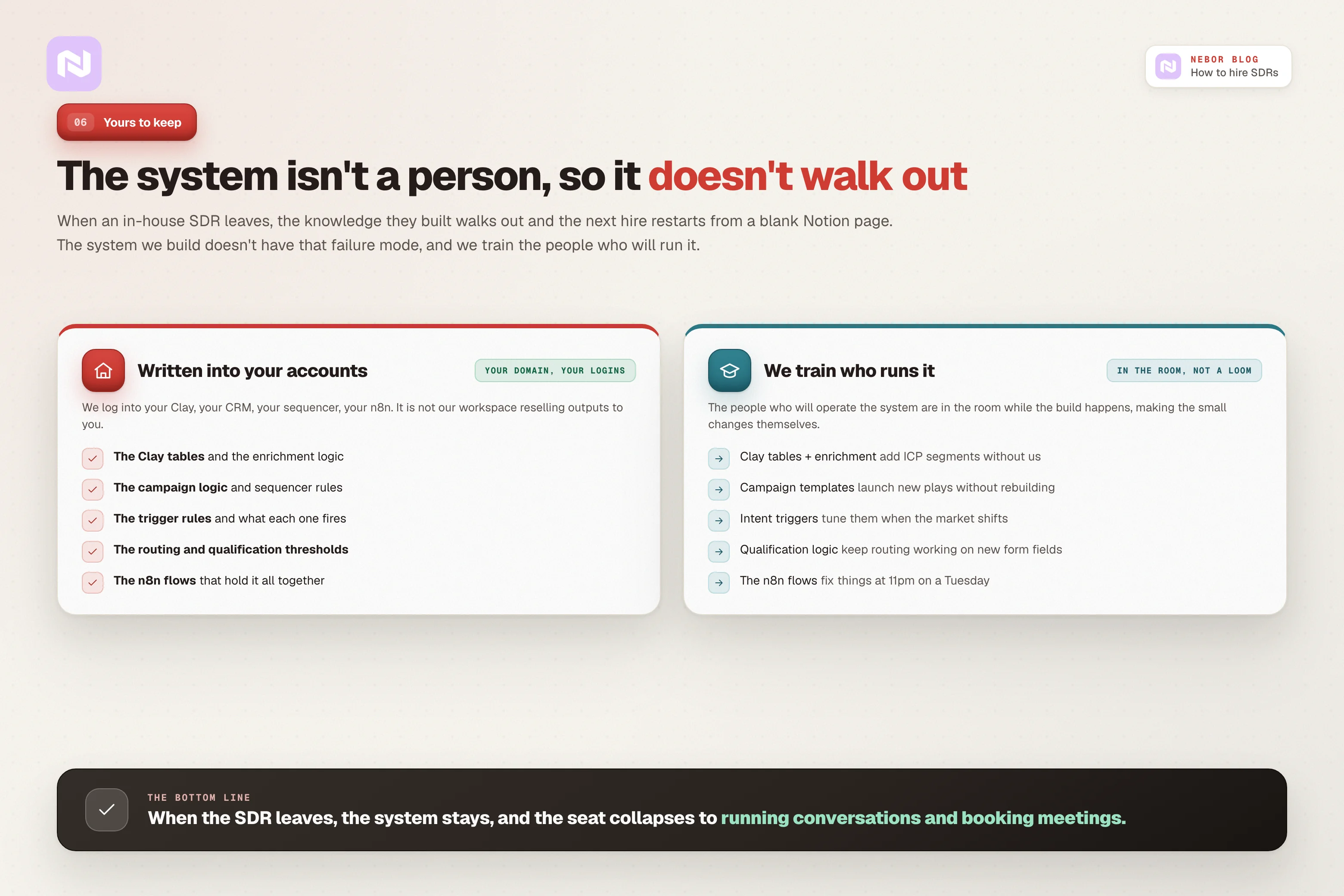
The Clay tables, the campaign logic, the trigger rules, the routing, the qualification thresholds, and the n8n flows are all written down inside your accounts and on your domain.
And, importantly, the build lives in your accounts, not ours. We are not using our own Clay workspace and our Instantly and reselling outputs to you.
We log into your Clay, your CRM, your sequencer, your n8n, and the whole system gets built on infrastructure you control, so you can edit it, extend it, or hand it to your team after the engagement ends.
Most agencies rent you a service that ends the moment the retainer does. Nebor builds you a system that keeps going after the work is finished, in your stack, on your data.
Faster execution during the engagement
A typical SDR has to juggle research, list-building, writing messages, sending emails, qualifying leads, scheduling meetings, and reporting performance.
That's a lot of separate jobs for one seat, and most of them are jobs the SDR is actively bad at compared to a system designed to do them.
When you bring Nebor in, the SDR stops juggling all of those jobs at once. We handle lead sourcing, enrichment, message-writing that actually gets replies, and the automation that sends those messages on the right cadence.
The SDR's day collapses back to having conversations and booking qualified meetings, and the AE picks it up from there.
Everyone ends up in the seat they were hired for, doing the thing they're actually good at. The launch happens in weeks instead of months because the build stands on a backbone we have used for ourselves and dozens of clients before yours.
We train your SDRs to operate the build, so they spend their time talking to prospects instead of sourcing them
The last piece of the work is the handoff. We build the system, we operate it ourselves during the engagement, and we train whoever is going to operate it after we leave so the team owns the outputs as well as the inputs.
What we train on is concrete.
The Clay tables and the enrichment logic, so the team can add new ICP segments without us
The campaign templates and the sequencer rules, so the team can launch new plays without rebuilding the cadence
The intent triggers and what each one is wired to trigger, so the team can tune them when the market shifts
The qualification logic that catches inbound demo requests, so the routing keeps working when your form gets new fields
The n8n flows that hold it all together, so the team can fix things when something breaks at 11pm on a Tuesday
The training is not a recorded Loom that nobody watches. It is the people who will operate the system, in the room while the build is happening, asking the questions and making the small changes themselves so they actually know what is wired to what.
The reason this matters for an article about hiring SDRs is the obvious one. The SDR seat collapses back down to the part of the job an SDR is actually good at, which is having conversations, qualifying replies, and booking meetings. The prospecting, the list-building, the data scrubbing, the cadence design, and the qualification ping-pong all happen inside the system the SDR now operates instead of doing by hand.
You can hire fewer SDRs and get more pipeline out of them. Or you can hire one strong SDR and give them a system that does the work two or three traditional SDRs would have done by hand.
Either way, the budget you would have spent on three SDR seats and a tool stack doesn't have to be three SDR seats anymore.
The outsourced-versus-in-house question we keep having with prospects almost always lands here, on the side of fewer people operating a system that does the rest of the work for them.


Related Articles

By clicking Sign Up you're confirming that you agree with our Terms and Conditions.