
10 Best RevOps Agencies in Europe to Clean Up the Chaos in Your Revenue Engine

by
In this post:
If you lead sales or RevOps and you landed here, your sales, marketing, and customer success teams are probably out of sync. Reps are spending more hours updating fields than closing deals.
Your HubSpot or Salesforce is full of half-dead records, and the reports you pull never quite agree with each other. Your tools do not talk, automations break in the dark, and nobody fully trusts the numbers anymore.
Marketing is pulling one way, sales is pulling another, and the leadership review turns into a debate about whose data is right.
You are trying to grow, and things keep slipping through the cracks. Leads go cold while reps wait on stale records, deals stall in stages nobody updates, and nobody on the team can say with confidence what is actually working.
So you looked around for the best RevOps agencies in Europe and ended up on this page, which is a reasonable next step. RevOps is the discipline that fixes the back-end of the revenue engine so the front-end can finally compound.
The harder part is finding a partner that actually does the work.
A lot of agencies stop at tool implementation. Others sell strategy decks that nobody on your team will ever execute. Most show up with a one-size playbook that fits nobody, then bill you a retainer to keep adjusting it.
This is our list of the 10 best RevOps agencies in Europe right now, including our own Amsterdam-based GTM infrastructure agency, Nebor.
We are practitioners who were salespeople before we were anything else, and we build the full GTM system inside your accounts so you own it after we leave.
Here is the full list in the order we cover them.
Note: Are you looking for a RevOps partner in Europe?
At Nebor, we are a GTM engineering and RevOps agency. The RevOps half means rebuilding your CRM, your lifecycle stages, your routing and your reporting into one system your revenue teams share, handed over so your team can change it later without us.
The GTM engineering half is what fills it: outbound, intent monitoring and inbound, built on the same spine, so what you report finally reflects something real.
Book a 15-minute call to discuss your business.
The 10 RevOps agencies at a glance
Before the deep writeups, here is the side-by-side view. The table is meant to help you narrow the list quickly. Read the deep section on whichever ones survive that first cut.
# | Agency | Best for | Core platforms | Engagement style |
1 | Nebor | Teams that want to own the GTM system, not rent it | Clay, n8n, HubSpot, Salesforce | Project build with full handover |
2 | Avidly Agency | Mid-stage teams with a tangled HubSpot setup | HubSpot (EMEA Partner of the Year) | Retainer |
3 | Think RevOps | Fragile revenue setups with mismatched forecasts | Salesforce, HubSpot, Gainsight, Marketo | Fractional and on-demand |
4 | Digital Litmus | Teams wanting a hands-on HubSpot platinum partner | HubSpot | Retainer |
5 | RevOps Automated | CRM cleanup and response-time fixes without hiring FTEs | HubSpot, Salesforce | On-demand |
6 | Nexa Cognition | Companies tired of gut-feel decisions on revenue | HubSpot, attribution layer | Project and retainer |
7 | Six & Flow | Marketing-led shops needing the sales side caught up | HubSpot Elite | Retainer |
8 | New Breed | Demand gen and RevOps under one roof | HubSpot Premier, Distributely | Retainer |
9 | Elefante RevOps | Niche teams wanting a deeply embedded partner | HubSpot | Retainer |
10 | Winning by Design | PLG and SaaS teams needing structured sales science | Methodology-led, tooling-agnostic | Training and advisory |
Each one earns a place on the list for a different reason. Some are HubSpot platinum implementers, some are sales-science training houses, some are fractional-leadership shops, and one (Nebor) is a Clay-native GTM infrastructure team.
The right pick depends on what is actually broken inside your revenue engine, not on whose website looks the slickest.
Let’s start by walking through what RevOps actually is, how to choose, and where each of these agencies fits.
What RevOps actually is, and what to expect from a real partner
RevOps, short for revenue operations, is the function that brings sales, marketing, and customer success under one operating model.
People, process, technology, and data all aligned around the same buyer journey, instead of three teams working three different systems that fight each other.
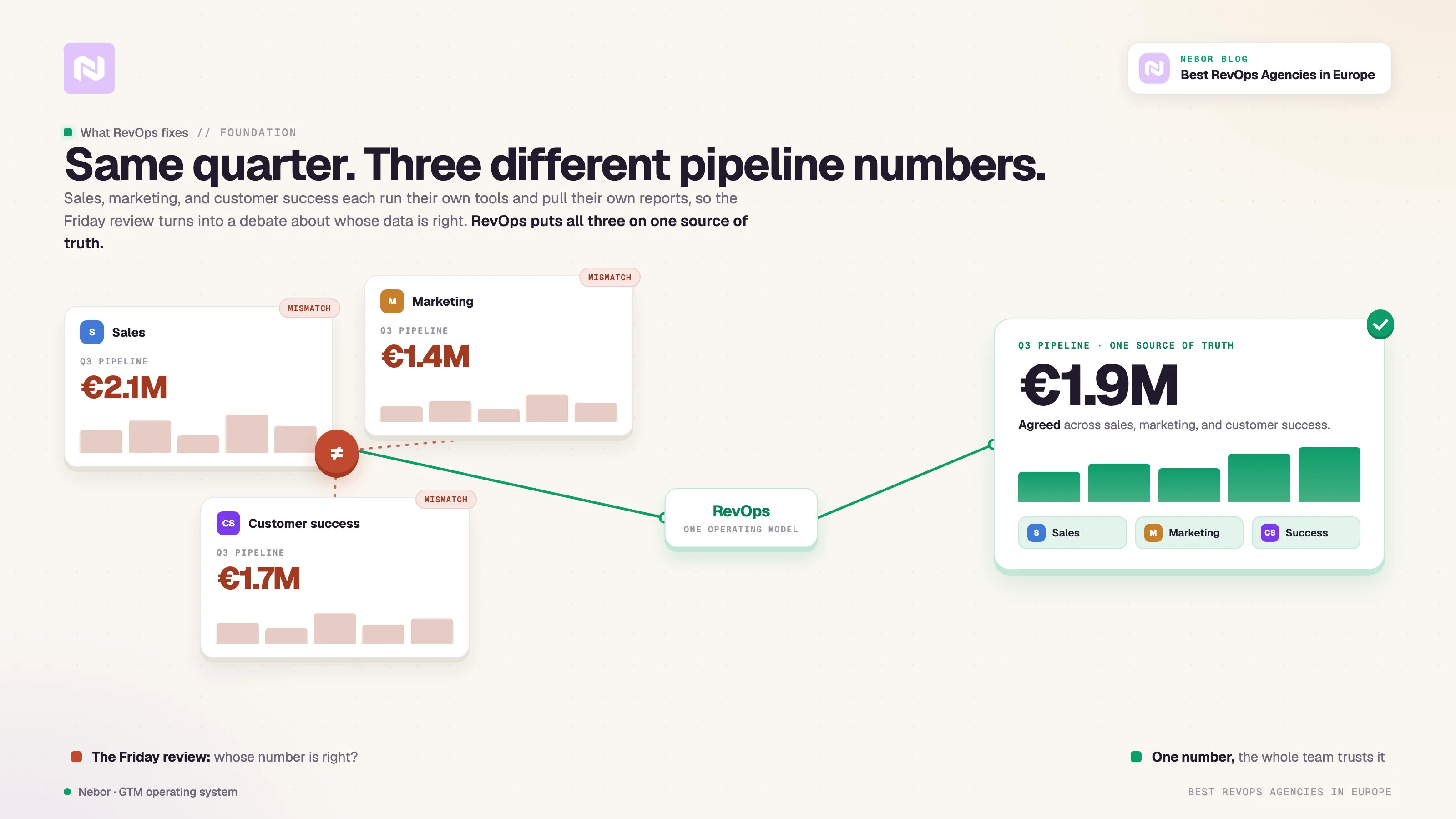
When it works, your sales, marketing, and customer success teams stop operating in silos. They share signals through one source of truth, work off the same definitions of fit and intent, and hand off without anything falling through the cracks.
The output of a working RevOps system is straightforward to picture. Sales cycles get faster, close rates climb, forecasts hold up under scrutiny, and the pipeline does not collapse the second somebody changes a job title in the CRM. The team finally trusts the numbers in the Friday review without a debate.
A good RevOps partner moves you toward that outcome. Not by adding another tool, and not by rewriting your strategy deck. By rebuilding the actual plumbing of your revenue engine and handing it back to you in a state your team can operate.
Why RevOps is what makes the buyer journey feel coherent
The thing buyers feel, when sales and marketing are misaligned, is friction.
They get a marketing email about feature X, then a sales call from somebody who has never heard of feature X. They request a demo on Monday and hear from sales on Thursday.
They are pitched a contract their CSM is going to renegotiate three months later because the original promise did not match the product.
A working RevOps system removes those gaps from the buyer experience. When the same data flows through marketing, sales, and customer success, the buyer hears one story across every conversation.
Messaging stays consistent across touchpoints, follow-ups come fast because routing is automated, and renewals do not surprise anyone because the CSM has had visibility the whole time.
That is the actual ROI of RevOps work, beyond the slide-deck version. The deliverable is a buyer journey that feels like the company on the other end has its act together. Buyers reward that with shorter sales cycles, better contracts, and fewer churn calls down the line.
How to choose the right RevOps agency for your business
The biggest name and the flashiest website are not the criteria. The right agency understands your business, listens to your goals, and works alongside your team to build sales systems that actually drive revenue.
Some shops lean heavily toward tech and platform implementation, others toward strategy and enablement. Some are made for early-stage companies finding product-market fit, while others shine inside scaled, multi-region revenue orgs.
Here is what we look for, drawn from the agencies we respect and the ones we have replaced.
1. Look for a partner that understands your growth stage and your real problem
Most lists tell you to find an agency with experience in your industry, and we disagree. Industry experience is nice to have, but the actual deal-breaker is whether the agency has the discovery process to understand your business in a few weeks.
The right RevOps partner spends less time on your industry label and more time on what you are actually trying to do.
Are you scaling a proven product into new markets? Are you testing a new motion in a market you do not own yet? Are you trying to push from $1M ARR to $10M without doubling headcount?
Those are different problems with different systems behind them, and a good agency asks the diagnostic questions before it prescribes the fix.
2. Prioritize a sharp playbook over a custom-built fantasy
Every business is different, including yours. That does not automatically mean an agency with a tested playbook is the wrong call.
If their playbook has worked for thirty companies that look like yours, that structure is a feature, not a bug. The question is whether they understand why it works and whether they will adapt it in the spots where your situation actually differs.
A few questions worth asking in the first call before anything gets signed.
How do you decide on the right approach for a new client? Will you re-architect our tech stack if it is the thing holding us back, or will you bend your plan to fit what we already use? How much of your engagement is implementation work versus enablement of our team?
The right partner ships a proven core and adapts the edges. They do not invent from scratch every time, and they do not force you into a generic template either.
3. Check that they can scale with you
Good RevOps work is not just patching today's mess. It is putting the foundation down for the growth you are trying to hit in the next eighteen months.
Ask about market expansion, onboarding new sellers, integrating new tools, and what changes when your headcount doubles. Whether you are at $1M ARR or pushing past $10M, the partner should grow with you and not slow you down.
A good signal is whether they can give you a realistic ROI picture for scale, not just for the current state.
4. Understand their tech stack and the depth of their service
RevOps is where people, process, and platforms meet. Your partner needs to know how to put those three together.
Ask which platforms they specialize in (HubSpot, Salesforce, Pipedrive, Marketo, Pardot, Clay, n8n) and what they actually do with those platforms.
The range across European RevOps shops covers CRM cleanup, pipeline automation, reporting dashboards, lifecycle marketing, inbound qualification, intent data infrastructure, sales enablement, and attribution modeling.
Some shops only touch CRM setup and stop there. Others layer outbound and inbound qualification on top of the CRM work. The full-stack agencies do end-to-end RevOps that covers marketing ops, customer success ops, attribution, and CRM migration in one engagement.
Make sure their range matches what you need today and what you will need twelve months from now.
5. Look at outcomes, not logo lineups
Anyone can park a row of logos on the homepage. What actually matters is what those companies got out of the engagement once the work was done.
Look for case studies with real numbers attached. Lead response time cut from days to minutes, close rates that climbed after the rebuild, forecasts that finally hold up, pipeline recovered from places that were leaking before.
Detailed testimonials are also worth a lot when the numbers are not public yet, because they tell you whether the partner showed up and stayed honest.
If an agency cannot point to a single customer story with specifics, that is your answer.
6. Watch how they communicate
This one gets overlooked, and it is where most agency relationships break. The right RevOps partner does the work and keeps you in the loop. They explain what they are building, why, and what it costs you in time on your end.
A few practical questions worth asking up front during the discovery call.
How often do you communicate during a build? What tools do you use for that (Slack, Notion, Basecamp, email)?
Will we have one named point of contact, or will we be passed around? How do you handle delays when something on your side slips?
If those answers are vague at the start, you will be chasing them three weeks into the engagement.
Why Nebor is the RevOps partner to hire if you actually want a system
Most companies that come to us think their RevOps problem is capacity. They believe they need another HubSpot admin, another ops manager, another retainer to keep workflows alive. Then we look inside their CRM and see what is actually going on underneath.
The pipeline stages do not match how the team actually sells. Half the properties are empty because nobody uses them. Whoever set up the lifecycle stages two years ago built them for a motion the team has long since dropped.
Reps stopped updating records months ago because the CRM creates more work than it saves. Marketing automation pushes out campaigns based on data nobody trusts.
Inbound leads wait in a queue for forty-eight hours before somebody touches them. The "intent" tool the previous agency installed has not produced a real meeting in six months.
The capacity problem is the visible symptom of something deeper. The actual problem is that the system underneath is broken, and throwing more hours at a broken system just spreads the breakage further.
What we do at Nebor is rebuild that system inside your accounts and walk away when it works.
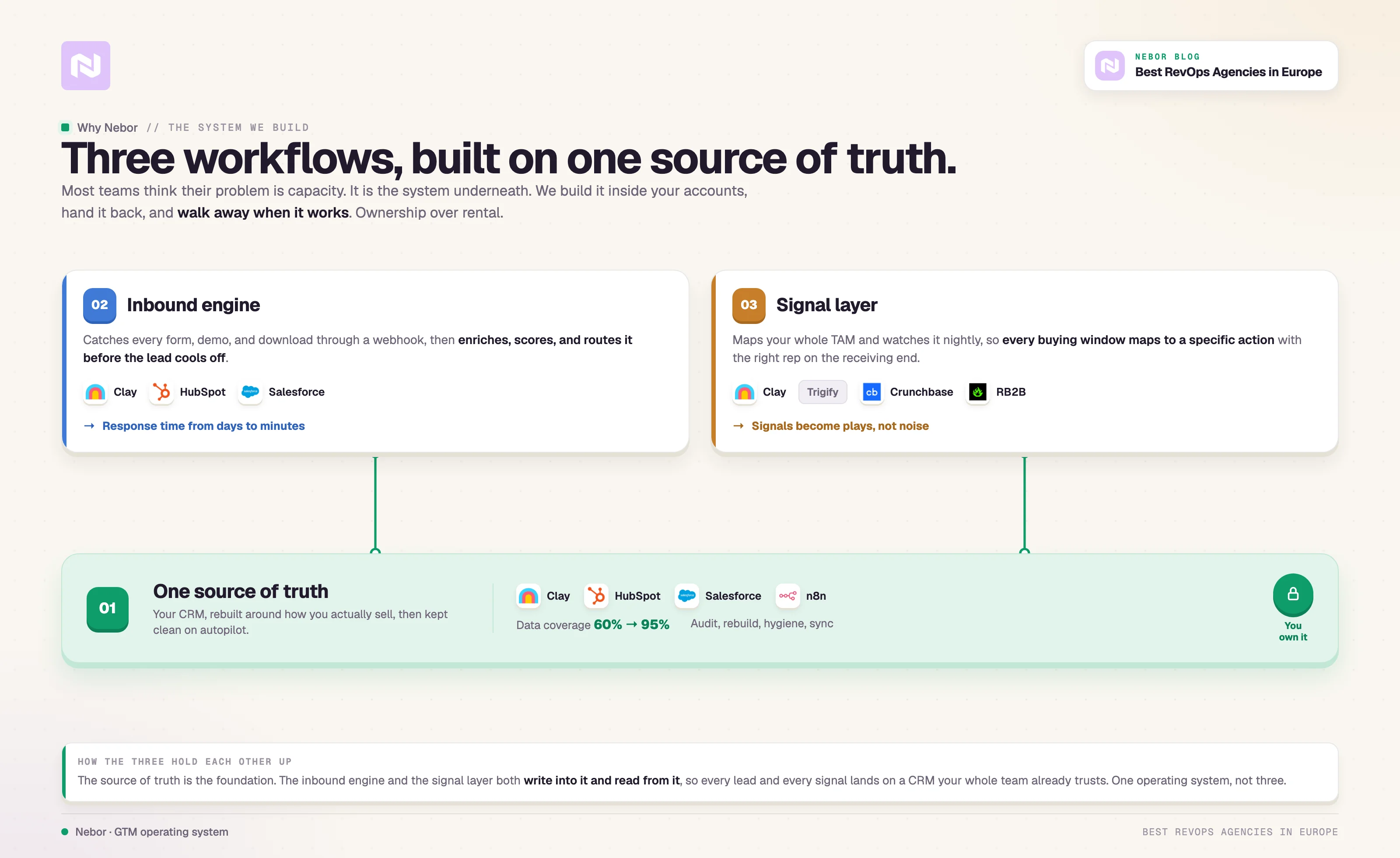
We do not own your tooling, we do not host your workflows, and we do not bill you a monthly retainer to keep things alive. We build the GTM infrastructure once, you own it, and your team operates it.
Three workflows do most of the heavy lifting.
One rebuilds your CRM into a live source of truth. One catches every inbound signal and routes it before the lead cools off. One watches continuously across your whole TAM and pushes every buying window into a specific action.
Here is how each one gets built, what it produces, and how the three fit together.
We rebuild your CRM into a live source of truth, then keep it that way on autopilot
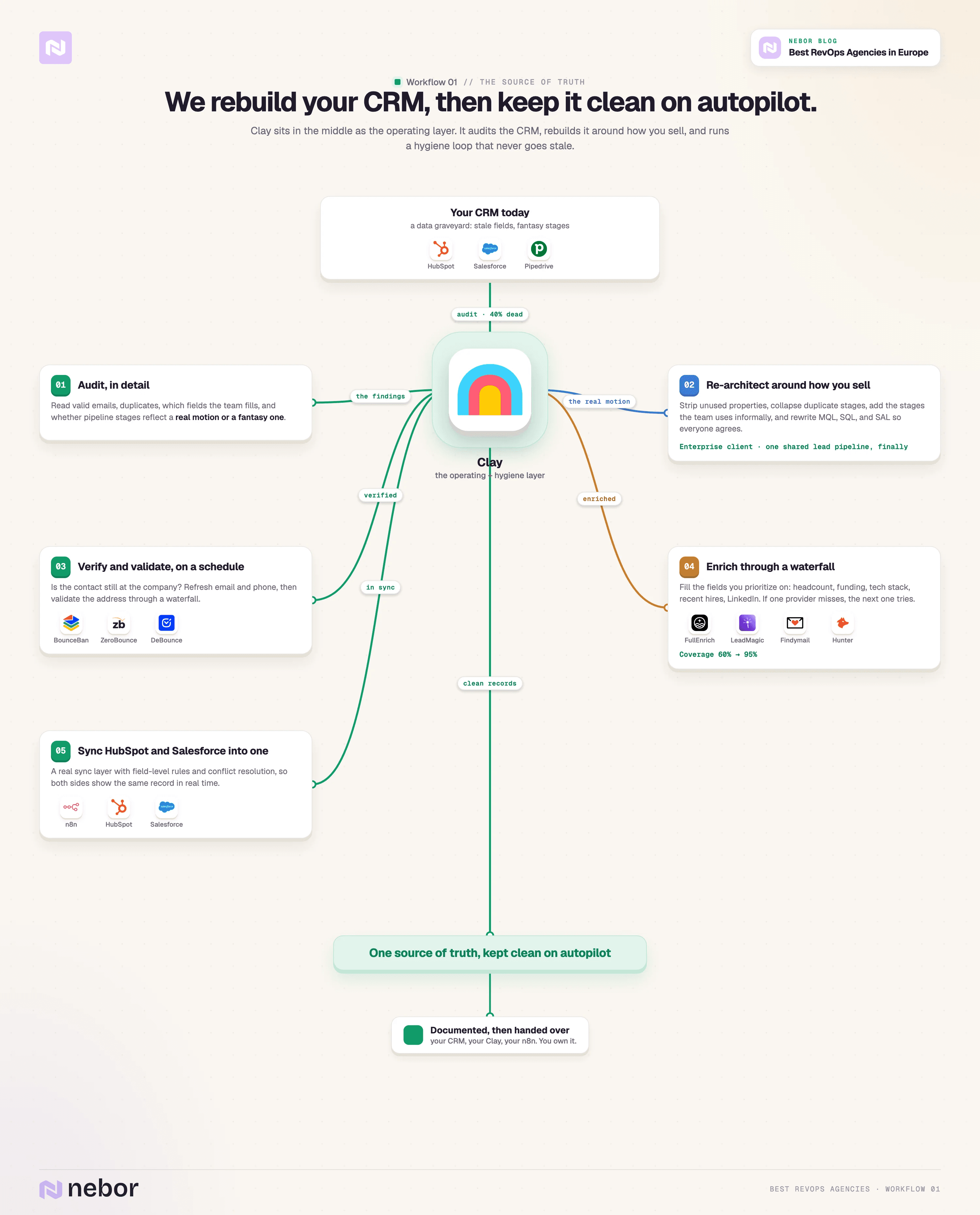
Most CRMs we walk into are data graveyards. The fields are stale, the lifecycle stages got copied from a HubSpot template in 2022, and the team has lost faith in the numbers on the dashboard.
The fix is not another integration tacked on top. The fix is to rebuild the CRM around how the company sells today, then put a hygiene layer underneath it that works without anyone having to watch.
This is the foundation everything else is built on. If your CRM is wrong, every workflow you build on top of it inherits that wrongness.
We start by reading what is already in your CRM, in detail
Before we touch anything, we do a full audit of what lives inside your HubSpot, Salesforce, Pipedrive, or whatever you are using.
We look at how many of your contacts have valid emails, how many records are duplicates, and which fields the team actually fills in versus which ones stay empty. We pull a snapshot of pipeline by stage and see whether the stages reflect a real sales motion or a fantasy one.
Most of the time, the audit takes a week and produces a hard list of findings. Forty percent of contacts have unverifiable emails buried in the database. The "qualified" stage is being used three different ways across reps because the definition was never written down.
Lifecycle stages do not move forward without manual intervention because nobody set up the automation trigger. Three different tools are pushing data into the same field with three different definitions of what the field means.
That audit report is the starting point of every Nebor RevOps build, because without it any rebuild is guesswork.
We re-architect properties, lifecycle stages, and pipelines around how your team actually sells
Once we know what is broken, we talk to your sales lead, your CRM admin, and your AEs to map how deals actually move. Not how they are supposed to move on a slide. How they move when a real prospect comes in.
Then we rebuild the CRM to fit that motion. We strip out the properties nobody uses, collapse stages that duplicate each other, add the stages your team uses informally but never had a field for, and rewrite the lifecycle definitions so MQL, SQL, and SAL mean something everyone agrees on.
We also build the lead pipeline structure when there is none.
With a workplace-technology company we work with, the sales team of about thirty people had no central place to manage their leads. Some used Excel, some used a notebook, some used nothing.
We built a HubSpot lead pipeline as the central source, hooked it into Clay for enrichment on the way in, and the team finally had a shared list to work from.
Note: Are you looking for a RevOps partner in Europe?
At Nebor, we are a GTM engineering and RevOps agency. The RevOps half means rebuilding your CRM, your lifecycle stages, your routing and your reporting into one system your revenue teams share, handed over so your team can change it later without us.
The GTM engineering half is what fills it: outbound, intent monitoring and inbound, built on the same spine, so what you report finally reflects something real.
Book a 15-minute call to discuss your business.
We build the always-on data hygiene layer in Clay
This is the layer that keeps the rebuild from going stale six weeks later. We connect Clay to your CRM and set up continuous workflows that verify, dedupe, and enrich every record on a schedule.
For every contact, the workflow checks whether they are still at the company, refreshes the email and the phone, and validates the email through a waterfall (Bouncer, ZeroBounce, DeBounce, depending on what you already use).
It fills in the fields you actually use for prioritization, like headcount, funding stage, tech stack, recent hires, and LinkedIn URL. It also flags duplicates for human review instead of silently merging them and erasing history.
The enrichment side works as a waterfall as well. We chain FullEnrich, LeadMagic, Findymail, Hunter, and PhantomBuster so that if one provider fails to find an email, the next one in the chain tries.
Coverage goes from sixty percent to ninety-five percent on most ICPs without you paying for one premium tool that tries to do it all badly.
We sync HubSpot and Salesforce into one source of truth when both exist
A lot of growing B2B companies end up on both HubSpot (for marketing) and Salesforce (for sales) while pretending the native integration handles itself, when in practice it does not.
The default sync ships fields out of order, overwrites the wrong record on the wrong side, and creates two parallel views of the same account.
We use n8n to build a real sync layer between the two, with field-level rules and conflict resolution that match how your team actually works.
When marketing updates a record in HubSpot, sales sees the update on the matching Salesforce account in real time. When sales updates a deal in Salesforce, the activity flows back into HubSpot so marketing can adjust the nurture flow.
One source of truth, finally, with the audit trail to prove it.
We hand it back as something your team owns and can edit
The build lives in your CRM, your Clay workspace, and your n8n instance, not ours. Once it is live, we do a two-week handover with your CRM admin, your ops lead, or whoever holds that work in-house. We document every workflow, the tools it touches, and the failure modes to watch for.
Then we leave the engagement.
If something breaks six months later, your team fixes it without calling us. If you want to add a new property to fit a new motion, your team adds it on their own.
The system belongs to you, not to us.
This is what we mean by ownership over rental. You did not pay us a retainer to keep your CRM alive. You paid us to build it once and own it after.
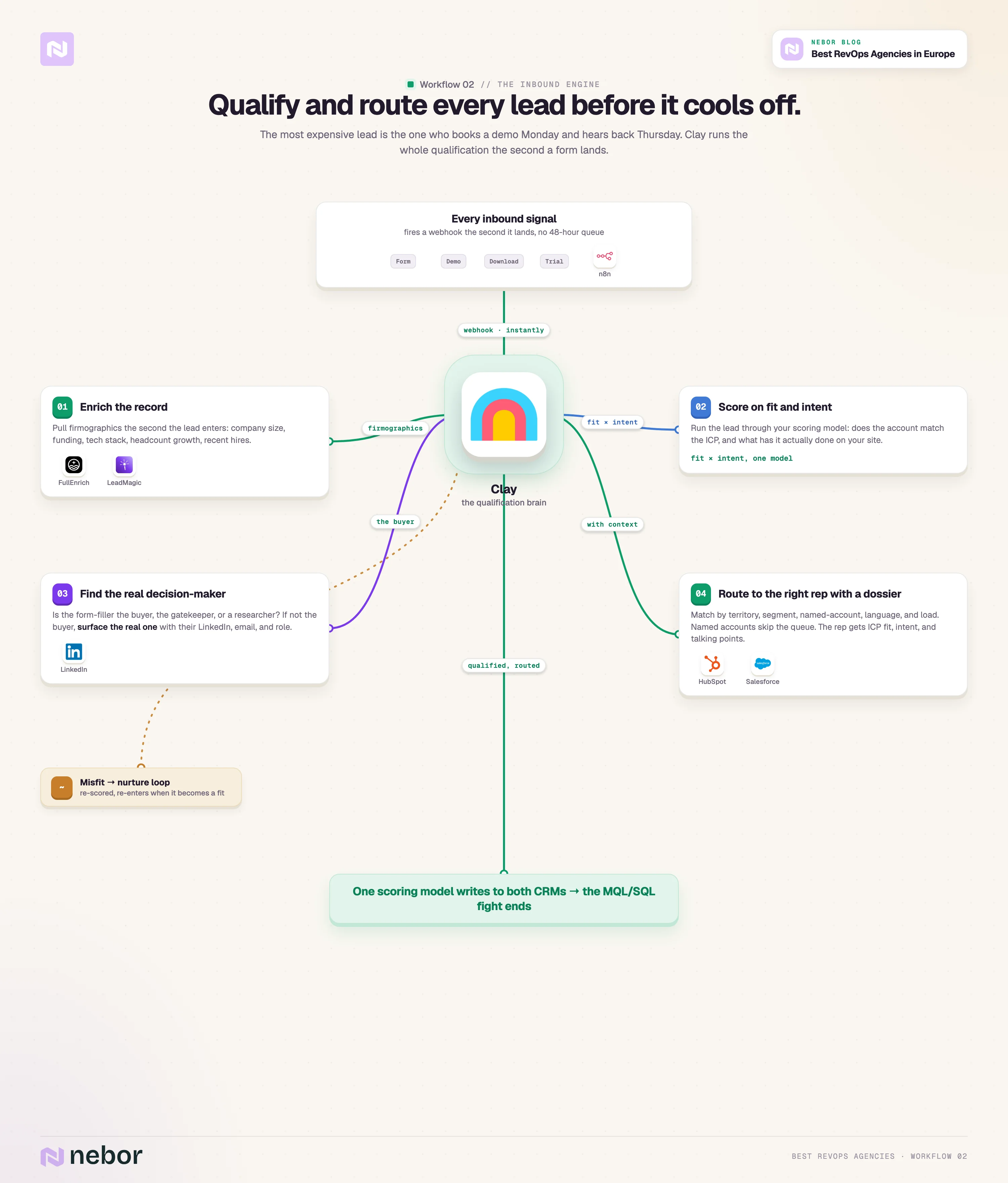
We build the inbound qualification and routing engine that stops good leads from cooling off
The most expensive lead in B2B is the one who fills out a demo form on Monday and hears from sales on Thursday.
By Thursday, they have already booked three calls with your competitors. The deal you should have won is now a 25 percent close-rate deal because the buyer already moved on.
Most companies have a version of this problem on their pipeline today. The fix is a qualification and routing engine that kicks in the moment a lead enters the system, with full enrichment and full context attached before it ever hits a rep's inbox.
Every form fill, demo request, and content download hits Clay through a webhook
When a prospect submits a form on your site, books a demo, downloads a piece of content, or starts a free trial, that signal flows into Clay through a webhook (or through n8n if your stack needs an extra hop). Clay is the brain that applies the qualification logic.
We do not let the form fill wait in HubSpot's queue waiting for somebody to glance at it. The webhook goes out the second the submission lands and the workflow finishes end-to-end before anyone on your team has time to refresh their inbox.
Clay enriches, scores, and identifies the real decision-maker
Inside Clay, the workflow does three things at once.
It enriches the record with firmographics (company size, funding, tech stack, headcount growth, recent hires). It passes the lead through your scoring model, which combines fit (does the account match your ICP) with intent (what did they do on your site, what other signals are open).
And it identifies whether the person who filled out the form is actually the buyer, the gatekeeper, or somebody doing research on behalf of someone else.
If the form-filler is not the decision-maker, the workflow surfaces the real one and pulls their LinkedIn, email, and current role.
The rep gets a brief that says "this lead is fit, the actual buyer is the VP of Engineering, here is her LinkedIn, here is what she has been posting about." That is a different conversation than "somebody filled out a form."
We route the lead to the right rep with full context, in HubSpot or Salesforce
The routing rules are not "round robin." We build them in HubSpot or Salesforce to match accounts to reps based on territory, segment, named-account ownership, language, and current pipeline load.
If a rep is over their threshold, the lead goes to the next best fit. If a named account appears, it skips the queue and goes straight to the AE who owns that logo.
Then the rep gets the full dossier in their CRM record. ICP fit score, intent signals, decision-maker context, recent triggers, suggested talking points pulled from the prospect's recent activity.
Their first outreach is not a generic "saw you filled out our form." It is a relevant, contextual reach-out written in five minutes instead of fifty.
Misfit leads go into a nurture loop instead of a black hole
Not every form fill is a fit for sales right away. The ones that are not get sent to a marketing nurture flow automatically, with the same enrichment data attached to the record.
Marketing knows what they are working with on the way in. They send the right campaign for that segment and re-score the lead each time it engages with anything.
If a misfit becomes a fit later (the company hires, raises, or hits the revenue threshold), Clay catches it on the next pass and the lead re-enters the qualified pipeline without anyone having to remember it.
Marketing sees the same scoring on their dashboard, so the MQL/SQL fight ends
The fight between marketing and sales over what counts as qualified is almost always a definition fight, because the two teams keep two different scoring models in parallel. Once the same scoring logic lives in Clay and writes back to both HubSpot and Salesforce, there is one definition that both sides see and agree on.
Marketing sees their dashboard reflect the same fit-plus-intent score sales is working with. The "you sent us junk" complaint stops because marketing can see exactly what sales is seeing on the same record. Forecast meetings get shorter, and the Friday review stops being an argument about whose data is right.
If you want a deeper read on how this fits with your demand-gen motion, our piece on inbound-led outbound walks through how the same engine pulls double duty for outbound prospecting.
We build an always-on signal layer that watches your TAM and pushes every buying window into the right action
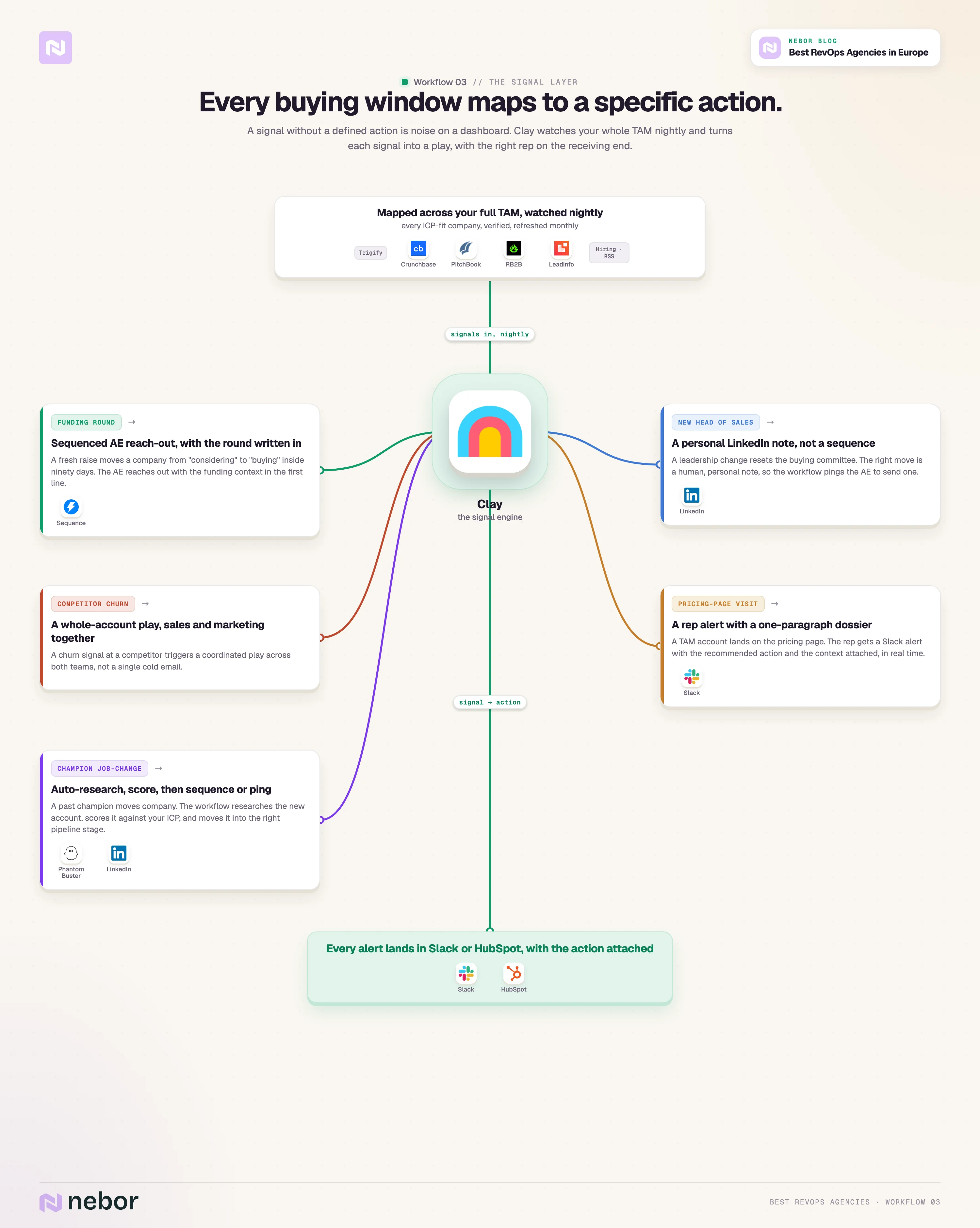
A signal without a defined action attached is just noise on a dashboard. Most "intent" tools sell you a feed of accounts that look interested and then leave you to figure out what to do with that feed. That is the reason most intent investments produce nothing of value.
What we build instead is a continuous signal layer across your entire TAM. Every signal type maps to a specific action, written into a workflow, with the right rep on the receiving end. The signal does not stall in a dashboard waiting for somebody to notice.
We map your full TAM inside Clay and write it back into your CRM
Before any signal monitoring begins, we map your total addressable market inside Clay. Every company that fits your ICP, with verified contacts, refreshed monthly.
We pull from data sources that match your motion (Apollo, Cognism, ZoomInfo, Ocean.io, niche scrape jobs we build on LinkedIn for harder-to-find criteria) and we push the enrichment waterfall on the output.
The TAM lives in Clay, but it also writes back to your HubSpot or Salesforce. That way, the team that uses the CRM every day sees the entire market on the account record without leaving their tool.
When a TAM account hits a signal, the CRM record updates in real time. We wrote about why this kind of TAM-driven build outperforms keyword-driven prospecting in a separate post if you want the longer read.
We monitor signals continuously across your TAM
The signal layer checks on a nightly cadence across the full TAM.
We use Trigify for social and behavioral intent (LinkedIn engagement, content interaction, role changes inside target accounts). We pull funding rounds from Crunchbase and PitchBook into Clay.
We push hiring-signal scans against the major job boards. We pull RSS feeds for industry news that matters to your ICP and let Clay decide which signals are worth surfacing.
For website-visitor identification, we use RB2B in the US (person-level) and Leadinfo or Snitcher in the EU (account-level). The de-anonymized visitors flow into the same Clay layer for enrichment and scoring.
There is a deeper write-up on the website-visitor tracking workflow we have built for several clients.
The output is one continuous feed of named accounts inside your TAM, each with the type of signal that just landed, the date, and the freshness rating.
Each signal type maps to a specific action, not a pile of "intent"
This is the layer where most intent investments quietly fail. The signal arrives in a dashboard, nobody on the team knows what to do with it, and three weeks later the buying window has closed without anyone noticing.
We build the action mapping into the workflow itself.
A funding round triggers a sequenced reach-out from the right AE, with the funding context written into the email. A new head of sales triggers a personal LinkedIn note, not a sequence.
A churn signal at a competitor triggers a whole-account play that pulls in marketing and sales together. A pricing-page visit on a TAM account triggers an alert to the rep with a one-paragraph context dossier.
Reps see the alert in Slack or directly inside HubSpot, with the recommended action and the relevant context attached. They do not have to guess at what to do or why this account just got flagged.
Champion job-change, free-trial scoring, and competitor-churn plays build on top of the same layer
Once the signal layer is live, it carries weight beyond pure outbound.
We build the champion job-change workflow on top of it. Every contact in your CRM tagged as a positive past relationship gets monitored through PhantomBuster and LinkedIn for a job change.
When somebody moves, the workflow auto-researches the new company, scores it against your ICP, and either starts a sequence or pings the rep, depending on the fit. The contact also moves into the right stage in the sales pipeline so nothing slips.
For PLG companies, the same layer scores free-trial signups against your ICP and the engagement they have shown inside the product. Not every trial signup is worth a sales conversation.
The scoring tells you which ones are worth a personal reach-out from an AE and which ones belong in the product-led nurture flow until they show real intent.
For revenue teams worried about churn, the layer watches your competitors' funding, hiring, and product-launch signals. If a competitor announces something that is going to push their customers to look around, your team gets the alert with the relevant TAM accounts attached.
If you have ever wondered why most Clay implementations fail at this layer, the short answer is that they stop at "we set up Clay" and never wire the action mapping in. The signal layer without action is a more expensive version of guessing.
How the three workflows hold each other up
The CRM rebuild is the foundation that every other workflow stands on. Every other workflow writes to it and reads from it, so if the foundation is wrong, everything built on top of it inherits the wrongness.
The inbound qualification engine catches the warm signals that come in by themselves and routes them before they cool off. The signal layer watches the rest of the TAM and pushes every cold-but-intent-ed buying window into a real action with a real owner.
Together, they produce a revenue engine where nothing gets lost, every lead has context, and the team trusts the data on the screen.
The closest case study we can publicly point to is Dymaxa, an Austrian aerodynamic-side-skirts manufacturer. They came to us with essentially zero pipeline and a CEO handling everything manually out of spreadsheets.
We built their full GTM system, set up HubSpot as their CRM from scratch, wired the inbound qualification engine into the same CRM, and stood up the signal layer for the European trailer-OEM market.
Eighteen months later, they had €12 million in qualified pipeline, 84 active enterprise prospects, 14 closed clients, and meetings with all 10 major trailer OEMs in Europe.
The four-person sales team at Dymaxa today operates a system they own and understand, not a retainer that turns off the day we leave.
Another company we work with is a live example from earlier in the build. The thirty-person sales team had no central lead management when we started.
We rebuilt the HubSpot lead pipeline, plugged in Clay for enrichment, and layered RSS feed scanning of real-estate news for ICP buildings. The team now works off a shared list with hundreds of qualified leads they trust.
Andrew leads the working sessions on the next ten workflows on the backlog.
If you want to talk through what these three workflows would look like for your own setup, find us on LinkedIn (Andrew or Yannick). We are happy to walk through where your CRM is broken before we ever talk pricing.
The other 9 RevOps agencies in Europe worth your shortlist
We are first on this list, and we are honest about why. The other nine are real shops doing real work, and depending on what you actually need, one of them might fit your motion better than we do. Here is how each of them earns a spot on the list.
2. Avidly Agency
Avidly shines for businesses stuck in the awkward growth stage where you have traction but your sales and marketing systems feel like Lego sets that nobody finished.
They go into your CRM, your marketing automation platforms, and your data flow, then rebuild the pieces that are slowing you down.
What you get with them is clean, reliable data your teams trust, inbound strategies that produce ICP-fit lead lists, and HubSpot expertise (they have been awarded HubSpot Partner of the Year in EMEA three years in a row).
They do well across full lifecycles, from first click to loyal customer, without leaving you with disconnected dashboards or half-finished automations.
3. Think RevOps
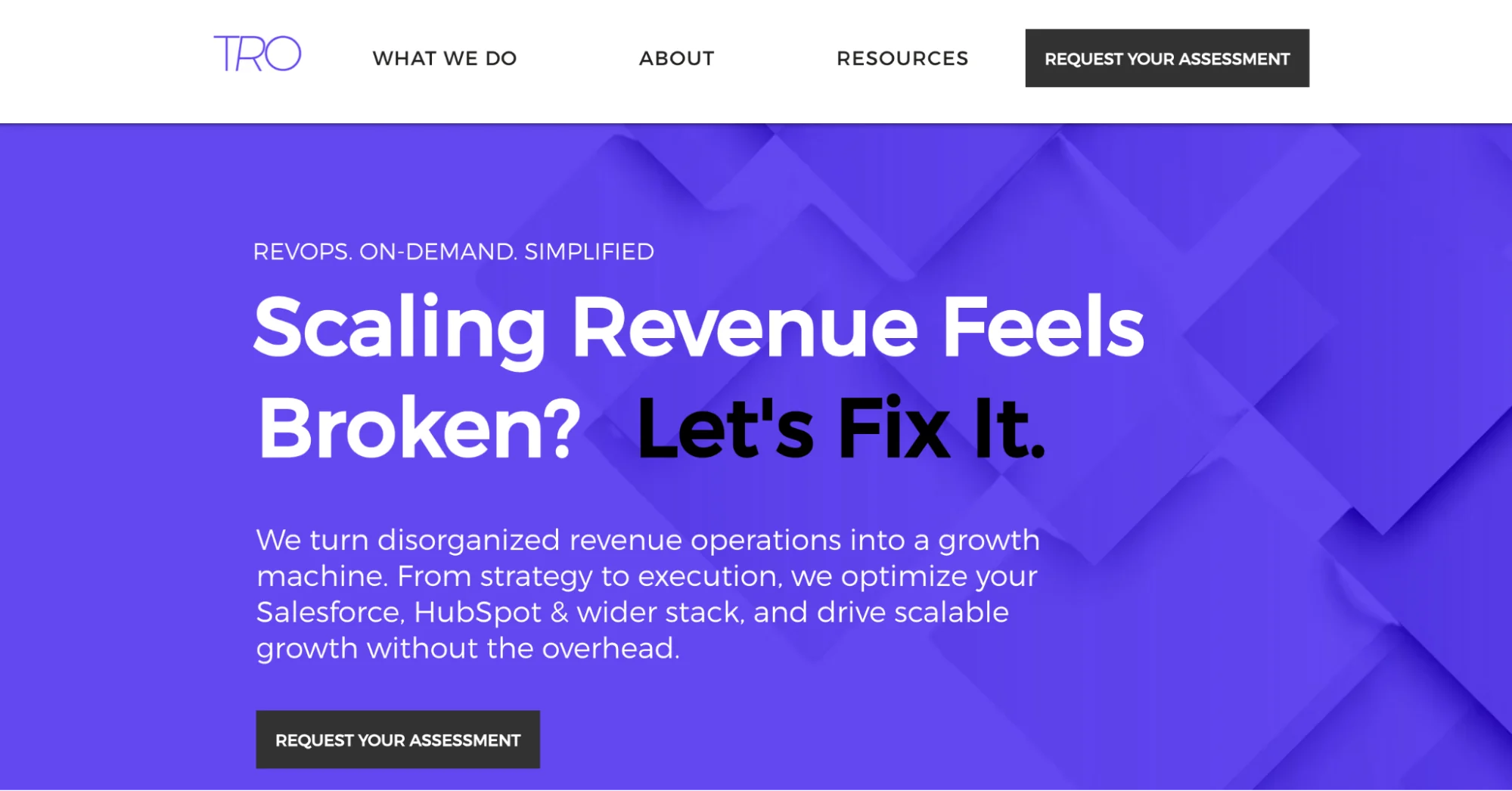
Think RevOps is the call when your revenue setup feels fragile. Too many manual handoffs, mismatched forecasts, endless firefighting. They redesign the way your full revenue engine works, across data, systems, people, and strategy.
What sets them apart is a blueprint-before-build approach. They start with a strategy that fits your business, not an off-the-shelf template. The data layer comes first, so your numbers actually mean something before you build automations on top.
They are deep on Salesforce, HubSpot, Gainsight, and Marketo, and they offer fractional flexibility. You can work with a full team, a part-time pro, or on-demand support depending on the stage you are in.
4. Digital Litmus
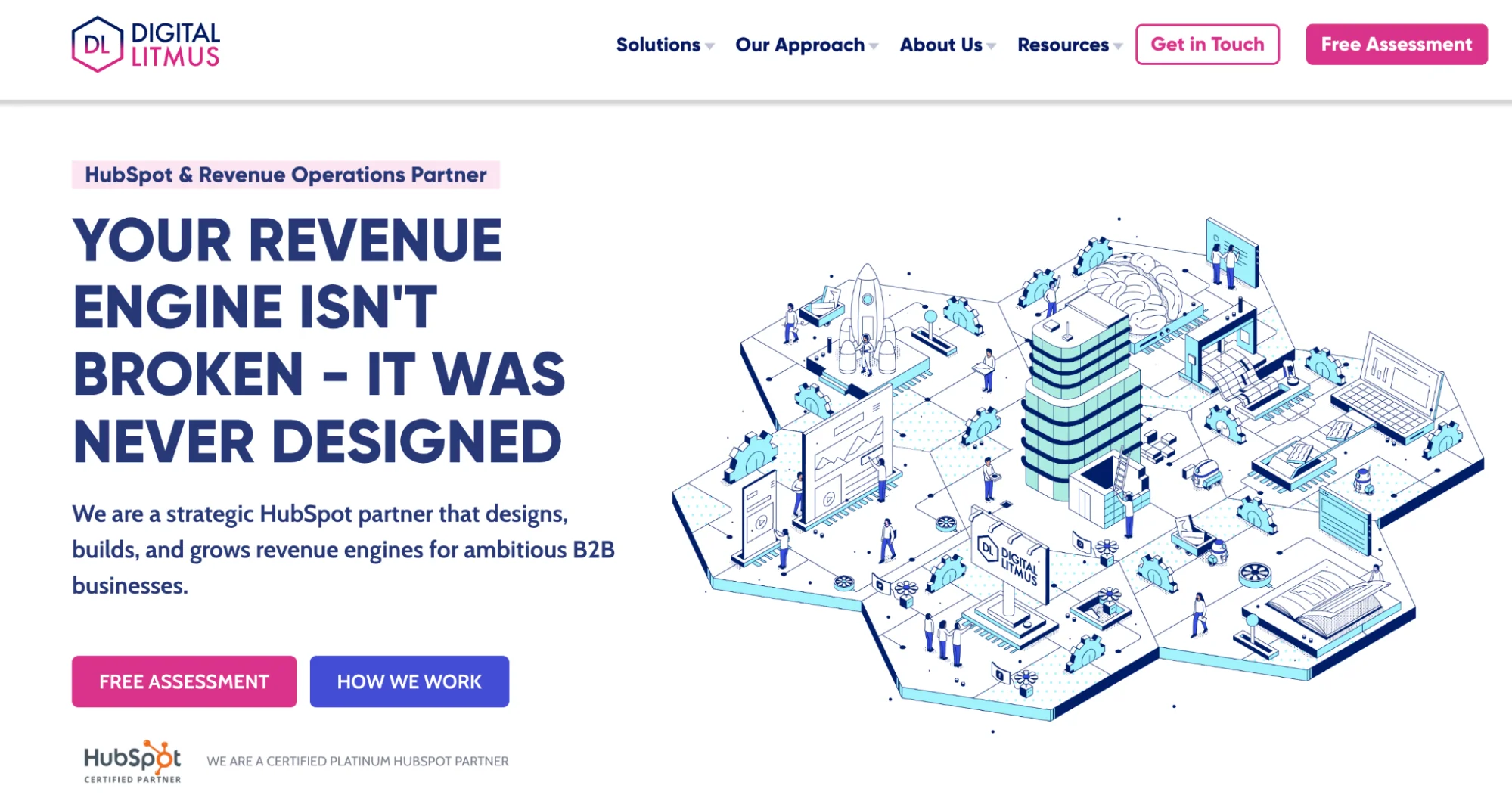
Digital Litmus brings a friendly, studio-style approach to revenue operations. They are HubSpot platinum partners who do more than set up workflows.
They embed with your team, fix messy data, score leads sharply, and spot bottlenecks in your funnel before they start eating into your growth.
You end up with fewer manual handoffs, sharper insights into where the funnel is leaking, and campaigns that actually convert.
Their style works well for teams that want a partner with the technical depth of a HubSpot specialist and the soft skills to actually integrate with your people.
5. RevOps Automated
If your CRM is the thing keeping you up at night, RevOps Automated is the team for the job.
They are masters at HubSpot and Salesforce, and they have moved conversion rates by 100 percent and dropped lead response times by 90 percent for clients who needed the back-end fixed without hiring full-time ops staff.
What you get is an on-demand team handling tech stack chaos so you can focus on closing deals. They are a strong fit when you need RevOps depth at a fraction of an FTE cost, with the option to scale the engagement up as your ops needs grow.
6. Nexa Cognition
Nexa Cognition is the partner for companies that are tired of gut-feel decisions and want to actually understand what is driving (or blocking) their revenue. They rewire your sales, marketing, paid media, and customer success around real insights.
They start by analyzing your numbers across revenue data, CRM history, funnel analytics, and customer behavior, then pull out the stories your dashboards are not telling you.
They will tell you where deals are stalling, where handoffs are failing, and which part of the process is eating into your margin. Once they have the picture, they help you fix it through CRM cleanup, lead-scoring rebuilds, and attribution models that match how customers actually buy.
They feel less like an analytics firm and more like a revenue translator embedded with your team.
7. Six & Flow
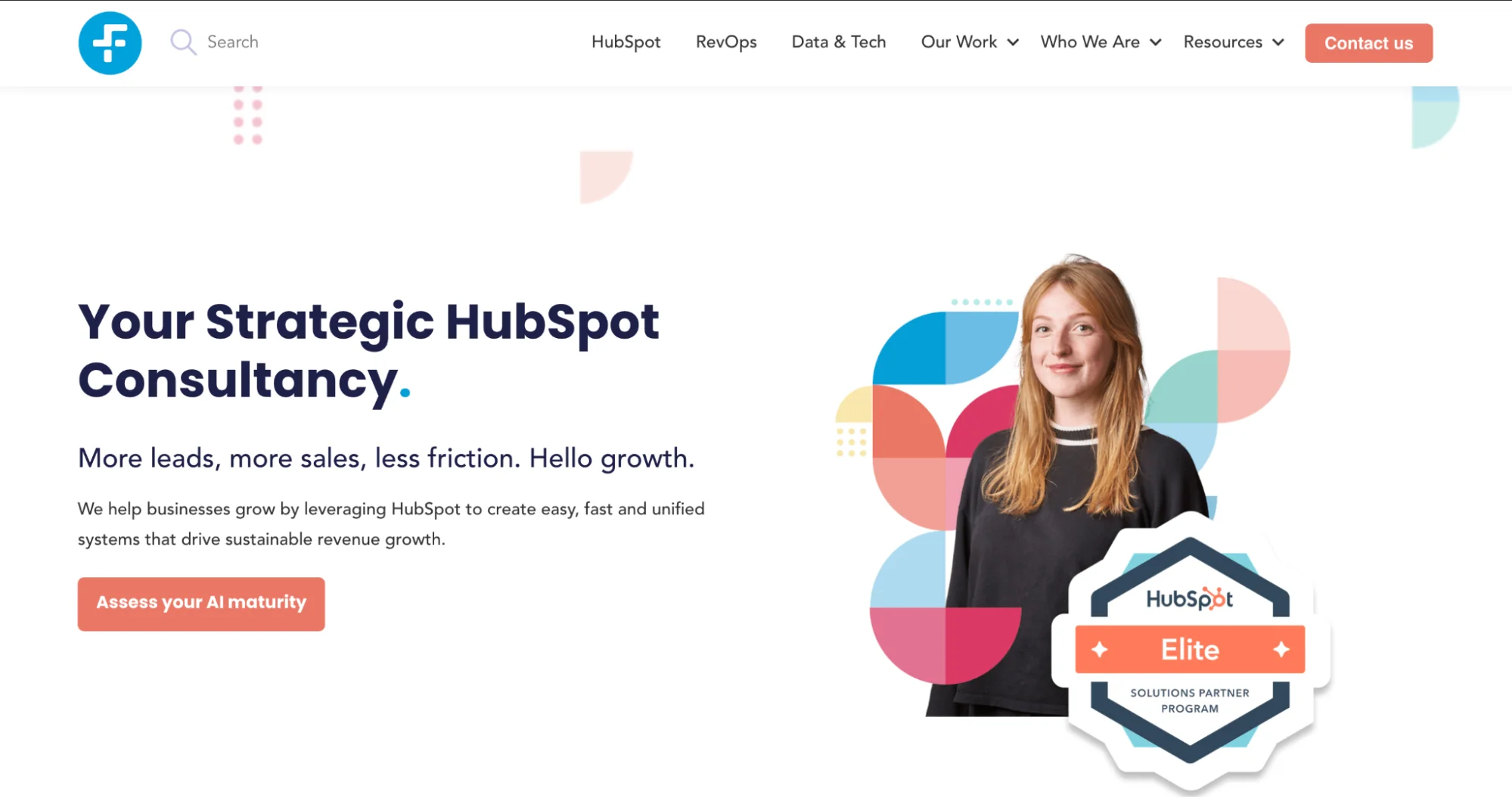
Six & Flow is the agency to bring in when growth has momentum and operations cannot keep up. They blend marketing creativity, sales enablement, and technical know-how into a process that your team can actually follow.
They are HubSpot Elite partners, which means they know the platform inside out, but their RevOps work is what stands out. They bridge the gap between vision and execution.
Whether you are working on customer lifetime value, tightening reporting, or stopping leads from getting lost between teams, they will help you design RevOps that scales as you scale. Good fit for marketing-led companies that need the sales side caught up.
8. New Breed
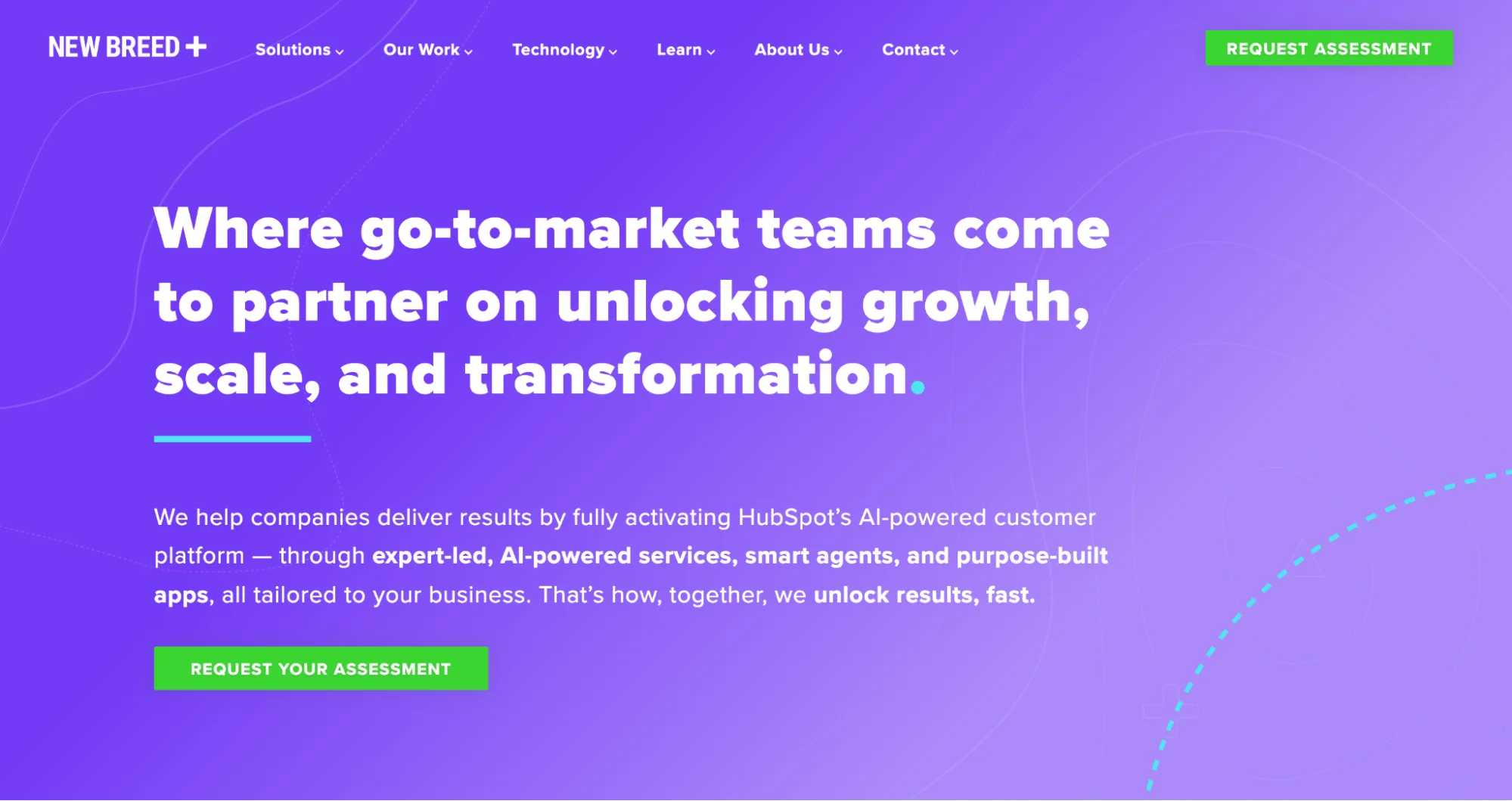
New Breed has seen every phase of B2B growth, from scrappy startup to a fully scaled revenue machine. They are HubSpot Premier partners globally, and in Europe they bring that big-picture expertise into your stack.
What makes them stand out is the way they connect demand generation to RevOps. If your marketing generates leads but sales complains about quality (or the other way around), New Breed treats that as one problem and fixes the whole pipeline rather than one side of it.
They are also the team behind Distributely, a HubSpot tool for complex lead routing and CRM workflows. The fact that they built it tells you how deep they go on the technical side of the work.
9. Elefante RevOps
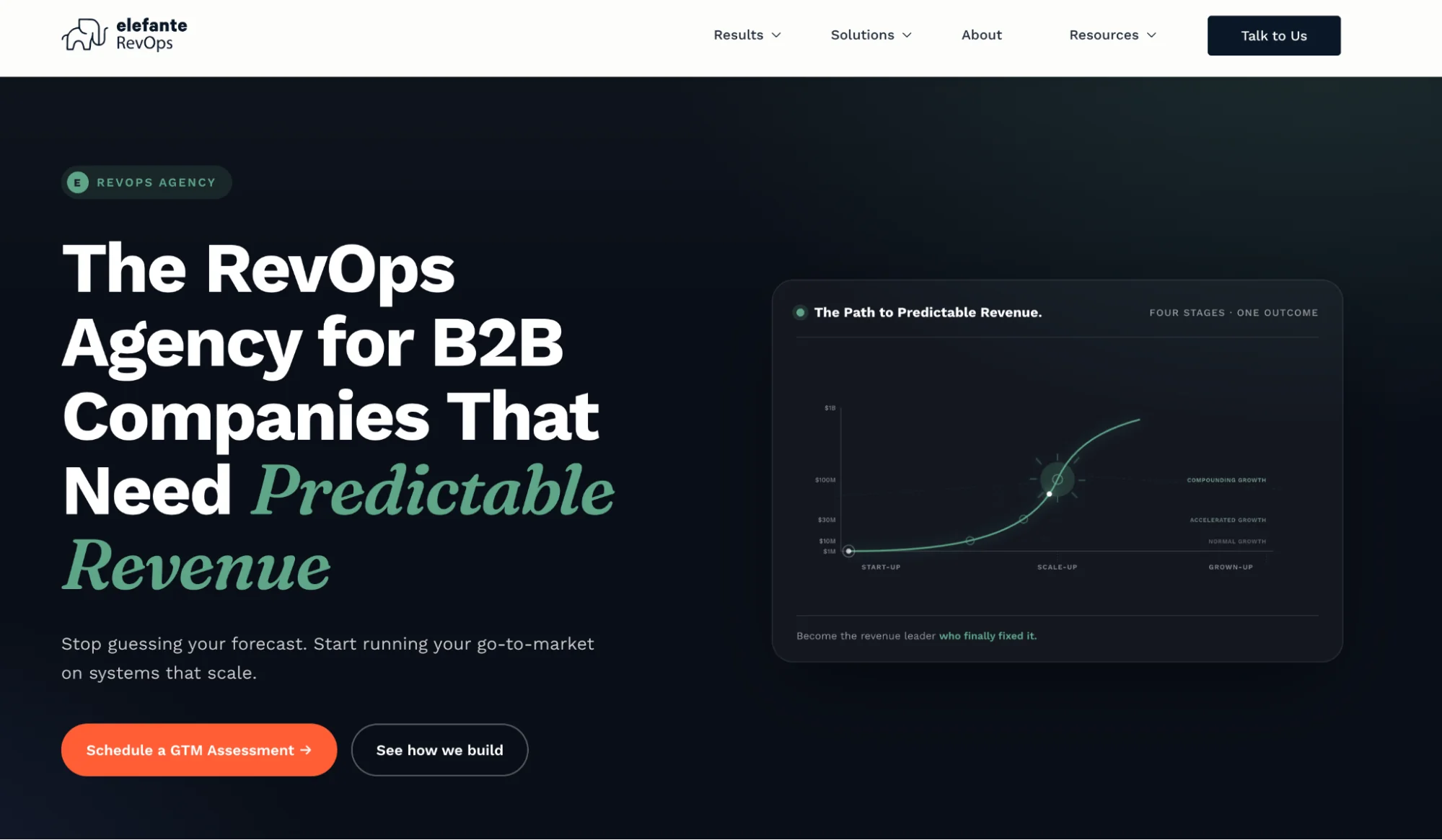
Elefante RevOps is the partner for teams who want a RevOps shop that actually understands their niche, their constraints, and their team dynamics. Their onboarding starts with conversations about the DNA of your business before they ever recommend tooling.
They are not shy about experimenting with the stack. They adapt your systems as you hit new growth stages, ship new products, or change the shape of the sales team.
A typical Elefante engagement covers CRM cleaning and automation in HubSpot, RevOps strategy tied to your ICP and GTM motion, and the shift from chaotic lead flow to a structured, trackable sales pipeline.
10. Winning by Design
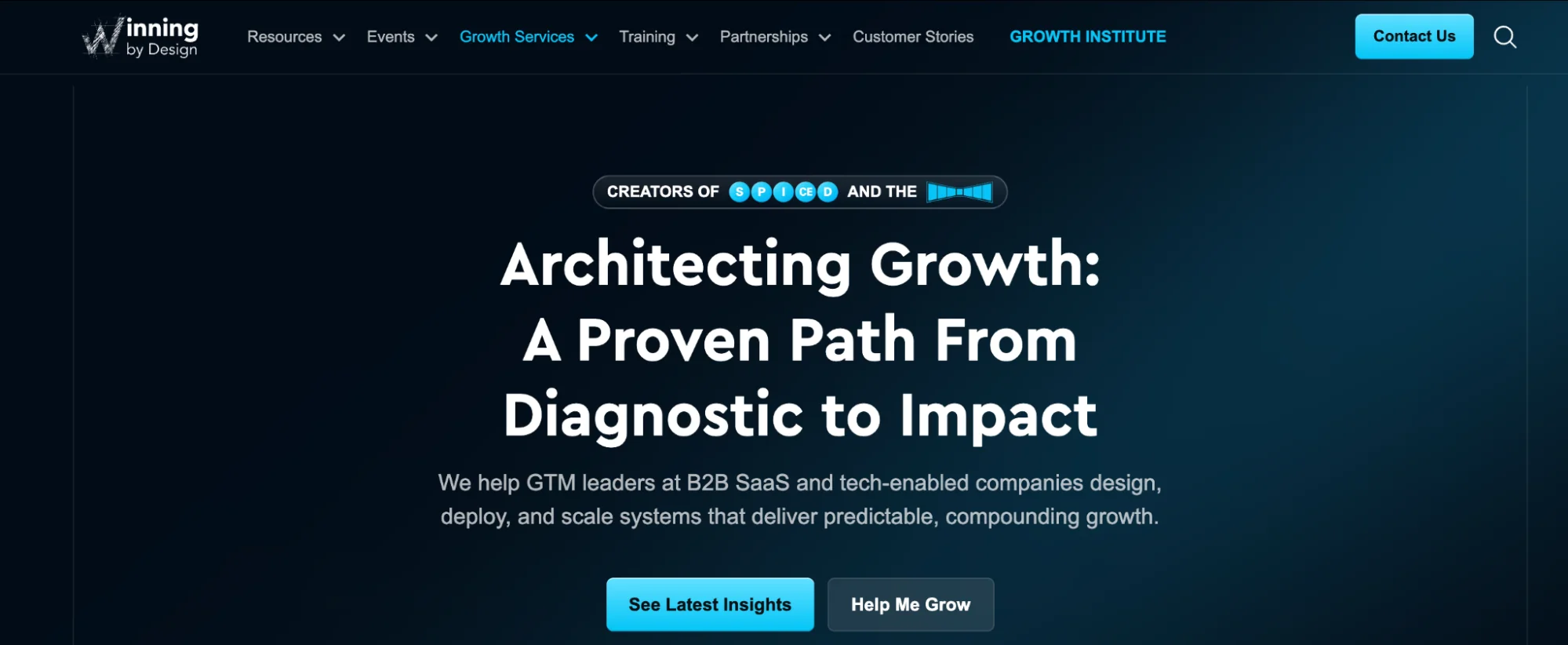
Winning by Design is RevOps meets sales science. They are known for structured training, playbook development, and adaptive sales strategies that produce predictable, repeatable outcomes.
For them, RevOps is not about tools or dashboards. It is about building a customer-centric, data-backed framework that the team can keep for years.
Their "bow tie funnel" model connects acquisition to retention, which makes them a strong fit for PLG and SaaS companies focused on customer success, upsells, and expansion.
The other thing they do well is teach. Their playbooks and live coaching embed new thinking inside your sales and ops orgs, so you are not depending on consultants to keep the system alive.
How much does it cost to work with the best RevOps agencies in Europe?
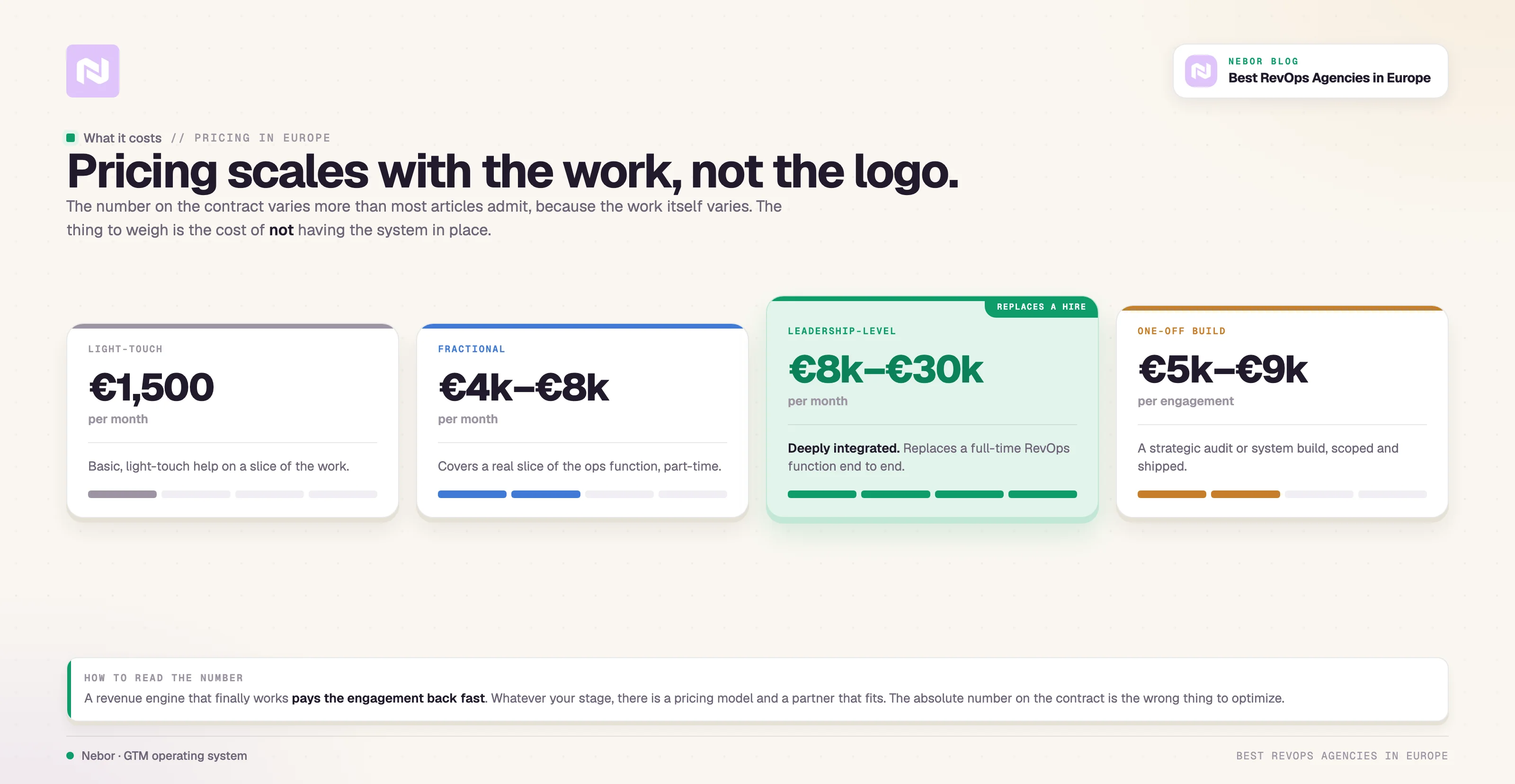
Working with a serious European RevOps agency is an investment in predictable, scalable growth. The pricing varies more than most articles admit, because the work itself varies.
Expect to pay around €1,500 per month for basic, light-touch help. Fractional support that covers a slice of ops work tends to land between €4,000 and €8,000 per month.
Deeply integrated, leadership-level engagements cost €8,000 to €30,000 per month and replace a full-time RevOps function. Strategic one-off audits or system builds typically range from €5,000 to €9,000 for the engagement.
Whatever your stage, there is a pricing model and partner that fits.
The thing to weigh is not the absolute number on the contract. It is the cost of not having the system in place. A revenue engine that finally works pays the engagement back fast.
Hire Nebor to build a RevOps system you actually own
That is the shortlist for European RevOps right now. Choosing the right partner is about finding a team that understands your business, your goals, and the messy back-end that is slowing you down more than you realize. There are real options in Europe, and you just read through ten of them.
If you want a partner that goes beyond templates and tools, that builds the system inside your accounts and hands it back as something your team owns, we believe Nebor is the right call.
We build around your product, your market, your ICP, your goals, and your team's bandwidth.
Whether you are getting started with RevOps or scaling a motion that already half-works, we will help you build the GTM engine that connects sales, marketing, and customer success into one operating system.
We would love to hear about your business and walk through how we would approach it.
Find Andrew or Yannick on LinkedIn for a 15-minute call to talk through your setup. We will skip the pitch deck and just dig into what is broken, then tell you honestly whether we are the right team to fix it for you.
Note: Are you looking for a RevOps partner in Europe?
At Nebor, we are a GTM engineering and RevOps agency. The RevOps half means rebuilding your CRM, your lifecycle stages, your routing and your reporting into one system your revenue teams share, handed over so your team can change it later without us.
The GTM engineering half is what fills it: outbound, intent monitoring and inbound, built on the same spine, so what you report finally reflects something real.
Book a 15-minute call to discuss your business.


Related Articles
By clicking Sign Up you're confirming that you agree with our Terms and Conditions.