
15 Best Clay Sales Automation Agencies And How to Choose One In 2026 (clay.com)

by

In this post:
Most sales teams are drowning in banal, repetitive tasks.
They’re manually hunting for prospects, painstakingly copying and pasting information between systems, and staying late to send follow-up emails that rarely get responses.
If you’re here, we are sure this sounds familiar.
Most sales teams don’t know how to leverage modern AI technology and data properly, and their sales results are suffering because of it.
Now, if you are reading this article, that means you know the power of Clay, you also know that implementing sales workflows around Clay requires expertise and that’s why you are seeking experts to help you build your sales systems around it.
That’s where sales automation agencies come in.
The problem is that “Clay agency” is now three categories of company. There are outbound execution shops that happen to use Clay as their data layer. There are Clay-specialist consultancies that build tables and workflows but never send the campaigns themselves.
And there are full GTM-systems builders who use Clay as the spine of an end-to-end revenue infrastructure that includes outbound, inbound, signal monitoring, and RevOps.
If you hire from the wrong bucket, no amount of agency talent fixes the mismatch.
So the post below covers fifteen agencies worth knowing in 2026, sorted with the categories made explicit, and ends with a short framework for picking the one that fits your stage and your team.
Let’s get started.
Note: You already know what Clay can do. The hard part is the expertise to build your sales systems around it.
That is the entire reason this page exists. Tables are easy to make and hard to make useful, and the difference is whether somebody designed the motion before building anything.
At Nebor we came from sales, and we build the full system on Clay: prospecting, outreach, signals, inbound, and the CRM work underneath.
Book a 15-minute call and let's talk about your motion.
TL,DR
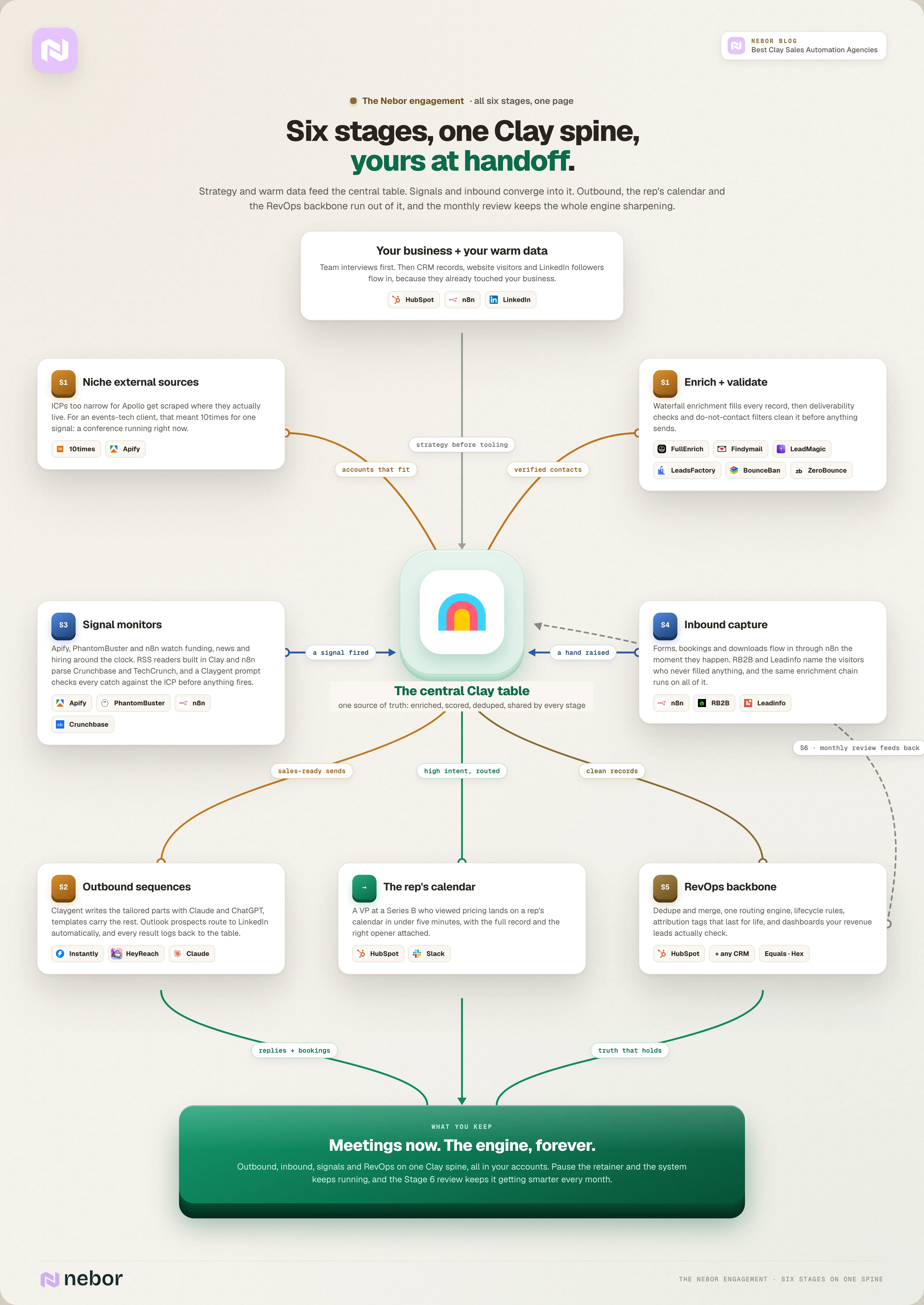
Most automation-forward agencies that offer services around tools like Clay will either sell you campaigns they send from their own infrastructure or hand you Clay tables your team has to figure out alone. We do the whole job instead.
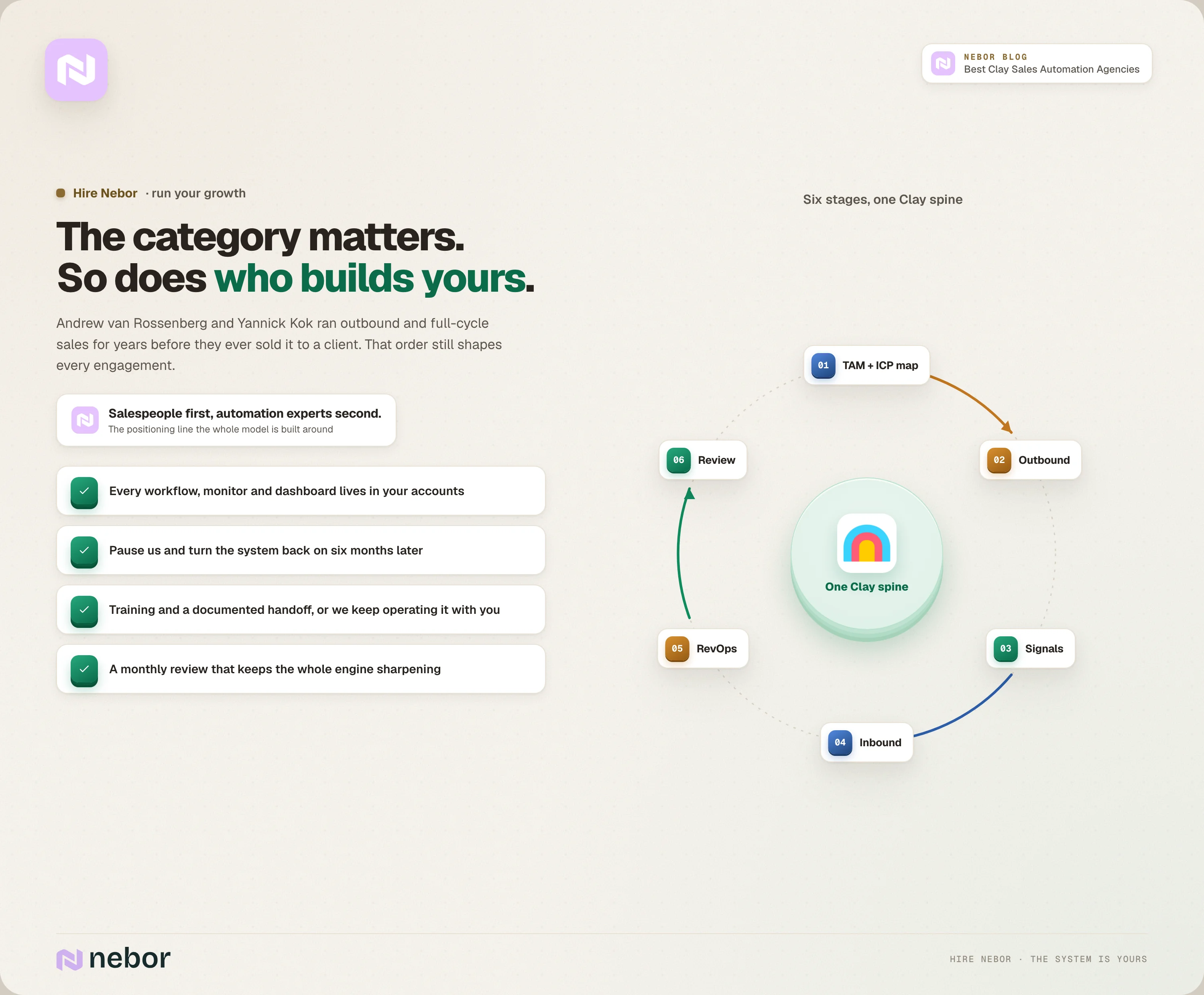
One engagement with us builds your entire revenue stack on a single Clay spine, with all unique stages your business needs working as one engine.
This includes everything outbound, inbound, ABM, plus the RevOps backbone that keeps your CRM honest, and a monthly review loop that makes the whole thing sharper every cycle.
Our workflows are built by sales operators as we’re salespeople first and automation experts second, every workflow, signal monitor and dashboard are built in consequence to drive your growth and make your existing sales/revenue team more efficient.
You can operate the system yourself, hand it to a junior operator, or pause us and switch it back on six months later. Here is the whole engagement on one page:
The 15 agencies, at a glance
Agency | Category | Best for |
Nebor | Full GTM systems | Teams that want outbound, inbound, ABM, signal monitoring, and RevOps built as one infrastructure they'll own. |
ColdIQ | Outbound execution | Managed outbound at volume across email and AI personalization |
The Kiln | Clay consultancy + RevOps | GTM teams that want to push Clay to its technical ceiling |
Sopro | Outbound execution | Multi-channel managed prospecting across email, LinkedIn, and display |
OneAway | Outbound execution | Clay automations with CRM hygiene baked in |
RevPartners | Clay consultancy + HubSpot | RevOps-led Clay implementation tied to HubSpot |
Afonto | Outbound execution | High-volume cold email with managed inbox and reply handling |
Sales Automation Systems | Clay consultancy | Hands-on Clay implementation tailored to specific pain points |
Revnuu | Clay consultancy | Holistic Clay rollout across the existing sales process |
LeadBird | Outbound execution | Pay-per-lead cold email with no monthly retainer |
Avalanche Outbound | Outbound execution | Deliverability-first outbound with full client ownership of the stack |
frontBrick | Clay consultancy + outbound | Long-cycle SaaS outbound with intent and funding signals |
The Playbook Agency | Full GTM systems | Sales-leader-built Clay across sales, marketing, and RevOps |
GTM Engineering | Full GTM systems | Seed to Series B startups that need the infrastructure built right the first time |
Growth Engine X | Outbound execution | Volume outbound playbooks pioneered for Clay |
How to choose a Clay agency in 2026
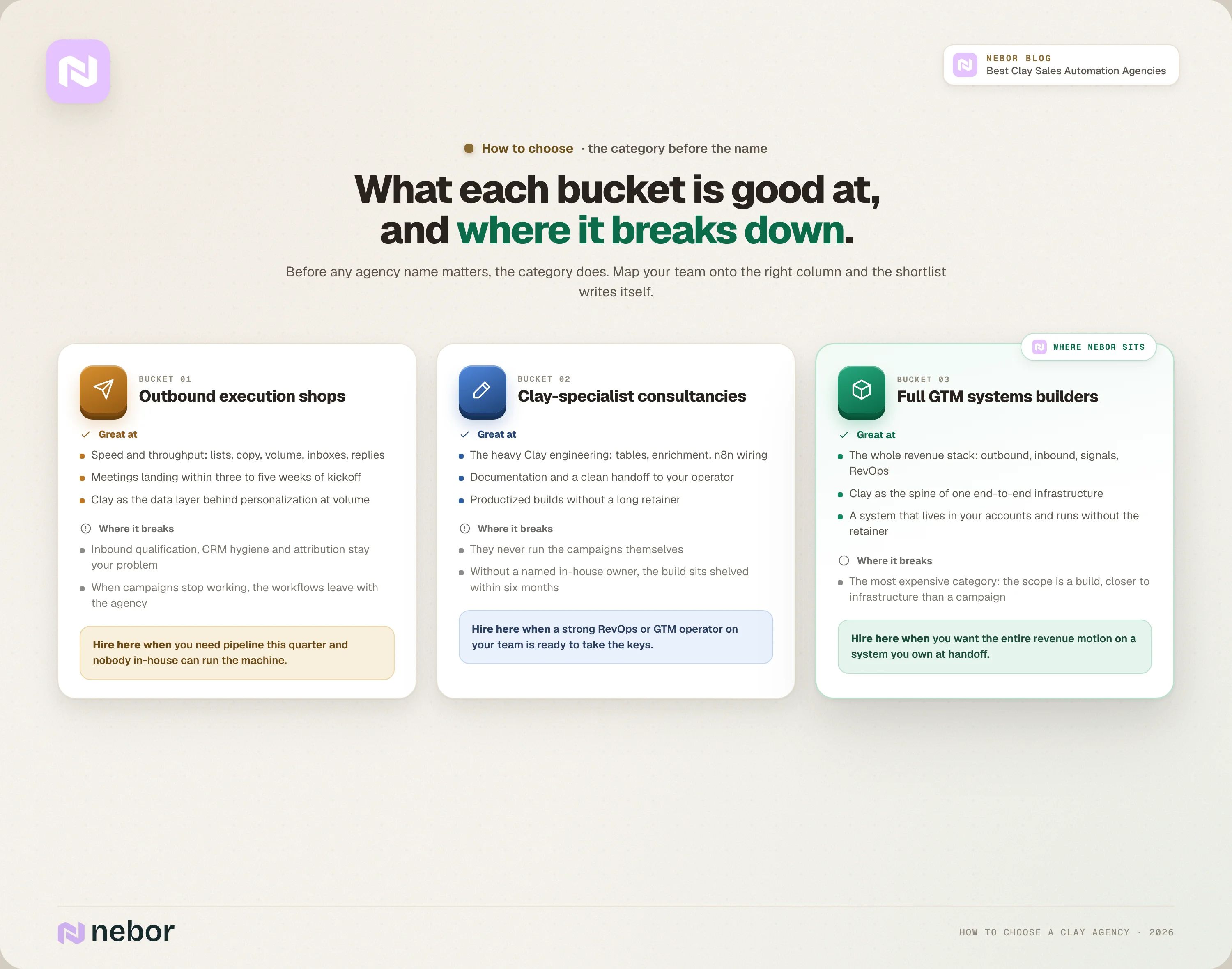
Before any agency name matters, the category does. Here's what each of the three buckets is actually good at, and where each one breaks down.
Outbound execution shops
These are the agencies that send campaigns for you. They build the lists, write the messages, send the volume, manage the inboxes, and report back on replies. Clay lives inside their stack as the data layer that makes personalization at volume possible.
What they're good at is speed and throughput. You hire them, they take three to five weeks to set up, and meetings start landing on the calendar.
What they don't do is the rest of the GTM motion. Inbound qualification, CRM hygiene, and attribution all stay in your hands.
When the campaigns work you get meetings, and when they stop working the contract usually ends and the workflows walk out the door with the agency.
Clay-specialist consultancies
These shops will not send your campaigns for you. They build the Clay tables, the enrichment workflows, the n8n connections, and the documentation around them. Then they hand all of it back to your team.
You hire them when you have a strong in-house RevOps or GTM operator and you want the heavy Clay-engineering work productized.
You don't hire them when nobody on your team can operate what they hand off, because Clay implementations that don't have an owner end up shelved within six months.
Full GTM systems builders
This is the smallest category and the newest one. These shops build the full revenue stack with Clay as the spine, covering outbound, inbound capture and routing, signal monitoring, CRM hygiene and dedupe, attribution, lifecycle automation, and pipeline reporting.
What you get back is a system, not a campaign or a workflow. The system lives in your accounts and keeps going without the agency on retainer. We covered the position behind this in our blog on why we are not a lead generation agency.
This is also the most expensive category, because the scope spans more than one function and the engagement is closer to a build than a campaign.
Five questions to ask before you sign an agency
Once you know which category you actually need, the agency conversation gets a lot shorter. Here are the five questions worth asking on the first call.
Who owns the workflows after the engagement actually ends? If the answer is the agency, you are renting your GTM. If the answer is your team, you are building one.
What does the handoff back to your team look like? Documentation, training, and a named owner inside your team should be on the table. If they shrug at this, they plan to keep the retainer alive indefinitely.
Which functions of your GTM does the engagement actually cover? Outbound only, or outbound plus inbound, plus RevOps, plus reporting. Get the scope on paper before pricing comes up.
How does the agency handle your CRM hygiene over time? This question filters the outbound shops from the systems builders within ten seconds. If they say "we don't touch the CRM," they're an execution shop.
What's the agency's actual definition of being done? Some agencies define done as "campaigns are live." Others define done as "your team can operate the system without us." Those are two very different deliverables, and the price tag follows.
The right agency falls out of the answers. If you want the longer version, we've written a separate piece on the red flags most companies miss when hiring a growth agency.
15 top Clay-driven sales automation agencies in detail
1. Nebor (formerly Utmost Agency)
We co-founded the agency originally as Utmost, then rebranded as Nebor in 2026 once the work outgrew what the old positioning could carry.
Andrew van Rossenberg and Yannick Kok lead the agency. Both are sales operators who did outbound and full-cycle sales for years before they ever sold it to a client, which is the order we still think matters most.
Salespeople first, automation experts second.
The model is built around that positioning line. After a Nebor engagement, the workflows, enrichment logic, automation sequences, signal monitors, and reporting dashboards all live inside your own accounts.
You can operate the system, hand it to a junior operator, or pause us and turn it back on six months later. We’ve written the deeper version of this position in our post on why we set out to be the best growth agency, which is basically the story behind our agency.
Clay is the spine of everything we build, because at this point no other tool comes close on the data and orchestration layer.
Stevie Case, CRO at Vanta, put the case for it cleanly when she said, "Clay should be an essential pillar of every company's GTM stack, enabling outbound built on the highest quality data foundation possible. Now you can automate hours of manual research so sales teams can focus on selling."
Where most Clay shops stop at outbound, we build the whole flywheel.
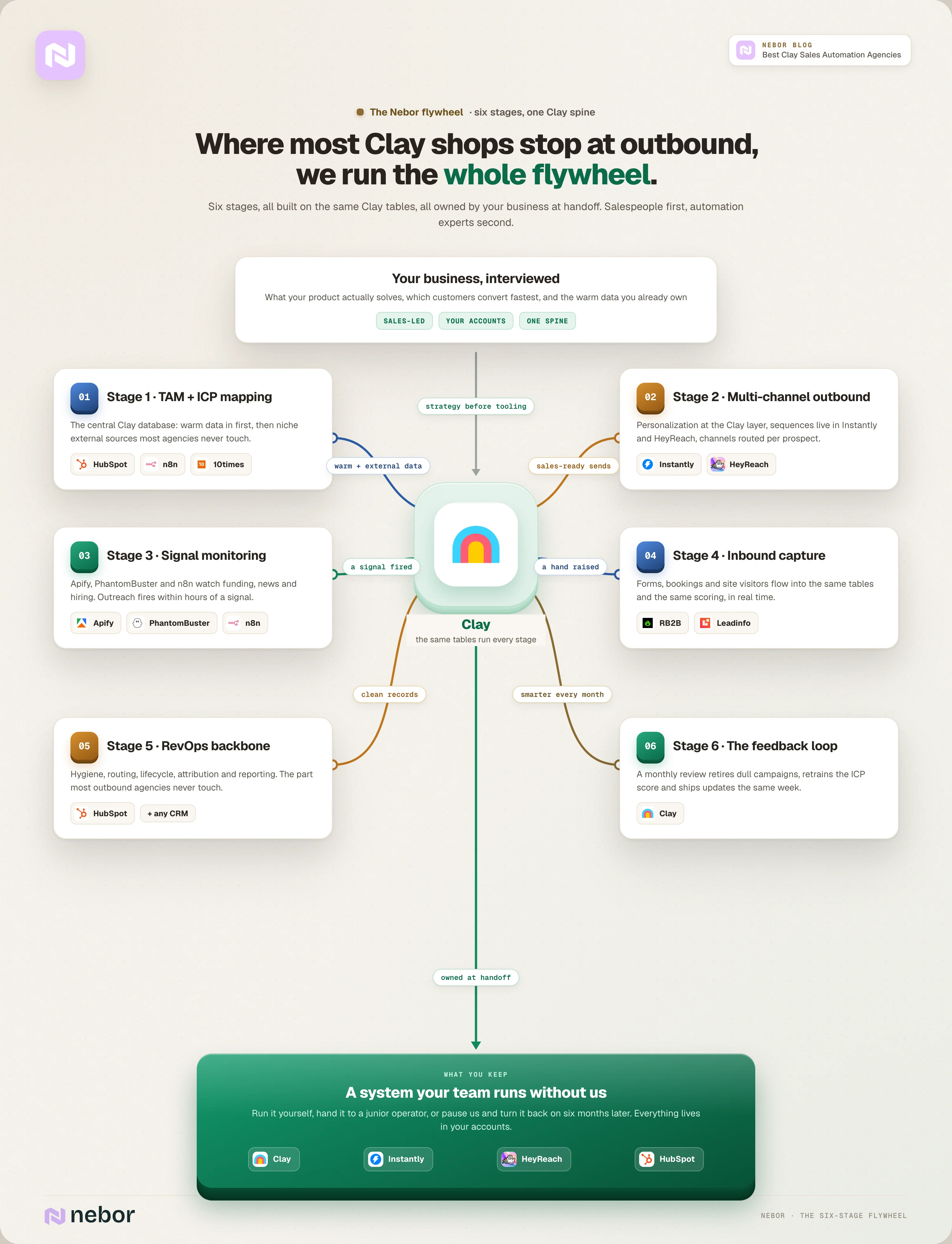
All the stages your business needs, all built on the same Clay tables, all owned by your business at handoff. Let’s briefly discuss some of the key stages and what they mean for your business.
Stage 1: TAM and ICP mapping inside Clay
We start by interviewing your team to nail down what your product actually solves and which customers convert fastest. Then we build the central Clay database the rest of the system is built on.
Your existing data goes in first because it's already warm. CRM records, website visitors, and LinkedIn followers all flow into Clay tables through API calls we set up or through n8n webhooks.
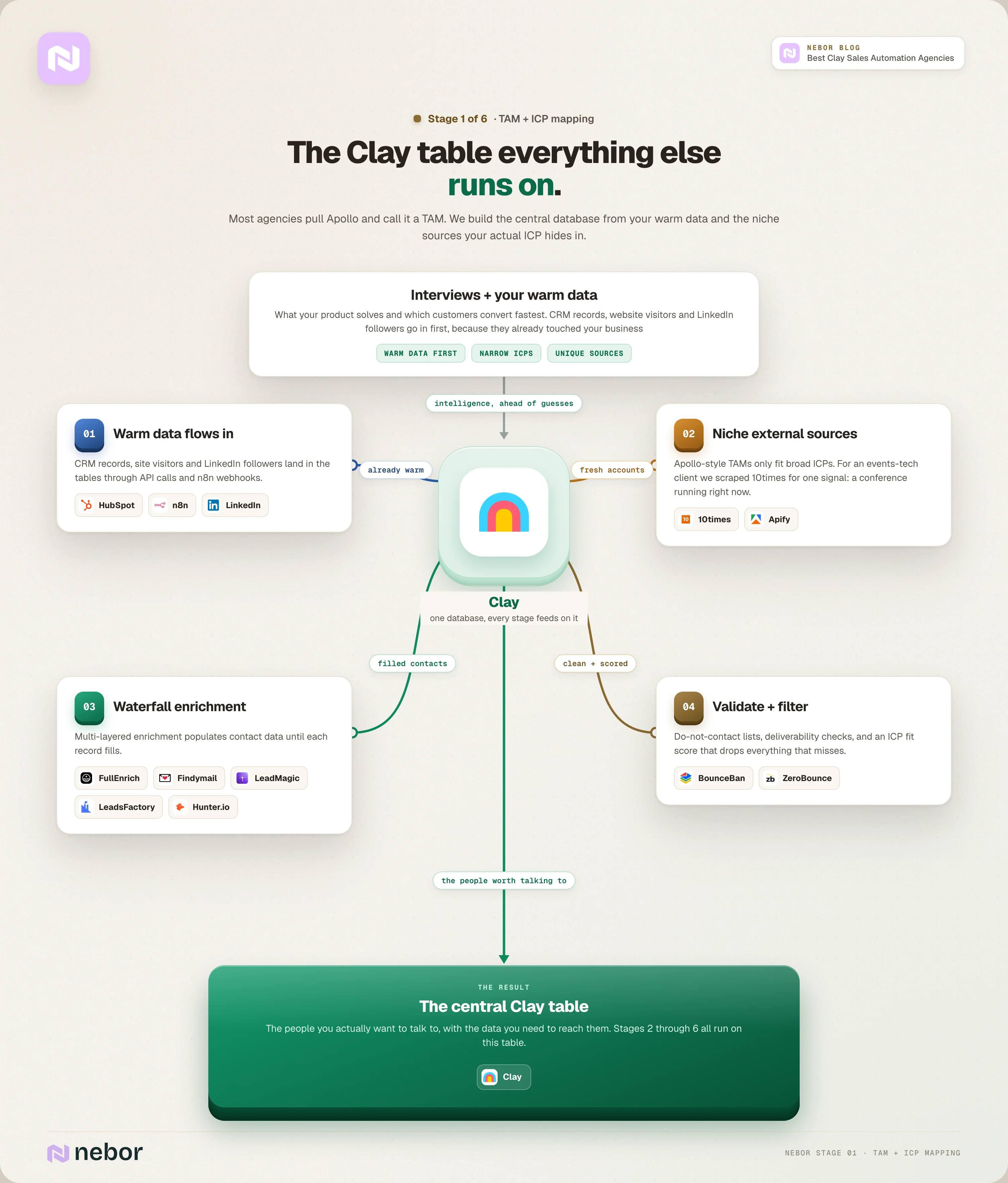
The point of starting there is that those prospects have already touched your business in some way, so the campaigns start with intelligence instead of cold guesses.
Then we expand to external sources. Most agencies default to Lusha, LinkedIn Sales Navigator, or Apollo and call it a TAM. We don't, because those tools only work when your ICP is broad enough to slice by region and revenue band.
Most of our clients have ICPs narrower than that, which means the data has to come from somewhere else.
One example was a client selling event technology that needed scraping of event directories like 10times because the only signal that mattered was “is this company actively holding a conference right now”.
In Clay, we push multi-layered enrichment through FullEnrich, Findymail, LeadMagic, LeadsFactory.io, and Hunter.io to populate contact data.
We then validate against do-not-contact lists, pass deliverability checks through BounceBan and ZeroBounce, and filter out anything that doesn't match the ICP fit score.
The output of Stage 1 is a Clay table that holds the people you actually want to talk to, with the data you need to reach them.
We covered the full version of the methodology in how to build your TAM for B2B sales and go-to-market in 2026 and the decision-maker-finding workflow in Clay plus LeadsFactory plus LinkedIn Sales Navigator.
Stage 2: multi-channel outbound automation orchestrated through Clay
Once the Clay table is enriched and filtered, the campaigns kick off, but Clay itself isn't the place where we send the sequences. The actual sending happens in Instantly for email and HeyReach for LinkedIn, with both pulling their data from the same Clay tables.
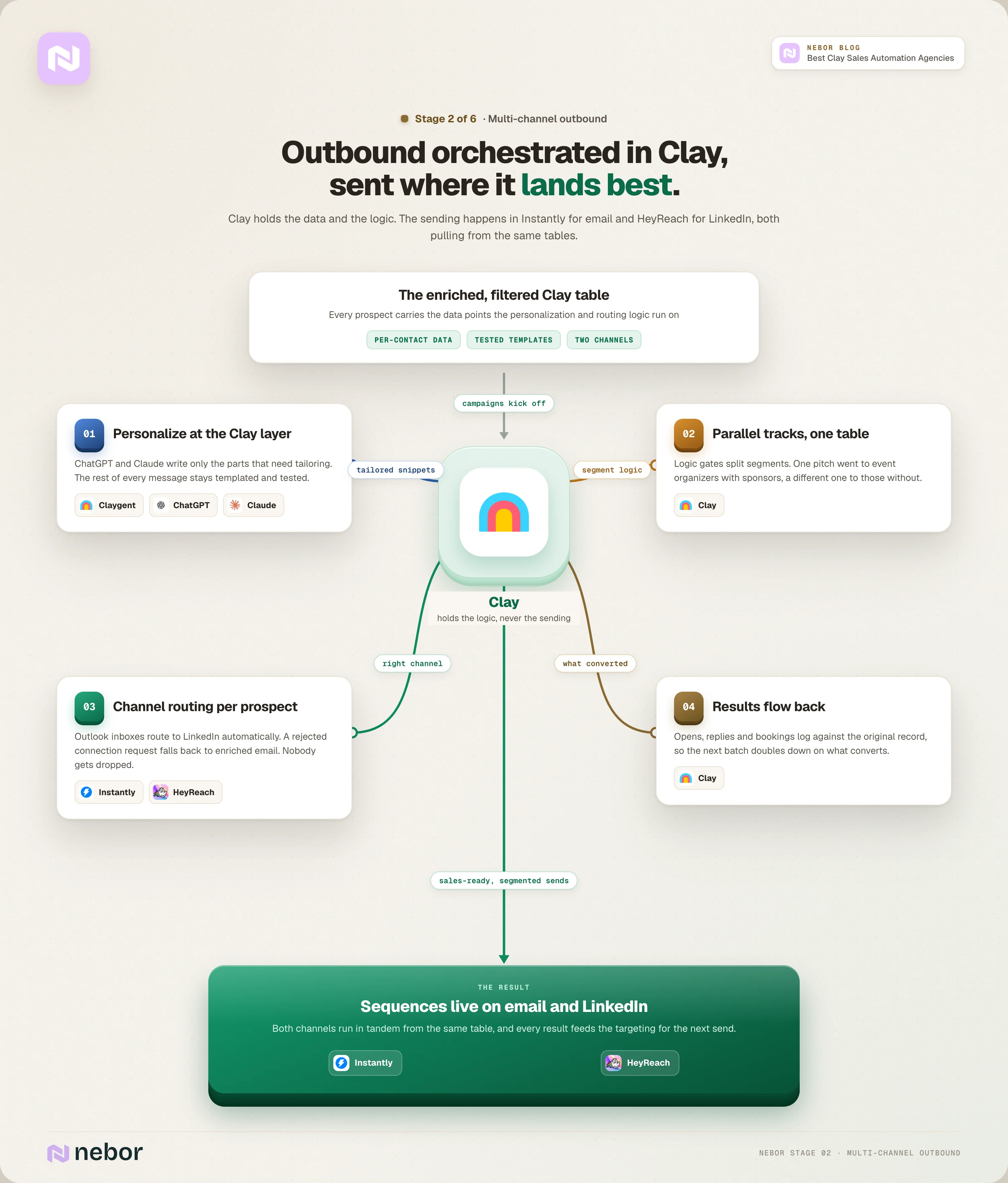
Personalization happens at the Clay layer before any message goes out. We use Clay's native integrations with ChatGPT and Claude to generate openers and snippets based on the data points already in the table.
We don't have the AI writing the whole message. It writes the parts that need to be tailored to the prospect, and the rest of the email is templated and tested.
For one client selling enterprise events technology, we built two parallel campaign tracks inside the same Clay table.
We sent one pitch to event organizers holding events with sponsors. A different pitch went to organizers holding events without sponsors. Same Clay table, different logic gates, different message templates, all pushed automatically into Instantly campaigns.
Email and LinkedIn go out in tandem rather than in series. When the Clay enrichment flags that a prospect uses Outlook (deliverability is meaningfully lower there), the workflow routes them to LinkedIn outreach via HeyReach instead of email.
When LinkedIn rejects a connection request, the same workflow checks for an enriched email and falls back. The point is that no prospect gets dropped because one channel didn't load.
We then push campaign results back into the same Clay tables. Open rates, reply rates, meeting bookings, all logged against the original prospect record.
That's how we know what's working, who's converting, and which segments to double down on. We've written the longer version of this in how to automate sales prospecting from scratch.
Note: You already know what Clay can do. The hard part is the expertise to build your sales systems around it.
That is the entire reason this page exists. Tables are easy to make and hard to make useful, and the difference is whether somebody designed the motion before building anything.
At Nebor we came from sales, and we build the full system on Clay: prospecting, outreach, signals, inbound, and the CRM work underneath.
Book a 15-minute call and let's talk about your motion.
Stage 3: signal and intent monitoring on autopilot
Most agencies talk about "intent data" and mean either article views or company-level IP tracking. What we mean by intent is something narrower than article views.
A signal is a specific external event that tells us a given company is more likely to need our client's solution this month than next month. That definition of intent is what makes signal-based outbound work.
We use Apify and PhantomBuster, and n8n to build the signal monitors that feed Clay tables in real time. Each client gets a different set of signals because the right signal depends on what they sell. Here what the flowchart looks like at this stage:
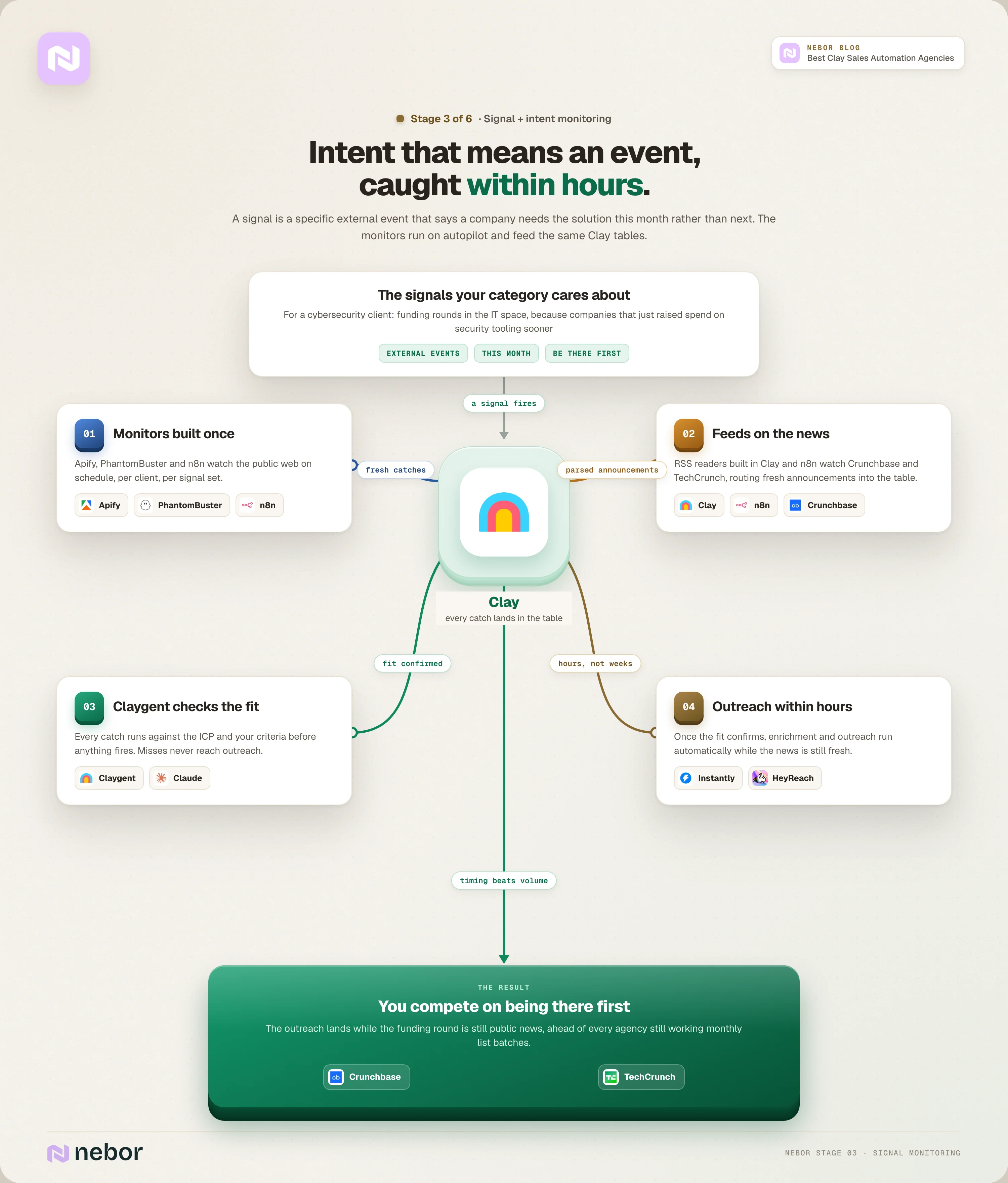
We have a cybersecurity client that cares about funding rounds in the IT space, because companies that just closed a round are spending on security tools sooner than companies that haven't.
For them, we set up Apify together with RSS feed readers to watch Crunchbase and TechCrunch and route new announcements into the Clay table.
Anytime they catch relevant news, we have a Claygent prompt that rapidly checks the company against the ICP and a few other criteria.
Once it confirms that it’s a fit, the workflow kicks off and the enrichment and outreach happen automatically within hours of the round being public.
The point of this stage is timing rather than volume. You stop competing on outreach volume and start competing on being there first. We covered the broader pattern in our piece on signal-based outbound campaigns.
Stage 4: inbound capture and qualification with the same enrichment engine
The mistake most companies make on inbound is treating it as a different system from outbound. The forms get treated as a separate database, the qualification logic lives in a different tool, and the routing rules live in someone’s head or a Slack channel.
We don’t do that.
The inbound layer plugs into the same Clay tables and the same enrichment workflows behind outbound, which means the moment a lead comes in we already know everything we'd know about an outbound prospect at the same company.
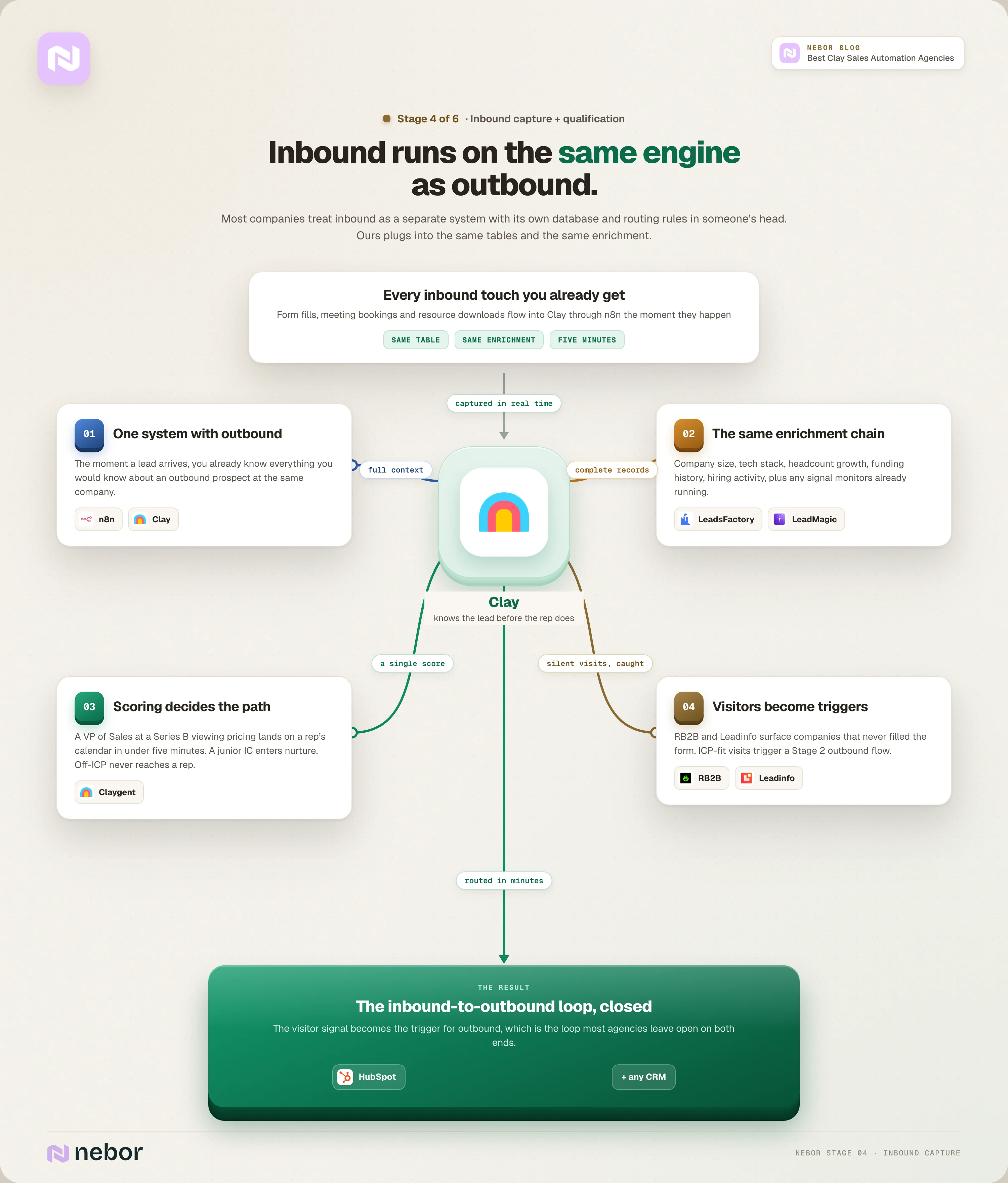
In practice, when someone fills out a form on the site, books a meeting through whatever platform you use, or downloads a resource, the form data flows into Clay through n8n.
Clay then applies the same enrichment chain we built for outbound, pulling company size, industry, tech stack, headcount growth, funding history, hiring activity, and any signal monitors we have watching for that ICP.
A custom scoring model decides what happens next. A VP of Sales at a Series B SaaS company who viewed the pricing page lands on a rep's calendar in under five minutes, while a junior IC at a 10-person agency goes into a nurture sequence instead. Anything that doesn't match the ICP at all gets filtered out before a rep ever sees the record.
We also pipe in RB2B and Leadinfo for visitor identification, which surfaces companies that visited the site but didn't fill anything out.
When those companies match the ICP and show enough engagement, we generate an outbound campaign aimed at the right contact inside that company.
The visitor signal becomes the trigger for a Stage 2 outbound flow, which closes the inbound-to-outbound loop most agencies leave open.
We’ve written the full version of this workflow in how to build an inbound meeting workflow with Clay, HeyReach, and Instantly, and the position behind it in our piece on inbound-led outbound.
Stage 5: the RevOps backbone that holds it all together
This is the part of the system most outbound agencies don’t touch, and it’s also the part that decides whether any Clay implementation that also touches your CRM survives past month six.
Without it, the pipeline you build in stages one through four stands on a CRM that’s getting messier every week, and within a quarter your reps are working off stale records and the dashboards stop matching reality.
So we build the RevOps layer alongside the outbound and inbound layers. What that looks like comes down to six concrete pieces.
Let’s explain.
CRM hygiene and dedupe
The Clay tables are the source of truth for prospect data, but HubSpot, Salesforce (or whichever CRM you use) is where the deal records live.
We build dedupe logic in Clay that matches incoming leads against existing records in the CRM, merges where needed, and flags conflicts for review.
We also normalize fields on the way in (company names, geos, industry codes) so the segmentation downstream isn't fighting bad data.
Lead routing
Inbound and outbound both feed into the same routing engine, so your sales reps don’t get the same lead from two sources or work over a teammate’s account.
We use a combination of HubSpot’s native routing, Clay-side rules for ICP fit, and n8n for anything more complex like round-robin within a region or assignment by deal size.
Lifecycle automation
Lead becomes MQL becomes SQL becomes Opportunity, and each transition triggers rules built on data already in the Clay tables.
A prospect who books a meeting (we catch it through your meeting booking tool) auto-converts to MQL, and from there an MQL with a confirmed budget conversation auto-converts to SQL.
Once a deal closes won, the record pushes back into the Clay tables we use for prospecting, so we can train the ICP scoring model on actual revenue rather than guesses.
Attribution
Every lead carries a source tag from the moment it enters Clay, and that tag follows it through the full lifecycle.
When a deal closes nine months later, we know exactly which Stage 2 campaign or Stage 3 signal it came from. That’s how we tell the client what to keep funding and what to retire.
Pipeline reporting
You’ll get weekly and monthly dashboards built either in HubSpot or in a lightweight reporting layer like Equals or Hex, depending on your stack.
The reporting layer is a live view that the head of sales and the head of revenue both check on their own time.
ICP-fit feedback loop
Closed-won and closed-lost data flows back into the Clay table that drives prospecting, so the ICP score gets sharper every month.
That means the companies that look like your best closed-won deals get scored higher in the next outbound batch, and the ones that look like the closed-lost reasons get tagged for a different sequence or filtered out earlier.
The output of Stage 5 is the part of the system that survives the engagement. It’s also why we can confidently say what we say about why we are not a lead generation agency.
Lead-gen shops don’t touch any of this, which is why their work disappears the moment the contract ends.
Stage 6: the feedback loop that makes the system improve on its own
A built system without a feedback loop decays. The campaigns that worked in January won’t work in July, the signals that were sharp last quarter go dull, and the ICP that converted twelve months ago isn’t quite the ICP that converts now.
Stage 6 is the part of the engagement that prevents that decay. We set up a monthly review cadence with the client and walk through the same agenda each month.
Which Stage 2 campaigns are still converting and which need to be retired.
Which Stage 3 signals are still producing meetings and which have gone dull.
What the latest closed-won and closed-lost deals are telling us about the ICP.
How the message templates are performing on reply rates against the previous batch.
After the review, we update the Clay tables. Bad campaigns get retired, new signals get added, the ICP scoring model gets retrained, and message templates get rewritten or A/B tested against the winners. The client sees the changes the same week.
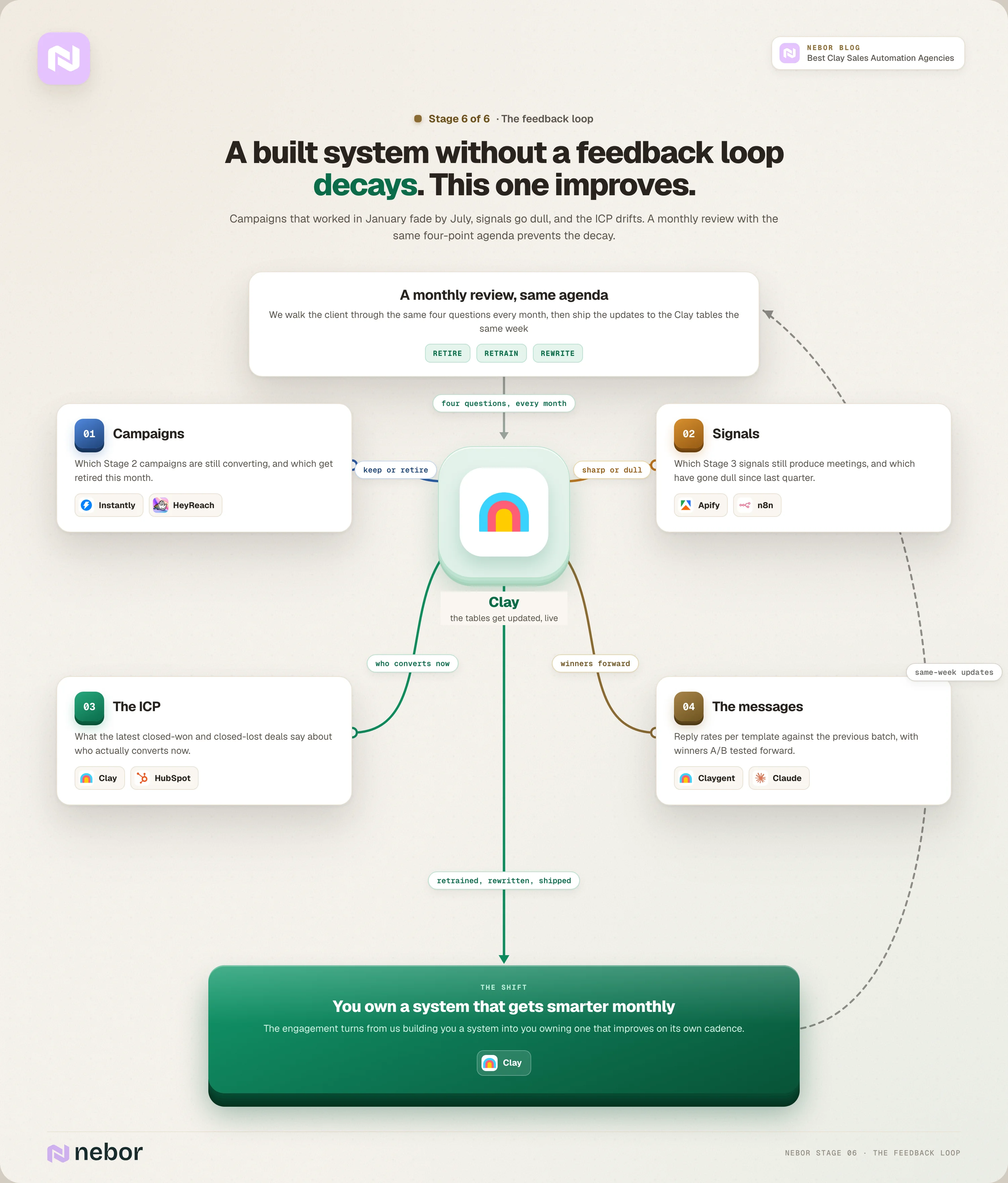
This is the part that turns the engagement from us building you a system into you owning a system that’s getting smarter every month.
We’ve written a more elaborated version of why this matters in sales systems vs headcount, and the broader frame in how to build a go-to-market system that generates business on autopilot.
2. ColdIQ
ColdIQ is one of the most visible Clay-focused outbound shops on the market and the agency most companies discover first when they search “Clay agency”.
They handle the full outbound stack, including email infrastructure setup, message writing, list building, and inbox management.
Their differentiator is volume and AI personalization at scale. They use intent signals like hiring news, funding rounds, and tech changes to time their sends, and they push enough emails per day to make the system economics work for B2B companies that need pipeline at a steady rate.
They best fit companies that want managed outbound and don't want to think about who's writing the messages.
3. The Kiln
The Kiln was founded by former Clay employees, which gives them an edge most agencies can’t replicate. They know the platform’s edge cases, the unreleased features, and the workflows other agencies copy six months later.
Their work spans across inbound, outbound, and RevOps systems for go-to-market teams, and they push Clay further into technical territory than most.
You’ll also get CRM data cleaning, complex lead scoring, and hyper-personalized outbound campaigns are the typical scope.
They’re best for companies with a meaningful Clay budget that want to push the platform to its technical ceiling.
If you are looking for a partner to help you with basic outbound execution and don’t have a technical operator on your team to absorb what The Kiln hands back, you should look for alternatives to the Kiln.
4. Sopro
Sopro is a fully-managed B2B prospecting service that works across email, LinkedIn, and display ads. They handle strategy, list building, message writing, and execution, with Clay-enhanced targeting woven into the data layer.
They’re better positioned to serve SMBs and mid-market companies that want managed outbound across multiple channels.
Their model is closer to a traditional managed-prospecting agency than a Clay-native consultancy.
Sopro builds and sends the campaigns directly for you. What you receive at the end of a sprint is reports and booked meetings rather than reusable workflows.
5. OneAway
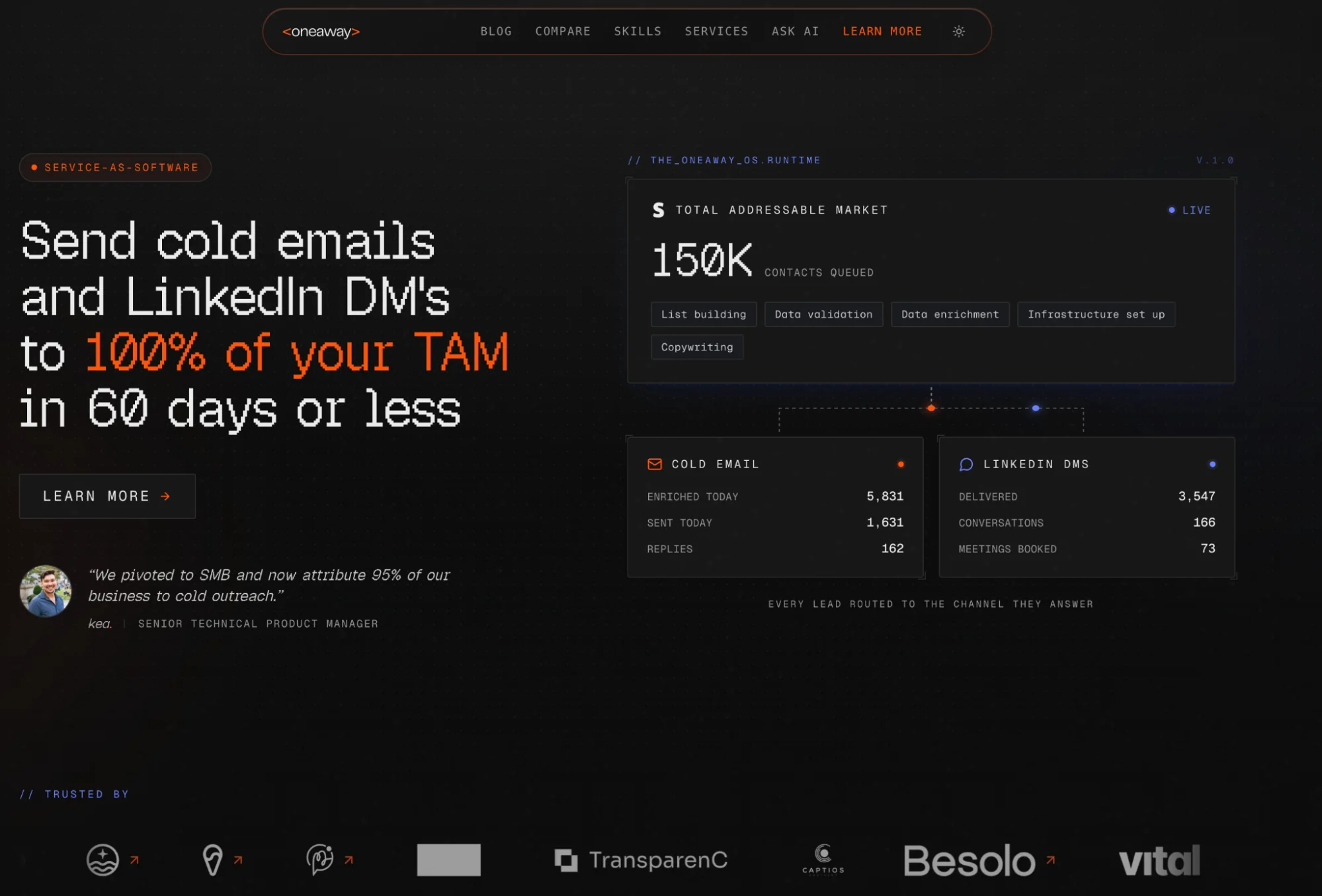
OneAway builds custom go-to-market systems for B2B companies, with Clay and Apify at the center. Their focus is automating sales tasks and cleaning CRM data, with workflow design tailored to each client.
They land somewhere between an outbound-execution shop and a Clay-specialist consultancy, depending on how the engagement gets scoped.
Some clients hire them for full campaign delivery. Others hire them just for the workflow design and bring the execution in-house.
If you want a Clay shop that’s flexible on scope and doesn’t lock you into a fixed retainer model, OneAway is worth a look. They’re less of a fit for companies that want a plug-and-play managed outbound service.
6. RevPartners
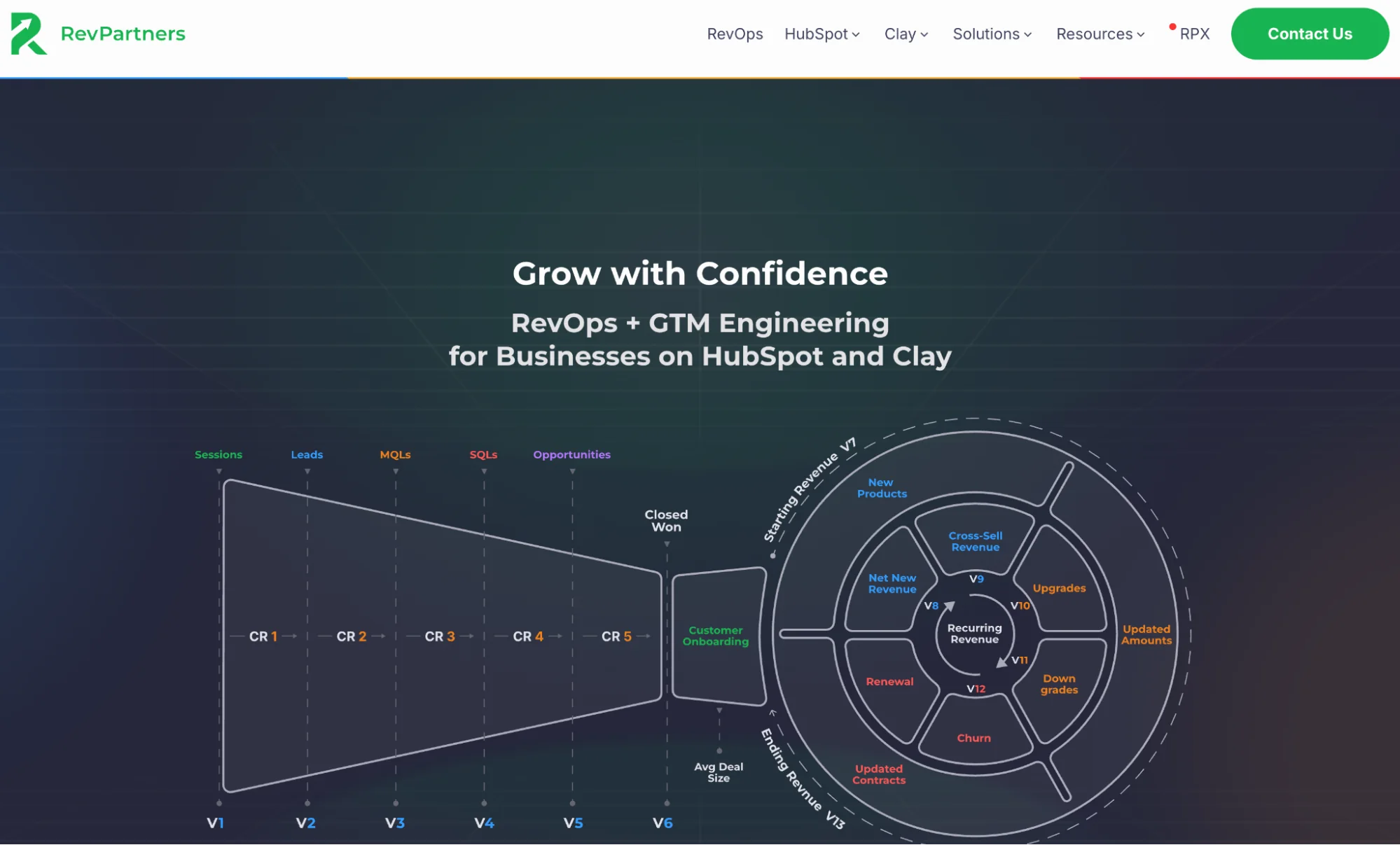
RevPartners is one of the larger Clay-and-HubSpot specialists in the market and operates as a Clay Elite Studio Partner alongside their HubSpot Solutions Partnership.
If your stack is HubSpot-centric and you want a Clay implementation that integrates cleanly with the way your revenue team already works, they’re one of the strongest options on this list.
The combination is rare and useful, because most Clay shops can build the outbound layer but stop short when it comes time to wire the CRM behind it.
Their work focuses on measurable outcomes and continuous optimization, with emphasis on the client's existing tech stack rather than swapping it out. RevOps is in their DNA in a way it isn’t for most Clay-only outbound shops.
7. Afonto
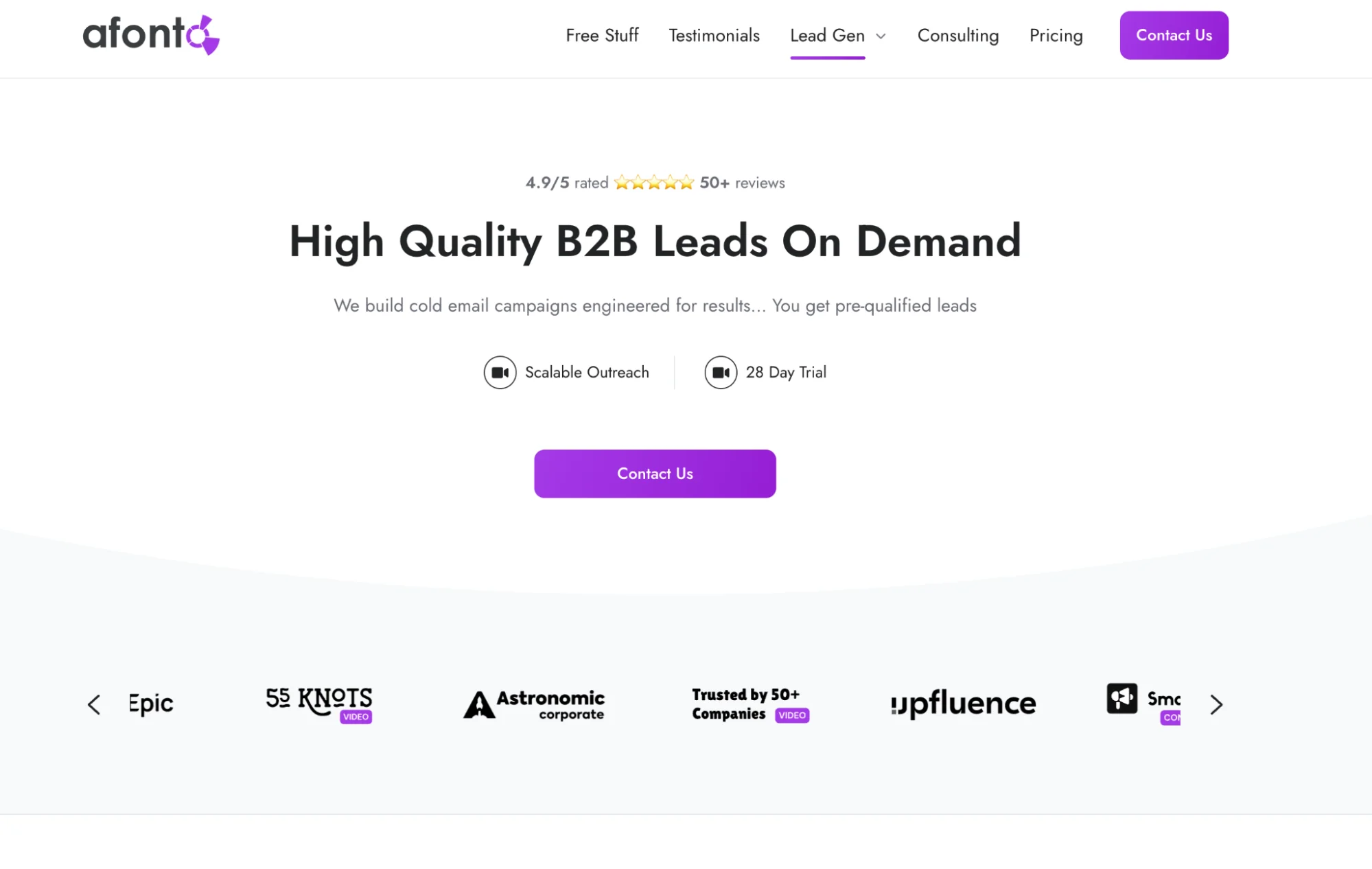
Afonto delivers AI-powered cold outreach at high volume, with the full stack handled in-house, including list building, copywriting, deliverability, inbox management, and reply handling.
The pitch is over 1,000 personalized emails sent daily to ICP-matched prospects, with a 28-day satisfaction guarantee on the trial.
The model is high-throughput managed outbound with risk shifted onto the agency. If you don’t see results in the trial period, you don't pay. That's a meaningful commitment most Clay-adjacent shops won't make.
They best fit mid-market companies that want a high-volume cold email engine with someone else taking the operational risk. That also means they’re less of a fit if your ICP is narrow enough that volume isn’t the answer.
8. Sales Automation Systems
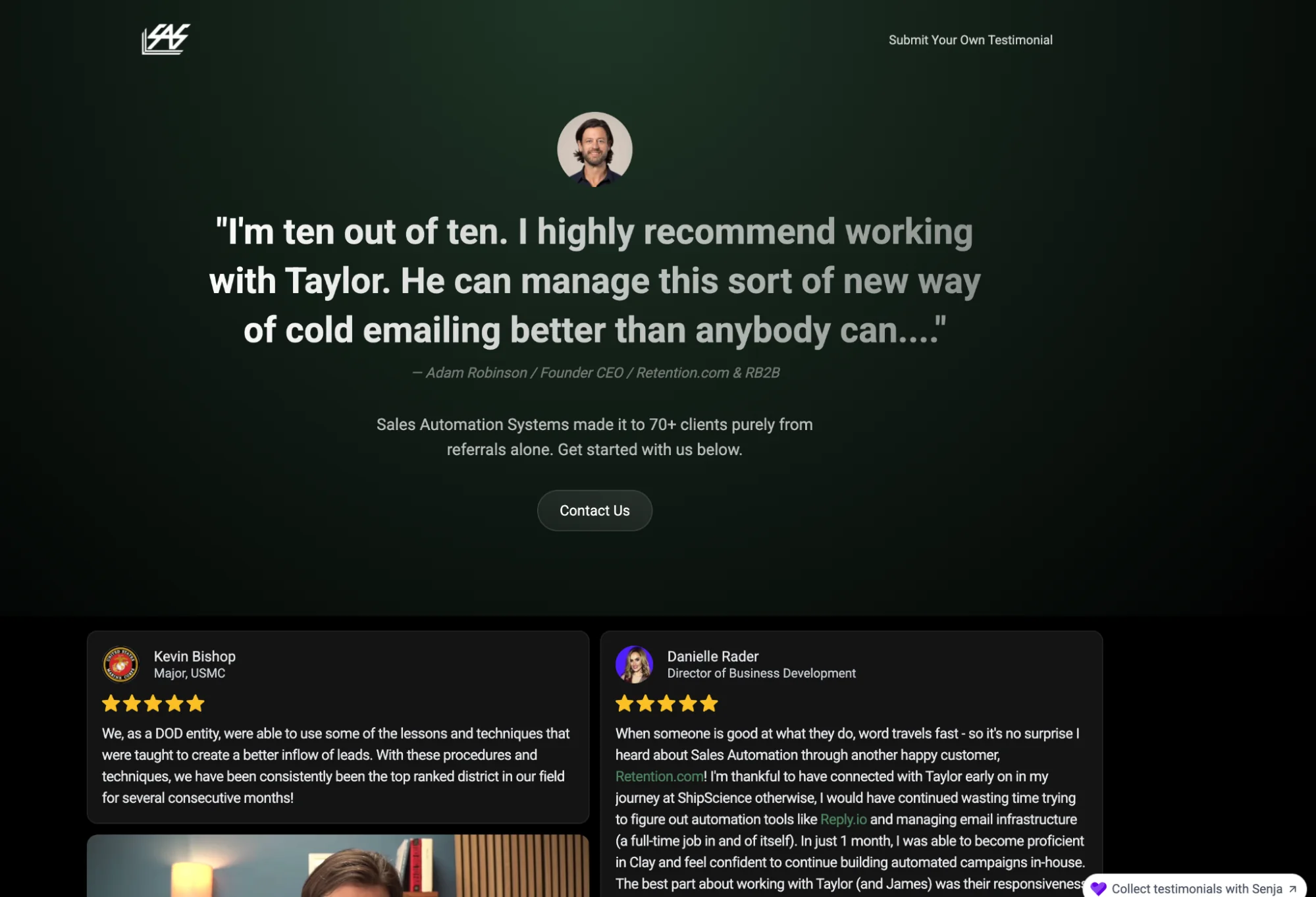
Sales Automation Systems is a Clay consulting shop with a hands-on implementation model. They work closely with each client to understand the specific pain points and then build tailored Clay workflows around them.
This is more of a productized consultancy than an outbound-execution shop. The team builds the workflows, sets up the integrations, and trains the client's team to operate them. Sending the campaigns long-term is on the client team to handle.
If you have an internal operator who can take a Clay handoff and carry it forward, this is a clean way to get the engineering done without the retainer overhead. If you don't have that operator, the workflows will go unused.
9. Revnuu
Revnuu takes a process-first approach to Clay implementation, looking at the whole sales motion rather than just the campaigns.
The scope typically includes process analysis, custom Clay implementation, integration with existing tools, and ongoing support after go-live.
They belong firmly in the Clay-specialist consultancy bucket. The orientation is process-first rather than channel-first, which appeals to teams that want the whole sales motion documented and automated rather than just outbound campaigns going out.
They’re an excellent fit for mid-market and enterprise teams that already have a defined sales process and want Clay woven into it cleanly.
10. LeadBird
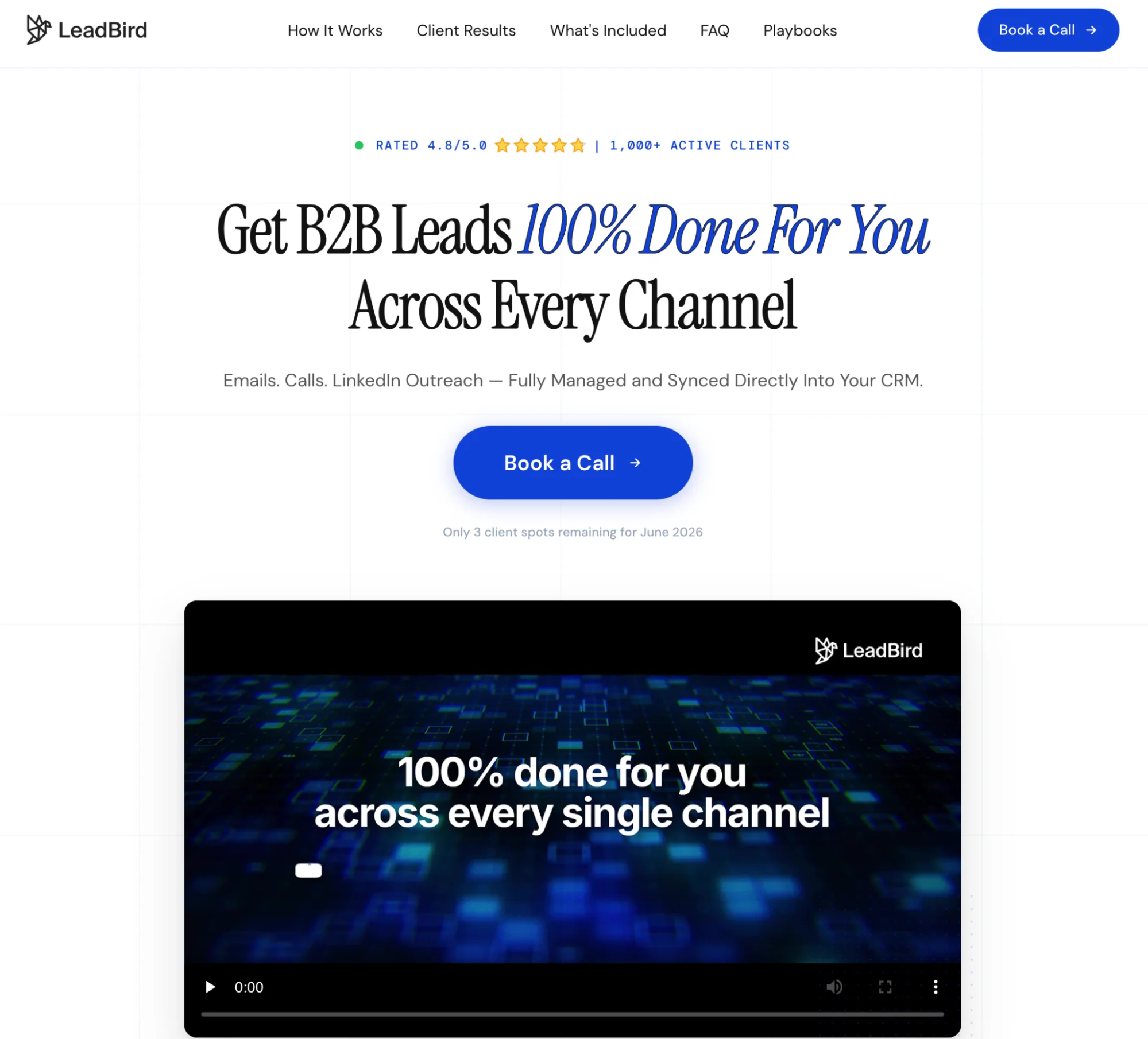
LeadBird is a B2B lead generation agency that combines hyper-personalized cold email campaigns with Clay automations to generate demos. The differentiator is the pricing model they offer clients. Instead of a monthly retainer, you pay per qualified lead delivered.
Their service includes account management, list building, campaign copywriting, and reporting, with the trial period structured so you only pay for meeting-ready leads. Some companies prefer this risk-shifted economics over fixed retainers.
The model fits early-stage and resource-constrained teams that want pipeline without the upfront commitment.
It’s less suited to companies that want to own the workflows after the engagement ends, since the LeadBird system lives on LeadBird infrastructure rather than in the client's own accounts.
11. Avalanche Outbound
Avalanche Outbound is one of the few Clay.com Certified outbound partners and treats deliverability as a first-class part of the engagement rather than an afterthought.
The team builds domain warm-up infrastructure, inbox setup, and technical email configuration alongside the campaign workflows themselves.
Their copywriters write outbound messages rooted in buyer psychology, and the system covers cold email and LinkedIn outreach as a single coordinated motion.
What sets them apart from most outbound shops is the explicit ownership commitment. Clients get full access to the systems, data, and tools the team builds, and they train the client's team to operate it once the engagement winds down.
12. frontBrick
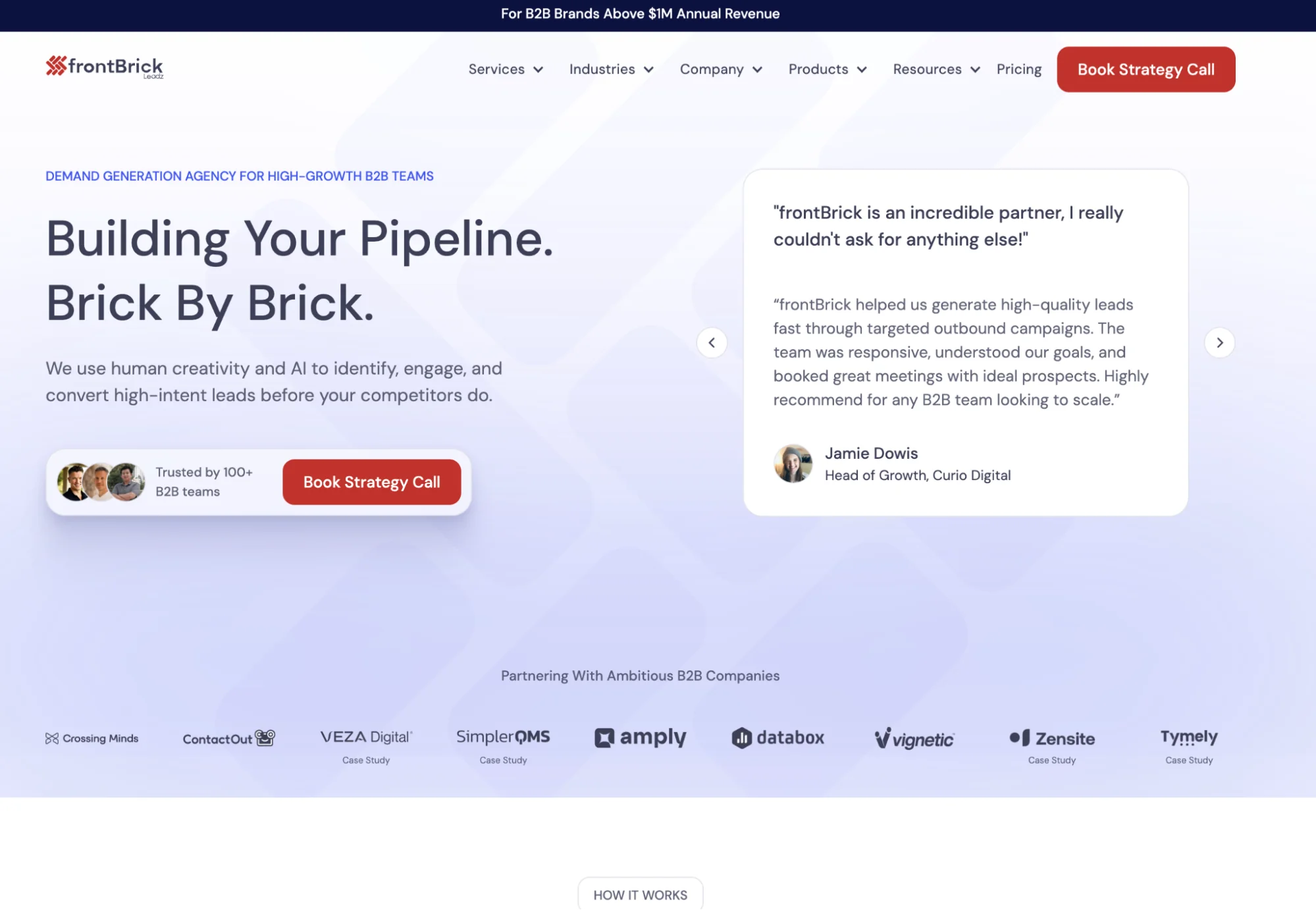
frontBrick is a Clay-certified consulting agency that pairs technical Clay expertise with revenue strategy, with the focus skewed toward complex SaaS deals and long sales cycles.
The team builds multi-channel outbound stacks across Clay, Instantly, Smartlead, and Lemlist, then ties the leads cleanly into the CRM and ad systems on the back end.
What sets them apart is the orientation toward complex deal cycles. Where most Clay outbound shops optimize for fast-cycle SMB sales, frontBrick designs for the eight-to-eighteen-month enterprise procurement reality.
Buyer intent signals, funding data, and tech-stack insights drive the targeting, with messaging built to survive longer evaluation periods.
They mostly work for SaaS companies selling into mid-market and enterprise where the sales cycle isn't measured in weeks.
13. The Playbook Agency
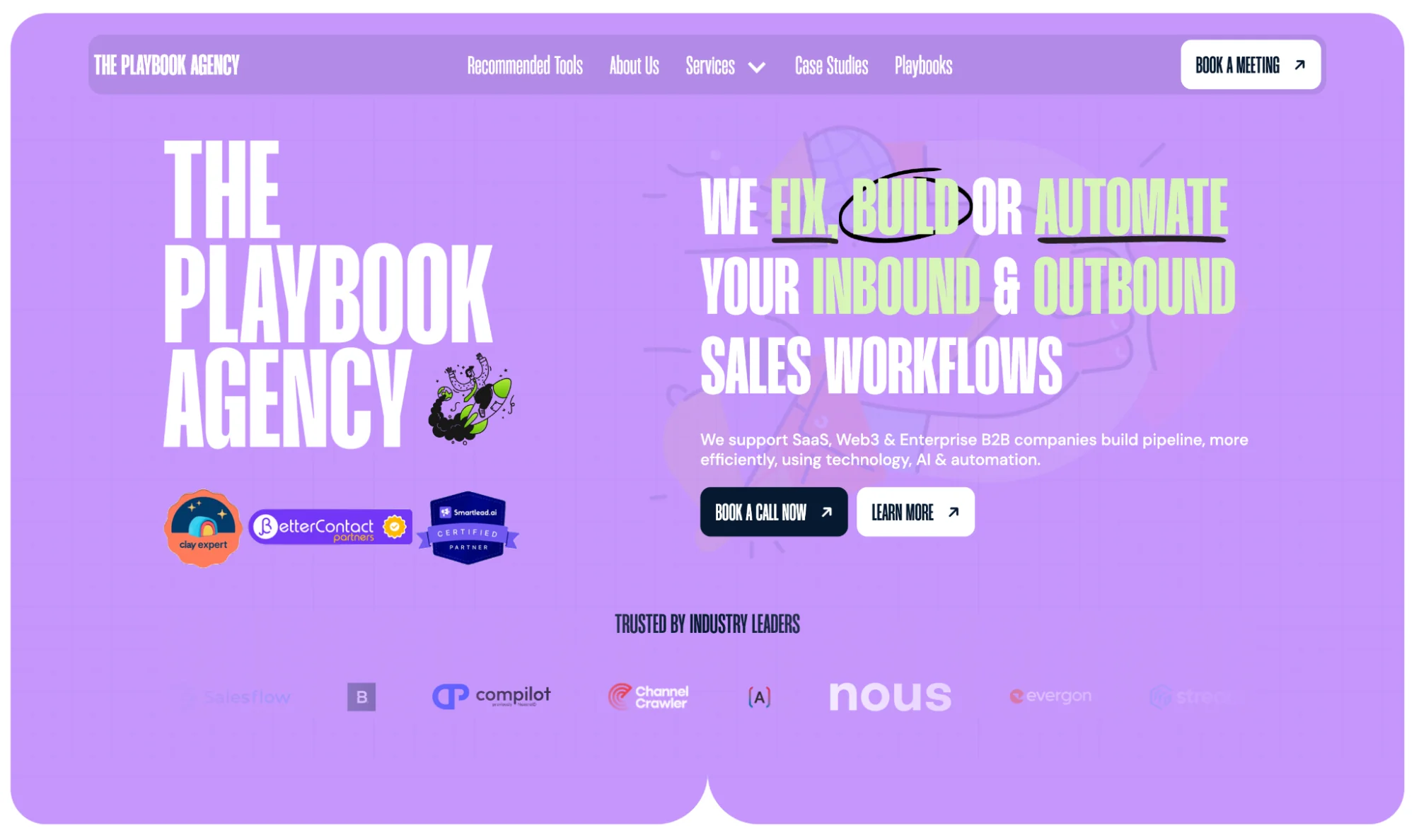
The Playbook Agency was founded by two former Heads of Sales who got tired of watching outbound, marketing, and CS each working from their own disconnected stacks.
So they built a unified Clay-powered engine that centralizes data sourcing, enrichment, segmentation, and outreach in a single visual canvas, then implemented it across every revenue function rather than just outbound.
The scope spans sales, marketing, RevOps, CS, and account management, which puts them in the full GTM systems builder bucket alongside Nebor and GTM Engineering.
The orientation is no-code first, which means the system is genuinely meant to be operated by revenue people rather than engineers after handoff.
14. GTM Engineering
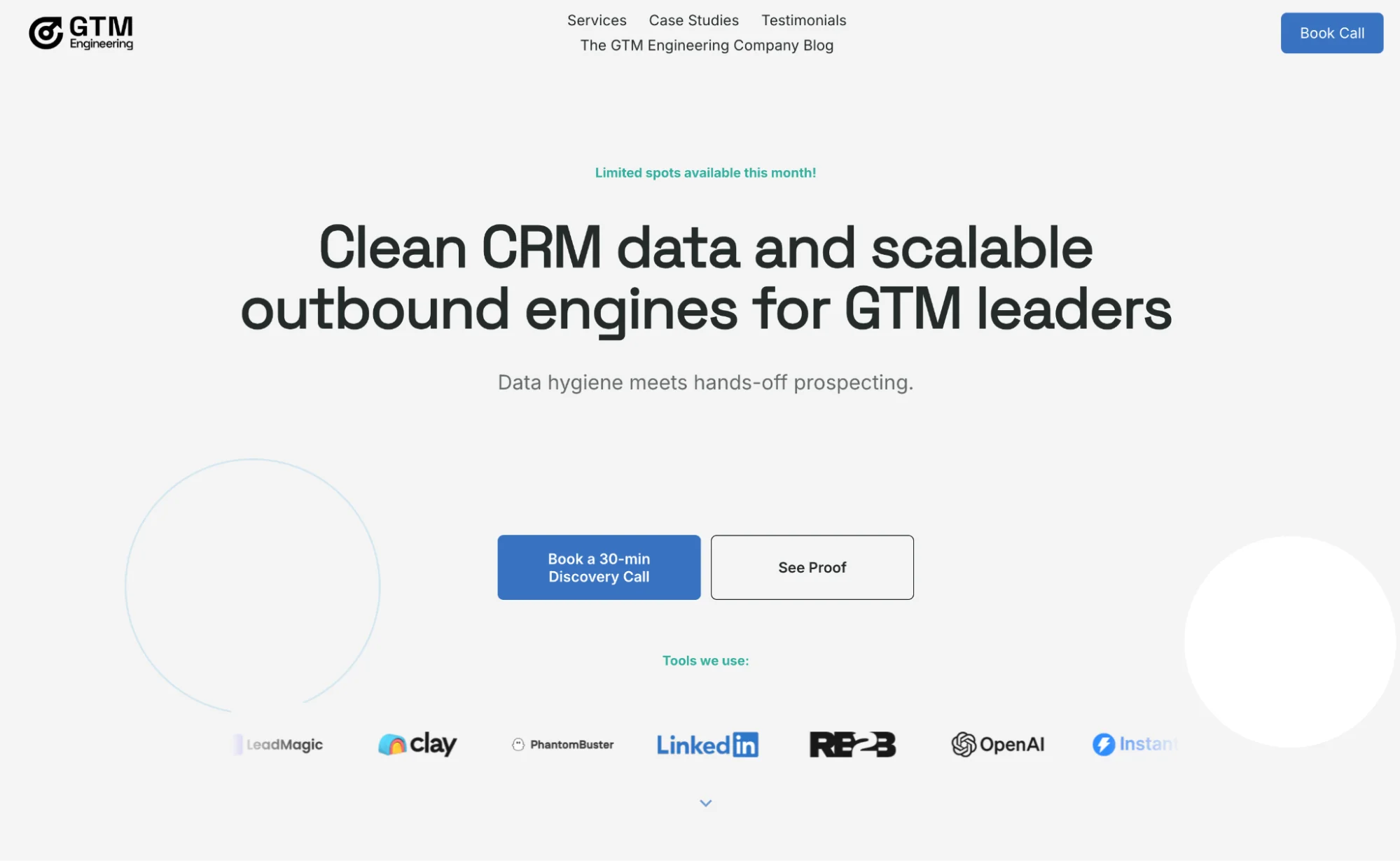
GTM Engineering focuses on scalable infrastructure for Seed-to-Series-B startups, where the priority is getting the GTM stack built right the first time rather than patching campaigns onto a foundation that's still wobbly.
They combine clean CRM data with rapid outbound execution, with Clay in the middle as the data layer.
The team also keeps one of the more useful Clay-agency content libraries on the open web at blog.gtm-engineering.io, which is itself a tell that they're treating Clay as a category to be developed rather than a tool to be used.
They niche down to venture-backed startups in the post-PMF, pre-scale window where GTM infrastructure has to support 5x growth without breaking.
15. Growth Engine X
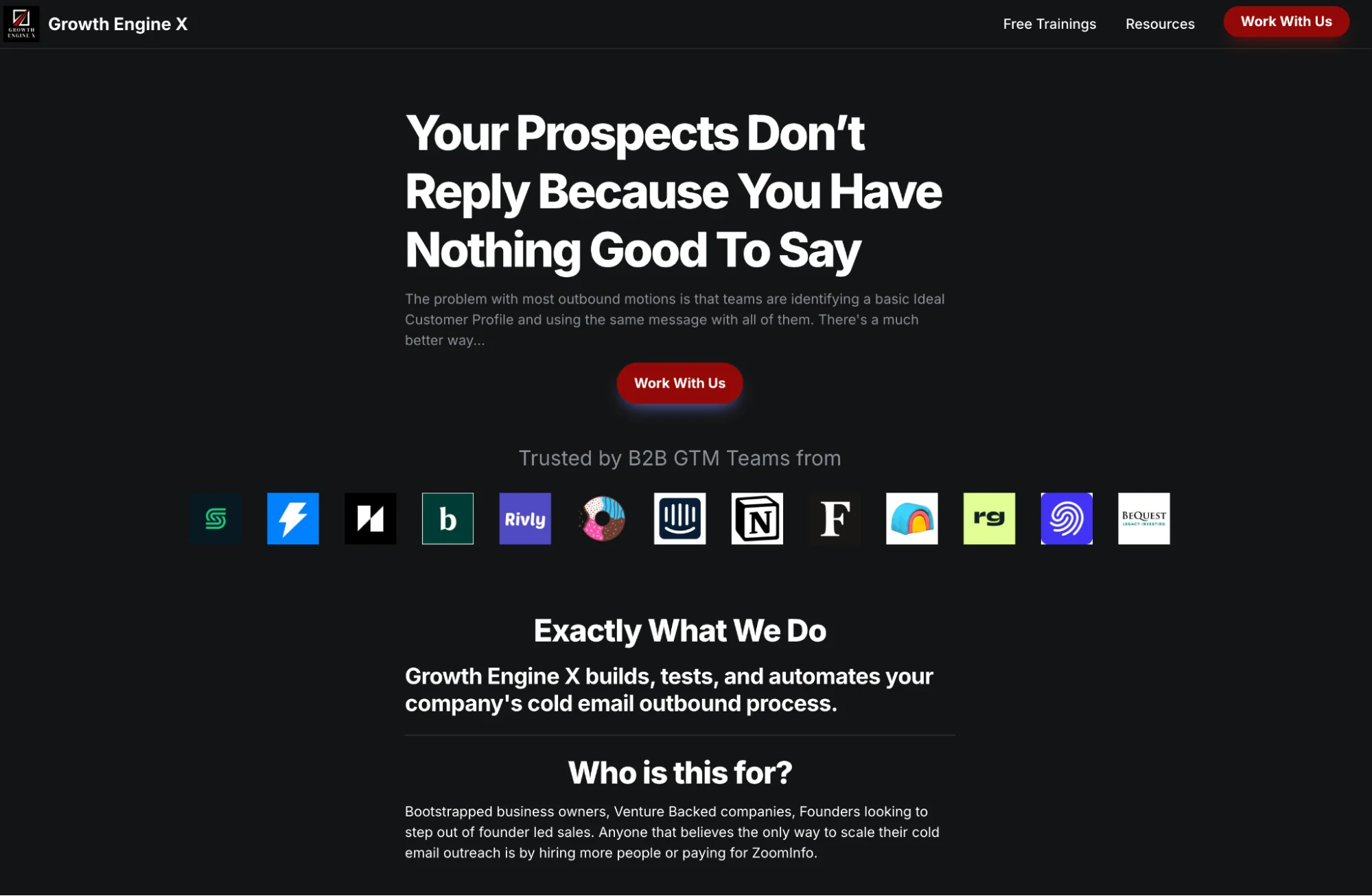
Growth Engine X is led by Eric Nowoslawski, who built much of the early outbound playbook the rest of the Clay agency category now copies.
He's earned the "godfather of Clay" tag in GTM circles, mostly through publishing the workflows other agencies repackage six to twelve months later.
The agency specializes in high-volume outbound campaigns using Clay, with the operational rigor to keep deliverability and reply rates intact at scale.
Founder-led shops have ceiling problems, but they also tend to ship faster and iterate harder than larger agencies, and Growth Engine X falls firmly on the iteration-velocity side of that trade-off.
Hire Nebor to drive your growth and make your team more efficient
The Clay agency category is maturing faster than most service categories ever do. The shorthand “Clay agency” meant outbound execution and very little else two years ago.
Today the same shorthand covers at least three different kinds of company, and the gap between “outbound shop” and “GTM systems builder” is going to keep widening over the next eighteen months.
The fifteen agencies above split cleanly into three jobs to be done. If you map your situation onto the right job first, the shortlist falls out of the framework rather than out of brand recognition.
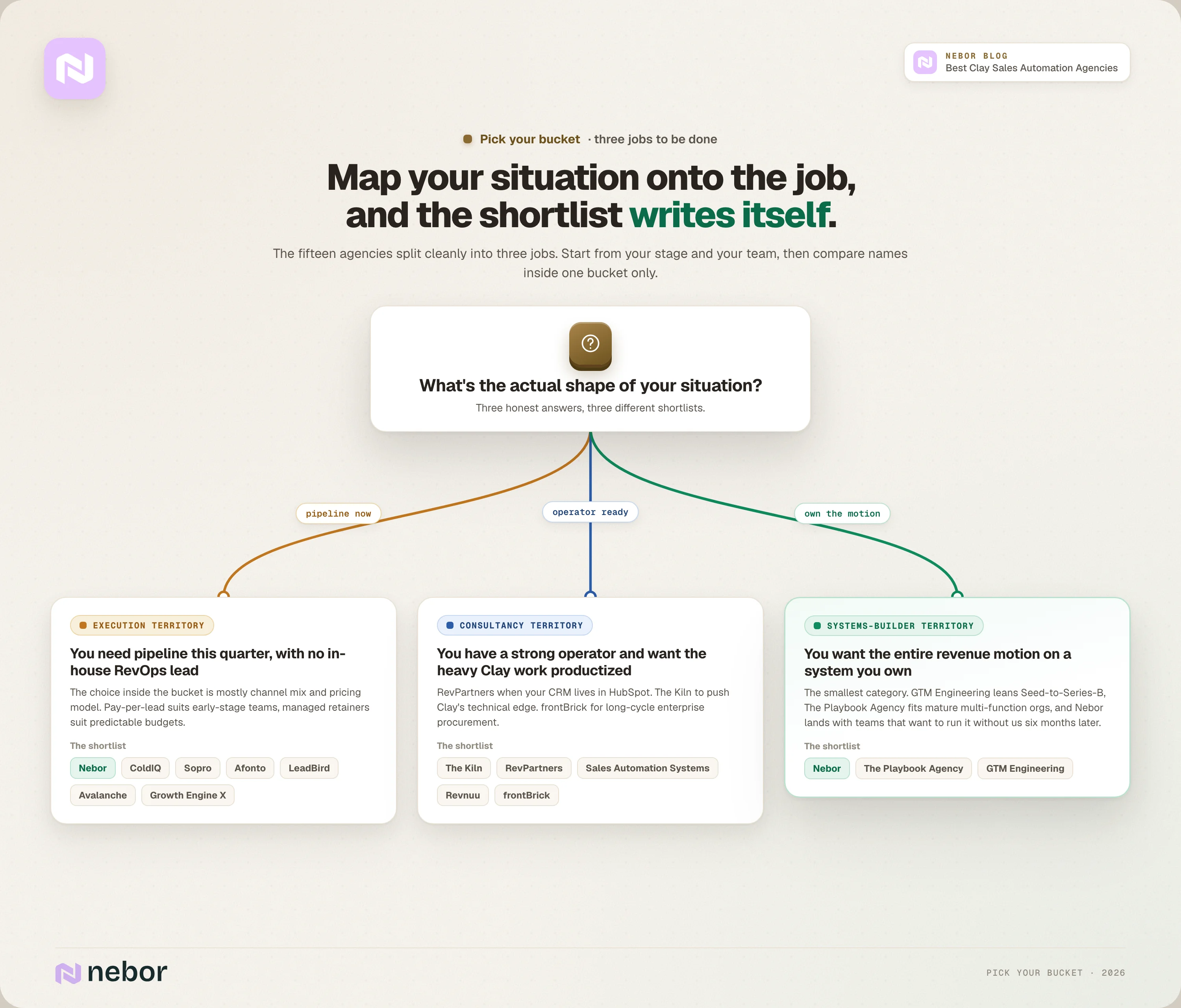
Youneed pipeline this quarter and don’t have an in-house RevOps lead. If that’s the shape, you're in outbound-execution territory and the shortlist comes from there. Nebor, ColdIQ, Sopro, Afonto, LeadBird, Avalanche Outbound, and Growth Engine X all live here.
The choice between them is mostly a question of channel mix and pricing model. Pay-per-lead suits early-stage teams, while managed retainer suits teams that already have predictable budget for sales and marketing.
You have a strong internal operator and want the heavy Clay work productized. If that’s the shape, the right shortlist comes from the Clay-consultancy bucket. The Kiln, RevPartners, Sales Automation Systems, Revnuu, and frontBrick all build the system and hand it back.
RevPartners is the call when your CRM lives in HubSpot. The Kiln makes more sense when you want to push Clay's technical edge. And frontBrick is the right pick if you sell into long-cycle enterprise procurement.
You want the entire revenue motion on a system you own. This is full GTM systems builder territory and the smallest category. Nebor, The Playbook Agency, and GTM Engineering all build outbound, inbound, signal monitoring, and RevOps as one infrastructure.
GTM Engineering leans heavily into Seed-to-Series-B startups. The Playbook Agency targets mature revenue orgs with multiple functions working in parallel.
Our own Nebor work tends to land with companies that want a system they can operate without us on retainer six months later.
Here’s a piece of related context worth weighing before you commit to a bucket.
We’ve written about the SDR-as-a-service model and why it stopped working in 2026, the in-house-versus-outsourced SDRs debate, and why most B2B teams no longer need to outsource lead generation at all.
If you’re hiring for pipeline, those three together are worth the read before you sign anything.
Note: You already know what Clay can do. The hard part is the expertise to build your sales systems around it.
That is the entire reason this page exists. Tables are easy to make and hard to make useful, and the difference is whether somebody designed the motion before building anything.
At Nebor we came from sales, and we build the full system on Clay: prospecting, outreach, signals, inbound, and the CRM work underneath.
Book a 15-minute call and let's talk about your motion.


Related Articles

By clicking Sign Up you're confirming that you agree with our Terms and Conditions.