
Pay Per Appointment Lead Generation: Why It Sounds Great and Why Owning an Automated Lead Generation System Is Better

In this post:
If you’re searching for pay per appointment lead generation, you’re probably fed up with monthly retainers that deliver nothing, business growth or appointment setting agencies that charge you thousands while your calendar stays empty.
Or, you’re tired of signing 6-month contracts where you only get leads that are in reality just names on a spreadsheet who never respond to your emails.
Or, maybe your lead generation efforts are costing you too much and you’re looking for a lead generation service but you are tight on budget and so you are looking at the pay-per-appointment option to keep things a bit more affordable for you while generating high-quality leads.
So pay-per-appointment lead generation sounds like the answer. You only pay when someone actually shows up to talk business.
We get it. You want sales conversations with verified and qualified leads that match your ICP and actually show up to discuss business. We used to offer pay-per-appointment ourselves.
But after working with dozens of B2B companies and generating millions in pipeline, we’ve come to a different conclusion. The pay-per-appointment model is better than traditional lead generation. But there’s something even better than both.
Owning your own, automated, AI-driven sales system that takes care of your entire prospecting and top-of-the-funnel lead generation campaigns and lead qualification process to bring leads to your CRM so that you sales people actually focus on having meetings and closing deals.
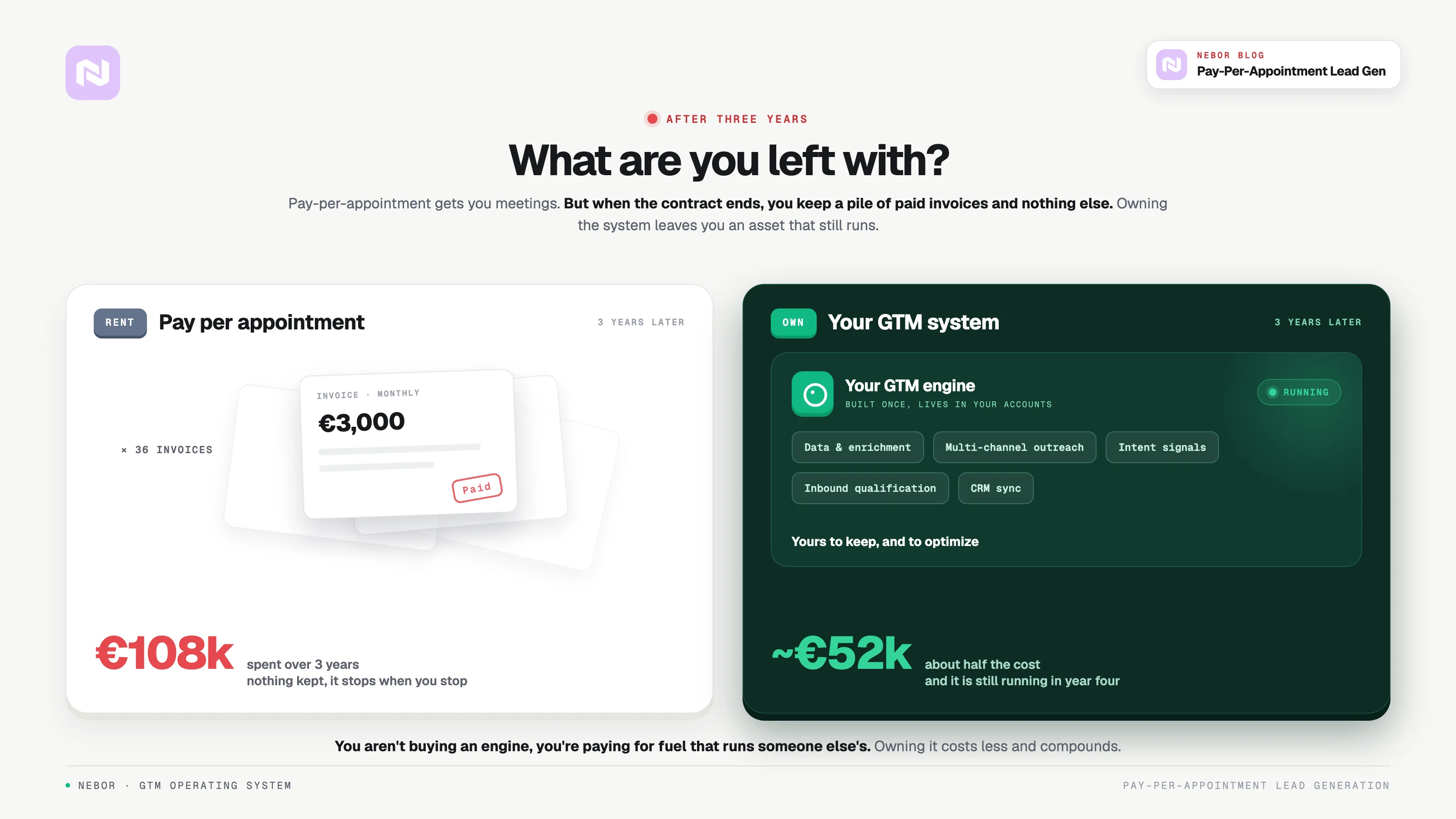
What makes this even more valuable for you is that you build it internally for your team to drive business growth, pay small monthly maintenance and subscriptions fees, which in the end comes more affordable than pay-per-appointment companies and traditional lead generation itself.
In this post, we’ll walk you through everything you need to know about pay-per-appointment lead generation. We’ll cover what it is, how it works, and why it beats traditional models.
Then we’ll show you why building an automated lead generation and sales system you actually own delivers even better results, and how we help companies do exactly that.
By the end, you’ll understand why the most successful companies are moving away from renting leads and toward owning their growth engine.
Let’s get started.
TL,DR: Automated appointment setting/lead generation workflow that you can own and operate internally
So, the idea is that you are short on pipeline, and you can actually build and own an AI-powered workflow system that takes care of your lead generation or appointment setting issues instead of paying per appointment.
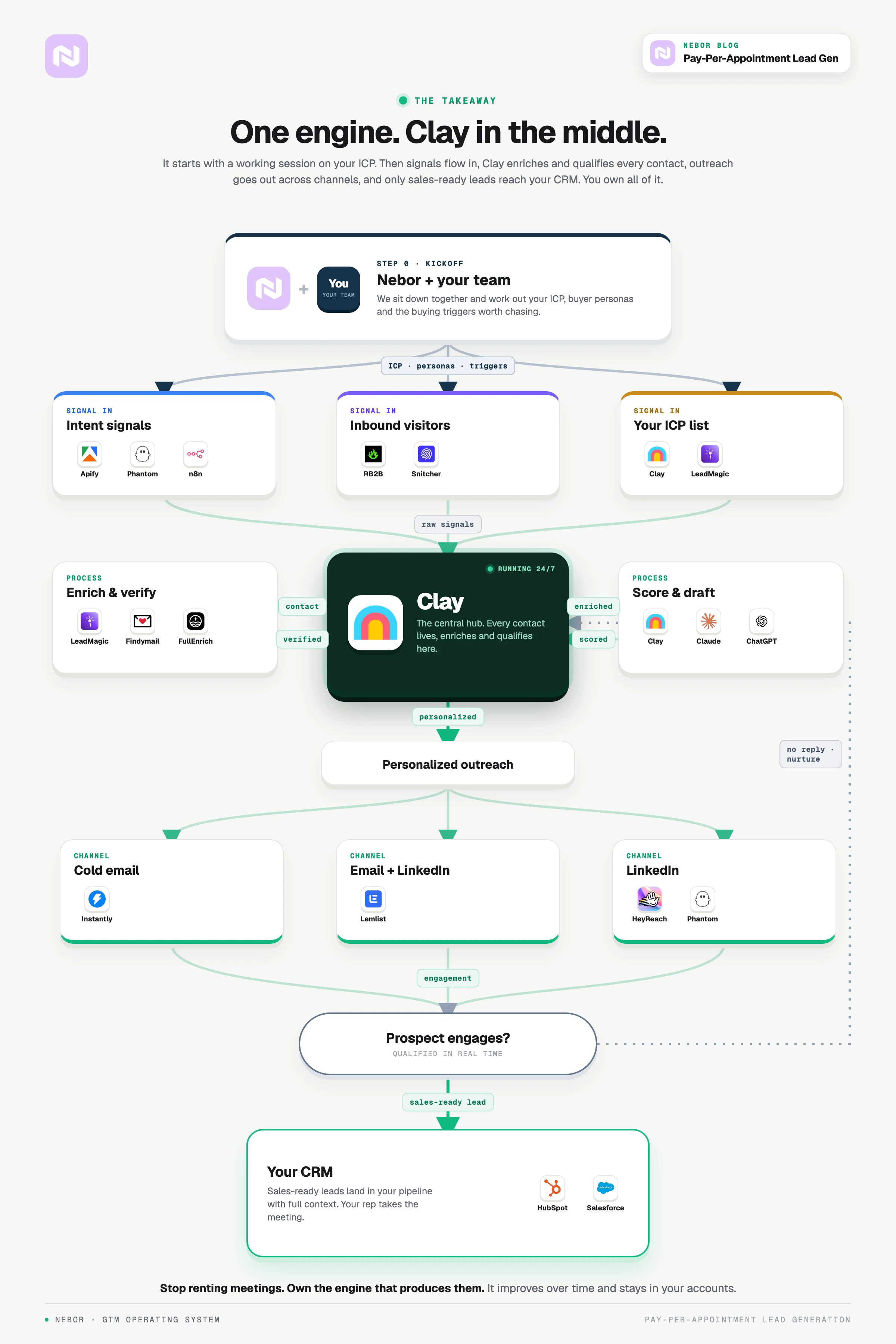
Here’s roughly what the workflow looks like:
What is pay-per-appointment lead generation?
Pay-per-appointment is a lead generation model where you only pay for confirmed appointments with prospects who have expressed real interest in your product or service.
Here's where the model differs from a normal list buy. Instead of paying for a list of cold names or maybe-interested leads, the partner adds a layer to their process that confirms each prospect has buying intent before passing them over.
You only pay once a qualified prospect agrees to sit down and talk. The agency carries the prospecting, the outreach, the nurture sequence, and the qualification before anyone hits your calendar.
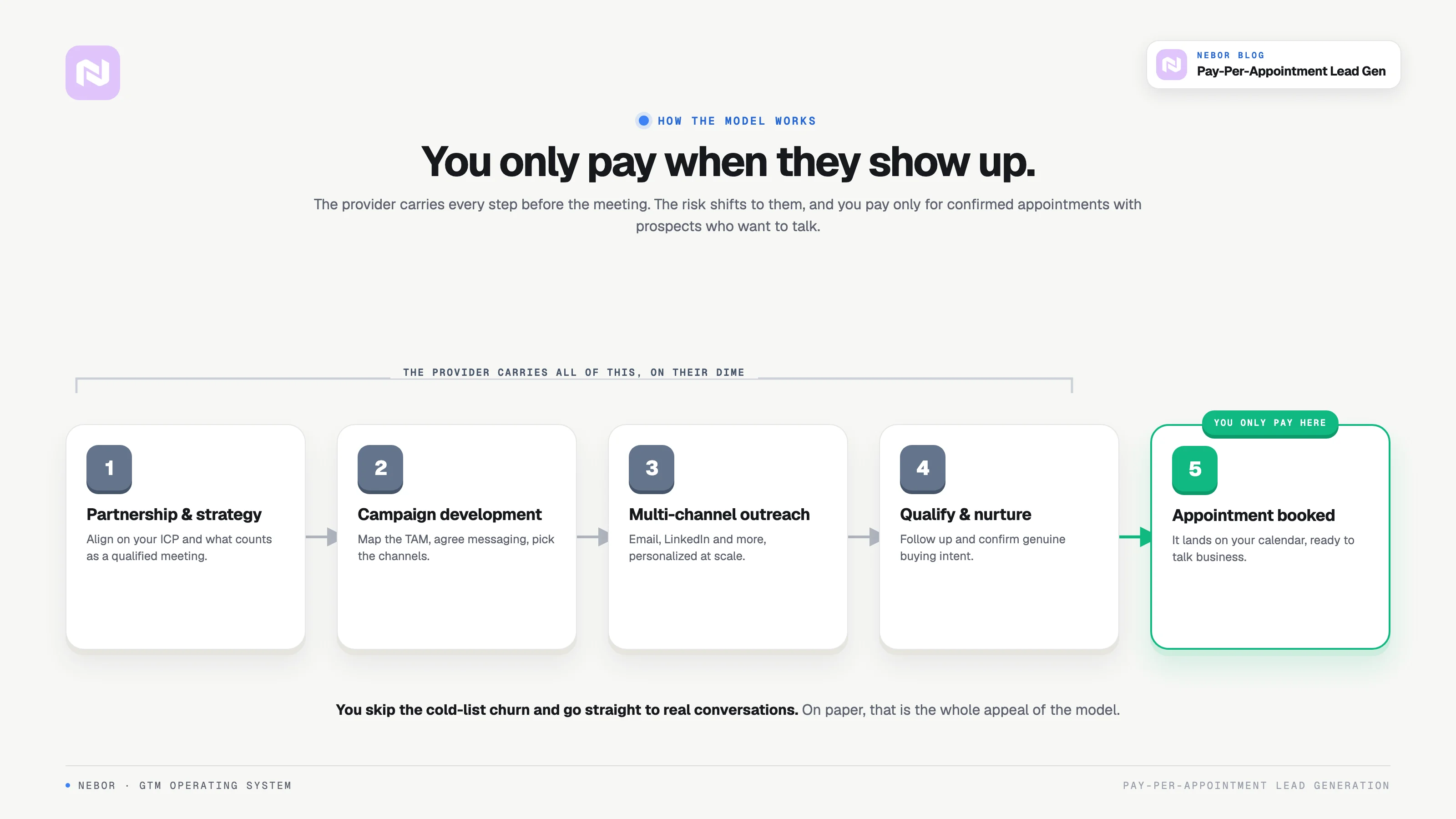
That eliminates the risk of a monthly retainer, where you pay no matter what happens with the results. The provider takes on more of the result risk, and only earns when they book a meeting with someone worth your team's time.
On paper, the model gets you straight to real conversations with prospects who actually want to buy. Skipping the cold-list churn is real value for any sales team that has lived through it.
How pay-per-appointment lead generation should work
Here's how the model usually goes from start to finish.
Step 1. Partnership and strategy
You partner with a provider who knows your industry and digs into your business, your ICP, and your goals. The work cannot be one-size-fits-all, so everything has to be shaped around your specific situation.
You also have to align on what counts as a successful appointment or a qualified lead. That definition is what stops the partner from booking random meetings just to hit the volume metric.
Step 2. Campaign development
Together you map your target market and ICP, agree on the messaging, and set appointment or lead generation goals.
The provider also picks the right channels for your buyers, whether that means cold email, LinkedIn outreach, or another route. For the TAM mapping side of this work, we wrote a full guide on the math.
Step 3. Multi-channel outreach
The provider launches your campaign across the chosen channels and tries to reach buyers where they actually engage. Modern providers use AI-driven prospecting workflows to personalize at scale while keeping a human voice on the message.
Step 4. Qualification and nurturing
This is where the real work happens. Instead of forwarding anyone who shows a flicker of interest, the provider follows up, nurtures the lead, and confirms genuine buying intent before booking a meeting.
Step 5. Appointment booking
Only after the provider has qualified the prospect and confirmed real interest does the meeting land on your calendar. You stop wasting time on tire-kickers and start talking to people who are actually ready to buy.
The result is that you only pay for appointments with prospects who match your criteria and who actually want to talk. Those are the low-hanging fruit that convert into customers most easily.
Why pay-per-appointment beats traditional lead generation
Traditional lead generation ran on one assumption. Pay enough upfront, and results would eventually show up.
You got lists you didn't ask for, retainers locked in for twelve months, and promises that read more like horoscopes. Most companies accepted this because the shelf had no better options.
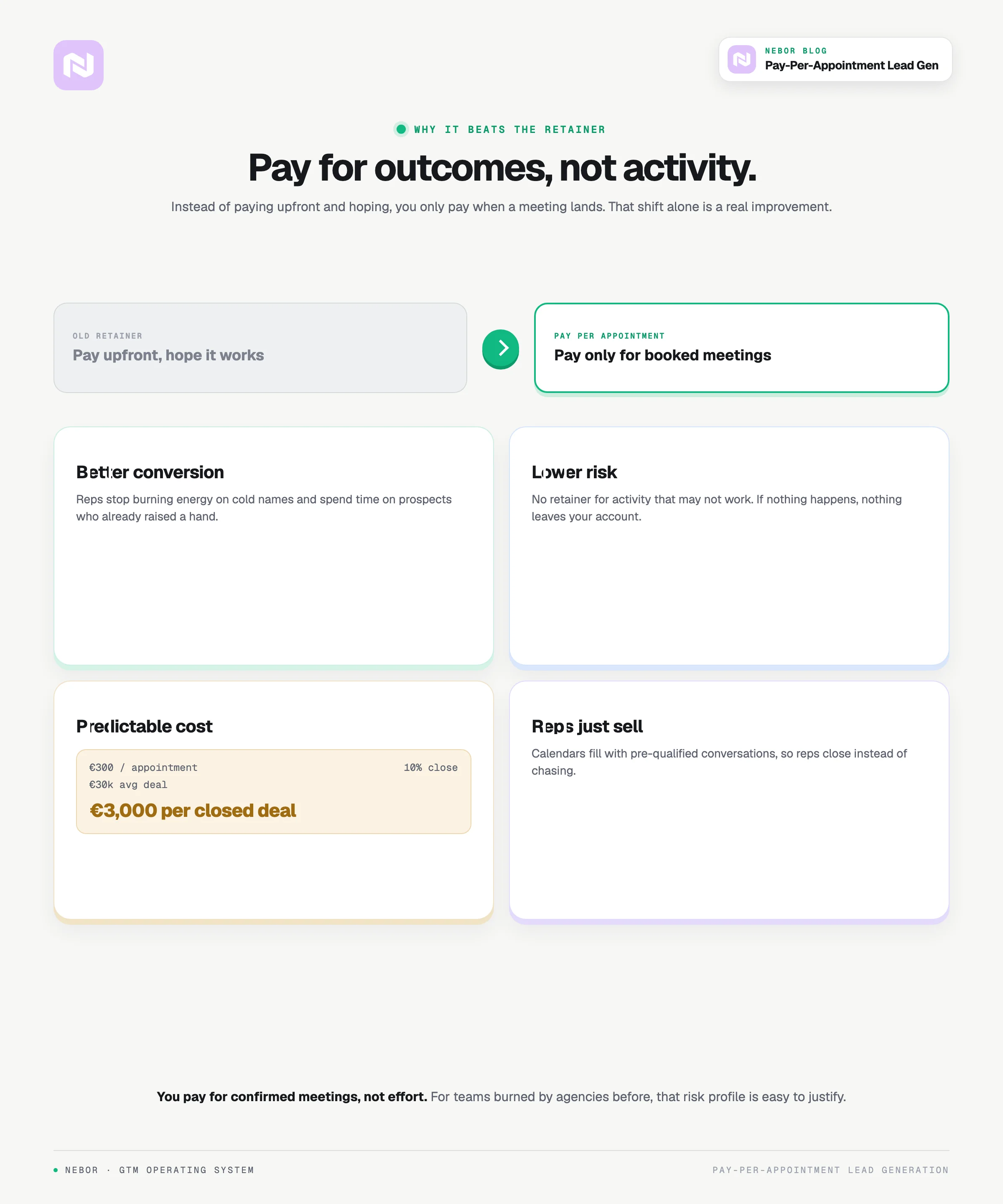
Pay-per-appointment changed that, and for a while it felt like a breakthrough. Instead of paying for activity, you pay for outcomes.
Instead of hoping a campaign works, you only pay when the provider books a meeting on your calendar. That shift alone makes pay-per-appointment a clear improvement over the old retainer model.
Better conversion rates
When you only pay for meetings with prospects who already raised their hand, the quality of the conversation improves. Sales reps stop burning energy on people who never had a reason to be on the call.
The result shows up in two places. Conversations get less friction up front, and close rates climb because reps spend their time on warmer prospects. This is why so many teams see close rates climb fast when they switch to pay-per-appointment.
Lower risk, and the chance to save money
Traditional lead generation asks for trust before proof. You commit to months of retainers, campaigns, and tools without knowing whether any of it will work for your market.
Pay-per-appointment flips the logic. You don't pay for effort, you pay for confirmed meetings. If nothing happens, nothing leaves your bank account. The risk profile is much easier to justify, especially for teams that have been burned by agencies before.
Predictable cost per opportunity
Pay-per-appointment gives marketing teams something a retainer almost never provides, which is real cost clarity. You know what each sales opportunity costs. ROI calculations stop being emotional, and budgeting becomes a math problem instead of a guessing game.
If an appointment costs €300, your average deal size is €30,000, and your close rate is 10%, your fully-loaded acquisition cost per closed deal lands at €3,000.
The number is simple, transparent, and predictable, which is almost impossible to claim with a traditional retainer.
Reps can focus on selling
Pay-per-appointment also wins on operational focus inside the sales team. Reps stop prospecting and start selling, which is the work they were hired to do in the first place.
Instead of cold outreach and manual qualification, calendars fill with pre-qualified conversations.
Your sales reps spend more time closing, and less time chasing. For many teams, that shift alone justifies the model.
The hidden problems with pay-per-appointment that agencies don’t talk about
Pay-per-appointment fixes some real problems with the old retainer model. It also quietly creates new ones, and most teams only spot them after a few months of paying invoices.
The incentive problem is baked in
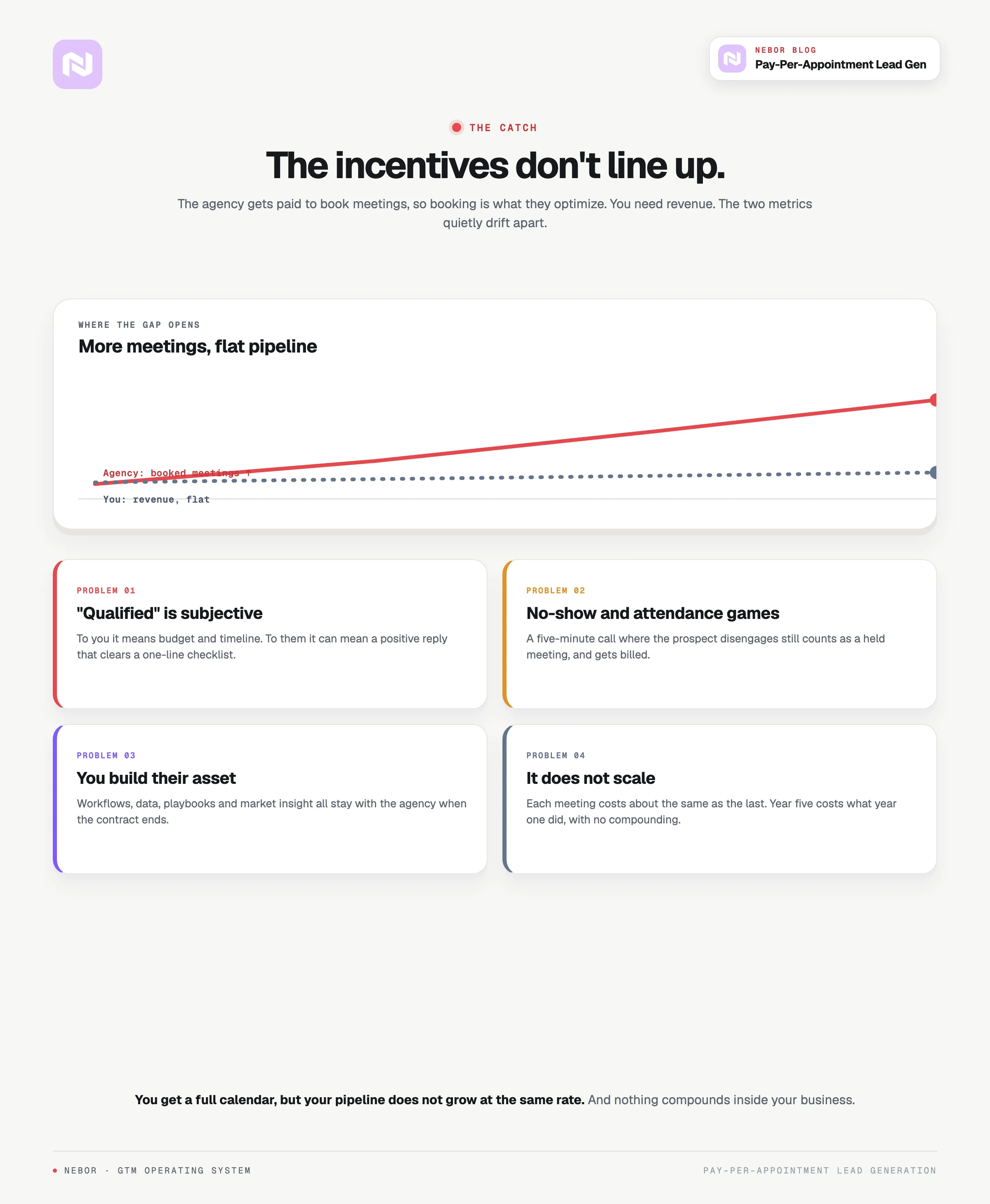
Pay-per-appointment lead generation agencies get paid to book meetings, so booking is the metric they optimize against. Yours is revenue, and the two metrics do not line up.
When the agency optimizes for booked calls, qualification naturally loosens. Anyone who shows a sliver of interest becomes a meeting. More meetings mean more revenue for the agency, no matter what happens after the call.
You get a full calendar, but your pipeline does not grow at the same rate. Close rates drop quietly, deal quality slides, and the agency does not feel any of it because their fee already cleared.
Quality is almost impossible to guarantee
Every agency promises qualified appointments in the contract they sign with you. The hard part is that "qualified" is a subjective definition.
To you, qualified usually means a decision-maker with budget, a real pain point, and a sensible timeline. To the agency, qualified can mean a positive reply that hits a one-line internal checklist.
That gap is why so many teams end up in calls that never had a chance to convert. The label says qualified, but the pipeline tells a different story two quarters later.
No-shows and attendance games
The fine print matters more here than in most contracts. Some agencies charge when a meeting is scheduled, others charge when the meeting is held, and the definitions vary across contracts.
A five-minute call where the prospect immediately disengages still counts as a held meeting in most contracts. The agency checks the box, books the revenue, and you get nothing that moves a deal forward.
You’re building their asset, not yours
This is the part most teams miss until the contract ends. Pay-per-appointment is a rental, not a build, and when you stop paying, everything stops with the invoice.
Nothing transfers from the agency's side to yours when the contract ends, including the workflows, the data, the playbook, the enrichment logic, the messaging that finally worked, and the read on what your market actually responds to.
After a year of spend, nothing inside your business has compounded.
The agency, on the other hand, keeps everything they built with your money. They own the playbooks, the enrichment recipes, the demand insights, and the texture of your market.
You aren't buying an engine, you're paying for fuel for someone else's engine, often the same engine they use for ten other clients in your space.
This is the core argument behind ownership over rental, and it is at the heart of how we think about agency models at Nebor.
You can’t optimize what you don’t control
Because the agency owns the outreach, you cannot do real experiments. You cannot test messaging in real time, change targeting based on a new product launch, or build the feedback loops that make outbound get smarter over the months it operates.
When something breaks, or when your business goals change, you wait. The agency's priority does not shift when your goals do. Their incentive is still booking meetings, not building anything that compounds inside your company.
It does not scale sustainably
Pay-per-appointment scales linearly, which means each new meeting costs roughly the same as the one before it, no matter how long you have been at the program.
There is no learning curve that makes the model cheaper over time, and no compounding efficiency that builds inside the system. Year five costs about the same as year one, adjusted for the agency's price increases.
The better alternative is owning the GTM infrastructure that builds your pipeline
Here is what we believe at Nebor. You should own your outbound and sales infrastructure, full stop. If your sales pipeline still needs help while you build that, the right outbound experts can patch things in the meantime.
The trade is not complicated when you write it out.
Instead of paying per appointment forever, you invest once in a system that works on autopilot, improves over the months it operates, and stays inside your company when our engagement ends. Your team understands it, controls it, and can keep optimizing it long after we hand it over.
Owning the system means more than having access to a few tools. We are talking about a setup shaped around how your business actually sells.
Every part of the build is shaped by your market, your deal cycles, your buyers, and the internal constraints your team has to work inside.
And no, this is nothing about a generic playbook. This is where most automation-first agencies fall short.
They start with the technology, then try to fit your business into the tools they happen to know. We start with the business problem and pick the tools afterward.
Because of our 10+ years in corporate B2B sales, we understand pipeline problems before we touch software. We know how pipeline gets created, where deals stall, how qualification actually works, and what sales teams need from the system in front of them.
That is what lets us translate business needs into technology, instead of forcing technology onto the business.
Salespeople first, automation experts second.
Tools like Clay are powerful, but they are only as good as the thinking behind them. Most Clay implementations fail because teams treat the tool as the strategy.
Clay on its own is not a solution. It is raw infrastructure, and the value comes from shaping it around your ICP, your buying signals, and your go-to-market motion. That is the part where we earn our fee, not in the tool license.
That is why our systems get built around best-in-class tools, including Clay, Lemlist, Instantly, HeyReach, Zapmail, Leadsfactory, HubSpot, Salesforge, Leadinfo, and Snitcher, and never led by them.
Everything we build is custom, the tools stay interchangeable, and the system design adapts to the business in front of us.
How we build your automated GTM system at Nebor
As we said earlier, building a GTM system that actually works is not about stringing tools together and hoping automation magically books meetings.
The job is to understand your business, your customers, and your sales motion, and then design a system that replicates what your best sales reps do, automatically, every day.
Here is what working with us looks like in practice. None of it is a cookie-cutter engagement, because none of our clients have identical sales motions. The deliverable is a system you own that handles your top-of-funnel on autopilot.
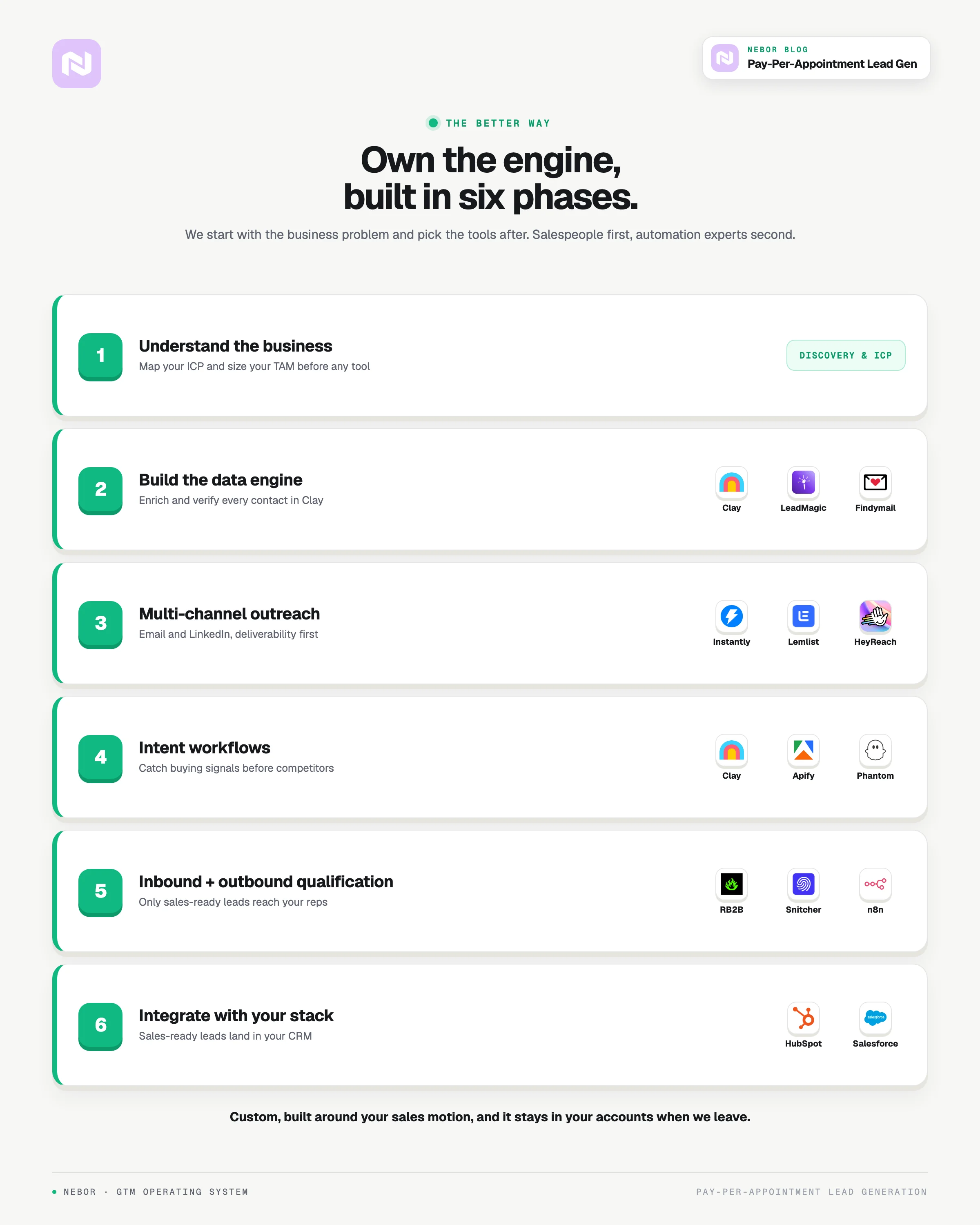
Phase 1: Understanding your business, mapping your ICP, and sizing your TAM
Before any tool, sequence, or automation, we get to understand your business at a granular level. Most agencies stop at "Who is your target customer?" That answer scratches the surface and never reaches the foundation underneath it.
We ask questions most teams have not stopped to consider:
Who are your current best customers, and what traits do they share?
What specific problems does your product or service solve for them?
Who else influences the buying decision inside their company?
Which industries or company sizes fit best with your offer?
Why do some prospects choose a competitor instead of you?
If you could clone your best customer 100 times, what would those companies look like?
What triggers make a prospect need your solution right now?
This is not a quick 30-minute call. It is a full discovery process that lays the foundation for the build that follows. No matter how clever the automation gets, an automated system pointed at the wrong people with the wrong message just accelerates the wrong outcome.
Once we have mapped your ideal prospects, we align on your sales goals, including the number of leads your team can actually handle, your revenue targets, and your capacity limits. Then we size your total addressable market so the build stands on a realistic, measurable foundation.
Phase 2: Building your data infrastructure in Clay
With clarity on who to target and why, we build the data engine.
Clay becomes the central hub of your outbound system. We use Clay because it lets us house every prospect, enrich them, and qualify the contact before any sequence touches them.
We do not lean on the generic, oversaturated databases everyone else defaults to, like Apollo. Instead, we go into industry-specific sources your competitors are not even thinking about, because unique data still gives you a competitive edge in any market that has been over-prospected.
We layer multiple enrichment tools, including LeadMagic, FullEnrich, LeadsFactory.io, and Findymail, and we pick the stack based on the use case.
We verify every contact across multiple sources, because relying on a single list is risky in 2026. Emails bounce, phone numbers go dead, and LinkedIn profiles drift out of date.
Deliverability matters more than most teams realize. We verify emails through ZeroBounce, BounceBan, and DeBounce. We cross-reference phone numbers and LinkedIn profiles.
The multi-layered verification costs more, and the accuracy saves time, effort, and sender reputation. Automated outbound only works when the data underneath it is real.
Phase 3: Designing your multi-channel outreach orchestration
Clean data is half the battle, and the other half is designing outreach that actually creates conversations, not just hits send on cold emails.
For email, we use Instantly and Lemlist, but never before we build the deliverability infrastructure underneath. That means proper domain setup, warm-up cycles, and sending patterns that protect your sender reputation across the year.
For LinkedIn, we wire Lemlist or HeyReach into the Clay workflow with PhantomBuster handling the parts the platforms make harder. LinkedIn outreach has its own rules, so the workflow has to reach your audience without tripping detection systems.
This is where our sales experience earns its keep, because we do not blast generic templates. Using Claude and ChatGPT, we craft research-backed, personalized messaging, or calling scripts when the channel is cold calling. Each message reflects a prospect's role, their company, the pain points they actually have, and the real-time context around their account.
Everything ties together through Clay or n8n webhooks when we cannot make a direct API call between two tools.
The result is a self-sustaining system that surfaces opportunities and reaches out automatically, day and night, with Clay at the center for full visibility into every touchpoint.
Phase 4: Building intent workflows that catch buying signals before competitors do
This is the phase where the build starts catching buying intent before your competitors even notice.
Because of our sales background, we know how to set up monitoring, tracking, and scraping systems that pull intent data and buying signals from public sources into our Clay tables, so the system reaches out automatically the moment a signal lands.
Here we wire RSS-feed workflows around tools like Clay, Apify, PhantomBuster, RB2B, and n8n. What we monitor depends on your business and your buyers, but it usually falls into one of four categories:
Job postings that signal a need for your solution
Funding announcements that indicate fresh budget
Content engagement that shows interest in adjacent topics
Technology adoption that complements your offer
A concrete example makes the workflow tangible. We work with a Nebor client that sells tax solutions to enterprise companies, and we set up RSS feeds to track outlets that report on revenue surges at Fortune 500 companies.
The logic is simple, since a surge in revenue means more tax exposure, which is when our client's product earns its place. The system scrapes the news, pulls the signal into Clay, and our outreach goes out automatically with the news baked into the message.
When the system spots these buying signals, we prioritize those prospects in our outreach, which dramatically improves response rates compared to generic timing.
Phase 5: Connecting inbound and outbound so qualification stops being a manual job
This phase is one most lead generation agencies do not deliver, and it shows up in the hand-offs your sales team is forced to do manually. We were salespeople first, so we know exactly how much time gets wasted on the inbound side.
Most teams qualify inbound leads manually, which costs hours and burns sales talent on work that should happen on rails. If you have a bigger team with separate sales and marketing departments, you also have the chronic alignment fight over who is "ready" for a sales conversation.
Inbound interest is messy by definition, since some leads are casually curious while others are seriously evaluating, and a generic follow-up flow treats both groups the same.
Our system qualifies leads based on their responses and engagement patterns, after we sit with your team and lock in the qualification criteria your reps actually trust.
The system works through Clay workflows wired to Apify, RB2B, Snitcher, Leadsfactory, PhantomBuster, Make, or n8n, depending on your stack and the signal source.
When a prospect shows real interest, whether through your blog, your socials, or your inbound meeting flow, the data lands in Clay, the qualification happens automatically, and only the sales-ready prospects move to your reps.
The rest enter a nurture sequence, and the system re-evaluates them when their behavior changes.
Because we integrate with your existing CRM, sales-ready leads land cleanly inside your pipeline, complete with the engagement history and the talking points your reps need to walk into the first call already knowing the context.
Phase 6: Integration with your existing systems
Everything we build gets wired into your existing stack, your CRM, your communication tools, and your processes. We do not rip out what already works for your team.
Data flows automatically from prospecting into your CRM. Notifications reach the right people at the right time. Your team operates inside the tools they already know, while the system works in the background and generates pipeline without daily oversight.
How much pay-per-appointment lead generation actually costs over time
Let me lay out the numbers honestly, because the math matters more than any pitch.
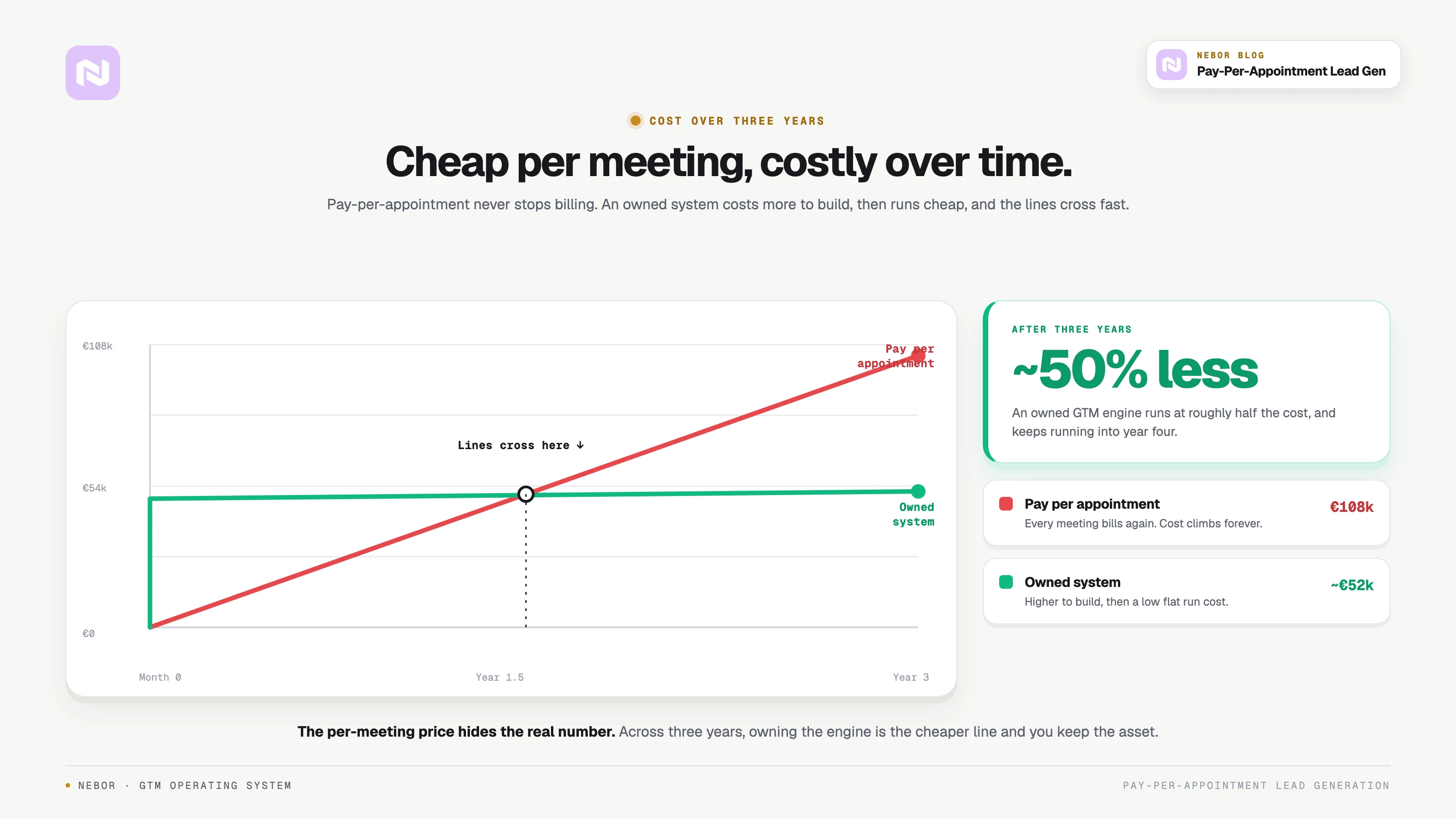
If you pay €300 per appointment and book 10 of them per month, that lands you at roughly €3,000 per month, or €36,000 per year.
After two years, you have spent about €72,000.
After three years, you are at €108,000.
The bigger problem is invisible in those numbers. The moment you stop paying, the pipeline stops with you.
Then layer in the conversion math. If your average close rate is 10%, that €108,000 over three years yields a handful of closed deals, not a stack. You are paying for volume, not for guaranteed revenue, and the volume disappears the day the contract ends.
How an owned GTM system compares on cost
Owning the system has a different cost structure with three components.
Tool subscriptions. CRM, data enrichment, email verification, outreach automation, and monitoring platforms that range from a few hundred to a couple thousand euros per month, depending on scale.
Setup and implementation. The one-time work to configure tools, build workflows, and design sequences, which is the upfront investment that makes the rest last for years.
Ongoing maintenance and optimization. Monthly monitoring, troubleshooting, workflow tweaks, deliverability checks, and campaign refinements that keep the engine working and adapting to your market.
Even with all three line items priced in, projections over three years show that owning the system costs 50% or less of pay-per-appointment at the same volume, while leaving you with a working pipeline that does not disappear if you pause spending.
Why Nebor builds Owned GTM systems instead of selling appointments
Pay-per-appointment was a clear improvement over the retainer-based agency model. It reduced risk for the buyer and aligned incentives more closely with results.
At the end of the day, though, it still treats pipeline as something you rent, not something you own. That is a fundamental limitation, especially with the AI tooling available in 2026.
The companies winning today are not the ones with the best agencies. They are the ones with the best GTM systems, the kind that keep going all year, get smarter over time, and turn outbound from a grind into a predictable, self-sustaining engine. Here’s what it looks like.
At Nebor, we approach the work differently because the founding team ran outbound campaigns of our own for years before we started building these systems for clients. That order matters more than any tool stack.
Salespeople first, automation experts second.
That experience shapes everything we build for clients. The systems we put in place work because they are built on a real sales motion, and the team you keep after we leave can operate them without us. This is the reason we position ourselves as a GTM agency, not a lead generation agency.
If you only want meetings booked forever, pay-per-appointment works, sort of. If you want to own the engine that produces those meetings, there is a better path. We have helped companies generate millions in pipeline by building systems they keep, and we can help you do the same:
Automate your outbound outreach end-to-end
Save your team 20+ hours a week on manual prospecting
Build a predictable, scalable pipeline that does not disappear when you stop paying
If you want to talk through how this would look for your setup, book a 15-minute call and we'll map what a GTM build would do to your cost structure, and what your forecast would look like a year out.


Related Articles


By clicking Sign Up you're confirming that you agree with our Terms and Conditions.