
7 beste GTM engineering-bureaus voor B2B revenue-automatisering (en hoe je kiest wat bij je team past)


In this post:
GTM engineering is a simple sales enablement job that picked up an engineering name along the way, and the engineering part was always the easy half.
Wiring the tools is solved problem now: anyone with a free afternoon and a Claude subscription can connect Clay to Instantly, push replies into HubSpot, and send an n8n webhook when a funding round hits the news.
The hard part never moved: it is still deciding what the machine should do.
Which companies the system should go after in the first place.
How to go about targeting enterprise accounts.
Which of them are worth reaching this week instead of next year.
What the message has to say to earn a reply.
Every one of those was a sales call back when a rep made it by hand, and it is still a sales call now that a system makes it a thousand times a day. No tool makes those calls, and no engineer who never carried a quota makes them well.
That gap is why this shortlist is worth reading. Search for GTM engineering agencies today and you get automators, outbound shops, SDR firms, HubSpot partners, and paid media agencies all using the same two words, each good at a different job and a different go-to-market strategy.
Picking the wrong go-to-market agency for your business model will cost you a quarter you cannot get back.
So, here, we explain what GTM engineering agencies do that traditional marketing agencies do not, show how we build these automated systems, and give you a straight read on six other go-to-market agencies and when to hire them instead of us.
TL;DR
Most GTM agencies sell you the build: the enrichment waterfall, the sending setup, the Clay tables, and a Loom on how it all fits. That is the visible half of GTM engineering, and the half that gets cheaper with every new AI release.
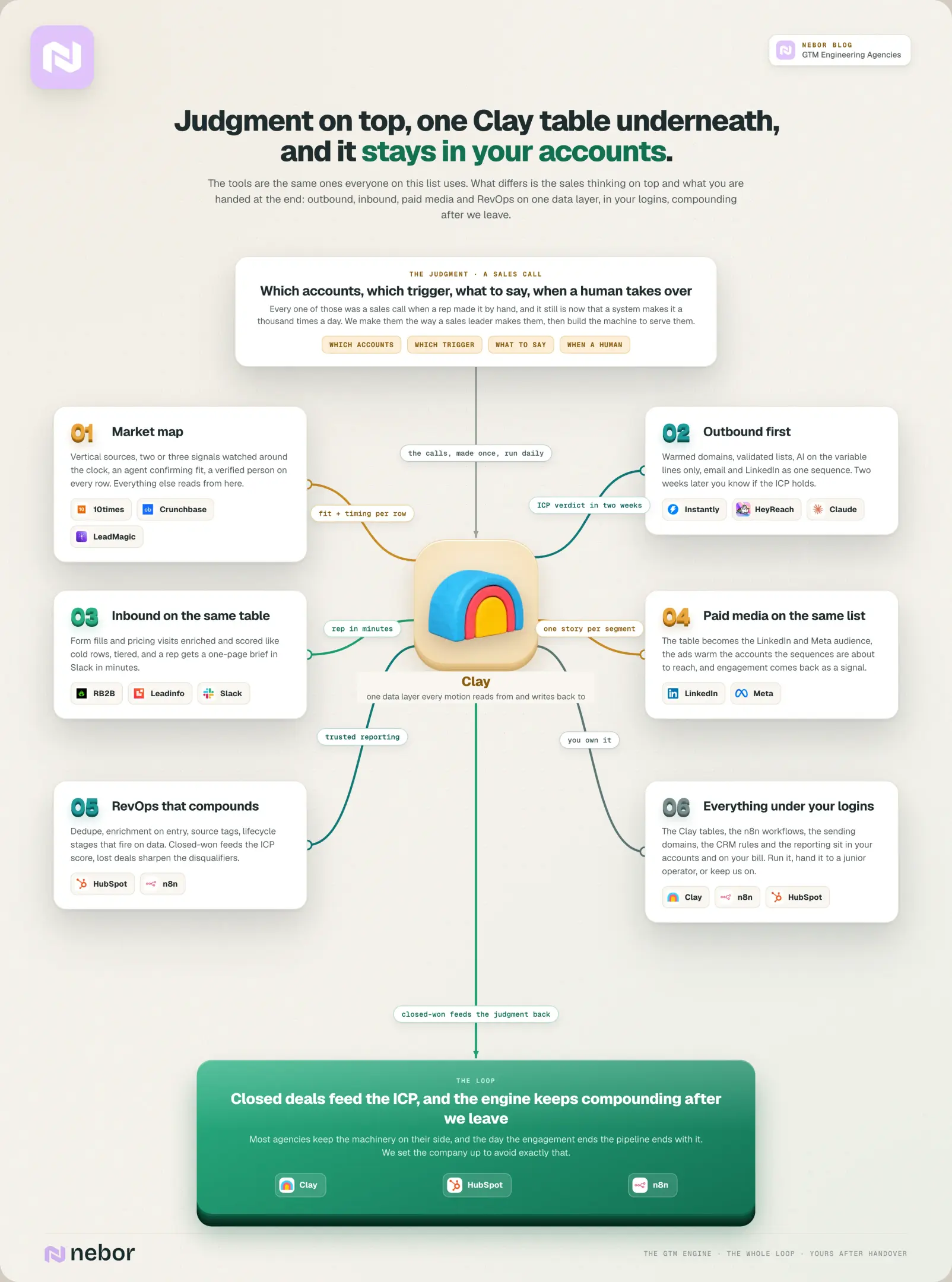
The half that decides whether any of it produces revenue is the growth strategy and the judgment on top of the build: that judgment is GTM strategy, and no tool ships with it.
Which accounts enter your system, what counts as a buying trigger in your market, which channel your go-to-market strategy funds first, and when a human takes the conversation over from the machine.
We ran outbound and closed deals for years before automating any of it, so we make those calls like a sales leader and build the machine to serve them. Here's what our client's say:
We also do the deep customer research and build the whole engine, outbound, inbound, paid media, and RevOps on one data layer, in your accounts, so it compounds after we leave.
How we chose the best GTM agencies for this list, ourselves included
We are on this list, so read our criteria knowing that. We scored everyone's key services on the seven things we would check before hiring a good GTM agency ourselves, and that we would want you to check on us.
Criteria #1: Depth in data enrichment and the automation platforms behind your revenue engine
GTM engineering integrates your CRM with a stack of enrichment, outreach, and marketing automation tools, the plumbing under every sales enablement promise, so we looked for real depth in Clay, HubSpot, Salesforce, n8n, Instantly, and the data providers behind them.
Depth means the agency has hit the platform's edge cases on real accounts, so we read case studies and partner directories instead of the logo strip.
Criteria #2: A track record with numbers attached, and named clients behind the numbers
Case studies, named clients, meetings booked, reply rates: data-driven GTM agencies publish their results, and the ones hiding behind vague promises usually have a reason.
We also read the numbers with a sales eye, because "eight million emails a month" and "thirty companies supported" describe two very different clienthoods.
Criteria #3: Focus on B2B SaaS revenue automation and demand generation instead of a little bit of everything
We weighted agencies focused on revenue operations, outbound automation, and demand generation for B2B SaaS and service companies over a market agency that also does brand, PR, influencer marketing, content marketing, and everything else, or one built for consumer brands, and we looked at industry specialization, because some agencies specialize in B2B SaaS and complex sales cycles, and a partner who knows your vertical ramps faster.
Criteria #4: Documentation and handover, meaning who owns the system when the contract ends
Who owns the workflows when the engagement ends separates GTM agencies more than any tool logo. If the tables, the domains, and the logic live in the agency's workspace, you have rented a service, and the day you stop paying is the day your pipeline finds out.
Criteria #5: Speed to first result, and honesty about what that speed costs you later
Some of these agencies get a first campaign live within two weeks, and others need a full quarter of GTM planning before anything ships. Neither is wrong, but a good GTM agency tells you which one you are buying up front.
Fast usually means narrower scope with more process on their side; slow usually means a system designed before it switches on.
Criteria #6: Integration across CRM automation and the entire revenue stack instead of one channel done well
CRM data, enrichment, outreach, ads, and reporting either share one source of truth or they do not, and effective go-to-market strategies rely on unified data across teams.
An agency that only touches one channel can make that channel look great while your CRM, your ads, and your inbound keep describing three different companies, and your revenue funnel pays for the confusion.
Criteria #7: What happens after launch, because that is where systems either compound or rot
Continuous optimization, performance measurement, weekly reviews or GTM workshops, and someone owning the GTM strategy after launch. Vendor studies claim sales automation can triple pipeline generation; we treat vendor math as marketing, but the direction is right. The real test of any engine is whether the list refreshes, the signals still land, and someone is watching the reply rate in month five, because GTM performance compounds or rots after launch.
The alignment research backs the last three points: the oft-quoted benchmarks put sales and marketing alignment at roughly 15 percent higher revenue growth, with customer acquisition costs 10 to 20 percent lower and customer retention around 36 percent higher. Effective alignment takes regular communication and shared goals across sales teams and marketing, which is what real sales alignment and marketing alignment mean in practice; a single-channel agency cannot deliver it.
A GTM engineering agency that only touches one channel cannot help you with any of that.
The 7 best GTM engineering agencies at a glance, and when to hire each one
Agency | What they mainly sell | Hire them when |
|---|---|---|
Nebor | A full GTM engine you own (outbound, inbound, paid, RevOps on one data layer) | You want the pipeline system built, explained, and left in your accounts |
ColdIQ | Managed outbound and a GTM data API | You want outbound handled and a large data toolbox behind it |
The Kiln | Deep technical Clay engineering | You have a strong in-house operator to take the handoff |
RevPartners | RevOps and HubSpot rebuilds with Clay on top | Your CRM has to be fixed before outbound is worth doing |
Understory | Allbound: paid media, outbound, content, RevOps | Your ads and your emails currently say different things |
GTM Engineering (gtm-engineering.io) | A fractional GTM engineer on retainer | You are seed to Series B and building the stack for the first time |
The Playbook Agency | Clay and RevOps engineering plus outbound as a service | You want a European partner with published starting prices |
What you get when you hire Nebor, a GTM growth agency, to build your go to market engine
We are Nebor, a GTM and growth agency, and we build GTM systems for B2B SaaS and service companies that plan to keep them.
Our marketing automation stack is the same one everyone else on this list uses: Clay, n8n, Instantly, HeyReach, RB2B, Leadinfo, FullEnrich, Findymail, and LeadMagic.
Nobody in this category has a tool the others cannot buy, so comparing tool lists tells you nothing.
What you should compare instead is how each agency thinks about modern go to market work and revenue engines, which core services it actually sells, and what each one hands you at the end.
Connecting sophisticated tools together does not grow anything on its own.
The sales thinking and the GTM strategy behind the engineering do, which is why you want people who sold before they engineered. Here is what that looks like in practice, layer by layer, starting with the GTM planning that decides who the engine talks to, built on real customer research.
You get a market map and buying signals that decide who the whole engine talks to
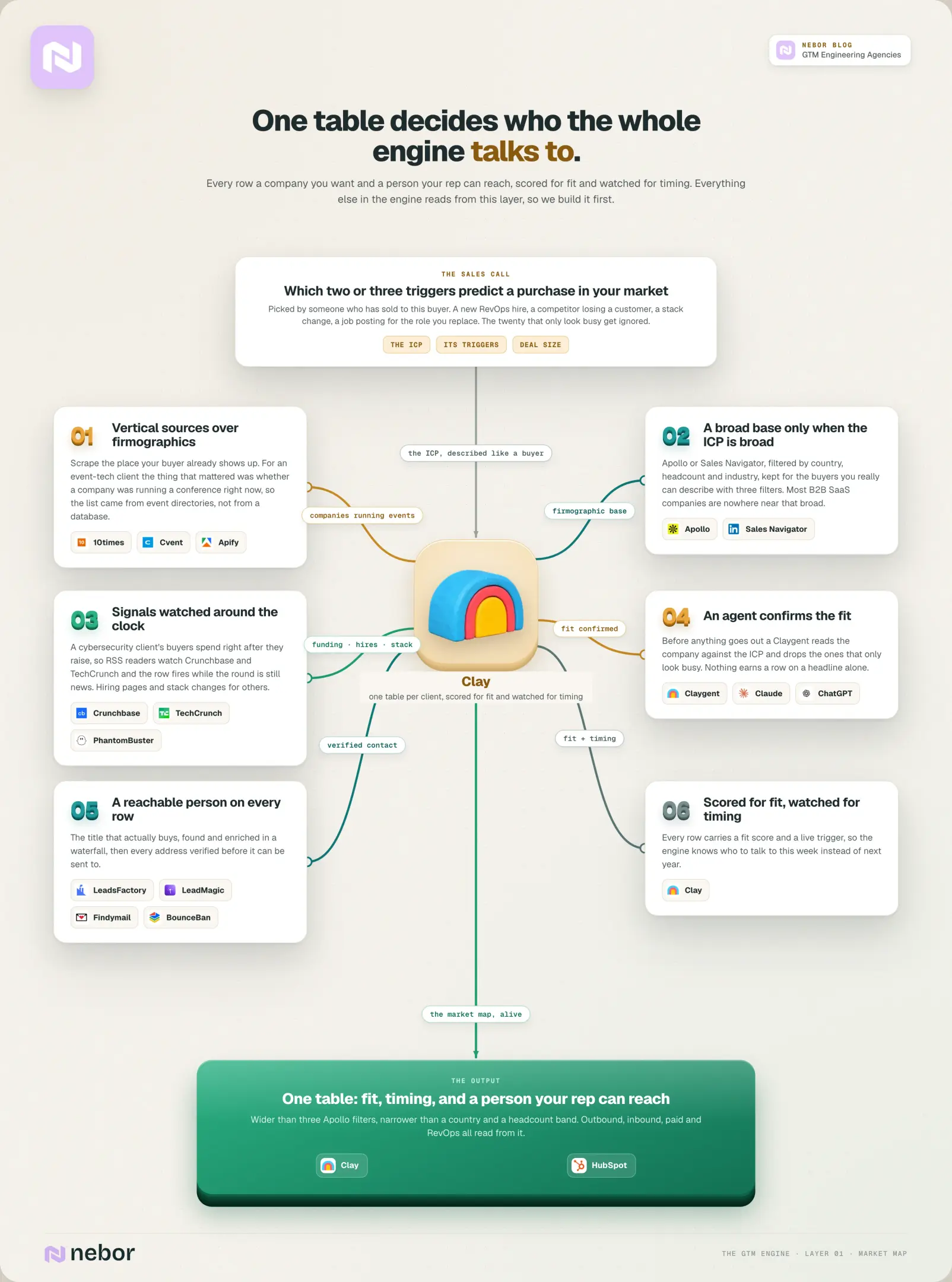
Everything else reads from this layer, so we build it first: one Clay table where every row is a company you want and a person your rep can reach, scored for fit and watched for timing. Your Ideal Customer Profile, the precise description of who gets the most value from you, anchors the scoring and keeps marketing, sales, and customer success aligned on who matters.
Teams blame their copy when outbound goes quiet, and the list underneath is almost always the real problem. The usual lead sourcing approach, even from expert GTM agencies, is to open Apollo, filter by country, headcount, and industry, and export whatever comes back: a list you could pull yourself, a guessing game you are paying for.
That works when your buyer fits three filters, and most of the B2B SaaS companies we work with are nowhere near that broad.
We worked with a SaaS company selling event technology, and the thing that mattered for their value proposition was whether a company was holding a conference right now.
No database sells that in a column, so we scraped event directories like 10times and Cvent and built the list from companies actively hosting events, instead of from firmographics.
The event itself was the intent, and your rep could read the sponsors and exhibitors and qualify the account before writing a word. (Though we automated that too.)
The same table then watches your target market for buying signals.
Another client sells enterprise cybersecurity, and their buyers spend right after they raise, so we set up signal-based prospecting with Apify and Clay's RSS readers watching Crunchbase and TechCrunch, and a Claygent confirms the company fits your ICP before anything goes out. The first message lands while the round is still news.
Every client needs different triggers: a new RevOps hire, a competitor losing a customer, a tech stack change.
Our job is picking the two or three that predict a purchase and ignoring the twenty that only look busy; our post on how to build your TAM walks through the method.
You get outbound first, because it is the fastest way to test the go-to-market strategy
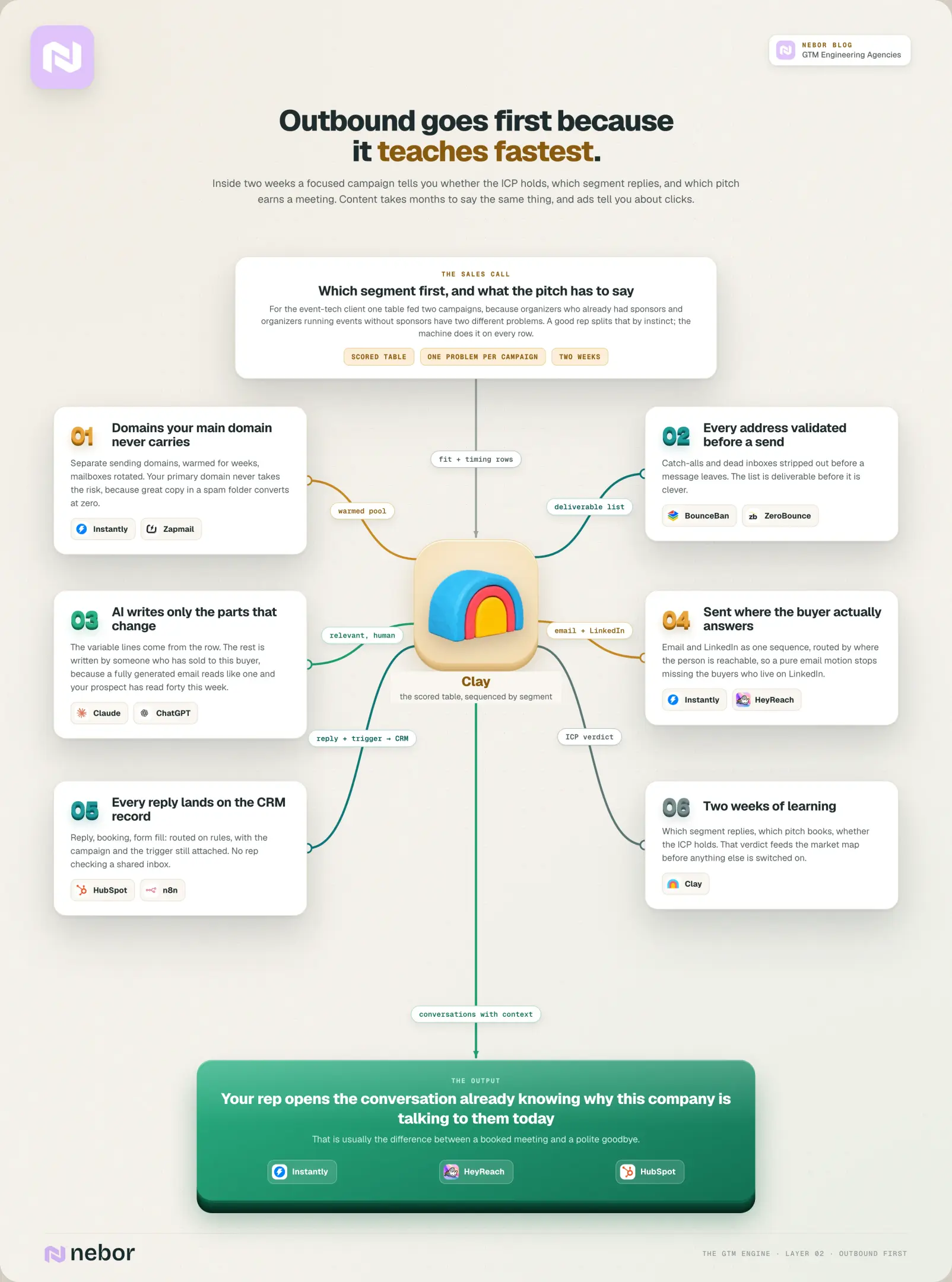
We switch outbound on first for speed of learning rather than any belief that outbound is the best channel: a focused campaign tells you within two weeks whether the ICP holds, which segment replies, and which sales pitch earns a meeting, and no other channel gives your GTM strategy that data as fast.
The outbound infrastructure is unglamorous and it matters: separate sending domains, proper warmup, inbox rotation, and validated addresses, because great copy in a spam folder converts at zero.
We use AI to write only the parts of a message that change per prospect, because a fully generated email reads like one.
The pitch logic is where selling experience shows up most. For that event client, one Clay table fed two campaigns, because organizers with sponsors and organizers without them have two different problems, and one generic email would have missed both. That split is a sales decision a good rep makes by instinct, and we build it into the machine so it happens on every row.
Every reply, booking, and form fill then lands on the right CRM record with its campaign and trigger attached, and routing follows rules instead of a rep checking a shared inbox. Your rep opens the conversation knowing why this company is talking to them today, and that is real sales enablement, usually the difference between a booked meeting and a polite goodbye.
You get inbound leads captured, enriched, and routed through the same system
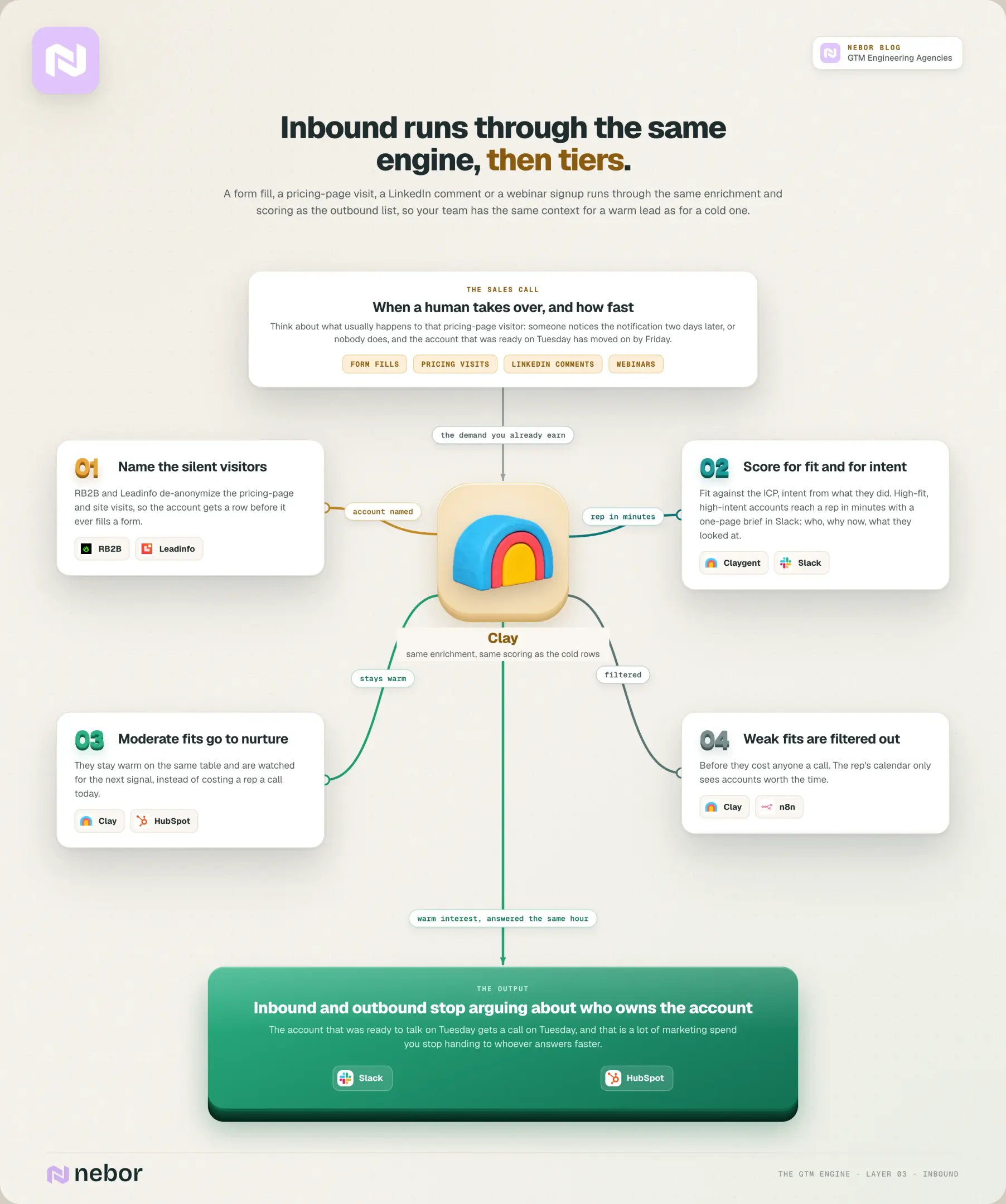
Once outbound has proved the ICP, we point the same engine at the demand you already earn: form fills, pricing page visits deanonymized by RB2B or Leadinfo, LinkedIn comments, and webinar signups all pass through the same data enrichment and scoring as the outbound list, so a warm lead gets the same context as a cold one.
Think about what happens to your visitors today: your team notices inbound leads two days later, or not at all, and the account that was ready to talk has moved on. That is a lot of marketing spend handed to whoever answers faster.
Our tiering does the rest of the work. Response speed is the cheapest conversion rate optimization there is: high-fit accounts reach a rep in minutes with a one-page brief in Slack, moderate fits go into nurture, and weak fits are filtered out before they cost anyone a call.
We wrote up the mechanics in our inbound meeting workflow guide, and the point of doing it in the same system is that inbound and outbound stop arguing about who owns the account, which is what a coherent GTM strategy looks like in practice.
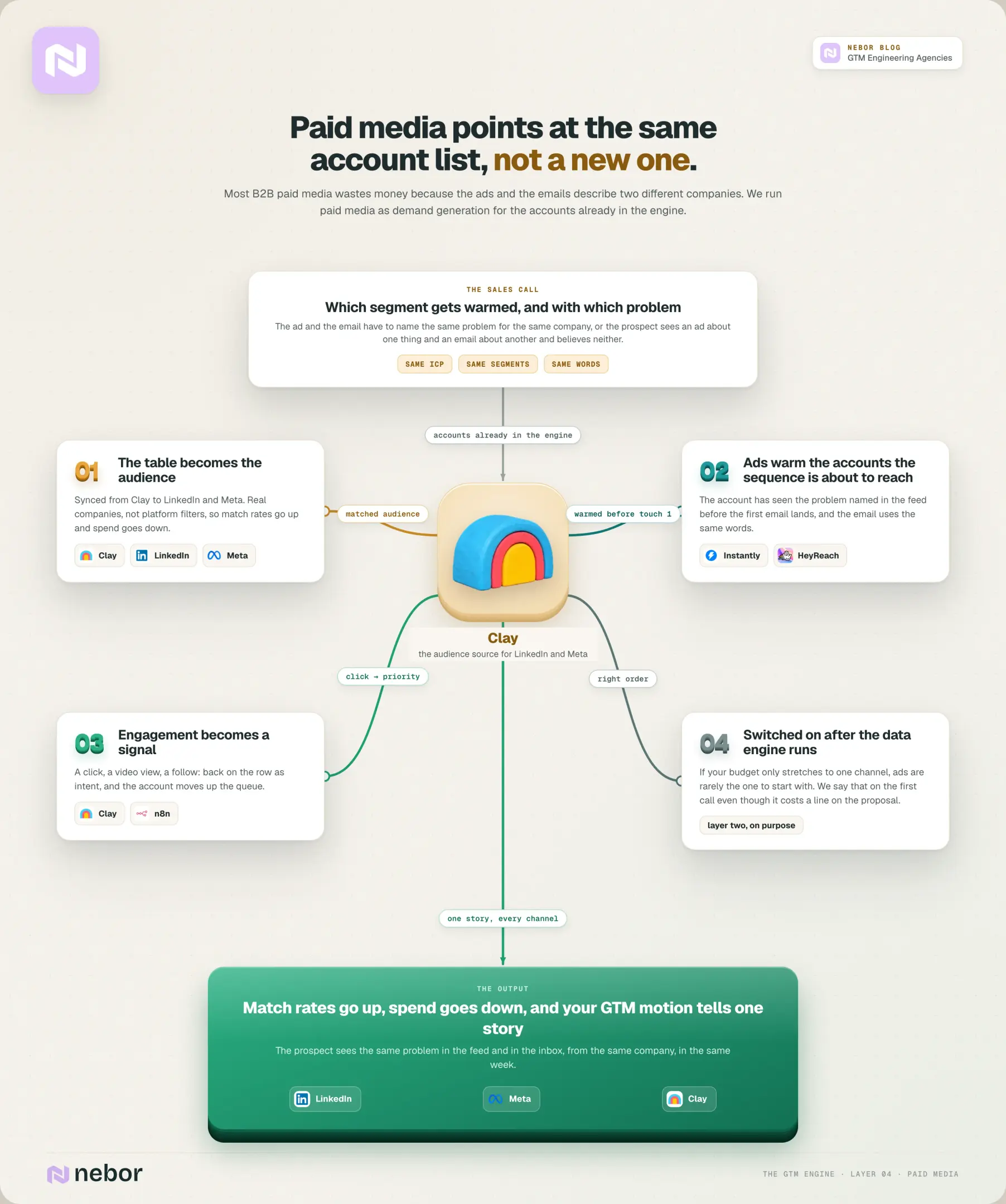
You get paid media pointed at the same accounts
Most B2B ad spend wastes money because the ads and the emails describe two different companies: the performance marketing agency builds an audience from platform filters, the outbound team builds a list from Clay, and the two never meet.
We use paid media as demand generation for the accounts already in the engine. The Clay table becomes the LinkedIn and Meta audience, the ads warm the companies your sequences are about to reach, and engagement with an ad becomes a signal that moves the account up the queue.
Match rates go up, spend goes down, managing budgets gets easier, and your GTM motion tells one story across every channel.
We recommend this layer once the data engine is live. If your budget stretches to only one of your growth channels, ads are rarely the one to start with, and we will say so on the first call.
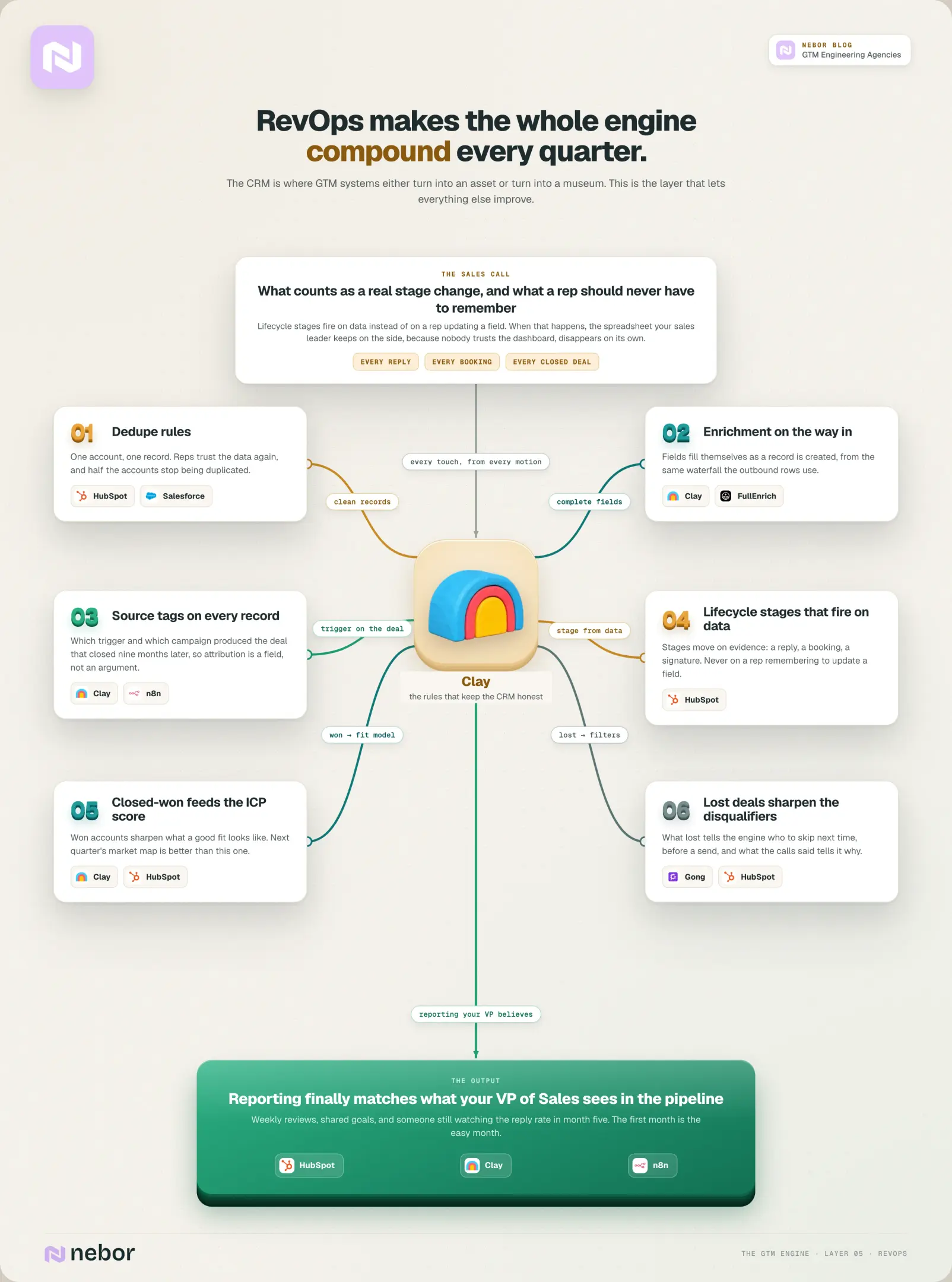
You get RevOps and CRM data that make the whole engine compound every quarter
The CRM is where GTM systems either turn into an asset or turn into a museum.
We build the CRM automation: dedupe rules, enrichment on entry, source tags that show which trigger produced the deal that closed nine months later, and lifecycle stages that move on data.
This is the layer that lets everything else improve. Closed-won accounts feed back into the ICP scoring, lost deals sharpen the disqualifiers, and reporting finally delivers actionable insights that match what your VP of Sales sees in the qualified pipeline.
When that happens, the spreadsheet your sales leader keeps on the side, because nobody trusts the dashboard, tends to disappear on its own. We covered how the six layers connect in how to build a GTM system that works on autopilot.
With Nebor, you get a system that stays in your accounts, designed by people who sold before they built
Andrew van Rossenberg and Yannick Kok lead Nebor from Amsterdam, and both spent more than 10 years each selling B2B software before automating a single workflow.
That matters because every decision in the engine, from which signal to trust to when a human should take over, is a sales judgment dressed up as a technical one, and we have been the rep on the receiving end of a bad one.
That GTM infrastructure, the Clay tables, the n8n workflows, the sending domains, the CRM rules, and the reporting all live under your logins and on your bill. Operate it with your own team, hand it to a junior operator after a walkthrough, or keep us on to keep improving it.
Most go-to-market agencies keep the machinery on their side, and the day the engagement ends the pipeline ends with it, which is the arrangement we set the company up to avoid.
The situations where we are the wrong hire, and you should keep reading
If you need thirty meetings in three weeks and do not care about month seven, hire an execution shop: a system takes a few weeks to pay back, and there is no shame in buying the meetings if that is the job.
If nobody on your side will touch the engine after handoff, most of what we build goes to waste: Clay setups without an owner get shelved within six months, and ours would too. Our post on why most Clay implementations fail explains that pattern in detail.
6 top go-to-market agencies you should consider in 2026
Several of the go-to-market agencies below would serve you better than we would in the right situation. Here is a straight read on each one: its key services, where it stands out, who it fits, and where it stops.
1. ColdIQ
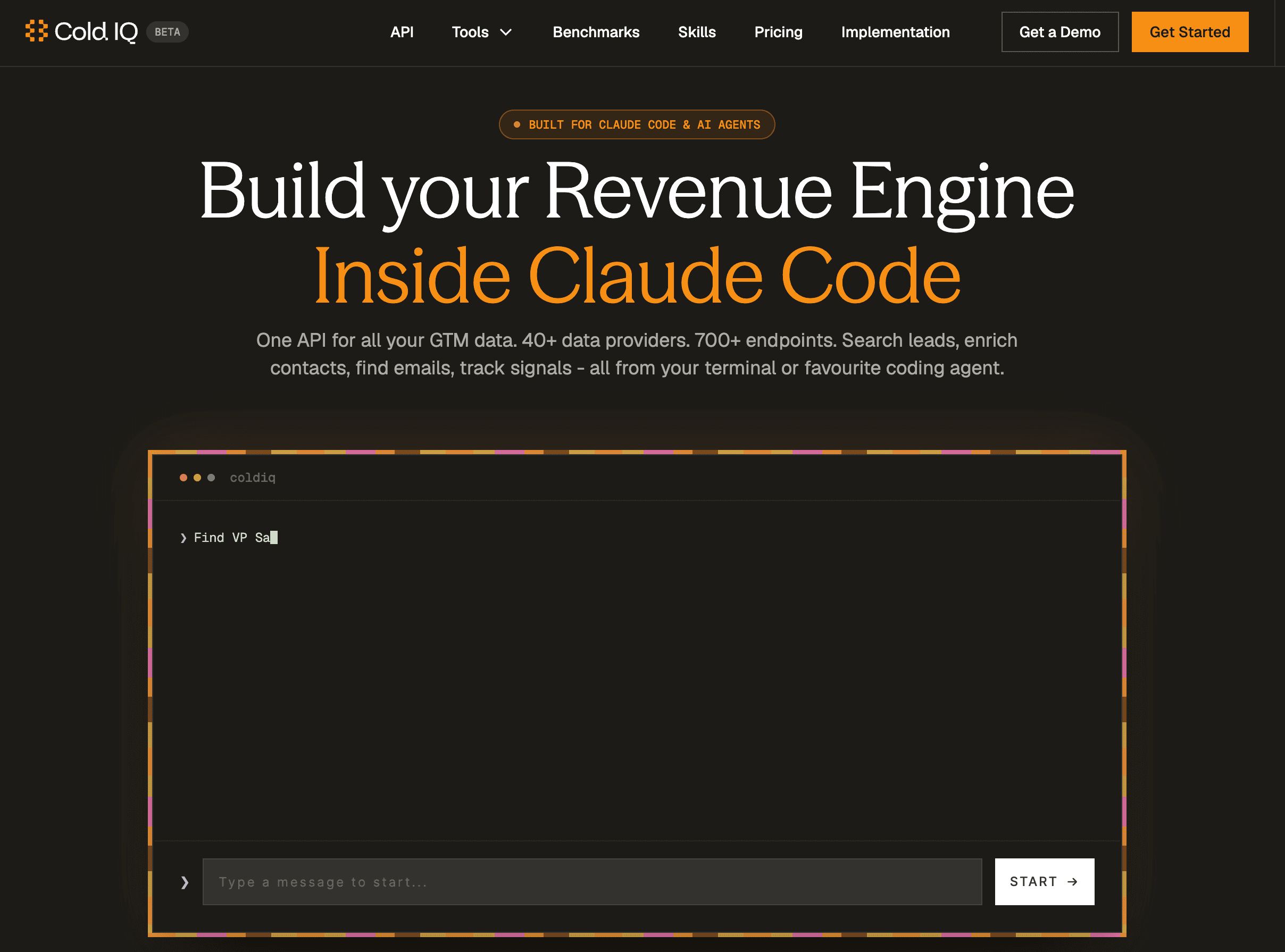
ColdIQ grew from an affiliate blog about sales tools into one of the best-known outbound agencies in Europe, and in 2026 put a data product on its homepage: a unified API wrapping forty-plus data providers, with an MCP server you can call from Claude Code.
The agency side is still live, pitched at SaaS and B2B companies above roughly $100k a month in revenue, with 275-plus clients and $50M-plus in generated ARR claimed.
Best for
Tech companies, and SaaS companies especially, that want outbound handled at scale by a team with an unusually deep data toolbox, comfortable with the process living mostly on the agency's side.
Core services and strengths
Elite Clay Expert with years of Instantly and Smartlead volume behind them.
A GTM data API that covers 40-plus providers, useful even if you never hire the agency.
Campaigns typically live within about two weeks.
A large body of public content, so you can check how they think before you call.
Where it falls short
The company is split between a platform and an agency, and their homepage tells you which one gets the attention.
If you want a partner who lives in your stack, explains the decisions, and hands the system over, this is a services menu more than an ownership model. You will get good outbound, and you will keep buying it monthly.
2. The Kiln
The Kiln is a Clay agency focused on the builds other agencies give up on, and it is the most technically deep team on this list, with early Clay people on staff.
Best for
RevOps and growth teams with a hard data problem, custom market research at scale, or a stack that outgrew standard waterfalls.
Clay's directory lists them at $10k-plus a month, a serious budget for a serious problem.
Core services and strengths
The deepest Clay engineering on the market, with HubSpot and Salesforce integration to match.
Custom data pipelines and scoring models rather than templates.
A GTM engineer recruiting service if you want to hire the operator to own what they build.
Where it falls short
What you get from them is high-level engineering that needs an operator on your side to keep it alive; if your team cannot read a Clay table, the build becomes a monument. We covered more about the agency in our The Kiln alternatives post.
3. RevPartners
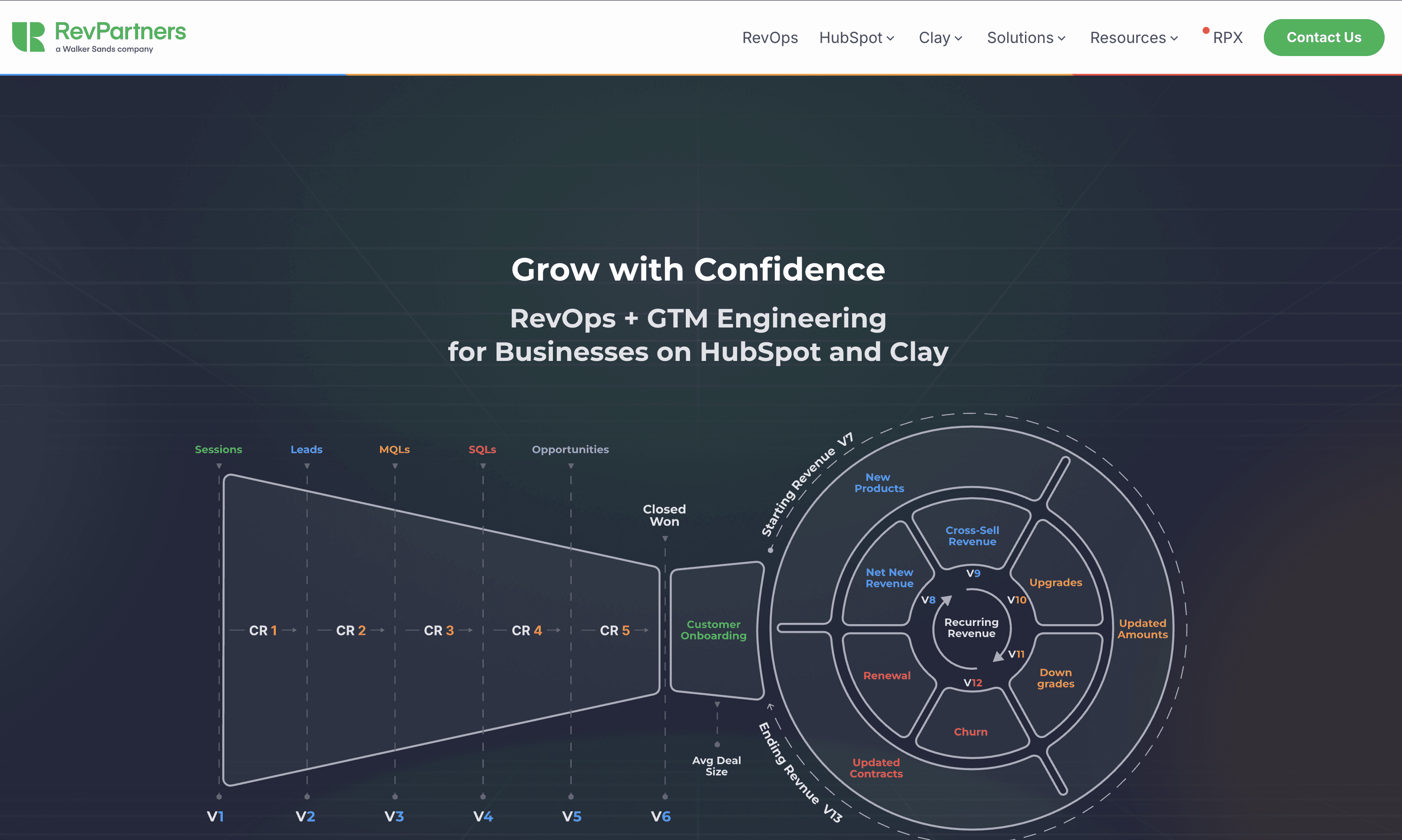
Some outbound problems are CRM problems wearing a disguise. Your reps do not trust the data, half the accounts are duplicated, and nobody can say where last quarter's deals came from.
RevPartners fixes that layer before anything else gets built, and it is the only firm holding both HubSpot Elite Solutions Partner and Clay Elite Studio Partner status. Walker Sands acquired it in June 2026, keeping the brand and leadership.
Best for
Mid market companies whose CRM has to be trusted again before outbound is worth doing, or that want revenue operations as a standing function instead of a one-off project.
Core services and strengths
HubSpot Elite plus Clay Elite Studio, a combination nobody else holds.
Migrations from Salesforce, Marketo, Pipedrive, and Dynamics into HubSpot.
1,000-plus CRM and RevOps deployments and hundreds of HubSpot directory reviews.
Around 85 strategists and engineers, so capacity is rarely the constraint.
Where it falls short
This is a HubSpot house through and through: if you are on Salesforce, or want a small senior team thinking about your list, the fit is weaker, and post-acquisition you are buying from a much larger group.
4. Understory Agency
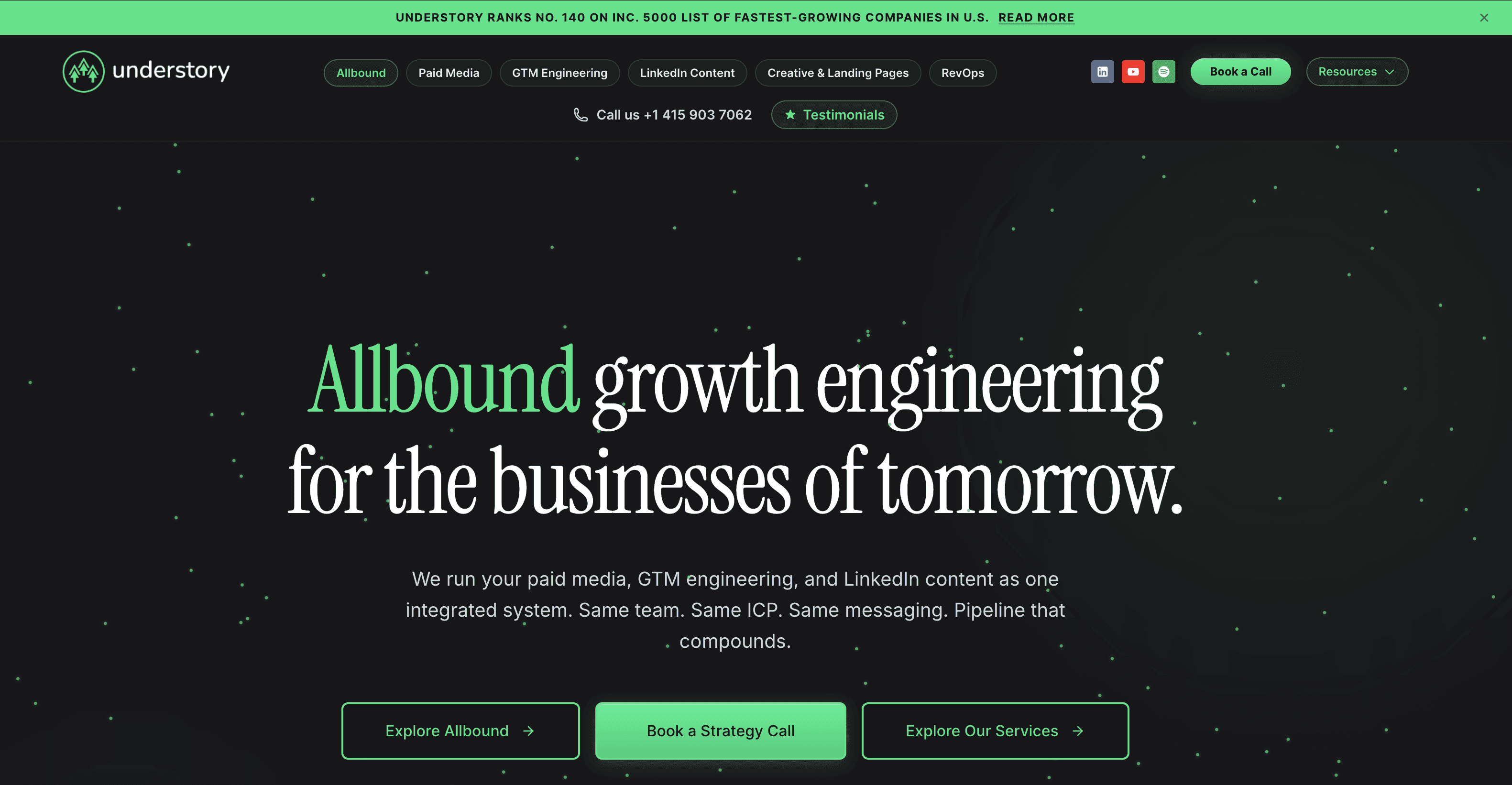
Understory's model is allbound, and the idea is a good one: paid media, GTM engineering, LinkedIn founder content marketing, creative, and HubSpot-native RevOps work as one pod on one target list, so the ads warm the accounts the emails are about to hit.
Client logos include Zapier, Clay, and Expensify.
Best for
Post-product-market-fit B2B companies with budget for at least two channels and two quarters, especially where ads and outbound currently describe two different companies and you want them working as one demand generation motion.
Core services and strengths
Paid media execution across LinkedIn, Google, Meta, Reddit, and X, delivered alongside outbound.
Clay Enterprise Partner, Instantly and HeyReach expert, HubSpot Solutions Partner.
A pod per client, with a GTM engineer, an ops manager, and a paid strategist.
Launch in three to four weeks, results expected by month three.
Where it falls short
Retainers last six months minimum with a pod attached, common among GTM agencies that sell the bundle, and third-party reviews put GTM engineering alone at five figures a month. If you only need one layer, you are paying for the bundle, and the machinery stays on their side unless you negotiate it.
5. GTM Engineering (gtm-engineering.io)
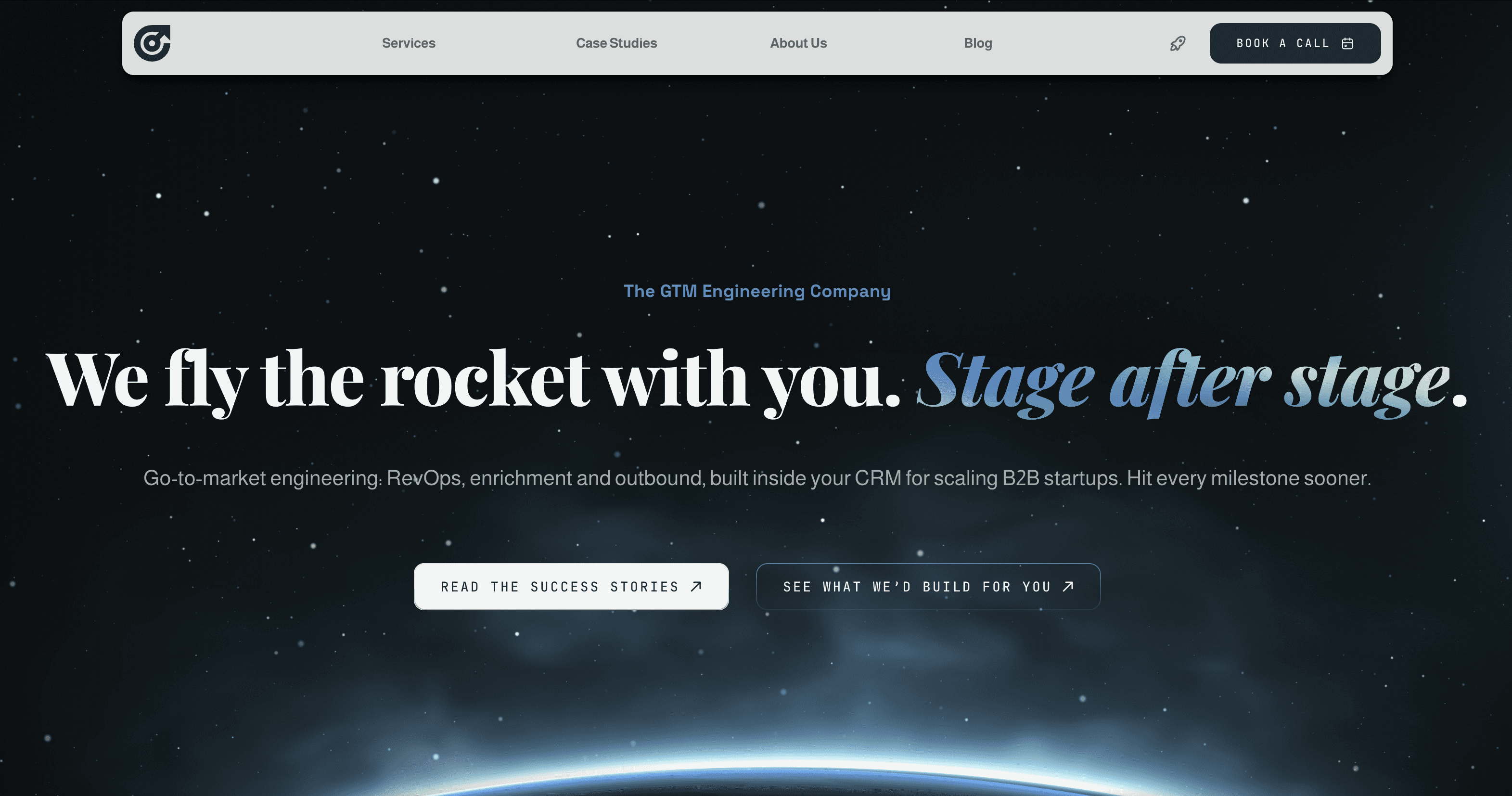
GTM Engineering is a fractional GTM engineer on retainer: $4k a month starter, $6k growth, covering ICP research, lead sourcing and lists, Clay workflow automation, and RevOps setup at five to ten hours a week.
Best for
Seed to Series B startups building the stack for the first time that want it done right, documented, and handed over.
Core services and strengths
Transparent pricing published on the site, with a defined scope per tier.
Weekly builds and working sessions instead of a report.
Covers ICP, lists, Clay, and RevOps configuration in one retainer.
Documentation and handover are part of the offer.
Where it falls short
It is one senior person on part-time hours: with years of CRM history and real data debt, you are not who this was built for, and there is no bench to scale into.
6. The Playbook Agency
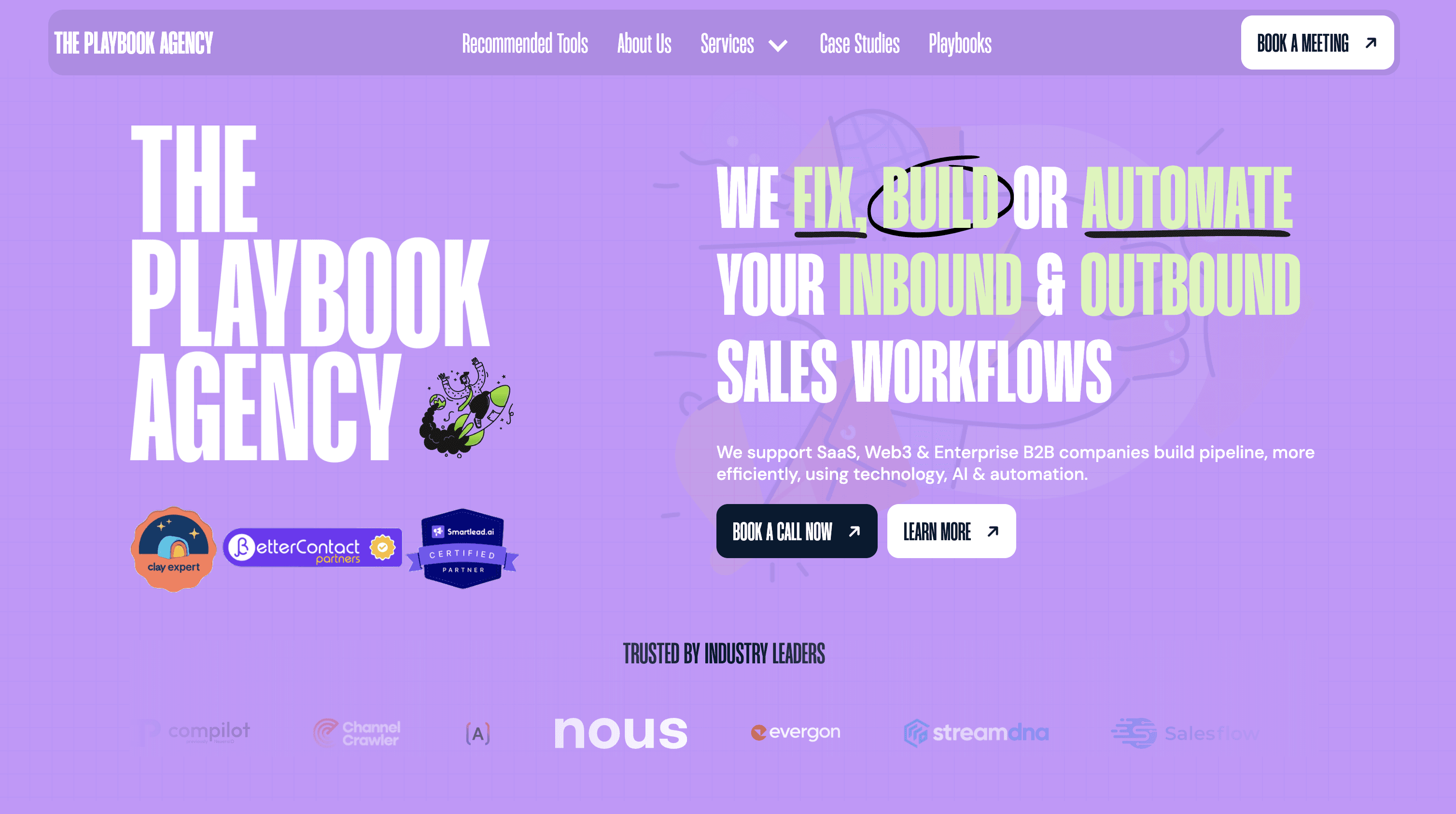
The Playbook Agency is a London-based agency focused on one problem, started by former sales leaders who watched outbound, marketing, and customer success each working off a separate stack.
Their answer is one Clay-powered engine across revenue teams, with published starting prices: RevOps and Clay engineering from $6,500, outbound as a service from $4,500, contact data and research from $1,000.
Best for
Founder-led SaaS and B2B teams that want a Clay and RevOps build with a clear price tag, a European partner, and their own team operating it afterwards.
Core services and strengths
Published starting prices for every service line.
Clay engineering with a public library of automations to inspect.
Outbound as a service with a defined volume per month.
Built to be handed over to non-technical revenue teams.
Where it falls short
Thirty-plus companies supported is a small book, results are self-reported, and a six-month minimum applies. The cross-team engine only pays off once you have the teams to connect.
Bonus: You will also meet Growth Engine X (the loudest cold email operation in the Clay ecosystem; the value proposition is pure volume, eight million-plus emails a month for B2B SaaS companies with huge markets), OneAway (a managed outbound agency delivering 60-day cycles of pure outbound execution, with humans calling interested replies within minutes and published pricing), SalesCaptain (an outbound shop for SaaS and digital platforms reporting 5 to 10 sales-qualified leads a week, 391 positive replies in one campaign, and improved first-touch-to-meeting conversion), and LeadGem (25,000-plus CRM contacts enriched for one client) among the GTM agencies in your research. All are credible options for tech companies and lean sales teams in the outbound lane; we left them off for overlap with the names above.
How to choose the right GTM agency for your stage, your go-to-market motion, and your stack
Name the job before you name the agency: match each agency's core services to the job, and three variables settle most shortlists of GTM agencies. That is the GTM planning that avoids costly mistakes during product launches. If you need market fit and positioning defined first, that is strategy consulting; go-to-market agencies operationalize the answer.
Your stage and revenue set the ceiling. A seed-stage team with $5M ARR revenue goals needs a fractional engineer or a small builder, and GTM Engineering or The Playbook Agency will serve you well.
Mid market B2B SaaS companies above $10M ARR with a real CRM and several motions should be talking to RevPartners, The Kiln, Understory, or us.
Your GTM strategy and motion decide the shape of the partner: email volume across an enormous market points to ColdIQ; a CRM that must be trusted first points to RevPartners; ads and outbound that must tell one story point to Understory.
Your stack decides who ramps fastest on day one, and which GTM capabilities your team can absorb. Automated workflows streamline sales processes and improve conversion rates wherever they land; the open question is always who owns them and the GTM strategy after launch. HubSpot shops should look at RevPartners and Understory, and Clay-heavy teams with in-house operators should look at The Kiln.
If the job is the whole go-to-market engine, outbound, inbound, paid, and RevOps, built to be operated by salespeople and kept, that is what we build (with a strong GTM strategy behind it). A good GTM agency tells you which of these jobs it is before you sign; that is how you find the right GTM partner instead of the loudest one.
Which GTM engineering agency is best for you?
The table at the top of this post maps every agency to the situation it fits, and the three variables above settle the rest. The short version: choose Nebor if you want the full GTM engine built in your accounts by people who had extensive sales experience before they built automation, and you plan to keep it.
Choose the others when the job is one well-defined channel or layer, and hire the one whose core services match that job.


Gerelateerde artikelen


Door op Registreren te klikken bevestig je dat je akkoord gaat met onze Algemene Voorwaarden.