

Automates B2B paid campaign operations across eight ad channels, building the audiences, running the experiments and optimising to pipeline instead of clicks, sold by quote to teams with real ad budget.
What is
Metadata
A B2B paid media team burns most of its week on account maintenance, rebuilding audience lists, cloning campaigns across LinkedIn and Meta, nudging bids by hand and then stitching together a report that ties any of it back to pipeline. Metadata exists to automate that week, running campaigns across eight ad channels from one place. Audiences come out of a 500M profile graph carrying firmographic, technographic and Bombora or G2 intent layers, and the patented MetaMatch identity match puts B2B targeting onto Meta and Google where the native filters are consumer grade. Campaigns build into each channel's own ad structure, and Insights maps anonymous site traffic back onto accounts. The experiment engine is the part worth paying for. It permutes audience, creative, offer, bid and budget, kills losers and scales winners on its own, with the public counter at 263,554 experiments across $1B of managed spend. Seven named agents sit on top, exposed as 141 MCP tools you can drive from ChatGPT or Claude. Metadata pays off above roughly $20,000 a month in paid social and search, because below that the experiments never gather enough clicks to settle an argument and the platform fee eats a tenth of the budget. We have not run it at Nebor, and no optimiser rescues a weak offer.
Integrations and the modern GTM stack
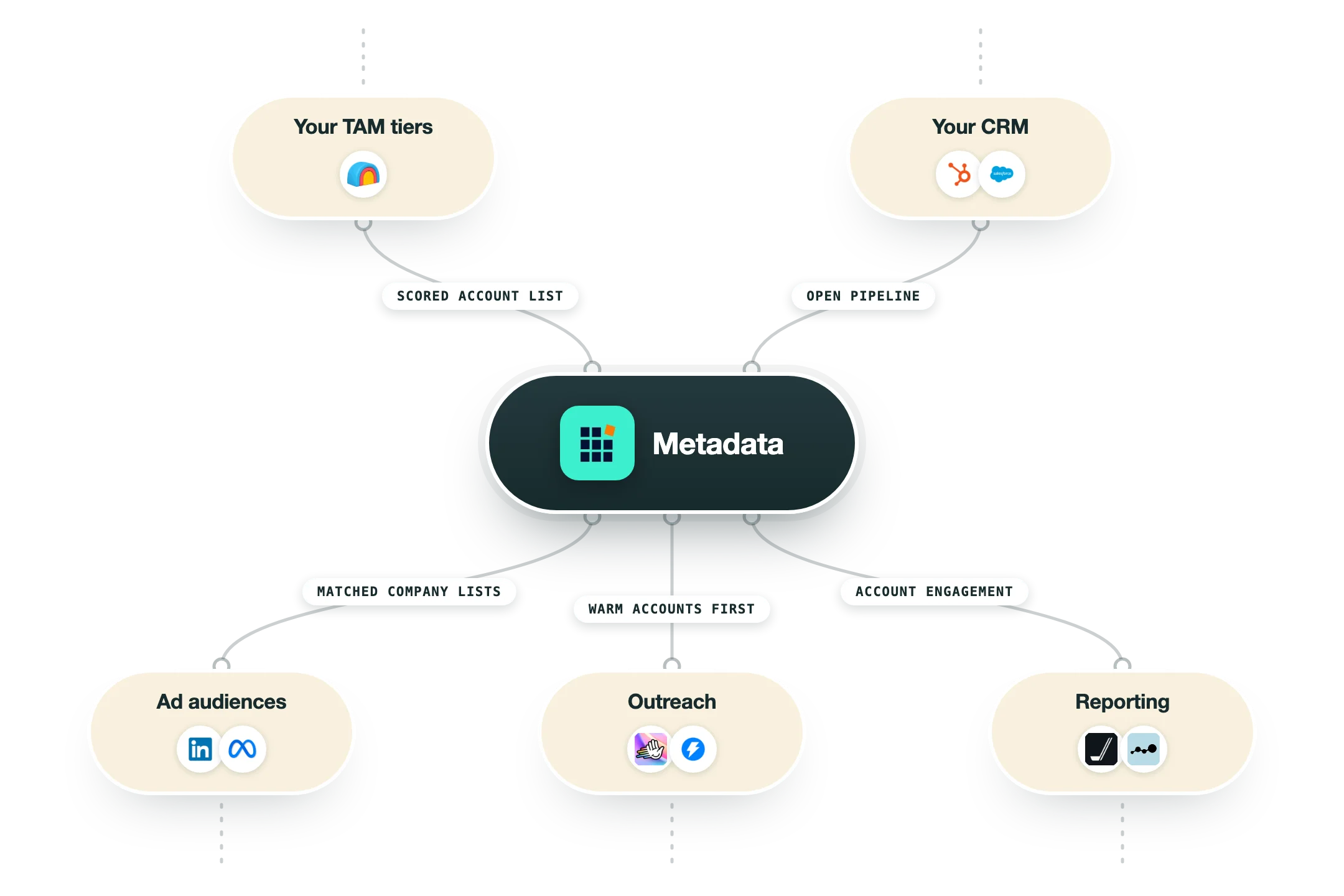
Metadata's integrations split into two jobs. The ad channels are where it writes, creating native campaign objects inside each platform, and the CRM, marketing automation and warehouse connections are where it reads, since cost per opportunity only works if the closed deal makes it back into the model.
LinkedIn Ads | The channel the product grew up on and still the deepest. Campaigns, audience sync, budget pacing and the Bid Agent all run here, with the agent making bid adjustments through the day against auction conditions. If you only run LinkedIn, this is the connection that carries the whole business case. |
Meta, X and Reddit | Facebook, Instagram, X and Reddit take the audiences MetaMatch resolves, which is the point of the whole identity graph. Native targeting on these platforms has no useful B2B filter, so account and persona lists have to arrive from outside to make consumer inventory worth buying. |
Google Ads, Microsoft Advertising and ChatGPT Ads | Search, display and Bing sit alongside social under the same budget view, and ChatGPT ads were added as an eighth channel. Search behaves differently from paid social under an experiment engine, so expect keyword controls to need more human attention than an audience test does. |
Salesforce, HubSpot and Pipedrive | The CRM connection is what turns clicks into cost per opportunity, mapping ad exposure onto opportunity and closed won records. Salesforce and HubSpot are the mature ones. Pipedrive appears on the list but shows up nowhere in the case studies we read. |
HubSpot Marketing Hub, Pardot and Oracle Eloqua | Marketing automation handles form fills, lead records and suppression lists in both directions. Marketo does not appear on the current integrations page, which is worth checking before you commit if your demand gen runs on it. |
Bombora and G2 | Third party intent pipes in as an audience layer rather than a separate scoring product, so accounts researching your category can be targeted directly. You buy those feeds yourself, and Metadata gives them somewhere to go instead of a dashboard nobody opens. |
Snowflake, BigQuery, Amazon S3, Google Analytics and Zapier | Warehouse and analytics connections let campaign and account data land next to the rest of your reporting, which matters if attribution is argued outside the vendor's own UI. Zapier is listed, so lightweight routing to other tools is available without engineering. |
MCP server and public API | Every workflow a human runs in the app is also an MCP tool, 141 of them, authenticated with API keys and documented with approval gates and idempotency. Named clients include Claude Code, Claude Desktop and custom agents, and this is the most interesting part of the product for a team that already builds with agents. |
What is missing | No native Clay connection and no n8n app, so a Clay-built account list reaches Metadata through a CSV, the API or Zapier. Metadata's own comparison page frames Clay as the tool that assembles lists while Metadata runs the campaign, which reads as a fair division of labour rather than an overlap. |
Pro’s
Metadata does the part that 6sense and Demandbase hand back to you, because it builds the audience, assembles the campaign in each channel's native ad structure and pushes it live across eight platforms from one screen.
The experiment engine is the real product, permuting audience, creative, offer, bid and budget, then killing losers and scaling winners without anyone opening LinkedIn Campaign Manager, and the public counter sits at 263,554 experiments and 84,737 campaigns.
MetaMatch maps corporate identity onto personal accounts on Meta, X and Google, so you can run B2B targeting on inventory that costs a fraction of a LinkedIn impression.
Optimisation runs against cost per opportunity pulled from Salesforce or HubSpot, so the system keeps funding the channel with the worse cost per lead when that channel produces the better pipeline.
Every workflow in the app is exposed as one of 141 MCP tools behind an API key, so a team already running Claude Code or a custom agent can drive paid media programmatically instead of clicking through a UI.
LinkedIn, Meta, Google, Microsoft, X, Reddit and ChatGPT ads share one budget view and one report, and that alone removes the weekly reconciliation most paid teams still do by hand.
Cons
Metadata publishes no prices at all, and third party listings put the core platform near $60,000 a year with roughly $24,000 for the audience and site modules and a $2,500 implementation fee, so sizing a budget means running a sales cycle first.
The engine needs volume to work, and Metadata's own guidance is to spend $15,000 to $20,000 across at least a quarter before the experiments say anything reliable, which puts a hard floor under who should buy it.
G2 and TrustRadius reviewers repeatedly call the experiments both the best feature and the hardest to use, and several report that changing creative, audience and bidding on a live campaign cannot be done in one place.
Multi touch attribution lands directionally right and stops short of proving causation, so it will settle a budget argument better than it settles a credit argument inside a long enterprise deal.
The optimiser tunes delivery and cannot rewrite a weak offer, and Metadata's own agent roster now includes an offers and promotions lead, which tells you where the remaining lift sits.
Pricing
Bid Agent trial
Free Reported as 15 days covering up to $25,000 of LinkedIn spend. We could not confirm these terms on metadata.io, so treat the cap as unverified.
LinkedIn bidding only
Thousands of bid adjustments a day
Reacts to auction dynamics and time of day
No other channel included
MetaMatch standalone
From $250 to $295/month Per installation, third party listings only, no public page
B2B audience matching onto Meta, X and Google
Firmographic, technographic and intent layers
Audience sync to your own ad accounts
No campaign automation or experiments
Core platform
About $60,000/year Third party listings, quote only, one report puts onboarding at $5,000 and up
Campaigns across eight ad channels
Experiment engine and budget pacing
CRM and marketing automation attribution
Insights, visitor de-anonymization and alerts
AI agents and the MCP tool surface
Modules and setup
About $24,000/year plus $2,500 Audience targeting and the site personalization module are listed separately, implementation is a one time fee
Audience targeting module
SiteAdapt web personalization
One time implementation per installation
Media spend sits outside all of it
How it fits your stack
Alternatives


At a glance
Runs eight ad channels from one place
MetaMatch B2B targeting on Meta, Google and X
500M profile graph with Bombora and G2 intent
Autonomous experiment engine across audience, creative and offer
Seven named AI agents from strategy to reporting
141 MCP tools for ChatGPT, Claude and custom agents
Visitor de-anonymization and account heat alerts
Salesforce, HubSpot, Pardot and Eloqua syncs
Read some of our client stories





GTM Workflows
Learn how to use GTM tools in workflows
Guides and tutorials to get the most from your workflows











Ready to get started?




By clicking Sign Up you're confirming that you agree with our Terms and Conditions.








