

A GTM context layer where you model your ICP, personas, positioning and objections once, then let Clay, your sequencer and any AI agent read that same library at runtime over an API or MCP.
What is
Octave
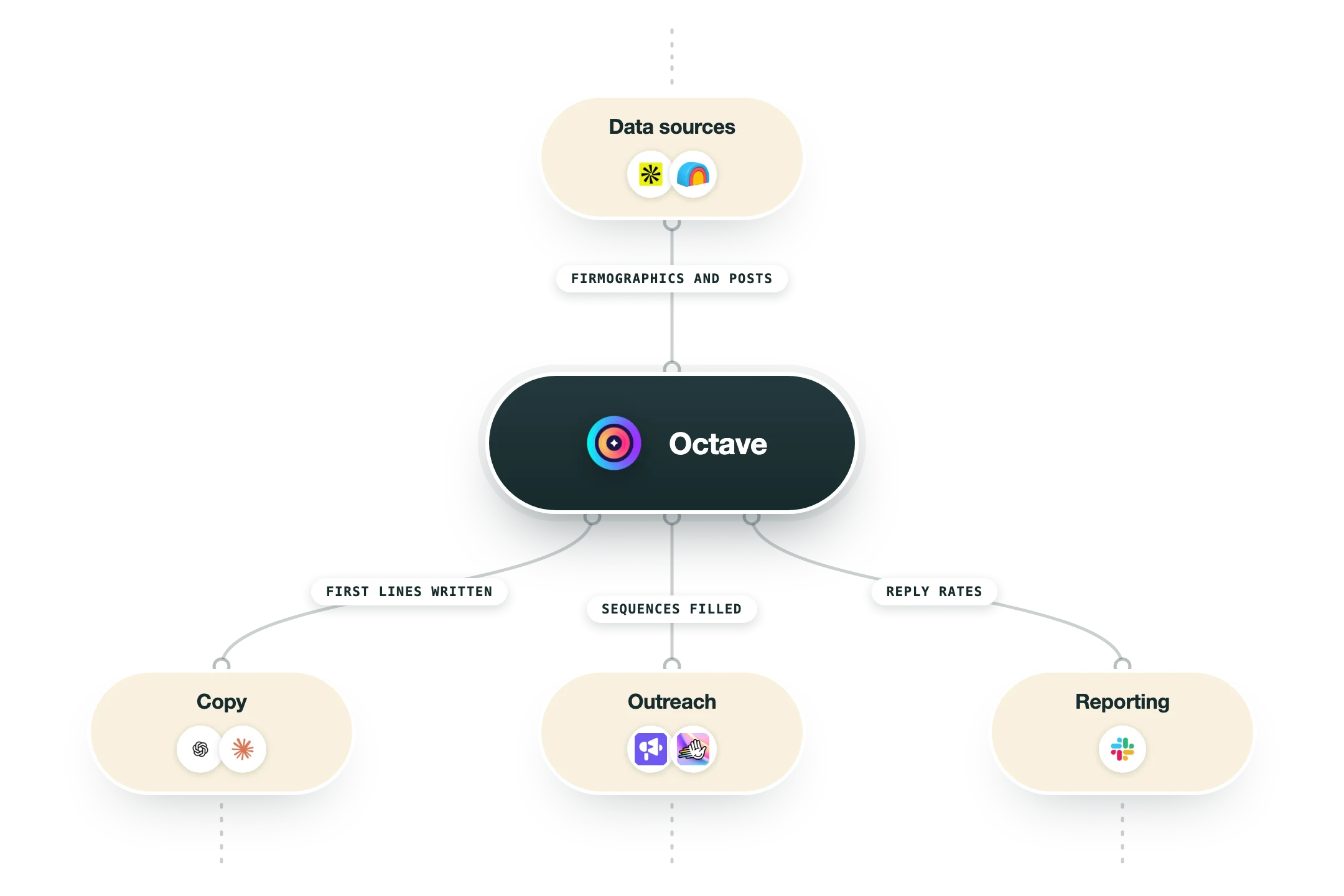
Your Clay table holds one description of your ICP, the sequencer template holds a slightly older one, and the AE writing a battlecard is working from a third in a Google Doc. Octave keeps a single copy of that positioning and hands it to all three when they run. You build the model first in Motion Builder, which captures offerings, personas, segments, use cases, competitors, objections, proof points and reference customers as linked entities in what Octave calls the Library. Messaging Studio turns those entities into playbooks for each motion you sell. Ten prebuilt agents read the Library at execution time, covering person and company enrichment, qualification against your ICP, prospecting, sequence writing and call prep. They run through a REST API with async callbacks, an MCP server for Claude, Cursor and ChatGPT, and a Claude Code plugin, so Clay, n8n and your sequencer pull from the same brain. We would pay for Octave once several systems write copy from your positioning and their prompts have started to disagree. Below that line, a maintained doc and two Clay prompt columns do the same job for free. Nebor has not run it on a client account, and a $1,500 a month floor makes this a considered purchase.
Integrations and the modern GTM stack
Octave is designed to be read by other software, so the integration list matters more here than it does for most tools. The connections split into three jobs: places that consume the context, places that feed it, and the developer routes for everything else.
Clay | The pairing Octave writes about most. You copy a shared Octave template table into your Clay workspace, paste your workspace API key into the HTTP columns for Enrich Person, Enrich Company, Sequence and Personalize, then set the agentOId of an agent you saved in Octave. Octave lists and searches can also be pushed into Clay through a Clay import webhook. |
MCP | A hosted MCP server that exposes the Library, findings, prospect research, content agents, hosted assets and managed skills to any MCP client. Claude Desktop, Claude Code, Cursor, VS Code, Zed and Windsurf are all listed, and Octave positions this as the replacement for stale custom GPTs and pasted system prompts. |
Claude Code plugin | An open plugin called LFGTM on GitHub that layers slash commands and specialised agents over the MCP tools, aimed at battlecards, enablement, campaign planning, deal coaching and content production from inside Claude Code or Cowork. |
REST API | Key based auth with a separate key per workspace, one endpoint per agent type, async runs that return a job id and post the result to your callback URL, and full CRUD over Library entities such as motions, playbooks, personas, segments, products and proof points. |
Sequencers and outbound tools | Outreach, Salesloft, Smartlead, Instantly, Supersend, EmailBison and HeyReach are listed as native integrations, which is how generated sequences and the activity coming back from them stay attached to the right motion. |
CRM | Salesforce, HubSpot and Attio, plus Cargo for orchestration. CRM sits on the paid tier, so the deal and pipeline context that makes the analytics loop useful is not something you can test on the free plan. |
Call recording | Gong, Fathom, Fireflies, Chorus, Orum and Circleback push calls in, and Octave turns them into findings and suggested revisions to the Library. This is the loop that keeps personas and objections current instead of frozen at onboarding. |
Automation and documents | n8n and Zapier for orchestration, Slack for notifications, and Google Drive and Notion as context sources that auto sync when the underlying documents change. A generic events API takes emails, calls, CRM deals and social touches from Make or any in-house system over plain HTTP. |
What is missing | Octave's own docs still say native Clay integrations are coming soon, so today the Clay side is HTTP columns and shared templates rather than a first-party Clay enrichment. There is no contact database behind it either, so emails, phones, firmographics and intent still come from Clay, Apollo or a waterfall you already pay for. |
Pro’s
Positioning lives in one versioned place with full change history, so a repositioning propagates to every downstream tool instead of being re-pasted into six prompt columns by hand.
The API is built for engineers rather than demos, with a separate endpoint per agent, async runs that post results back to a callback URL, and saved agent configs you can branch into experiments and pin the winner.
The MCP server and Claude Code plugin put the same context inside Claude, Cursor and ChatGPT, so a PMM writing in chat and an agent running in Clay work from one source rather than two drifting copies.
Calls from Gong, Fathom, Fireflies, Chorus and Circleback come back as findings and suggested revisions, so the library gets corrected by what buyers said instead of aging from the day it was written.
The Base plan carries no time limit and still includes API and MCP access, so an engineer can wire it into a Clay table and judge the output before anyone signs anything.
The Clay pairing is documented down to shared template tables for person enrich, company enrich, sequence and personalize, plus a webhook route for pushing Octave lists into a Clay table.
Cons
Paid pricing now starts at $1,500 a month billed annually, and the $149, $499 and $999 tiers that review blogs still quote have disappeared from the pricing page, so the affordable middle of the ladder is gone.
Credits burn per agent run and the cost of a run varies with its configuration and model settings, so you cannot forecast the monthly bill until you have already pushed production volume through it.
It carries almost no contact data of its own beyond resolving an email or a LinkedIn profile, so you still pay Clay, Apollo or a waterfall for phones, firmographics and intent signals.
Output quality tracks the quality of what you typed into the library, and a workspace built in an afternoon will produce confident, well-formatted copy grounded in a half-true ICP.
Public proof is thin for the price, with a 4.9 score resting on a G2 seller profile listing seven reviews and one customer number from WorkSpan doing most of the persuading on the site.
Pricing
Base
$0/month Free with no time limit, capped on what you can generate
100 generation credits a month
2 active workspaces, 1 offering, 12 elements, 2 playbooks
ICP Library, version control, brand voice, smart CTAs
ICP Agent and GTM Explorer
Agents, Read, Library, Playbook and Workspace APIs plus MCP
Community support
Octave Ultra
From $1,500/month Billed annually, platform fee plus metered credits
10,000 generation credits a month
Unlimited users and unlimited managed agents
2 active offerings, 36 elements and 8 playbooks per workspace
Salesforce, HubSpot, Gong and Clay integrations
MCP, API, CLI and SDK, Claude Code plugin
SSO and RBAC, dedicated CSM and private Slack
Custom
Talk to sales Custom limits on every dimension
Custom credit volume and custom active limits
Bulk credit packs
GTM engineering services
Data warehouse integration
How it fits your stack
Alternatives


At a glance
Library of offerings, personas, segments and objections
Ten prebuilt agents including Prospector and Sequence
REST API with async runs and callback URLs
MCP server for Claude, Cursor and ChatGPT
Claude Code plugin with prebuilt GTM skills
Clay template tables and an n8n connector
Gong, Fathom and Fireflies feed calls back in
Free Base plan with 100 credits a month
Read some of our client stories





GTM Workflows
Learn how to use GTM tools in workflows
Guides and tutorials to get the most from your workflows










Ready to get started?




By clicking Sign Up you're confirming that you agree with our Terms and Conditions.








