
What’s the Best Way to Get B2B Leads in 2026? Three AI-Driven Strategies That Actually Work

In this post:
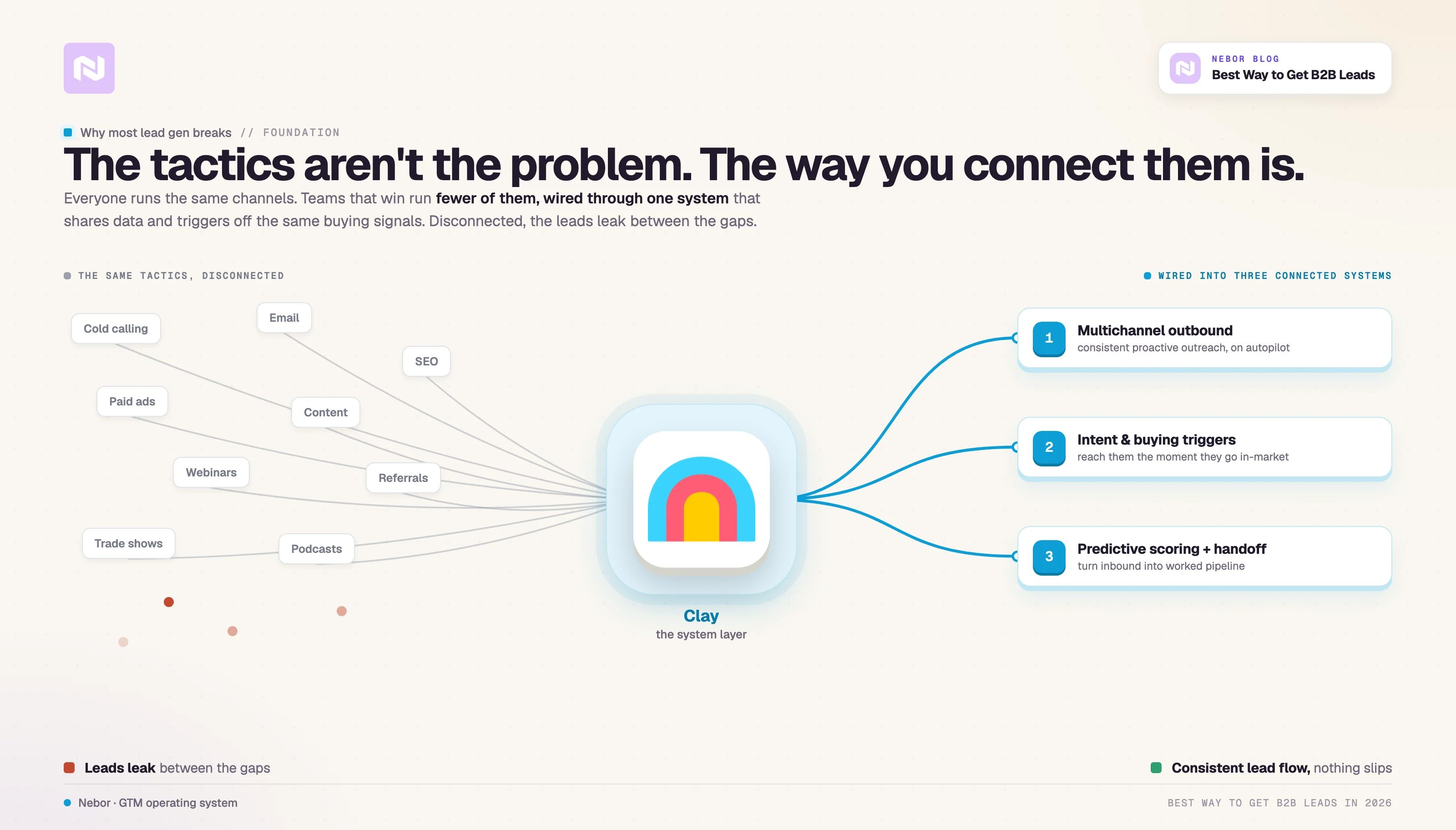
Most articles about getting B2B leads in 2026 hand you the same recycled list of tactics. Cold calling, email, SEO, content, paid ads, trade shows, referrals, free trials, webinars, podcasts.
The tactics are not the problem. The way most teams string them together is what breaks the whole lead generation engine.
The teams winning at lead generation right now are not using more tactics than everyone else. They are using fewer of them, connected through systems that share data and trigger off the same buying signals.
The actual work happens at the system layer. I mean, what lead generation tactic are people going to invent or teach you today?
We use three of these systems for our own outbound at Nebor and for clients across industries.
The rest of this post walks through how each one works, the tools that hold them together, and where to start if you want to build the same thing yourself.
Let’s get started.
Note: The three strategies in this article all depend on the same thing underneath.
Data that is current, signals somebody is watching for, and routing that gets a lead to a person while it is still warm. Without that layer, each strategy is just another tab for your team to check.
At Nebor, we automate outbound prospecting and lead generation, and that underneath layer is exactly what we build.
Book a 15-minute call and let's discuss which of the three would suit your business.
Why the way most companies are getting B2B leads is breaking
Open any article on “how to generate B2B leads” and you will see the same checklist played back to you. Cold calling, content marketing, lead gen forms, SEM, demand gen, landing pages, trade shows, referrals, podcasts, free trials, webinars, etc.
Every respectable salesperson already knows the list, and every B2B marketing team already uses most of them.
Presenting these tactics as a disjointed checklist is exactly why so many lead generation programs stall in the first place.
The reader gets theory and a long list, but no actual path forward. Worse, a team that tries to do all of them at once stretches itself flat across the whole effort. Mediocre execution everywhere ends up being the usual outcome.
The sales and RevOps teams we talk to keep hitting the same five problems underneath the surface, no matter the industry or the size of the team.
Email is producing fewer leads each year
Generic cold emails do not cut through anymore, and the data backs that up across every channel report we see.
Anyone can write one with AI and send it to a thousand prospects scraped from Apollo.io in an afternoon.
Spam filters have been keeping pace with that volume, and the bar to land in an inbox keeps moving up every quarter.
Reps are burning hours on prospects who are not ready
Sales and marketing teams research and reach out manually to people who are months away from buying anything at all.
There is rarely a system in place to qualify those prospects fast, so reps end up calling them too early or too late and lose the deals either way.
Tools that do not talk to each other create silos
Companies stack tools chasing the AI wave and end up with a sales tech stack where nothing actually connects.
The bills add up across all of them every month. The data is stuck in silos that no one has time to merge. Workflows break across the gaps between tools, which is exactly where most lead leaks start to happen.
Real-time buying signals are going to waste
Most lead gen ignores real-time buying signals that show when a company is actively moving toward a purchase decision.
Picture a competitor with a system that flags companies fitting your ICP the moment they start needing your solution.
They reach out first and win the deal, while your reps are still working through a cold list and dialing through it row by row.
Manual prospecting collapses the moment a company grows
Reps spend their days moving data between tools, enriching contacts by hand, and chasing leads through brittle spreadsheets.
That is sales talent doing data-entry work, when low-cost systems could be doing the data-entry and the reps could be focused on the actual selling.
Three strategies for generating B2B sales leads in 2025
We use three connected lead generation strategies built around AI, and we use them every single day for our own outbound at Nebor.
The rest of this section walks through each one, including how to implement it yourself and the tools you will need to make it work.
Strategy 1: Build a multichannel outbound automation workflow that works on autopilot
The traditional approach to outbound sales and lead gen means manually researching prospects, writing individual messages, and following up across channels by hand.
That kind of work is labor-intensive, scales poorly, and leans far too heavily on individual rep performance to ever become a real engine.
The approach we use looks nothing like that.
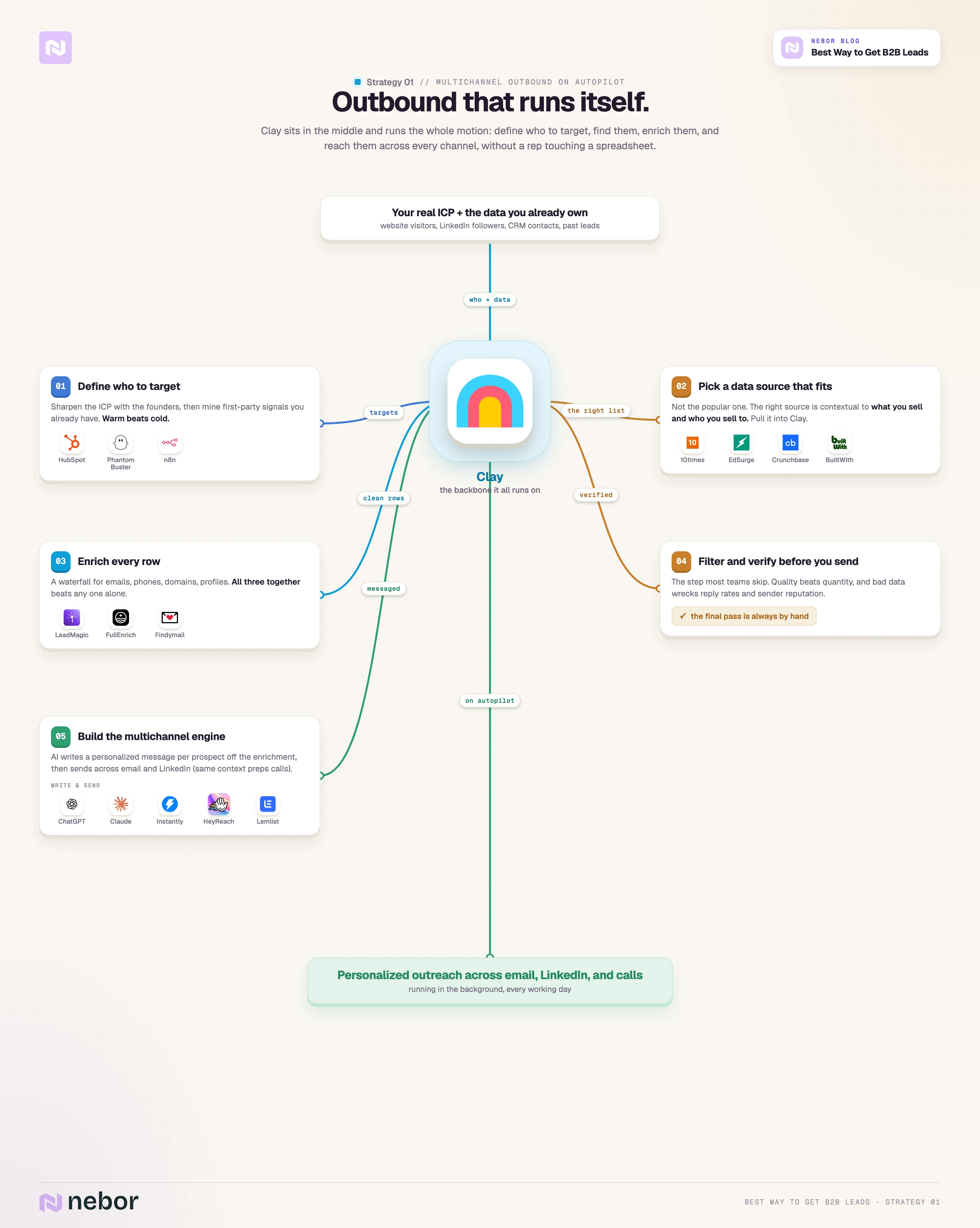
It is a systematic workflow that combines targeting precision with operational efficiency, using AI, GTM, and outbound and lead gen tools like Clay, specialized data sources, Instantly.ai, HeyReach.io, and automation platforms like n8n.
Step 1: Define your ICP and pull insight from the customers you already have
The foundation of effective outbound is not volume but precision in who you actually go after. Before you ever open Apollo.io or any other data tool, get clear on what you sell, who you are selling to, and why those buyers should buy from you specifically.
Sit down with the founders and ask them questions that go past basic demographics.
Ask why the product was built in the first place, and ask which customers signed on earliest and what those customers had in common.
Ask how those customers coped before they found you, and ask which job titles actually sign off on the purchase today. These conversations give you a sharper picture of your ICP than industry, size, and location ever will on their own.
Then look at the data you already have lying around the business. Most companies are holding first-party signals without even realizing it.
Website visitors, LinkedIn followers, CRM contacts, past leads, and engagement history are all starting points for outbound work.
To pull all of that data together, Clay is the connective layer we lean on. It handles enrichment, drives workflow automation, and integrates natively with CRMs like HubSpot, so existing contacts come in cleanly without any manual export work.
For LinkedIn data, we use PhantomBuster to pull profile data, company pages, and engagement on your posts.
Most of these tools connect natively with Clay anyway. If you have data locked in a custom CRM that does not integrate, n8n handles the upload work without manual effort from your team.
The advantage of starting with people who have already engaged with your business is that the outreach does not feel cold to them. The recipient already knows your company exists, which lifts reply rates from the start.
The bigger benefit is everything you learn doing this work, because by the end you can tell exactly which companies fit your ICP and what the buyer persona should look like before you reach out.
Step 2: Pick a data source that actually fits your ICP, not just the popular one
Your choice of data source has to be contextual to what you sell and who you sell to. Apollo.io, LinkedIn Sales Navigator, and Lusha are not always the right call for every B2B business out there.
For one client targeting event hosts with exhibitors and sponsors, we used 10times instead of the usual sources because it tracks upcoming events across industries, locations, and other relevant criteria the popular tools miss. We pulled the data with Instant Data Scraper and pushed it into Clay for further processing and enrichment.
The right data source for your business depends entirely on your ICP. Here are some sources we have used and recommend across different industries.
10times: best for finding companies hosting events across the Western world
EdSurge: best for scraping EdTech companies
SifData or Clay: great for tracking job changes and sales trigger events at SaaS companies
ConstructConnect: for construction projects and contractor databases
Definitive Healthcare: rich profiles on healthcare providers, hospitals, and payers
Data Axle: excellent for legacy B2B sectors like manufacturing and distribution
StoreLeads: great for data on Shopify, WooCommerce, and BigCommerce stores
Crunchbase: best for startup and venture funding data
CB Insights: excellent for private company insights, fintech trends, and funding
BuiltWith or Wappalyzer: best for tracking tech stacks on websites
Some of these are information sources rather than direct data tools. For those, the Instant Data Scraper Chrome extension keeps you out of the manual scraping work entirely.
If you have strong case studies and want to target lookalike accounts, Discolike is the move worth trying first.
At this stage, talking to an outbound and Clay expert often saves weeks of trial and error. Better data sources exist for most niches than the popular ones tend to get credit for among non-experts.
Note: The three strategies in this article all depend on the same thing underneath.
Data that is current, signals somebody is watching for, and routing that gets a lead to a person while it is still warm. Without that layer, each strategy is just another tab for your team to check.
At Nebor, we automate outbound prospecting and lead generation, and that underneath layer is exactly what we build.
Book a 15-minute call and let's discuss which of the three would suit your business.
Step 3: Enrich the list with contact information
Once you have a preliminary list pulled together, enrich it with contact information for everyone on it.
Inside Clay, we use LeadMagic, FullEnrich, and Findymail to add email addresses, phone numbers, company domains, LinkedIn profiles, and other contact details to every row in the table.
You can stick with one provider on its own and get reasonable coverage.
Though, using all three together in the workflow has consistently given us better coverage and more usable data points across the same list, because the sources are complementary rather than redundant.
Step 4: Filter and verify the list before you launch
This is the step that most teams quietly skip in the rush to send. Quality always beats quantity in B2B leads, and the data has to be solid before any of the rest matters.
Use Clay to verify domains and check the list against past contacts and do-not-contact rosters.
Add BounceBan and DeBounce into the workflow to keep email deliverability where it needs to be. On top of those checks, apply ICP and campaign-specific filters before you push anything live.
The tools do a lot of work, but the final pass should always be yours by hand. For example, if you are targeting event hosts, you might need to confirm a company is actually hosting events rather than just attending one.
Tools miss those distinctions more often than not, and getting them wrong cuts straight into reply rates and reputation across your sender domains.
Step 5: Build the multichannel outreach engine
With a clean list in hand, set up automated outreach across channels. That does not mean blasting the same generic message to everyone on the list.
It means generating personalized, relevant messages at scale and routing them across both email and LinkedIn for the same prospect.
Use ChatGPT or Claude.ai inside Clay to write the outreach.
The point here is to build messaging that actually speaks to each prospect using the enrichment data already in Clay.
Pull the pain point of the ICP, the value of your product, and the specific data points unique to that company together, and the AI generates a personalized message in a single click.
Clay integrates with both ChatGPT and Claude.ai natively, so pick whichever model works best for your team.
Sometimes we use the AI to generate fragments and write the rest by hand for a creative touch. That kind of mix often outperforms either pure approach on its own, so pick the workflow that fits your team and your messaging bar.
Use Instantly.ai for email and HeyReach.io or Lemlist for LinkedIn.
With your Clay table enriched and ready, push the email send to Instantly.ai through their built-in integration in a few clicks.
Instantly handles personalized sequences with automated follow-ups based on opens, replies, and other actions, and it reports back into your Clay table in real time so the data stays in one place.
HeyReach.io does the same job for LinkedIn outreach with the same data feeding it.
Pull the same context into your CRM for cold calls.
If your motion includes phone work (cold calls), prepare reps with the same enrichment data already feeding the email and LinkedIn sequences.
Instead of generating outbound messages, prompt the AI to generate conversation starters built on the prospect’s role, background, and current company situation. The calls land sharper and feel far less awkward on both sides of the line.
When the row is fully enriched, push it to your CRM automatically for the rep to work, or to a spreadsheet if that is how the team prefers to operate today.
The point of this whole outbound automation workflow is to create consistency without manual effort from your team.
The system works in the background continuously, and the team focuses on the actual selling instead of the data-entry work that used to drown them.
Strategy 2: Set up automated intent and buying-trigger detection with instant outreach
The good news is that the system from Strategy 1 already does most of the heavy lifting that this strategy needs. Strategy 2 builds on top of that foundation and feeds it a different kind of input.
Most sales intelligence platforms call article views and IP visits intent data and leave it at that. The reality is that surface noise rarely points to a real buying conversation.
A VP of Marketing reading an article about email platforms could be mildly curious one afternoon and never touch the category again for the next year.
We have built a different approach to this problem at Nebor. We track real business events that actually predict a buying decision in the next ninety days.
Funding rounds, hiring patterns, leadership changes, acquisitions, product launches, and geographic expansion are the events that matter.
None of those show up as a topic surge on a generic intent platform, but every one of them moves a company closer to a real purchase.
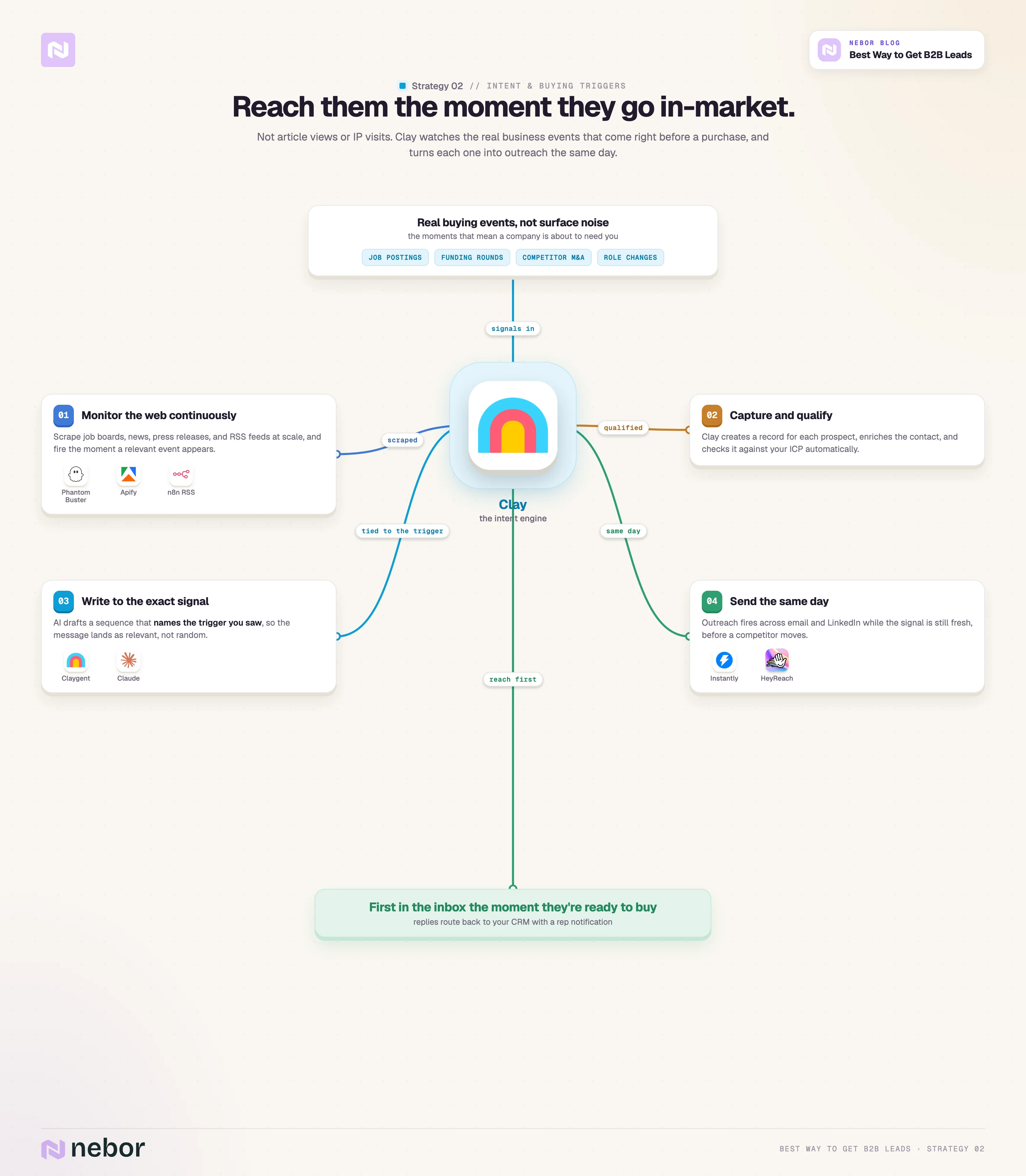
We combine Clay, PhantomBuster, Apify, and n8n.io into automated systems that monitor sources continuously for signal-based outbound opportunities. A few examples from systems we use for ourselves and for clients.
Job postings: we scrape LinkedIn for new SDR job postings every morning, identify the hiring manager and department head, and send personalized outreach automatically the same day.
Funding rounds: for a cybersecurity client, we monitor IT-sector funding rounds because capital infusion usually precedes team expansion, which creates immediate demand for new security tooling.
Competitor acquisitions: when a competitor gets acquired, their customers often start shopping for alternatives over concerns about pricing or service changes, so we track those deals and reach out to the affected customer base.
Role changes: when a happy customer or past lead changes companies, they often re-implement what worked at their last job, so we track the move and trigger appropriate outreach into their new environment.
Industry news: for an AI furnishing-solutions provider, we monitor real estate development outlets like Multi-Housing News and Chicago Yimby for new property project announcements. The system pulls project details, developer info, and contact persons, then reaches out the same day they are published.
The work breaks into two parts that need to happen in order. First, decide which signals actually matter for your business and your offering. Then build a system that monitors them, captures the prospect data, and routes them into the funnel continuously.
Manual tracking falls apart fast across hundreds or thousands of accounts. Automation through PhantomBuster, Apify, and Clay is what makes this kind of monitoring scale across the volume that actually matters.
Here is how to set up the monitoring side of the system.
For job postings, PhantomBuster performs daily searches on LinkedIn Jobs against the titles or keywords that signal demand for what you sell. Results push into Clay automatically the moment they are scraped, ready for enrichment.
For funding news, acquisitions, and other business events, Apify watches news sources, n8n RSS feeds, and company press releases on a schedule. Both handle scraping at scale and feed the results back into Clay through the same integration layer.
For job changes among contacts already in your CRM, LinkedIn Sales Navigator paired with PhantomBuster will alert you the moment a profile updates with a new role at a new company.
Once the data lands in Clay, the workflow from Strategy 1 picks it up and takes over. Clay creates a record for each prospect, enriches the contact information, checks the prospect against your ICP, generates a cold outreach sequence tied to the specific signal that triggered the entry, and sends it through Instantly or HeyReach.
Replies come back into Clay through the same integration. Positive responses route to the CRM with rep notifications, or into a spreadsheet with the engagement history attached.
The signals and sources will look different for every business and offering. The shape of the system stays the same across all of them.
Identify the events that precede a buying decision, build monitoring around them, and write outreach that names the specific signal you saw.
Identifying the opportunity is the easier half of the work. What actually wins the deal is the speed and consistency of the response that follows the signal across the next few days.
The system detects the relevant signal as it happens
It pulls and enriches contact information for the decision-makers automatically
It generates contextual outreach written around the specific signal
It sends the message through the right channel for that prospect
It manages follow-up based on response or silence over the following days
The whole sequence happens in near real time, which means you are first in the inbox when a prospect actually becomes ready to buy.
Strategy 3: Set up predictive lead scoring and automated sales handoff
Even teams with strong inbound usually struggle with what happens after the lead actually arrives. Traditional lead qualification has four problems that we see across nearly every B2B team we walk into.
First, qualification is inconsistent across the team because different people apply different standards to the same lead. Good prospects fall through the cracks while reps waste time on poor-fit leads that never had a chance.
Second, qualification is slow because the lag between a prospect showing interest and a rep following up is often measured in days rather than minutes. In B2B sales, that lag costs deals every week of every quarter.
Third, there is a structural disconnect between marketing’s qualification (MQLs) and what sales actually counts as a qualified lead (SQLs). The handoff turns into friction that nobody wants to own across the org.
Fourth, qualification gets treated as binary when, in practice, lead quality lives on a spectrum that needs more nuanced handling. A rep treating “qualified” and “not qualified” as the only two states will miss the leads that need a different kind of attention.
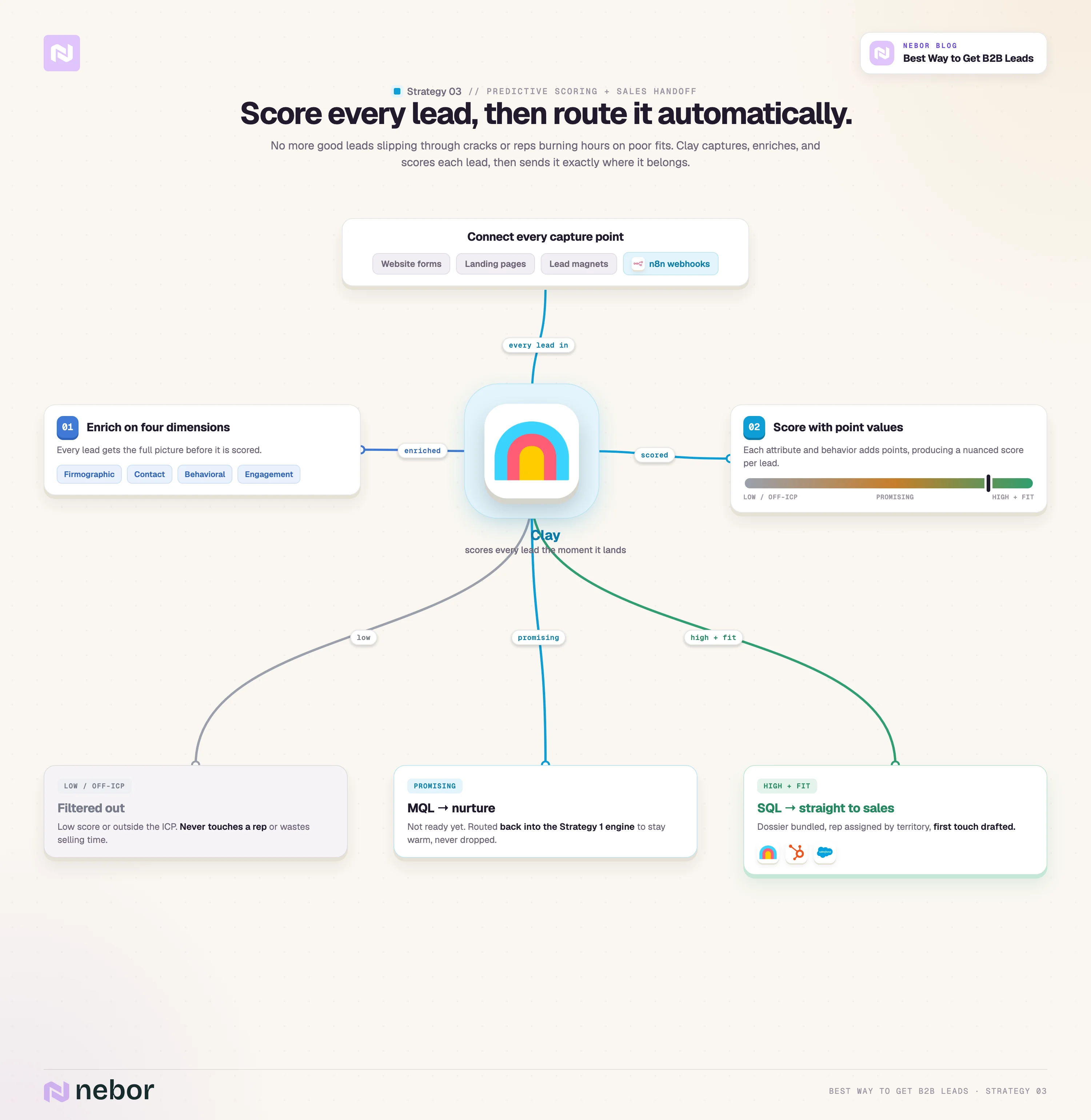
The strategy we use automates the entire flow from initial capture, through enrichment and scoring, to sales handoff. It ensures that your reps focus on the leads that actually matter, and the rest stay in nurture without falling out of the system entirely.
Here again, it all ties back to Clay and the workflow we built in Strategy 1.
Connect every lead capture point you have to Clay, either directly or through n8n webhooks in between. That includes website forms, landing pages, lead magnets, and every other entry point into your funnel. Each new lead lands in your central system automatically the moment it comes in.
Clay then enriches every lead with the data that drives the score. Firmographic data comes in first, including company size, industry, technology stack, funding history, and growth trajectory.
Because the workflow already integrates with the contact-data tools from Strategy 1, it pulls direct phone numbers, work emails, social profiles, and the rest at the same time.
Once enriched, the system applies a scoring model based on what actually matters to your specific business. Things to factor in look like the following.
Company characteristics: size, industry, location, growth rate, funding status
Contact attributes: job title, seniority, department, decision-making authority
Behavioral signals: pages viewed, content downloaded, webinars attended
Engagement patterns: email opens, social interactions, repeat visits
Assign point values to each attribute and behavior that matters. The output is a nuanced score for every lead that lands in the system.
Based on the resulting score, leads route automatically to where they need to go.
High-scoring leads that fit the ICP become SQLs and go straight to the sales team.
Promising-but-not-ready leads become MQLs and feed back into the Strategy 1 nurture workflow.
Low-scoring leads outside the ICP get filtered out before they ever touch a rep.
For SQLs, the system bundles a complete profile and assigns the lead to the right rep based on territory, vertical expertise, or current load. The rep gets a notification with everything they need for the first conversation in one place.
You can even prompt Claygent to draft email templates or call scripts using the prospect’s specific behaviors and characteristics, so the rep is ready to reach out in minutes rather than hours.
How we build these systems for our clients at Nebor
The reason these three strategies hold up under real conditions is that they connect to each other through the same Clay-based workflow.
Outbound automation drives the consistent proactive outreach that fills the top of the funnel. Intent monitoring catches the time-sensitive opportunities the moment they happen. Lead scoring and handoff turn inbound interest into something a sales team can actually work without losing leads in the cracks.
Together they cover the three places leads come from in a real B2B business, and the same Clay-based system holds them all together in one place.
This integrated approach fixes the structural problems with traditional lead generation that we walked through earlier.
At Nebor, we orchestrate these systems daily for clients across industries with consistent results.
Our work is to build sales automation and GTM systems that combine targeting precision with operational efficiency, so the lead flow stays consistent and the team is not spending its day moving data between tools.
The systems live inside your accounts when we are done. That is the ownership-over-rental part of how we work, and the reason these engagements actually pay off after the contract ends.
If you want help building this in your business, we have three ways to start the work.
Done-for-you implementation: we set up and operate the systems for you, and qualified leads land directly with your sales team every week.
System design and training: we design custom workflows for your business and train your team to operate them after we hand off the build.
Strategy consultation: we audit your current approach and give you specific recommendations on what to build, what to keep, and what to cut.
Thanks for reading all the way through. If you want to talk through how this would work for your specific setup, find us on LinkedIn or book a 15-minute call and we will dig into your stack together.
Note: The three strategies in this article all depend on the same thing underneath.
Data that is current, signals somebody is watching for, and routing that gets a lead to a person while it is still warm. Without that layer, each strategy is just another tab for your team to check.
At Nebor, we automate outbound prospecting and lead generation, and that underneath layer is exactly what we build.
Book a 15-minute call and let's discuss which of the three would suit your business.


Related Articles


By clicking Sign Up you're confirming that you agree with our Terms and Conditions.