
11 Top Outbound Sales Agencies to Consider in 2026


In this post:
If you are reading a blog post on outbound sales agencies, we can guess a few things about you.
You are a business owner with a lean startup, where you juggle product, marketing, and sales yourself, and you came here looking for someone who can take the top of the funnel off your plate.
Or, you are a sales or RevOps team lead who hired good salespeople but they spend most of their day researching prospects, updating spreadsheets, and sending cold emails nobody opens.
The pipeline you expected to grow stays thin, your team misses targets, and somewhere along the way you start wondering whether you need more reps or whether the whole system is broken.
Either way, the truth that matters is the same. The right partner takes prospecting work off your reps so your closers actually close. The wrong one burns through your budget, hands you unqualified leads, and wastes months of your time.
We wrote this list to help you avoid the second outcome. Below, you will find the criteria we use to evaluate agencies, a detailed breakdown of how we work at Nebor, and ten other outbound sales services worth considering.
Each one gets an honest look at strengths, weaknesses, pricing, and how they compare to us, so you know what you are signing up for.
Let’s get started.
Why Nebor is the best outbound sales agency for your growth needs
We’re Andrew van Rossenberg and Yannick Kok, and we started Nebor (originally Utmost) because we kept hitting the exact problem that brought you to this post.
We sold software and services ourselves before we ever sold this work to anyone else, so we know what it costs a rep to spend the morning chasing data, cleaning records, and writing the same five-line email forty times before lunch.
We also know what it costs a company when nobody fixes that.
That is where the practitioner half of our identity comes from. We're salespeople first, automation experts second. Every workflow we ship started with someone on our team using it themselves at a sales job that needed it to work.
The other half is the design choice that shapes everything else we build. Outbound is one motion inside a much larger flywheel.
The same Clay tables, enrichment routines, and signal pipes that feed your cold email workflow can also drive inbound capture, intent monitoring, CRM hygiene, lifecycle handoff, and pipeline reporting. Pull on any one thread and the rest moves with it.
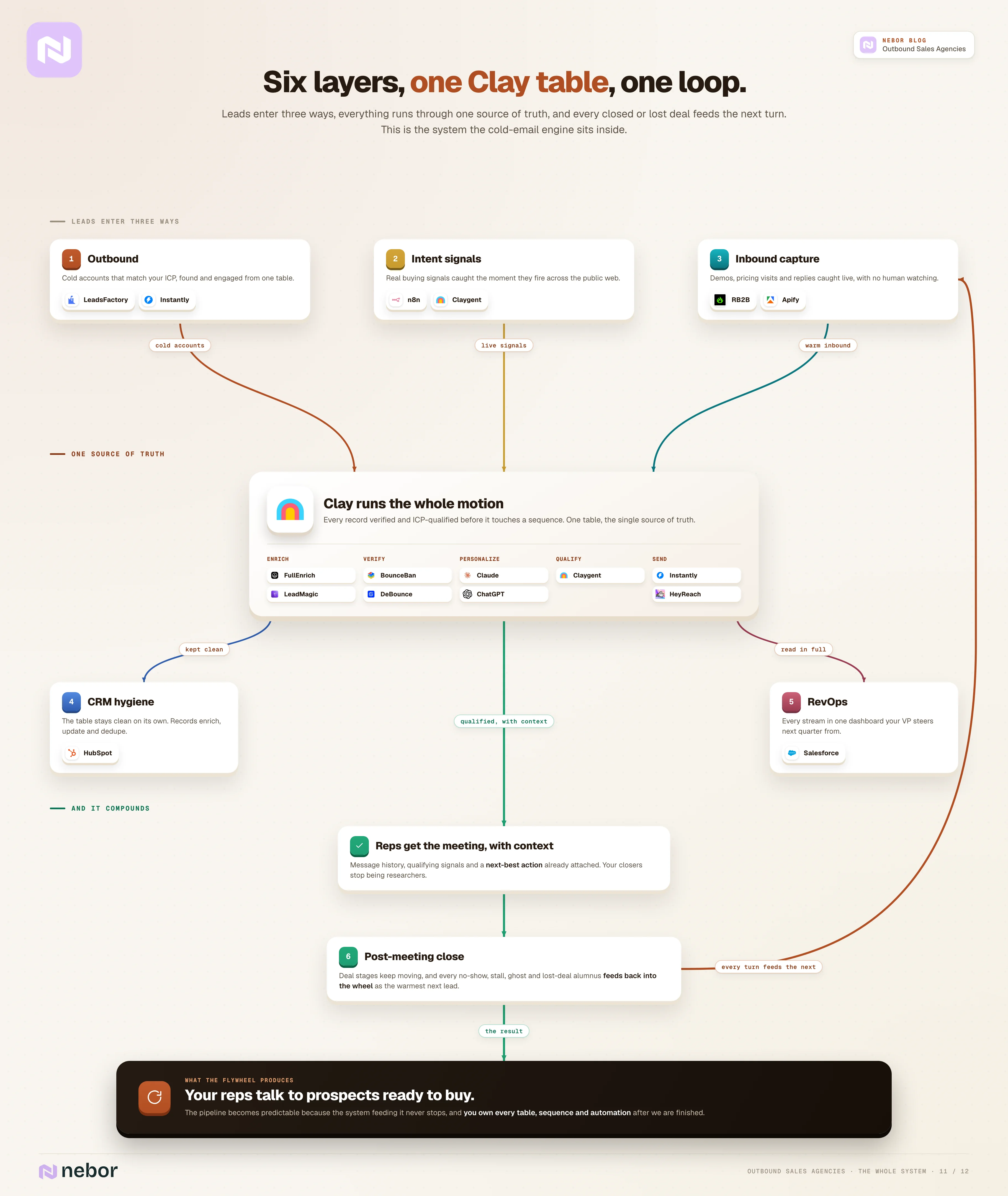
That is what we mean when we describe ourselves as a GTM infrastructure agency rather than an outbound vendor. Most agencies on this list build a cold-email engine and call the work done.
We build the system the engine lives inside, and you own the tables, sequences, and automations after we're finished.
Here is what each layer of the flywheel actually does for you. The real workflows go deeper than this overview, but the shape is right.
We push outbound through Clay and orchestrate every channel from one source of truth
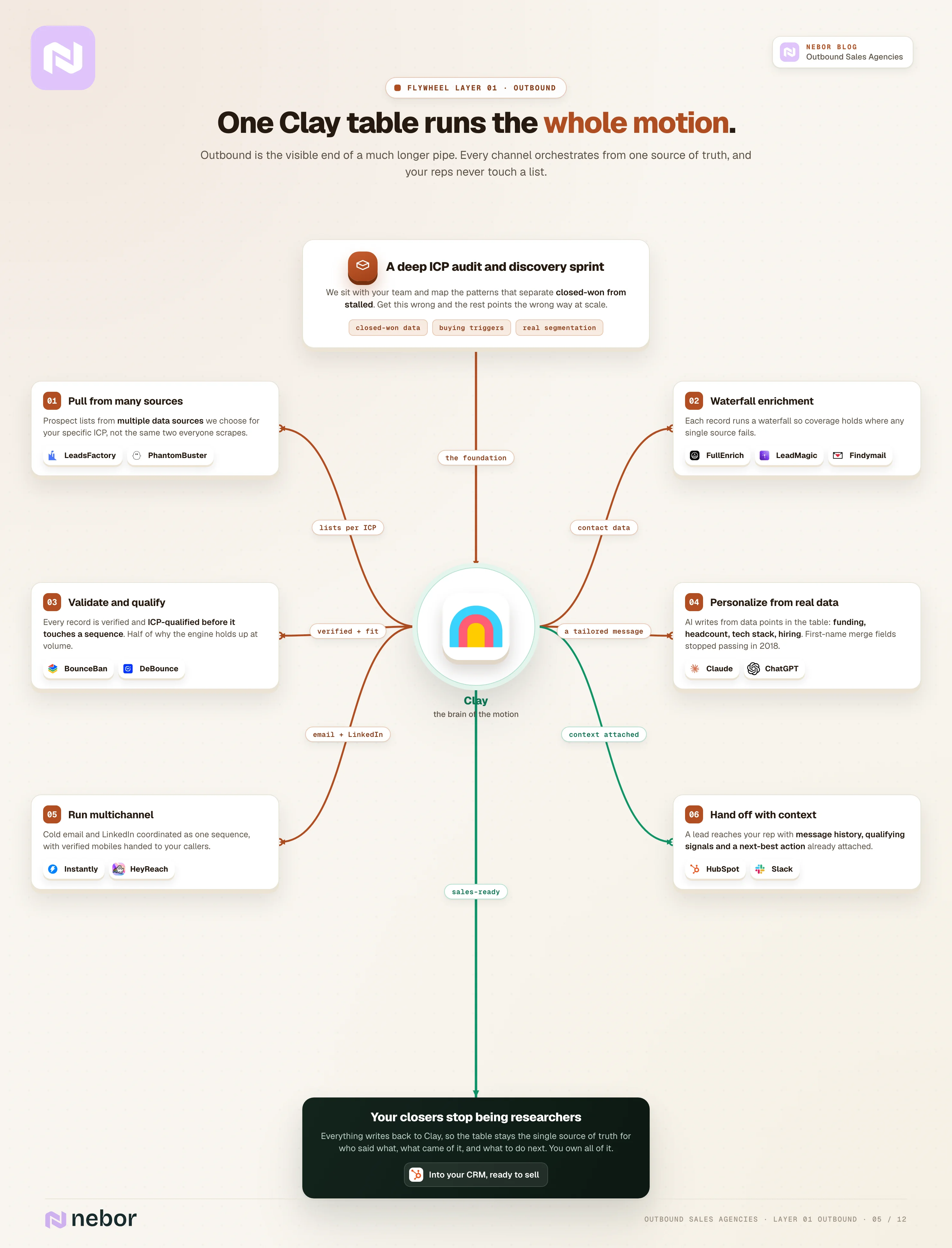
Most agencies set up a cold-email tool, build a sequence, and call that outbound. We treat outbound as the visible end of a much longer pipe.
Setup begins with a deep ICP audit and discovery sprint. We talk to your team, dig into your closed-won data, and map the patterns that separate the deals you won from the ones that stalled. This is not a checkbox round of segmentation copied from a deck.
The work we do here is the foundation everything downstream is aimed at. Get this wrong and the rest of the system points the wrong direction at scale, so we take it seriously.
From there, we build a Clay table that becomes the brain of the entire motion. We pull prospect lists from multiple data sources we choose for your specific ICP, then push waterfall enrichment across FullEnrich, LeadMagic, Findymail, Snov.io, and PhantomBuster.
We pass email validation through BounceBan and DeBounce. We verify and ICP-qualify every record before it touches a sequence, which is half of why our Clay-led automation engagements hold up at volume.
Personalization is where most agency setups quietly die. We use Clay's native ChatGPT and Claude integrations to write messages that pull from real data points already in your Clay table.
We pull recent funding rounds, headcount changes, tech stack signals, hiring patterns, and dozens of other points we collect on each account.
First-name merge fields stopped passing as personalization in 2018. We segment the list against the criteria that actually differentiate your ICP and route each segment into a different message track.
Multichannel execution lives in Instantly for cold email and HeyReach for LinkedIn outreach, with deliverability monitored against the standards in our email deliverability playbook. We feed your internal team verified phone numbers from FullEnrich for cold-call work.
Everything writes back to Clay, so the table stays the single source of truth for who said what to whom, what came out of it, and what to do next.
By the time a lead reaches your reps, they already have message history, qualifying signals, and a recommended next-best action.
The handoff goes into your CRM or a Slack channel, and your closers stop being researchers. The full pattern is what we describe in our post on automating lead generation.
Our intent data and buying signal workflows help you win the low-hanging fruit
Most outbound teams leave money on the table because they cannot spot real buying signals fast enough to act on them. By the time a salesperson notices a prospect raising a hand, three competitors are already in the inbox.
We design intent data and signal workflows inside Clay and n8n that monitor and scrape sources continuously. This goes well beyond what tools like Bombora and Cognism sell as intent.
We are not tracking article views and calling that intent. We are catching signals that mean someone is actively in-market, and we route them into the same outbound system the moment they appear.
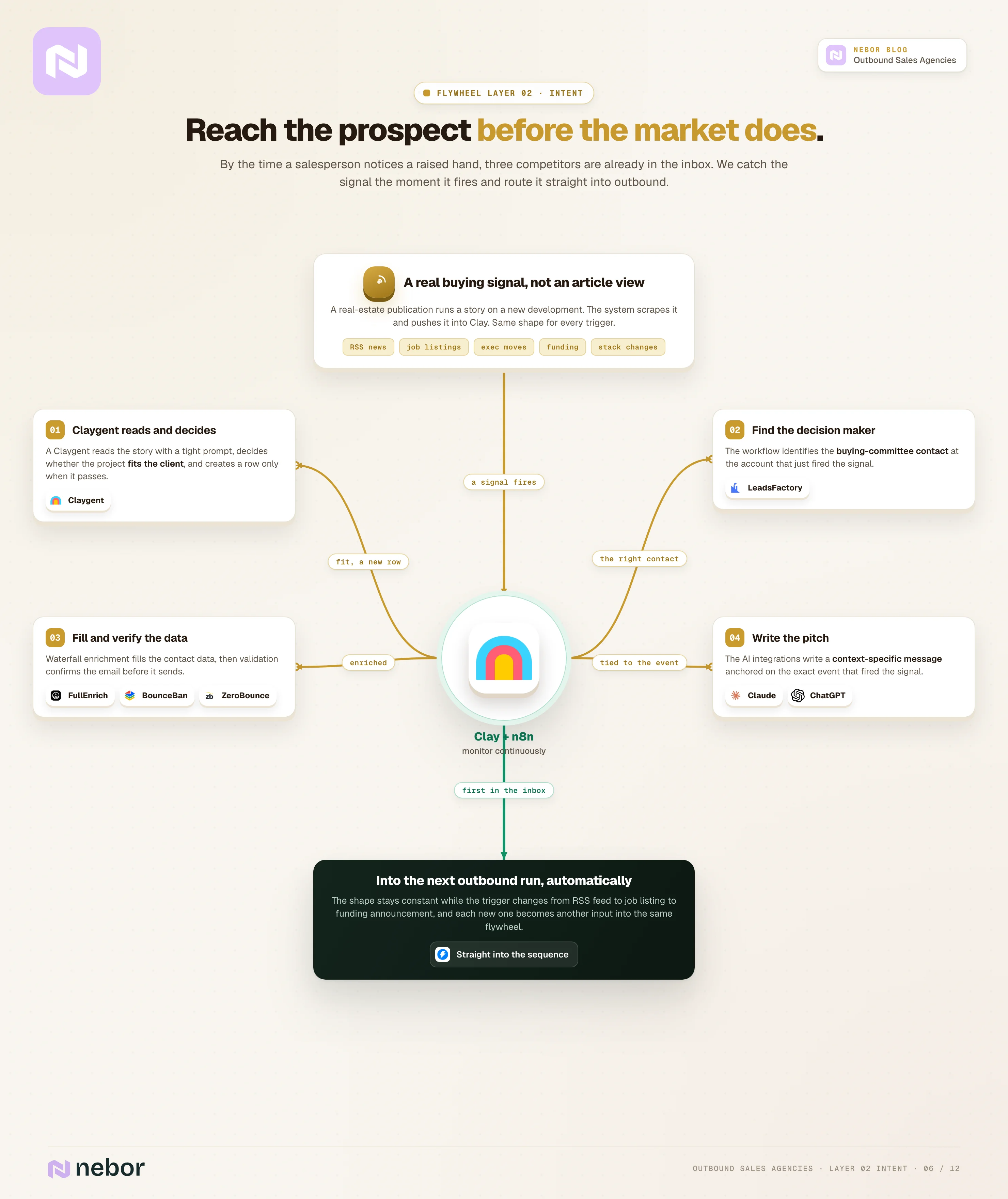
The shape of the workflow is the same every time. A signal hits, the system enriches the company, identifies the buying-committee contact, validates the data, drafts a context-specific message, and pushes the prospect into the next outbound wave.
For one client selling AI-powered furnishing into property developers, we built an RSS-feed monitoring workflow that watches real estate publications. Every time a publication publishes a story about a new development project, the system scrapes the article and pushes it into Clay.
A Claygent reads the article with a tight prompt, decides whether the project fits the client, and creates a row when it passes.
From there, LeadsFactory finds the right decision maker, FullEnrich and waterfall enrichment fill the contact data, BounceBan and ZeroBounce verify the email, and the AI integrations write the personalized pitch.
That same pattern drives a dozen other intent triggers we build, including job-listing signals, executive-move signals, competitor-acquisition signals, funding signals, and stack-change signals.
The shape of the workflow stays constant across every trigger we wire up, while the signal type changes from RSS feed to job listing to funding announcement, and each new one becomes another input into the same flywheel.
You get to the prospect before the rest of the market knows the opportunity exists, and that is the entire point of the workflow.
We capture, qualify, and route every inbound signal back into the same system
Your website, content, podcast, ads, and social channels generate leads too. Most companies let those leads wait in a queue while someone gets around to following up.
We plug your inbound traffic into the same Clay system that powers outbound. The setup uses RB2B and Leadinfo for de-anonymizing visitors, Apify for scraping, and n8n for orchestration.
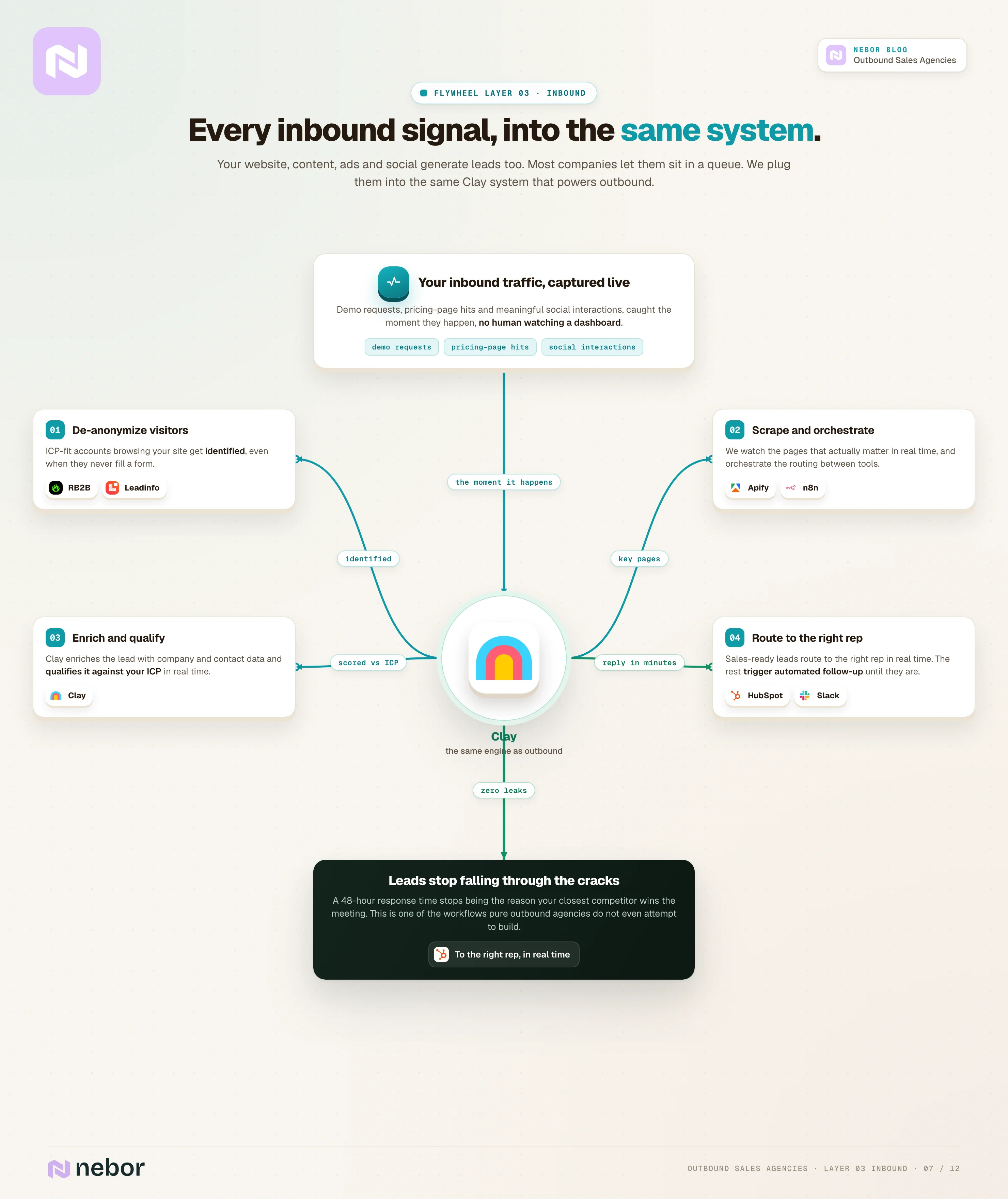
We watch the pages that actually matter in real time, with no human watching a dashboard.
The full walk-through of our website-visitor workflow lives on our blog for anyone who wants the wiring diagram.
We capture every demo request, pricing-page hit, and meaningful social interaction the moment it happens.
We enrich the lead with company and contact data, qualify it against your ICP, and route it to the right rep in real time, or trigger automated follow-up if the lead is not yet sales-ready.
Leads stop falling through the cracks, and 48-hour response times stop being the reason your closest competitor wins the meeting. This is one of the workflows pure outbound agencies do not even attempt to build.
We eliminate CRM chaos with cleaning and updating workflows
Your CRM is probably a mess and quietly hurting every campaign that touches it. Contacts who left their company three years ago are still in your active sequences, email addresses bounce, duplicate records pile up, and fields stay empty or full of stale data.
We build Clay-driven CRM automation that connects directly to your HubSpot, Salesforce, or whatever CRM holds your pipeline.
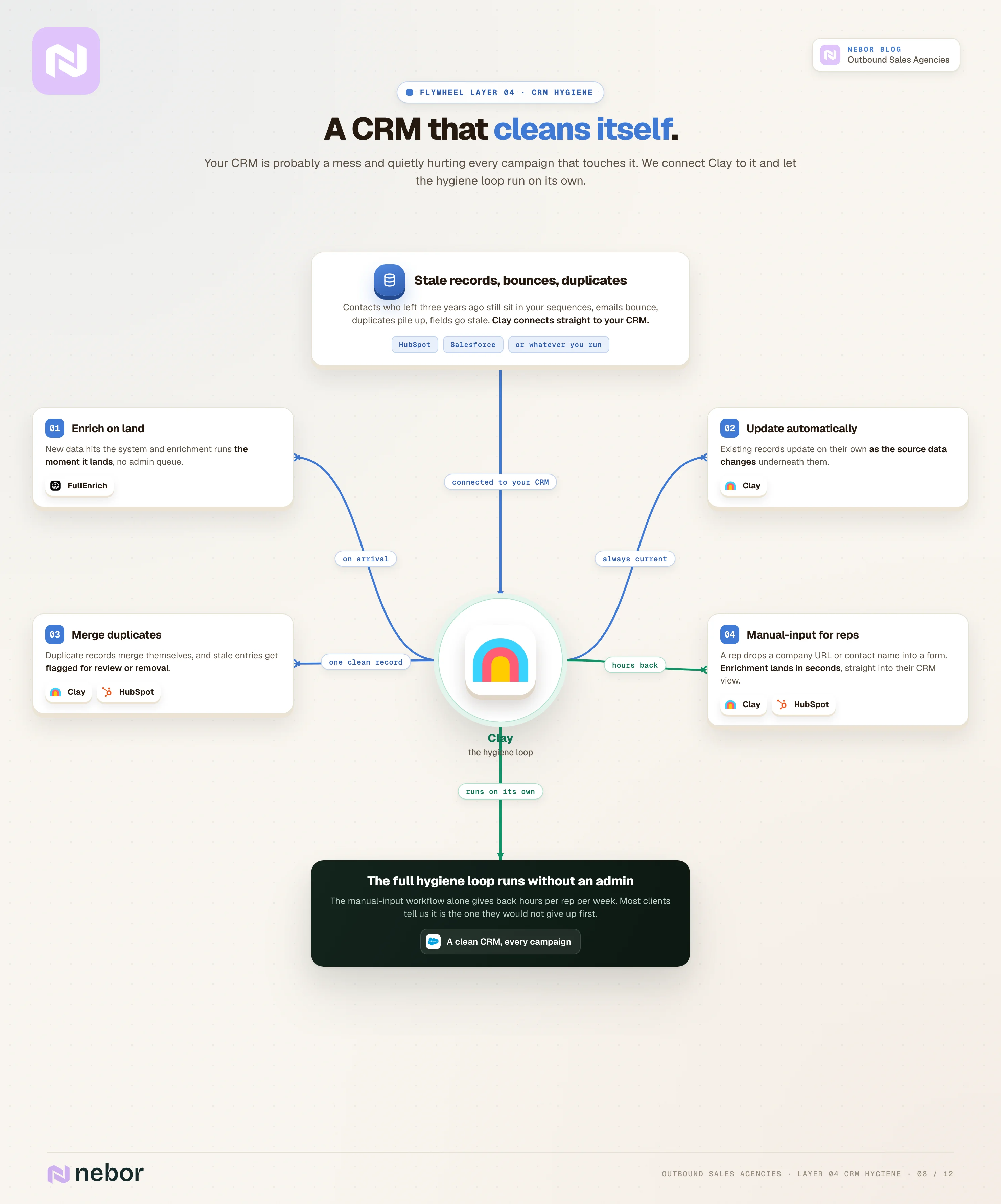
New data hits the system and enrichment happens the moment it lands. Existing records update automatically as the source data changes, duplicate records merge themselves, and our workflow flags stale entries for review or removal. The full hygiene loop works on its own without an admin chasing it down.
We also build manual-input workflows for your reps. Instead of a closer spending twenty minutes researching a prospect before a call, they enter a company URL or a contact name into a form, and the Clay workflow handles the rest. Enrichment lands in seconds and drops straight into the rep's HubSpot view.
That alone gives back hours per rep per week, and most of our clients tell us it is the workflow they would not give up first.
We close the RevOps loop with reporting and pipeline visibility you can actually steer
Most outbound agencies stop at the meeting booked. The week they hand the meeting over, the workflow ends as far as they are concerned.
That is also the moment most pipeline reporting falls apart. The signal data lives in Clay, the activity data lives in HubSpot or Salesforce, the dialer notes live in another tool, and the leadership dashboard shows numbers that nobody trusts.
We pull the signal data, the outbound activity, the inbound capture, the meeting outcomes, and the deal-stage progression into one set of dashboards your sales leadership actually opens.
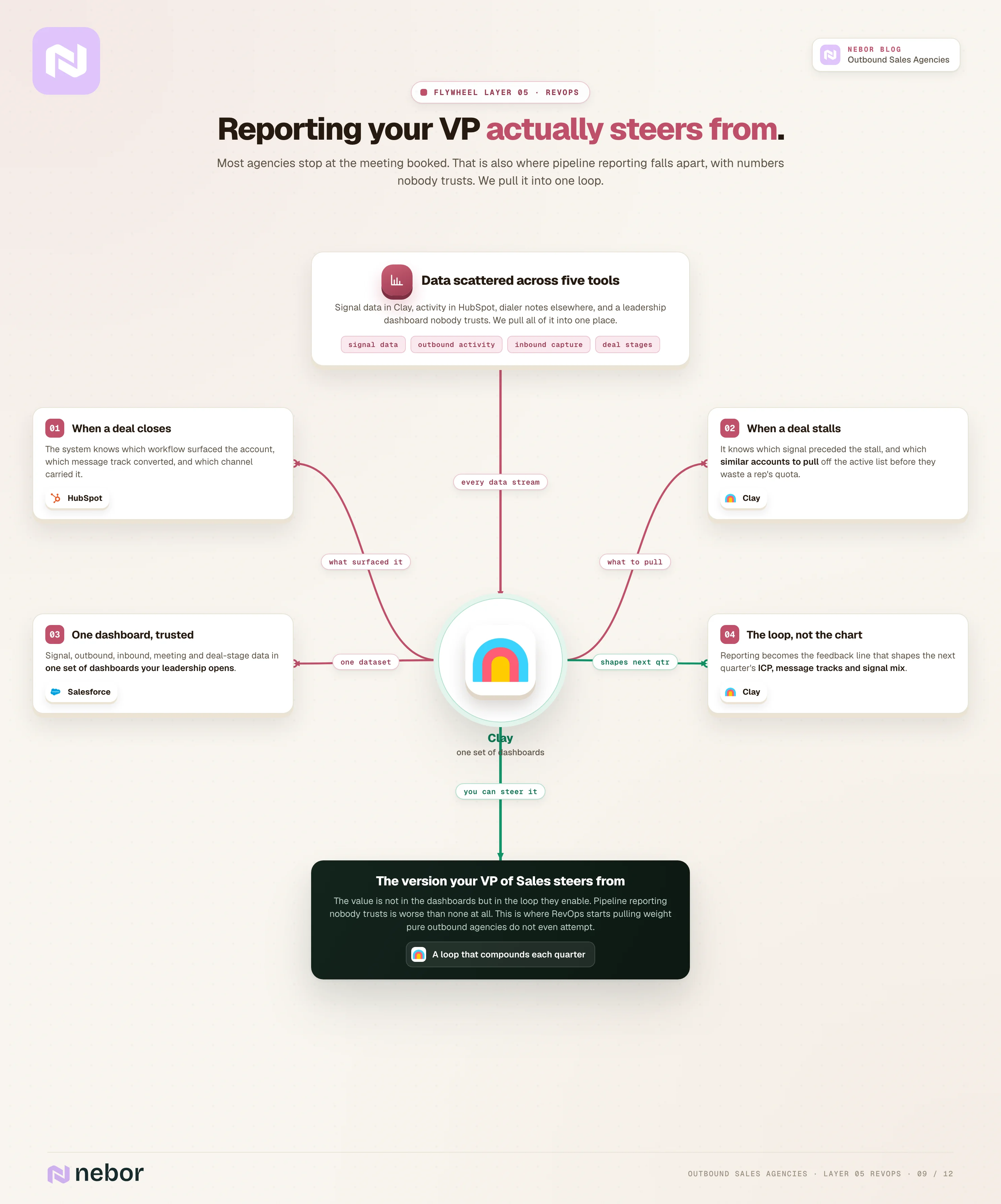
The value is not in the dashboards but in the loop they enable, which is what changes how you plan the next quarter.
When a deal closes, we want the system to know which workflow surfaced the account, which message track converted the meeting, and which channel carried the deal across.
When a deal stalls, we want the system to know which signal preceded the stall and which similar accounts to pull off the active list before they waste another rep's quota.
This is where our RevOps work starts pulling weight that pure outbound agencies do not even attempt. Reporting becomes the feedback line that shapes the next quarter's ICP refinement, your personalization tracks, and the signal mix you choose to invest in.
Pipeline reporting that nobody trusts is worse than no reporting at all. We build the version your VP of Sales actually steers from.
We close the loop after the meeting books, from handoff through deal stages
Booked meetings are not the finish line on their own. The lead drops into your team, and within a week you know whether the rep ran the right call, whether the follow-up landed, whether the prospect ghosted, and whether the deal moved into stage two.
We build deal-stage automations inside HubSpot and Salesforce that keep that motion clean. Stage transitions trigger enrichment refreshes, follow-up sequences, and stakeholder mapping for the rest of the buying committee.
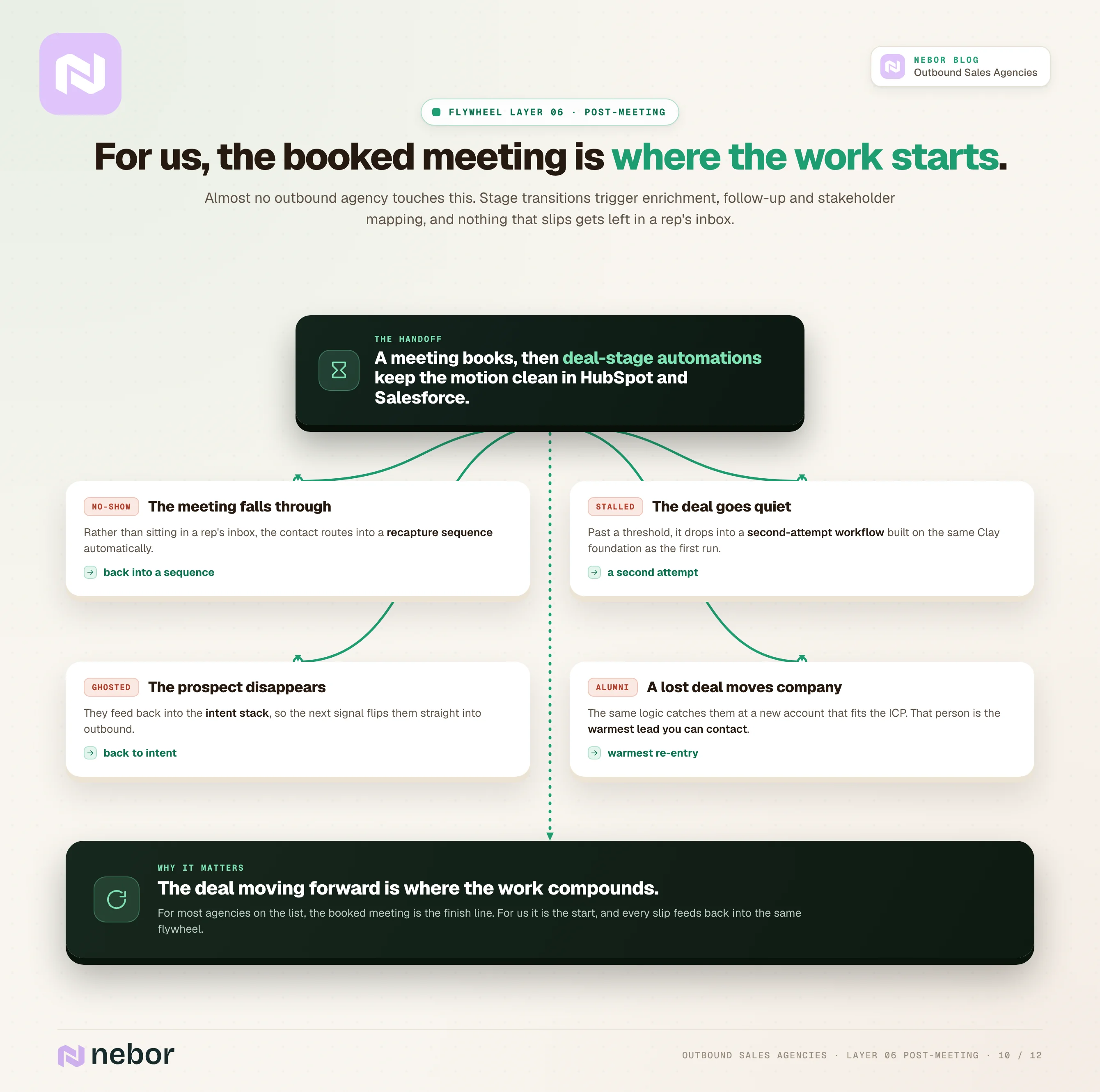
When a meeting goes no-show, we route the contact into a recapture sequence rather than letting it go cold in a rep's inbox.
Deals that stall past a threshold drop into a second-attempt workflow built on the same Clay foundation as the first pass, and prospects who ghost entirely feed back into the intent stack so the next signal flips them straight into outbound.
The same logic catches lost-deal alumni who later move to a new company that fits the ICP, since that person is the warmest lead you can possibly contact.
This is the part of GTM that almost no outbound agency on this list will touch. For them, the booked meeting is the finish line. For us, the deal moving forward is where the work starts to compound.
Our sales experience shapes everything we build
Tools are part of the equation, but the thinking behind how we use them is what matters. Andrew and Yannick spent years selling software before they built any of this.
The frustration of waiting on bad leads, switching between a dozen tools that do not talk to each other, doing manual prospecting under quota pressure, that is the experience that shaped the system.
Automation is only useful when it picks the right tasks. We automate the right ones in the right way, and we leave the human work, the pitching, the discovery, the negotiation, with the people who are paid to do it.
Working with us means salespeople who learned automation, and a system that works the way sales actually works rather than the way consultants think it should.
What criteria we looked at to qualify outbound sales agencies for this list
These are the qualification elements we believe you should weigh when partnering with an outbound sales agency. Plenty of agencies talk a strong game and deliver garbage leads. Others promise the world and disappear after cashing your check.
The criteria below are the ones we used to evaluate every agency on this list, and the same ones you should use when making your own decision.
Vertical specialization matters more than you think
The first thing to check is whether the outsourcing partner knows your industry and speaks your buyer's language. The right agency for you will already understand the sales cycle, the objections, and the decision-making process inside your vertical.
A generalist agency will spend months learning what a specialist already knows. If you sell SaaS to enterprise CFOs, you need a partner who has done that work before, so they can have real conversations with your target audience instead of practicing on your dime.
Proven results, client satisfaction, and case studies that tell the real story
This one looks obvious, and we still want to call it out. Plenty of agencies will tell you they do cold outreach. Far fewer can actually prove their results held up under audit.
Ask for case studies from companies similar to yours in size, industry, and deal complexity. Look for metrics that move the bottom line, like meeting-to-opportunity conversion rates, pipeline generated, and deals closed. Ignore vanity metrics like cold calls dialed or emails sent, because those numbers do not pay your bills.
What an agency contributes to revenue should weigh more heavily than the volume of activity they push through.
Team quality determines your campaign's ceiling
Whether you are working with an outsourced SDR team or with an agency that automates outbound, the people assigned to your account will represent your brand. Ask about their experience, training process, and tenure on the team.
Can they handle objections from a senior buyer? Do they understand complex B2B sales cycles? A junior rep reading from a script will not hold up against VP-level prospects.
ICP targeting separates good agencies from bad ones
A quality agency follows a rigorous process for identifying and validating the right leads. They do not just scrape LinkedIn and call it a day.
They research fit signals, verify data accuracy, and filter out companies that will never buy. If an agency cannot explain their ICP qualification process in detail, walk away.
Personalization capabilities show how much they actually care
Generic templates produce generic results, and the best agencies tailor scripts and messages to highlight your specific value proposition. They customize outreach based on prospect research, industry context, and the pain points your buyers actually feel.
Ask the agency to show you real campaigns they have shipped. If everything you see looks templated, keep looking elsewhere.
Tech stack alignment prevents integration headaches
Verify that the agency uses modern sales tools and can integrate with your existing systems. If you are on Salesforce, make sure they can plug in. If you are on HubSpot, confirm they have shipped real work inside it before.
Misaligned tech stacks create data silos and reporting nightmares that take quarters to undo.
Data compliance protects you from legal trouble
If you sell into Europe, GDPR, CAN-SPAM, and the rest of the regulations are not optional. Make sure your partner follows the data privacy laws relevant to every market you target.
A single compliance violation can cost you more than any campaign is worth.
Ramp-up time tells you if they understand outbound
Be skeptical of any agency promising immediate results. Quality outbound is iterative work, and 45 to 60 days is the realistic window for testing, refining, and optimizing your first campaigns.
Anyone promising meetings in week one either does not understand outbound or is setting you up for disappointment.
Pricing model affects how incentives align
Understand whether the agency charges a fixed fee, a retainer, or a pay-per-meeting rate, and know what each tradeoff buys you.
Fixed fees give you predictability but do not tie compensation to outcomes. Pay-per-meeting aligns incentives but can quietly push the team toward quantity over quality.
Know exactly which model you are signing into before you sign.
1. Belkins.io: for B2B appointment setting in tech and SaaS
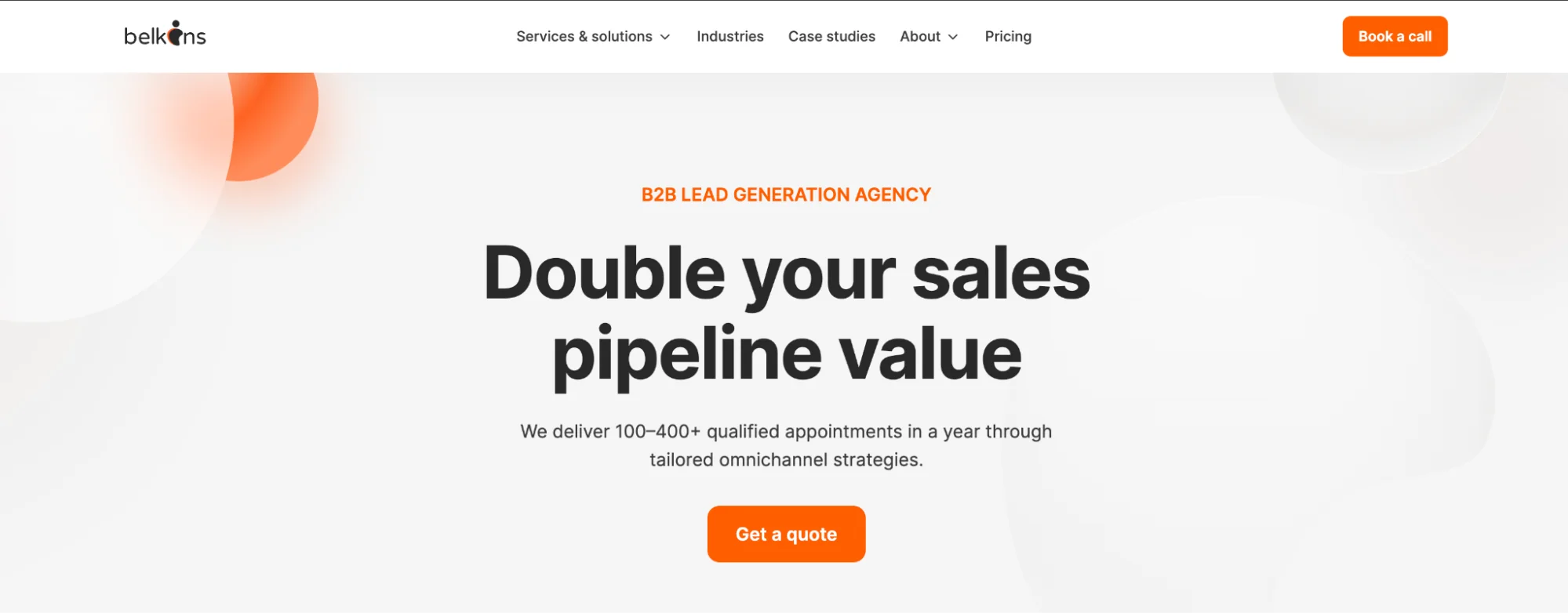
Belkins is one of the biggest names in B2B appointment setting. They have been active since 2017, worked with over 1,000 clients, and built a strong reputation across tech and SaaS.
Their model focuses on multi-channel outreach across email, LinkedIn, and phone. They emphasize manual research over automation, which means real humans verify and qualify every prospect. They also built Folderly to handle email deliverability, which is a smart move that shows they understand what makes outbound actually work.
What works:
Strong track record with over 1,000 clients and 223+ Clutch reviews averaging 4+ stars
High-quality manual research process that produces better-qualified leads
Folderly tool helps solve the deliverability problems that kill most campaigns
Multi-channel approach covers email, LinkedIn, and phone
No-show recovery services salvage meetings that would otherwise be wasted
Where they fall short:
Premium pricing between $5,000 and $14,800 per month puts them out of reach for smaller companies
Quality varies depending on which account manager and SDR team you get assigned
Manual processes mean slower scaling than automation-first approaches
Long ramp-up period before you see meaningful results
Limited transparency on held meeting rates versus booked meetings
Pricing: Retainers between $5,000 and $14,800 per month depending on volume and services. Most clients pay around $8,000 monthly for roughly 100 appointments per year.
How they compare to Nebor: Belkins delivers a traditional, human-heavy outbound model with experienced SDRs at the center.
They throw seasoned humans at the problem and rely on manual research, while we take a systems-first approach and build automated workflows that keep going without headcount limits.
Their method works, and ours scales better and captures opportunities they would miss. If you are weighing both, our Belkins alternatives breakdown goes deeper on the contrast.
Why we recommend them: If you have the budget and you prefer human-driven outreach over automation, Belkins can deliver. They are especially strong for companies selling complex SaaS where personalization carries the deal.
2. Martal Group: for tech-focused lead gen with dedicated SDR teams
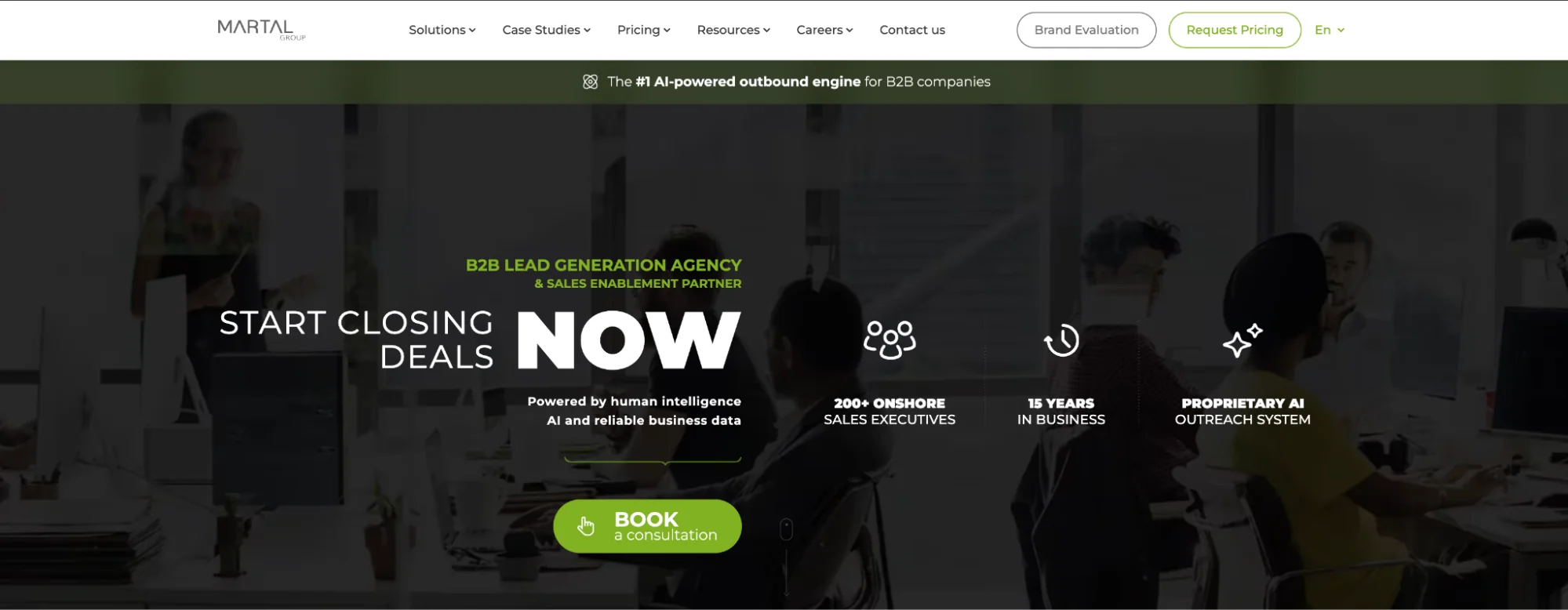
Martal Group has been in the game since 2009, giving them over 15 years of B2B lead generation experience. They specialize in tech companies and offer dedicated SDR teams rather than shared resources.
Their model assigns you a specific team that works exclusively on your campaign. They cover over 50 industry verticals and bring onshore talent across North America, Europe, and Latin America. They have also built their own AI SDR platform to combine automation with human outreach.
What works
15+ years of experience means they have seen most challenges before
Onshore talent in multiple regions lets you match SDRs to your target market
Industry specialization across 50+ verticals covers most buyer behaviors
Hybrid AI plus human approach balances efficiency with quality
Multi-language support including English, Spanish, German, and French
Where they fall short
Mid-to-premium pricing strains smaller budgets
Volume-focused approach sometimes sacrifices lead quality for quantity
Some reviews mention inconsistent lead quality depending on the campaign
Reporting can feel opaque compared to more transparent agencies
Standardized playbooks do not always adapt well to unique value propositions
Pricing: Retainers between $4,100 and $10,500 per month with custom pricing based on scope. Most engagements start with a 3-month pilot.
How they compare to Nebor: Martal Group staffs dedicated SDR teams that act like an extension of your sales force. We build systems that replace the need for additional headcount.
Their model requires managing an outsourced team, ours requires maintaining automated workflows. Two different philosophies match two different scenarios, and our Martal Group alternatives post lays out the practical tradeoffs.
Why we recommend them: Martal Group is a good fit if you want human SDRs working full-time on your campaign without hiring internally. They are also a strong option for international expansion thanks to the multi-language coverage.
3. CIENCE: pairs proprietary data with SDR services
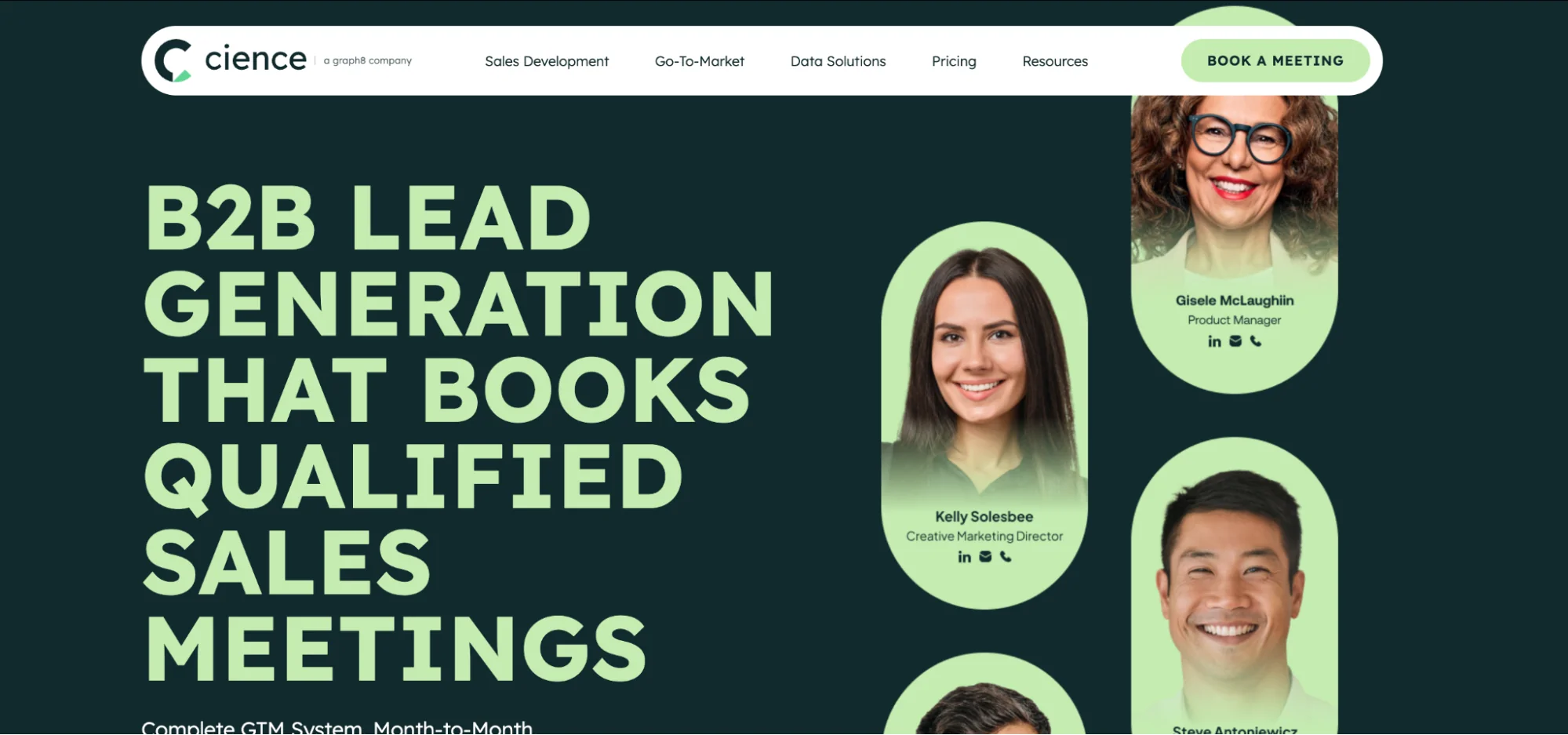
CIENCE built their entire business model on data. They own a database of over 140 million contacts and pair that proprietary data with SDR services to deliver outbound campaigns. They have grown quickly and earned spots on the Inc 5000 list four times.
Their services span outbound and inbound SDR teams, multi-channel outreach, and AI-powered research workflows.
What works
Massive 140+ million contact database gives them reach few agencies match
Coverage of 150+ industries lets them serve almost any vertical
Strong scale capabilities for companies that need high-volume outreach
Data intelligence and research capabilities help with targeting
Inc 5000 company four times over, showing sustained growth
Where they fall short
Reviews are extremely polarized, either glowing or scathing
Some clients report concerns about fabricated or unqualified leads
Heavy reliance on templates and AI for messaging can feel generic
Expensive for what you get if your campaign does not perform
High SDR turnover reported, which hurts campaign consistency
Pricing: Typically between $5,000 and $10,000 per month, with $10,800 monthly for a single dedicated SDR team. Custom pricing based on scope.
How they compare to Nebor: CIENCE leads the market on raw database scale, with more contact data than almost any other agency.
Our edge goes the other way, through workflow intelligence that captures signals and personalizes outreach against real-time data.
Volume comes with a precision tradeoff, and we would rather reach 100 perfect-fit prospects than 1,000 mediocre ones. We compare the two approaches in detail in our CIENCE alternatives post.
Why we recommend them: If you need massive reach and your ICP is broad, CIENCE gives you data access others cannot match. Verify lead quality rigorously before paying for results.
4. AnyBiz: delivers AI-powered sales automation for multi-channel campaigns
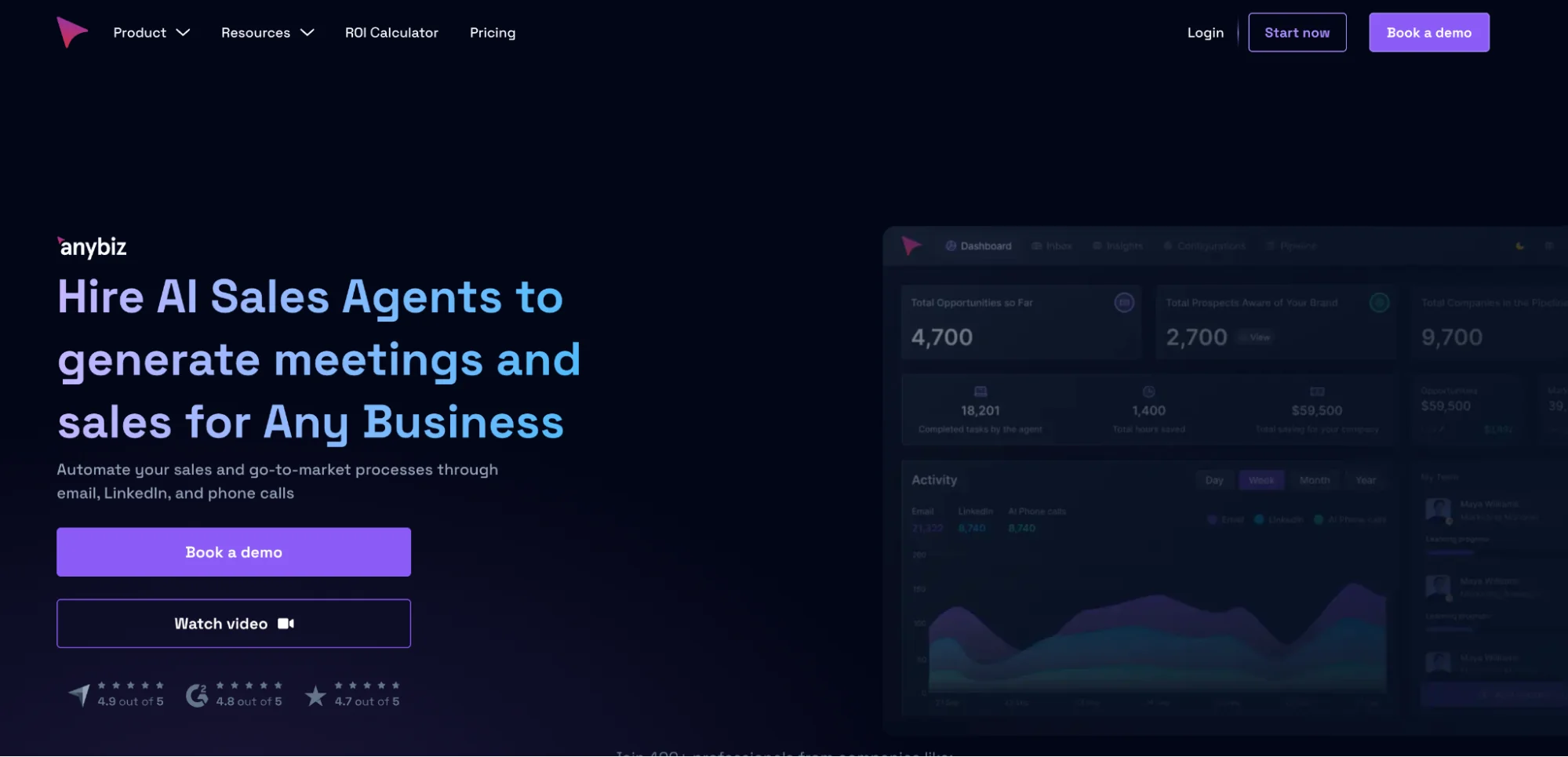
AnyBiz takes the opposite approach from most of this list. Instead of human SDRs, they built AI agents that handle prospecting, outreach, and engagement automatically.
Their platform works 24/7, sources leads from a 400 million+ prospect database, generates personalized messages, and executes multi-channel campaigns across email, LinkedIn, and phone.
It is the closest thing to a fully automated SDR currently on the market.
What works
Works 24/7 without human limitations or time-zone constraints
AI-driven personalization adapts messaging to each prospect at scale
Multi-channel coverage including email, LinkedIn, and AI cold calling
Cost-effective compared to hiring human SDRs at similar volume
Domain warming included to help with deliverability
7-day free trial lets you test before committing
Where they fall short
AI struggles with complex queries that require human judgment
Setup has a learning curve that can frustrate non-technical users
Outreach can feel too automated and robotic to sophisticated buyers
Limited human oversight means problems can compound before you notice
Newer platform with less proven track record than established agencies
Pricing: Tiered plans starting at $49 to $99 per month for basic features, $349 per month per AI agent, and up to $749 monthly for full capabilities.
How they compare to Nebor: AnyBiz automates the execution end of outbound work, while we automate the intelligence layer that decides which prospects, signals, and messages those workflows should act on.
Their agents send messages, and our workflows capture signals, enrich data, and route everything through coordinated systems. AnyBiz is a tool, and we build the strategy around tools like it. For a wider read on this category, see our AI sales tools breakdown.
Why we recommend them: It works as a solid entry point for companies that want automation without agency fees. It also handles straightforward ICP targeting where AI can carry most of the decisions.
5. Sopro.io: delivers UK-based, email-first prospecting at scale
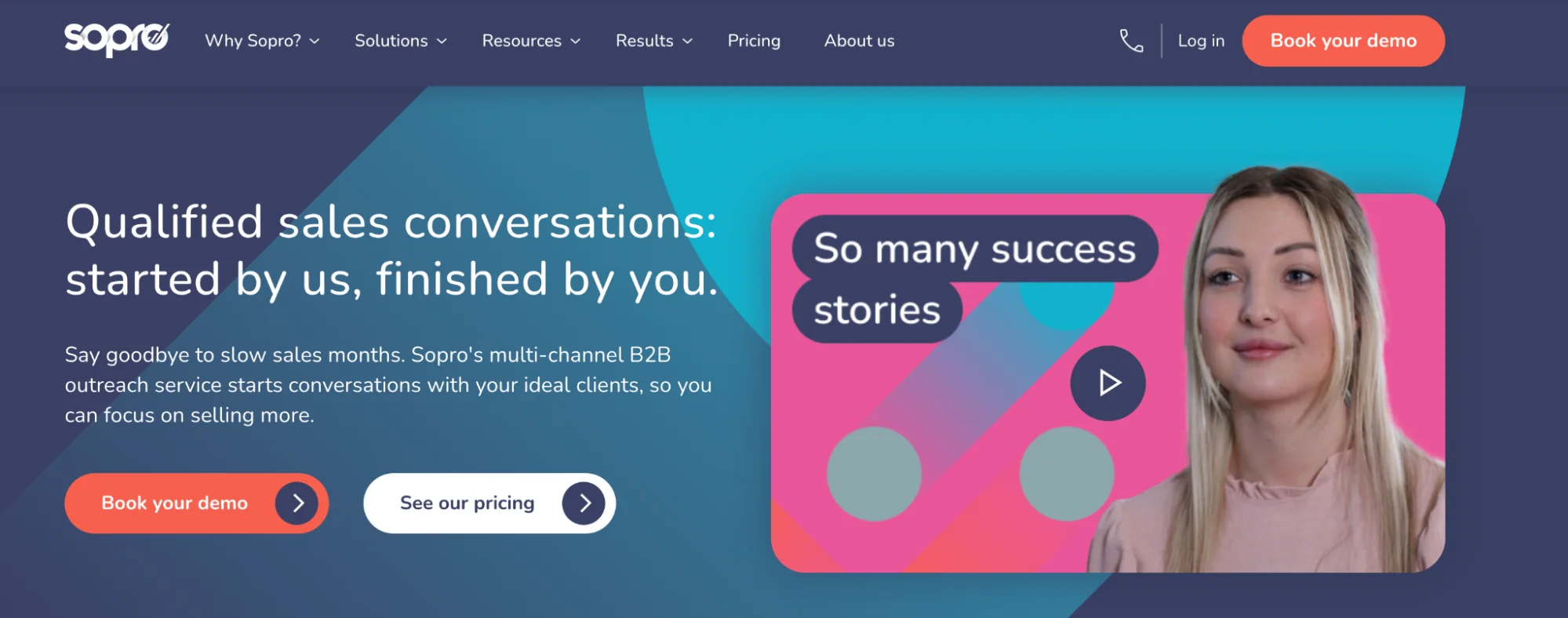
Sopro operates from the UK and delivers fully managed multi-channel prospecting campaigns. They emphasize transparency, data ownership, and a strong team-based approach.
With over 300 team members and no minimum contract requirement, they have built a flexible model that appeals to companies hesitant about long-term commitments.
What works
No minimum contract, you can stay month-to-month
100% data ownership means you keep everything you pay for
Live campaign portal gives real-time visibility into results
GDPR compliant for European-focused campaigns
Strong Trustpilot presence with 4.6 stars across 226+ reviews
Where they fall short
Pricing feels steep for what is largely manual execution
Most work goes through human teams, with limited automation benefit
Some reviews cite quality concerns with lead relevance
Limited AI or automation compared to modern approaches
Pricing: Starting at £3,000 per month (about $3,750 USD) with month-to-month flexibility.
How they compare to Nebor: Sopro delivers a high-touch, human-driven service across every campaign. They are more traditional, with teams of people doing manual prospecting.
We have automated the parts that do not need humans, so the humans on our side spend their time on the parts that do. Our Sopro alternatives post walks the contrast in more detail.
Why we recommend them: Sopro is a good option for UK and European-focused companies that want flexibility and do not mind paying for human-powered prospecting. The no-contract model lowers risk for first-time outsourcers.
6. SalesRoads: delivers sales appointment setting with US-based reps
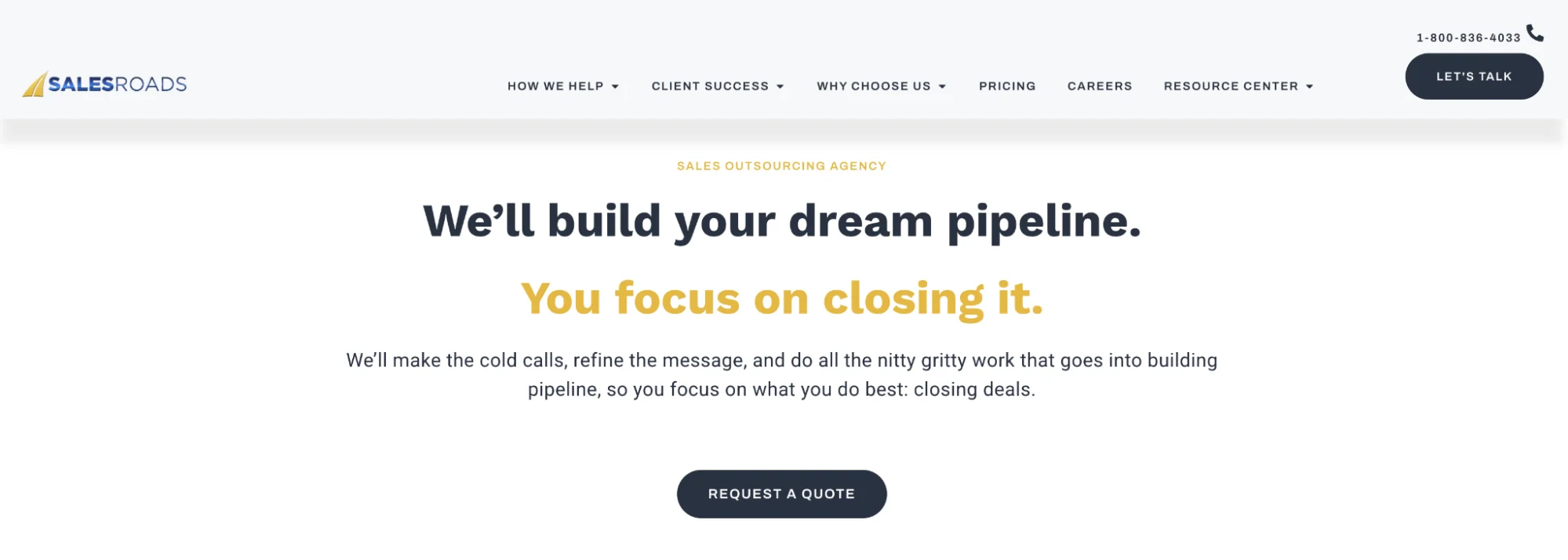
SalesRoads has been active since 2007 and built their reputation on phone-heavy outbound with experienced US-based SDRs. Their reps average 5 to 10 years of experience, which puts them well above industry standards.
They focus on quality over quantity and back the work with a 28-day satisfaction guarantee.
What works
Highly experienced US-based reps with 5 to 10 years on the phones
Strong phone expertise for companies where calls convert better than email
17+ years in business with over 100,000 appointments set
28-day satisfaction guarantee reduces upfront risk
Quality-focused approach with rigorous training and coaching
Where they fall short
Expensive at $9,950+ per month for starting engagements
Phone-centric model limits effectiveness for email and LinkedIn-native buyers
Long ramp-up before campaigns hit full stride
Not ideal for companies with highly complex or niche ICPs
Premium pricing excludes most SMBs and startups
Pricing: Starting at roughly $9,950 per 4-week cycle. Premium tier with custom quotes only, no standardized public pricing.
How they compare to Nebor: SalesRoads is at the opposite end of the spectrum from our model. Their model is to invest heavily in experienced human talent and charge accordingly, while ours invests in systems that multiply the talent already on your team.
Their SDRs are excellent, and our workflows never take a day off. Choose based on whether you value human touch or systematic scale, and read our cold-calling agency comparison for context.
Why we recommend them: If phone outreach drives most of your sales and you need experienced reps who can handle live conversations, SalesRoads is the right partner for that profile. They earn the premium for companies with high average contract values.
7. Leadium: combines data sourcing with managed outbound services
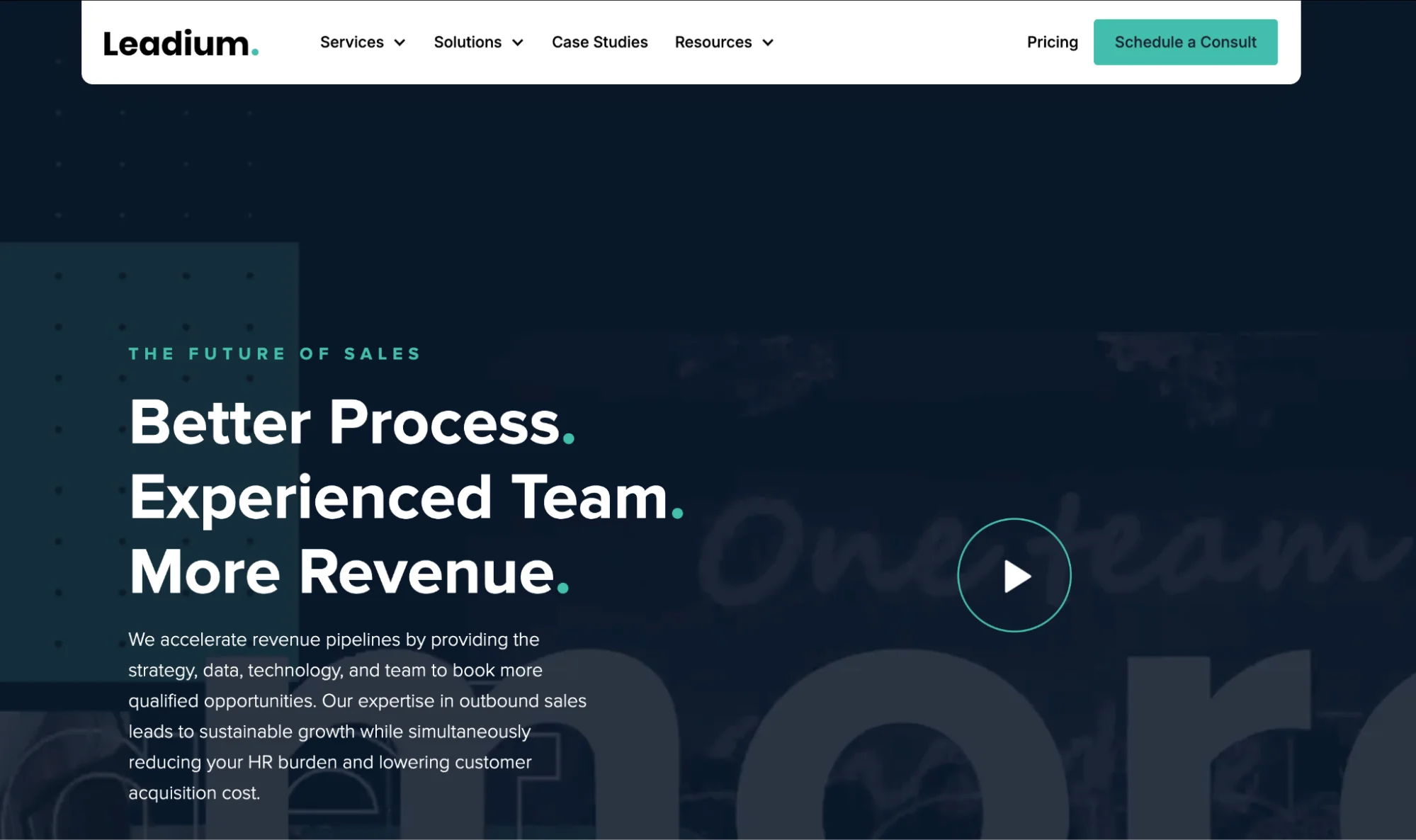
Leadium combines human-verified data sourcing with managed outbound services. Their 100% US-based SDR team handles everything from research through lead generation and appointment setting.
What sets them apart is their channel optimization focus. They study which channels work best for your prospects and configure campaigns accordingly.
What works
100% human-verified data means fewer bounces and bad contacts
Channel optimization matches outreach to how your buyers prefer to engage
Fully US-based SDR team for quality and compliance
Data ownership, you keep everything they build
Fast inbound response with sub-5-minute SLA for lead follow-up
Generated over $1 billion in client pipeline
Where they fall short
Requires a well-defined ICP and meaningful deal values to make ROI work
Smaller brand recognition than larger competitors
Less suited for startups with tight budgets
Pricing: Custom monthly retainers, estimated starting around $2,000 to $3,000 per month. Month-to-month contracts available.
How they compare to Nebor: Leadium puts most of its weight on data quality and human verification, while we put most of ours on workflow automation and signal capture.
Both approaches value accuracy, but their version reaches it through manual processes and ours reaches it through systems.
Leadium delivers, and our approach scales better as your motion grows. Our outsourced SDR companies guide covers the broader category if you want more context.
Why we recommend them: Choose them if you need data quality and prefer working exclusively with US-based teams. Their channel optimization research adds strategic value beyond basic appointment setting.
8. Operatix specializes in B2B tech and SDR outsourcing
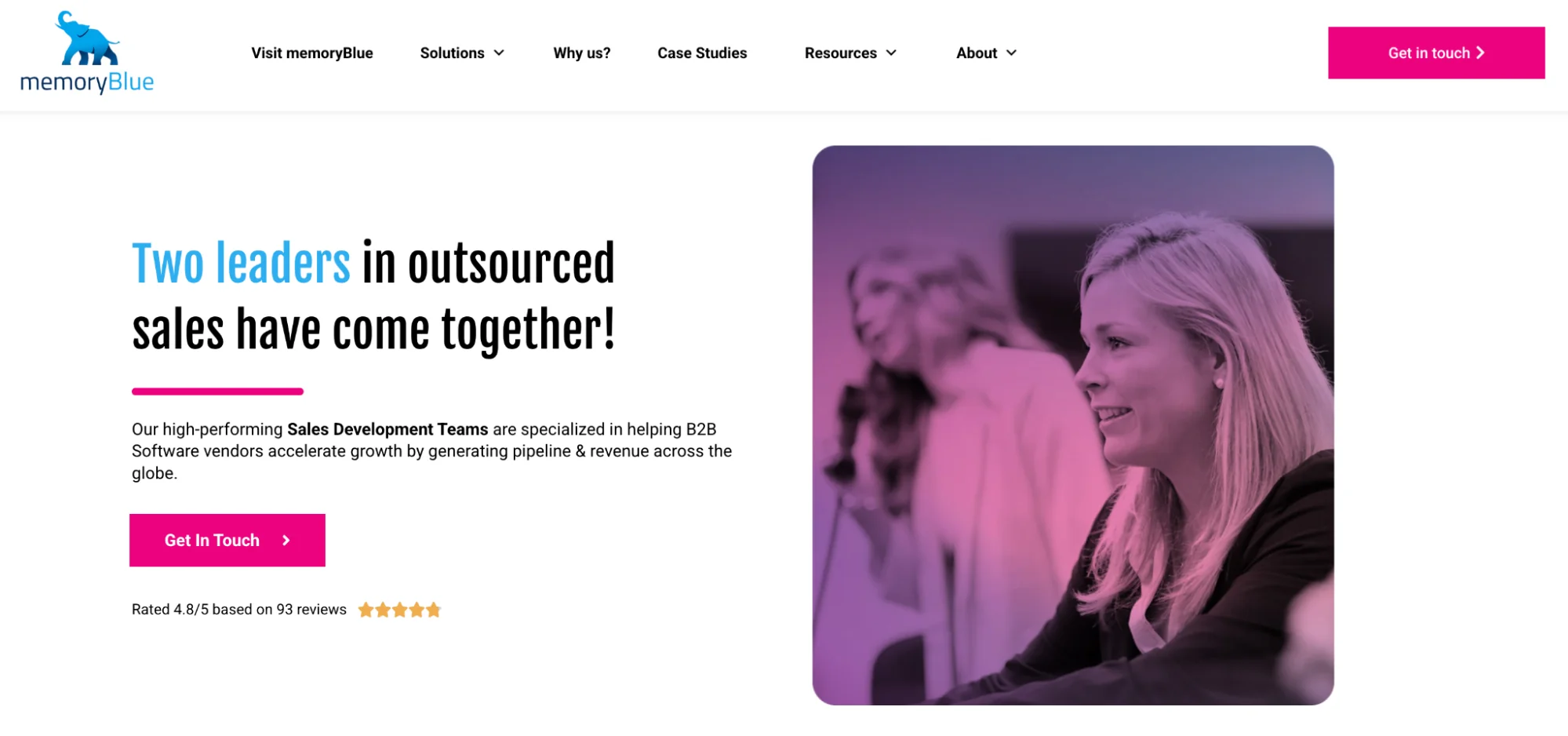
Operatix focuses exclusively on B2B tech companies as their entire client base. They merged with memoryBlue to expand their capabilities and now offer global coverage across EMEA, North America, LATAM, and APAC.
Their model includes flexible pricing options, including performance-based arrangements that tie compensation to results.
What works
Deep SaaS and B2B tech expertise means they understand your buyers
Global reach with multilingual teams for international campaigns
Flexible pricing models including performance-based options
Experienced SDRs who can handle complex enterprise sales cycles
Embed with client teams rather than operating in isolation
Where they fall short
Staff turnover issues reported by some clients hurt campaign continuity
Slower campaign setup and onboarding compared to smaller agencies
Standardized processes can feel less personalized at scale
Smaller accounts may feel impersonal alongside enterprise clients
Pricing Custom and tailored based on scope, regions, and channels. Performance-based options available.
How they compare to Nebor Where Operatix staffs outsourced SDR teams for tech companies, we build automated systems for the same buyer set. The growth path goes through headcount on their side and through workflows on ours.
Why we recommend them: Operatix is a strong fit for B2B SaaS companies targeting global enterprise buyers. Their performance-based pricing option lowers risk for first-time outsourcers.
9. Pearl Lemon Leads: delivers UK multi-channel outbound lead gen

Pearl Lemon Leads is part of the larger Pearl Lemon Group and operates as a UK-based lead generation agency with global reach. They deliver multi-channel outbound campaigns across LinkedIn, cold email, cold calling, and appointment setting.
Their pay-per-lead division offers performance-based campaigns where you only pay for leads that meet agreed qualification criteria.
What works
Multi-channel capabilities covering LinkedIn, email, phone, and more
Pay-per-lead option aligns costs with actual results
Global team across Europe, Africa, Asia, and North America enables broad coverage
Competitive pricing with services starting around $1,500 to $2,500 per month
Experience in complex verticals including legal, finance, healthcare, and property
Where they fall short
Reviews are mixed, with some praising results and others reporting few or no leads
Communication quality varies by engagement
Some negative reviews cite disagreements over performance and refund policies
Some recipients describe their own outreach as aggressive or spammy
Less specialized than agencies focused on specific industries
Pricing: Single-channel services start around $1,500 CAD per month. LinkedIn or cold email campaigns from $2,500 CAD monthly. Multi-channel solutions from $4,000 to $6,700 CAD per month.
How they compare to Nebor: Pearl Lemon Leads offers traditional agency services at competitive prices.
Their model is execution-focused, and ours is one layer up at the system design level. Their pay-per-lead model can work well if qualification criteria are airtight, and you should pay close attention to how the contract defines a "lead". Our Pearl Lemon Leads alternatives post walks through the tradeoffs in more depth.
Why we recommend them: It is a reasonable budget option for companies testing outbound for the first time. The pay-per-lead model lowers risk if you negotiate clear qualification standards upfront.
10. demandDrive: offers an embedded SDR model often paired with SaaS
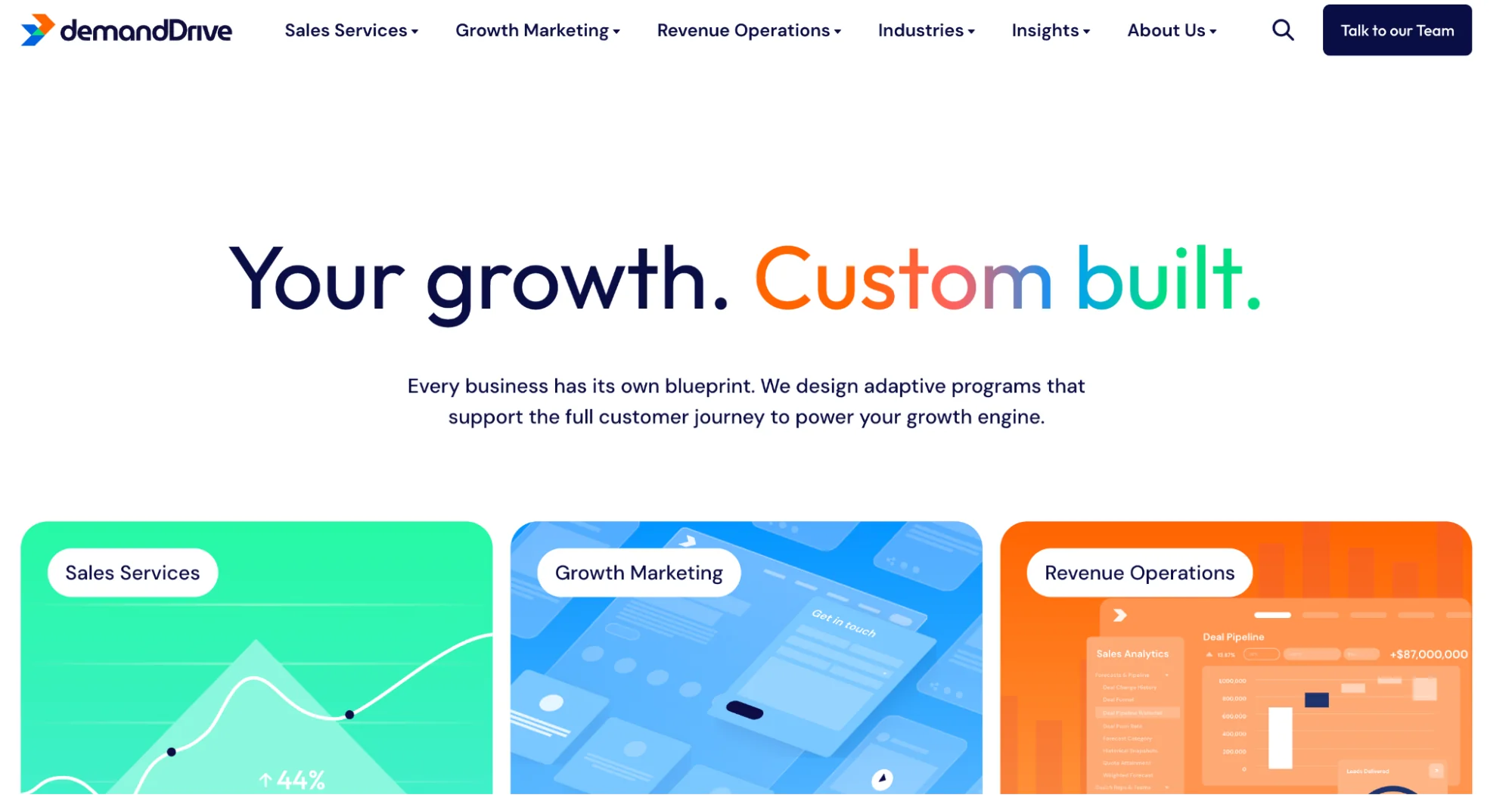
demandDrive has been building outsourced SDR programs since 2011. They position themselves as an integrated sales, marketing, and technology partner rather than a pure SDR vendor.
Their approach embeds SDR teams inside your organization, so the team feels like internal employees rather than external vendors. They have grown to roughly 400 employees and earned multiple Inc 5000 spots.
What works
Embedded model creates close integration with internal teams
13+ years of experience across hundreds of B2B tech clients
Full-funnel approach including marketing, web, CRM, and RevOps services
Strong case studies showing significant pipeline and closed-won revenue
Inc 5000 recognition demonstrates sustained growth and client success
Where they fall short
Premium pricing not publicly available, custom quotes only
High-touch model takes longer to ramp than simpler approaches
Broad service offering can dilute focus compared to pure-play SDR agencies
Better suited for companies with budget for comprehensive engagement
Integration depth means switching costs climb high if the relationship breaks down
Pricing Custom-scoped based on number of SDRs, regions, channels, and additional services. Not published publicly.
How they compare to Nebor Their model centers on embedded SDR teams that feel like internal employees, while ours is built on automated SDR systems that operate independently of headcount.
Where their consistency depends on managing the right people, ours depends on shipping the right automation once and letting it work.
Why we recommend them: It is a good option for mid-market and enterprise SaaS companies that want SDRs who feel like internal team members. Their full-funnel services make sense if you need help beyond just outbound.
Hire Nebor to take care of your outbound sales functions so your sales reps can focus on closing deals
The pattern across every agency on this list is the same. They are solving a real problem, where your sales team spends too much time on prospecting and lead research and not enough time selling. Where they differ is in how they solve it.
Most agencies throw more people at the same problem. They hire SDRs, train them on your product, and hope volume produces results.
That model works, and it hits a clear ceiling. You need more headcount to reach more prospects, quality varies by who the agency assigns to your campaign, and when people leave, you are back to square one.
We built Nebor around a different idea entirely. Instead of stacking more humans onto a broken process, we automate the process itself, and we connect outbound to the rest of the GTM motion.
Our Clay-powered systems work continuously, capturing intent signals, enriching data, generating personalized outreach, and routing qualified leads to your team.
The same system handles inbound capture, CRM hygiene, RevOps reporting, and post-meeting handoff, so the outbound work is not happening in isolation from the rest of the pipeline.
Your reps talk to prospects who are ready to buy. They stop wasting time on research, data entry, and chasing unqualified leads. Your pipeline becomes predictable because the system feeding it never stops.
If you are ready to stop hiring SDRs and start building systems, we should talk. Book a 15-minute call with our team to discuss your specific situation and see what an outbound engine that actually works could look like for you.


Related Articles


By clicking Sign Up you're confirming that you agree with our Terms and Conditions.