

A B2B data vendor selling company, employee and job posting datasets through APIs, flat files and integrations, built for teams putting the data into their own product, warehouse or Clay table rather than in front of a rep.
What is
Coresignal
Coresignal is a B2B data vendor that sells raw datasets and APIs rather than an application your reps work inside. Three datasets carry the product, 70 million company records, 895 million employee profiles and 468 million job postings, all collected from public web sources and sold by the credit or by the file. The shape worth understanding is that the same record comes in three grades. Base is freshly scraped and structured, Clean is that data deduplicated and standardized, and Multi-source merges several sources into one profile carrying headcount trends, funding, technologies and salary bands. You choose the grade you can afford to clean up yourself. A dashboard covers plain-language search and a CSV company enricher, the REST API charges nothing for Elasticsearch queries and bills only when you pull records, and an MCP server answers agent questions directly. Webhooks fire on employee profile and job changes, and flat files land in S3, Azure or Google Cloud. We would only send a client here with an engineer or a Clay table already waiting for the data. Coresignal has never been in our stack, and what it holds that PredictLeads and TheirStack do not is person-level history and the job-change events sitting on top of it. Buy it with the destination built first.
Integrations and the modern GTM stack
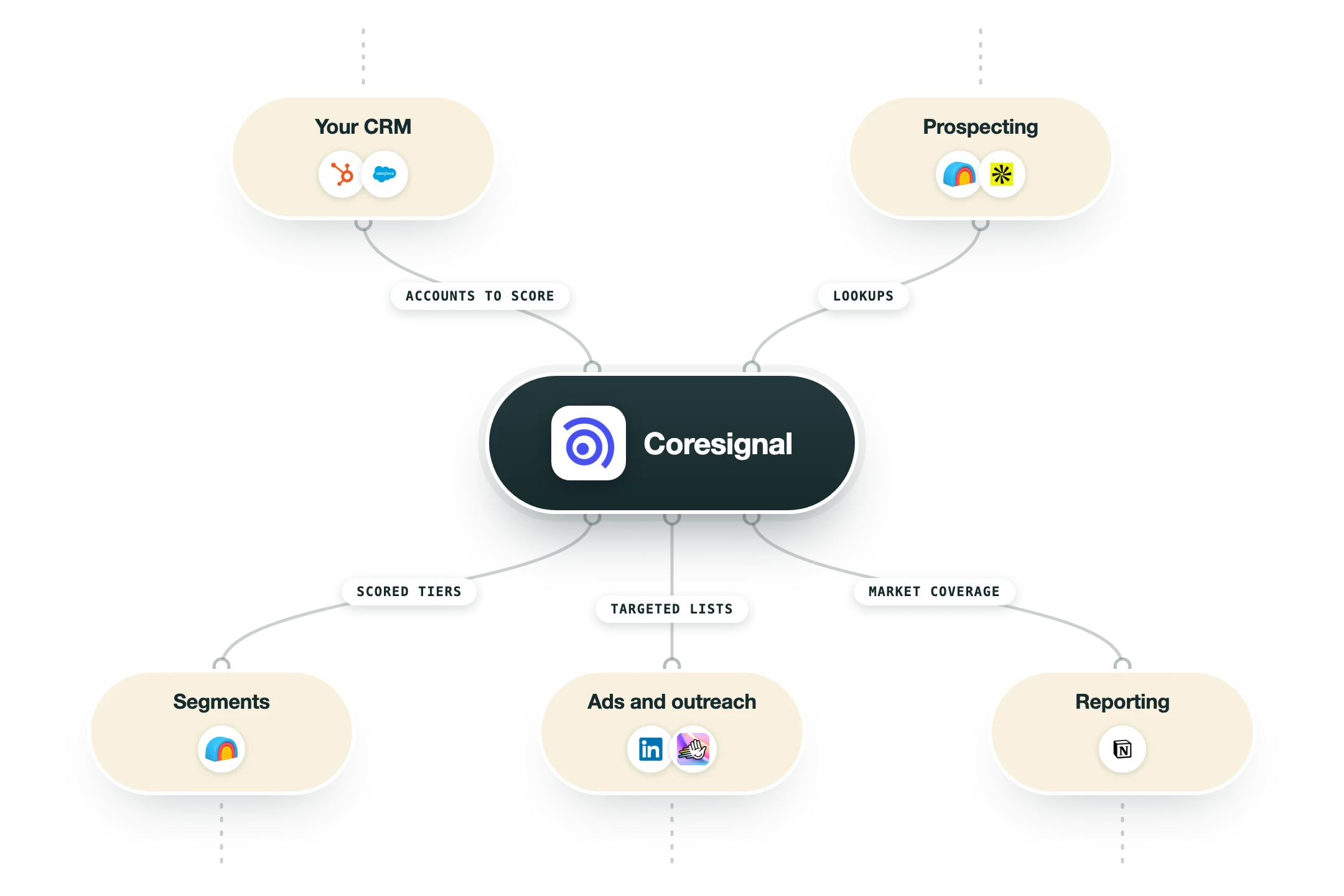
Coresignal has no CRM app and no place for a rep to work, so its integrations are all about where the data lands. Two groups matter: the automation tools that pull a record at a time, and the bulk routes that drop whole datasets into storage you own.
Clay | Two native cards, Multi-Source Company Enrichment and Multi-Source Employee Enrichment, plus an HTTP API action for any other endpoint using your own key in the apikey header. The native cards need Clay Growth or higher, and Coresignal's own guide warns that a Multi-source record can exceed Clay's 200 KB cell limit, which stops the enrichment on that row. Trim the monthly time-series, compensation and executive fields before you run it wide. |
n8n | An official Coresignal node authenticated with an API key, covering Multi-source company, employee and jobs data plus employee posts. This is the route we would use to turn a job-change webhook into a CRM update, since the rest of the workflow can sit in the same canvas. |
Zapier | Seven actions across three patterns, find by filter, find by ID and an AI prompt search, reaching 9,000 or so apps. Worth knowing before you plan anything: Coresignal ships no Zapier trigger, so every Zap has to start somewhere else and call Coresignal as a step. Previews return 20 records at a time or up to 1,000 bare IDs to loop over. |
Coresignal MCP v2 | A hosted server at mcp.coresignal.com/mcp/v2 over streamable HTTP with OAuth 2.1 sign-in, so no API key is stored on the server. Field discovery costs nothing, every response reports the credits it burned, and large pulls pause for confirmation before spending. Big results arrive as a file link instead of flooding the chat. |
Webhooks | Subscriptions on employee profile changes and experience events, meaning positions added and closed, with a simulation endpoint for testing. Subscriptions last 91 days and notifications cost no credits, which is the closest thing here to a real-time trigger and the piece a GTM team would build a champion-move workflow on. |
Flat files and Databricks | Nine datasets in JSONL, Parquet or CSV delivered to S3, Azure Blob or Google Cloud Storage on a schedule you agree, then picked up in Databricks with Auto Loader or COPY INTO. Employee and jobs files can run daily, while Multi-source company files only come monthly or quarterly. |
Dashboard tools | AI Data Search takes a plain-language prompt and builds a list, charging 20 credits per 20 records previewed up to a 100-record cap, with enrichment capped at 2,000 credits per list. There is also a CSV Company Enricher and API playgrounds. CSV and JSON exports are free, while JSONL generation bills per record. |
What is missing | No Salesforce, HubSpot or Pipedrive app, no reverse ETL partner, no connection to Instantly, Smartlead or Lemlist, and no sequencing of any kind. Everything that reaches a human runs through Clay, n8n, Zapier or code you write, so budget the destination before you budget the data. |
Pro’s
Employee data is the reason to look here, since 895 million profiles carry career history, education, skills and more than 300 fields, and neither PredictLeads nor TheirStack sells that layer at all.
Search costs nothing, because the Elasticsearch and filter endpoints are free and credits only come off when you collect or enrich a record, so you can size an audience and tighten the query before spending anything.
Employee webhooks push a notification when a profile changes or a position opens and closes, subscriptions run 91 days and nothing is charged per notification, which turns the dataset into a job-change trigger rather than a lookup.
Three processing grades let you match spend to effort, since a Base or Clean record costs 10 credits against 20 for the merged Multi-source record, and a team with its own cleaning pipeline can take the cheaper grade.
The routes out are broad for a data vendor, covering native Clay actions, an n8n node, seven Zapier actions, an MCP server with OAuth and per-call credit reporting, and scheduled flat files into S3, Azure or Google Cloud.
Pricing is published in full, from a 7-day trial with 2,000 credits through eight tiers up to $5,000 a month, and the credit cost of every endpoint sits in the docs so you can model the spend before you sign.
Cons
There is a dashboard, and it is a search and export console with no CRM connector anywhere in the product, so every record you pull has to be carried into HubSpot or Salesforce by something you build yourself.
A Multi-source company or employee record costs 20 credits, so the $199 Starter plan buys 600 enriched records a month and the $49 Mini plan buys 125, which makes the entry prices look friendlier than the volume behind them.
Contact data is the weak point, with the Contact Enrichment API locked to the $499 Pro tier and above, no request or response fields published in the docs, and a compliance page that rules out personal phone numbers and home addresses.
Flat-file company data ships monthly or quarterly, and one rival vendor's teardown puts records at three to four months old, a figure we could not verify against Coresignal's own documentation.
Raw records need work before they are useful, and the Multi-source profile is large enough that Coresignal's own Clay guide warns it can break the 200 KB cell limit unless you trim the monthly time-series fields.
Pricing
Free trial
$0 2,000 credits valid for 7 days from signup
Access to all standard endpoints
Contact Enrichment enabled on request
5 requests per second
One trial per first user of a team or domain
Unused trial credits do not carry into a paid plan
Mini
$49/month 2,500 credits, monthly billing only
Roughly 125 Multi-source records or 2,500 job postings
Multi-source endpoints, Elasticsearch DSL and webhooks
Agentic Search API included
No Search Preview and no Contact Enrichment
Credits reset every billing cycle
Starter
$199/month 12,000 credits, first tier offered annually
Roughly 600 Multi-source records a month
5 requests per second
Email support
Annual billing takes 10 percent off
Still no Search Preview or Contact Enrichment
Pro
$499/month 35,000 credits, the first useful tier for GTM work
Roughly 1,750 Multi-source records a month
Search Preview unlocked
Contact Enrichment API unlocked
10 requests per second
Email support
Growth
$1,000/month 150,000 credits, best credit rate before rollover starts
Roughly 7,500 Multi-source records a month
20 requests per second
Everything in Pro included
Email support only at this tier
How it fits your stack
Alternatives


At a glance
70M+ company records with 500+ fields
895M+ employee profiles with 300+ fields
468M+ job postings across public sources
Base, Clean and Multi-source processing grades
Search requests free, record pulls 1 to 20 credits
Webhooks on employee profile and job changes
Clay, n8n, Zapier, MCP and Databricks routes
7-day free trial with 2,000 credits
Read some of our client stories





GTM Workflows
Learn how to use GTM tools in workflows
Guides and tutorials to get the most from your workflows











Ready to get started?




By clicking Sign Up you're confirming that you agree with our Terms and Conditions.








