

The design-first website builder, and the one nebor.ai is built on. In our builds it carries the forms, the visitor-ID script and the tracking, and its API lets a workflow write straight into the CMS.
What is
Framer
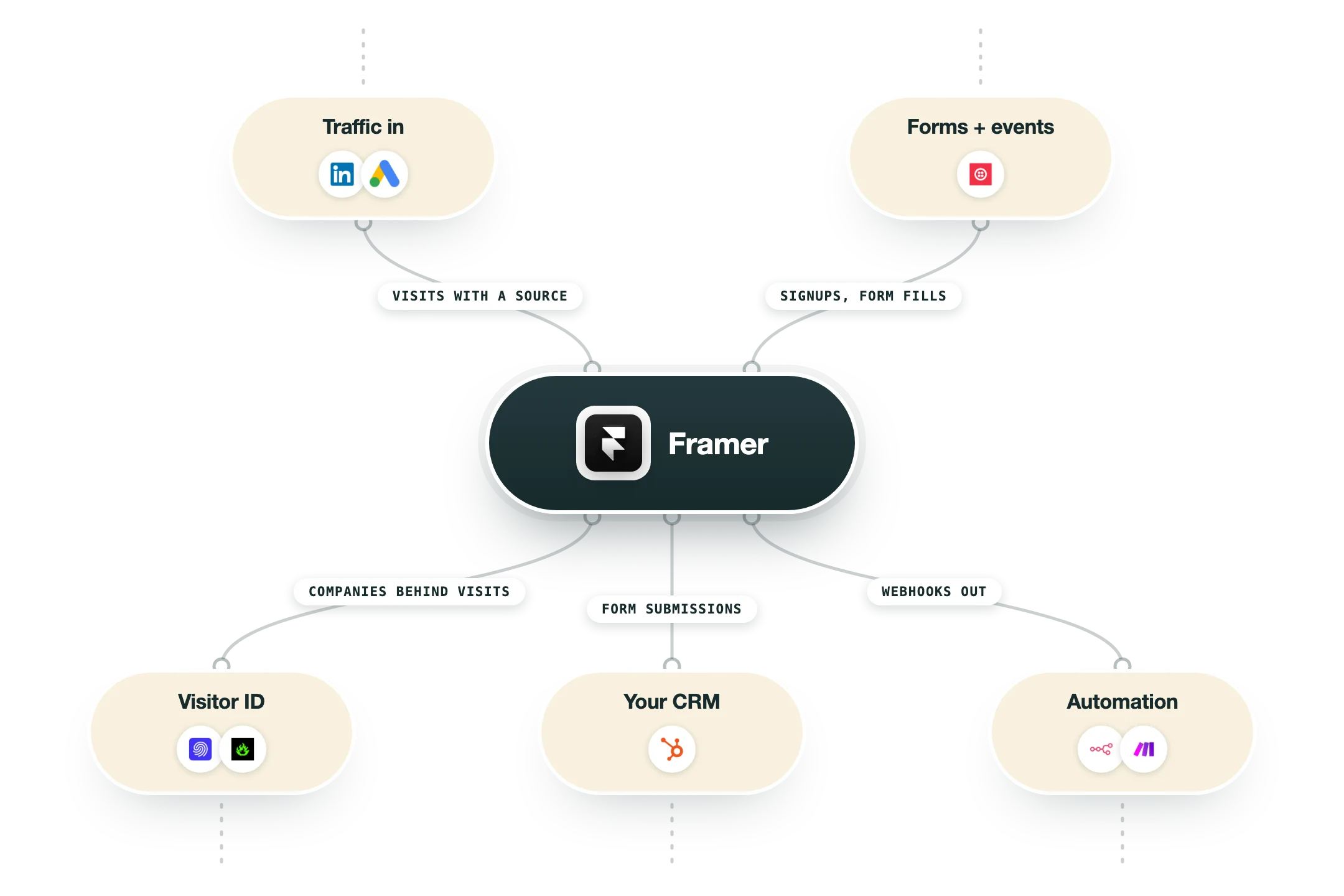
Framer is a website builder that starts from a design canvas: what you draw is what publishes, with a CMS, hosting, staging and forms built in. It's grown from a prototyping tool into the default for design-led marketing sites, and it's what nebor.ai itself is built on. We can describe it from experience, because our own workflow, tools and glossary pages live in Framer's CMS, and most of that content is pushed by scripts through the Server API, with almost nothing typed in by hand. That's the thing to know about it for a GTM stack: it's a site you can write to from a workflow, and read signals from. On the reading side, a form fill reaches your CRM through a webhook with the page stamped, and a visitor-ID script from RB2B or Snitcher in the custom code slot turns anonymous visits into named companies. On the writing side, a workflow can create and update CMS items, which is how a library of pages stays current without anyone editing. The trade is that seats and limits add up as the team and the site grow, and there are fewer native integrations than Webflow, so you'll lean on webhooks and n8n. For a fast-moving marketing site owned by designers, with a stack behind it, it's the tool we'd pick again.
Integrations and the modern GTM stack
Framer connects to a GTM stack through:
Forms and webhooks | Submissions post to your CRM, Slack or your automation with the source page attached. |
Custom code | Visitor-ID scripts (Snitcher, RB2B, Leadinfo), Segment, analytics and ad tags in the head or body. |
Server API | Read and write CMS items from a script or a workflow. It's how our own site gets its content. |
n8n, Make and Zapier | Form fills out, CMS updates in, and alerts to the team. |
HubSpot | Forms and tracking through the embed and the webhook path. |
Pro’s
Designing and publishing happen in one place, so a new landing page goes from idea to live in an afternoon.
The CMS is enough for most marketing sites: collections, references and templated pages, with a Server API for writing content from a workflow.
Forms and custom code make it a signal source: visitor-ID scripts, Segment and ad tags drop in cleanly, and submissions reach your CRM through webhooks.
Hosting, staging and branching are built in, so a small team ships a serious site without infrastructure.
It's what our own site is built on, and we push CMS content to it from scripts every week.
Cons
Editor seats are billed on top of the site plan, and a team of editors adds up.
Page and CMS item limits on the lower tiers cap large sites, and the overage pricing catches people out.
Fewer native integrations than Webflow, so more of the wiring goes through webhooks and automation.
Complex, deeply structured content is easier in a traditional CMS.
Pricing
Free
Free
Framer subdomain
Enough pages to build and test
AI credits included
Basic
From $10/mo billed annually
Custom domain
One CMS collection
For small sites
Pro
From $30/mo billed annually
More pages and CMS collections
Staging and branching
The plan most marketing sites need
Enterprise
Custom
SSO, SLA, custom limits
Unlimited editors
Annual contract
How it fits your stack
Alternatives


At a glance
Design-first website builder with CMS and hosting
Sites ship from the design canvas, no export step
CMS collections, staging and branching on Pro
Native forms and a custom code slot for tags
AI features and page generation on every plan
Site plans plus editor seats
The tool nebor.ai itself is built on
Fast to design in, fast to publish
Read some of our client stories





GTM Workflows
Learn how to use GTM tools in workflows
Guides and tutorials to get the most from your workflows





Ready to get started?




By clicking Sign Up you're confirming that you agree with our Terms and Conditions.








