

Warm outbound sold as one system, with intent signals, website visitor reveal, enrichment, AI-written sequences and managed sending inside a single chat-driven platform.
What is
Unify
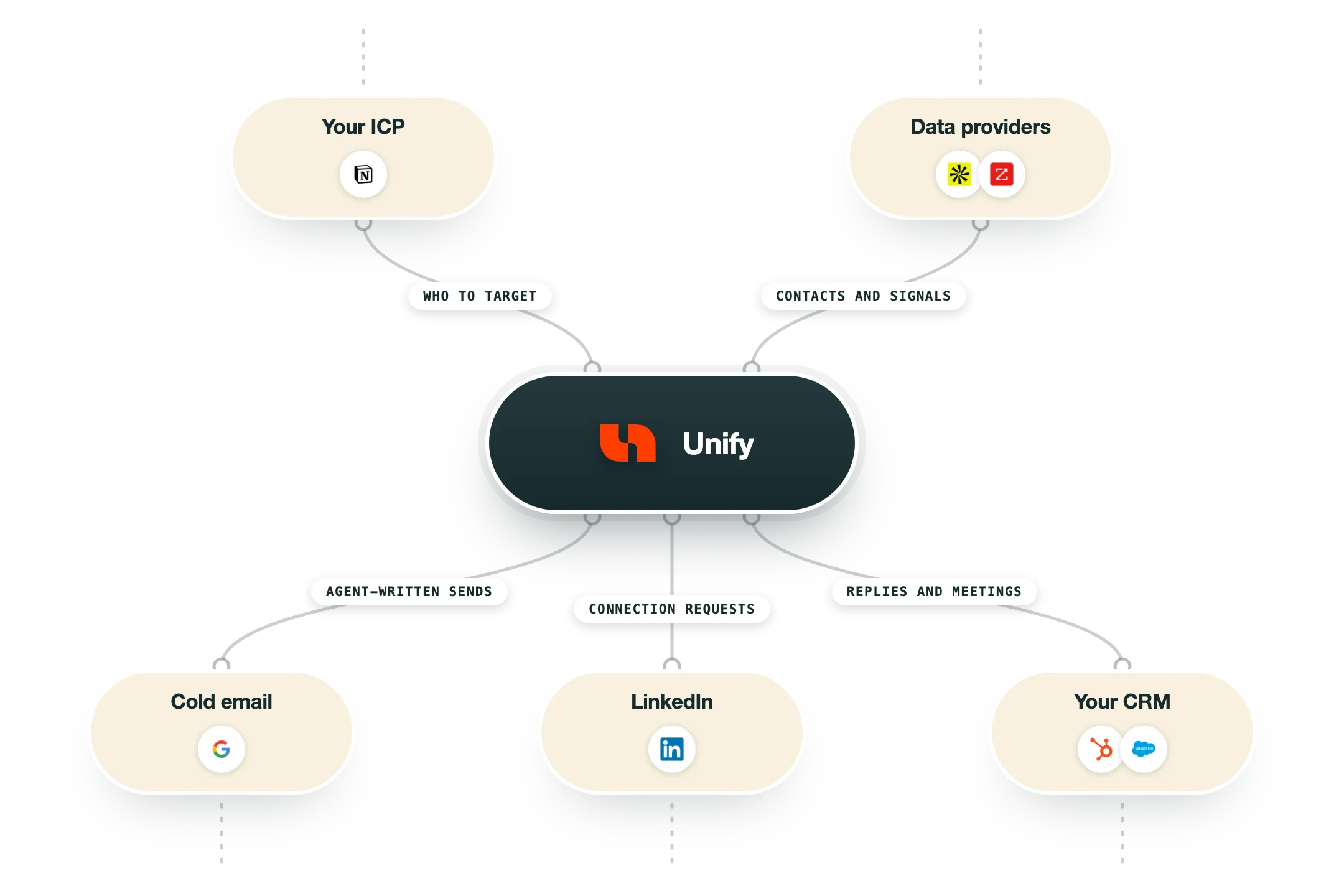
Unify is trying to be the whole outbound stack in one login, and whether that works for you comes down to one line on its pricing page. The product finds accounts, reveals who is on your website, enriches the contacts, writes the emails and sends them, all from a chat prompt instead of five separate tools. Signals do the work underneath, with Unify watching 40-plus sources for job changes, hiring, funding, tech stack moves, G2 activity and first-party website visits. Plays then fire automated workflows off those triggers, re-checked about every fifteen minutes, and push matched people into sequences with AI-written copy. Agents sit on top as a chat window where a rep describes a buyer in plain language and gets a researched, qualified list back. Unify also provisions and warms your sending mailboxes, rotates them, and reports pipeline attribution, so the sending infrastructure is theirs rather than something you stand up. We would pilot Unify rather than build a client's system on it, because the parts that make it warm outbound sit on the Business plan alone and your mailboxes, tables and logic then live in one vendor's account. Nebor builds the same motion in Clay and n8n, where you keep every piece.
Integrations and the modern GTM stack
Unify's integration list is short on purpose, because most of what other tools reach for through connectors is already inside the platform. What it does connect to falls into three groups, being the CRM it writes back to, the analytics and identification sources that feed intent, and the dialers it hands call tasks to.
Salesforce and HubSpot | The only two CRMs Unify supports natively. Both run bidirectional syncs with configurable field mappings, default values and bulk record updates, but sync is read-only on Pro and only becomes read-write on the Business plan, so writing enriched records back to your CRM sits behind the annual contract. |
Unify Intent Client, Segment and PostHog | Three ways to get website and product events into Unify. The native tag installs directly or through Google Tag Manager and captures page views, form fills, button clicks and UTM data, and teams already running Segment or PostHog can stream existing events instead of adding another script. |
6sense, Clearbit and Demandbase | Anonymous visitor reveal runs as a waterfall, and you can point an existing subscription at it with your own API key rather than buying identification twice. Unify's own reveal covers teams without one of those contracts, and person-level identity only fills in when a visitor submits a form or signs in. |
G2 | Connects your G2 profile so buyers researching you on the category page become an intent source alongside your own site traffic. This is one of the few third-party intent feeds that arrives without a separate data contract, and it triggers Plays the same way a website visit does. |
Gmail and Outlook | Reps can send from their existing Google Workspace mailbox on any tier through the Gmail integration. Business adds Unify-managed Gmail and Outlook mailboxes at $25 each a month with domain setup, warmup, rotation, send limits and reply forwarding handled inside the platform. |
Nooks and Orum | Call tasks generated by Unify sequences sync into either parallel dialer through your CRM, with documented setup paths for both Salesforce and HubSpot. Unify also ships its own dialer, though it remains in beta and Business only, so a phone-heavy team still runs a second vendor. |
Slack | Real-time alerts when a company or person enters an audience, plus messages fired as a step inside a Play. This is how most teams surface a website visit or a job change to the rep who owns the account, and it needs Pro or above. |
Clay and the APIs | Unify documents a Clay recipe using Clay's HTTP API enrichment with an X-Api-Key header to push companies, people or custom objects into the Data API. There is also an Analytics API for events and a Bulk API for exporting large datasets, both on Business. |
What is missing | No documented Zapier or n8n app, no CRM support beyond Salesforce and HubSpot, and no native connection to Instantly, Smartlead, Lemlist or a LinkedIn sender. If you run Attio or Pipedrive, or you send through cold email infrastructure you already own, you are back to the open API and webhooks. |
Pro’s
One login covers list building, enrichment, signal monitoring, copy and sending, so a two-person team gets a working outbound motion without wiring five vendors and a CRM together first.
Unify aggregates 40-plus providers and lets you point an existing 6sense, Clearbit or Demandbase key at visitor reveal, so you avoid paying twice for identification you already bought.
The workflow names the vendor behind each data point, so you can see whether an email came from Prospeo or Findymail and price the enrichment against buying that source direct.
Self-serve pricing starts free and runs $20 a seat, which means a rep can test the research and sequencing side on a personal card before anyone opens a procurement thread.
Managed Gmail and Outlook mailboxes come with warmup, rotation and bounce prevention at $25 a mailbox a month, and that removes the most tedious part of running cold email in house.
G2 reviewers rate it 4.7 across 43 reviews and keep singling out the customer success team, which matters on a product where the value depends on how well the Plays are configured.
Cons
The features that make it a warm outbound platform, meaning first-party website intent, product signals, signal-triggered Plays, managed mailboxes and read-write CRM sync, are Business plan only on custom annual pricing.
Credits cover data pulls and the language model passthrough from the same pool, so a deep agentic run and a simple list build compete for the same balance, and G2 reviewers say monthly spend is hard to forecast.
Your mailboxes, tables, logic and enrichment history all live inside Unify's account, so leaving means rebuilding the motion from scratch even though the Bulk API will hand back your records.
Sequence steps are automatic email, manual email, phone call and action item, so LinkedIn touches land as manual tasks and the dialer is still in beta, which makes multi-channel thinner than it sounds.
Reviewers report two to four weeks of configuration before Plays run properly, so the fast-setup promise holds for list building and stretches out for the automation layer that justifies the price.
Pricing
Free
$0 Free forever, up to 3 seats
Limited credits
1.1B+ people and 65M+ companies, 40+ data sources
Agentic chat, prospecting and list building
Multi-channel sequencing and browser extension
1 mailbox per seat, 100 records per search
Base
$20/seat/month Billed monthly, unlimited seats, 800 credits per seat
Everything in Free
AI email copywriting and personalization
Job change, hiring, tech stack and social signals
Phone and email enrichment
Credit top-ups that pool across the team
Pro
$60/seat/month Billed monthly, 2,400 credits per seat, 14-day free trial
Everything in Base
HubSpot and Salesforce sync, read only
Slack notifications
Sequence analytics and rep activity reporting
Full access trial with no credit card
Business
Custom Billed annually, custom credit pool per workspace, contact sales
Everything in Pro plus advanced models
Website intent and product usage signals
Signal-triggered automated Plays
Managed Gmail and Outlook mailboxes at $25 each, warmup and rotation
Read-write Salesforce and HubSpot sync, open API, webhooks, dialer in beta
How it fits your stack
Alternatives




At a glance
1.1B+ contacts and 65M+ companies
40+ signal and enrichment sources
Website visitor reveal on the Business plan
Signal-triggered Plays and automations
AI agents for research and copywriting
Managed mailboxes with warmup and rotation
Salesforce and HubSpot two-way sync
Free plan and a $20 per seat entry tier
Read some of our client stories





GTM Workflows
Learn how to use GTM tools in workflows
Guides and tutorials to get the most from your workflows











Ready to get started?




By clicking Sign Up you're confirming that you agree with our Terms and Conditions.








