
8 Best The Kiln Alternatives for Automating Sales Flows and Building GTM Engines (thekiln.com)

In this post:
The decision in front of you now is narrower than it looks. The Kiln does one thing better than almost anyone, which is custom Clay engineering for a small set of clients with the budget and patience for a multi-month build.
If that shape fits your business model, stop reading and go talk to them.
This piece is for everyone else who looked at the price tag, the timeline, or the boutique scope and started searching for “the kiln alternatives”.
We’ll walk through the eight agencies most worth a look, including us, and show you which one fits which kind of GTM need.
Some of these teams are sharper on outbound deliverability than on data infrastructure, and the reverse is true for others. A couple of them are educators first, with courses and coaching priced for teams that want to bring this work in-house eventually.
Two of them, including us, build the entire GTM flywheel and the RevOps function around it.
One note on positioning before we get into the comparison. We are Nebor, formerly Utmost, and we build GTM workflows.
We cover outbound, inbound, RevOps, and post-sale signals, and your team owns the systems rather than renting them from ours.
That framing matters for the comparison below, because most of the agencies on this list sell managed-service retainers where the workflows stay on their side of the wall.
So, let’s get started.
Why Nebor is the best alternative to The Kiln for building sales flows and the entire GTM flywheel
We’re going to spend more time on Nebor than on the other seven names in this list. The comparison only works if you can see what our entire GTM flywheel looks like as a delivered system, and that takes a few sections to walk through.
We are salespeople first, automation experts second
The Kiln’s team has former Clay employees and data scientists. They know the Clay platform as well as anyone in this category, and that depth is real. It shows up in the workflows they ship.
Here’s the wrinkle we’ve watched play out a dozen times. Knowing how to wire a Clay table is a different skill than knowing why a prospect won’t reply. Most agencies in this category have the first skill in spades and not enough of the second.
Andrew and Yannick spent years selling before they ever sold automation to anyone. Andrew has built and done outbound at the founder level for years. Yannick spent over a decade carrying a quota inside corporate SaaS.
They’ve sat in the meetings where the deal slips, written the cold email a prospect read and ignored, and rebuilt the sequence the next morning.
That experience changes what the workflow actually looks like.
By the time a lead reaches your AE, we have packaged context they can actually use in the first ninety seconds of the call, not a row in HubSpot with seventeen enrichment fields and no story.
There's a second piece worth saying out loud, because most of this category gets excited about the wrong thing. Technical complexity is not what we sell, and it is not what we measure ourselves on.
What moves us is pipeline movement, and the only honest measurement of that is whether qualified conversations grew this month versus last.
We will quietly delete a clever workflow if it is not producing meetings, and we will tell you about it on the next call rather than burying it in a status report. We judge the system on conversations generated, not data providers layered into an enrichment waterfall.
We map your full TAM and keep it alive
If you’re like most companies, your sales team is still prospecting from gut feel. A rep opens LinkedIn, tries a few searches in Apollo or Clay, finds twenty people who look like a fit, and starts emailing. The next day someone else does the same thing, often hitting the same accounts.
This kind of random prospecting is what people mean when they say “we don’t have pipeline”. What they actually have is patchy market contact with no scoring, no scheduling, and no central record of which prospects the team has already touched.
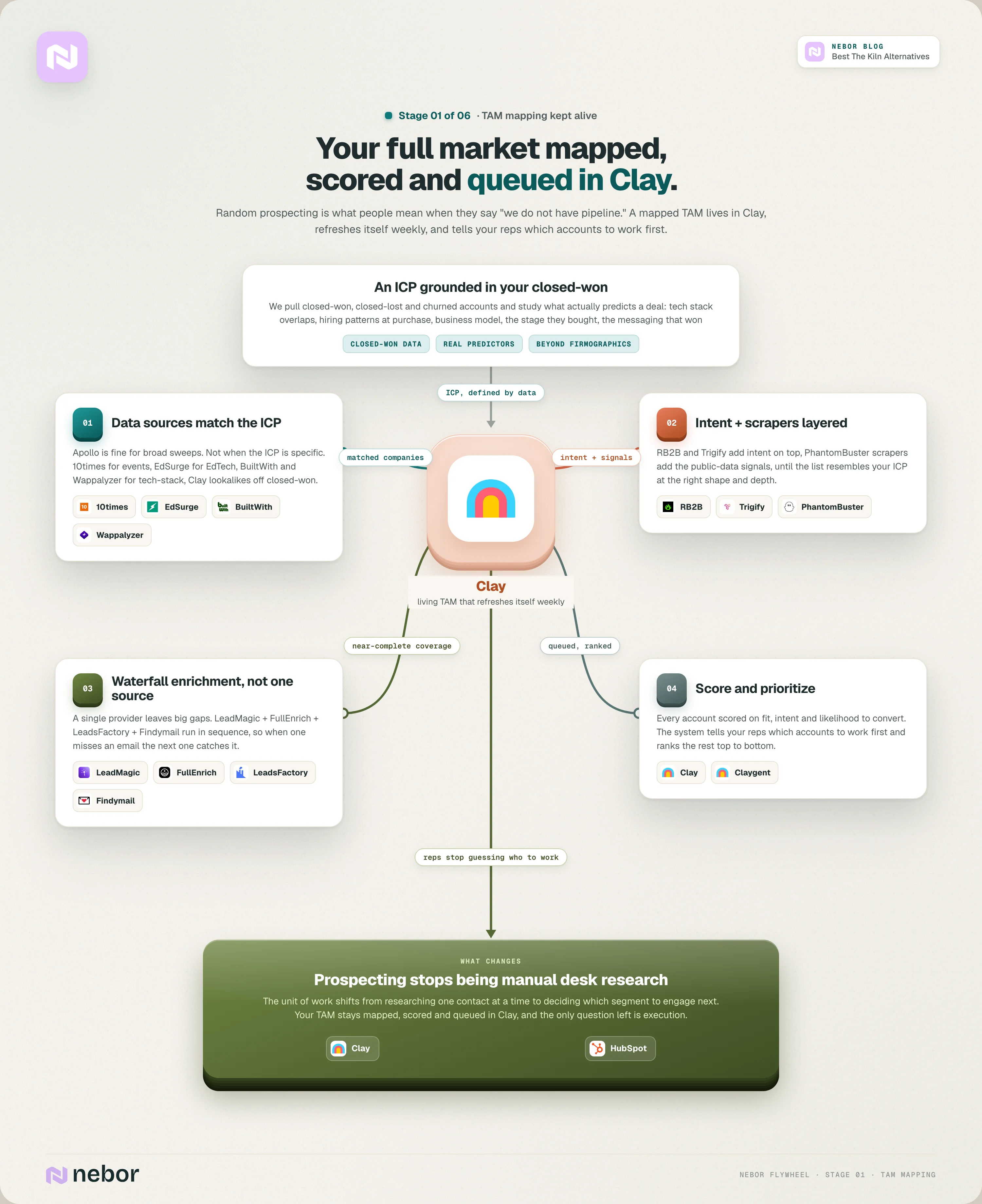
We replace that with a mapped Total Addressable Market that lives in Clay and refreshes itself. We pull every company that fits your ICP into the system, score them, and route them into the right outreach track.
The list does not go stale, because the workflow checks for new fits every week and removes companies that no longer match.
Here is what the build actually looks like in practice.
Start with an ICP grounded in your closed-won data
Most ICP work stops at firmographics. We start there, but we do not stop there.
We pull a sample of your closed-won, closed-lost, and churned accounts and study what actually predicts a deal.
The patterns we look for include tech stack overlaps, hiring patterns at the time of purchase, business model, the stage at which they bought, and the messaging that won.
The output is a real ICP, not a one-pager that says "B2B SaaS, 50 to 200 employees, US and Europe."
Pick data sources that match the ICP, not Apollo by default
Apollo and ZoomInfo are fine for broad sweeps and not fine when your ICP is specific. The data source has to match what you actually sell, which means we lean on different niche tools depending on the project.
For event organizers, 10times
For EdTech buyers, EdSurge
For companies on a specific tech stack, BuiltWith or Wappalyzer
For lookalike accounts, internal Clay workflows matched against your closed-won
On top of those, we layer intent signals from RB2B and Trigify, plus public-data scrapers like PhantomBuster, until the list resembles your ICP at the right shape and depth.
Enrich with a waterfall, not a single provider
A single data provider typically gets you somewhere in the 60 to 70 percent range of coverage on a serious B2B list.
We push an enrichment waterfall through LeadMagic, FullEnrich, LeadsFactory.io, and Findymail so that when one provider misses an email, the next one catches it.
The same logic applies to phone numbers, LinkedIn URLs, and verified company data, and the combined coverage usually lands above 90 percent on the kind of lists we work with.
Score and prioritize so reps know who to call first
Once we enrich the list, we score every account on fit, intent, and likelihood to convert.
The score uses signals you would expect (firmographics, tech stack, hiring patterns) and signals you would not (recent funding announcements, leadership changes, specific job postings, content engagement on your site).
Your reps stop guessing which 30 accounts to work this week. The system tells them which thirty to work and ranks the rest top to bottom.
To put real numbers on what this changes, take Uitgeverij Gorcum, a publishing company we worked with through our GroeiLeaders engagement.
Before we built the workflow, the founder was at his desk until 9pm researching prospects manually and finding maybe 15 contacts a day.
After we mapped the TAM and turned it into a living workflow, advertising deals were closing in the first week of campaigns. The unit of work shifted from researching one contact at a time to deciding which segment to engage next.
You stop guessing who to target each week. You stop wondering whether you are working the right accounts. We have your TAM mapped, scored, and queued in Clay, and the only question left is execution.
We build inbound-led outbound before cold outbound campaigns
Most agencies in this category sell outbound as a single motion. You give them an ICP, they build a list, they send cold emails, and the meetings show up or they don’t. The reply rates that come out of that motion in 2026 are not what they were in 2020.
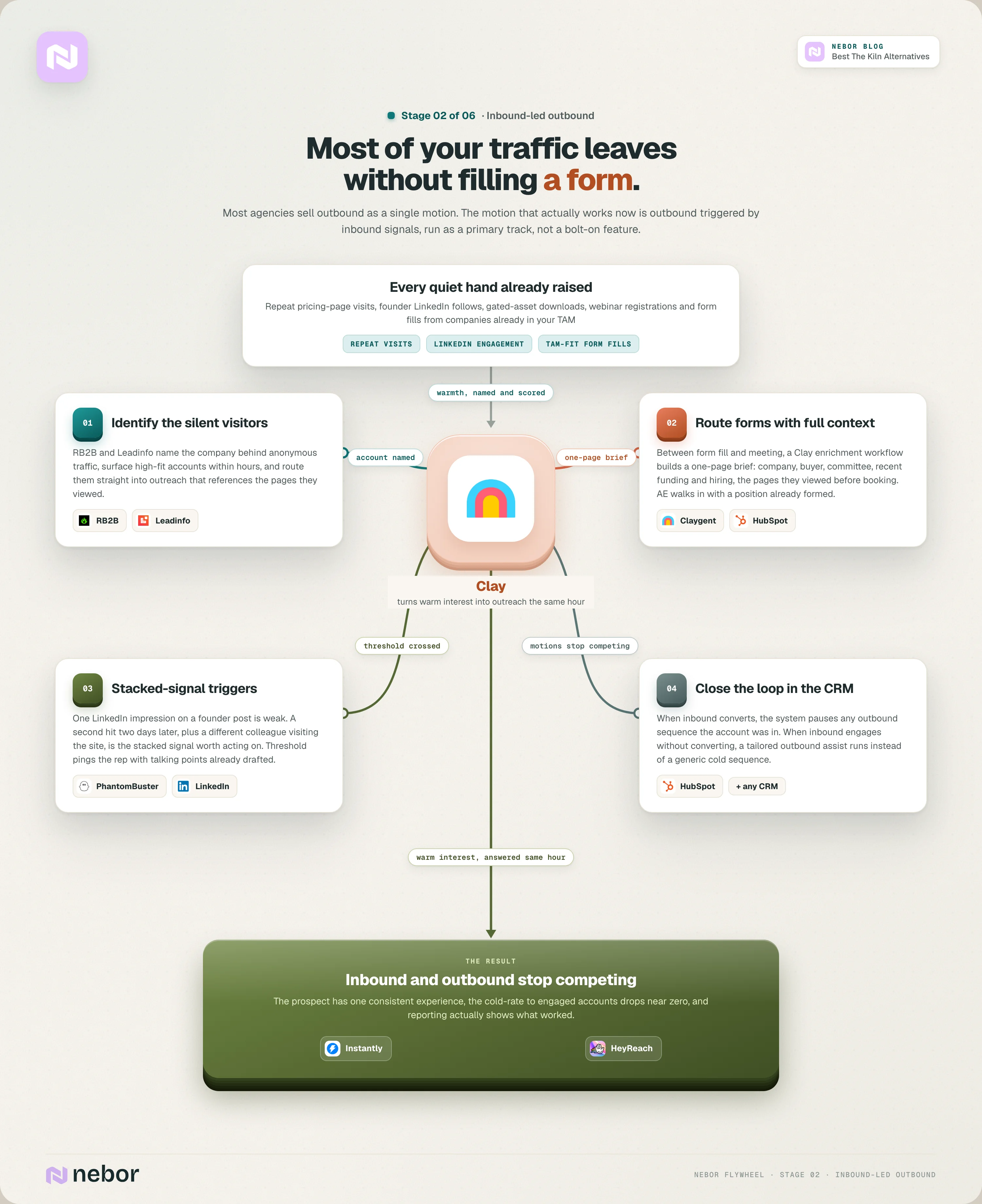
The motion that actually works now is outbound triggered by inbound signals. A signal can be anything from a repeat visit to your pricing page, to a follow on your founder's LinkedIn, to a form fill from someone whose company already shows up in your TAM as high-fit.
The reach-out happens because the prospect has already raised a hand, even quietly, and the open and reply rates look completely different from a cold sequence.
We build that motion as a primary track, not as a bolt-on feature. Inbound-led outbound is the engine that takes the work your marketing team is already doing and turns it into a steady stream of qualified outbound conversations.
Here is what the inbound side of the flywheel looks like in practice.
Identify the companies on your site, even when they don't fill anything out
About 97 percent of your website traffic leaves without filling a form. We use RB2B and Leadinfo to identify the companies behind that anonymous traffic, see which pages they viewed, and surface the high-fit accounts to your team within hours of the visit.
We route the matches straight into an outreach track that references the pages they actually looked at. Anything that doesn't fit your ICP, we filter out before it hits your reps.
Route inbound forms with full context, not just a name and an email
When someone fills out a demo or contact form, your team usually gets a notification with a name, a company, and an email. That is not enough context to take a useful first call.
We connect the form submission to a Clay enrichment workflow that works in the background between the form fill and the meeting.
By the time the AE opens the calendar invite, they have a one-page brief on the company, the buyer, the buying committee around them, recent funding and hiring signals, and the specific pages the prospect viewed before booking.
The first ninety seconds of the call sound completely different. The AE is not asking “so tell me about your company”. They walk in with a position about the prospect already formed.
Trigger outreach to accounts already engaged with your content
Engagement signals come in different strengths. A single LinkedIn impression on your founder’s post is weak on its own.
The same account hitting your post a second time two days later, combined with a website visit from a different person at the same company, is the kind of stacked signal worth acting on.
We aggregate these signals across LinkedIn, your blog, and your demand-gen channels and notify the sales rep the moment an account crosses an engagement threshold, with the talking points already drafted.
The cold outreach rate to those accounts drops near zero, because the rep is referencing something the prospect actually did.
Close the loop so inbound and outbound stop competing
This is the operational piece that most teams skip. Inbound and outbound usually live as separate workflows in separate tools, and the result is the same prospect getting hit by two uncoordinated motions in the same week.
We close the loop in HubSpot or Salesforce directly. The moment an account converts through inbound, we pause any outbound sequence they were in.
When an account engages through inbound without converting, we follow up with a tailored outbound assist instead of a generic cold sequence. The motions stop competing, the prospect has one consistent experience, and your reporting actually shows what worked.
We build outbound that works 24/7 with intent monitoring
There’s a difference between outbound automation and outbound that genuinely works without your team babysitting it.
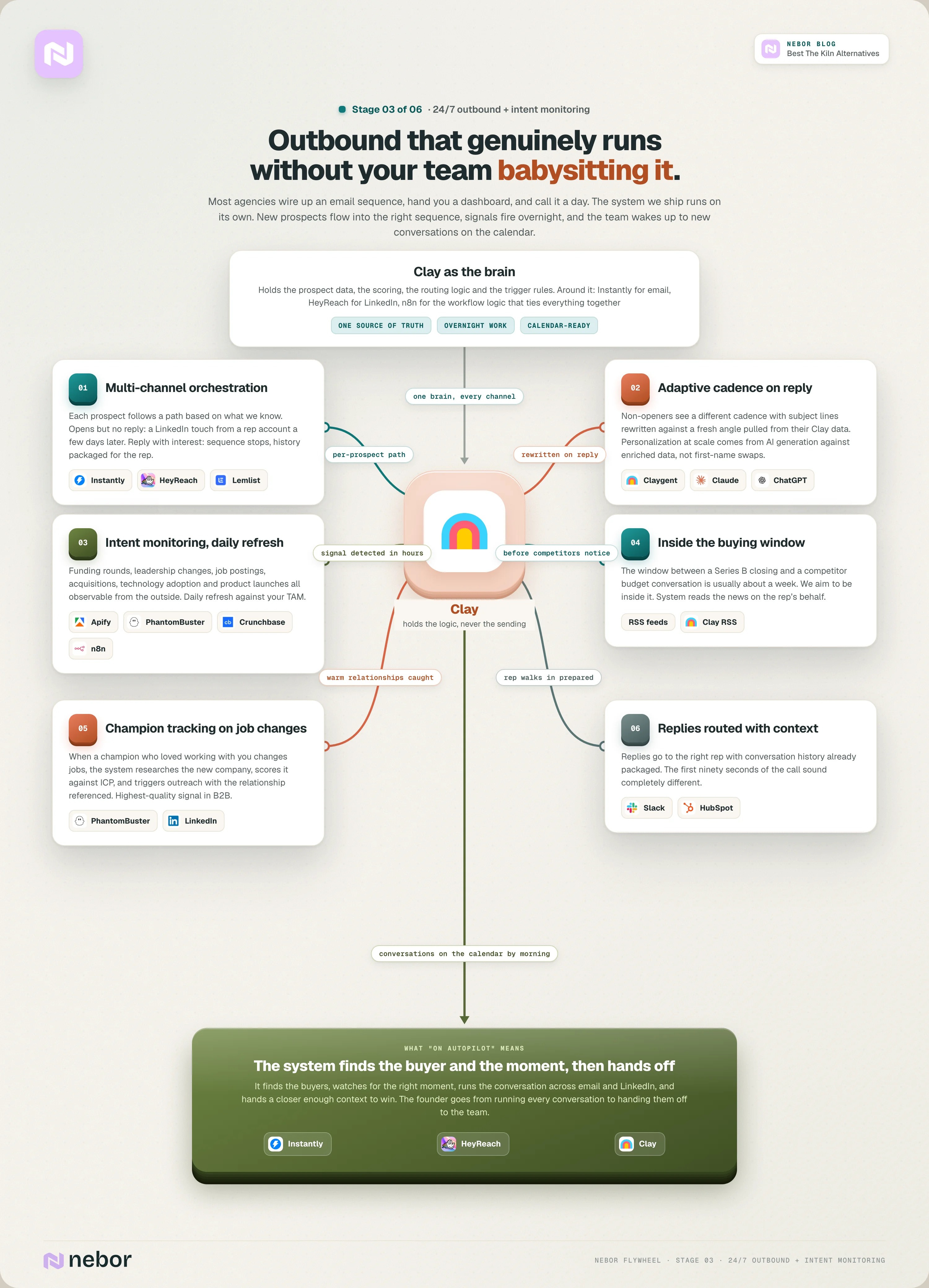
Most agencies in this space sell the first one. They wire up an email sequence, hand you a dashboard, and call it a day.
The system we ship works on its own. New prospects flow into the right sequence based on real signals, we route replies to the right rep with context they can actually use, and the heavy lifting happens overnight while your team is asleep.
By the time the team is online, the new conversations are already on their calendars.
Here is what the underlying architecture actually looks like in practice.
Multi-channel orchestration with Clay as the brain
Clay is the center of the system, holding the prospect data, the scoring, the routing logic, and the trigger rules. Around it, we connect Instantly for email, HeyReach for LinkedIn, and n8n for the workflow logic that ties everything together.
Each prospect has a path through that system based on what we know about them. If someone opens three emails but doesn’t reply, they get a LinkedIn touch from a rep account on day five.
The non-openers see a different cadence with subject lines rewritten against a fresh angle pulled from their Clay data. And if a prospect replies with interest, the sequence stops and the rep receives the conversation history already packaged for the call.
The personalization at scale comes from AI generation against the enriched Clay data, not the generic “Hi {first_name}, I noticed your company {company}” template prospects ignore on sight.
Intent monitoring that catches buying signals before your competitors
Funding rounds, leadership changes, job postings for specific roles, acquisitions, technology adoption, and product launches are all observable from the outside if you watch the right sources.
We watch them with Clay, n8n, RSS feeds, and PhantomBuster checking on a daily refresh against your TAM.
When something changes for an account in your TAM, the system detects it within hours, enriches the surrounding context, and triggers an outreach with a message built around the actual event.
A rep does not need to read the news, because the system reads it on their behalf and surfaces only the moves that matter.
That timing matters more than most people realize. The window between a Series B closing and a competitor reaching out for a budget conversation is usually about a week. We aim to be inside that window before the competitors get there.
Champion tracking that does not let warm relationships disappear
When somebody who loved working with you changes jobs, that's the highest-quality signal in B2B sales. The relationship is real, the trust is already there, and the new company is by definition a fresh account.
Most teams miss this entirely because they're not watching for it. We watch for it on every contact in your CRM.
The moment the system detects a job change, it researches the new company, scores it against your ICP, and either triggers an outreach with the relationship referenced or alerts the rep with talking points if the situation needs a human touch first.
These accounts convert at multiples of the rate of a cold sequence into the same vertical, in our experience. They are the most underused asset in most CRMs we look at.
What this looks like at scale
The clearest example we have is Dymaxa, an Austrian cleantech company building aerodynamic side skirts for European semi-trailers.
When we started, they had one reference customer and no commercial pipeline. The CEO was taking every sales conversation himself.
We stood up the outbound system from zero. Clay held the OEM and logistics-fleet TAM. The campaigns ran across email and LinkedIn against trailer manufacturers first, with logistics companies and rental fleets as the second track.
We layered the regulatory context (the EU’s VECTO 2030 deadline) into the messaging so every cold outreach landed as a relevant question.
By the time the system reached steady-state, it had generated €12 million in qualified pipeline and secured meetings with all 10 major European trailer OEMs, including Schmitz Cargobull, Europe's largest trailer manufacturer.
The system engaged 84 enterprise prospects in active sales conversations and closed 14 of them with an average sales cycle of eight months.
The CEO went from taking every conversation to handing them off to the four sales hires we onboarded into the system.
That is the bar for what "outbound on autopilot" actually means. The system has to find the buyers, watch for the right moment, carry the conversation across channels, and hand off enough context for a closer to win. An email sequence on a timer doesn't clear that bar.
We build the RevOps function you don't have to hire for
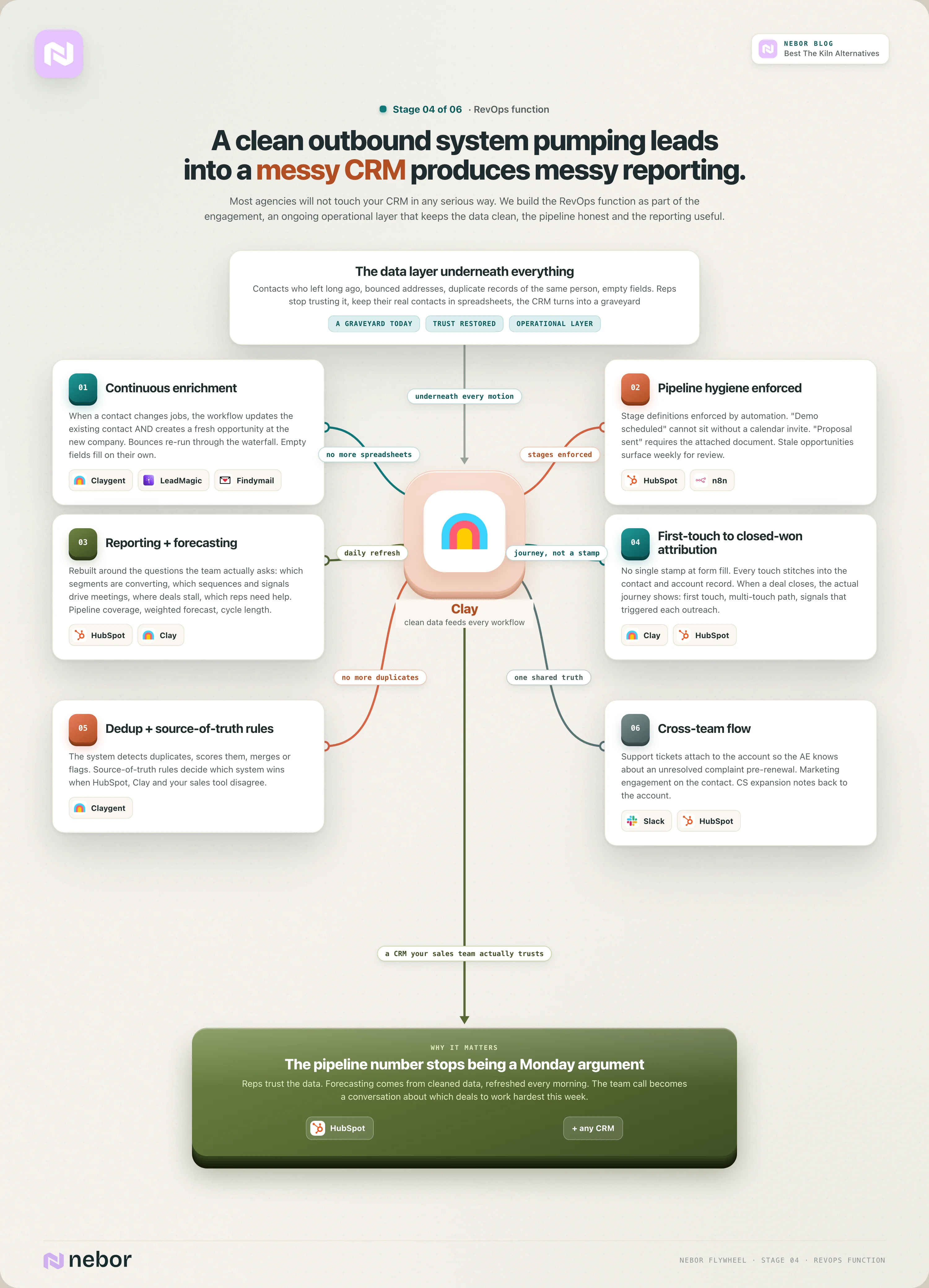
Most agencies in this category won't touch your CRM in any serious way, and that's one of the bigger red flags when you're evaluating who to work with.
They'll plug into HubSpot or Salesforce to push leads in, but the hygiene, the reporting, the deal pipeline, the forecasting, and the attribution all stay your problem.
Our position is that none of the work above this layer matters if the data layer underneath is broken.
A clean outbound system pumping leads into a messy CRM produces messy reporting, missed handoffs, and a sales team that quietly stops trusting the pipeline number on the Monday call.
So we build the RevOps function as part of the engagement. The work isn't a project plan we hand off when the contract ends. It's an ongoing operational layer that keeps the data clean, the pipeline honest, and the reporting useful.
Here is what that looks like as a deliverable.
Continuous enrichment so your CRM stops decaying
Most CRMs we look at have contacts who left their companies three years ago, email addresses that bounce, duplicate records of the same person across four entries, and entire fields that are empty or filled with stale data.
Reps stop trusting it, so they keep their real contacts in spreadsheets, and the CRM turns into a graveyard nobody opens.
We connect Clay directly to HubSpot or Salesforce and push continuous enrichment workflows against every record. When a contact changes jobs, the workflow updates the existing contact and creates a fresh opportunity record at the new company.
We put bounced emails back through the same enrichment waterfall we use for prospecting, and new funding rounds, hires, and product launches flow into the company record automatically.
The system detects duplicates, scores them, and either merges them or flags them for review. The same workflow fills empty fields from the enrichment waterfall instead of waiting for a rep to type them in.
Pipeline hygiene that the sales team actually trusts
A pipeline number is only useful if the team trusts it. We build the operational layer that keeps the trust intact.
We enforce stage definitions through automation, so a deal can't stall in "demo scheduled" without a calendar invite or in "proposal sent" without a document attached.
Stale opportunities surface for review on a weekly cadence, and reps either work them or close them out instead of letting them rot in the report.
The result is a pipeline number you can read on Monday and act on with confidence, instead of a number you have to mentally discount by 30 percent every week.
Reporting and forecasting your team will actually open
Most CRM dashboards live in a tab nobody opens.
We rebuild the reporting around the questions the team actually asks, like which segments are converting this quarter, which sequences and signals are driving meetings, where the deals are stalling, and which reps need help on what.
Forecasting comes out of the same operational layer. We pull pipeline coverage, weighted forecast, conversion rates by source, sales-cycle length by segment, and pipeline aging out of the cleaned data and refresh them every morning.
Your team call stops being an argument about whose number is right and starts being a conversation about which deals to work hardest this week.
Attribution from first touch to closed-won
Most B2B attribution doesn't survive contact with reality. Someone stamps the lead source field at form fill, and then nobody touches it again.
The closed-won deal shows as inbound-credited, even though the contact had been in three outbound sequences and on the buying committee at two prior accounts.
We close that gap by stitching every touch into the contact and account record, so when a deal closes the actual journey shows up.
That includes the first-touch source, the multi-touch path, the specific signals that triggered each outreach, and the specific content the buyer engaged with.
The marketing and sales teams stop arguing about who deserves credit and start agreeing on which motions are working.
Data flow across sales, marketing, and customer success (CS) so nothing lives in a silo
The other RevOps failure mode is data trapped inside the team that produced it.
Support knows what customers complain about, marketing knows which campaigns generate interest, sales knows what objections come up, and CS knows which accounts are at risk. None of that information shows up in the next conversation by default.
We wire the cross-team flow into the CRM directly. Support tickets attach to the account record, so the AE walking into a renewal call knows about the unresolved complaint.
Marketing engagement scores live on the contact record alongside the rest of the enrichment, which means sales can see which accounts are warming up without asking.
And expansion notes from CS flow back into the account record so the next upsell conversation happens at the right moment, with the right context.
We follow the customer past close
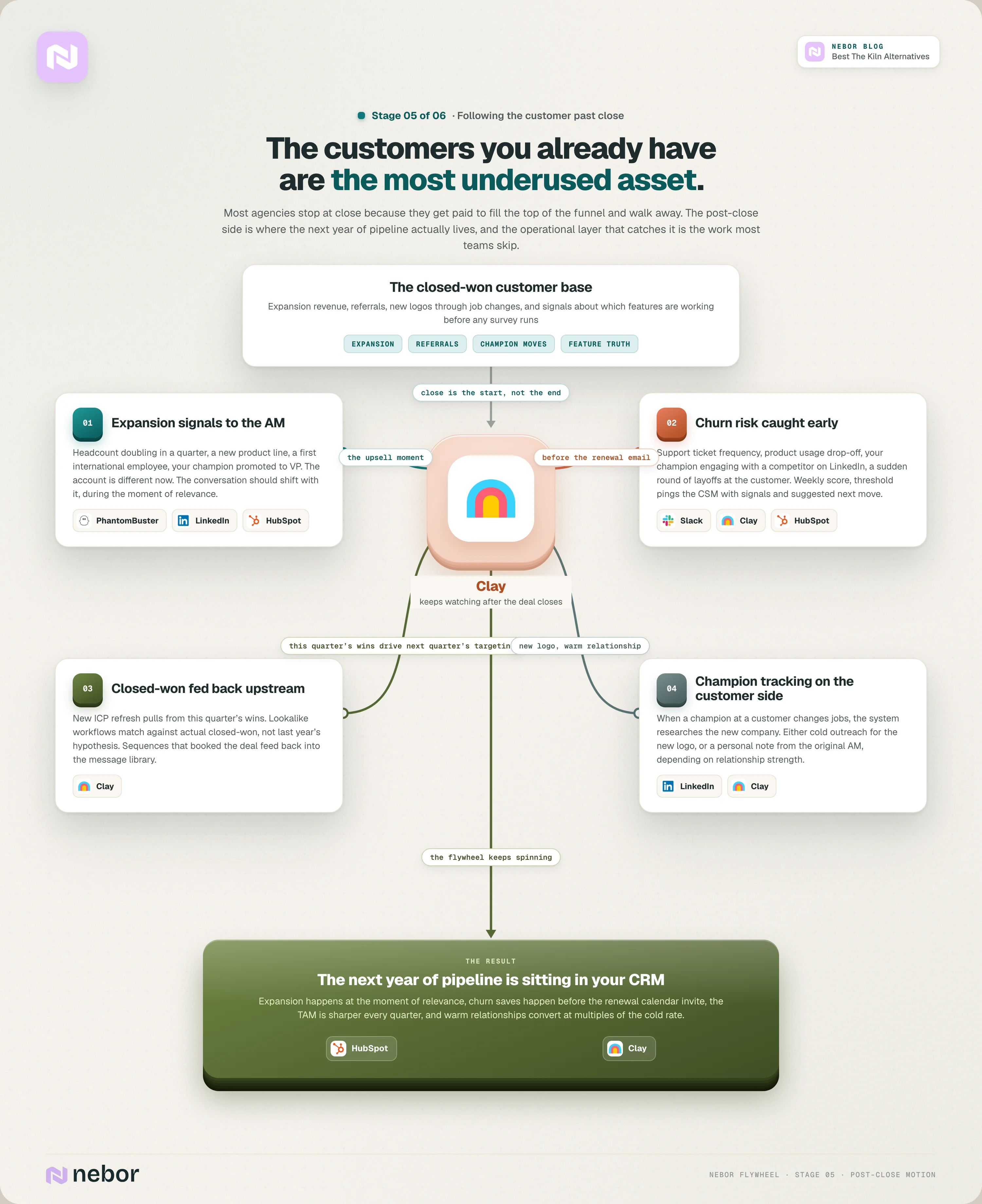
The flywheel keeps moving after the deal closes. Most agencies stop there because most agencies get paid to fill the top of the funnel and walk away. We keep going, because the post-close side is where the next year of pipeline actually lives.
The customers you already have are the most underused asset in your GTM motion. They generate expansion revenue, refer the next deal, open new logos through job changes, and tell you which of your features are working before any survey does.
Your team already knows all of this intuitively. The work most teams skip is the operational layer that catches it before it slips through the cracks.
Here is the post-close side of the flywheel as we build it.
Expansion signals that surface upsell windows before the AM has to dig
A customer doubling their headcount in a quarter is a different account than they were when they signed. Adding a new product line, hiring their first international employee, or promoting your champion to VP all change the account in the same way.
The shape of the relationship has shifted, and the conversation that follows should shift with it.
We monitor those changes the same way we monitor TAM signals on the outbound side, and we route them to the AM with talking points already drafted.
The expansion conversation happens during the moment of relevance, not the next QBR three months later.
Churn risk that the system catches before the CSM does
The best signals that an account is about to churn live outside your CRM. They show up in support ticket frequency, product usage drop-off, your champion engaging with a competitor's content on LinkedIn, or a sudden round of layoffs at the customer.
We pull all of those into the account record and score the account every week. When the score crosses a threshold, the system pings the CSM with the underlying signals and a suggested next move.
The save conversation happens before the renewal calendar invite goes out, when there is still room to fix things.
Closed-won customers fed back into the outbound motion
Every closed-won deal contains the data to find the next ten. We push that data back upstream so the outbound system actually learns from your customers.
The new ICP refresh pulls from this quarter's wins. The lookalike workflows in Clay match against the closed-won account profile, not last year's hypothesis.
Sequences that booked the deal feed back into the message library. The TAM mapping does not stay frozen at the start of the engagement, because your real ICP keeps changing.
Champions tracked beyond the relationship that started them
We covered this on the outbound side, but the same workflow applies to customer accounts too. When a champion at an existing customer changes jobs, the system researches the new company, scores it, and triggers the right move based on the situation.
That might be cold outreach to win the new logo, or a personal note from the original AM rather than a templated email, depending on how strong the relationship was and how the new company fits.
Either way, the relationship doesn't disappear because someone changed their email address.
08 alternatives to The Kiln (thekiln.com) and who each one is right for
The list below covers the eight agencies most worth a real look if The Kiln is not the fit for you. We’ve put ourselves first because we framed the rest of this article as a comparison and we want our positioning visible upfront, but the order beyond that is not a ranking.
Each agency has a profile of company, problem, and budget where they are the strongest answer, and the notes underneath each entry try to be honest about that fit.
1. Nebor.ai
Nebor is a GTM/Clay agency founded by salespeople who built the systems internally before selling them to anyone else. The founding team is Andrew and Yannick, based in Amsterdam.
Best for: Companies that need the entire GTM flywheel built and owned in-house. That includes outbound, inbound-led outbound, RevOps plumbing (CRM hygiene, reporting, attribution), and post-close motion (expansion, churn, champion tracking), all built on infrastructure that lives in your accounts after the engagement.
How we compare to The Kiln. The Kiln does deep custom Clay engineering for a small set of clients with multi-month timelines and a premium budget. We move faster (results in weeks, not months), cover more of the GTM motion, and build systems your team owns.
What makes us different: The infrastructure stays with you after the engagement. The Clay tables, the n8n workflows, the HubSpot or Salesforce automation, and the reporting layer all live inside your stack. You do not need a retainer to keep it going. That's what we mean when we say "owned GTM."
2. ColdIQ
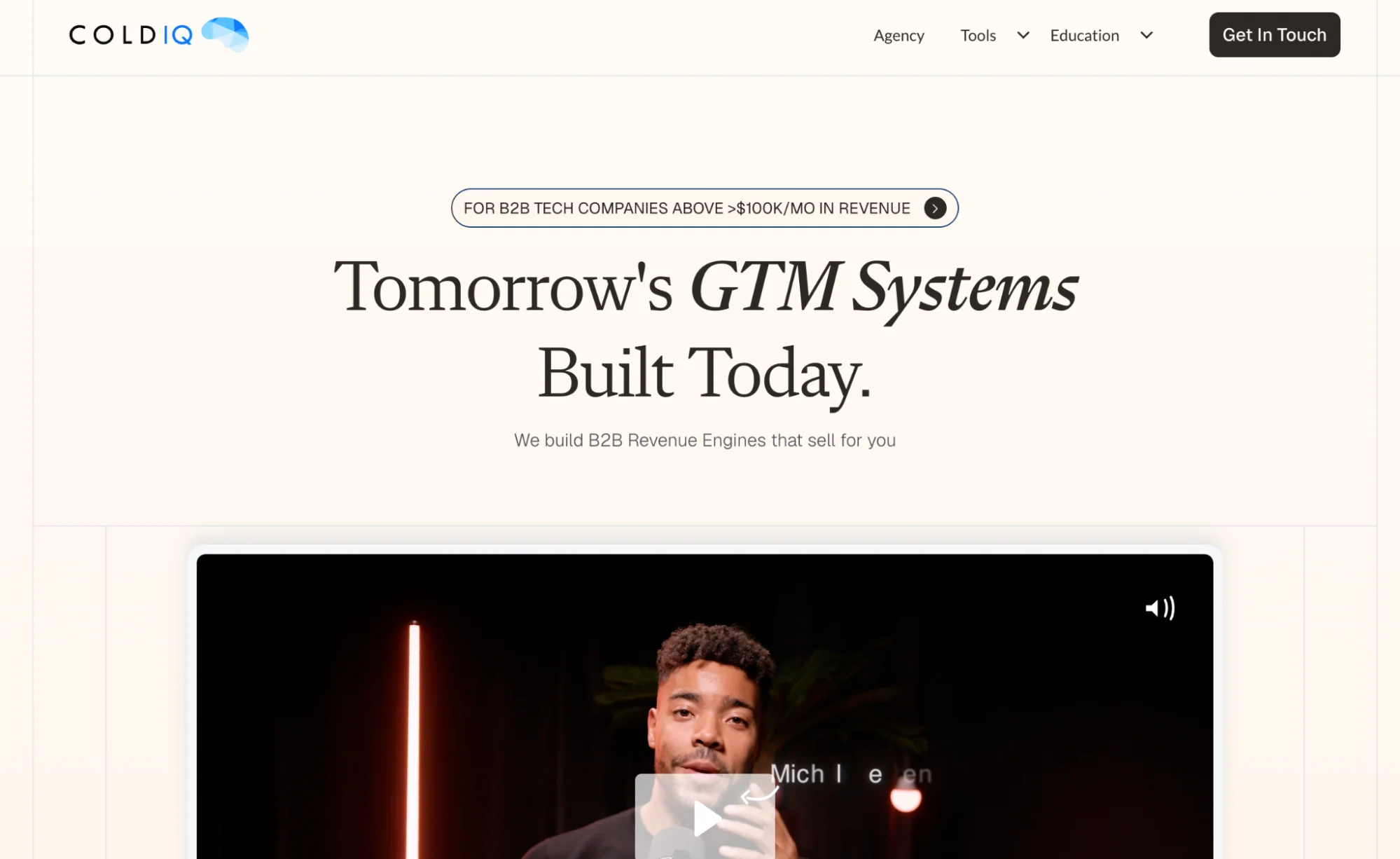
ColdIQ. Founded by Michel Lieben, this agency is one of the louder voices in AI-driven outbound.
Best for: Teams that want to build the outbound engine in-house and need a partner to help design it before handing over the keys.
ColdIQ also offers a course, an agency arm, and a consulting practice, so the relationship can take whatever shape fits the engagement.
How they compare to The Kiln: Both teams build deeply on Clay as the central tool. The Kiln is purely done-for-you custom builds for a small client list.
ColdIQ works a more accessible model with multiple entry points and a publicly visible body of work in podcasts, videos, and a tools comparison library.
What makes them different: Their resource library compares more than 500 sales tools, which gives them an unusual vantage point on what is actually working across the category.
The coaching programs train your team to become Clay experts, which puts them at the opposite end of the spectrum from the long-term retainer model.
3. OneAway
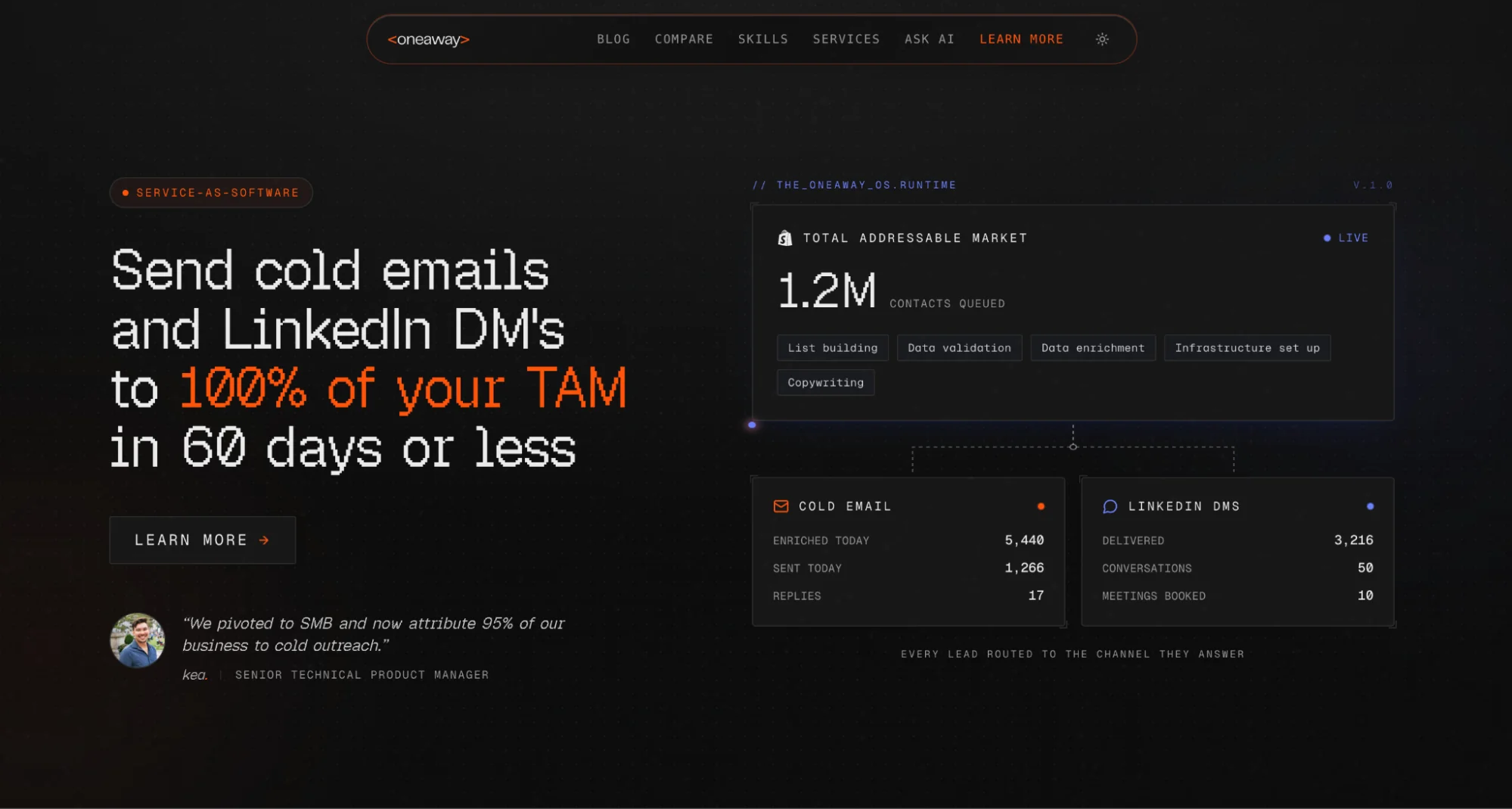
OneAway is a Clay partner that has built more than 500 custom Clay tables across 50+ B2B clients. The work centers on GTM engineering, automation, and the kind of CRM hygiene most agencies refuse to touch.
Best for: Series B and C SaaS companies, plus mid-market brands, that need enterprise-grade automation integrated into an existing HubSpot or Salesforce stack. The fit is strongest when the workflows have to span multiple teams and the existing system has a lot of operational debt.
How they compare to The Kiln: Both teams build deeply custom workflows on Clay. OneAway has a wider client list and is more open about who they have worked with than The Kiln's small, named-on-application roster.
They also lean harder on template development and CRM operations alongside the outbound work, which makes them a closer match if the operational layer is what you are actually trying to fix.
What makes them different: Their published numbers include 2–3x improvement in tough industries like healthcare, and they generated 78 qualified leads in a single week for one client, with a $1.2M opportunity inside that batch.
The pitch leans hard on reducing SDR burden through automation, which is the right frame for teams trying to grow pipeline without growing headcount.
4. Grow Surely
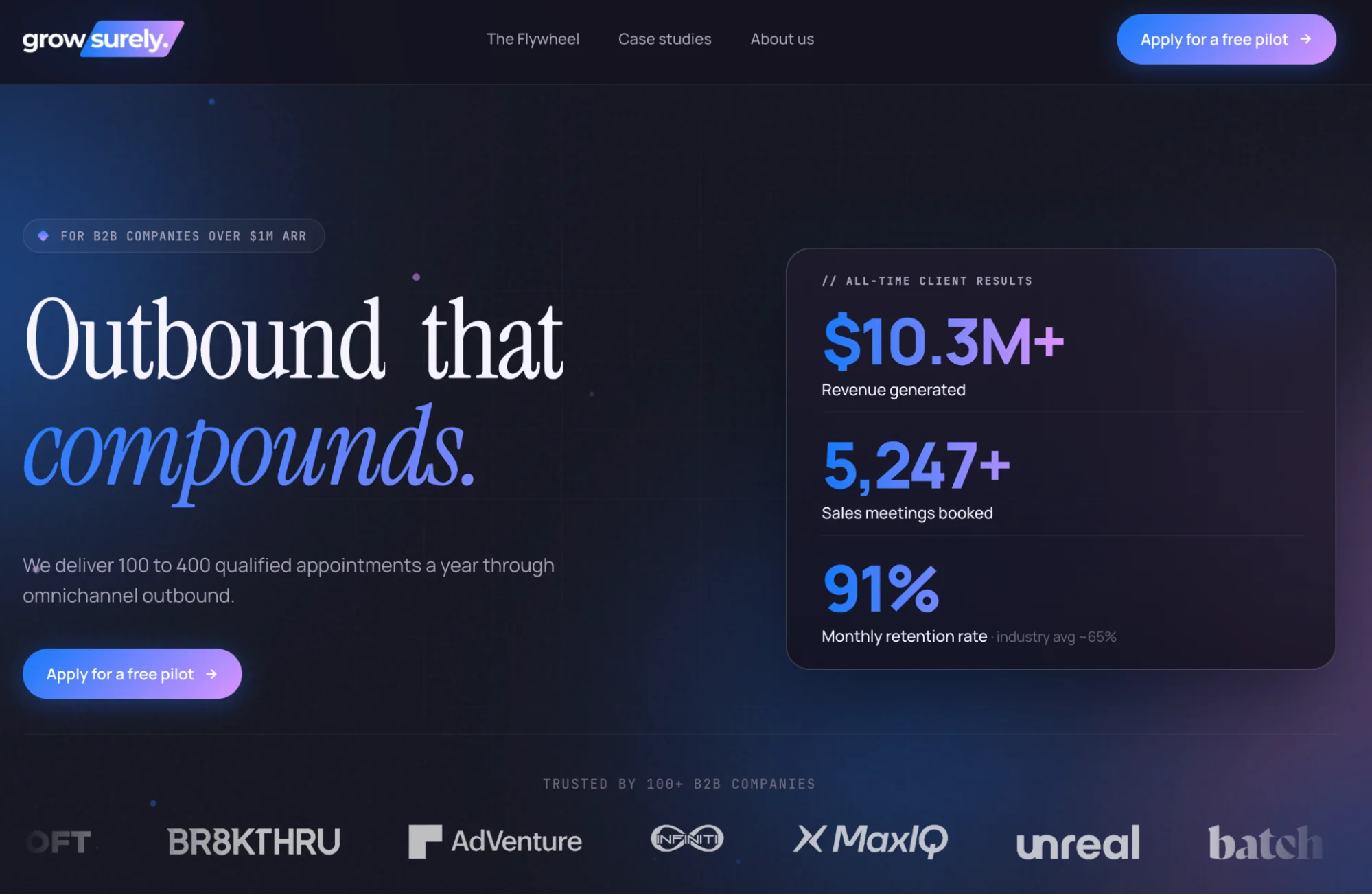
Grow Surely is a Clay-certified team that combines AI personalization with email deliverability expertise. Their public results show their campaigns have driven over $2.5M in closed deals.
Best for: Companies that have a deliverability problem more than a list problem.
If your sender reputation has degraded, your inboxing rate has dropped, or you are pushing high-volume cold email at scale and watching the open rates decline, they are the right partner.
How they compare to The Kiln: The Kiln’s strength is the workflow design itself.
Grow Surely’s strength is making sure the emails those workflows send actually reach the inbox. They specialize in the technical infrastructure layer underneath the campaign rather than the orchestration on top of it.
What makes them different: The founders have managed more than 14 million sent emails between them, which gives the team unusual depth on inboxing at scale.
They use diversified email infrastructure across Google, Outlook, and Maildoso, and they understand DNS configuration, sender reputation management, and spam placement at a level most agencies in this category lack.
5. Growth Engine X
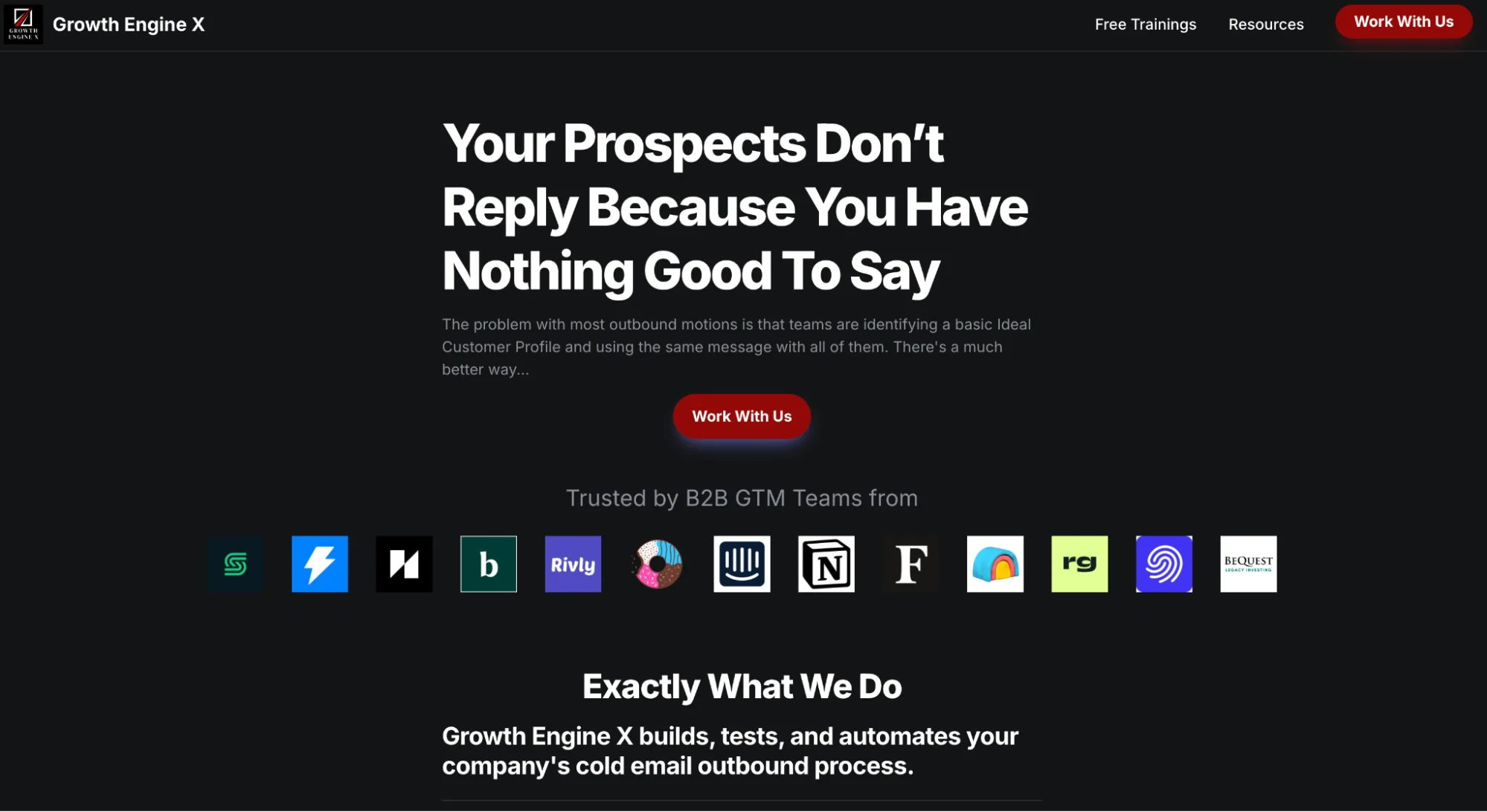
Growth Engine X, like The Kiln, is also founded by a former Clay employee, Eric Nowoslawski. The agency focuses specifically on cold email at scale, with deliverability and trigger-based campaign design as the core capabilities.
Best for: Teams that want trigger-based outbound built around specific prospect events, like a company founding, a leadership change, or a funding round.
If the campaign you have in mind sounds like "reach out the moment X happens to a prospect that fits Y," Growth Engine X has built that pattern dozens of times.
How they compare to The Kiln: Both founders trace back to former roles at Clay itself. The Kiln builds full custom GTM systems on Clay.
Growth Engine X focuses tighter on cold email execution and the deliverability layer underneath it. The fit is narrower but deeper inside that scope.
What makes them different: Their "Trigger Waterfall" workflow drives multiple campaign sequences off the same prospect signal, layered against email infrastructure designed for high-volume sending.
The work includes domain diversification, sender warm-up sequencing, and the kind of inbox-placement attention most teams skip.
6. Content Marketing Media (CMM)
Content Marketing Media (CMM) is led by Josh Whitfield, who has spent 17+ years in the space. CMM holds public certifications in Clay, Instantly, Maildoso, and Octave, which they describe as the four cornerstone platforms of modern outbound.
Best for: Teams that want personalized video baked into the outbound motion alongside Clay automation.
If standing out in a crowded inbox with a face and a voice rather than another text-only email is the strategy, CMM is one of the few agencies that offers both capabilities at once.
How they compare to The Kiln: The Kiln builds complex custom workflows, full stop. CMM builds workflows with a creative-personalization layer on top, especially video. The frame is making the outreach feel human at scale, not just technically clever.
What makes them different: They integrate Clay with SendSpark and Octave for dynamically personalized videos in cold sequences, which historically drive higher reply rates than text-only sends. They also do full email infrastructure evaluations as part of the engagement.
7. Understory Agency
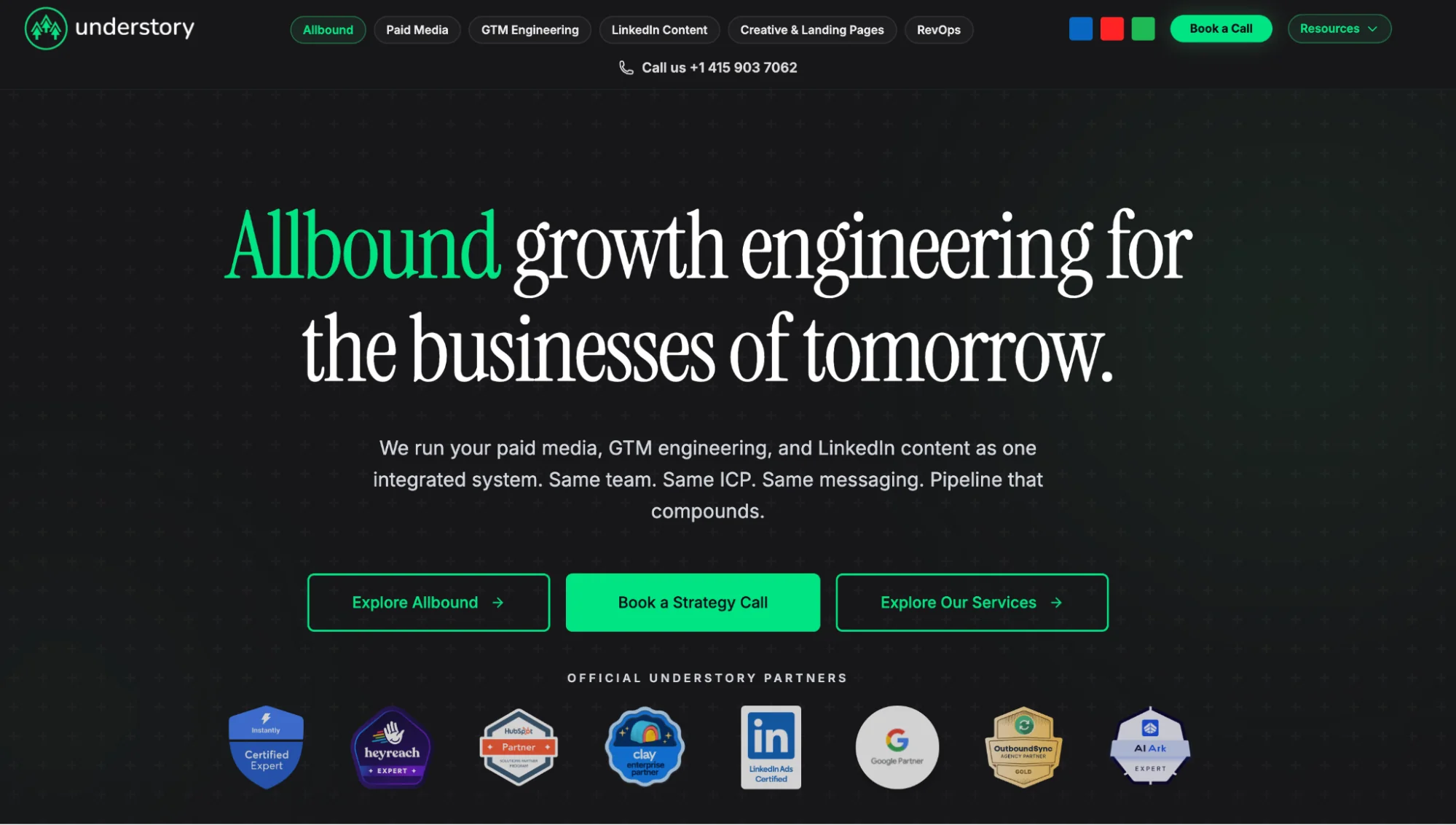
Understory is led by Naufal Nugroho, who built his own Clay agency to six figures before merging it into Understory. The team focuses on smart outbound that combines Clay, AI, and behavioral-signal monitoring.
Best for: Companies that want a system watching the market for buying signals (funding rounds, leadership changes, product launches) and automatically scoring them so the right outreach goes out at the right moment.
If "we want to act on intent in hours, not weeks" describes the gap, that's where Understory operates.
How they compare to The Kiln: Both teams operate at a deep technical level. The differentiator is Understory's focus on signal monitoring as a primary capability rather than an add-on.
Their published case work includes systems that process 1,000 annual reports in under two hours and score the intent signals coming out of them automatically.
What makes them different: The methodology centers on data-volume processing as part of the outbound design.
Where most agencies in this list build campaigns first and add signal triggers later, Understory tends to start from the signal-monitoring infrastructure and build the campaigns around what the system surfaces.
8. Automate RevOps
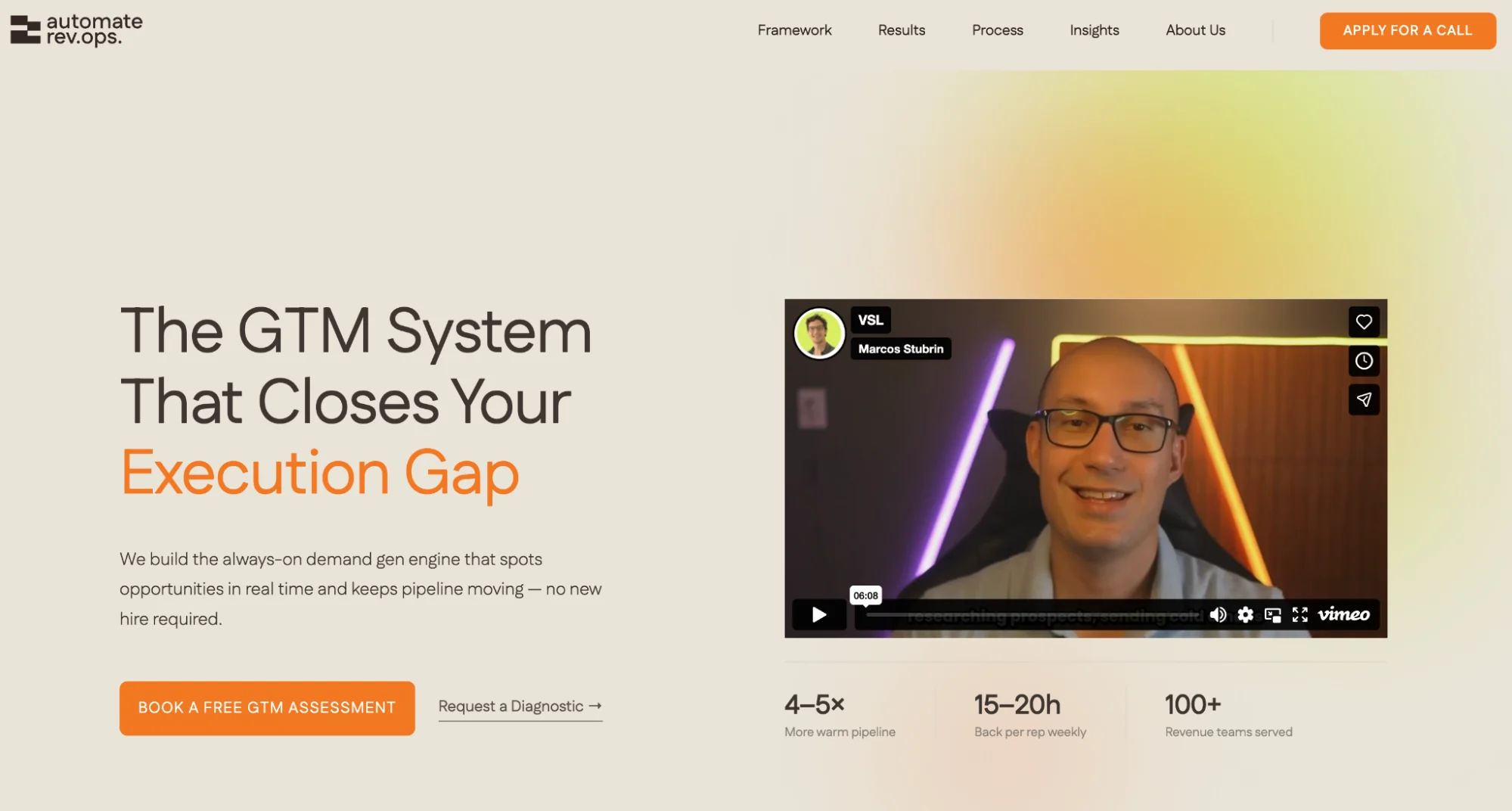
Automate RevOps a certified Clay expert and coaching program that trains sales professionals to become AI RevOps practitioners through hands-on work. The model is education rather than done-for-you service.
Best for: Teams that want to build the capability internally rather than rent it from an agency in perpetuity. If "we'd rather train our own people to do this than write a retainer check every month for the next three years" describes your preference, this is the right fit.
How they compare to The Kiln: The Kiln builds the system for you and operates it. Automate RevOps teaches you or your team how to build it yourselves. The decision between them comes down to whether you want capability or a deliverable.
What makes them different: The program lasts six weeks with direct Slack access, live sessions, and hands-on work applied to your actual project rather than synthetic exercises.
Alumni often complete the certified Clay Expert track. You leave with both the working knowledge and a live sales system built during the program.
Hire Nebor to grow your business through outbound, inbound, and RevOps
If you have the budget and the patience for a multi-month boutique build, and you want the deepest possible Clay engineering inside one slice of the GTM motion, The Kiln is the right call for that profile. They do that one thing better than almost anyone else on this list.
Email deliverability or sending volume at scale is its own problem, with its own specialists. Grow Surely and Growth Engine X both go deep on the technical infrastructure layer underneath the campaigns, and either is a strong match if that's the gap.
Some teams would rather build the capability inside their own house than rent it from an agency long-term.
ColdIQ and Automate RevOps both offer education and coaching programs that get your team there, and both are the right call if owning the work yourselves is the long-term plan.
OneAway is the strong match for enterprise-grade automation deeply integrated into HubSpot or Salesforce, especially when CRM operations is the messy part.
CMM is the only agency on this list doing personalized-video at scale alongside Clay automation, which makes them the obvious fit if creative differentiation in the inbox is the strategy.
Understory’s whole approach centers on signal monitoring at industrial scale, and the team is a good match when the question is “how do we act on intent in hours instead of weeks”.
The case for Nebor is narrower than the others on this list. We are the right fit when you want one team building the entire flywheel, including the inbound side, the outbound motion, the RevOps function, and the post-close work, all built on infrastructure your team owns and operates after the engagement.
We are not the right fit for everyone. If the engagement is going to live or die on a single ultra-deep custom Clay table, hire The Kiln.
If you need an agency to handle your outbound forever and never hand the system over, that is also not us. We built our positioning around the opposite of both.
If you’re somewhere between the rest of the list and the corner case, we are happy to talk it through. We build the first call around being helpful. If we are not the right fit, we will say so and tell you which of the seven other names on this list probably is.


Related Articles

By clicking Sign Up you're confirming that you agree with our Terms and Conditions.