
Top 07 Growth Engine X Alternatives for B2B Lead Generation and Clay Automations


In this post:
Growth Engine X is a done-for-you cold email agency. Eric Nowoslawski founded it after working as one of Clay's earliest experts on the platform.
The agency handles everything from building lead lists using 20+ data sources to setting up email infrastructure, writing data-driven copy, and sending campaigns end to end.
They are one of Clay's largest users by enrichment volume and send over 4 million emails monthly for clients.
Growth Engine X works best for B2B companies whose customer LTV is above $5,000 and whose sales cycles close inside six months.
They’re one of the agencies to partner with if you want campaigns live fast without building internal expertise. You hand over your ICP and their team does the rest.
They also offer industry playbooks for financial advisors, marketing agencies, and staffing firms. That makes them appealing if you need high-volume outbound and would rather not touch the tools yourself.
Despite the track record, Growth Engine X is not the right fit for every team. The done-for-you model means you rent access to their infrastructure. When the engagement ends, your system ends with it.
That creates a dependency problem if you want to build internal outbound capability, integrate campaigns tightly with your CRM, or build a multi-channel motion that goes beyond cold email.
Smaller teams without $5K+ deal sizes find the math harder to justify. The monthly retainer has to generate enough pipeline to clear the bar.
And teams that want hands-on control over targeting logic, copy iteration, or workflow customization end up inside a black box. You see the results without seeing how they got produced.
In this post, we break down the best Growth Engine X alternatives by what you are actually trying to solve, whether that is owning your systems, getting tighter RevOps integration, or matching the model to your deal size and GTM motion.
Let’s get started.
TL,DR
Most agencies on this list will book you meetings. Twelve months in, that’s all you have. The domains, the inboxes, the targeting logic, the data, the playbooks all stay on their side of the wall, and your next vendor or your new hire has to start from zero.
We work the opposite way. We do send cold emails and book your meetings, but you also get the entire sales motion automated and built in your accounts from day one. It works on your stack, and stays with your team when we step back.
Same monthly investment, but the work compounds instead of resetting every quarter. We also get into your org and create workflows with the unique purpose of improving your process, making your reps more efficient and your data clean.
That means your GTM bends to your motion instead of being squeezed into someone else's template. By the end of the engagement with us, you’ll have the meetings and also have a system your team can operate, edit and scale without rebuilding anything.
What attributes we looked at to make our list of Growth Engine X alternatives and competitors
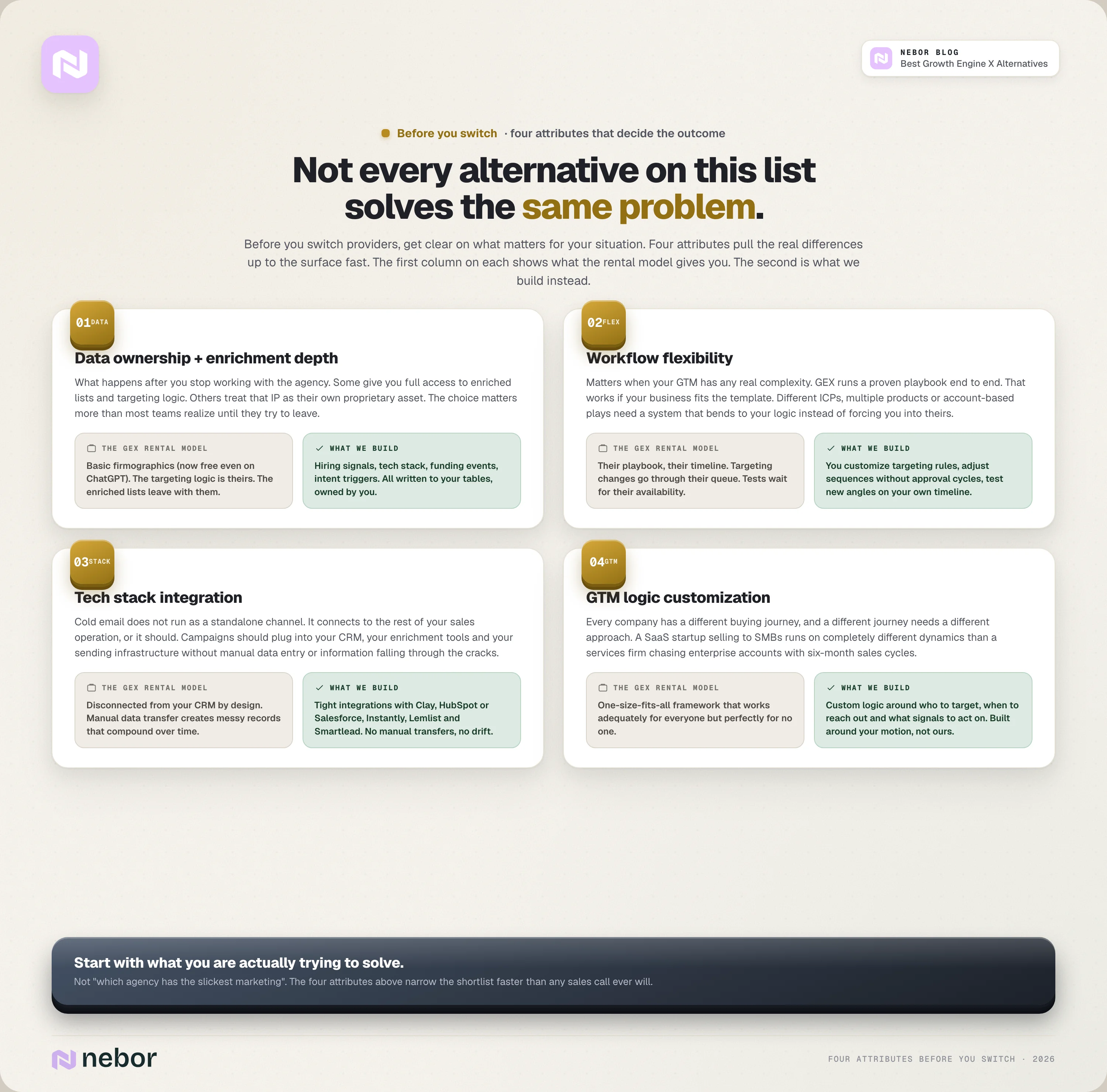
Not every alternative on this list solves the same problem. Before you switch providers, you have to be clear on what matters for your situation.
Here is what we believe you should weigh.
Let’s explain.
Data ownership and enrichment depth
Data ownership and enrichment depth determine what happens after you stop working with an agency.
Some agencies give you full access to your enriched lead lists and targeting logic. Others treat that intellectual property as their own proprietary asset. The choice comes down to what you actually want from the engagement.
If you want to build long-term assets rather than rent short-term results, ownership matters more than most teams realize until they try to leave.
Beyond ownership, you should evaluate how deep the enrichment actually goes. Basic firmographics have become table stakes by now. Even ChatGPT can give you those for free.
The real advantage comes from hiring signals, tech stack data, funding events, and intent triggers that help you time outreach to moments of actual need.
Workflow flexibility
Workflow flexibility matters when your GTM motion has any real complexity. Growth Engine X delivers a proven playbook end to end. That works if you want hands-off execution and your business fits the template.
If you have different ICPs, multiple products, or account-based plays, you need a system that bends to fit your logic rather than forcing you into theirs.
Ask prospective partners whether you can customize targeting rules, adjust sequences without long approval cycles, and test new angles on your own timeline rather than waiting for someone else to prioritize your experiments.
Tech stack integration
Tech stack integration matters because cold email does not work as a standalone channel. It connects to the rest of your sales operation, or it should.
Your campaigns should plug into your CRM, your enrichment tools, and your sending infrastructure without manual data entry or information falling through the cracks.
Look for tight integrations with Clay, HubSpot or Salesforce, and email platforms like Instantly, Lemlist or Smartlead. Disconnected tools create manual work and messy data that compounds over time to kill your motion.
GTM logic customization
GTM logic customization matters because every company has a different buying journey, and a different journey needs a different approach.
A SaaS startup selling to SMBs works on completely different dynamics than a services firm chasing enterprise accounts with six-month sales cycles.
The right agency works with your team to build custom logic around who to target, when to reach out, and what signals to act on. No one-size-fits-all framework that works adequately for everyone but perfectly for no one.
7 best Growth Engine X alternatives by use case
There is no single best alternative on this list. The right agency depends on your growth strategy.
Some teams want a hands-off agency that books meetings without internal involvement. Others want to build infrastructure they control and can modify without permission.
The seven alternatives below cover both ends of that spectrum and everything in between. Start from what you are actually trying to solve rather than which agency has the slickest marketing.
Why Nebor is the strongest Growth Engine X alternative on this list
Nebor does everything Growth Engine X does, from cold email campaigns and data enrichment to personalized outreach at scale. We just do not stop where they stop.
Where Growth Engine X delivers campaigns for you, we build the systems that make those campaigns work internally for your team. We can operate them too, or hand you the keys when we are done.
We use Clay at the center of everything, same as Growth Engine X. We send millions of emails through warmed inboxes on Instantly and push LinkedIn outreach through Lemlist.
Tools are just tools. What matters is who is doing the assembly, and whether they understand what actually generates revenue.
We are not a team of automation specialists who learned sales from YouTube. We are salespeople who got tired of doing the same manual work over and over, then built systems to fix it.
That background shapes everything we build for our clients. We do not optimize for clever workflows that look impressive in demos. We optimize for pipeline that converts into closed revenue. Here is a quick view of what you are signing up for if you pick us.
You get a team with sales experience that translates into systems that actually work
Most agencies build automations on behalf of their clients. We build sales systems instead, and the difference matters more than most buyers realize until they experience both approaches.
When you have spent years in the trenches qualifying leads, handling objections, and losing deals you should have won, you learn what information salespeople actually need and when they need it.
You learn which signals predict real buying intent versus noise that wastes everyone's time. You learn that a lead means nothing if it shows up without context, without scoring, and without a clear next step for the rep on the other end.
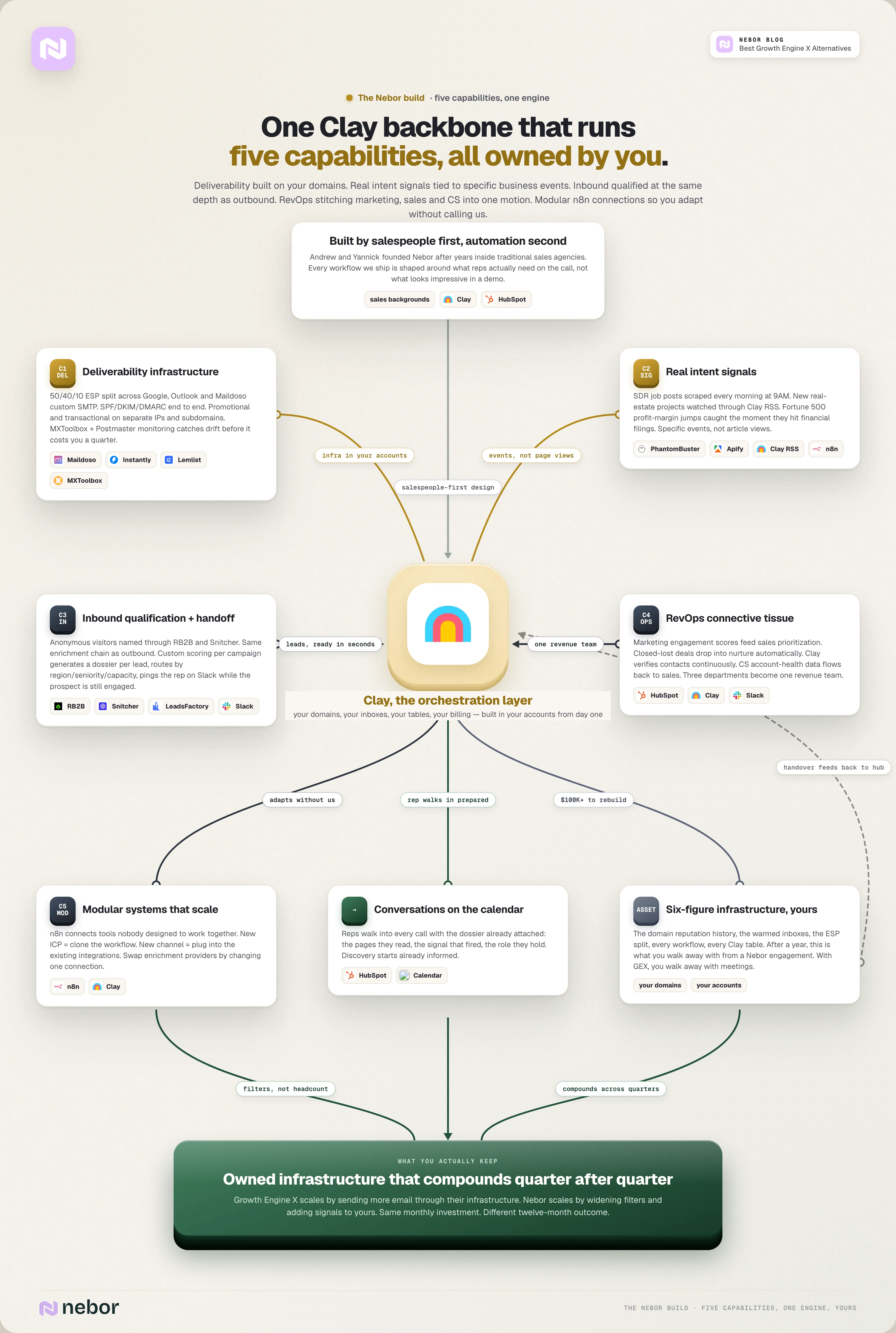
Andrew and Yannick founded Nebor after years inside traditional sales agencies, where they saw firsthand how broken most outbound processes are.
The conventional approach follows a flawed formula across the board. Teams buy email domains without thinking about deliverability, blast generic messages to purchased lists, and then wonder why reply rates are poor.
We built Nebor to fix what was broken rather than perpetuate what was easy.
Our team's sales background informs every system we build for clients. We understand your pipeline is on the line. We design workflows that mirror how deals actually close, surfacing the right prospect at the right time with the right context, then routing them to the right rep.
Everything we design works toward automating top-of-funnel work so your reps can focus on closing deals and building relationships with qualified buyers.
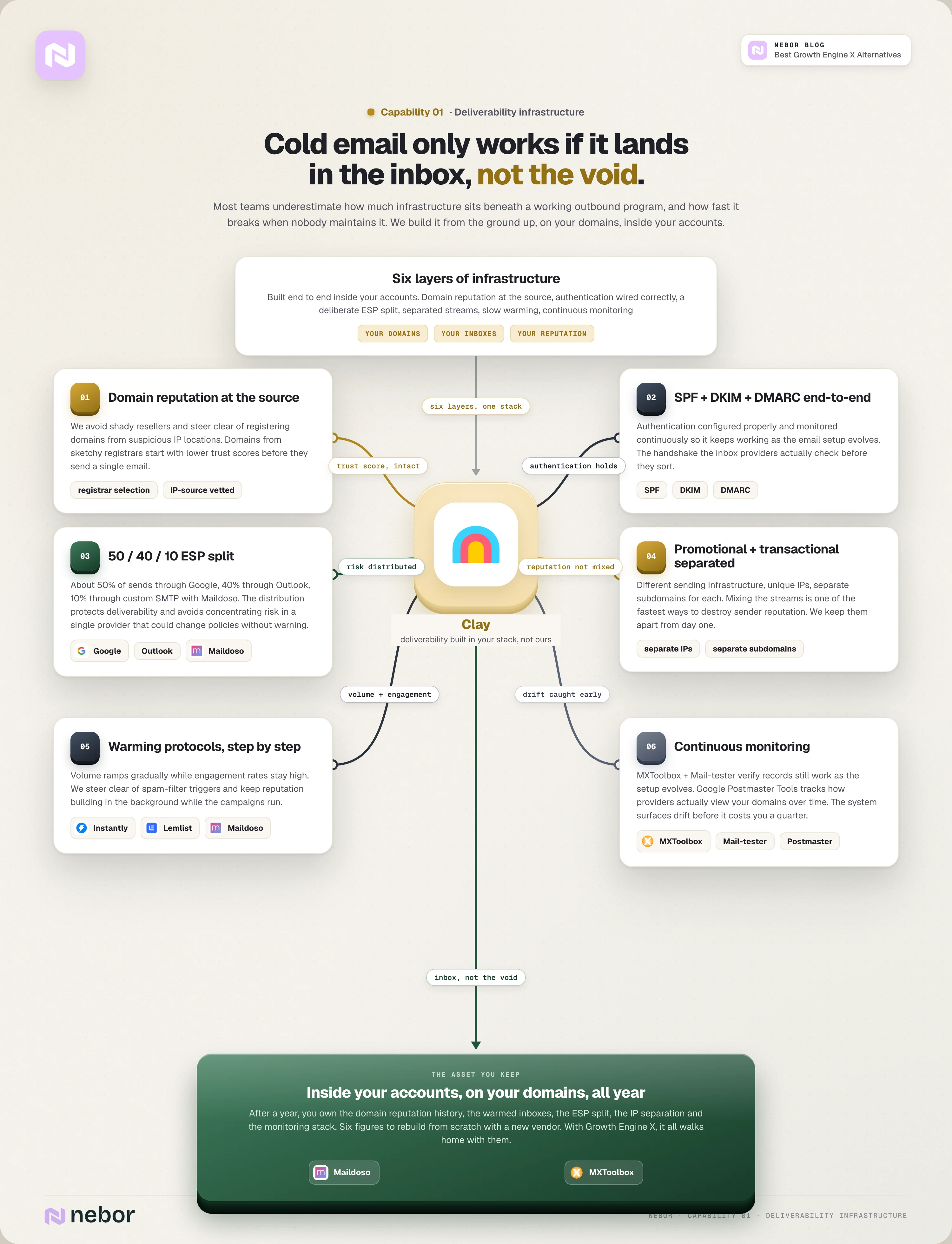
You get deliverability infrastructure that protects your domain and reaches inboxes
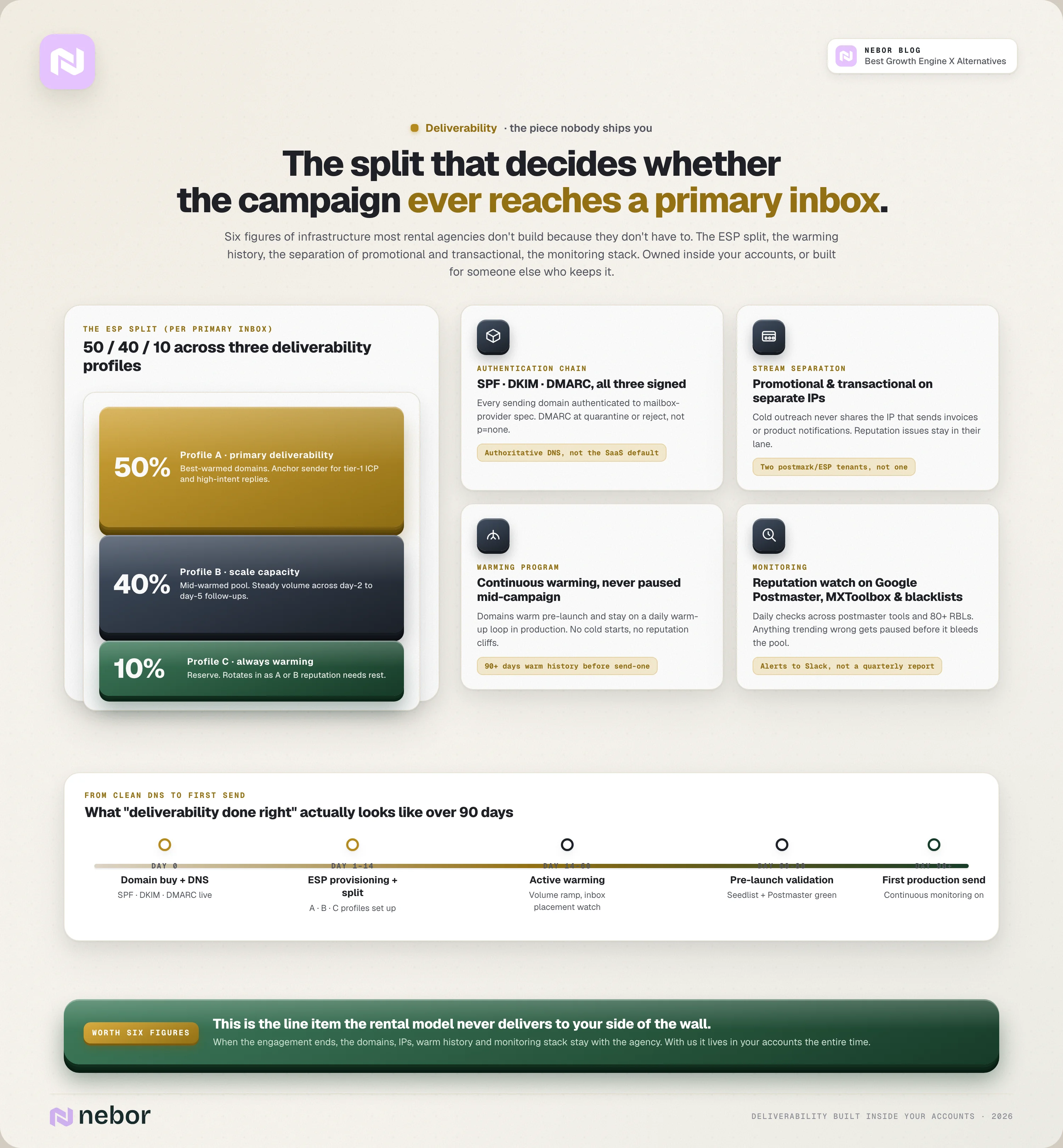
Cold email only works if it lands in the inbox rather than the spam folder or the void. Most teams underestimate how much infrastructure underpins a successful outbound program, and how fast it breaks when nobody maintains it.
We build deliverability systems from the ground up, starting with domain reputation at the source.
We avoid shady resellers and steer clear of registering domains from suspicious IP locations. Domains that come from certain countries or questionable registrars start with lower trust scores before they send a single email.
That initial handicap compounds over time and can tank campaigns before they get a chance to prove themselves.
We configure SPF, DKIM, and DMARC records end to end and monitor authentication so it keeps working as your email setup evolves.
We use specialized providers like Maildoso that understand cold email infrastructure nuances and pre-configure inboxes the right way. That prevents the common setup errors that flag accounts as suspicious before you send your first campaign.
At Nebor, we maintain a healthy ESP split. Roughly 50% of emails go through Google, 40% through Outlook, and 10% through custom SMTP with Maildoso.
That distribution protects your deliverability and avoids concentrating risk in a single provider that could change policies or flag your account without warning.
We separate promotional and transactional emails on different sending infrastructure, with unique IPs and subdomains for each type. Mixing those streams is one of the fastest ways to destroy sender reputation.
Our warming protocols build reputation step by step, ramping volume while keeping engagement rates high and steering clear of spam filter triggers.
We test regularly with MXToolbox and Mail-tester to verify records still work, and track performance through Google Postmaster Tools to see how providers view your domains over time.
Growth Engine X handles deliverability competently, but their infrastructure stays with them when the engagement ends. When you stop paying, your domain health history, your warmed inboxes, and your sending reputation walk out the door with their team.
We build deliverability systems inside your accounts using your domains, so the asset compounds over time instead of resetting every time you change vendors.
After a year with Growth Engine X, you have meetings. After a year with us, you have meetings plus infrastructure worth six figures to rebuild from scratch.
You get intent data and buyer-signal systems that prioritize the right accounts
Most outbound treats every prospect the same, sending identical sequences and timing for everyone, whether they are actively buying or completely indifferent.
That approach wastes sales attention on accounts that will never convert while ignoring accounts that are ready to buy right now.
We do not believe in the intent data most companies use. Legacy sales intelligence tools like ZoomInfo, Bombora, and Cognism sell simplistic data like article views or IP visits. That surface-level activity tells you almost nothing about actual purchase intent.
We build systems combining Clay with PhantomBuster, Apify, and n8n that monitor and scrape sources for real-time signals that correlate with actual buying behavior.
Here is what that looks like in practice.
With PhantomBuster on the back end, we scrape LinkedIn job posts for SDR roles every morning at 9 AM. When a post appears, it lands in Clay. We automatically find the hiring manager and department lead, then send each of them a message.
Companies hiring SDRs are actively investing in outbound sales capacity. That is the right moment to introduce our services, before they build an underperforming team internally.
For one client offering AI-powered furnishing solutions, we use Apify and Clay's RSS feed readers to monitor publications that report new real estate projects. When a development gets announced, the data flows into Clay.
We identify whether the article describes a new property project and extract the project name, developer info, and website. Then we pull contact details, auto-generate an email, and send it to the right person.
The client reaches prospects right when they are planning furnishing needs, before competitors even know the opportunity exists.
For a client offering tax incentive solutions to enterprises, we set up RSS feeds to monitor Fortune 500 companies that just posted a major jump in profit margins. Those moments are pure gold for the client and the campaign.
Companies flush with cash are more likely to invest in tax optimization, and we find contacts and reach out in real time without any manual monitoring from the client's side.
Most sales teams would not think to actively look for that kind of data, but we treat it as an intent signal that separates proactive outreach from spray-and-pray tactics.
Those signals flow into Clay, get enriched with contact data, and trigger outreach automatically. The value goes beyond personalization to prioritization itself.
Your sales team has limited hours in the day. Our systems make sure those hours go toward accounts showing real intent, not accounts that looked good on a static list six months ago.
You get inbound lead qualification and sales handoff systems
Outbound gets the attention in most sales conversations, but most companies leak pipeline on the inbound side without realizing it.
A lead fills out a form, waits in a queue, and gets touched two days later if anyone remembers. By then they have already talked to your competitor, who responded in fifteen minutes because they had better systems.
We build inbound qualification systems that work in real time using Clay, n8n, PhantomBuster, RB2B, Snitcher, and AI-driven enrichment.
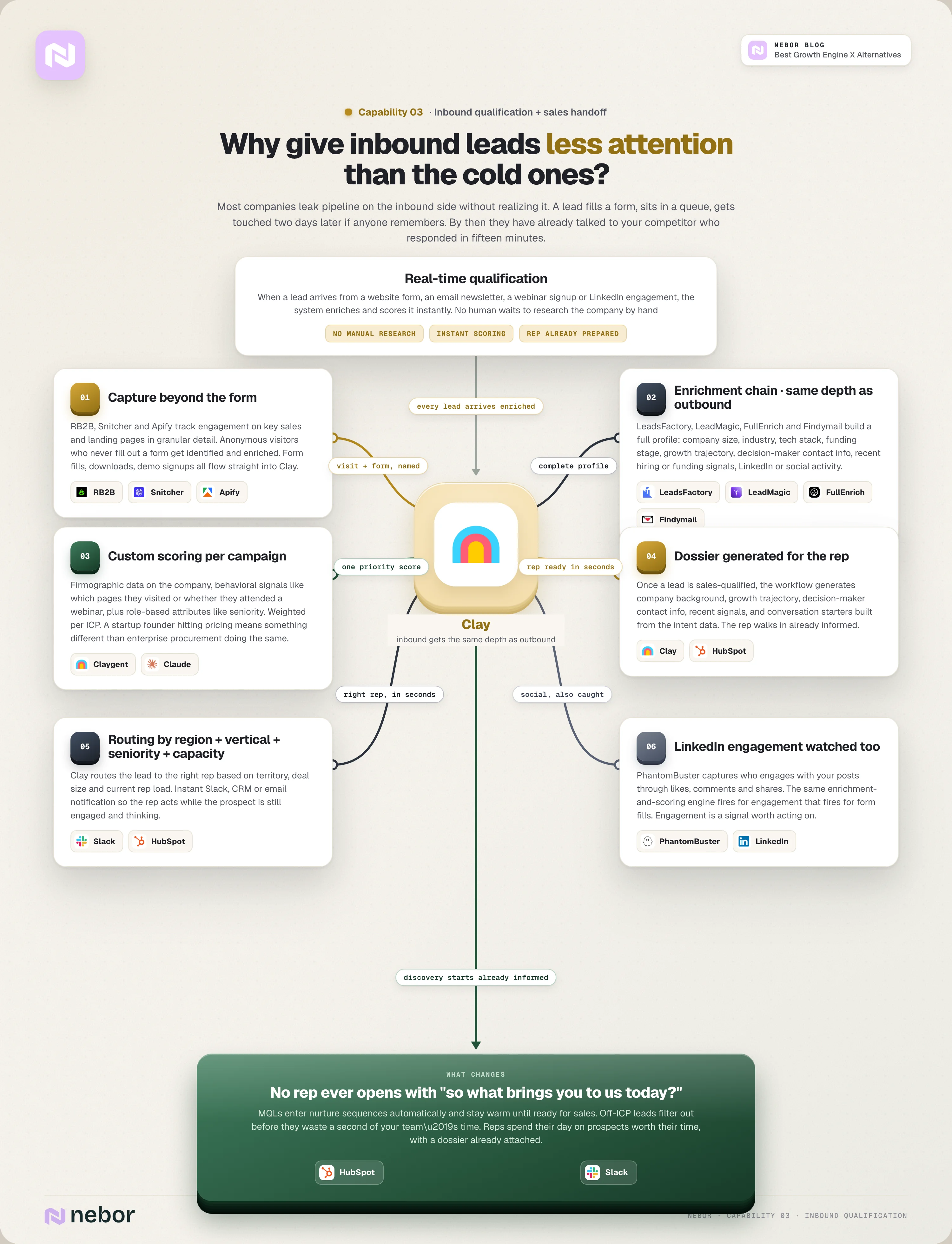
When a lead comes in from website forms, email newsletters, or LinkedIn engagement, our system enriches it instantly. No human waits to research the company by hand.
We combine RB2B, Snitcher, and Apify to track engagements on key sales and landing pages of your website in granular detail.
When someone fills out a contact form, downloads a guide, signs up for a demo, or hits pages that signal buying interest, their data flows straight into Clay.
That workflow lets you identify anonymous website visitors who never filled out a form, enrich them with contact details and profile data, and push them to Clay or your CRM to trigger workflows that would otherwise need a person to do them.
Our system enriches every inbound lead with the same depth as our outbound workflows. Why would you give inbound leads less attention when they have already raised their hand?
We use LeadsFactory, LeadMagic, FullEnrich, and Findymail together to build a full profile on each prospect.
That covers company size, industry, tech stack, funding stage, growth trajectory, decision-maker contact info, recent hiring or funding signals, and LinkedIn or social activity that hints at professional interests.
We then program Clay to apply a custom scoring model based on the factors that matter to your business. We include firmographic data on the company, behavioral signals like which pages they visited or whether they attended a webinar, and role-based attributes like seniority or department.
We weight and score each element with custom logic per campaign. A startup founder hitting your pricing page means something different than an enterprise procurement manager doing the same.
Once we enrich a lead and mark it sales-qualified, our Clay workflow generates a full dossier with everything your rep needs, including company background, growth trajectory, decision-maker contact info, recent signals, and conversation starters built from the intent data.
Depending on how your team assigns leads, we automate routing by region, vertical, seniority, or rep availability so the right person gets the right lead every time. Each rep gets an instant notification via Slack, CRM, or email so they can act fast while the lead is still engaged and thinking about their problem.
Marketing-qualified leads enter nurture sequences automatically and stay warm until they are ready for a sales conversation. The system filters out irrelevant leads before they waste a second of your team's time on companies that will never buy.
Your reps never have to open a call with "so, what brings you to us today?" Discovery starts already informed, with context that shows you understand the prospect's situation before they have to explain it.
One of the most underused inbound signals is social media engagement, especially on LinkedIn, where your buyers are already spending time.
We use PhantomBuster to track who engages with your posts through likes, comments, and shares, then push that data to Clay for enrichment and scoring.
The same enrichment and scoring engine that kicks in for form fills also kicks in here. Engagement with your content is a signal worth acting on.
You get RevOps workflows that keep your CRM clean and your revenue teams aligned
Revenue operations breaks down when systems do not talk to each other. Marketing launches campaigns in isolation, sales works deals without visibility into marketing activity, and customer success operates from their own data silo.
Nobody knows which accounts are getting touched, which signals matter, or why the CRM is full of garbage data that makes reporting meaningless.
Most CRMs do not fail because of lack of effort from the teams using them. They fail because broken or nonexistent workflows create entropy faster than humans can clean it up.
Data comes in from everywhere, including manual entry, website forms, outbound lists, trade shows, and LinkedIn imports.
Over time, what should be the clean heart of your sales process turns into a clogged, unreliable system, full of contacts who left their companies three years ago, emails that bounce, duplicate records that confuse reps, and fields that are empty or wrong.
We build workflows that connect these pieces automatically, so humans can focus on selling rather than data hygiene.
Marketing engagement scores feed directly into sales prioritization, so reps focus on accounts that are actually warming up rather than accounts they feel like calling based on gut instinct or alphabetical order.
Closed-lost deals enter nurture sequences without anyone remembering to add them. The workflow takes care of all of that automatically.
Your CRM data stays clean because enrichment keeps going continuously. Clay verifies contact information, checks whether people are still at their companies, and updates records when changes occur.
We pull down the silos inside your organization, so your customer success team's data on account health and expansion opportunities does not get lost in corners of your CRM where sales will never see it.
These capabilities are not nice-to-haves you can defer until the business matures. They are the difference between a revenue team that operates as one system and a revenue team that operates as three departments pulling in different directions.
Growth Engine X delivers campaigns that generate meetings. We build the connective tissue that makes your entire GTM motion work together as a unified system.
You get modular systems that scale without rebuilding
Growth changes everything about how you actually sell.
Your ICP shifts as you learn which customers succeed. You expand into new markets with different dynamics, add channels to reach buyers where they actually spend time, and test data sources that might surface better prospects.
If your outbound system is hardcoded for one use case, every change means a painful rebuild that takes weeks or months.
We design modular systems from the start of the engagement. We often use n8n to connect tools that nobody designed to work together, through non-native APIs. The point is to eliminate manual data transfer between systems and expensive custom development.
Adding a new ICP means duplicating a workflow and adjusting the targeting logic, not starting over from discovery.
Adding LinkedIn outreach means plugging a new channel into our n8n integrations without disrupting what already works.
Swapping enrichment providers means changing one connection, not untangling months of brittle integrations that break when you touch them.
We believe your tech stack complexity should match your company size and sales automation goals, not follow a one-size-fits-all template.
For smaller organizations, we build a minimal stack with Clay and a few prospecting tools that handle the essentials without overwhelming a lean team.
For enterprise-scale companies, we build complete workflows where leads flow automatically from CRM or data source into Clay for enrichment with contacts and real-time insights, then into outreach tools, with results feeding back into the CRM at every step.
That modularity matters most for agencies and RevOps teams handling multiple motions at once. We are not defined by Clay or by pre-set systems that force you into our way of doing things. We take a deep look at your entire sales function and automate as much as makes sense based on what the business actually needs. You build the system once with our help, then adapt it as needs evolve without calling us every time something changes.
2. ColdIQ
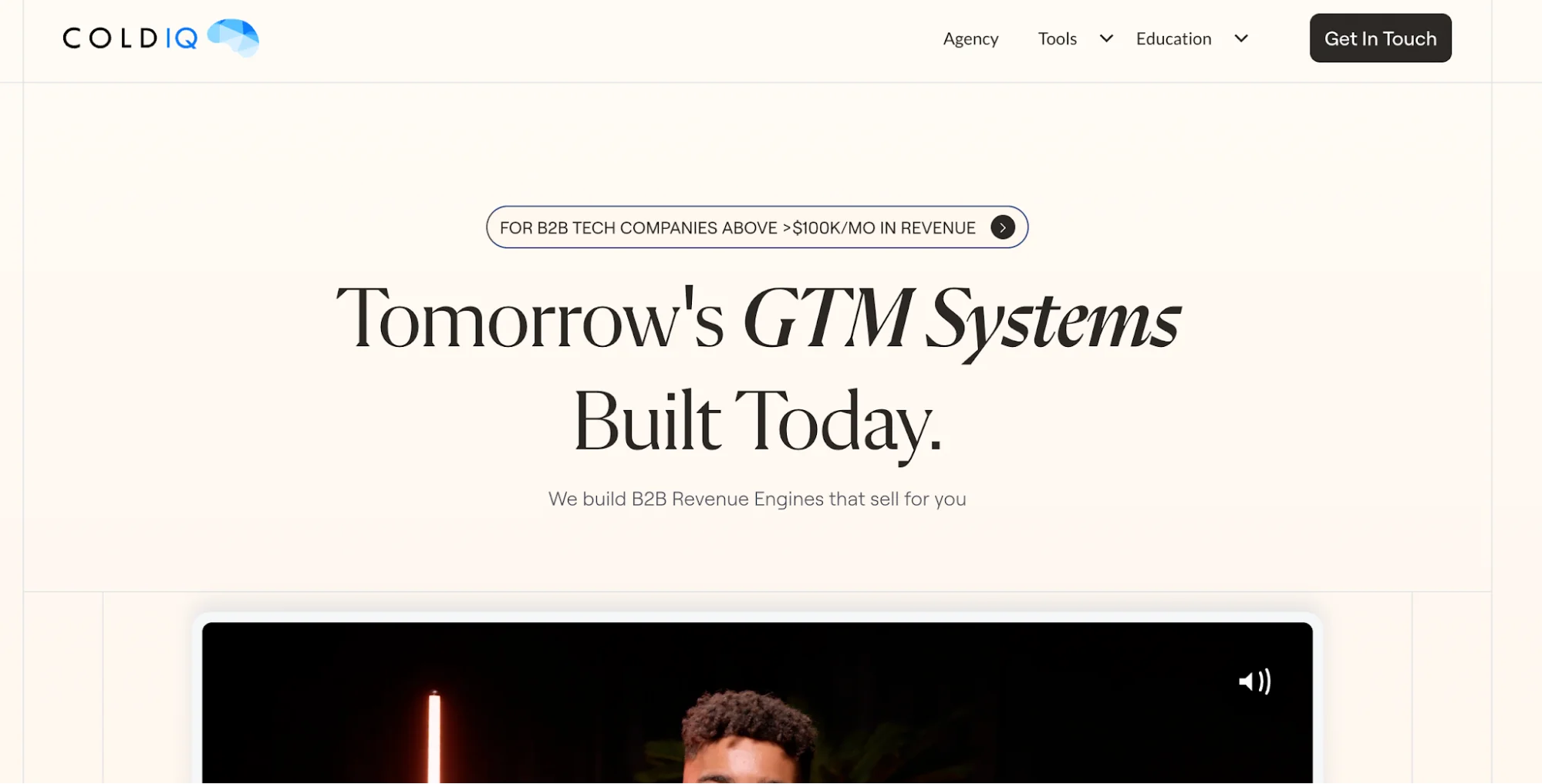
ColdIQ is a B2B sales prospecting agency built around Clay, AI-driven personalization, and multi-channel outreach.
The agency focuses on building repeatable prospecting systems that combine email and LinkedIn into one coordinated motion.
They occupy an interesting middle ground between full-service lead gen and pure consulting. They deliver campaigns for you while taking a tech-forward approach that prioritizes automation and deliverability over manual effort.
Where ColdIQ outperforms Growth Engine X
ColdIQ's biggest edge is intent signal integration done at a level most agencies do not attempt.
They connect tools like Clay, Unify, and Common Room to track buying signals including hiring surges, funding rounds, tech stack changes, and ad spend increases, then use those triggers to time outreach to moments of actual need.
Growth Engine X uses data for personalization to make emails feel relevant. ColdIQ, like us at Nebor, builds systems where the data decides when and who to contact, not just what to say once you do.
Our multi-channel execution and ColdIQ's are both tighter than most competitors in this space. Email and LinkedIn outreach go out in parallel, informed by the same enrichment layer, so your messaging stays consistent across channels.
If a prospect does not respond to email, they get a LinkedIn touch. If they engage on LinkedIn, the email sequence adjusts.
That coordination requires real technical infrastructure Growth Engine X does not provide. They focus almost entirely on email as a single channel.
Where ColdIQ falls short
ColdIQ requires operational commitment that not every team can provide. Their systems need two to three weeks to ramp because mailbox warm-up, domain setup, and sequence testing must happen before any outreach goes live.
We think the timeline makes sense for what they are building. If you need leads immediately, that timeline will not work for your situation.
They also focus on companies already doing meaningful revenue (think $100K+ in MRR) with established sales operations.
Their model assumes you have a defined ICP, a sales team ready to take meetings and work opportunities, and enough budget to sustain a multi-month engagement. Early-stage startups testing product-market fit will find the service overbuilt for their actual needs.
ColdIQ's strength in automation can also feel like a weakness if you want high-touch customization for every prospect.
Choose ColdIQ over Growth Engine X if you want signal-based outbound with real multi-channel coordination.
The approach works best for growth-stage SaaS teams that treat outbound as a primary revenue channel and want infrastructure they can see and measure, not a black box that produces meetings.
3. The Kiln
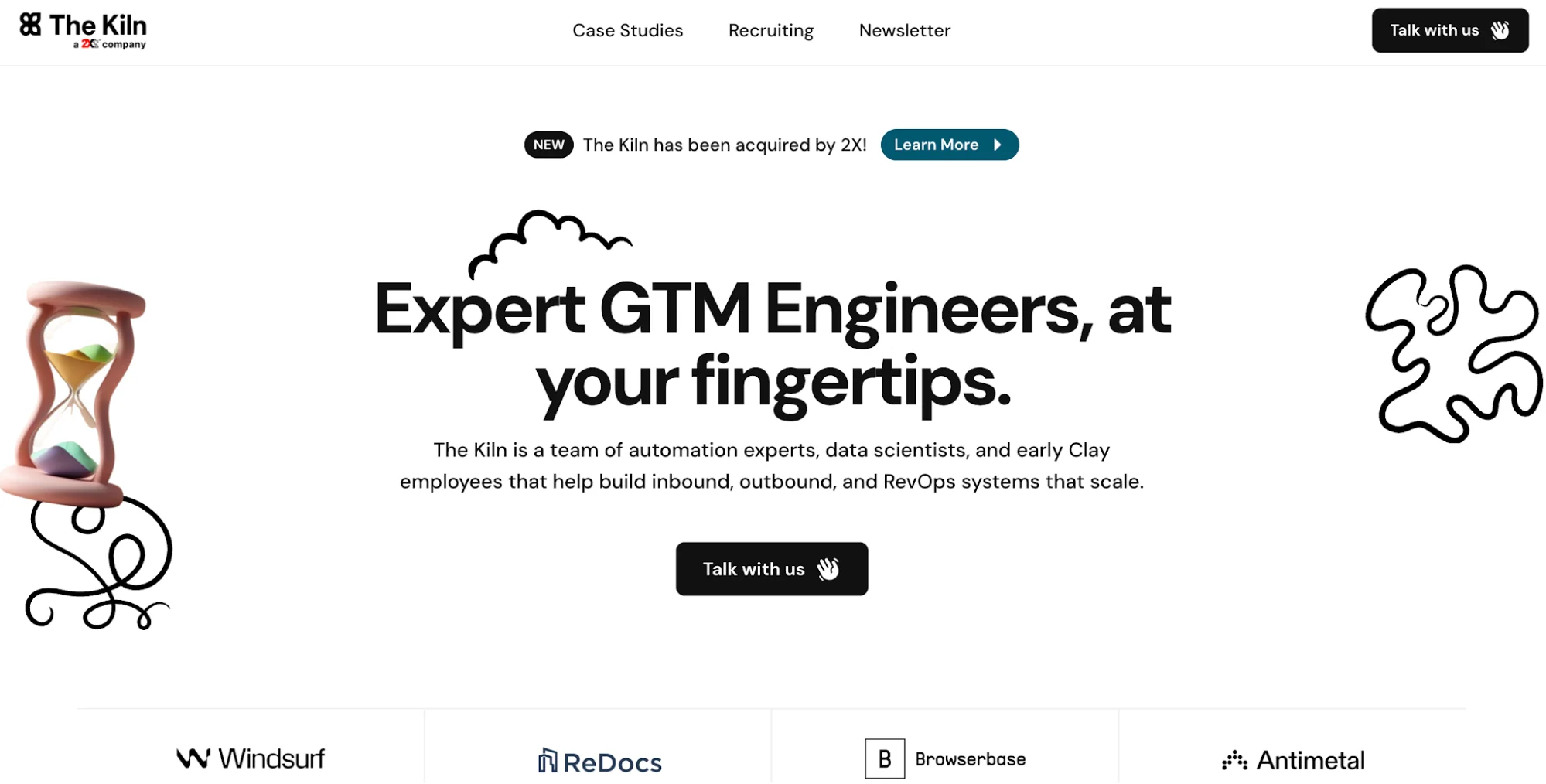
The Kiln is a GTM engineering agency founded by former Clay employees who helped build the platform itself.
They specialize in building sophisticated automation systems for inbound, outbound, and RevOps workflows, with Clay at the center.
Their work goes beyond campaign execution into system architecture, including lead scoring, CRM enrichment, data pipelines, and custom integrations that most agencies cannot build.
Where Growth Engine X delivers campaigns on your behalf, The Kiln builds the underlying systems that make those campaigns possible in the first place.
Where The Kiln outperforms Growth Engine X
The Kiln's technical depth is hard to match. Their team helped create Clay and understands the platform at a level most agencies cannot reach no matter how much they practice.
That expertise means they can push workflows further than anyone else, building custom enrichment waterfalls, multi-step lead scoring models, and real-time data syncs.
Their RevOps capabilities set them apart from agencies focused purely on generating meetings.
Growth Engine X handles outbound execution well, but The Kiln connects outbound to the rest of your revenue stack in ways that create compounding value, like us at Nebor.
They build systems where marketing engagement scores feed sales prioritization automatically, where closed-lost deals enter nurture sequences without manual intervention, and where CRM data stays clean without your team spending hours on data hygiene.
If your real problem is that your systems do not talk to each other, and that's costing you deals, The Kiln solves the underlying infrastructure problem.
They also handle complex integrations that would stall most implementation teams, like Clay to HubSpot, Clay to Salesforce, and custom API connections to niche data providers your competitors are not using yet.
If your GTM stack spans tools that nobody designed to work together, The Kiln can unify everything into one coordinated system that feels like a single product.
Where The Kiln falls short
The Kiln is expensive.
Their premium positioning puts them out of reach for smaller teams and early-stage companies with limited budgets.
If your resources are constrained, you will get more immediate output from Growth Engine X, ColdIQ, and Nebor. Sometimes you need meetings next quarter more than you need perfect infrastructure.
They are also not a quick fix for urgent pipeline problems. The Kiln's engagements involve discovery, architecture, and implementation phases that take time to complete properly.
If you need campaigns live in two weeks to hit quarterly targets, they are not the right partner. Their value shows up over months rather than days, and that timeline does not fit every business situation.
Their sophistication can be overkill for simpler businesses. If you have a straightforward ICP, a simple sales motion, and just need emails sent to qualified prospects, you do not need The Kiln. You would be paying for infrastructure complexity that you will never actually use.
Choose The Kiln over Growth Engine X only if you need advanced GTM engineering rather than just campaign execution.
The approach fits companies with complex sales motions, fragmented tech stacks, or ambitious RevOps goals, and the budget to match those ambitions with premium implementation.
4. Belkins.io
Belkins is one of the largest and most established B2B lead generation agencies, with over $2 billion in pipeline generated since 2017.
Belkins offers full-service appointment setting across email, LinkedIn, and cold calling, with dedicated human teams handling research, outreach, and response management.
Their model is high-touch and service-heavy. You get an assigned pod with an account manager, SDR, and copywriter that operates as an extension of your sales team rather than a disconnected vendor.
Unlike Growth Engine X's automation-forward approach, Belkins relies more on manual research and human execution to deliver consistent appointment volume.
We still believe they almost certainly rely on Clay or a similar service. They just won't tell you explicitly or label it as their secret sauce.
Think about it, with the current state of things, the way agencies like Nebor, ColdIQ, The Kiln, and Growth Engine X and the likes operate, they’d be dying if they didn’t.
Where Belkins outperforms Growth Engine X
Belkins excels at pure appointment setting when that is your primary metric. If your goal is a predictable number of qualified meetings per month and you care less about building internal capability, their model delivers those results consistently.
They have refined their process across 50+ industries and have the case studies to prove the approach works at scale.
Their human-centric approach adds a layer of quality control that automation cannot fully replicate. A real person manually verifies every lead with context. Trained SDRs handle every response, manage objections, read between the lines of prospect replies, and coordinate meetings without losing opportunities to timing gaps.
Growth Engine X automates more of this process, which scales better and costs less. Automation can also miss the nuance in tricky conversations. Belkins catches edge cases that automated systems might fumble.
Deliverability is another strength worth highlighting in their offering. Belkins keeps their own email health monitoring through Folderly, a product they built specifically to solve deliverability problems, and they maintain strict internal protocols for domain management.
For enterprise teams, Belkins offers omnichannel coordination that Growth Engine X does not match in depth.
Where Belkins falls short
Belkins is expensive, especially for smaller companies trying to establish initial traction. Their pricing starts high and scales with volume in ways that can strain early-stage budgets.
You also do not own anything when the engagement ends. The systems, the data workflows, and the institutional knowledge about what works for your ICP all stay with Belkins.
You are back to square one if you decide to bring outbound in-house or switch providers. Growth Engine X has the same limitation, but Belkins' higher price makes the lack of ownership sting more, because you are paying premium rates for rented access.
Their reliance on manual processes also means slower iteration when you need to pivot. Testing new messaging, shifting ICPs, or launching a campaign targeting a new market takes longer than with more automated systems.
Choose Belkins over Growth Engine X if you need reliable, high-volume appointment setting and have the budget for a premium full-service agency.
5. SocialBloom.io
SocialBloom is a Clay-focused outbound agency that prioritizes precision over volume in a market where most competitors optimize for scale.
They build personalized campaigns using Clay's enrichment capabilities paired with tools like Apollo, Smartlead, and MyLeadFox.
What sets them apart is their process architecture. They use dedicated list-building teams separate from their Clay operations, then layer enrichment and personalization on top of that cleaner foundation.
That approach has produced reply rates in the 9 to 17 percent range for clients in B2B services, SaaS, and tech. Those numbers land well above the industry averages we typically see.
Where SocialBloom outperforms Growth Engine X
SocialBloom's list-building process is more rigorous than what most agencies deliver.
Growth Engine X uses Clay for end-to-end prospecting, which works adequately but has inherent limitations. Clay is fundamentally an enrichment tool rather than a data aggregator.
SocialBloom builds lists separately using specialized researchers who understand how to find the right prospects, then enriches and scores those lists through Clay to add the intelligence layer.
The result is cleaner data and fewer wasted touches on prospects who were never actually qualified.
Where SocialBloom falls short
SocialBloom does not scale the way Growth Engine X does. They never designed their model for massive volume.
If you need millions of emails sent monthly to saturate a large addressable market, their approach does not fit. They optimize for precision, which means smaller lists and more manual effort per prospect.
They are also narrower in scope than some alternatives. SocialBloom focuses on cold email as their primary channel. If you need LinkedIn outreach, cold calling, or integrated multi-channel sequences, you will need to add other partners or tools to cover those gaps.
Choose SocialBloom over Growth Engine X if you care more about reply quality than send volume.
6. Martal Group
Martal Group is a B2B lead generation agency that combines AI-driven tools with a global team of 200+ SDRs spread across multiple time zones.
They deliver omnichannel outreach across email, LinkedIn, and phone, with a focus on intent-driven targeting and human-managed execution at every touchpoint.
Their scale lets them handle large prospecting volumes while still layering in personalization and manual qualification that pure automation cannot provide.
Where Martal Group outperforms Growth Engine X
Martal Group's hybrid model combining AI and human effort fills gaps that pure automation misses. Their SDRs handle objections in real time, qualify responses based on conversation context, and coordinate meetings with actual human judgment.
Growth Engine X automates response handling, which works well for straightforward replies but struggles with nuanced conversations where a prospect is interested but hesitant, or skeptical but persuadable.
Where Martal Group falls short
Martal Group is expensive at scale.
Their model requires paying for human labor that costs more per interaction than automation.
If your deal sizes are small and your margins tight, the unit economics may not work compared to more automated alternatives.
You also do not build internal capability through the engagement. Like Growth Engine X, Martal Group delivers campaigns for you rather than building systems you can operate yourself. When the engagement ends, you walk away with whatever pipeline they generated but none of the processes or infrastructure that created it.
Their reliance on SDRs introduces variability that automation does not have. Human performance fluctuates based on individual motivation, training quality, and simple day-to-day variance.
Choose Martal Group over Growth Engine X if you need omnichannel outreach with human oversight, especially for complex sales cycles. The approach works best for mid-market and enterprise teams targeting accounts that require conversations rather than just email sequences.
7. Sculpted Agency
Sculpted is a Clay agency focused on CRM enrichment, data hygiene, and pipeline generation for B2B SaaS companies on HubSpot.
The agency specializes in turning messy CRM data into clean, actionable records, then building outbound workflows on that foundation.
Where Growth Engine X sends outbound campaigns, Sculpted fixes the data layer that makes those campaigns actually effective. They serve teams whose CRM has become a mess and whose outbound suffers because targeting and personalization rely on data that no longer reflects reality.
Where Sculpted outperforms Growth Engine X
Sculpted solves a problem Growth Engine X does not even attempt to address, which is CRM data quality.
If your HubSpot is full of outdated contacts, missing fields, and duplicate records, your outbound will underperform no matter how good the copy or how sophisticated the sending infrastructure.
Sculpted cleans that foundation by enriching records, deduplicating entries, and filling gaps so your targeting actually reflects reality rather than stale assumptions from years ago.
Sculpted also builds systems you can maintain after the engagement ends. Their workflows live inside your HubSpot and Clay accounts, using your credentials and your configuration.
When the engagement ends, you keep the infrastructure and can continue operating it internally. Growth Engine X does not offer that handoff. They never built their infrastructure for clients to operate.
Where Sculpted falls short
Sculpted is narrow in scope compared to full-service alternatives. They specialize narrowly in HubSpot and CRM enrichment, so if you are on Salesforce, or if your primary need is campaign execution rather than data infrastructure, they are not the right fit.
They also do not send outbound campaigns the way Growth Engine X does. Sculpted builds the data layer and the enrichment workflows, but you still need someone to write copy, manage sequences, and handle responses.
If you want full-service execution where someone else handles everything, you will need to pair Sculpted with another partner for the campaign management side.
Their specialization also means limited flexibility if your GTM motion changes meaningfully.
If you migrate to a new CRM, expand into new channels that require different data structures, or enter new markets with different qualification criteria, Sculpted's HubSpot-first approach may not adapt as quickly as a more generalist agency.
Choose Sculpted over Growth Engine X only if your CRM data is a mess and you are on HubSpot.
When Growth Engine X pricing makes sense and when it does not
Growth Engine X does not publish pricing publicly, which is standard for done-for-you agencies in this space.
Based on industry benchmarks and comparable services, expect monthly retainers in the $3,000 to $10,000+ range depending on volume, targeting complexity, and contract length.
That pricing is consistent with other full-service cold email agencies. But the real cost question is not what you pay monthly. The real question is what you get to keep when the engagement ends.
Cost vs flexibility
Done-for-you agencies like Growth Engine X and Belkins charge premium rates because they handle everything from infrastructure and data to copy, sending, and response management.
Belkins costs $5,000 to $14,800+ per month for full-service retainers, with startup packages starting around $2,000 to $5,000 per month. ColdIQ charges around $5,000 per month for their retainer model, which includes system setup and campaign execution.
The tradeoff is flexibility.
When you pay for done-for-you services, you are locked into their process and their timeline.
Changing ICPs, testing new angles, or pivoting quickly requires coordination with their team and waiting for their availability. If your GTM motion evolves faster than their delivery cycle, you will feel friction every time you want to try something new.
System-building agencies like Nebor or The Kiln price differently because you are paying for implementation rather than ongoing access.
The upfront cost may be higher, but you own the output permanently. Once you have the system in place, your ongoing costs drop to tool subscriptions like Clay at $149 to $800 per month, Instantly at $37 to $97 per month, and enrichment APIs.
Over 12 months, a system you own costs less than a managed retainer while giving you more control.
When cheaper tools cost more operationally
The cheapest option on paper, buying Clay, Instantly, and Apollo subscriptions yourself, often becomes the most expensive in practice.
Tool costs typically land at $500 to $1,500 per month, but without expertise, you will burn weeks on setup, fight deliverability issues that tank your sender reputation, and underperform on targeting because you do not know the nuances yet.
Growth Engine X, ColdIQ, and SocialBloom make sense when speed matters more than ownership, when you do not have internal capacity to operate systems, and when your deal sizes justify $5,000+ per month for booked meetings.
Growth Engine X stops making sense when you are scaling past one use case, when you want to build internal capability that compounds over time, or when you are an agency that needs repeatable infrastructure across clients.
Hire Nebor to automate top-of-funnel prospecting so your reps can focus on closing deals
No tool or agency creates a growth system on its own. The components are just components until someone assembles them properly.
Clay does not build your outbound engine by itself. Instantly does not generate pipeline on its own.
The companies that win at outbound are not the ones with the best tools or the most expensive agencies. They are the ones who assemble the right pieces into a system that fits how they actually sell.
That means understanding your ICP deeply, choosing data sources that surface real buying signals, and building workflows that adapt as your market shifts rather than breaking every time something changes.
Growth Engine X is a strong option for teams that want hands-off execution and have the deal sizes to support premium pricing.
If you are looking to build capability that compounds over time, scale across multiple clients without linear cost growth, or own your infrastructure long-term, the alternatives in this guide offer paths that fit those goals better.
Start with your strategy and understand what you are actually trying to achieve. Then choose the partner that builds around it rather than forcing you to build around them.
If owning your outbound infrastructure sounds more useful than renting it, that is what we do at Nebor. We build Clay-centered systems that generate pipeline today and become an asset your team owns tomorrow.
If you want to walk through what that would look like for your setup, book a 15-minute call with us or find us on LinkedIn.


Related Articles

By clicking Sign Up you're confirming that you agree with our Terms and Conditions.