

Conversation intelligence that goes past the transcript, filling CRM fields from what was said, scoring calls against MEDDIC or BANT, and drafting the follow-up for the rep.
What is
Attention
A deal turns on details said out loud in a 30-minute call, and most of them never reach the CRM because the rep types the stage change from memory on Friday. Attention records the call and writes that record for you, filling CRM fields, drafting the follow-up and grading the conversation. A notetaker joins the meeting from your Google, Outlook or Zoom calendar and transcribes in over 100 languages, then agents map what was said onto Salesforce or HubSpot fields, appending or overwriting them, and score the call against MEDDIC, BANT, SPICED or your own criteria. Managers get cross-call analysis and Slack alerts. The layer above that is a directory of agents for follow-up email, deal-risk monitoring, competitor mentions and forecast calls, plus Super Agent, a chat that queries calls and CRM together. Attention also ships an official connector in Claude's directory, so you can ask about objections and deal health from inside Claude. Attention makes sense when your CRM is the real problem and a cheap notetaker has stopped paying for itself, because field autofill and methodology scoring are the whole purchase. We have not run it at Nebor and would pilot it against AskElephant, which does the same post-call automation without a bot on the call.
Integrations and the modern GTM stack
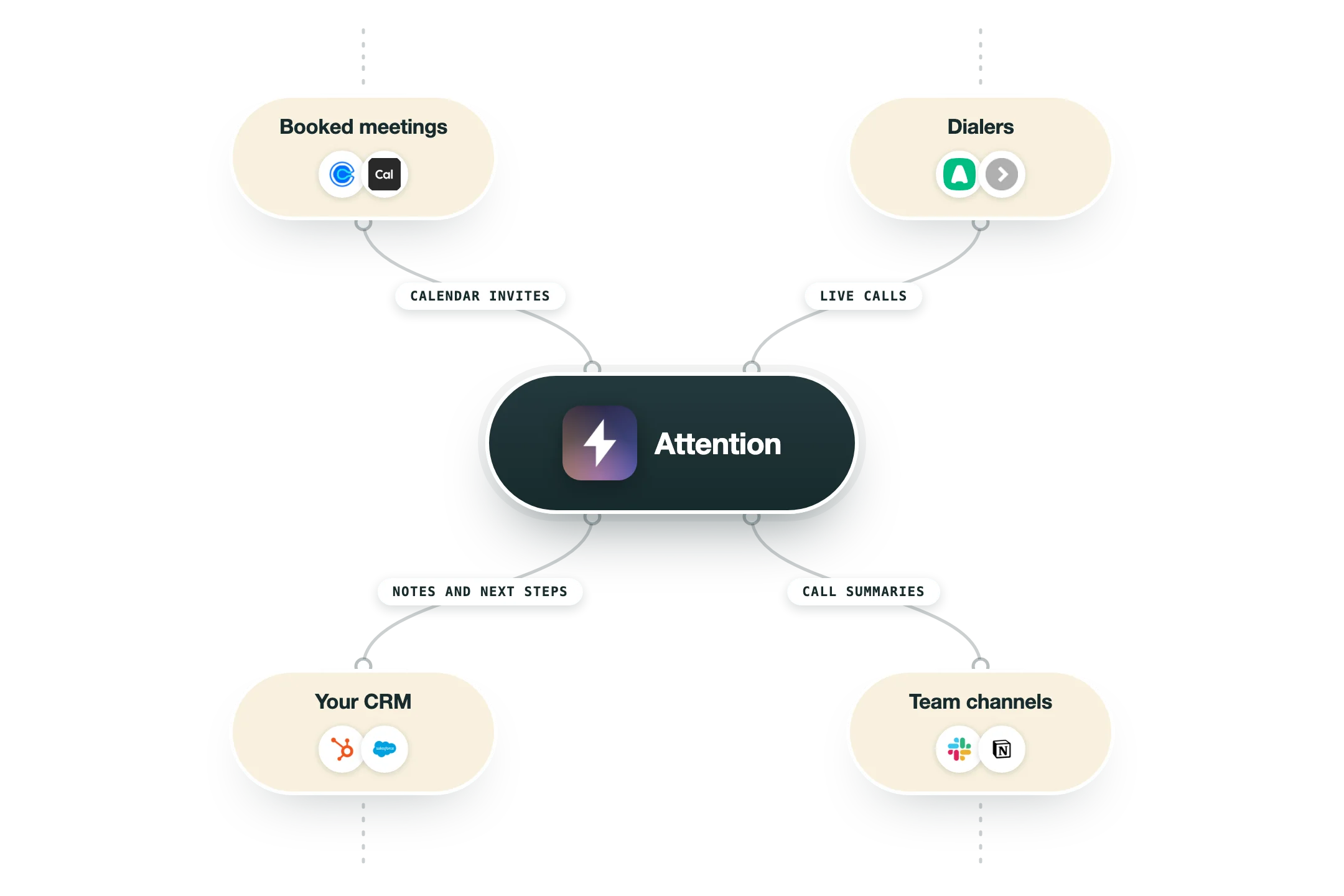
Attention markets a directory of 200+ integrations, and most of those pages turn out to be programmatic SEO with no setup detail behind them. The connections that carry real weight are the CRM, the meeting platforms, the places alerts land, and the Clay and Claude routes out of the platform.
Salesforce and HubSpot | The reason to buy the product. Attention maps call content onto the fields and objects you nominate, including custom ones, and lets you choose whether a note appends or overwrites, with different rules by deal stage. Lovable, a named customer, is targeting 70 to 80% of fields filled before a human opens the record. |
Zoom, Google Meet and Microsoft Teams | You connect a Google, Outlook or Zoom calendar and Attention reads upcoming events, then sends its notetaker into the ones that qualify. The bot name and profile image are yours to set. Auto-dialers are supported for outbound calling alongside the video platforms. |
Slack, Notion and Google Sheets | Where the output lands once a call ends. Scorecard results, coaching flags and custom alerts can be routed to a Slack channel, and Ask Attention Anything reads integrated knowledge bases in Notion and Google Docs when answering a question about a deal. |
Gmail and Outlook | Email is captured as a touchpoint alongside the calls, which is what lets the follow-up agent write in the customer's own language from the call and keeps the deal timeline complete rather than call-only. |
Clay | Attention pushes call recordings, transcripts, deal metadata and coaching scorecards into Clay, so post-call context can feed enrichment and outbound tables. Clay is also a named Attention customer. Setup is described only as authorising access and picking the data to sync, so scope it in a trial before you plan a workflow on it. |
Claude connector and Super Agent | Attention publishes an official connector in Anthropic's directory, so you can query transcripts across the team, pull objections and trends, review scorecards and create shareable snippets from a Claude chat. Super Agent does the same job inside Attention, querying calls and CRM together and executing updates. |
Zapier | Named on the revenue-teams page as the general-purpose escape hatch for anything without a native connector. Useful for pushing scorecard or transcript events into a tool Attention does not cover, and worth confirming which triggers and actions exist before you design around it. |
What is missing | We could not find public API documentation or an n8n node, so programmatic access outside Clay, Zapier and the Claude connector is unclear and worth asking about directly. The 200+ directory pages for tools like Bannerbear, Discord and Airtable read as templated marketing with a single line about swapping API keys, and we would not treat any of them as a working integration without a demo. |
Pro’s
The CRM autofill is the point of the product, mapping call content onto the Salesforce or HubSpot fields you pick and letting you append or overwrite, which is the part cheap notetakers hand back to the rep.
Scorecards run against MEDDIC, BANT, SPICED or criteria you write yourself, so a manager can compare reps on one rubric instead of spot-checking calls by ear.
The agent directory covers deal risk, competitor mentions, follow-up drafting and forecast calls, so the post-call work gets handled as named jobs rather than one flat summary.
An official Attention connector sits in Claude's directory, so a RevOps lead can query objections and deal health from a chat window without opening the platform.
Security is documented on the site rather than promised on a call, with SOC 2 Type II, HIPAA, single sign-on, annual penetration testing and a written recording-consent policy by country.
Cons
Pricing is demo-gated with no published tiers and no free plan, so you cannot size the spend or test the product before a sales conversation.
A notetaker joins the meeting from your calendar, so a team that wants recording without a visible bot in the participant list will prefer a botless recorder such as AskElephant.
The review base is thin for a category this crowded, with a G2 count in the dozens against Gong's thousands and no reviews at all on Capterra, so independent evidence is limited.
The 200+ integration directory is mostly programmatic pages, and the ones we opened for tools like Bannerbear offer nothing past a line about API keys, so the dependable list is Salesforce, HubSpot, Zoom, Meet, Teams, Slack, Zapier and Clay.
Every published result comes from vendor case studies, including the 40% win-rate lift at Unify and the forecast error cut from 15% to 5% at Certificial, so none of the headline numbers have been checked by a third party.
Pricing
Attention platform
Quote-based sold per seat on an annual contract, a demo is required to get a number
Recording, transcription and AI summaries
CRM auto-update for Salesforce and HubSpot
Coaching scorecards and cross-call analysis
Follow-up email drafting and agent directory
Enterprise
Quote-based adds security and service commitments, Attention claims implementation in about a week
Single sign-on and restricted data access
SOC 2 Type II and HIPAA controls
Custom agent builds and personalised CRM setup
Dedicated account manager and onboarding
Third-party estimates
Unverified review aggregators quote roughly $59 to $399 per user per month, none of it confirmed by Attention
Treat the range as a starting point only
No self-serve signup or free plan found
Ask for seat price and platform fee separately
Ask what the agent and transcription usage caps are
How it fits your stack
Alternatives


At a glance
Records and transcribes in 100+ languages
Fills Salesforce and HubSpot fields automatically
Scorecards for MEDDIC, BANT and SPICED
AI follow-up emails after the call
Deal risk and competitor mention agents
Super Agent chat across calls and CRM
Official connector in Claude's directory
SOC 2 Type II, HIPAA and SSO
Read some of our client stories





GTM Workflows
Learn how to use GTM tools in workflows
Guides and tutorials to get the most from your workflows











Ready to get started?




By clicking Sign Up you're confirming that you agree with our Terms and Conditions.








