

B2B revenue attribution and GTM analytics for enterprise marketing ops, built on a BigQuery warehouse you can audit, with account scoring, buyer journeys and marketing mix modelling on top.
What is
CaliberMind
The CFO asks which half of the marketing budget worked, and the answer arrives as three spreadsheets that disagree with each other. CaliberMind was built to settle that meeting, pulling your CRM, marketing automation, ad platforms and site activity into one governed warehouse and reporting on accounts and buying groups rather than isolated lead records. The platform sits on a Google BigQuery warehouse and loads raw data first, then runs the transformations downstream under rules you can read, so dedupe decisions and stage definitions stay auditable. There are more than 170 connectors, and the Salesforce side handles custom objects, formula fields, API quota control and writeback into CRM fields. On top of that sit multi-touch attribution with Markov chain models, account scoring, buyer journey alerts for sales, and marketing mix modelling for the spend no click ever records. Agent Cal, launched in January 2026 on Google Gemini, answers questions by writing SQL against the modelled data and showing the query it ran. CaliberMind fits one shape of company, the enterprise running twelve or more GTM systems with a marketing ops owner who will live inside the data model. Nebor does not run it, and a team below that line will get further with CRM campaign reporting and a cheaper attribution tool.
Integrations and the modern GTM stack
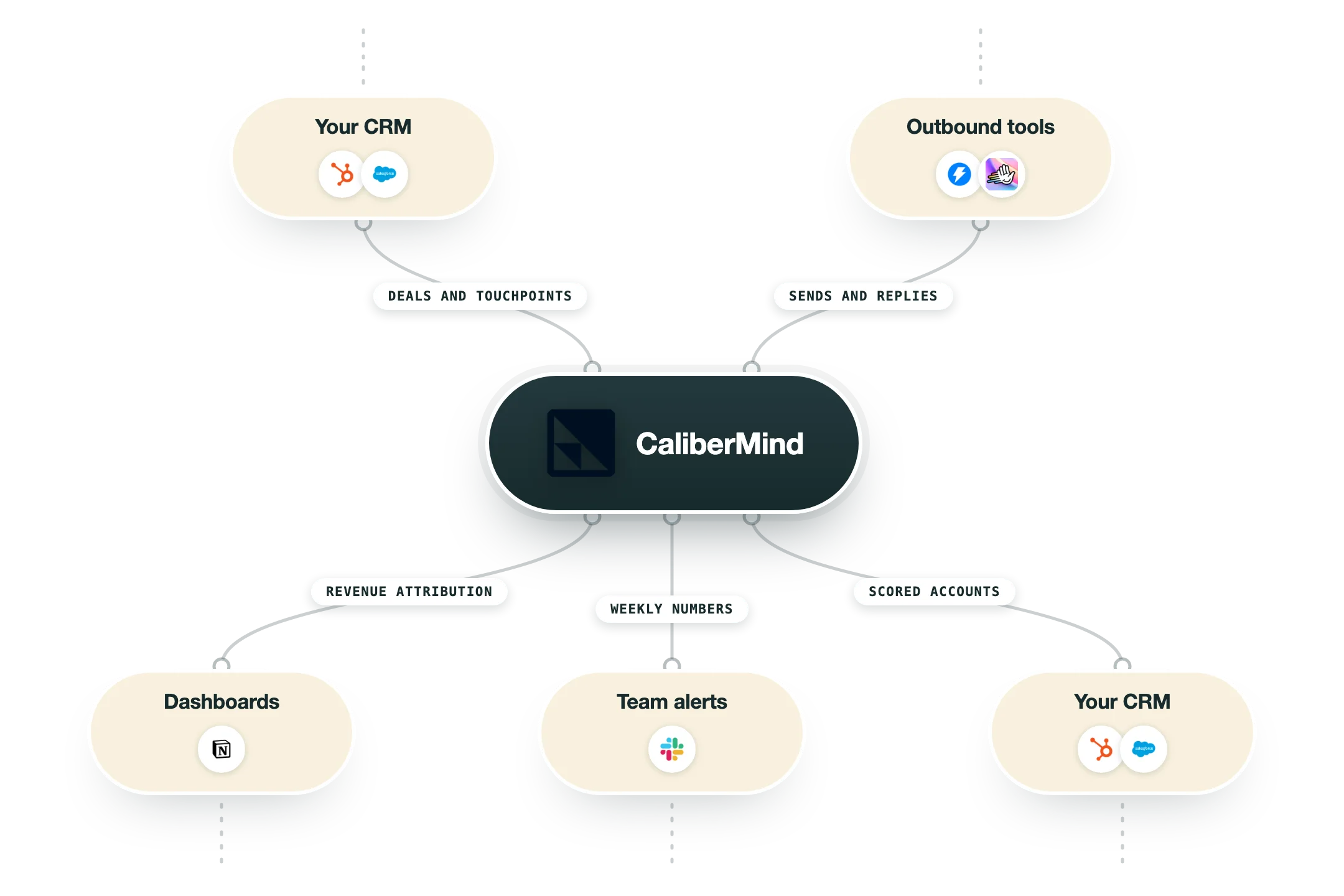
CaliberMind is an ELT pipeline with reporting on top, so the integrations are the product rather than a convenience layer. Connections are set up under Settings and Connectors, data lands raw in BigQuery, and the modelling happens after the load, which is why the depth of each connector matters more here than the count.
Salesforce | The deepest connection on the list. It reads custom objects and formula fields, gives you control over pull and push behaviour, sync frequency and API quota use, and writes scores and attribution results back into CRM fields through CaliberMind flows so a rep sees the output without opening a dashboard. |
Marketo, Pardot, Eloqua and HubSpot | The marketing automation side feeds program membership, email activity and form fills into the journey model. HubSpot and Microsoft Dynamics and SugarCRM also appear as CRM sources, so a split stack with one CRM and a separate MAP is the normal setup rather than an exception. |
Ad platforms | Google Ads, LinkedIn, Facebook and Instagram, Microsoft Advertising, TikTok, Snapchat, AdRoll, Criteo and Taboola pull spend and campaign data in for cost per pipeline reporting and for the marketing mix model. This is the layer that makes the budget argument possible in the first place. |
AnalyticsJS web tracking | A first-party script that detects form submissions on Marketo, HubSpot, custom gated assets, demo requests and chatbots. Identity runs on first-party cookies with server-side processing, or on fingerprint Sync IDs built from non-PII browser attributes, and journeys are stitched back to a contact retroactively once someone identifies themselves. |
Warehouses and BI | Snowflake, Redshift, S3, Postgres, MySQL, SQL Server, MongoDB and Azure appear as sources, and Tableau, Power BI and Looker sit on the reporting end. The platform's own store is BigQuery, and buyers report a warehouse connector billed separately at around $500 a month. |
6sense and Demandbase | Third-party intent is layered onto the journey rather than replaced. CaliberMind runs its own IP-to-company resolution and then blends in hybrid intent signals, so teams that already pay for an ABM platform keep it and use CaliberMind as the measurement layer above it. |
Post-sale and product data | Zendesk, Intercom, Freshdesk and Kustomer bring support activity in, and Heap, Amplitude, Snowplow, AppsFlyer, Segment and Google Analytics bring product and web behaviour. Very few attribution tools model the customer after the deal closes, and this is the part of the connector list that earns the enterprise framing. |
What is missing | The public connector page lists Outreach on the sales engagement side and no Salesloft or Gong, and we found no Zapier, n8n or Clay app for CaliberMind. There is also no self-serve entry point, so every route in starts with a demo and a scoping call about your data volume. |
Pro’s
Raw data lands in BigQuery before any transformation runs, so an analyst can open the tables and check why an account got the credit rather than arguing with a chart nobody can audit.
Pricing runs on data volume with unlimited users and sessions, so putting the whole sales floor on the same numbers as the board deck costs you nothing extra in seats.
The Salesforce work goes deeper than most attribution vendors, covering custom objects, formula fields, API quota control and writeback, and that matters when ten years of CRM customisation holds your funnel logic.
Marketing mix modelling sits beside the touch level attribution, so events, brand and the spend that no click ever records get a number instead of dropping out of the report.
Agent Cal answers in plain language by writing SQL against the modelled data and showing the query, so a figure in a board deck can be traced back to the logic that produced it.
The connector list reaches past the usual CRM and ad platforms into Zendesk, Intercom, Heap, Amplitude, Segment and a row of warehouses, so post-sale and product data can land in the same model.
Cons
No price appears anywhere on the site. Vendr's marketplace puts the median contract at $49,750 a year across a $6,000 to $53,340 range, and PriceLevel shows one buyer signing at $57,000 after a 25% discount off a $76,000 list.
Reviewers describe attribution thorough enough to surface connections to leads their own team would never qualify, so the output needs pruning and stage definitions need arguing about before anyone puts it in front of a CFO.
Customisation and filtering come up repeatedly on G2 as the weak spot, and deeper analysis pushes a non-technical marketer back to SQL or to CaliberMind's services team.
The vendor is roughly 32 people on about $21.9M raised, which is a thin bench to carry an enterprise data platform, 170 connectors and a new AI agent at the same time.
CaliberMind resolves IP to company itself but positions the script to layer on 6sense or Demandbase, and it publishes no match rate, so the anonymous share of your traffic stays unknown until you run it.
Pricing
Platform
Custom pricing Quote only, priced on data volume rather than seats, unlimited users and sessions, 14-day trial reported by buyers
Multi-touch attribution and account based funnel tracking
Buyer journey insights and sales signals
Agent Cal agentic analytics with SQL receipts
Unified BigQuery warehouse with full ETL and data unification
170 plus connectors including Salesforce custom objects and writeback
Data and AI credit plans with online support
Implementation and services
About $10,000 one-time Setup fee reported by buyers and often waived or bundled into the subscription, managed services and warehouse connectors priced separately
Onboarding with a CaliberMind representative, quoted at two weeks or less
ELT configuration, funnel definitions and rules engine setup
Managed services tiers, with one buyer paying $12,000 for six months of Bronze
Data warehouse connector reported at $500 a month
Guided configuration for marketing mix modelling
Explorer Package
How it fits your stack
Alternatives




At a glance
Runs on a Google BigQuery warehouse
More than 170 data connectors
Multi-touch and Markov chain attribution
Marketing mix modelling for offline spend
Agent Cal writes the SQL and shows it
Account scoring and buyer journey alerts
Unlimited users on every plan
SOC 2 certified and GDPR compliant
Read some of our client stories





GTM Workflows
Learn how to use GTM tools in workflows
Guides and tutorials to get the most from your workflows








Ready to get started?




By clicking Sign Up you're confirming that you agree with our Terms and Conditions.








