

B2B revenue attribution that stitches ads, site visits, CRM records and sales activity into account level journeys, then tells you which touches created pipeline.
What is
Dreamdata
A B2B deal touches your ads, your site, a webinar, three reps and a G2 review page over eight months, and nobody can say afterwards which of those created it. Dreamdata was built for that argument, collecting every touch across your GTM tools and rebuilding each account's journey from the first anonymous visit through to closed won. Underneath is a compact data model where contacts are email addresses and companies are records in your primary CRM. Everything else is a timestamped event, split between activities a person performed and exposures like an ad impression served at them. Stages are your funnel KPIs, and each one carries the journey of events that came before it. A first-party script does the collecting, with reverse IP resolution that Dreamdata says names up to 80% of anonymous companies and a cookieless fallback when a visitor declines consent. Six attribution models then work over each journey, from first touch to W-shaped to a data-driven one. The cleaned tables land in your own BigQuery or Snowflake. Attribution earns its budget once you have paid, content, outbound and events at the same time and the arguments about credit start costing you real spend. We have not used Dreamdata for a client, and below that point the free plan plus your CRM's own campaign reporting answers the same questions for nothing.
Integrations and the modern GTM stack
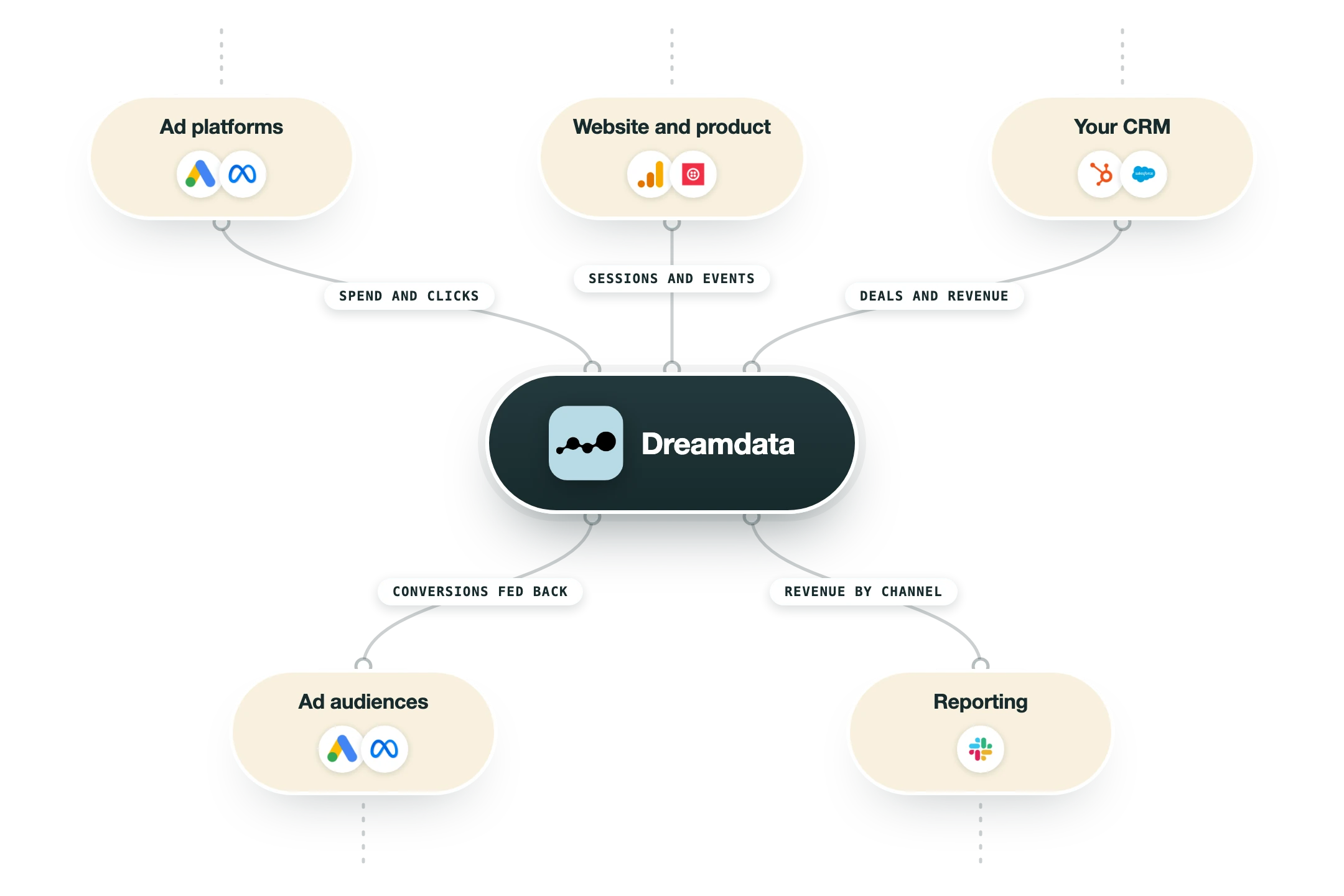
Dreamdata only works if it can read every system a buyer touched, so the integration list is unusually wide and the setup is mostly a matter of connecting sources and letting the model do its work. Your primary CRM is the anchor, since companies and stages are defined from it.
HubSpot, Salesforce, Pipedrive and Microsoft Dynamics | One of these is your primary CRM, and it defines what counts as a company and what counts as a stage. Dreamdata only creates a company record when it cannot find a match in a connected source, which keeps the model tied to the account list your reps already work. |
Marketo, Pardot, Oracle Eloqua and Salesforce Marketing Cloud | Marketing automation activity lands in the same event stream as site sessions and ad exposures, so a nurture email lands on the account timeline next to the pricing page visit it triggered. |
LinkedIn Ads, Google Ads, Meta, Microsoft Ads and Reddit | Spend, clicks and impressions come in as exposures rather than activities. Dreamdata is an official LinkedIn Marketing Partner, and the loop closes back the other way through the LinkedIn Conversions API, Google Enhanced Conversions for Leads and audience syncs to Matched Audiences and Customer Match. |
G2, Capterra and TrustRadius | Review site intent arrives as second-party data on the account journey, so a buyer comparing you on a category page shows up beside their own site behaviour. This is the touch most teams find out about far too late. |
6sense, Clearbit, Dealfront, Albacross, Demandbase, Snitcher and ZoomInfo | Third-party intent plugs into the same analytics script rather than needing its own tag, which Dreamdata calls hybrid intent. Useful if you already buy intent, and pointless if you were hoping Dreamdata would replace that spend. |
BigQuery and Snowflake | The models are built on BigQuery by default and can be exposed in your own project, or moved to Snowflake through a cloud bucket. You get the same tables that power the app, which is the strongest reason a data team would pick this over a closed reporting product. |
Hightouch and Census | Reverse ETL sends the modelled output back out, so intent signals reach the CRM, Dreamdata-identified accounts get created as records, and audiences reach ad platforms that have no native sync. |
Slack, Microsoft Teams and the Chrome extension | Engaged accounts trigger a notification with the engagement score and a link into the journey timeline. The extension shows the same scoring while a rep is on a CRM record, a company site or a LinkedIn company page. |
Tracking and developer surfaces | The client-side analytics.js, a Segment-compatible batch endpoint at api.dreamdata.cloud for server-side events, Node and Go SDKs, Segment, Google Tag Manager and Zapier. There is also a documented MCP server for agent access, which is rare in this category. |
What is missing | Sales engagement is thin. Outreach, Salesloft, Apollo, Chili Piper and Sales Navigator all arrive through your CRM into the Event Builder instead of connecting directly, and we found no integration with Instantly, Smartlead, Lemlist or Clay. If your outbound is built on cold email infrastructure, those touches only reach the journey if your CRM is logging them properly. |
Pro’s
The journey is account based from the ground up, so a deal with nine contacts reads as one timeline instead of nine disconnected lead records.
The cleaned tables live in your own BigQuery or Snowflake, so your analysts can audit the numbers rather than trusting a dashboard they cannot open.
Six attribution models ship out of the box, so you can see what first touch and W-shaped each claim before anyone argues about next quarter's budget.
The free plan carries company identification, engagement scoring, the audience builder and unified ad spend reporting on five seats, which is more product than most vendors hand over before a sales call.
Cookieless and server side tracking keep account level data flowing when a visitor declines consent or uses an ad blocker, and that gap widens every year in Europe.
Audience Hub, the LinkedIn Conversions API and Google Enhanced Conversions push modelled pipeline back into the ad platforms, so the measurement feeds the spending decision.
Cons
There is no published price above free. Vendr's marketplace data puts the median Dreamdata contract at $35,440 a year, with a spread from $27,000 up to $96,000.
Reviewers on G2 and Capterra consistently describe one to two months before the setup is trustworthy, and they still call the reporting clunky and thin on custom views at that price.
The output is only as honest as your CRM hygiene, so messy stage definitions, duplicate accounts and missing UTMs come back to you as confident numbers that are wrong.
Attribution stays a model rather than a measurement, and six models applied to the same journey will hand you six different answers about which channel deserves the credit.
It needs a named owner in marketing ops who understands the data model, and without one it drifts into an expensive dashboard that nobody opens after month three.
Pricing
Free
$0/month No credit card, five seats, two months of user history, three stage models, two notifications and one sync
B2B web analytics with cookie and cookieless tracking
Company identification and engagement scoring
Audience builder
Slack and Teams notifications
Ad spend report and B2B benchmarks
Self-serve onboarding, Slack community and AI chat
Activation & Attribution
Custom pricing Quote only, sold on monthly tracked users and data volume, guided free trial available
AI Signals, audience activation and account notifications
AI and custom attribution models with revenue and content analytics
Custom ROI and ROAS reporting with AI report summaries
Event Builder, custom UTM mapping, data model scheduler and custom sources
Multiple business units and SSO or SAML login
Full onboarding, dedicated CSM and technical manager, data science support
How it fits your stack
Alternatives




At a glance
Account based journey model
First-party and cookieless site tracking
Reverse IP naming up to 80% of visitors
Six attribution models including data-driven
AI Signals scoring and Slack alerts
Audience Hub syncs to LinkedIn and Google
BigQuery and Snowflake data access
Free plan with five seats
Read some of our client stories





GTM Workflows
Learn how to use GTM tools in workflows
Guides and tutorials to get the most from your workflows





Ready to get started?




By clicking Sign Up you're confirming that you agree with our Terms and Conditions.








