

A bulk email verification tool that flags invalid, risky, disposable, and role based addresses, with bulk lists, a real time API, and credits that never expire.
What is
DeBounce
DeBounce cleans a contact list before you ever send to it. Its job is to flag invalid, risky, disposable, and role based addresses so campaigns land in valid inboxes and the bounce rate stays low enough to protect the sending domain. It covers bulk list validation, a real time verification API, a sign up form widget, list monitoring, and integrations, and every plan unlocks the full feature set rather than gating the API or monitoring behind higher tiers. Pricing is pay as you go with credits that never expire, or a monthly and yearly subscription. That hygiene layer comes just before sending. Clean data here protects sender reputation and deliverability, the quiet foundation every outbound system depends on as it scales across many domains and mailboxes. DeBounce is one of our verify alternates. When a client already owns it, we slot it into our Clay enrichment waterfalls as the verification step, otherwise BounceBan is our default with DeBounce or ZeroBounce close behind. We also keep it on hand as a one off list cleaner. The non expiring credits make that cheap. We can buy a block, leave it untouched, and call DeBounce only when a list actually needs scrubbing. It is the dependable utility that saves a domain from a bad bounce spike, though catch all heavy lists go to BounceBan instead.
Integrations and the modern GTM stack
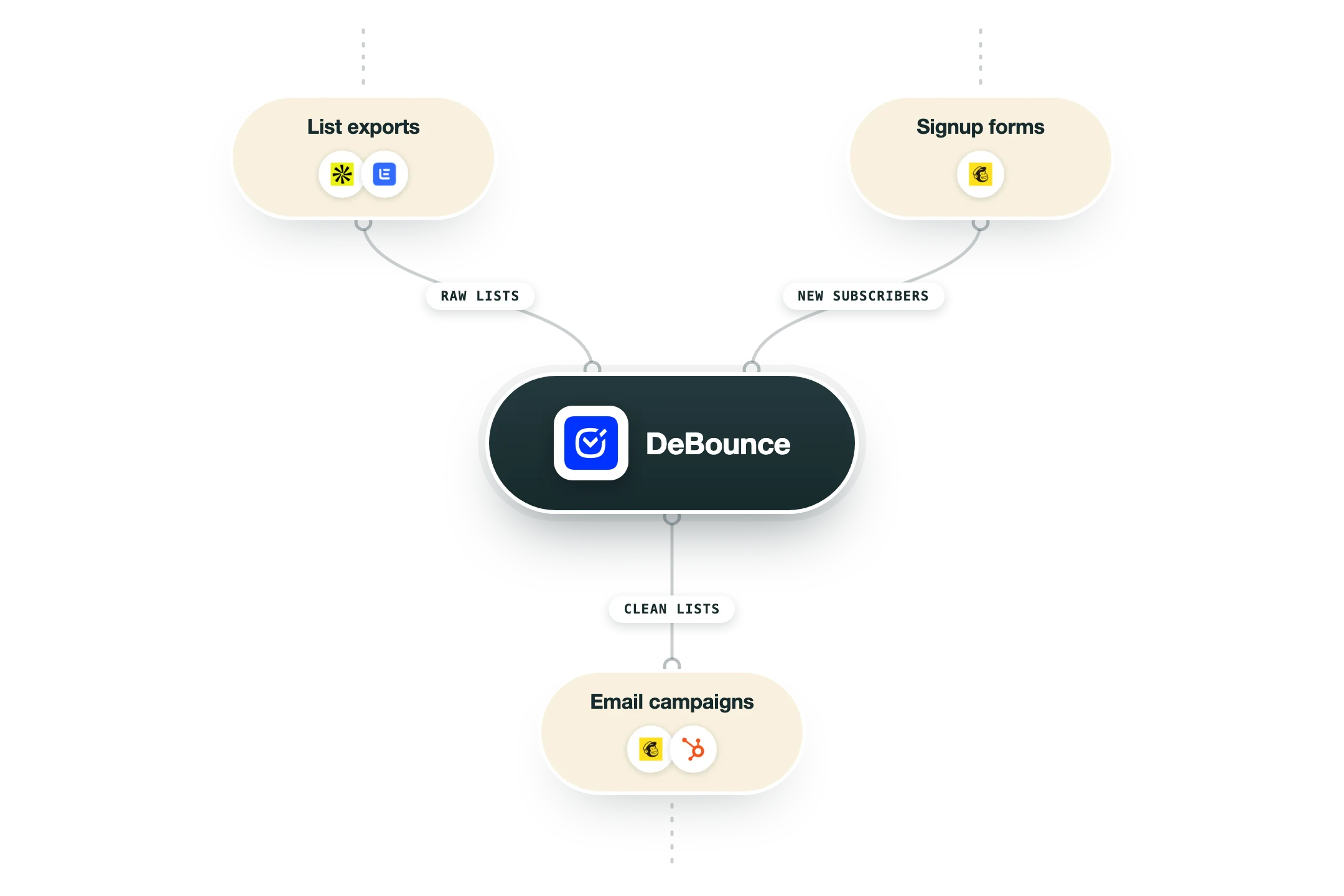
DeBounce cleans email lists across the whole email ecosystem, leaning toward the marketing side:
Apollo and lemlist | The two connections that matter for outbound: clean your Apollo exports and lemlist lists before anything sends. |
HubSpot and Mailchimp | Native list cleaning for CRM contacts and newsletter audiences. |
Google Sheets | Validate addresses directly in a spreadsheet. |
Signup forms | A WordPress plugin and a small website widget stop bad emails at the door, before they ever reach your list. |
Zapier | The bridge to everything else, including Salesforce, which is not a native connection. |
API | Simple programmatic validation, one address at a time or in bulk. |
Pro’s
Every plan unlocks the full feature set, so you are not gated out of the API or monitoring on cheaper tiers.
Pay as you go credits never expire, which keeps it cheap to hold for occasional list cleaning.
Per email cost drops sharply at higher volume, rewarding larger list cleans.
Bulk, API, and widget modes cover one off cleans and always on signup protection alike.
Cons
Catch all handling is weaker than tools that specialize in those addresses, so some get marked unknown.
It verifies emails but does not find or enrich them, so it needs a data source upstream.
The interface is functional rather than polished compared to larger deliverability suites.
It lacks the broader deliverability toolkit that some competitors bundle around verification.
Pricing
Free
Free 100 free credits
Test the verifier before buying
Full feature access
No card required
Pay-As-You-Go
From $10 5,000 verifications
Credits never expire
Cheaper per email at higher volume
Around $90 for 100,000
Monthly
From $15/mo 5,000 verifications
Fixed monthly verification quota
Full feature set included
Scales with list size
Yearly
From $150/yr 50,000 verifications
Discounted annual rate
Full feature set included
Best for steady ongoing volume
How it fits your stack
Alternatives


At a glance
Bulk list validation
Real time verification API
Disposable and role address detection
Sign up form widget
List monitoring
Full features on every plan
Credits never expire
Free test credits to start
Read some of our client stories





GTM Workflows
Learn how to use GTM tools in workflows
Guides and tutorials to get the most from your workflows





Ready to get started?




By clicking Sign Up you're confirming that you agree with our Terms and Conditions.