

A single platform that takes an inbound form fill through enrichment, qualification, routing and booking, with every step logged and reversible in one click.
What is
Default
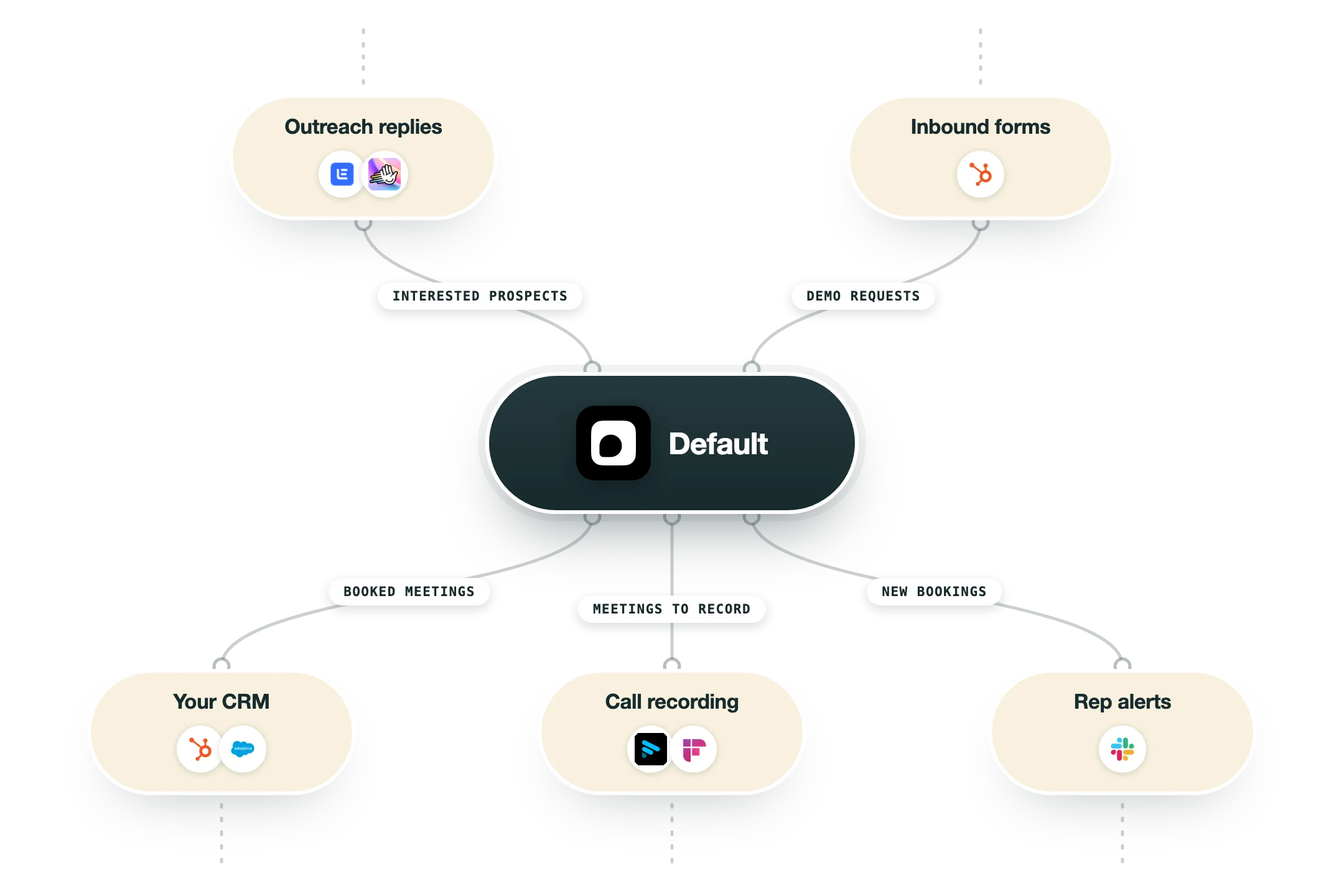
Default keeps $1.5M set aside to pay off whatever is left on your LeanData, Chili Piper, HubSpot, ZoomInfo or Clay contracts if you move over, which tells you how it wants to be bought. The product captures an inbound lead on a form, enriches it, qualifies it, routes it and books the meeting. Underneath sits a data layer that syncs CRM, marketing automation, product, call recording, ad platforms and enrichment vendors into one identity-resolved record, with waterfall enrichment applied field by field. On top of that, Tables, Workflows, Routing and Scheduling do the work, and an agent called Dot builds and edits those workflows from plain-language requests. Routing reads work schedules, out-of-office blocks, calendar availability and meeting buffers before it assigns anyone, and every decision, rule change and reassignment lands in an audit log you can roll back in one click. Bookings happen on embedded forms or round-robin links, and Salesforce, HubSpot and Attio update both directions. Consolidating beats stitching once inbound volume is high enough that leads die in the seams between a form tool, an automation layer and a scheduler. Below that line, the platform fee mostly buys neatness. We have not run Default at Nebor, and its buyout list treats Clay as legacy, which is ground we would not trade.
Integrations and the modern GTM stack
Default sells itself as the layer everything else plugs into, so its integration list is unusually long for a company this size. Read it with the labels attached, because a good share of the names carry a coming soon or webhook tag rather than a native two-way sync.
Salesforce, HubSpot and Attio | The three native CRM connections, each able to create, match and update any record in both directions. This is the piece the whole product rests on, since routing decisions and booked meetings are only useful if the CRM reflects them without a second automation step. |
Enrichment waterfall | Clearbit, People Data Labs, Demandbase, Harmonic, Icypeas, Wiza, Vector and Abstract are native and run per field rather than per record, so a missing phone number can come from one vendor and a headcount from another. ZoomInfo, Cognism, Captain Data and Swarm are listed as coming soon. |
Clay | Connected by webhook for two-way table-driven enrichment rather than a native app. Worth noting that Clay also appears on Default's contract buyout page as a legacy platform it will pay you to leave, so the integration and the sales pitch point in opposite directions. |
Calendars and meeting tools | Google Calendar, Outlook Calendar, Google Meet and Zoom are all native. Availability, out-of-office blocks and buffers sync in real time, which is what lets routing skip a rep who cannot take the call instead of booking them and hoping. |
Slack | Native, and it does more than notify. Approvals for agent-proposed changes and triggers for agent actions both run from a channel, so the human review step in Dot's workflow happens where the team already is. Microsoft Teams is still on the coming soon list. |
Sales engagement | Apollo, Outreach and Salesloft are native, pushing enriched and routed contacts into sequences and reading replies and cadence membership back as signal. Amplemarket is marked coming soon. Gong and Chorus are also pending, which leaves call data outside the unified record for now. |
Warehouse and product data | Segment, Hightouch, Census, Databricks, Amplitude, Mixpanel and PostHog all connect by webhook, so product events and modeled audiences can trigger workflows. Native Snowflake and BigQuery sync is announced but not shipped, so warehouse teams are wiring this themselves today. |
Webhooks, Zapier and MCP | Webhooks are native in both directions and Zapier opens the usual 6,000 app long tail. MCP access to the data layer and every tool is listed as coming soon, which is the connection that would let Claude or ChatGPT act on Default's data from outside the platform. |
Pro’s
A form fill is enriched, qualified, routed and booked inside one system, so the handoffs that break a forms plus Zapier plus scheduler chain never have to happen.
Routing reads work schedules, out-of-office blocks, calendar availability and meeting buffers before it assigns, so leads stop landing with reps who cannot take the call.
Every routing decision, rule change and reassignment is logged with attribution and rolls back in one click, and that audit trail is the part homemade automation chains almost never build.
Waterfall enrichment runs per field against Clearbit, People Data Labs, Demandbase, Wiza and Icypeas, so the data arrives before the routing decision rather than after it.
The $1.5M buyout fund covers what is left on a LeanData, Chili Piper, HubSpot, ZoomInfo or Marketo contract, which removes the usual reason a team delays a switch by a year.
SOC 2 Type II, SSO and SAML, field-level permissions on what each agent reads and writes, and data residency controls are further along than most companies at this stage bother with.
Cons
Default publishes no pricing page anywhere on its site, so every number you find comes from third-party write-ups, and those disagree by $250 a month on the base fee alone.
The company was founded in 2021 with $20M raised and carries 63 G2 reviews, most of them from small businesses, which is a thin track record for software you are asking to own form capture, routing and booking.
One vendor holding the whole inbound path means an outage, a price change or an acquisition hits capture, routing and scheduling at the same moment, and the exit is that same migration project run backwards.
Large parts of the integration list are still marked coming soon, including ZoomInfo, Cognism, Gong, Snowflake, BigQuery, Microsoft Teams and MCP access, so the unified data pitch is partly a roadmap today.
Reviewers who praise the routing still flag the platform as unintuitive, with poor user experience, product limitations and integration issues appearing across G2 feedback, so setup needs an owner who knows RevOps.
Pricing
Startup
$750/month Third-party figure, billed annually, no vendor pricing page
One workflow
Basic enrichment and around 10,000 credits
CRM integrations
Email support
Growth
Custom Quoted through a demo
Up to 10 workflows
Premium enrichment and around 20,000 credits
Website intent data
Slack alerts and approvals
Enterprise
Custom Quoted through a demo
Unlimited workflows and credits
Custom integrations and migration services
Data residency and field-level agent permissions
Dedicated support
Seats
$45 per user per month Reported by third parties, an older write-up lists a $500 platform fee with $20 scheduling seats and free admin seats
Priced per user on top of the platform fee
Editor and admin seats reported as free
Credit pools consumed by enrichment
Annual billing on the published tiers
RIP contract buyout
$1.5M fund Default covers the remaining balance on a qualifying legacy contract
Applies to LeanData, Marketo, Chili Piper, HubSpot, ZoomInfo and Clay contracts
Buyout sized against the fund during a demo
Migration pitched at under 10 days with forward-deployed engineers
How it fits your stack
Alternatives



At a glance
Forms, routing and scheduling in one platform
Real-time data layer across CRM and marketing tools
Per-field waterfall enrichment from your providers
Round robin, queue and owner-based routing
Dot agent builds workflows from plain language
Full audit log with one-click rollback
Native Salesforce, HubSpot and Attio sync
SOC 2 Type II, SSO and SAML
Read some of our client stories





GTM Workflows
Learn how to use GTM tools in workflows
Guides and tutorials to get the most from your workflows











Ready to get started?




By clicking Sign Up you're confirming that you agree with our Terms and Conditions.








