

Open-source scheduling and booking pages with round-robin, routing forms, an open API, and webhooks, so a meeting booking can trigger the rest of your GTM stack.

What is
Cal.com
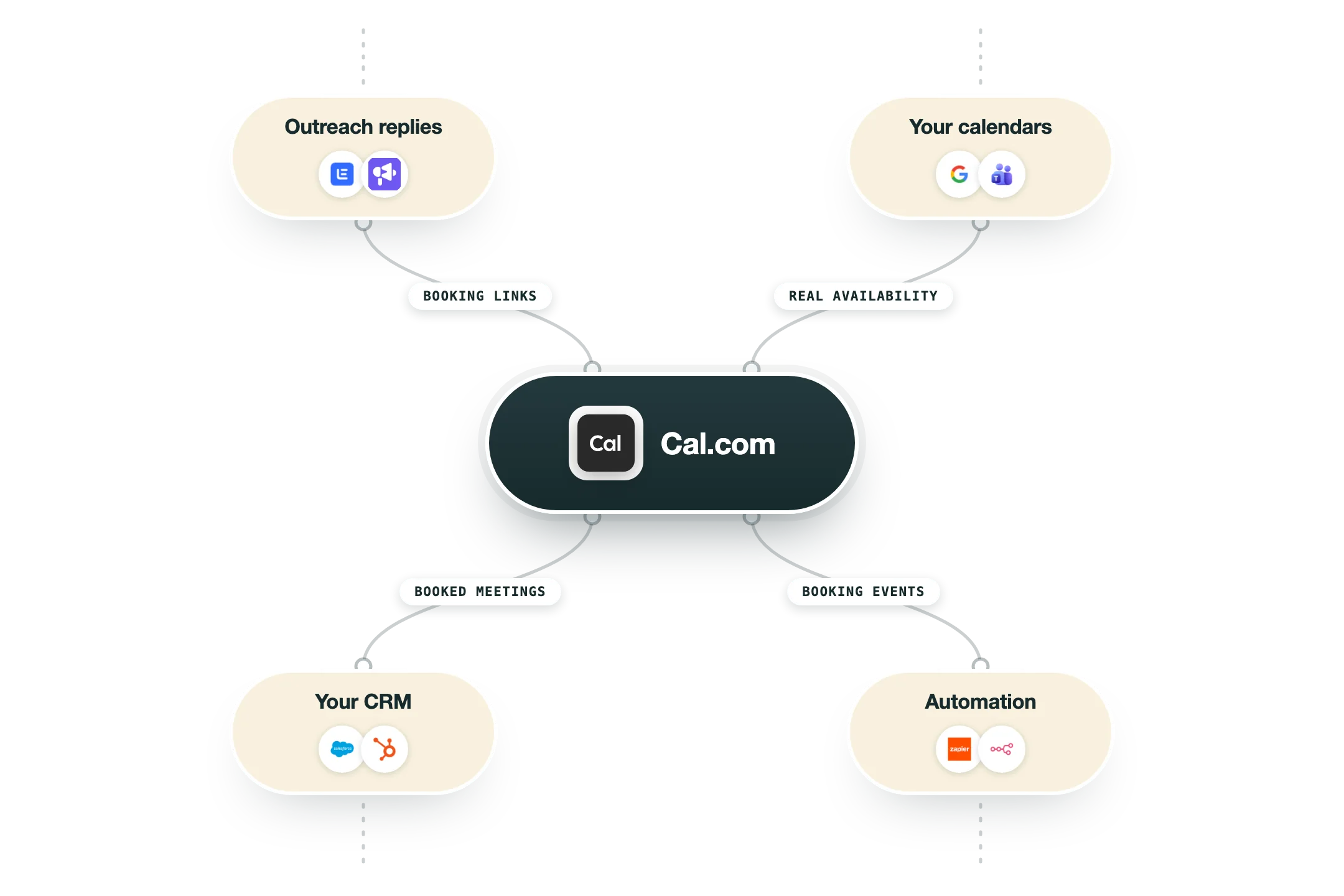
Cal.com is open-source scheduling software, an open-source alternative to Calendly, and its core job is booking meetings. It hands out shareable booking pages, manages availability across all of your connected calendars, and lets a prospect pick an open slot without any of the usual back and forth over email. Underneath the simple booking page is a real system. You get round-robin and collective team scheduling, routing forms that send a lead to the right rep based on their answers, and workflows for reminders. The part that matters most to us is the open REST API, HMAC-signed webhooks, and the option to self-host the whole thing. In a GTM stack it lands at the inbound entry point. A booking is the first real intent signal a prospect gives you, and because Cal.com sends a webhook the moment it happens, that signal becomes the trigger for everything downstream instead of getting stuck in a silo. We reach for Cal.com on the inbound and post-meeting workflows we build. When a prospect books through the Cal.com link, Cal pushes a webhook carrying the booking data, that data lands in Clay, and n8n routes it onward. The open API, webhooks, and self-hosting are exactly why we pick it over a closed scheduler.
Integrations and the modern GTM stack
Cal.com is open-source scheduling infrastructure, and it behaves exactly the way infrastructure should:
Calendars and conferencing | Google and Outlook calendars at the core, with Zoom, Meet and some twenty other conferencing tools attaching links automatically. |
Salesforce and HubSpot | Genuinely native two-way sync, unusual for a scheduler: bookings create records and route to the rep who owns the account. |
Stripe and PayPal | Take payment before a booking confirms, for paid consultations. |
Zapier | The official automation bridge for everything else. |
MCP server | An official hosted server lets AI assistants book and manage scheduling conversationally. |
API, webhooks and self-hosting | A full platform API, event notifications, and since the whole thing is open source, you can host it on your own servers if you ever need to. |
Pro’s
Open API and webhooks make it easy to wire a booking into the rest of your stack instead of leaving the data stranded.
Self-hosting the open-source version is free, so you can skip per-seat fees and keep the booking data in your own infrastructure.
The free tier gives individuals unlimited event types and calendars, which closed schedulers usually cap.
Round-robin, collective events, and routing forms handle real team scheduling, not just a single personal link.
A booking sends a webhook the moment it happens, giving you a clean trigger for downstream automation.
Cons
Self-hosting takes real setup work, and changing your IP or domain after install can be painful.
The integration marketplace is smaller than the closed incumbents, so some connectors you expect are not there.
Support reviews are mixed, with reports of template replies and multi-day response waits.
Cloud pricing is per seat, so the bill scales up as the team grows.
Wiring bookings into a full workflow still needs an automation layer like Clay or n8n around it.
Pricing
Free
$0 Free forever for one user; self-hosting the open-source version is also free
Unlimited event types and calendars
Email and SMS notifications
100+ app integrations and API access
Stripe and PayPal payments
Teams
$12 per user per month Billed yearly; 14-day free trial
Round-robin, managed, and collective event types
Routing forms and booking analytics
Recurring events and branding removal
Organizations
$28 per user per month Billed yearly; 14-day free trial
Unlimited sub-teams and company subdomain
SAML SSO, SCIM, and role-based permissions
SOC 2, HIPAA, and ISO 27001 compliance
Enterprise
Custom Annual, scoped through sales
Dedicated onboarding and engineering support
SLA and uptime guarantees
HRIS integrations and a dedicated database
Platform
Custom For developers embedding scheduling; priced through sales
Cal Atoms React components for embedded booking
Full API access to bookings and availability
White-label scheduling inside your own app
How it fits your stack
Alternatives



At a glance
Booking pages and availability
Round-robin and team scheduling
Routing forms to the right rep
Open REST API v1 and v2
HMAC-signed webhooks on booking
Self-host the open-source version
Workflows and reminders
100+ app integrations
Read some of our client stories




GTM Workflows
Learn how to use GTM tools in workflows
Guides and tutorials to get the most from your workflows





Ready to get started?




By clicking Sign Up you're confirming that you agree with our Terms and Conditions.