

An open-source link platform that shortens URLs on your own domain, tracks every click in real time, follows that click through to a signup or a paid deal, and runs an affiliate program on the same data.
What is
Dub
Dub turns a long URL into a short one on your own domain and keeps a record of every click on it. Everything else sits on top of that record, including real-time analytics, conversion tracking that follows a click through to a signup or a paid deal, and a full affiliate program layer. The tracking runs on a dub_id parameter that the Dub script stores as a first-party cookie on your site, after which your backend posts lead and sale events through the REST API or one of the SDKs for TypeScript, Python, Go, Ruby and PHP. Stripe, Shopify, HubSpot and Cal.com send those events for you. For outbound the useful part is one link per prospect. You mint links from the API at 100 per bulk call, drop the short link into the sequence, and a link.clicked webhook fires the moment someone opens it, so a rep hears about interest before any reply arrives. The HubSpot integration carries that click through to the deal. We would run Dub on tracked links in LinkedIn outreach, nurture and paid, and we would keep it away from cold email. We have not put a client on it, and our hesitation is that corporate mail scanners click every link in a message, while Dub only documents filtering for crawlers such as Googlebot and Twitterbot.
Integrations and the modern GTM stack
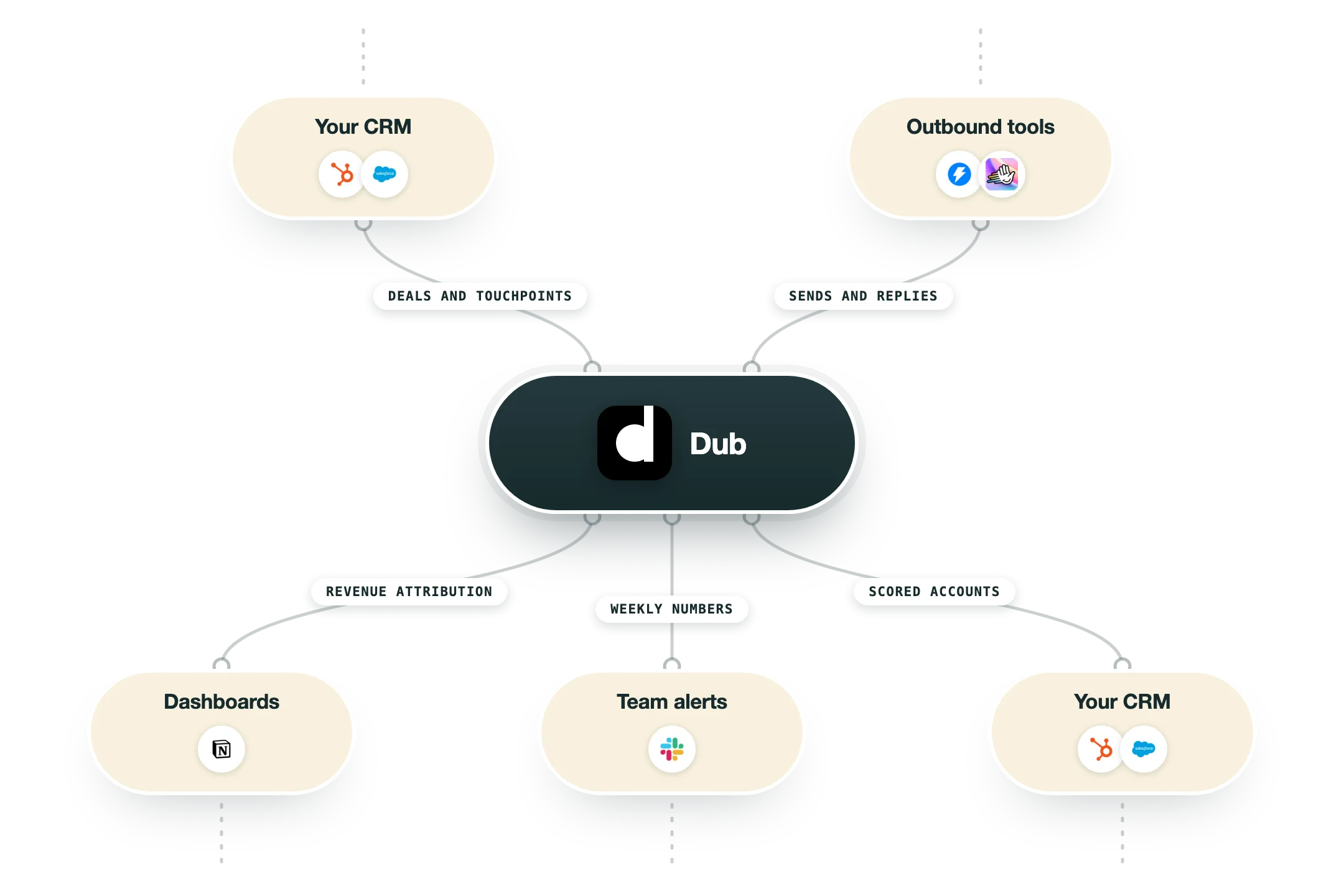
Dub's integrations split into two jobs. One set puts links where you already work, and the other set closes the loop by telling Dub that a click turned into a lead, a meeting or money. The second set is the reason to be here, and most of it needs the Business plan.
HubSpot | The closest thing to a GTM loop that Dub offers. Contacts sync with Dub lead events, HubSpot forms and the meeting scheduler fire leads, and a deal moving to Closed Won registers as a sale, with a custom deal stage ID if your pipeline names things differently. |
Cal.com | Booked meetings come back as conversions on the link that produced them. For an outbound team this is the cleanest measurement in the whole product, because a meeting is the outcome you are chasing and it lands against a named link rather than a channel. |
Stripe and Shopify | Both send sale events without any backend code, so a click attaches to real revenue rather than a proxy. Polar is listed as coming soon. Everything outside these two needs your own server calling POST /track/sale through the API or an SDK. |
Slack | Notifications for new leads, new sales and partner commissions. Paired with the link.clicked webhook this is how a rep finds out that a named account opened a link, and it is the setup we would build first if we were testing Dub on a real pipeline. |
Segment and Google Tag Manager | Segment exchanges events in both directions with your Dub workspace, and GTM fires conversion events from the browser. These are the routes to use when the tracking has to sit alongside an existing analytics setup rather than replace it. |
Zapier and Make | Official apps for both, reaching 7,000 and 2,000 destinations. They are the practical bridge to anything Dub does not support natively, though every hop adds latency to a click signal that is only useful while it is fresh. |
API, SDKs and MCP | REST API at api.dub.co with bearer auth, native SDKs for TypeScript, Python, Go, Ruby and PHP, an official MCP server, and webhooks for link.created, link.updated, link.deleted, link.clicked, lead.created, sale.created, commission.created and two partner events. Bulk link creation takes 100 per call and fires no webhooks. |
Everything else | WordPress, Raycast, Intercom, Publer and signup-tracking guides for Better Auth, Supabase, Appwrite and Clerk. Useful, though none of them touch outbound. |
What is missing | No Salesforce integration, no Clay action and no official n8n node, so from Clay you call the API through an HTTP enrichment and from n8n you build the request yourself with a community template. There is also no retargeting pixel on the link, so clickers cannot be turned into a paid audience. |
Pro’s
Minting one tracked link per prospect is a two-line API call and the bulk endpoint accepts 100 at a time, so wiring a personal link into every row of a Clay table stays cheap to build and cheap to run.
The link.clicked webhook fires in real time, so a rep can be told in Slack that a named account opened the proposal link while that interest is still worth acting on.
The HubSpot integration follows the chain from click to form fill to booked meeting to closed won deal, and no other shortener we looked at attempts that whole path.
The core is AGPLv3 on GitHub with about 24,000 stars and a published self-hosting guide, so a team with a strict data policy can run the redirect layer on its own infrastructure.
Known crawlers such as Googlebot and Twitterbot are excluded and repeat clicks inside an hour collapse into one, so the counts are closer to reality than a raw redirect log would be.
The free plan carries 25 new links a month, three custom domains and API access, which is enough to build the whole loop and see the data before anyone signs a contract.
Cons
Conversion tracking, webhooks and customer insights all start on the $90 Business plan, so the feature that makes Dub more than a shortener costs three times the Pro price.
Corporate email security scanners open every link in a message on delivery and Dub publishes no filtering for them, so click counts on cold email read hotter than the real level of interest.
The partner and affiliate side now owns the front page and the roadmap, and a GTM team that wants link attribution alone still pays for payout machinery it will never switch on.
There is no retargeting pixel on the link and no native Salesforce connection, so a paid team or a Salesforce shop hits the edge of the product quickly.
G2 shows 4.8 across roughly 23 reviews, and that is a thin evidence base for support and reliability next to shorteners that have carried enterprise traffic for a decade.
Pricing
Free
$0/month Free forever, one user
25 new links a month and 1K tracked events
3 custom domains and a free .link domain
30-day analytics retention
API access and 60 requests a minute
Custom QR codes, UTM templates and link tags
Pro
$30/month Monthly rate, 3 users, 14-day trial
1K new links a month and 50K tracked events
10 custom domains and 1-year retention
Deep links, cloaking, geo and device targeting
Link folders and 600 API requests a minute
No conversion tracking and no webhooks
Business
$90/month Monthly rate, 10 users, the first tier with conversion tracking
10K new links a month and 250K tracked events
100 custom domains and 3-year retention
Conversion tracking, customer insights and A/B testing
Event webhooks and 1,200 API requests a minute
Dub Partners with $2.5K of monthly payouts at 5% fees
Advanced
$300/month Monthly rate, 20 users
50K new links a month and 1M tracked events
250 custom domains and 5-year retention
3,000 API requests a minute
Embedded referral dashboard and email campaigns
Unlimited partners and $15K of monthly payouts
Enterprise
Custom Custom annual billing, demo required
Unlimited links, events, domains and users
Unlimited payouts at 3% fees
SAML and SSO plus audit logs
Partner Network access and volume discounts
Dedicated Slack support with an SLA
How it fits your stack
Alternatives


At a glance
Branded short links on your own domains
Real-time click analytics with geo, device and referrer
Conversion tracking from click to lead to sale
REST API, five native SDKs and an MCP server
link.clicked and lead.created webhooks
Native Stripe, Shopify, HubSpot and Cal.com
Affiliate program with global partner payouts
AGPLv3 core on GitHub with a self-hosting guide
Read some of our client stories





GTM Workflows
Learn how to use GTM tools in workflows
Guides and tutorials to get the most from your workflows











Ready to get started?




By clicking Sign Up you're confirming that you agree with our Terms and Conditions.








