

An account scoring tool that models your best customers, ranks your market against more than 2,000 pre-wired signals, and syncs a tight target list into Salesforce or HubSpot.
What is
Keyplay
Buy a standard database and you get every company in your category, which leaves a rep working forty thousand accounts when maybe nine hundred could ever sign. Keyplay was built to cut that number down before anyone starts prospecting, scoring companies against a model made from your best customers and handing back a ranked target list. The scoring runs on two tracks you control. A signal score counts how many of your chosen attributes an account matches and weights them the way you set, while a similarity score rates how closely a company resembles the customers you fed in. Five modes decide how those two combine into the overall fit score. Signals arrive in four groups covering profile, relevance, stack and org, so headcount growth, hiring for a named role, a free trial on the website or a tool spotted inside job posts all become scoring inputs. AI agents take a research question typed in plain language and write the answer back as a field on every account. Keyplay fits a team with a small clean TAM and a focused ABM motion, where five thousand well-ranked accounts beat fifty thousand raw ones. Clay reaches a similar ranked list for a team that likes building, with the logic sitting in a table anyone can open and no pending migration into a marketing automation suite.
Integrations and the modern GTM stack
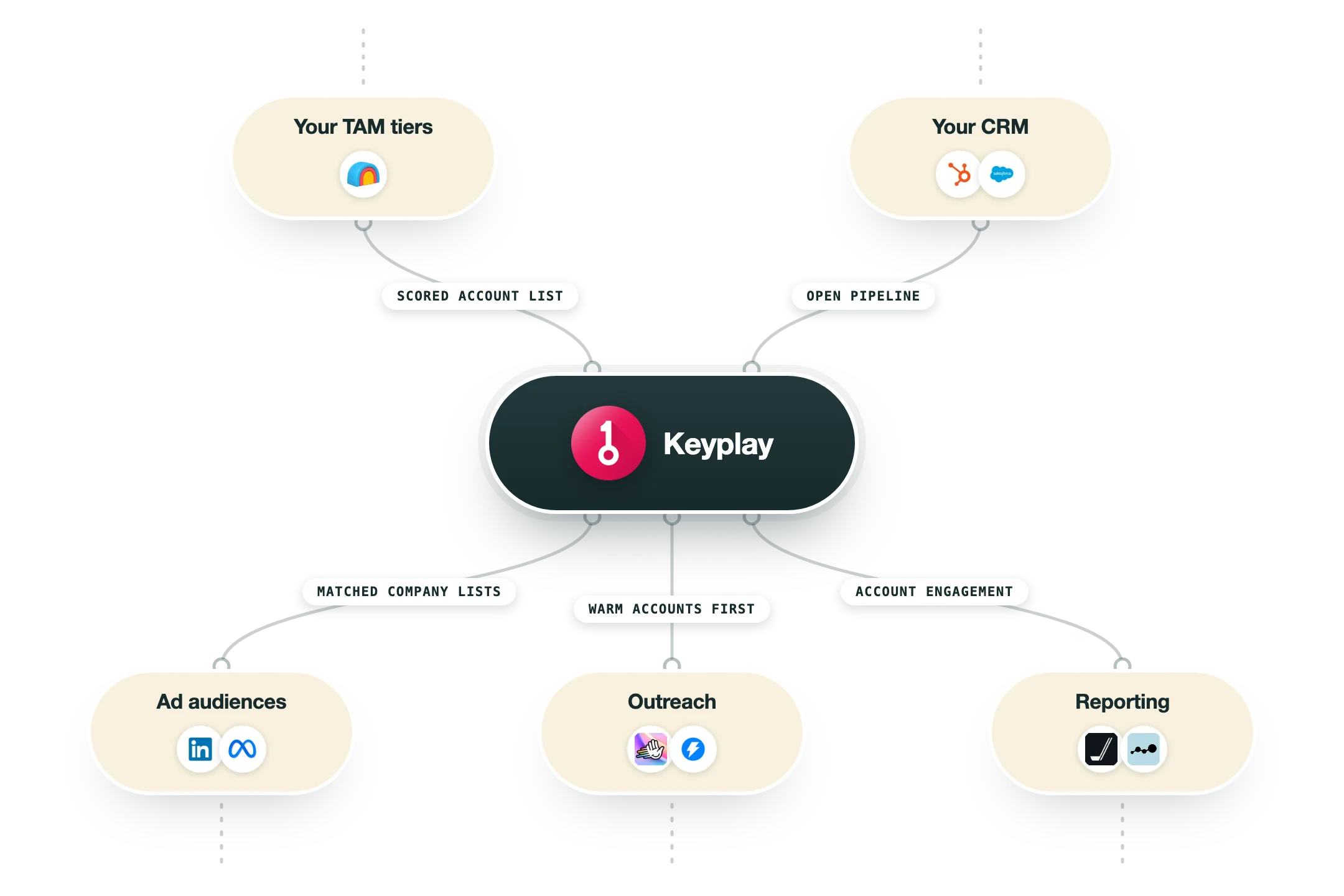
Keyplay is built to score accounts and then push the result somewhere a rep already works, so the integration list is short and pointed at CRM. The two APIs pull in opposite directions, one sending enriched data out and one taking your behavioural data in, which is worth understanding before you plan around them.
Salesforce | Runs one-way to create and enrich net new accounts, or two-way to pull in every Salesforce account and score it. Keyplay creates its own managed fields on the Account object for scores and signals, and values refresh weekly once the integration is switched on. It touches the Account object only. |
HubSpot | The same one-way and two-way choice against HubSpot company records, with a dedicated Keyplay enrichment property group created automatically. The weekly run updates enrichment fields, syncs newly saved accounts from Discover and scores companies created in HubSpot since the last pass. |
Custom field mapping | Beyond the managed fields, you can map any Keyplay field to an existing CRM field as long as the data types match. Selective sync, where only a defined subset of CRM accounts is scored, exists but has to be arranged through a customer success manager rather than switched on yourself. |
Enrichment API | A call to api.keyplay.io/enrich with a domain, a CRM record id, your API key and a webhook URL returns a JSON payload of Keyplay data. It is the route for scoring on demand at the moment a record is created, instead of waiting for the weekly CRM sync. |
Intent API | This one runs inward. You POST behavioural events to api.keyplay.io/v1/intent_data with a pre-registered source id and a domain, and Keyplay attaches them to the matching account. Keep it under five requests a second. Keyplay scores the fit, so the buying signal has to come from your own systems. |
iPaaS | Both APIs are documented for use through Zapier, Make, Workato and Tray, which is how most teams wire the enrichment call into a record-created trigger. There is no listed native app in any of them, so you are building an HTTP step and handling the webhook response yourself. |
MCP server | Keyplay publishes an MCP server for Claude.ai, Claude Desktop and Claude Code, exposing search_accounts, get_account_data, filter_accounts and list_filter_options plus a set of guided prompts for customer analysis and list building. It is the most interesting connection on this list and rare in the category. |
Import and export | Accounts can be imported by CSV for scoring against your model, and enriched data exports back out as a file. This is the fallback for any destination without a native path, which currently means most sequencers and outbound tools. |
What is missing | No native Clay, n8n, Outreach, Salesloft or Slack connection that we could find, and no contact or people data at all, since the product stops at the account. If you want scored accounts turned into contacts and sequences, that hand-off is a build on your side. |
Pro’s
The fit score splits into a signal score and a similarity score across five combination modes, so a rep who disputes a ranking can be shown the exact attributes that produced it.
The signal library reaches past firmographics into hiring for a named role, headcount growth, a free trial on the site and tools detected inside job posts, which is where a usable ICP definition usually lives.
AI agents turn a question typed in plain language into a scoring field on every account, so a judgment call like whether a company sells into regulated buyers becomes something you can filter and weight.
Scores and signals land as managed fields on the Salesforce account object and HubSpot company records and refresh weekly, so routing and territory rules read Keyplay without anyone passing a spreadsheet around.
A published MCP server exposes account search, filtering and enrichment to Claude, so an analyst can interrogate the target list without learning the filter syntax inside the app.
The free test drive previews 25 scored accounts with 30 enrichment fields, which is enough to check whether the model ranks your own closed-won customers highly before any contract conversation.
Cons
Inflection acquired Keyplay in March 2026 and every keyplay.io route now serves the same one-line merger notice, with the vendor promising current customers no immediate change and a path onto Inflection over time.
No price survives on the vendor's site and the third-party figures still circulating contradict each other across a $9,000 to $29,000 a year spread, so nobody can budget for this without a sales call.
A high fit score says a company resembles your best customers rather than that anyone inside it is shopping, and the intent API is an inbound pipe for behavioural data you already own, so sourcing real buying signal stays your job.
CRM enrichment runs on a weekly schedule and a changed scoring model needs a manual data refresh from the account menu, which makes this a planning layer rather than something that reacts inside a day.
AI agent usage bills as credits multiplied by accounts multiplied by refreshes, and a four-credit researcher running monthly across 25,000 accounts turns into a serious line item before anyone notices.
Pricing
Test Drive
$0 Free preview, no card required
Preview up to 25 scored accounts
ICP scoring against your definition
Keyplay industry categories
Download 30 account enrichment fields
No AI agents or CRM integrations
Paid platform tiers
Quote only Priced on the size of your scored account universe
Continuously scored universe against your serviceable market
Custom signals and multiple ICP models
AI agents billed on credits
Two-way Salesforce and HubSpot sync
Enrichment API, intent API and MCP access
ICP Analysis
Quote only Analyst service layered on the platform
Keyplay analysts build the scoring model for you
Review of closed-won and closed-lost patterns
Segmentation and market sizing output
Handover into the app for ongoing use
How it fits your stack
Alternatives


At a glance
Signal score and similarity score combine into one fit score
More than 2,000 pre-wired account fit signals
Profile, relevance, stack and org signal groups
AI agents answer research questions in plain language
Discover tab surfaces up to 10k matching accounts
Two-way Salesforce and HubSpot sync, refreshed weekly
Enrichment API, intent API and an MCP server
Free test drive previews 25 scored accounts
Read some of our client stories





GTM Workflows
Learn how to use GTM tools in workflows
Guides and tutorials to get the most from your workflows











Ready to get started?




By clicking Sign Up you're confirming that you agree with our Terms and Conditions.








