

A B2B account-discovery platform built around lookalike search that turns your best customers into a ranked target list, then enriches it with company and contact data.
What is
Ocean.io
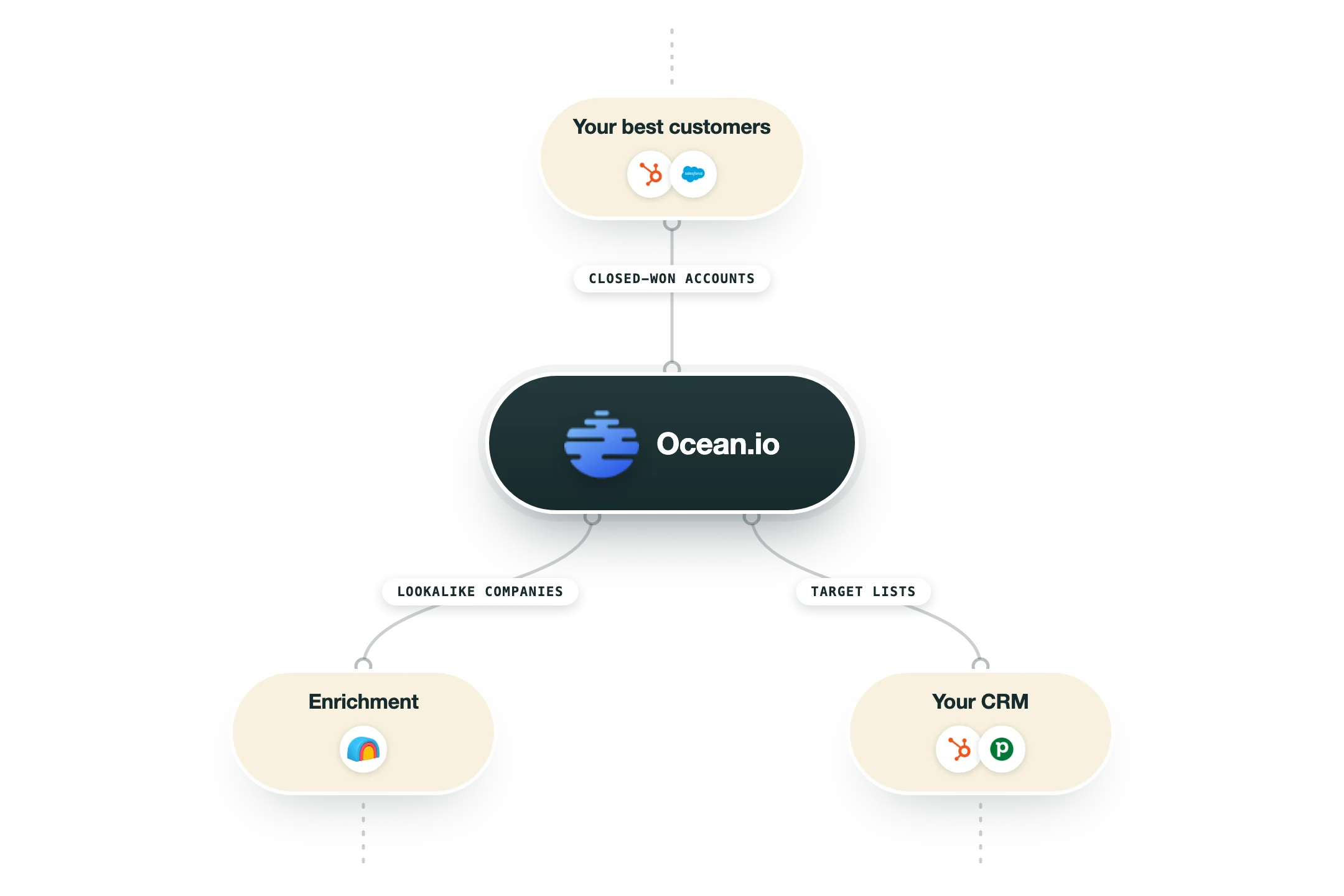
When a client needs to expand from a handful of winning accounts, lookalike search is the fastest honest way to do it, and Ocean.io is one of the tools we reach for. It is a B2B account-discovery platform built around that lookalike engine: feed it a sample of your best customers or a described profile and it returns ranked companies that closely resemble them. It pairs that engine with company and contact data, email and phone enrichment, and verified counts where you only pay for confirmed records. Filters let you tune the list by firmographics, region, and growth signals before a clean export. In a GTM stack Ocean.io lands at the top of the funnel as a TAM-mapping and account-discovery layer that feeds the CRM, enrichment, and outreach tools downstream. It answers the who-should-we-target question before any contact data or sequencing logic comes into play. At Nebor we feed a client's closed-won accounts into Ocean.io, often alongside Discolike, when the goal is to map a niche TAM or build out from a few proven wins. The lookalike output goes straight into a Clay table. There the companies get enriched, scored, and routed into the outbound system rather than left as a one-off export. That keeps the pipeline pointed at real fit instead of a guessed-at filter.
Integrations and the modern GTM stack
Ocean.io finds companies that look like your best customers, and its honest surface is Clay, three CRMs and an agent-ready API:
Clay | Its most-used home: lookalike company and people finding works natively inside Clay tables. |
HubSpot | A marketplace app imports your customer list to model on and sends target lists back. |
Salesforce and Pipedrive | Same pattern: pull existing customers in for lookalike modeling, push target lists out. |
MCP server | An official MCP server lets Claude and Cursor do searches and exports conversationally. |
API | Official endpoints for search, enrichment and lookalike scoring, available on contracted plans. |
Pro’s
The lookalike engine builds ICP-fit target lists fast from a few sample accounts.
Strong for niche or hard-to-define TAMs where keyword filters fall short.
Verified-only billing means you pay for confirmed emails and phones, not guesses.
Unlimited users on most plans keeps it affordable for whole teams.
Clean API and CRM sync slot it into an automated discovery workflow.
Cons
The tiered credit system gets expensive for high-volume contact and phone enrichment.
Contact-data depth trails dedicated databases like ZoomInfo and Cognism.
Plans require annual contracts with no monthly billing option.
Lookalike quality depends heavily on the sample accounts you feed it.
Pricing
Starter
$79/mo billed annually
Around 500 credits for companies and contacts
Lookalike search
Email verification
Professional
$299/mo billed annually
Around 2,000 credits
CRM integrations and API
Lookalike audiences
Enterprise
Custom annual contract, contact sales
Custom credit volume
Advanced support and onboarding
Higher data limits
How it fits your stack
Alternatives


At a glance
Lookalike company search
ICP and TAM mapping
Company and contact data
Email and phone enrichment
Verified-only credit billing
CRM integrations and API
Chrome extension
Unlimited users on most plans
Read some of our client stories


GTM Workflows
Learn how to use GTM tools in workflows
Guides and tutorials to get the most from your workflows






Ready to get started?




By clicking Sign Up you're confirming that you agree with our Terms and Conditions.