

Website visitor identification joined to in-app product usage, scored and pushed into Slack for product-led sales teams, and switched off for good on 30 September 2025 after Cursor acqui-hired the team.
What is
Koala
Koala watched who was on your website and what they did inside your product, then told your reps in Slack the moment those two lines crossed. It no longer runs, because Cursor acqui-hired the team in July 2025 and the platform went dark on 30 September that year. A pixel handled the website half and a Segment, RudderStack or warehouse feed handled the other half, so a trial account hitting a usage ceiling and a stranger reading your pricing page landed on the same record. An identity graph put names and companies against both. That product-usage half is what separated Koala from company-level visitor tools, and it is also why it only ever suited product-led companies. Its reported deanonymization ran above 75 percent on PLG sites against roughly 30 percent elsewhere, since signups and in-app events give an identity graph far more to work with. Do not plan around Koala, and treat any 2026 review quoting its pricing as stale, because the app has been offline since 2025. For the job it did, we would run RB2B or Leadinfo for the visitor half and pipe your own product events into Clay, since that is where our visitor work already runs.
Integrations and the modern GTM stack
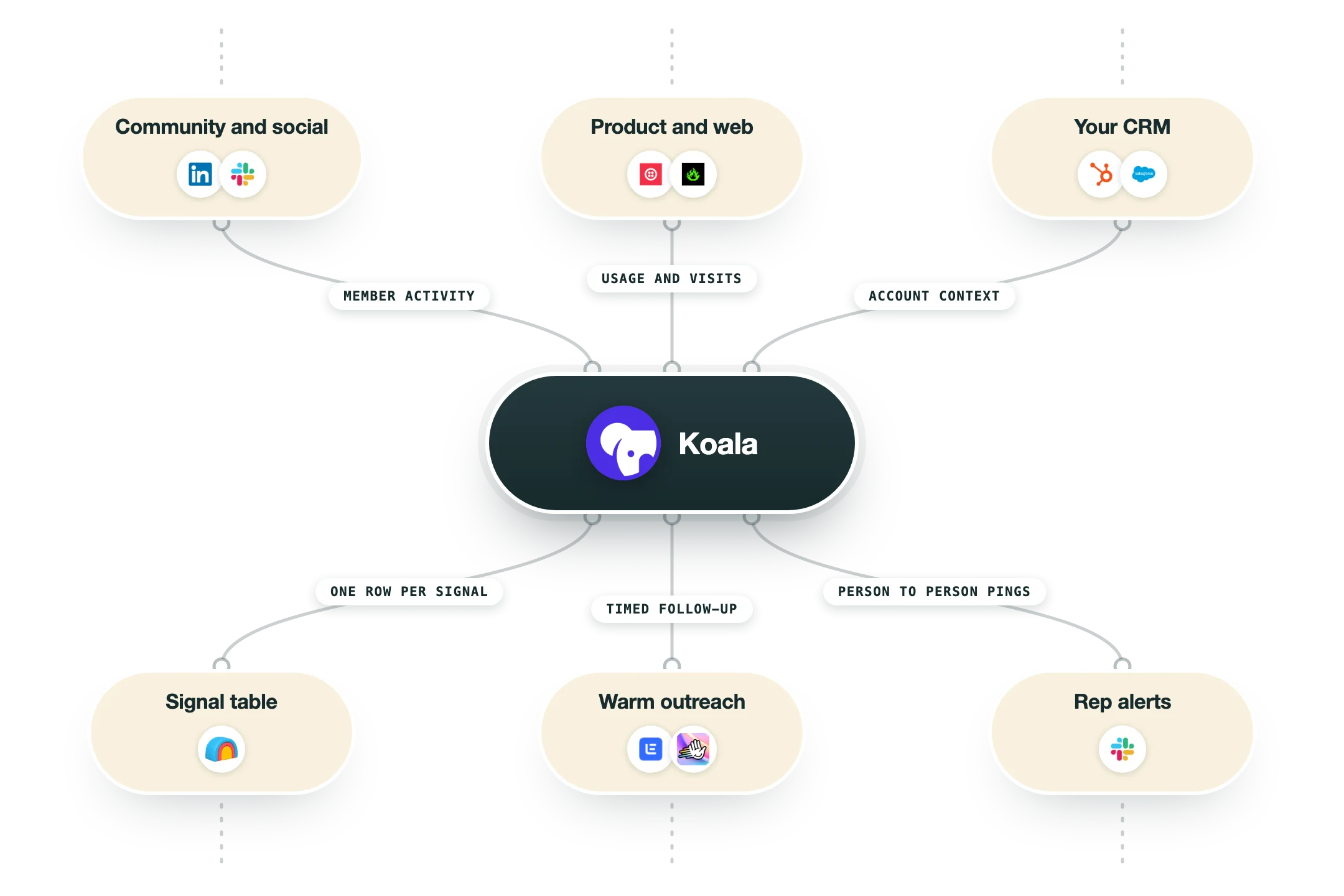
Every connection below stopped working on 30 September 2025, so read this as a specification rather than a setup guide. The shape of it is the useful part, because one pixel plus one product-data pipe plus one CRM is what any stand-in has to reproduce, and most tools in this category only cover the first and third.
Segment, RudderStack and the warehouse | The pipe that carried in-app events into Koala and the reason its match rate beat plain visitor tools. Snowflake and BigQuery connections handled teams without a CDP. Any replacement stack needs its own version of this, which usually means product events landing in Clay or a warehouse first. |
Salesforce | Read, import and write. Koala pulled accounts, owners and open opportunities in to score against them, then wrote signals and activity back. Writing actions into Salesforce was gated to the Business plan, so mid-tier customers got the reading half only. |
HubSpot | The same three modes as Salesforce, with the same Business-plan gate on automated writes. HubSpot Ventures was an investor in Koala's Series A, and Breeze Intelligence now covers a thin version of the visitor half for teams already inside that CRM. |
Slack | Where the product actually lived for most customers. Alerts fired on the specific intent signals you defined rather than on a score change, and you picked which signals reached which channel. The free plan allowed 250 alerts a month, which is what made it testable without a contract. |
Outreach and Salesloft | Signals mapped straight to sequences, with the email sent either from the account owner or from a named user in your sequencer. This was the Auto Outbound path for teams running seat-based sales engagement rather than cold email infrastructure. |
Webhooks and Auto Outbound | The escape hatch for anything without a native connector, capped at 1k webhooks and 100 automated outbound a month on the Growth plan. This is the piece a Clay and n8n stack already covers, and it is the cheapest half of Koala to rebuild. |
RB2B | Koala documented an RB2B integration to bring person-level US visitor identification alongside its own company-level graph. Worth knowing because RB2B is still running and still cheap, so the visitor half of a Koala replacement is the part that survived. |
What you now have to rebuild | Identity resolution across web and product, the scoring layer, and the alert routing. Visitor identification is easy to buy again from RB2B, Leadinfo or Snitcher. Joining product usage to it is the part nobody sells as a single product, so it lands in Clay, your warehouse or n8n. |
Pro’s
Joining in-app product usage to website visits on one account record is the thing most visitor tools still cannot do, and for a free-trial motion that pairing is the whole signal.
The reported deanonymization rate above 75 percent on product-led sites came from having signups and product events as identity anchors instead of IP data alone.
Setup was a pixel plus a Segment or warehouse connection, so a team could be live in an afternoon rather than running a data project first.
Slack alerts fired on intent signals you defined yourself, so a rep saw the specific action behind the ping instead of a score that moved for no visible reason.
The free plan carried company deanonymization, the identity graph and 250 alerts a month across two seats, which made it one of the few tools in this category you could prove out at zero cost.
Cons
The product has been offline since 30 September 2025, with no migration path, no export window and no successor, so customers lost their saved accounts, filters and scoring outright.
Everything Koala was known for sat on the Growth plan at $1,000 a month, including intent scoring, product activity, CRM sync and sequencer triggers, so the free tier was a demo of the shell rather than the engine.
The strong match rate depended on being product-led, and a site with no free product or trial fell back to roughly 30 percent company-level identification like everything else in the category.
Product signals needed Segment, a warehouse or engineering time before any of it worked, so the afternoon-setup story only held for teams that were already instrumented.
It was a signal layer with no sequencing or CRM of its own, and G2 reviewers who ran it without tight CRM integration described it as tactical rather than something their process depended on.
Pricing
Free
$0 2 seats and 100 credits a month, with 1 month of data retention
Company deanonymization and identity graph
People and company search plus CSV import
250 alerts a month and round-robin lead routing
Documentation-only support
Starter
$200/mo 2 seats and 1,000 credits a month, extra seats sold separately
Everything in Free
Email and company enrichment
Advanced waterfall enrichment
Email support
Growth
$1,000/mo 3 seats and 5,000 credits a month, 3 month data retention, marked most popular with a 14 day trial
Intent scoring, ICP scoring, custom signals and trending accounts
Website, product, community and CRM activity
AI company research and outreach drafting
1 CRM connection and sales engagement platform integrations
1k webhooks and 100 automated outbound a month
Business
Custom quote Custom seats, credits and retention
Everything in Growth
Territory-based routing and custom owner fields
Multiple CRM connections and advanced integrations
SSO and a dedicated CSM with a shared Slack channel
How it fits your stack
Alternatives


At a glance
Company level website deanonymization
Product usage signals via Segment and warehouses
AI intent scoring and trending accounts
Real-time Slack alerts on named signals
Salesforce and HubSpot read and write sync
Outreach and Salesloft sequence triggers
Auto Outbound with webhooks
Free plan with 2 seats and 100 credits
Read some of our client stories





GTM Workflows
Learn how to use GTM tools in workflows
Guides and tutorials to get the most from your workflows











Ready to get started?




By clicking Sign Up you're confirming that you agree with our Terms and Conditions.








