

Predictive fit and behavioural scoring for product-led teams, with a Data Studio that lets you open the model, read the splits and change the rules yourself.
What is
MadKudu
Four hundred people sign up in a week and most are students, competitors and browsers who will never pay, so whoever works that queue is guessing. MadKudu scores every lead and account twice, once on who they are and once on what they have been doing. The company was bought by HG Insights in August 2025 and the name is being retired. madkudu.com redirects to hginsights.com, the help centre is titled HG Insights Platform, and the scoring now ships as modules of a Revenue Growth Intelligence Platform sold beside Market Analyzer and a Sales Copilot. Customer Fit reads firmographics, demographics and technographics to say whether a company could ever buy, and Likelihood to Buy sums ninety days of product usage, site visits and campaign activity with a decay on each event, so an account that went quiet slides back down. The part that separates it from the rest of predictive scoring is that you can open the thing. Data Studio shows the decision tree the model split on, the computations feeding each split, the overrides you layered on top, and reps see up to ten plain signals explaining the segment. MadKudu is the one predictive scorer we would defend to a rep who distrusts scores, because the tree, the split conditions and the traits behind a segment are readable. We have not run it at Nebor, and at a median contract near $34,000 we would only reach for it where product usage decides the deal.
Integrations and the modern GTM stack
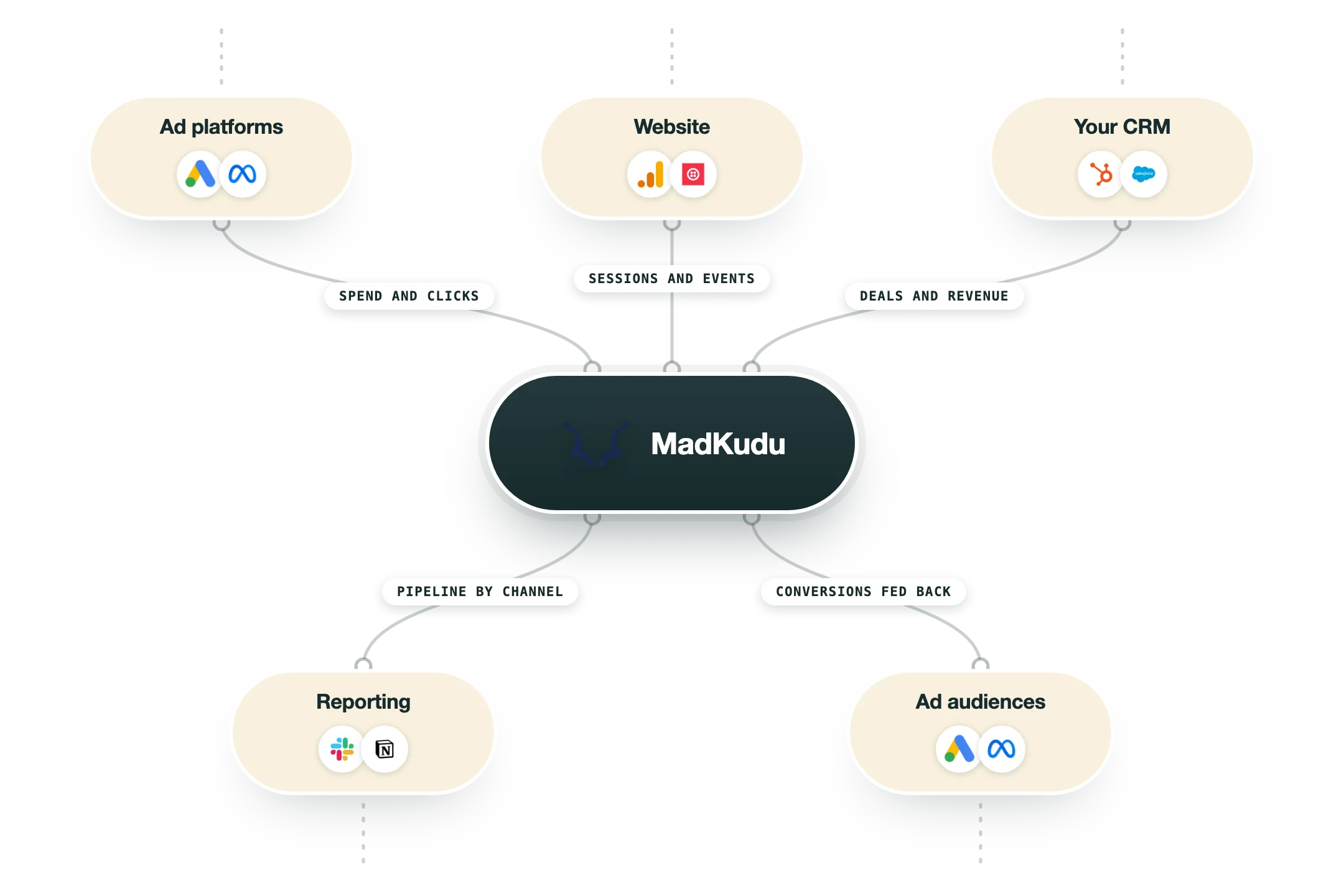
MadKudu is a scoring layer, so its integrations split cleanly into places it pulls signal from and places it writes scores back to. Salesforce gets the deepest treatment on both sides, and the product-usage sources are what make the behavioural model worth paying for.
Salesforce | Source and destination, and the only CRM the Sales Copilot supports. A managed package reads Leads, Contacts, Accounts, Opportunities, Tasks and Campaigns, writes scores and signals back to all three record types, and renders the Copilot panel inside the record page. |
HubSpot | Source and destination, with real limits. It pulls Contacts, Companies, Deals and form submissions and pushes scores to Contacts, but Companies cannot be scored and HubSpot's API refuses to hand over web activity, so only form fills and email clicks reach the behavioural model. |
Product and web analytics | Segment, Amplitude and Mixpanel feed in-app events and page views, which is the half that separates this from a firmographic scorer. Events are named and grouped by hand in an event mapping step, and each one gets an importance weight and a lifespan you can override. |
Data warehouses | Snowflake, BigQuery and Amazon S3 act as the catch-all source for anything with no native connector, covering support tickets, survey answers, third-party intent and custom enrichment. This is also the documented route for sending historical events in bulk. |
Marketo and Salesforce Campaigns | Both feed marketing engagement such as webinar attendance, content downloads and email activity into the behavioural score. Marketo also supports real-time Customer Fit scoring via a webhook. Pardot has no integration despite the Salesforce connection. |
Gong Engage, Outreach and Salesloft | The Copilot embeds as an iframe in all three, and reps can push a prospect straight into a sequence from the panel. A Chrome extension overlays the same intelligence on Salesforce, Outreach and Gong pages, with a separate LinkedIn Copilot for prospect profiles. |
Clay | A native MadKudu action scores an email address and returns the Customer Fit segment, score and signals. Clay credits use a default model, and pasting your own API key runs your trained model instead. There is also a documented path for calling the HG API directly from Clay. |
Zapier, Intercom and Slack | Zapier covers ad-hoc scoring of Salesforce accounts and target lists through the API. Intercom is a push destination so support and chat see the score. Slack takes qualified-lead alerts, and a separate Slack connection reads community activity as a signal. |
What is missing | No Pardot, no n8n app, no company-level scoring in HubSpot, and no connector for cold email infrastructure such as Instantly or Smartlead. The Fastlane widget that booked meetings for high-fit signups has no article left in the current documentation. |
Pro’s
You can open the live model in Data Studio and read the exact split conditions the tree used, which is the opposite of what reviewers report about 6sense buying stages.
Each record carries up to ten plain signals, five positive and five negative, so a rep who disagrees with a score can see the traits behind it before deciding to ignore it.
The behavioural model gives every event an importance and a lifespan, so a trial that stopped logging in decays back down instead of sitting near the top of the queue forever.
Product usage is a first-class input through Segment, Amplitude, Mixpanel, Snowflake, BigQuery and S3, which matters for a PLG company where the signal that predicts revenue lives inside the app.
Model quality is reported with precision and recall against a validation set, so RevOps can defend the scoring with measured performance instead of taste.
The Clay action returns Customer Fit segment, score and signals from an email address, so you can rank a target list in a table before anyone builds a CRM workflow.
Cons
The product is no longer sold under the MadKudu name, since the domain redirects to hginsights.com and the help centre has been renamed HG Insights Platform, so you are buying into an acquirer's roadmap.
Vendr puts the median contract at $33,644 a year across 40 purchases, which is heavy for a scoring layer that carries no contact database and no sequencing of its own.
The models learn from your history, and reviewers describe four to six weeks of RevOps configuration and a large base of past conversions before the accuracy holds up.
HubSpot sits well behind Salesforce here, because scores push to Contacts only, Companies cannot be scored at all, and the HubSpot API blocks web activity from being pulled.
Behavioural scores and lead grades recompute on a four to twelve hour batch, so a trial account that spikes at nine in the morning can surface hours after the moment passed.
Pricing
RGI Platform module
Quote only MadKudu scoring is now sold as modules of the HG Insights RGI Platform, priced on data consumption
Market Analyzer, Data Studio and Sales Copilot bought separately or together
Each module includes a preset number of seats and intelligence credits
AI scoring, playbooks, account research and contact intelligence
Salesforce connection required for the Copilot
Small deployment
$20,000 to $40,000/year Vendr band for roughly 10,000 to 25,000 leads scored a month
Customer Fit and Likelihood to Buy models
Score push into Salesforce or HubSpot
Standard integrations and event mapping
Data Studio access for one ops owner
Mid-market
$40,000 to $100,000/year Vendr band for roughly 25,000 to 100,000 leads a month
Higher scored volume and more model complexity
Warehouse and product analytics sources
Copilot seats across the sales floor
Playbooks pushed into Outreach, Salesloft or Gong Engage
Enterprise
$100,000+/year Vendr band above 100,000 leads a month, with 15 to 30 percent off for multi-year terms
Secondary fit models and custom computations in SQL
Full RGI Fabric technographic and spend data
Dedicated customer success team
Custom API and warehouse delivery
How it fits your stack
Alternatives



At a glance
Customer Fit and Likelihood to Buy models
Decision trees you can read and edit
Product usage from Segment, Amplitude, Mixpanel
Warehouse sources: Snowflake, BigQuery, Amazon S3
Scores pushed to Salesforce and HubSpot
Copilot embeds in Gong, Outreach, Salesloft
Native scoring action inside Clay
Now sold as part of HG Insights
Read some of our client stories





GTM Workflows
Learn how to use GTM tools in workflows
Guides and tutorials to get the most from your workflows








Ready to get started?




By clicking Sign Up you're confirming that you agree with our Terms and Conditions.








