

A visual builder for messy files, where you drag steps to clean, join and reshape spreadsheets, PDFs and email attachments on a schedule.
What is
Parabola
Every ops team keeps a file nobody wants to open, usually a vendor CSV where one column is half text and half number. Parabola was built for that file, and it works by letting you drag steps onto a canvas to clean, join, filter and reshape the data, then run the whole flow on a schedule. Since June 2026 the front door is Prowork, where you describe the process in plain language and Parabola builds the steps for you, each one visible and editable on the canvas. The AI steps handle the parts a spreadsheet cannot, including pulling line items out of a scanned PDF invoice. The integration list tells you who the company is chasing now. Alongside Google Sheets, Snowflake, Salesforce and HubSpot sit NetSuite, SAP, Flexport, ShipBob, UPS, Coupa and a US tariff-code lookup. Parabola calls itself an AI agent platform for ops and finance, and the connectors back that up. We would not put Parabola in a GTM stack, and we have not run it. Nothing in it enriches a contact, sends an email or touches LinkedIn, and the list cleanup it does well is work Clay already does beside the enrichment. It earns a look only for arbitrary file work, like a folder of supplier PDFs.
Integrations and the modern GTM stack
Parabola's connector list reads like a supply chain diagram, with ERPs, warehouses, carriers and accounting systems sitting where a GTM tool would put a CRM and a sequencer. Anything without a native connector still comes in through the API and webhook steps, so the gaps are usually a question of effort rather than a hard stop.
Spreadsheets and file storage | Google Sheets, Google Drive, Excel, CSV, JSON, Smartsheet, Coda, Box, Dropbox, OneDrive, SharePoint and FTP, all of which can start a flow or receive its output. The File queue step loops through a pile of PDFs and spreadsheets across several runs when one run would time out. |
Extract from email | Parabola gives a flow its own inbound address, and anything mailed to it triggers a run. It parses CSV, Excel, PDF and JSON attachments or the body text itself, and Parabola's own docs name this as the best way to bulk load PDFs, one document per email. |
Extract from PDF | An AI and OCR parser aimed at invoices, bills of lading and packing lists, returning repeating line items as columns and document-level values as keys. It caps at 30 pages and 500MB per file, rejects password-protected documents, and the docs tell you to audit every parsed result. |
Warehouses and databases | Snowflake, BigQuery, Databricks, Redshift, PostgreSQL, MySQL, MS SQL, MongoDB, Looker and Metabase, most of them with custom SQL on the read side and insert, update or upsert on the write side. Parabola Tables act as an internal store so one flow can hand data to another. |
ERP, WMS, carriers and finance | NetSuite with SuiteQL queries, SAP S/4HANA, Microsoft Dynamics Finance, Cin7, Brightpearl, Fulfil, Deposco, ShipBob, ShipHero, Stord, InfoPlus, Flexport, UPS, FedEx, DHL, AfterShip, EasyPost, SPS Commerce, Coupa, Ramp, QuickBooks Online and Stripe. This is the part of the list the company is investing in. |
CRM, support and marketing | Salesforce and HubSpot read and write across objects, with Zendesk, Front, Gorgias, Kustomer, Klaviyo, Mailchimp, Google Analytics, Facebook Ads, TikTok, Typeform, Airtable, Asana, Jira, Slack, Twilio and SendGrid alongside. Useful for reporting on GTM data, and no help for creating pipeline. |
API, webhook and MCP | Pull from API, Send to API and Enrich with API cover REST and GraphQL with bearer, basic and OAuth 2.0 auth. The webhook step triggers a flow from any external system and queues up to 1,000 runs, and Parabola's MCP server lets Claude, ChatGPT or Glean query workspace, flow and run metadata. |
What is missing | No Clay, Apollo, LinkedIn, Instantly, Smartlead, Lemlist, Outreach or Salesloft connector, and no published app on Zapier, n8n or Make in either direction. Send emails by row caps at 75 emails per run, so outbound has to live somewhere else and reach Parabola over the API step. |
Pro’s
Every step shows its input and output rows on the canvas, so when a reconciliation comes out wrong you can click back through the flow and find the row where it broke.
The PDF parser and the inbound email trigger cover work most automation tools skip, because a supplier who emails a scanned packing list every Tuesday is a real problem and no webhook is going to solve it.
Credits are spent only when a flow runs and building costs nothing, so you can rework a messy flow for an afternoon without watching a meter tick.
Prowork writes a description for every step it builds, which leaves an audit trail a new hire can read without going to find whoever built the thing.
The transform library is deeper than most no-code tools, with regex replace, table joins, overlap matching, timezone-aware date formatting and duplicate merging available as ready-made steps.
The free plan opens up all integrations and steps with 1,000 credits a month, which is enough to build one real flow and judge the output before any money changes hands.
Cons
Parabola stopped publishing tier prices, so the pricing page shows the free plan and a talk-to-sales box, and you have to sign up or call to find out what Explorer or Advanced costs.
Credits go faster than the headline number suggests, since a standard step costs 10 credits and a Prowork step runs 20 to 80, so a ten-step flow on a daily schedule clears the free 1,000 in about ten days.
Scheduled flows sit behind the paid plans, which leaves the free tier as a place to prototype rather than somewhere a nightly job can live.
Nothing in the connector list points at outbound. There is no Clay, no Apollo, no LinkedIn and no cold email platform, and the send step caps at 75 emails per run, so it cannot carry a sequence.
Reviewers keep reporting slowdowns and timeouts on large datasets, and the PDF parser caps at 30 pages per file, so heavy document volume has to be split into batches before it will run.
Pricing
Basic
$0/month Free indefinitely, 1 user
1,000 credits per month
All integrations and steps
Limited AI capability
Manual runs only, no scheduling
Hard stop at the credit cap with no overage
Explorer
$20/month Price from third-party listings, not published by Parabola
Around 1,500 credits per month
Full access to AI steps
Daily flow scheduling
Pay-per-credit billing once the allotment runs out
Roughly 250MB of Parabola Tables storage
Advanced
Custom Quoted by sales, unlimited users
Custom credit allotment
Unlimited users
Custom scheduling frequency
Role-based access controls
Version history and rollback
Business and Enterprise
Custom Sales-led, opens with a free proof of concept on production data
Custom credit volumes plus 7,500 chat credits per user
Automation engineers build alongside your team
SSO, SOC 2 Type II and audit log streaming
Centralised credential and connection governance
SLAs and a dedicated account manager
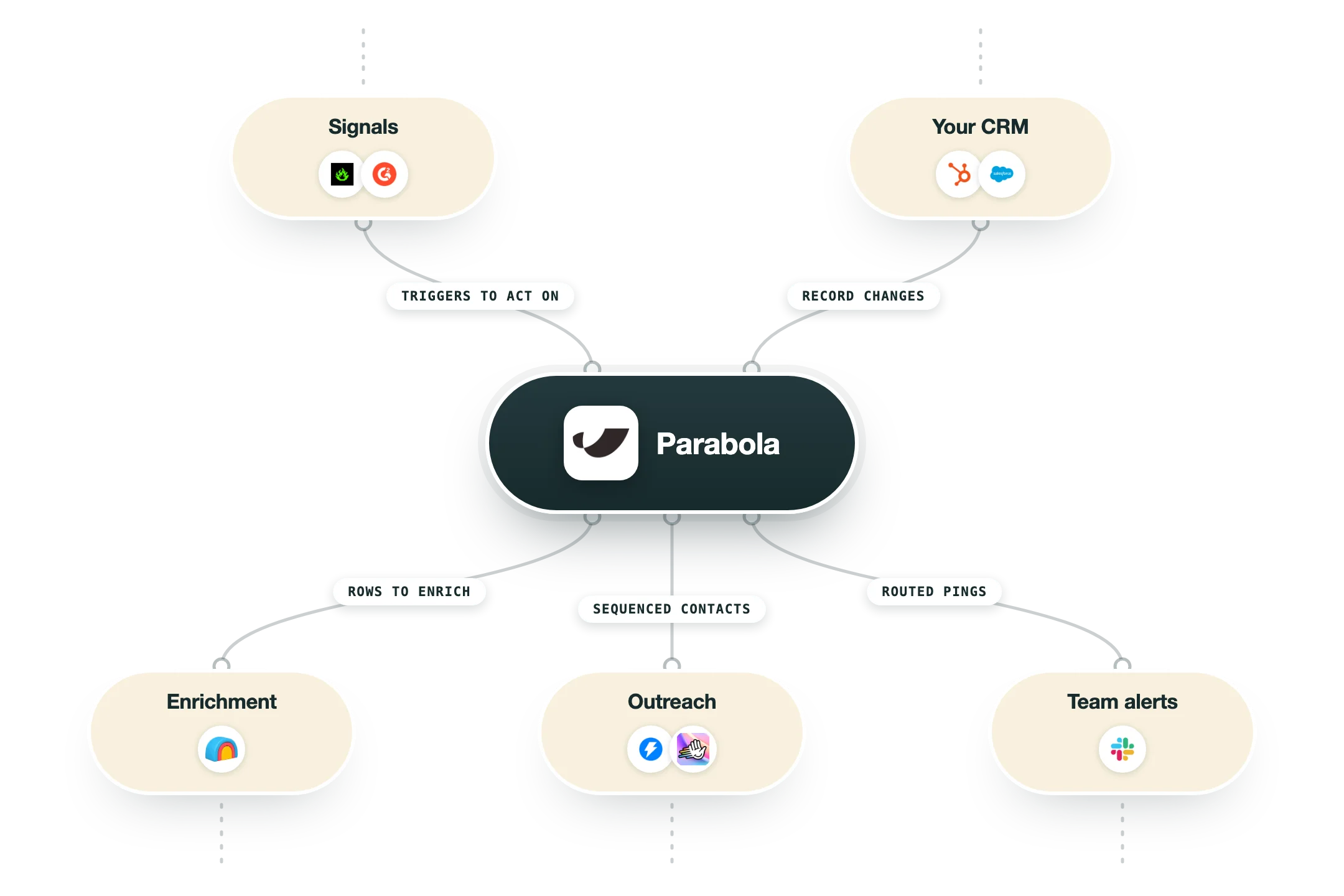
How it fits your stack
Alternatives



At a glance
Drag-and-drop canvas for cleaning and joining data
Prowork builds a flow from a plain-language brief
AI PDF parser for invoices and packing lists
Triggers on inbound email attachments and webhooks
50-plus integrations plus a REST and GraphQL API step
Parabola Tables for storing data between flows
Credit pricing with a free 1,000-credit plan
SOC 2 Type II, SSO and audit log streaming
Read some of our client stories





GTM Workflows
Learn how to use GTM tools in workflows
Guides and tutorials to get the most from your workflows











Ready to get started?




By clicking Sign Up you're confirming that you agree with our Terms and Conditions.








