

A cheap, flat-priced domain registrar with free WHOIS privacy and SSL, plus an API that can register and configure a fleet of sending domains from a script.
What is
Porkbun
A .com at Porkbun costs $11.08 to register and $11.08 to renew, and that flat number is most of the reason a cold email team ends up on a registrar's site at all. Porkbun sells domain names out of Portland, which puts it upstream of every other tool in an outbound stack. Every domain includes WHOIS privacy, a Let's Encrypt certificate, DNS management, URL forwarding and up to 20 email forwards, so the SPF, DKIM and DMARC records live in the same console where you bought the name. Bulk search handles 100 names at once and drops the available ones into the cart. The API covers the whole lifecycle from an availability check through /domain/create, renewals, transfers, DNS records and SSL bundles, with a sandbox key for testing, so registering 40 sending domains and writing their DNS becomes a script rather than an afternoon of clicking. Porkbun manages over four million domains for about 750,000 customers. Buy your sending domains here and buy them in .com. The registrar side is the best value we found, though it stops at the domain, so mailboxes, warmup and reputation monitoring come from somewhere else. Cheap first-year extensions are the trap, since a $1.96 .site renews at $28.84 on a TLD spam filters already distrust.
Integrations and the modern GTM stack
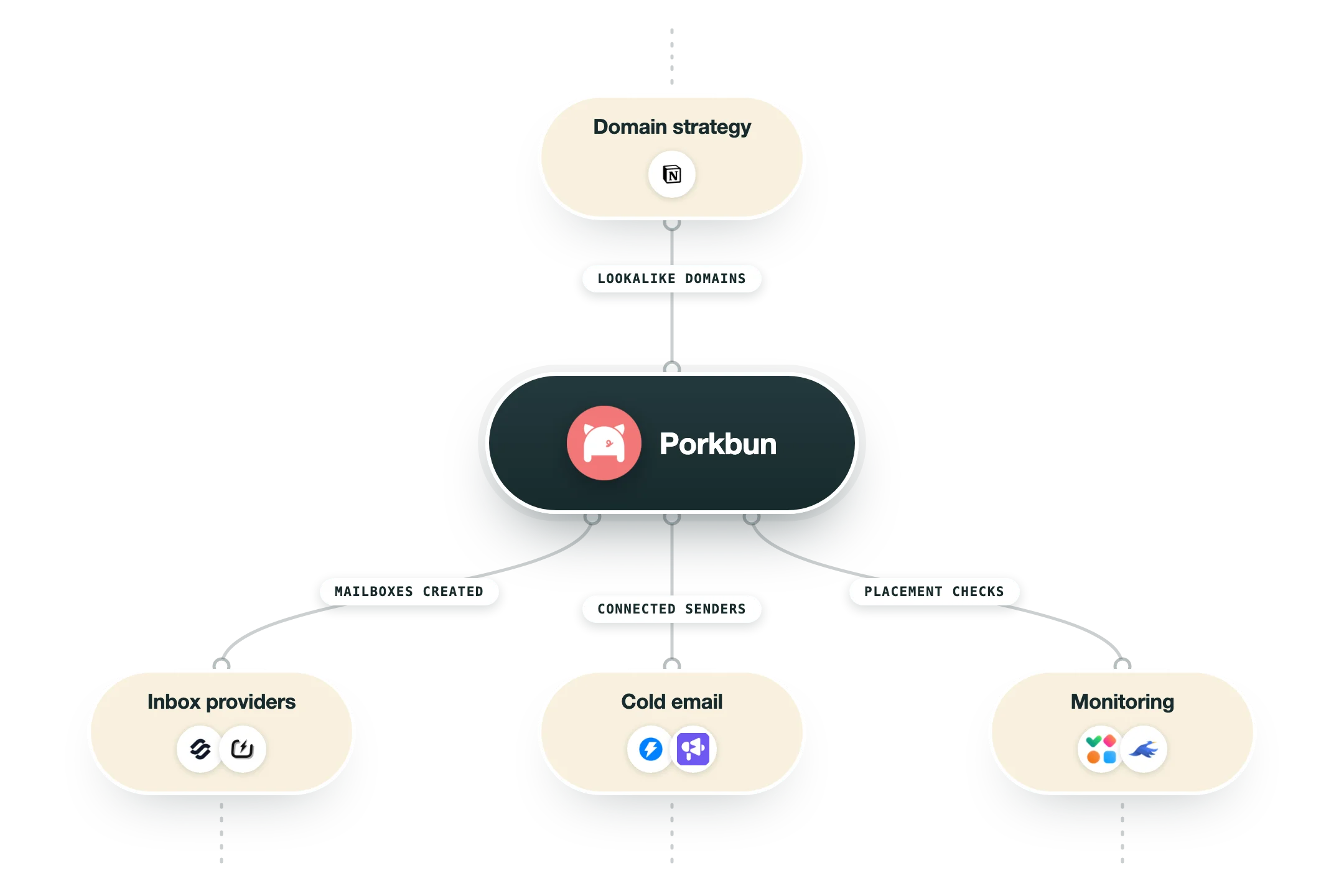
Porkbun does not integrate with your GTM stack in the usual sense, because a registrar's job is to hold the name and answer DNS queries. What matters is whether it gets out of the way when you script a fleet, so the useful list here is the API, the DNS surface and the things it deliberately leaves to other vendors.
Porkbun API | A JSON REST API covering availability, pricing, /domain/create, renewals, transfers, listing, DNS records, nameservers, glue, contacts, forwarding and SSL bundles. Auth is an API key plus a secret key sent as headers or body fields, idempotency keys stop retries double-charging, and a sandbox key runs the whole flow on fake credit. |
Per-domain API toggle | Keys are made under Account then API Access, but each domain also needs its own API Access switch flipped in Domain Management before a script can touch it. Porkbun publishes no bulk method for this, so budget the clicks when you register a batch of sending domains. |
Google Workspace and Microsoft 365 | Neither is provisioned by Porkbun. You point MX at the provider and paste the SPF, DKIM and DMARC records into Porkbun DNS, which allows 200 records per domain. The dashboard has a Configure DMARC button that writes DKIM at the same time for Porkbun-hosted mail. |
Instantly, Smartlead and other sequencers | No native connection exists in either direction. Your sequencer hands you TXT and CNAME values and you add them in Porkbun DNS by hand or through the API. That is normal for a registrar, though it is the step teams most often want automated when they are standing up 40 inboxes. |
Cloudflare | Porkbun's free DNS runs on Cloudflare infrastructure at the root, and the dashboard exposes Cloudflare-backed DNSSEC. You can also move the domain fully onto Cloudflare by swapping nameservers, which is the route to take when you want Cloudflare's proxy and page rules on your redirect domains. |
URL forwarding | Free 301, 302 and masked forwarding with SSL and optional URI path pass-through. This is the piece a sending fleet uses most, since every look-alike domain should redirect to your real site instead of returning nothing when a prospect pastes it into a browser. |
acme.sh, lego, certbot and Terraform | Community DNS-01 plugins read PORKBUN_API_KEY and PORKBUN_SECRET_API_KEY, so wildcard certificate issuance and infrastructure-as-code domain management both work. None of these are built or supported by Porkbun, and one Netgate thread shows an API change breaking a client, so pin your tooling. |
What is missing | No official Zapier or n8n app, no Clay integration, no mailbox provisioning, no warmup, no blocklist or reputation monitoring, and no bulk toggle for API access. Porkbun sells and serves the domain, and every layer that turns a domain into a sending inbox belongs to another vendor. |
Pro’s
Registration and renewal prices match on the extensions that matter, so a fleet of 40 .com sending domains costs the same $443 in year two as it did in year one.
WHOIS privacy is included at no charge on almost every extension, so the contact details behind a rack of throwaway sending domains stay off the public record without a recurring line item.
The API runs the full lifecycle from an availability check to /domain/create, DNS records and SSL bundles, and a sandbox key with fake credit lets you rehearse a bulk registration script before it spends anything.
Bulk search takes 100 names at a time and adds every available one to the cart, while Bulk Manage rewrites nameservers, contacts and forwarding across the whole account in one submit.
DNS runs on Cloudflare infrastructure with 200 records per domain and free Let's Encrypt certificates that renew themselves, which covers the authentication records and the HTTPS that a sending domain needs.
Free URL forwarding with 301, 302 and masked options handles the redirect that every look-alike sending domain should point at your real site, set from the same dashboard.
Cons
Porkbun stops at the domain, so mailboxes, warmup, reputation monitoring and inbox rotation all come from other vendors, and its own $3 mailbox is built for a founder's inbox rather than a sending fleet.
The discount extensions are cheap for exactly one year, and a .site or .online bought at $1.96 renews at $28.84, well over double what holding a .com costs.
Those same discount extensions cluster near the top of Spamhaus abuse rankings, so a filter meeting your domain for the first time starts from a worse position on .top or .xyz than on .com.
API access has to be toggled on for each individual domain in Domain Management, and Porkbun documents no bulk way to do it, so a 40-domain fleet starts with 40 manual clicks.
Phone and chat only run 9AM to 5PM Pacific, and some new accounts get pushed into photo ID verification through Veriff based on region and other signals, which is an unwelcome surprise mid-launch.
Pricing
.com
$11.08/year Same price to register, renew or transfer in
Free WHOIS privacy
Free Let's Encrypt SSL, auto-renewed
Cloudflare-backed DNS and DNSSEC
20 email forwards and URL forwarding
Full API access once enabled per domain
Other flat-priced TLDs
$11.84 to $14.93/year Renewal prices, first year often lower
.org $11.84, first year $7.98
.net $12.52 flat
.dev $12.87, first year $8.75
.app $14.93, first year $8.75
.us $7.00, first year $4.43, no WHOIS privacy allowed
Promo-priced TLDs
$1.96 first year Renewals jump hard, check before buying a fleet
.online and .site $1.96 then $28.84
.xyz $2.04 then $12.98
.info $3.60 then $22.14
.biz $6.69 then $19.05
.co $15.76 then $31.20, .io $28.12 then $51.80
Porkbun Email
$3/inbox/month Billed annually, one custom domain per mailbox
10 GB storage per user
Webmail, IMAP and POP3
Spam filter, signatures, auto-responders
DKIM and DMARC configured from the dashboard
20 email forwards included alongside
How it fits your stack
Alternatives


At a glance
.com at $11.08 to register and renew
Free WHOIS privacy on most extensions
Free Let's Encrypt SSL, auto-renewed
Cloudflare-backed DNS, 200 records per domain
Bulk search up to 100 domains at once
API for register, renew, DNS and SSL
20 free email forwards per domain
Mailbox hosting at $3 per inbox monthly
Read some of our client stories





GTM Workflows
Learn how to use GTM tools in workflows
Guides and tutorials to get the most from your workflows











Ready to get started?




By clicking Sign Up you're confirming that you agree with our Terms and Conditions.








