

An open-source product analytics platform where events, session replay, feature flags and a managed warehouse share one usage meter, with group analytics rolling product usage up to the company record that product-led sales runs on.
What is
PostHog
PostHog is an open-source product analytics platform that records what people do inside your app. Events, funnels, retention and user paths sit at the core, and around them the company has stacked session replay, feature flags, experiments, surveys, error tracking and a managed data warehouse, all metered on one usage bill. You install an SDK, tag the actions worth tracking, and PostHog stores the stream. Its warehouse then syncs Stripe, Postgres, Salesforce and HubSpot next to those events, and the pipeline layer sends them back out to HubSpot, Slack webhooks and Intercom in real time. The GTM-relevant piece is group analytics, which rolls user events up to a company record so you can see which accounts adopted a feature and which went quiet. That company-level usage is the raw material behind product-led sales, and scoring tools such as MadKudu and Common Room run on exactly this signal. Buy PostHog when engineers own the instrumentation and the product is what you are measuring. We do not run it at Nebor and would not hand it to a sales team as a GTM tool, because the events must be tagged first and the signal reaches Clay or your CRM through a warehouse sync or a webhook.
Integrations and the modern GTM stack
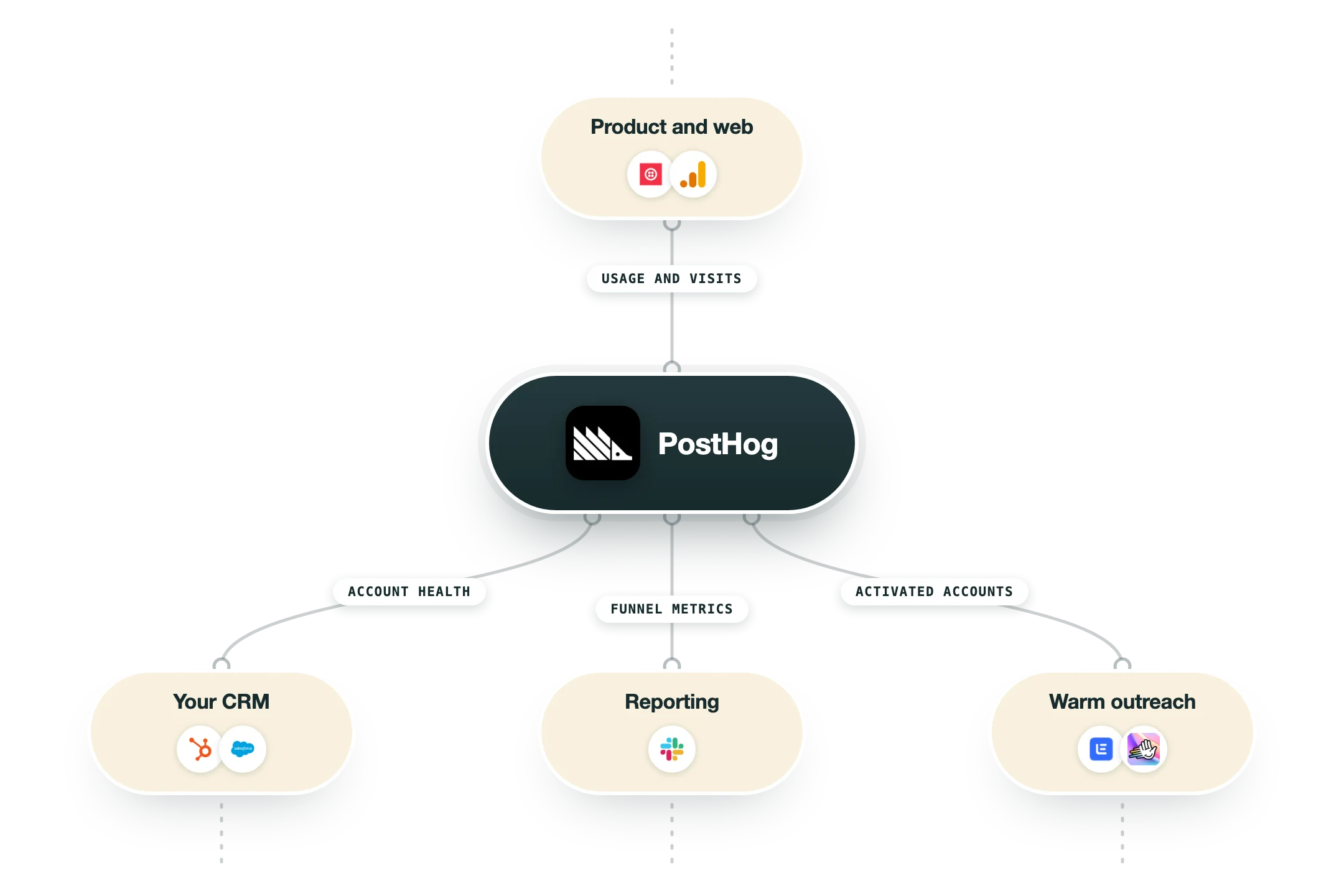
PostHog plays two roles at once, a place your own product data arrives from SDKs and a pipe that moves it somewhere else. For a GTM reader the second role is the one that counts, and the honest summary is that account-level product usage gets to your CRM through the warehouse, a destination or a webhook you own.
SDKs and autocapture | Data arrives through libraries for JavaScript, React, Next.js, Python, Node, iOS, Android and more. Autocapture picks up pageviews and clicks with no work, but the named events that a revenue team cares about, such as a workspace invite or a credit limit being hit, only exist once a developer tags them. |
Group analytics | Sending a group key on your events aggregates them onto a company, with up to five group types per project. This is the switch that turns user-level analytics into account-level analytics, and it is a paid add-on that begins billing every identified event in the project the moment you enable it. |
Data warehouse sources | PostHog links Stripe, Postgres, Salesforce, HubSpot and dozens of other sources so business data sits beside product events and can be queried together in SQL. The first million rows a month are free and syncing bills from $0.000015 per row after that. |
Real-time destinations | The pipeline layer pushes events out as they land, with HubSpot, Slack webhooks, Intercom, Customer.io and generic webhooks among the popular ones. Ten thousand trigger events a month are free and the rate starts at $0.0005 per trigger event, so a chatty alert filter has a cost attached to it. |
HubSpot and Salesforce | Both run in each direction. As sources they pull CRM records into the warehouse next to product usage, and as destinations they receive event-driven updates, so a trial account hitting an activation milestone can land on the record a rep already works from. |
Segment, RudderStack and Zapier | PostHog accepts a stream from Segment or RudderStack if a CDP already sits in front of your app, which saves reinstrumenting from scratch. A Zapier app is documented in the libraries section for the lighter automations that do not justify a webhook. |
Clay | There is no native Clay source for PostHog and no PostHog action inside Clay. The working pattern that consultants publish is a PostHog webhook or scheduled export into a cloud function, which writes rows into a Clay table where firmographics and outbound get attached. Plan for someone to build and maintain that. |
MadKudu and Common Room | Both score product usage, and neither reads PostHog directly. Common Room leaves PostHog off its published integration list and ingests usage through Snowflake, Segment, Census or Hightouch, so the practical route is PostHog into a warehouse and the warehouse into the scoring tool. |
What is missing | No visitor identification of anonymous companies, no sequencer, no CRM of its own, and no native connector to the tools most GTM teams run. PostHog also states that self-hosted deployments are unsupported and that paid features are cloud only, so an on-premise plan caps you at free-tier functionality. |
Pro’s
The free tier carries 1 million events, 5,000 web session replays, 1 million feature flag requests and 1,500 survey responses every month, and PostHog says more than 90 percent of its companies never pay it anything.
Seventeen tools bill against one meter, so a team that would otherwise pay Amplitude, Hotjar, LaunchDarkly and Typeform separately gets a single invoice and one event stream sitting under all of it.
Group analytics aggregates events onto a company record with up to five group types per project, and that is the shape product usage has to be in before a scoring tool or a CRM can act on it.
The managed warehouse syncs Stripe, Postgres, Salesforce and HubSpot next to your product events, so the question of whether a paying account has stopped using a feature gets answered without exporting anything.
PostHog for Startups hands eligible early-stage companies $50,000 of credits for 12 months plus $12,000 of partner benefits, which covers instrumentation long before the meter starts to matter.
The code is MIT licensed and the EU cloud region is a choice you make at signup, so a privacy review that stalls on a US-hosted analytics vendor has somewhere to land.
Cons
It is a product tool sold to engineers, and the events a sales team would want do not exist until a developer tags them, so the real cost sits in an engineering backlog rather than a subscription line.
Nothing here reaches a GTM stack natively at the account level. Common Room leaves PostHog off its integration list and takes product usage through Snowflake, Segment, Census or Hightouch instead, and Clay has no PostHog source either, so somebody on your side maintains that join.
Group analytics is a paid add-on that starts billing every identified event in the project the moment it is switched on, including events with no group attached, and identified events already cost up to four times what anonymous ones do.
The bill swings once session replay and error tracking are live, mobile recordings meter at roughly twice the web rate, and G2 reviewers report usage charges moving in ways they had not planned for.
The learning curve is the most repeated complaint across G2 and Product Hunt, HogQL expects SQL from whoever writes the query, and a marketer without a developer stays inside the default dashboards.
Pricing
Free
$0/month No credit card, 1 project, 1 year data retention, community support
1 million product analytics events a month
5,000 web and 2,500 mobile session replays
1 million feature flag requests and 1,500 survey responses
100,000 error tracking exceptions and 1 million warehouse rows
10,000 real-time pipeline trigger events
Pay as you go
From $0.00005/event Add a card for 6 projects, 7 year retention and email support, with per-product billing limits you set yourself
Product analytics from $0.00005 down to $0.000009 per event above 250 million
Session replay from $0.005 per web recording and $0.01 per mobile recording
Feature flags from $0.0001 per request, surveys from $0.10 per response
Warehouse rows and batch exports from $0.000015 per row
Real-time destination triggers from $0.0005 per event
Boost
$250/month Platform package stacked on top of usage billing
Unlimited projects
SSO enforcement and HIPAA BAA
White labeling
7 days of activity logs
Scale
$750/month Everything in Boost
SAML single sign-on
Priority support with 24 hour response
2 months of activity logs
Higher-touch onboarding for a growing org
Enterprise
Custom Everything in Scale and Boost
Role-based access control
Dedicated account manager and training
8 hour priority support response
60 months of activity logs and real-time alerts
How it fits your stack
Alternatives


At a glance
Product analytics with funnels, retention and paths
Session replay for web and mobile
Feature flags, experiments and surveys
Group analytics rolls events up to companies
Managed warehouse syncs Stripe, Salesforce and HubSpot
Real-time destinations including HubSpot and Slack
1 million events a month free forever
MIT-licensed code you can run yourself
Read some of our client stories





GTM Workflows
Learn how to use GTM tools in workflows
Guides and tutorials to get the most from your workflows











Ready to get started?




By clicking Sign Up you're confirming that you agree with our Terms and Conditions.








