

A second-layer verifier that takes the catch-all and risky addresses your main tool returned as unknown and forces a real answer, either in minutes or by test sending over 72 hours.
What is
Scrubby
Push a B2B list through any standard verifier and a large slice comes back as catch-all, risky or unknown, because the domain accepts everything at the server and nobody can tell whether the mailbox exists. Scrubby exists to answer that one question, and it takes only the addresses your first verifier gave up on. The verification engine works in two modes. Quick Verification costs one credit and returns a call in minutes across standard, catch-all and gateway-protected domains. Deep Verification costs three credits and gets its answer by sending, mailing each address from burner accounts and watching servers for up to 72 hours to catch delayed bounces. Results come back bucketed as valid, recovered or invalid, and Scrubby positions itself as a second layer rather than your main verifier, placed behind ZeroBounce, NeverBounce or MillionVerifier and taking only what they could not resolve. Cargo ships it as a native block, and Ashby reports recovering up to a third of the emails it would otherwise discard. Scrubby earns a slot as a second pass on the risky bucket and nothing else. We have not used it at Nebor, though the mechanism holds up. Three credits an address puts deep verification near two and a half cents, fine on a few thousand named accounts and expensive across a full list.
Integrations and the modern GTM stack
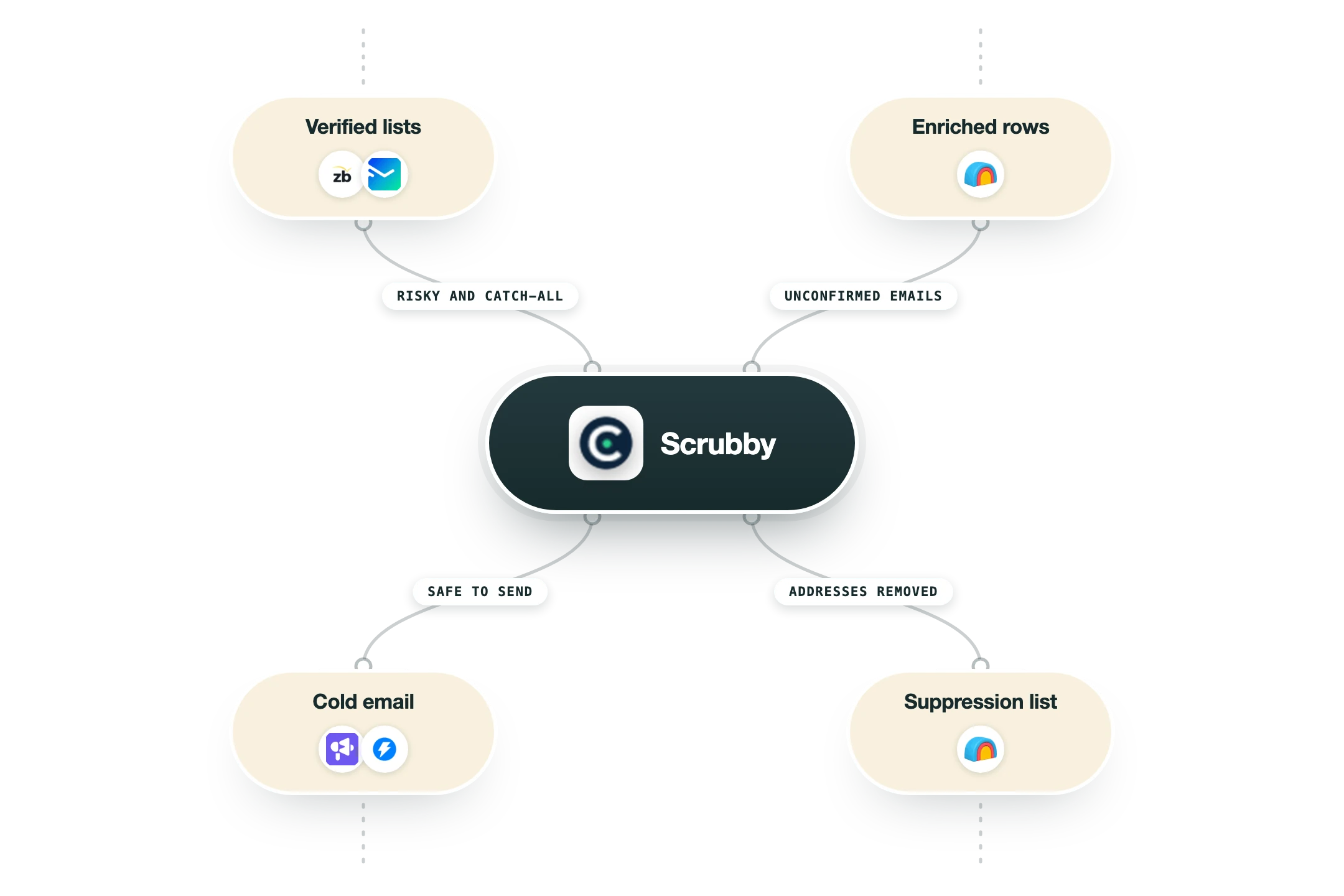
Scrubby's integrations split cleanly in two. On one side are the verifiers whose leftovers it eats, on the other are the tables and sending tools that receive the cleaned segment. The thing to plan for is the delay, because Deep Verification returns over hours rather than in a single API call.
ZeroBounce, NeverBounce and MillionVerifier | The intended upstream. You use the cheap verifier first, export everything it labelled catch-all, risky, unknown or accept-all, and hand that file to Scrubby. Bouncer, Debounce and Hunter are listed the same way, and Scrubby is explicit that it does not replace any of them. |
Clay | Scrubby publishes a Clay page describing enrich in Clay, validate in Scrubby, then merge the results back into the table. What the page does not document is how the 72-hour deep wait is handled inside a Clay workflow, so treat it as an out-and-back file or an API call with a webhook rather than a synchronous column. |
Cargo | The strongest published wiring we found. Cargo carries Scrubby as one of roughly fifteen native enrichment blocks alongside Apollo, ZoomInfo, Clearbit and ZeroBounce, and its Ashby story credits the block with recovering up to a third of the emails that would otherwise have been discarded. |
Instantly and Smartlead | The two cold email platforms are listed as sync destinations, so a cleaned list moves into campaigns without a manual CSV round trip. Both belong at the end of the chain, which is where you want them given that everything upstream has already made the keep or drop decision. |
HubSpot, Salesforce, Pipedrive and Mailchimp | The CRM side covers list cleaning on records you already own rather than new prospecting. This is the Ashby pattern, passing existing contacts back through validation to rescue addresses that were written off as invalid years ago. |
REST API and Zapier | A JSON API with bulk submission and webhook notifications, plus a Zapier app for teams without an engineer. Webhooks are the part that matters here, since a mode that answers over 72 hours needs a callback rather than a polled response. |
What is missing | No native n8n or Make app, no documented Clay action of its own, and no public detail on batch size or rate limits. The API reference at docs.scrubby.io renders as an empty Scalar page, so anyone building against it should ask support for a spec before committing a workflow to it. |
Pro’s
It goes after the one segment that wastes the most list, the catch-all and unknown bucket that every standard verifier hands back without an answer.
Deep Verification reaches its verdict by sending real mail and waiting out delayed bounces, which is a harder test than the SMTP probing that produced the unknown in the first place.
Cargo ships a native Scrubby block and publishes an Ashby story where the team recovers up to a third of the emails it would otherwise discard, so the recovery claim has support outside Scrubby's own marketing.
Pay-as-you-go credits cost $0.008 and never expire, so you can hold a small balance for the risky segment without signing up to a monthly plan you will not use every month.
The one-credit quick mode returns in minutes, so you can triage a list and spend the three-credit deep check only on the addresses that are worth a three-day wait.
It plugs in on both sides of the job, pulling the unknown segment from ZeroBounce, NeverBounce, MillionVerifier, Bouncer, Debounce and Hunter and pushing cleaned results into Clay, Smartlead, Instantly, HubSpot and Salesforce.
Cons
Deep Verification takes 24 hours for first results and up to 72 for the rest, so a list you wanted to load on Monday morning is not ready until Thursday.
Three credits per deep check works out near two and a half cents an address, which is many times what a standard verifier charges and turns a full list into real money fast.
The method depends on sending real blank mail to your prospects from Scrubby's burner accounts, and plenty of buyers will not want an unexplained email landing at a target account before their rep does.
Scrubby's own material says unverified catch-alls average a 9 percent bounce rate and 23 percent of risky addresses hard bounce, so a pass through it lowers the risk without removing it.
The published claims move around between 98 percent accuracy, 98.7 percent accuracy and an 83 percent recovery rate depending on the page, third-party reviews are thin with no rating at all on Capterra, and a wall of enterprise logos appears next to a lifetime total of one million emails validated.
Pricing
Free trial
$0 200 credits, no card required
Enough for about 66 deep checks
Same engine as the paid plans
Quick and Deep Verification both included
Starter
$47/month 6,000 credits, about $0.0078 each
6,000 quick checks or 2,000 deep checks
API access included
Unused monthly credits roll over
Growth
$97/month 15,000 credits, about $0.0064 each
15,000 quick checks or 5,000 deep checks
Roughly 19 percent off the list rate
Integrations and smart data cleaning
Pro
$497/month 100,000 credits, about $0.0049 each
Built for agencies and high-volume senders
Roughly 38 percent off the list rate
Volume rates continue above 100,000
Pay as you go
$0.008/credit 5,000 for $40, 100,000 for $800
No monthly commitment or renewal
Credits never expire
Same engine and no feature gating
How it fits your stack
Alternatives


At a glance
Verifies catch-all and risky addresses
Quick Verification at one credit
Deep Verification sends real test mail
Deep results in 24 to 72 hours
Handles gateway-protected domains
Works behind ZeroBounce and NeverBounce
Native block inside Cargo
200 free credits with no card
Read some of our client stories





GTM Workflows
Learn how to use GTM tools in workflows
Guides and tutorials to get the most from your workflows






Ready to get started?




By clicking Sign Up you're confirming that you agree with our Terms and Conditions.








