

An outbound agent you brief in Slack the way you would brief a junior hire, planning the targeting, building the list, sending on email and LinkedIn, and stopping for your approval before every launch.
What is
SellScale
SellScale will disappoint anyone who wants software they can operate, and that is on purpose. Its product Selix is an outbound agent you brief in Slack the way you would brief a junior hire, giving it an outcome like filling a dinner at a conference and then approving the list and the campaign it brings back. Underneath sit three sub-agents with different jobs. A Supervisor plans the targeting and strategy, a Worker builds the lists, research, copy and sequences, and a Secretary handles coordination. Selix routes lists across five-plus data sources, provisions and warms its own mailboxes with DMARC, SPF and DKIM, sends on email and LinkedIn, and triages every reply in one inbox. The agent works a single goal across days and holds context between sessions, interrupting you with a clarifying question at a fork rather than guessing. No campaign launches without a human yes. SellScale rejects the AI SDR label hard enough to publish a free tool that drafts a demand letter to escape your current AI SDR contract. We would spend $90 on the Sampler before anything heavier, because both paid tiers carry a one-year minimum at $6,000 or $30,000 and Selix has one public G2 review behind that commitment. Nebor has never run it for a client. CRM sync appears on Enterprise alone, and the case studies count setup minutes instead of meetings.
Integrations and the modern GTM stack
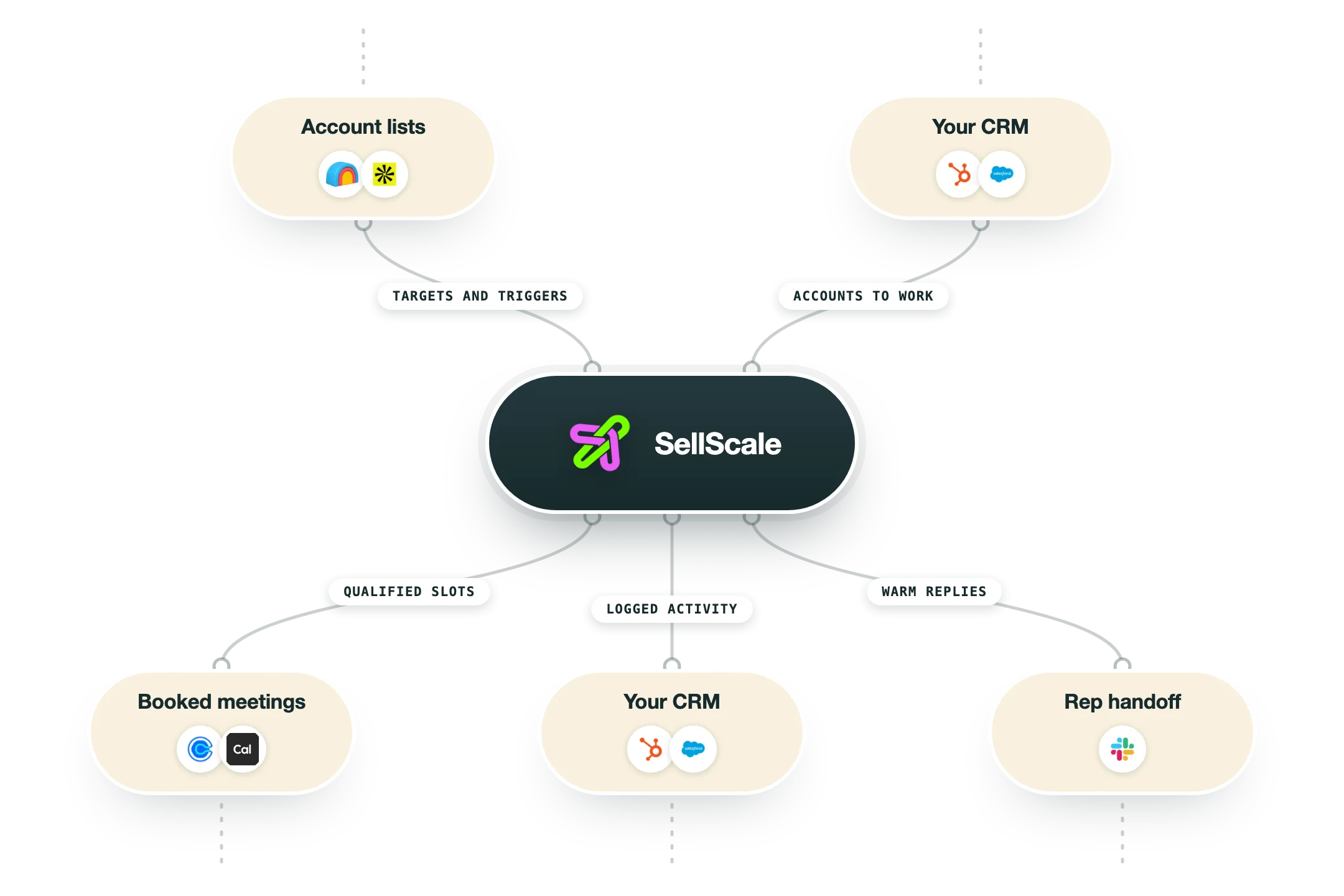
Selix treats its integrations as places to talk to the agent rather than a connector directory. Slack is the primary surface, email and LinkedIn are the channels it sends on, and the CRM link is the one that changes the price of the whole thing.
Slack | The main way you work with Selix. You brief campaigns in plain language in a channel, the agent posts progress and clarifying questions back, reply alerts land with the intent already classified, and you can pull link clicks, opens and pipeline reporting without leaving the thread. Selix Lite is Slack only with no web app. |
Selix provisions and manages its own dedicated mailboxes rather than borrowing your main inbox, handling domain purchase, DNS, SPF, DKIM, DMARC, warming and placement monitoring across hundreds of mailboxes. Replies forward to your normal inbox, and you can brief the agent by forwarding a thread or an attachment to selix@sellscale.com. | |
Connection requests and follow-up messages run from your own LinkedIn account inside the same sequence as the email steps, with built-in rate limits meant to keep the account healthy. Acceptances and replies feed the unified inbox. Lite covers one LinkedIn account, Max covers ten. | |
CRM | HubSpot and Salesforce connect through Merge, pulling records, notes and fields in as research and scoring inputs and pushing outbound activity back, with suppression against existing contacts and live deals. The pricing page lists CRM integration against the Enterprise tier only, so treat it as a reason to move off Max rather than something Max includes. |
Calendar | Calendly or any other booking link drops into the conversation when Selix detects scheduling intent, which keeps the handoff inside the thread. Selix stops at the booking offer and hands positive replies to your team, so a human still runs the meeting and closes the loop. |
In-app web app | The full Selix interface with chat, campaign views and the unified inbox arrives on the Max plan and above. On Lite you get the Slack channel and nothing else, which matters if you want to inspect lists and copy in a table rather than read them in a chat window. |
Data sources | Selix says it routes list building across five-plus sources covering a contact database, SMB data, LinkedIn, deep web research and Shopify stores marked as coming soon. No vendor behind any of those is named on the site, so you cannot check coverage or compare the cost against buying the source direct. |
What is missing | No public API, no webhooks, no Zapier or n8n app, and no documentation at all. Their docs page reads "We don't have docs" and points you at talking to the agent instead. There is no dialer or voice channel, and no native link to Clay, Instantly, Smartlead or HeyReach, since Selix intends to replace that layer rather than sit beside it. |
Pro’s
Selix publishes its prices in a category that hides behind a demo, and the $90 one-time Sampler lets you run one LinkedIn campaign end to end before you sign a thing.
Living in Slack means your whole team watches the agent work and can jump into the thread, so outbound stops being one person's private browser tab and becomes something a founder and a marketer steer together.
Sending infrastructure comes with the plan, covering domain purchase, DNS, warming, placement tests and health monitoring across hundreds of mailboxes, and that is the part of cold email small teams most often get wrong.
Every campaign stops for a human approval and the agent asks a question when it hits a fork, so the worst case is a delay rather than a thousand bad emails already in flight.
One goal survives across days and sessions, so a brief like filling a conference dinner keeps moving while you do other work instead of resetting each time you open the chat.
Research is attributed to a source on every claim and you can add custom qualification questions such as whether a company runs a global team, which gives you a way to audit why a prospect made the list.
Cons
Both paid tiers carry a one-year minimum, so the real decision is $6,000 or $30,000 committed up front rather than the friendly monthly number on the pricing page.
CRM integration is listed on the Enterprise line only, which leaves a $2,500 a month Max customer running outbound next to their HubSpot or Salesforce with no sync included.
Independent evidence is close to nonexistent, with a single G2 review for Selix AI and nothing on Capterra or TrustRadius, so you are buying almost entirely on the vendor's own material.
That material reports setup speed, such as two minutes of hands-on time and one Slack message for the Amplify Security event, and none of the five customer stories publishes meetings booked or pipeline created.
The docs page says in plain words that there are no docs, and no vendor behind the five-plus data sources is named anywhere, so you cannot audit coverage or price the enrichment against buying it direct.
Pricing
Sampler
$90 one-time One-time use only, no ongoing access
1 campaign, end to end
LinkedIn only
Hands-on trial before committing
No contract attached
Selix Lite
$500/month 1 year minimum
1 seat and 1 campaign live
1 mailbox and 1 LinkedIn account
Hard usage caps
Slack access only, no web app
Selix Max
$2,500/month 1 year minimum, marked as the recommended tier
10 seats and 10 campaigns live
20 mailboxes and 10 LinkedIn accounts
Full in-app access
Unlimited usage
Enterprise
Custom 1 year minimum, contact sales
Unlimited seats, campaigns, mailboxes and LinkedIn accounts
Unlimited usage
CRM integration
Slack support
How it fits your stack
Alternatives




At a glance
Selix agent briefed in Slack
Supervisor, Worker and Secretary sub-agents
List building across 5+ data sources
Managed mailboxes with DMARC, SPF and DKIM
Email and LinkedIn in one sequence
Unified inbox with intent tagging
Job change, funding and hiring signals
$90 one-time Sampler campaign
Read some of our client stories





GTM Workflows
Learn how to use GTM tools in workflows
Guides and tutorials to get the most from your workflows











Ready to get started?




By clicking Sign Up you're confirming that you agree with our Terms and Conditions.








