

An enterprise integration platform that connects 700-plus systems, runs the processes on top of them, and now builds governed AI agents through Merlin.
What is
Tray.ai
Tray moves data between your business systems and runs the processes that sit across them, so a form fill can be scored in Marketo, matched to an account in Salesforce, routed to the right rep and posted into Slack without a human touching it. The company was tray.io until July 2024 and is now tray.ai. You build in Tray Build, a drag and drop canvas with branching, loops, approvals and error handling, on top of 700-plus connectors and an HTTP client for any API that has no connector. Tray Headless exposes the same engine to Claude Code, Cursor and Codex through MCP for teams that would rather write it. The AI half of the platform is Merlin Agent Builder, where you assemble an agent from knowledge sources and tools and ship it to Slack, Teams, a chatbot or an API, with every tool call logged and approval steps on sensitive actions. Any major model plugs in behind it. Tray earns its price inside a company already carrying Salesforce, NetSuite and a compliance team, where the audit trail and the workspace governance are the product. Nebor builds client automation in n8n and Make, so we have not run Tray, and for a GTM team under a few hundred people we would not put the budget here.
Integrations and the modern GTM stack
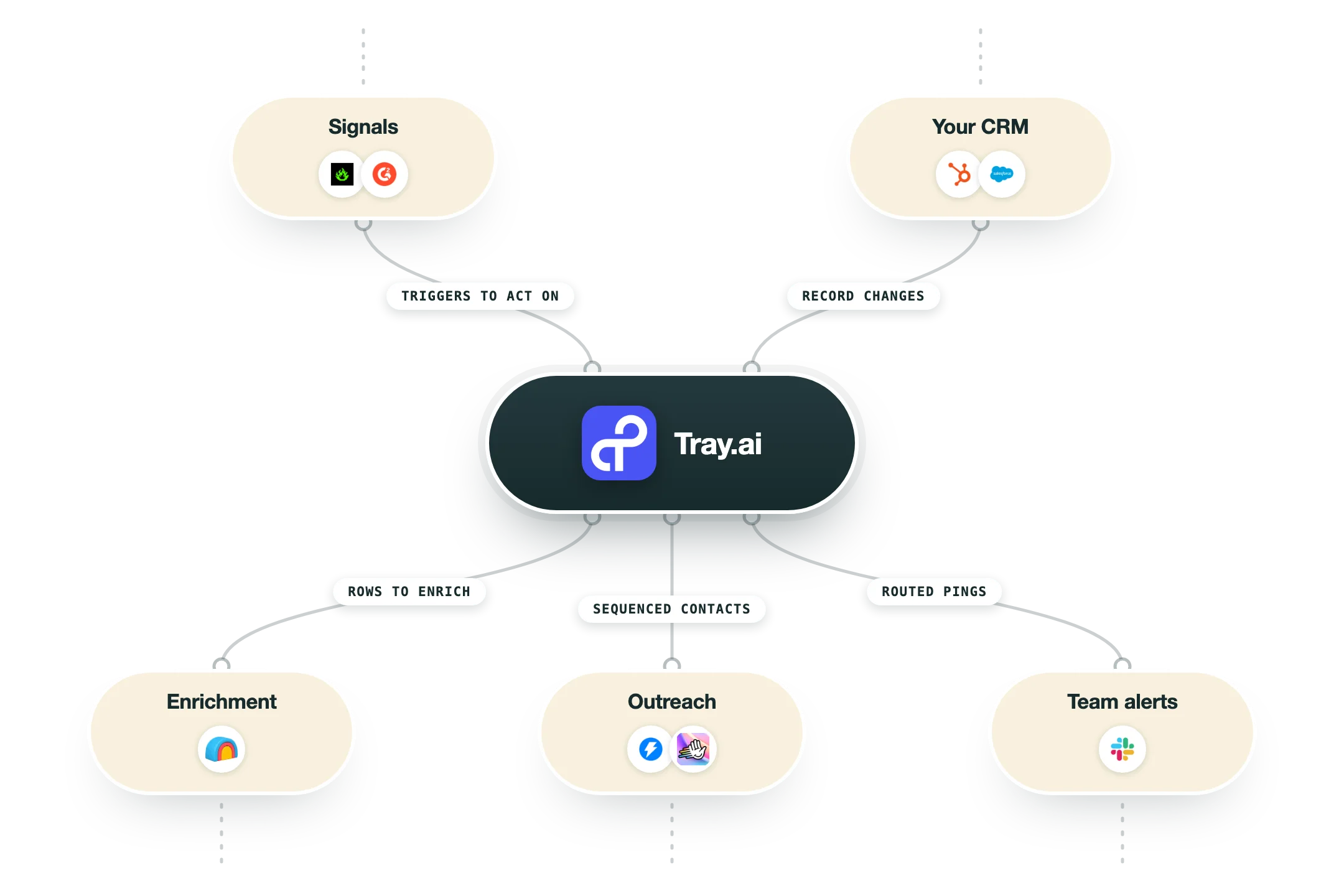
Tray's connector library is the reason enterprise buyers look at it, with 700-plus prebuilt connections and an HTTP client that reaches anything left over. The interesting part in 2026 is the second layer, where the same connectors become tools an agent can call and MCP servers your coding assistants can reach.
Salesforce | The centre of most Tray builds we found. Beyond the connector, Tray ships named RevOps solutions on top of it for lead lifecycle management and lead routing, so the sync, the scoring handoff and the round robin are patterns rather than something you invent from scratch. |
Marketo and HubSpot | Two-way sync with Salesforce is the flagship use case here, keeping lead data, campaign activity and scores lined up between marketing automation and the CRM. Tray publishes the Marketo to Salesforce pairing as a solution page, which tells you where its demand has historically come from. |
Snowflake, BigQuery and SQL databases | The data side of the platform, covering warehouse loads, database reads and writes, and file and storage sources. This is the half that separates Tray from a GTM-only automation tool, and it is also where the task meter climbs fastest on large batch jobs. |
Slack and Microsoft Teams | Both work as notification endpoints in a normal workflow and as deployment surfaces for a Merlin agent, so the agent answers and takes action in the channel your team already sits in. Tray also offers dedicated Slack support channels on the Team and Enterprise tiers. |
OpenAI, Anthropic, Google, Bedrock and Azure OpenAI | Every major model is pluggable behind an agent or an AI step, with multi-model routing so you can move a workload to a cheaper or newer model without rebuilding the agent. Classification and document extraction run as steps on the same canvas. |
Agent Gateway for MCP | Turns Tray connectors into managed MCP servers with audit and observability, so internal assistants call your systems through one governed door. Pair it with Tray Headless, which has dedicated plugins for Claude Code and Codex and reaches Cursor and Windsurf over MCP. |
Any API | The HTTP client handles OAuth, JWT, API key and basic auth, and supports webhooks, polling and batch patterns. A connector SDK exists for building a proper reusable connector, which is the route to take for an internal system your team will call from many workflows. |
Embedded integrations | Software vendors can render Tray's configuration wizard inside their own product under their own branding, giving customers a native integration marketplace. It is an Enterprise add-on rather than part of the standard plan, so price it separately. |
What is missing | We found no Clay connector and no native connection to Instantly, Smartlead or Lemlist, so a cold email stack reaches Tray only through the HTTP client and webhooks. If outbound infrastructure is the thing you need wired, that work is manual here. |
Pro’s
The connector library covers 700-plus systems and an HTTP client with OAuth, JWT, API key and basic auth reaches the rest, so a homegrown internal app stops being a dead end.
Governance is built into the platform rather than bolted on, with workspaces, per-user access control, audit trails, log masking and approval steps on sensitive agent actions.
Merlin lets you swap the model behind an agent without rebuilding it, and OpenAI, Anthropic, Google, Bedrock and Azure OpenAI all route through the same steps.
Tray Headless hands the same engine to Claude Code, Cursor and Codex over MCP, so an engineer can build the integration in the editor while ops keep a visual version of it.
The RevOps use cases are documented rather than implied, with lead lifecycle management, Marketo to Salesforce sync and lead routing shipped as named solutions.
Capterra reviewers rate customer service 4.8 out of 5, and Team and Enterprise carry 24/7 support with enhanced SLAs and dedicated Slack channels.
Cons
Tray publishes no prices anywhere and even the free trial starts with a sales call, while Vendr's marketplace data puts the median annual contract at $37,641 across 108 purchases with a range of $18,700 to $96,300.
Billing counts tasks as workflow steps, so every loop iteration, branch and error handler adds to the meter, and Tray keeps the account running through an overage and bills it at the next quarterly cycle.
The agent work Tray rebranded around sits in a paid Agent Development add-on on top of the base plan, and the full add-on menu only opens from the Team tier upward.
Gartner has placed Tray as a Visionary in the iPaaS Magic Quadrant three years running while Workato and Boomi sit in the Leaders quadrant, and procurement teams do read that chart.
Reviewers on Capterra and G2 keep flagging the ramp, since anything off the standard connectors needs JSON paths and API knowledge, and ease of use scores 4.1 against 4.8 for support.
Pricing
Pro
Custom Quoted by sales, aimed at one specific use case
3 workspaces
7-day insights and 7-day log retention
700-plus connectors, Tray Build and Tray Headless
Automation, integration, API management and MCP governance
Tray Advantage support during business hours
Team
Custom Quoted by sales, aimed at a department running several use cases
20 workspaces
30-day insights and expandable log retention
Log retention management and Guardian log masking
All add-ons available for purchase
Tray Advantage Plus with 24/7 support and a dedicated Slack channel
Enterprise
Custom Quoted by sales, aimed at multiple departments and partner integrations
Unlimited workspaces and 180-day insights
Advanced on-premise deployment
SSO, HIPAA and regional hosting
Log streaming and data engineering
Embedded integrations available as an add-on
Add-ons
Priced separately Bought on top of a plan, fully available from Team upward
Agent Development covering Agent Gateway for MCP and Merlin Agent Builder
SSO, HIPAA and regional hosting
30-day log retention and 180-day insights visibility
Tray IDP for document processing
Log streaming and data engineering
How it fits your stack
Alternatives




At a glance
700-plus prebuilt connectors plus any API
Tray Build visual canvas with branching and loops
Merlin Agent Builder for no-code AI agents
Agent Gateway for governed MCP servers
Tray Headless for Claude Code, Cursor and Codex
Embedded integrations for software vendors
Workspaces, audit trails and role-based access
SSO, HIPAA and regional hosting on Enterprise
Read some of our client stories





GTM Workflows
Learn how to use GTM tools in workflows
Guides and tutorials to get the most from your workflows











Ready to get started?




By clicking Sign Up you're confirming that you agree with our Terms and Conditions.








