
What Makes The Best Clay Lead Generation Agency?

In this post:
If you’re hiring a Clay lead generation agency to build a Clay-powered GTM system or automate your lead generation operation around Clay, you’re in the right place.
We’ll cover what to look for in a Clay lead generation agency so you can pick the right one for your team.
We’ll also share why we think we’re the right fit when your goal is to build the full GTM system around Clay, not just send a few campaigns, and walk through the workflows we actually build.
If you’re already past “we just need leads” and into “we need a system we own”, the second half of this piece is where it gets specific.
Let’s get started.
Note: Most Clay lead generation agencies sell you volume, because volume is the easiest thing to bill for. You get bigger lists and more sends every month, and the reply rate stays where it started.
Our team at Nebor came from sales, so we start with the strategy. We work out why someone buys what you sell, design the workflows around that, and only then build them in Clay: who to approach, what makes them worth approaching this week, and what your rep says when they do.
The outreach, the routing and the CRM all follow from that, and we build all of it in your own accounts so it stays yours.
Book a 15-minute call and we'll tell you which of the five evaluation points in this article your current setup would fail.
TL,DR: what you get with our Clay lead generation workflow
Keep in mind the final flow depends on your business and what you sell.
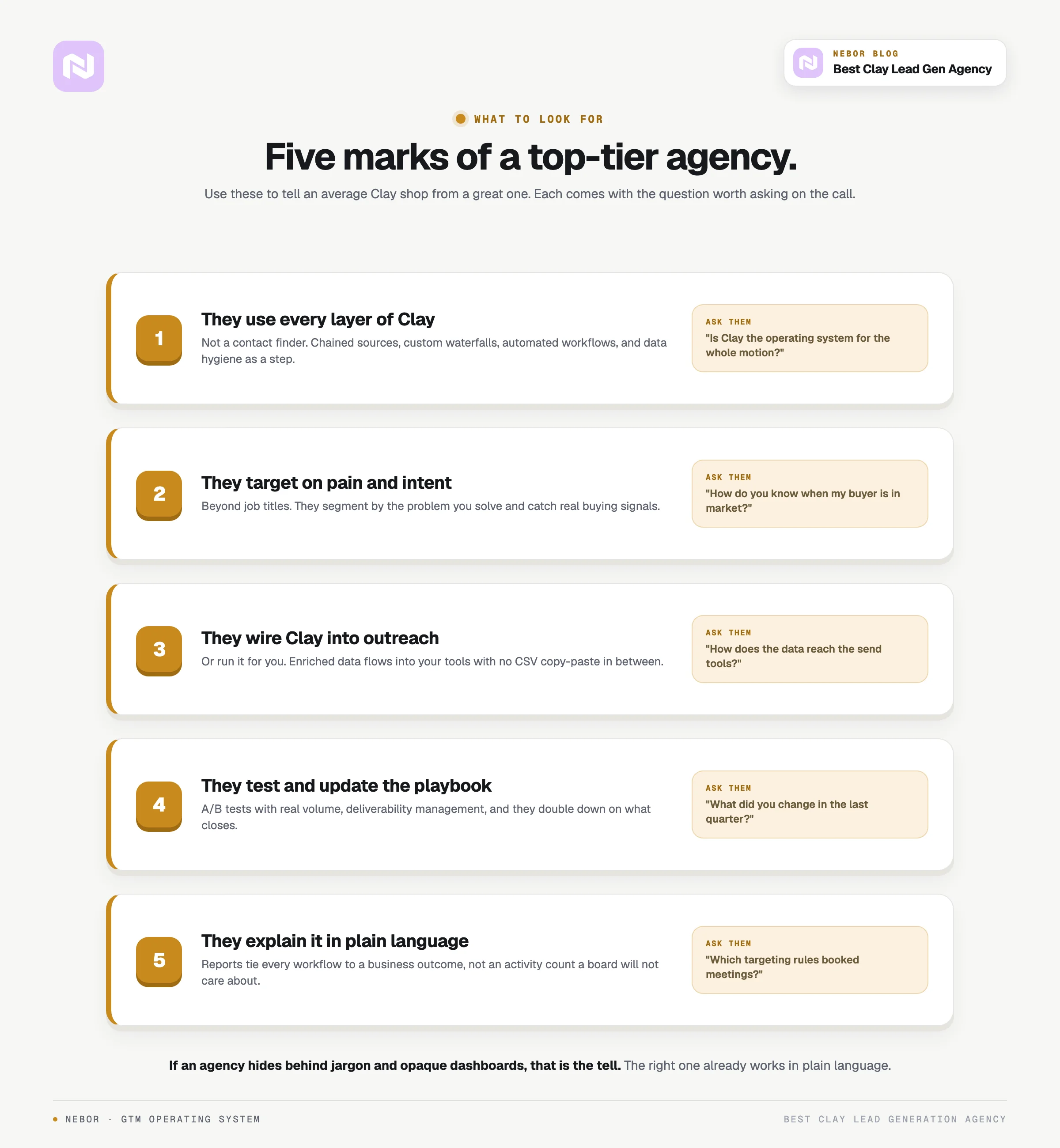
Top 5 qualities that make a top-tier Clay lead generation agency
The gap between an average Clay agency and a great one is rarely about technical skill. It’s about how they think. The good ones balance fast wins with the long-term health of your program, and they look for more than names and emails when they build a list.
What you want is an agency that puts you in front of the right prospects at the moment those prospects are actually ready for a conversation. Most agencies cannot do that. They sell volume because volume is easier to bill for.
Here are the five things to evaluate when you're picking one.
1. They know Clay inside out and use every layer of the platform
What separates an average Clay agency from a great one starts with how they look at the empty Clay table on day one.
Average operators see a contact finder. Strong ones see a data engine for the whole lead generation operation. Lists get enriched and scored automatically. Outreach pulls from those tables without anyone hand-copying anything.
Here's what to look for when you evaluate an agency.
Multiple data sources, chained. A strong agency pulls from LinkedIn, Apollo, Clearbit, Hunter, FullEnrich, LeadsFactory.io, and LeadMagic, and routes the right one to the right field instead of pushing everything through one default.
Advanced filtering and custom enrichment. Custom Clay formulas and waterfalls verify ICP fit before a contact ever leaves the table.
Automated workflow creation. The most important one. When a new signal lands, say a target account closing a Series B, the table re-enriches, the right contacts get re-scored, and the new prospects flow into the active outreach campaign without a human in the loop.
Data hygiene as a step, not an afterthought. They dedupe and clean every list before push, so nobody ever lands "Hi {first_name}" in their inbox.
When you’re evaluating an agency, ask whether they think of Clay as an operating system for the whole prospecting motion.
If yes, the leads they hand over are cleaner and the conversations they tee up land warmer. If no, you're going to spend the first six months fighting list quality.
2. They go beyond demographics to pain points, intent data, and buying signals
This is the most important thing to look for once you've confirmed they actually know Clay.
The whole point of using Clay for lead generation is to lift the painful, repetitive prospecting work off your sales team's plate without dropping quality on the way.
So you want an agency where the personalization, the targeting, and the depth of pre-campaign research stay strong even as a tool takes over the legwork. The bar has to rise.
On top of that, Clay is the best place to put intent data and buying signals to work. The agency you hire should be as fluent in the signal-monitoring side of Clay as they are in the enrichment side.
Here's what targeting actually looks like at a strong agency.
Pain-point and ICP personalization. They can describe your ICP in your own language before they ever open Clay. They segment by the specific problem your product solves, not by job title or company size alone.
Smart data source choice. They pick the data source by ICP, not by habit. If your buyer lives on a niche industry platform, that's the source they pull from, even if it means writing a custom scraper.
Intent data and buying-signal identification. They build Clay workflows that catch real triggers like job-change moves, new funding rounds, hiring waves, and tech-stack adoptions, then route those triggers straight into outreach.
Contextual enrichment for personalization. They pull recent podcast appearances, LinkedIn posts, and public quotes into the table so the outreach references something real instead of a templated line.
Precision over spray-and-pray. They turn down volume that doesn't fit. The reputation of your domain and your brand matters to them as much as it matters to you.
The agency you want is one that knows when your buyer is actually in market, on top of knowing who that buyer is. The reps on your side then walk into conversations where the timing already works in their favor, which is what compresses the sales cycle.
3. They connect Clay to your outreach tools, or handle the outreach themselves
The heading covers most of it. Clay is powerful, but it's still one piece of the lead generation puzzle. The agency you hire has to bridge the table to the outreach layer cleanly, or take that side off your hands altogether.
That can mean two things. Either they push the enriched data into the outreach tools your reps already use, so your team sends the campaigns and the cold calls, or they handle the outreach themselves and hand you the booked meetings.
Here's what integration actually looks like in practice.
Multi-platform connectivity. They push enriched leads into the outreach tools you already use, like Instantly, Smartlead, Lemlist, HubSpot, or HeyReach, without anyone hand-exporting CSVs.
Automated multichannel outreach. They draft personalized messages inside Clay, then push the table into Instantly for email and HeyReach for LinkedIn so the same prospect gets a coordinated sequence across both channels.
Trigger-based sequences. Leads enter the right cadence the moment a score, a status, or a timing trigger lands.
List refreshment automation. Clay keeps the campaign list fresh on its own. New contacts flow in, stale ones drop out, all while the campaign keeps going.
The payoff lands the same way in both setups. No lead falls through the cracks because the data and the outreach live in the same loop.
Your reps stop burning hours on the import-export-copy-paste cycle and get a steadier flow of opportunities week after week instead of in unpredictable batches.
4. They keep constant experiments going and update the playbook as they learn
Outbound lead generation punishes anyone working a static playbook. Subject lines that printed meetings six months ago land in spam today. Channels that worked at one company size break at the next. The agency you hire has to test constantly to stay ahead of those shifts.
The agency you want has measurement and iteration baked into the way they work. Anyone who shows up as a one-workflow pony will fall behind your market inside three months. Here's what testing actually looks like in a real engagement.
Systematic testing. They do A/B tests on subject lines, on CTAs, and on targeting criteria, with enough volume per variant to actually learn something instead of guessing.
Deliverability management. They pair Instantly alongside tools like Mailflow, BounceBan, and Debounce to keep inbox placement strong and stay out of spam folders.
Pattern recognition. They mine the Clay data to find the industries, stages, or tech stacks where you're closing the most, and they double down there instead of spreading the campaign thin.
Real ownership of revenue operations. They look at the whole revenue motion across inbound, outbound, and the handoff to AEs, and they automate the parts that drag your team down.
The CRM stops being a graveyard, the routing rules actually catch the right leads, and the AE handoff stops dropping pipeline on the floor.
The compounding effect is what matters. Three months in, the agency knows your buyers better than the previous one did in a year, and the campaigns get sharper every cycle.
You're paying for lead generation expertise, not for someone who happens to have Clay open.
5. They explain their work in plain language and report on what actually matters
Many sales agencies hide behind technical jargon and opaque dashboards. The reason to push past that is practical.
You’re paying real money for this work, and at some point you have to explain it to a CFO or a board that doesn't care about multi-vector scoring or enrichment waterfalls.
Push for plain explanations of how they build the lists and why specific targeting rules made the cut. Push for reports that connect every Clay workflow to a business outcome instead of an activity count.
The right agency already works this way because that's how their own internal teams stay aligned.
Reporting that earns its keep goes past lead-volume math. It tracks how those leads convert through the funnel, which targeting rules produce booked meetings rather than reply rates, and which segments turn into closed deals six months later.
That's the level of visibility you should expect, and it's how we do our internal client reviews.
Why Nebor is built for Clay outbound lead generation, and the wider GTM system around it
Most companies we talk to are stuck in the same cycle. They spend tens of thousands of dollars a quarter on lead generation services and walk away with a stack of "campaigns sent" reports and an inbox full of out-of-office replies.
Before we built Nebor, we ran outbound for a living. We worked inside sales agencies and watched the same pattern repeat across clients.
Agencies optimized for the metric they could invoice instead of the meetings their clients actually closed. That experience is why we built the firm we wished existed.
There are usually four problems underneath all of it.
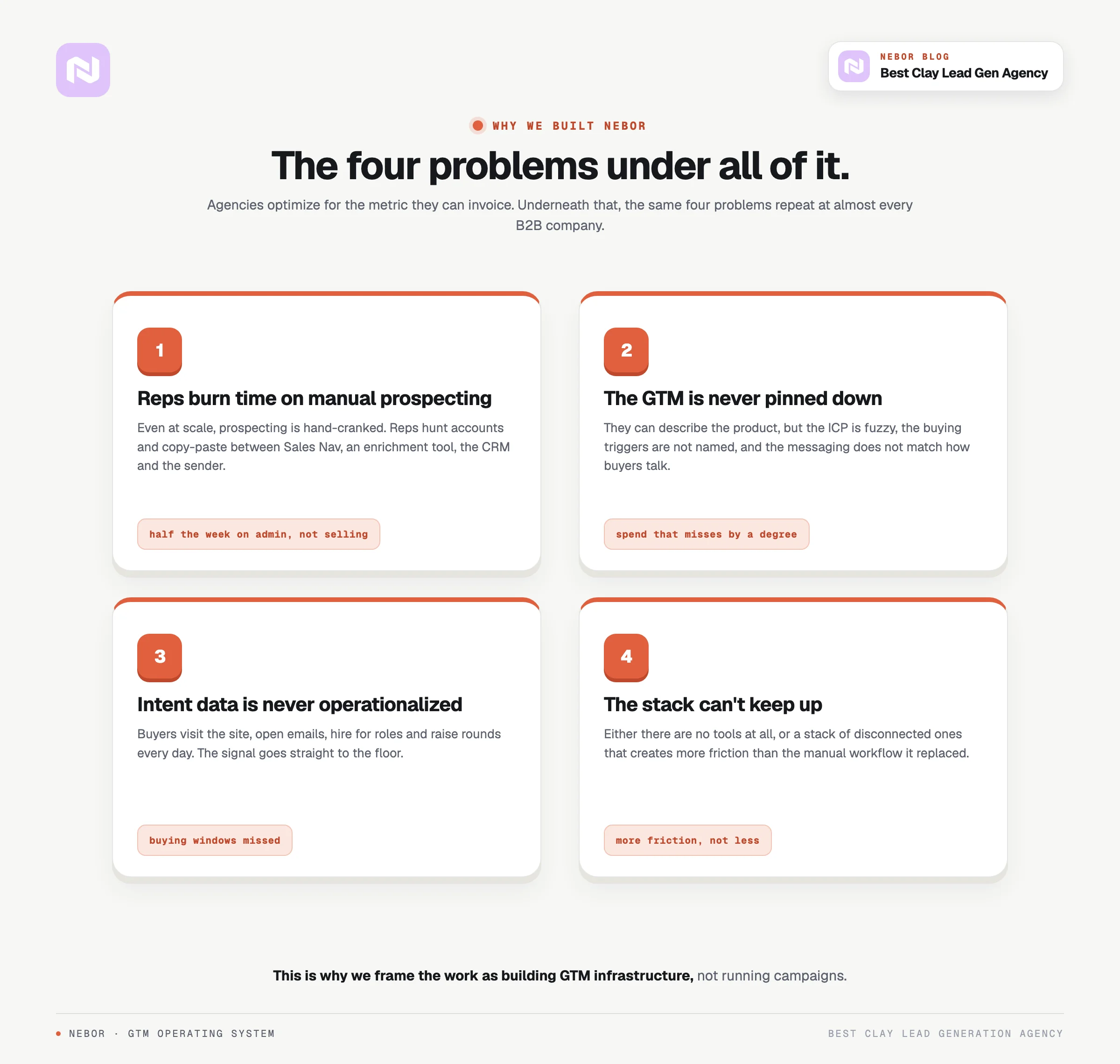
1. Sales teams burn enormous time on manual prospecting. Even at corporate-scale companies, prospecting is still hand-cranked.
Reps hunt for accounts, track job-change signals on LinkedIn one tab at a time, and copy-paste between Sales Navigator, an enrichment tool, the CRM, and the outreach platform.
2. Most leadership teams haven't pinned down their own GTM. They can describe their product, but the ICP is fuzzy, the buying triggers aren't named, and the pain-point language inside their messaging doesn't match the language buyers actually use.
So they spend on outreach that misses by a degree.
3. Businesses don't operationalize intent data. Some teams haven't even mapped what counts as intent for their market.
Meanwhile every day, real buyers are visiting their site, opening sales emails, hiring for relevant roles, and announcing funding rounds, and that signal goes straight to the floor.
4. Companies can’t keep up with sales technology. They either don't have the tools at all, or they have a stack of disconnected ones that creates more friction than the manual workflow it was meant to replace.
This is why we built Nebor differently from the start, and why we frame the work as building GTM infrastructure instead of sending campaigns.
Note: Most Clay lead generation agencies sell you volume, because volume is the easiest thing to bill for. You get bigger lists and more sends every month, and the reply rate stays where it started.
Our team at Nebor came from sales, so we start with the strategy. We work out why someone buys what you sell, design the workflows around that, and only then build them in Clay: who to approach, what makes them worth approaching this week, and what your rep says when they do.
The outreach, the routing and the CRM all follow from that, and we build all of it in your own accounts so it stays yours.
Book a 15-minute call and we'll tell you which of the five evaluation points in this article your current setup would fail.
How Clay becomes the center of the GTM system we build
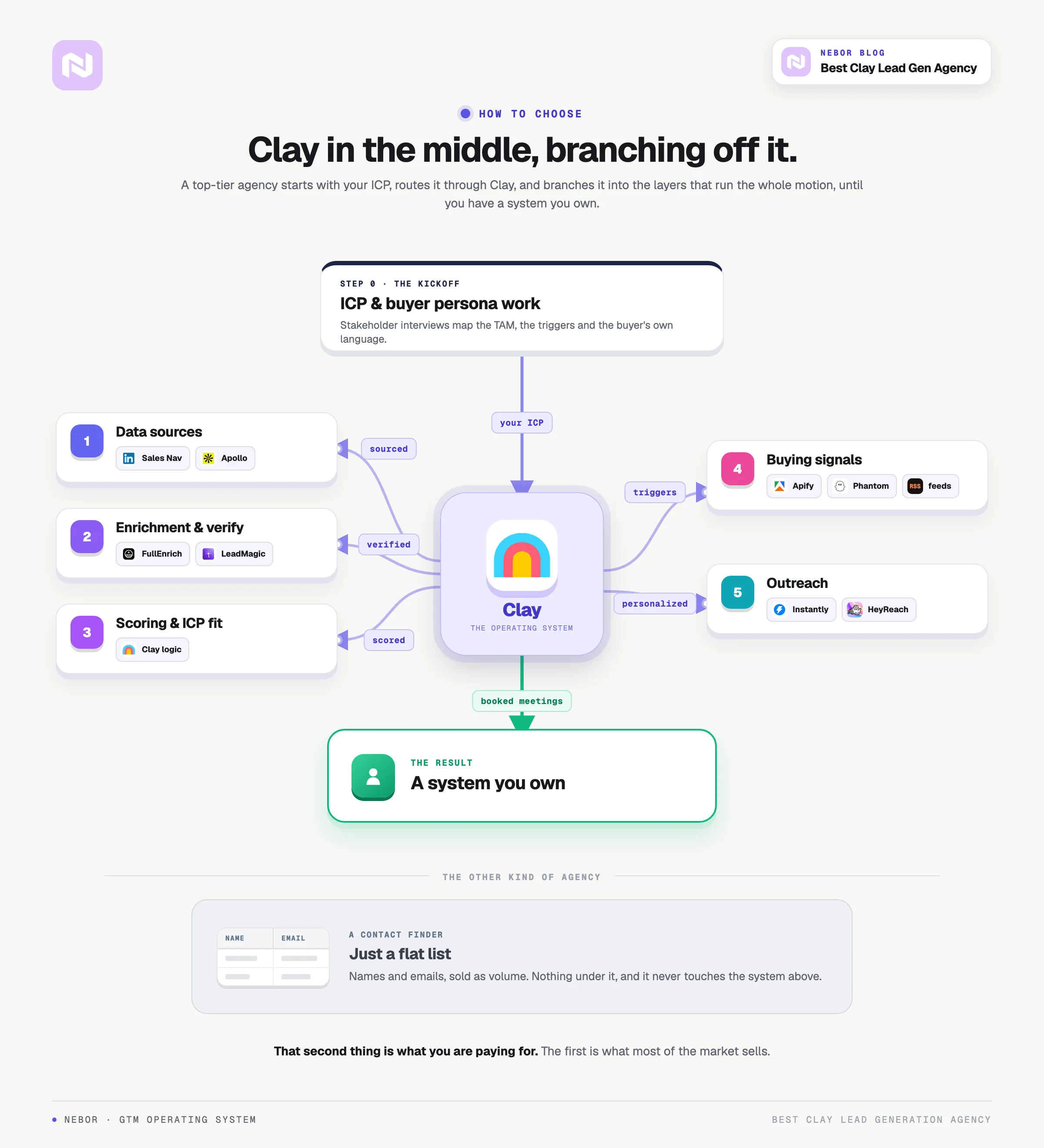
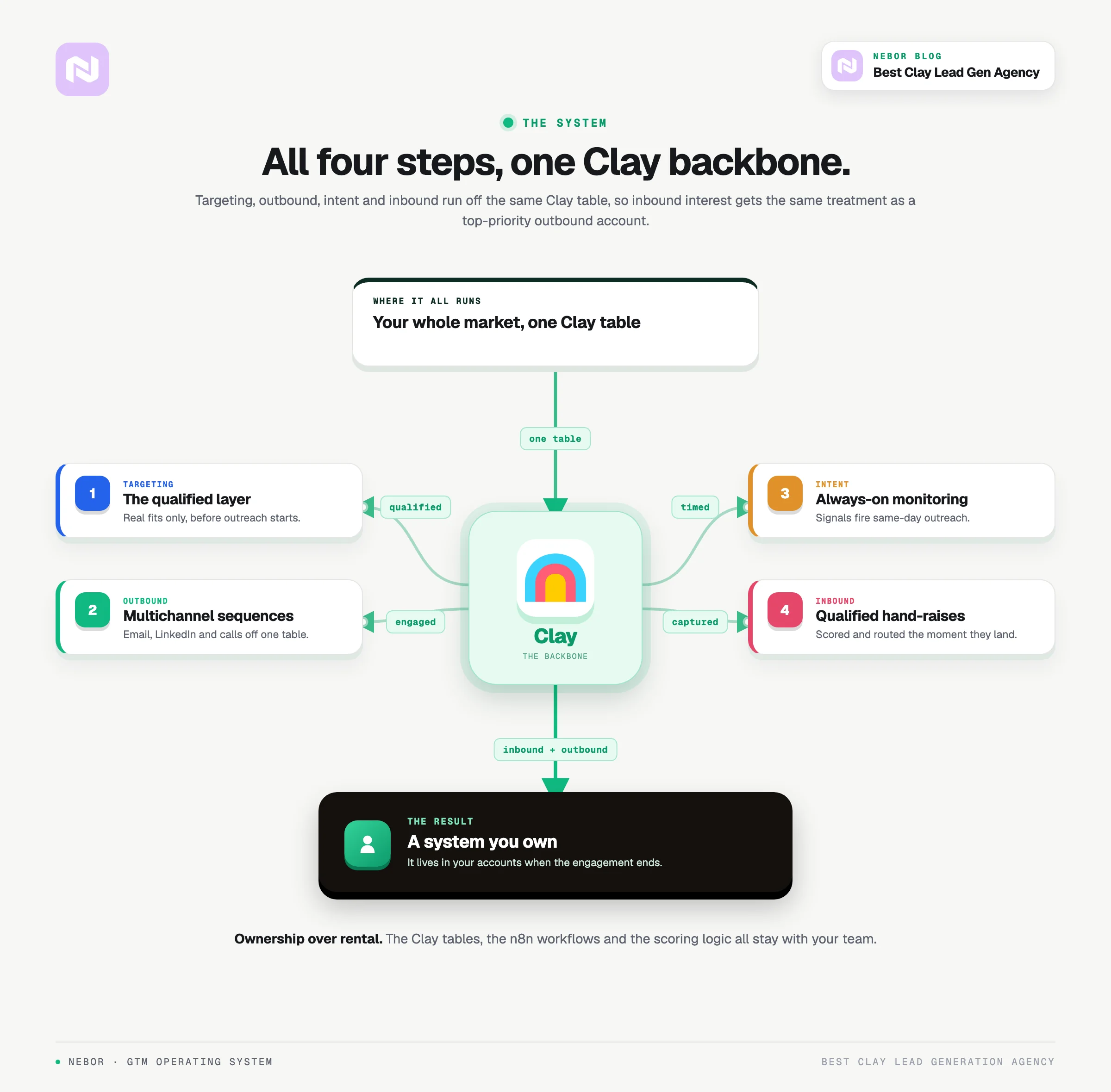
Clay is the operating layer for everything we build. Data lands in it, scoring happens inside it, messaging gets drafted on top of it, and the outreach tools pull from it when it's time to send.
The same table that handles outbound enrichment also catches inbound signals and routes them straight to your reps.
Our Clay work goes deeper than most agencies care to go. Here are the four pieces that matter most.
1. We build custom Clay table structures around the way you actually sell
Most agencies set up a single flat Clay table per campaign and call it a day. We build multi-layered tables where each layer corresponds to a real qualification rule we agree on with you up front. The table is the thinking, the outreach is just the execution.
For one client targeting event hosts, we built Clay automations that verify whether each prospect is actually hosting events this year, count their exhibitors, and check for sponsor presence on autopilot. We never push a lead into outreach unless it clears every layer.
By the time a contact leaves the table for outreach, your reps already know it's worth a meeting.
2. We wire Clay into the rest of your stack as one connected loop
Clay alone won't power a full outbound system. Most agencies stop at the basic native connectors and call the integration done. We treat Clay as the hub of a wider system that automates the prospecting motion end to end, and the integration work is where most of the real value lives.
Here's what the full integration map looks like.
Data sourcing. We start by mapping the niches your buyers actually live in. For some clients that's LinkedIn Sales Navigator.
For others it's a niche directory or industry platform. We use tools like PandaMatch for lookalike modeling and Telescope for hyper-specific ICP discovery, and when the right source lives somewhere unusual, we'll write a custom scraper to pull from it directly into Clay.
Enrichment and waterfalling. Clay routes each contact through a chain of LeadMagic, Hunter, FullEnrich, LeadsFactory, and Findymail, so we get the most accurate email and phone match without burning through credits.
Validation and deliverability. We pass every record through do-not-contact suppression and a deliverability check via BounceBan, DeBounce, or ZeroBounce before pushing it into the outreach platform.
Outreach orchestration. Clay pushes natively into Instantly for email and into HeyReach for LinkedIn. The connection between Clay and HeyReach goes through a custom n8n workflow we built, so message variables, sequence triggers, and status updates flow in both directions and the campaign can self-correct in real time.
Intent monitoring. We use PhantomBuster and Apify to scrape buying signals on a schedule, push the resulting accounts into Clay, enrich them, and send outreach the same day the signal lands.
The connections between the tools matter more than the tools themselves. The same prospect gets sourced from one platform, enriched through five APIs, validated for deliverability, and pushed into outreach. That same prospect should also flow back into Clay with reply data, campaign status, and meeting-booked timestamps. That round trip is what most agencies skip, and it's what turns a stack of disconnected tools into a system you can actually build a business on.
3. We use AI inside Clay to write personalized messages at the prospect level
Templated cold outreach is dead, and most prospects can spot a generic message before they finish the subject line. We use Claude and ChatGPT inside Clay to draft messages that reference real things about each prospect.
The data feeding those AI calls comes from the same waterfall we use for enrichment. We pull LeadMagic, FullEnrich, and Findymail on the contact side, then apply Clay's own enrichments on the company side to pick up recent funding, recent hires, and whatever the company has actually shipped or announced in the last quarter.
When that data is in the table, the AI calls have something specific to work from. The first line of every email pulls from a real fact about the buyer's company instead of a guessed-at compliment.
We sometimes let the AI write the whole message. We sometimes let it draft the first line and write the rest by hand. The right balance depends on how complex your sale is.
Clay also lets us segment the table and build different message paths for different buyer types.
For one event-tech client, when the system detects that a target company holds events with sponsors, it routes the prospect into a sponsor-revenue pitch.
When the target hosts events without sponsors, it routes into the registration-experience pitch. Same campaign, two messaging paths, both working off the same enriched table.
4. We turn intent data into outreach the same day the signal lands
Intent data is a buzzword at most agencies. The actual implementation ends at a dashboard nobody checks, with maybe a handful of tracked page visits underneath.
Real intent automation is different. We build Clay workflows that catch real buying triggers and send outreach the same day the signal lands.
Job postings are the simplest example. When a target company posts a role that signals demand for what you sell, our Clay automation pulls the company into the table, enriches the right contacts, validates their emails, and pushes them into a personalized sequence built around the hire. The trigger-to-touch can happen inside an hour.
What we monitor depends on what you sell. A client targeting high-growth startups gets funding-round triggers. For a real estate tech vendor we work with, the trigger is property development announcements.
Enterprise-focused clients lean on profit margin shifts inside their target accounts. The principle is the same in every case. Catch a real moment of buying intent, and reach out before the buyer starts a vendor search.
Sales automation workflows like these repeat on a schedule, every day, without anyone watching the dashboard.
Your reps don't see the prospect until the system has verified the signal and pushed the outreach. By the time it lands in their pipeline, the conversation is already started.
The 4-step Clay-powered process we build on every engagement
Here's the actual end-to-end process we follow for clients. Each step builds on the previous one, and by Step 4 the inbound and outbound sides of the operation are working off the same Clay tables.
Step 1. We build the ICP and the targeting layer inside Clay
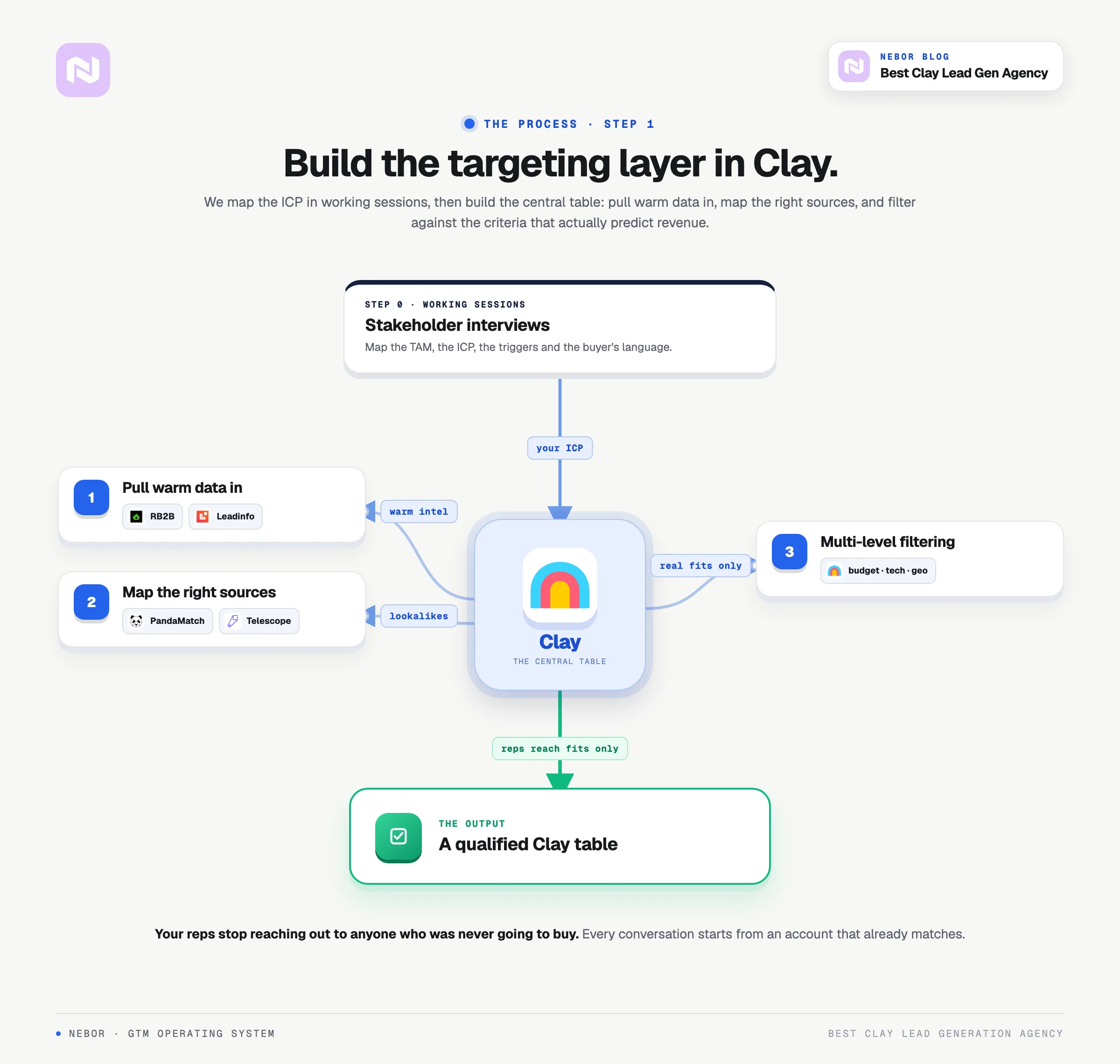
We start with stakeholder interviews to map the actual value of your product and the specific pains it solves. These are working sessions, not surface-level briefs. By the end of them we have the TAM, the ICP, the buying triggers, and the language your buyers use named in plain terms.
Then we build the central Clay table that carries the rest of the engagement. Inside Clay, the work breaks into three pieces.
First, we pull your existing data into the table. CRM contacts, website visitors via RB2B and Leadinfo, LinkedIn followers, and prior campaign history all flow in so we can build the prospect list on top of warm intelligence instead of starting from cold.
Second, we map the right data sources for your ICP. Most agencies default to Sales Navigator and Apollo and stop there.
We start with PandaMatch to find lookalikes of your best current customers, then layer specialized sources that fit your exact buyer.
For some clients that means niche industry directories. For others it means writing custom scrapers against the platforms where your buyers actually live.
Third, we apply multi-level filtering. Data sources are never accurate enough on their own, so we layer Clay workflows that verify each prospect against the specific qualification criteria for your business.
Budget thresholds, tech stack, hiring patterns, and geography are all examples. Whatever filters actually predict revenue for you, we code into the table.
What this gets you is straightforward. Your reps stop reaching out to anyone who was never going to buy in the first place, and the conversations they do start come from accounts that already match the buying profile.
Step 2. We automate multichannel outreach off the same Clay tables
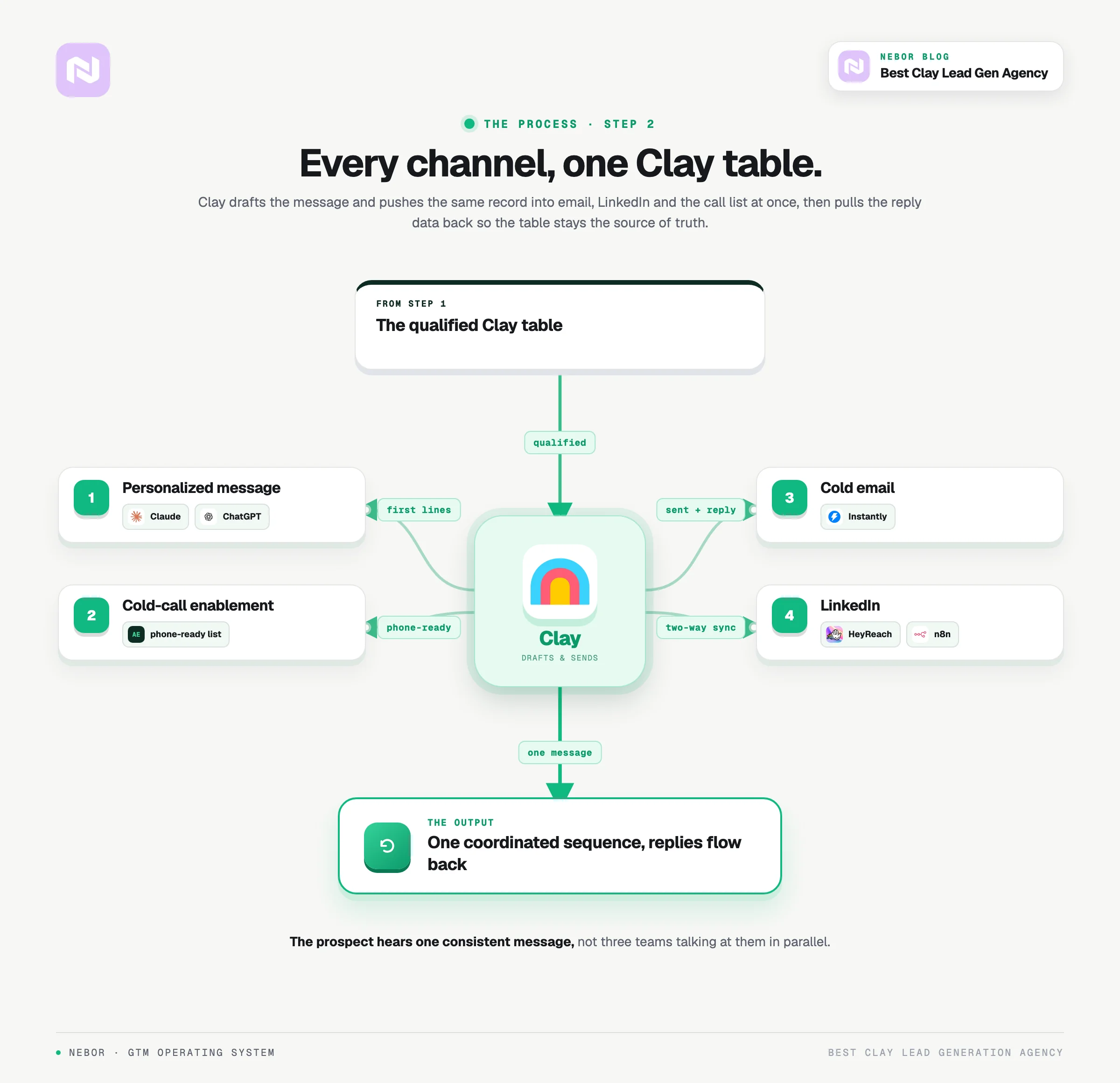
The qualified Clay table from Step 1 becomes the source for every outbound channel. The same prospect data flows into email, LinkedIn, and cold-call enablement in parallel. The reply data flows back into the same table.
Personalized message generation. As covered in the Clay deep-dive above, every message draft starts inside Clay using the native AI integrations and the enriched company-side data. The first lines reference real intel about the buyer, not template variables.
Email sending via Instantly. Once the table is ready, we push it into Instantly using the native integration. Each campaign uses the personalization variables we wrote inside Clay.
We also pipe Instantly's campaign status (delivery and reply) back into a Clay column matched on email, so the table stays the single source of truth for the campaign.
LinkedIn outreach via HeyReach. HeyReach doesn't have a native Clay integration, so we built a custom n8n workflow that handles the connection.
Webhook out from Clay, into n8n, into HeyReach with the right contact fields and the right sequence trigger. The connection works both ways, so HeyReach activity flows back into the Clay table alongside the email signal.
Cold-call enablement. When you'd rather your AEs handle outreach themselves, we hand them an enriched, phone-ready call list out of Clay instead of sending the campaigns ourselves.
Each row carries the contact details, the conversation starter pulled from the company-side data, and the intent context that triggered the outreach. Sales gets a list that already does the prep work.
Step 3. We automate intent monitoring and the outreach that follows it
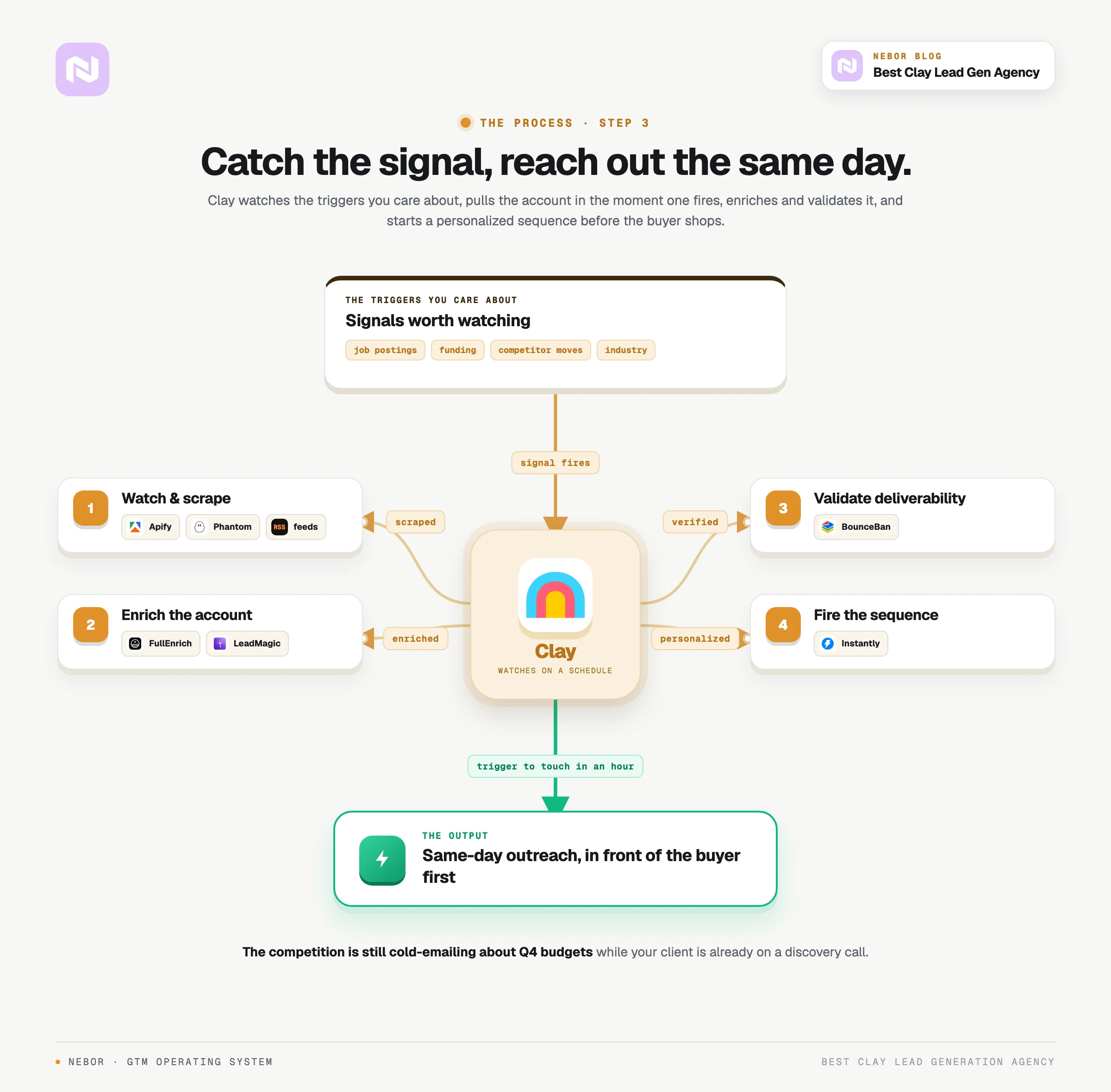
This is the layer where Clay does the heaviest lifting. We build workflows that watch the signals you care about on a schedule, push qualifying accounts into the table the moment they land, enrich them, and start outreach the same day.
The signals worth watching depend on what you sell. Here are the four we set up most often.
Job postings, when a company posts a role that signals demand for your product.
Funding rounds, when an account in your ICP closes new capital.
Competitor moves, when one of your competitors gets acquired or shuts down. Their customers are about to start a vendor search.
Industry-specific triggers, anything from new property development announcements to regulatory changes to product launches that signal a buying moment.
Here's what one of those workflows actually looks like in practice. For a client selling AI-powered furnishing solutions, we set up Apify and PhantomBuster to scrape online publications that report new real estate projects.
The moment a new development is announced, we push the property and the developer into Clay.
Clay then enriches the developer's contact info, applies the deliverability check, and sends a personalized outreach sequence that positions our client as the furnishing partner for the project.
Our client gets in front of the developer weeks before the developer starts a vendor search. The competition is still cold-emailing about Q4 budgets while our client is already on a discovery call.
Step 4. We handle inbound qualification and the sales handoff off the same Clay tables
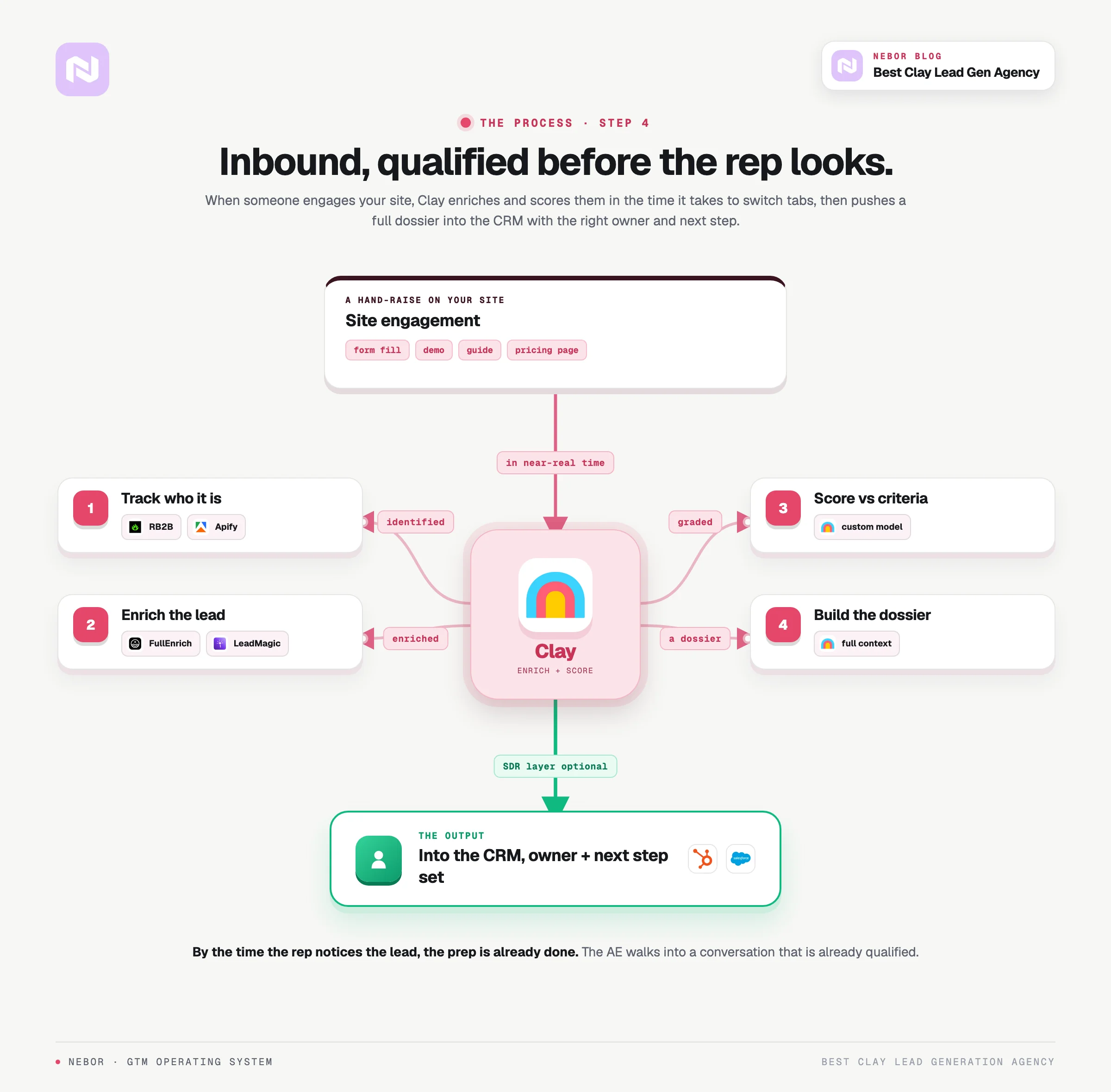
The Clay engine doesn't only cover outbound. The same enrichment, scoring, and routing logic catches your inbound interest the moment it hits your site, so a hand-raise gets the same treatment as a top-priority outbound account.
Here's what the full inbound flow looks like.
RB2B and Apify track engagement on your site. When someone fills out a form, books a demo, downloads a guide, or hits the pricing page, we push the visitor and their company into Clay in near-real time.
Clay enriches the inbound lead with the same depth we apply to outbound. Contact-side waterfall, company-side intel, intent context (which page, which content, which campaign).
Then a custom scoring model written into the table grades the lead against your fit and signal criteria. We set the thresholds with you up front, and the scoring happens the moment the data is in.
Once the lead clears the threshold, Clay auto-generates a full lead dossier and pushes the lead into your CRM with the right owner, the right next-step task, and a conversation starter your rep can actually open the call with.
The whole sequence finishes in the time it takes for someone to switch tabs after submitting a form. By the time the rep notices the lead, the prep is already done.
This is the move that makes the SDR layer optional. When you've automated inbound qualification this deeply, you don't need a row of SDRs reading enrichment dashboards by hand.
The workflow handles the reading, and your AEs walk into conversations that are already qualified.
Each of these four steps has more depth than this article can carry. Here’s a quick workflow that breaks down the many things involved in the process:
If you want to dig further, our post on the sales automation companies space walks through the broader agency landscape, and our take on why most Clay implementations fail covers what to fix before adopting the tool at all.
What this approach gets you that most Clay agencies cannot
We've never thought of this as a campaign service. We build a system that carries the customer acquisition motion for you, so the wins compound month after month instead of disappearing the day the engagement ends.
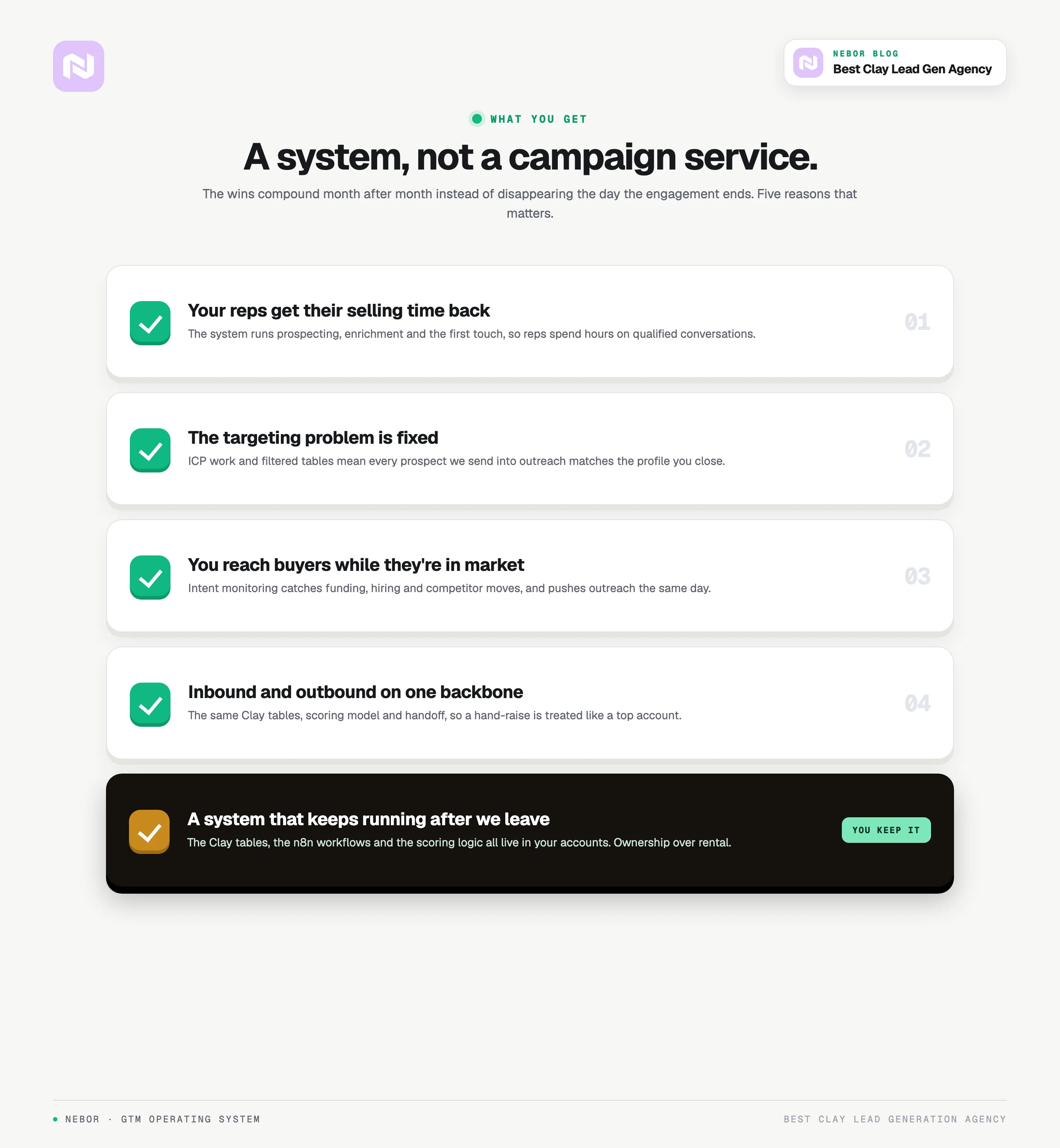
Here are five reasons that matters in practice.
1. We strip the manual work that's eating your reps' selling time
Most sales reps spend more than half their week on admin instead of selling. Our Clay automation handles the prospecting, the enrichment, and the first outreach touch on its own, so your reps spend their hours on conversations with already-qualified leads.
2. We fix the targeting problem that drains your outbound budget
Random list-building and spray-and-pray are the two biggest reasons outbound budgets get burned. Our ICP work, data-source mapping, and filtered Clay tables make sure every prospect we send into outreach matches the buying profile you actually close. The conversations your reps start are with people who fit, not with a wider audience that wasted the credits.
3. We get to buyers while they're still in market for what you sell
Buyer timing is the variable that swings the most outcomes in outbound.
Our intent monitoring layer catches companies while they're showing real buying signals like funding rounds, hiring waves, role-specific job posts, or competitor moves, and pushes the outreach the same day.
Your reps land in conversations where the buyer hasn't started shopping yet.
4. We unify your inbound and outbound on the same Clay backbone
Most companies keep inbound and outbound as two separate disciplines with two separate stacks. We work both off the same Clay tables, with the same enrichment logic, the same scoring model, and the same handoff to your AEs.
Inbound interest gets the same treatment as a top-priority outbound account, and outbound prospects who eventually raise their hand on your site flow through the same loop.
5. We build a system that keeps going after the engagement ends
Most agency engagements end the day the retainer stops. Ours don't. The Clay tables, the n8n workflows, the integrations, and the scoring logic all live in your accounts when we're done.
Your team can operate it, extend it, or hand it to a new agency. That's ownership over rental, and it's the version of this work we believe in.
Work with Nebor to get B2B leads and pipeline generation on autopilot
If you've read this far, you probably have a system in mind that you've been wanting to build but haven't found the right team for. That's the kind of engagement we take. Here what the entire workflow looks like and handles:
We're a small team based in Amsterdam. Andrew and Yannick lead the firm, and we work with B2B companies who want a Clay-powered GTM system they own at the end of it.
We're salespeople first, automation builders second. We pressure-test every workflow we ship in our own outbound before it ever reaches a client engagement.
If you’d like to talk through what this would look like for your team, find Andrew and Yannick on LinkedIn or send a note via our site. We'll be straight with you about whether the fit is right.
Note: Most Clay lead generation agencies sell you volume, because volume is the easiest thing to bill for. You get bigger lists and more sends every month, and the reply rate stays where it started.
Our team at Nebor came from sales, so we start with the strategy. We work out why someone buys what you sell, design the workflows around that, and only then build them in Clay: who to approach, what makes them worth approaching this week, and what your rep says when they do.
The outreach, the routing and the CRM all follow from that, and we build all of it in your own accounts so it stays yours.
Book a 15-minute call and we'll tell you which of the five evaluation points in this article your current setup would fail.


Related Articles


By clicking Sign Up you're confirming that you agree with our Terms and Conditions.