

In this post:
Identity resolution is the process of stitching together the scattered signals a person or company leaves behind, like website visits, emails, and ad clicks, into a single connected profile of who they really are. It turns a pile of disconnected interactions into one clear picture of a real buyer or account.
Most of what happens in your funnel is anonymous and fragmented. The same company visits your site on Monday, clicks an ad on Wednesday, and opens an email on Friday, and to most systems those look like three unrelated strangers instead of one account circling a purchase.
Identity resolution is what connects those dots. It's the quiet infrastructure that lets you see the real buyer behind the anonymous activity, which is what makes personalized outreach, accurate attribution, and account-level visibility possible at all.
TL;DR
Identity resolution is the practice of connecting scattered identifiers, like cookies, IP addresses, emails, and device signals, into one unified profile of a person or, in B2B, a company. It answers who is actually behind all this activity.
Most of your funnel is anonymous and fragmented, so without it you see disconnected events instead of real buyers. In B2B specifically, it powers deanonymizing the companies visiting your site, even before anyone fills out a form.
The practical payoff is account-level visibility, where every anonymous visit, click, and open gets tied to a real company. That's what lets you prioritize accounts, personalize outreach, and attribute what's working, instead of flying blind through a sea of unknown traffic.
So what is identity resolution exactly, and what problem does it solve?
Identity resolution is the process of figuring out that many separate signals belong to the same person or company. It takes the fragments someone leaves across your systems and resolves them into a single, unified identity.
Those fragments are everywhere, like a cookie on your website, an IP address, a hashed email, a device fingerprint, and a CRM record, each of which is just a partial clue on its own.
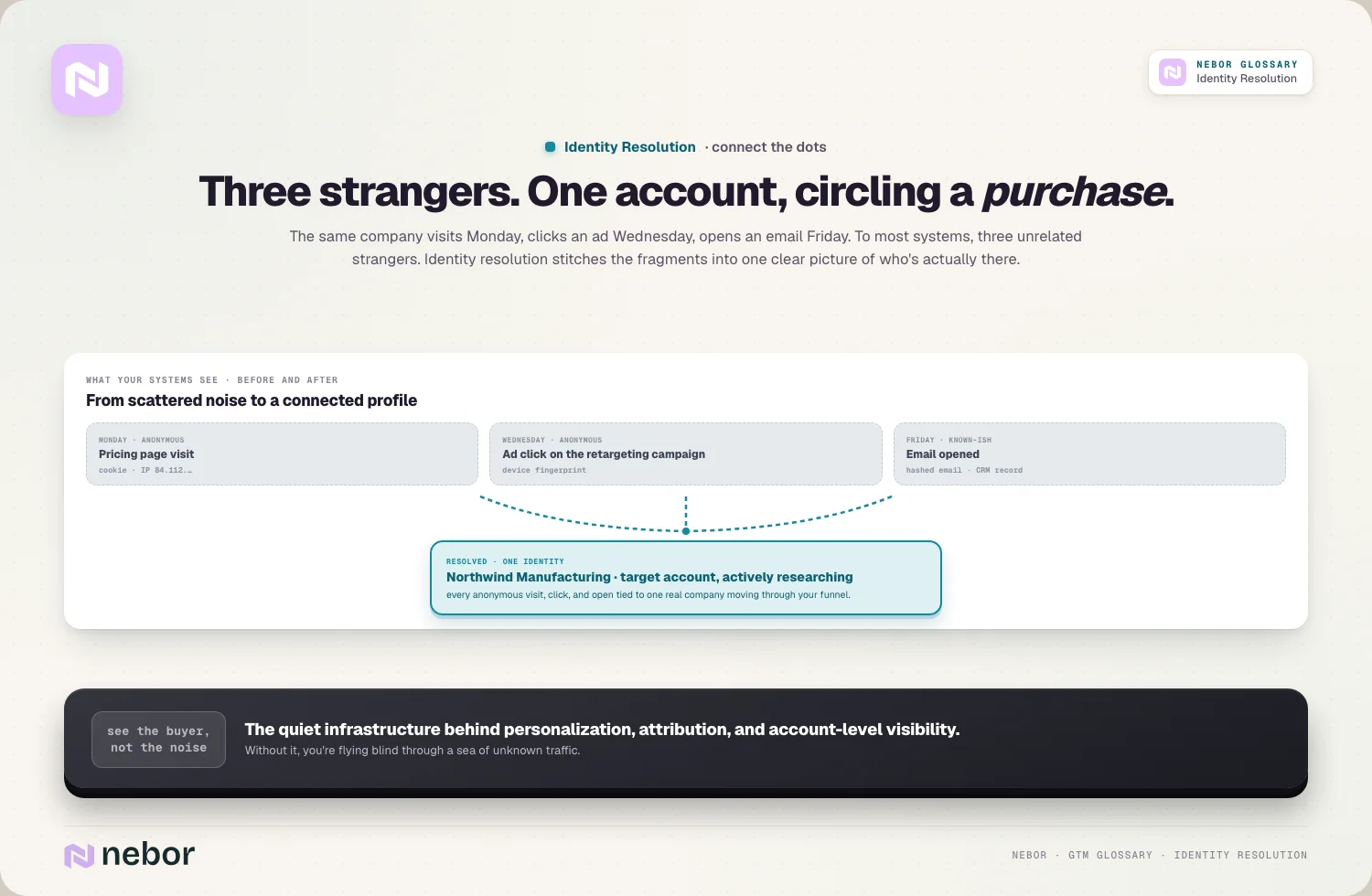
Identity resolution is the work of matching those clues, so the anonymous session, the ad click, and the known contact are recognized as one account rather than three unrelated events. The output is a connected profile instead of scattered noise.
The job, said plainly, is connecting the dots between everything a buyer does.
Without it, your systems see a crowd of strangers who each do one thing and vanish, and with it, you see that those actions were really one company moving through your funnel, which is a completely different and far more useful picture.
Why is so much of your funnel anonymous in the first place anyway?
To understand why identity resolution matters, it helps to see why so little of your buyer activity comes pre-labeled. Most of what happens never announces who it is.
The reality is that buyers research quietly long before they identify themselves. They visit your site, read your content, click your ads, and compare you to competitors, all without filling out a form or giving you their email.
That means the bulk of their journey stays invisible to you.
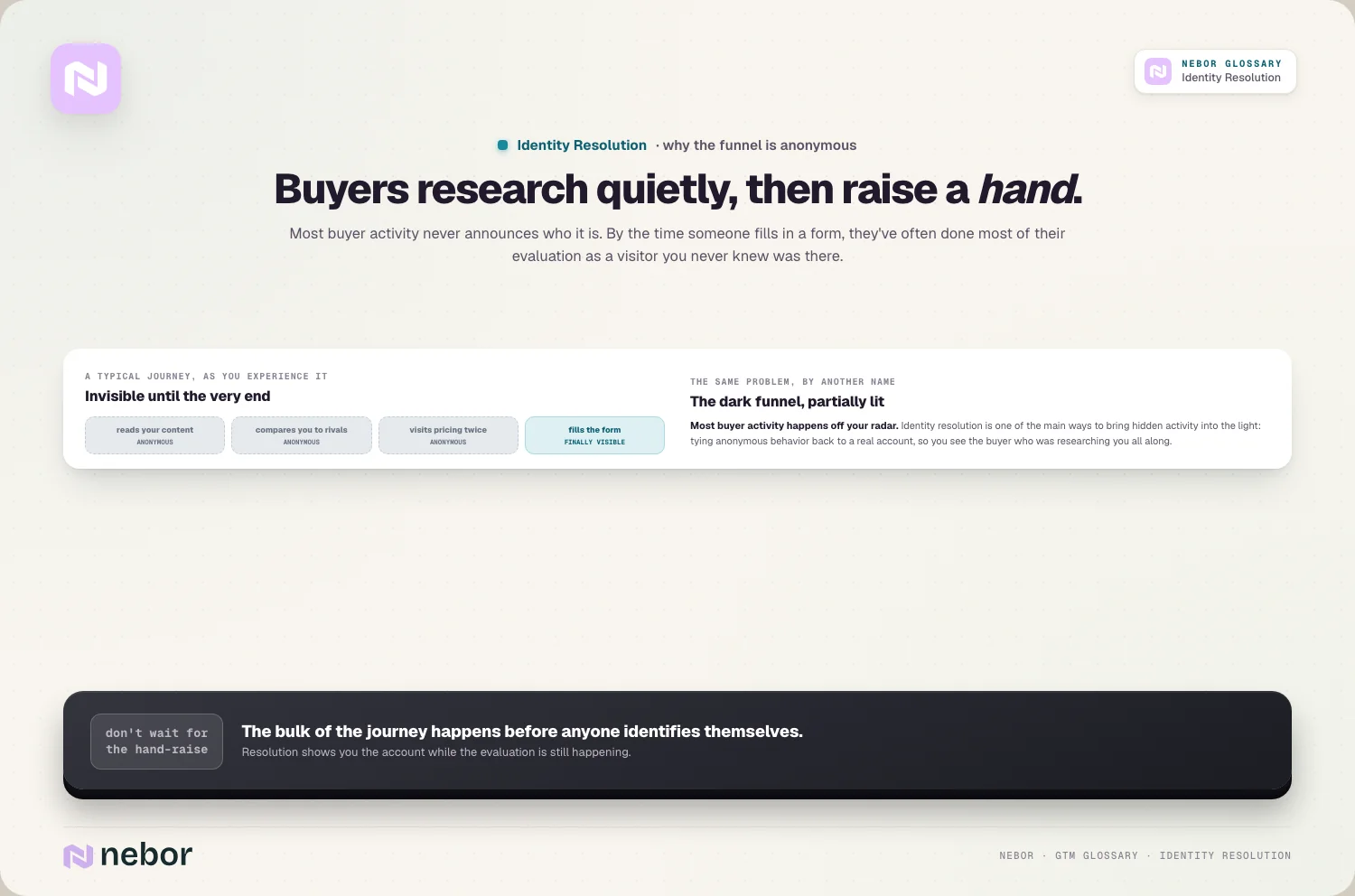
By the time someone finally raises their hand, they've often done most of their evaluation as an anonymous visitor you never knew was there.
This is the same problem as the dark funnel, where most buyer activity happens off your radar.
Identity resolution is one of the main ways to bring some of that hidden activity into the light, by tying anonymous behavior back to a real account so you can see the buyer who was researching you all along, instead of waiting for them to reveal themselves.
How does identity resolution work, deterministically and probabilistically?
Identity resolution comes down to matching, and there are two main ways to do it. Knowing the difference helps you understand why some matches are rock-solid and others are educated guesses.
Deterministic matching uses hard, verified identifiers, like a hashed email or a confirmed login, that point to one specific identity with near-certainty.
These matches are highly accurate, but they're scarce, because most anonymous activity arrives with no verified identifier attached.
Probabilistic matching fills the gaps, using statistical inference across signals like IP address, device patterns, and behavior to conclude that two interactions are very likely the same entity, with less certainty but far more coverage.
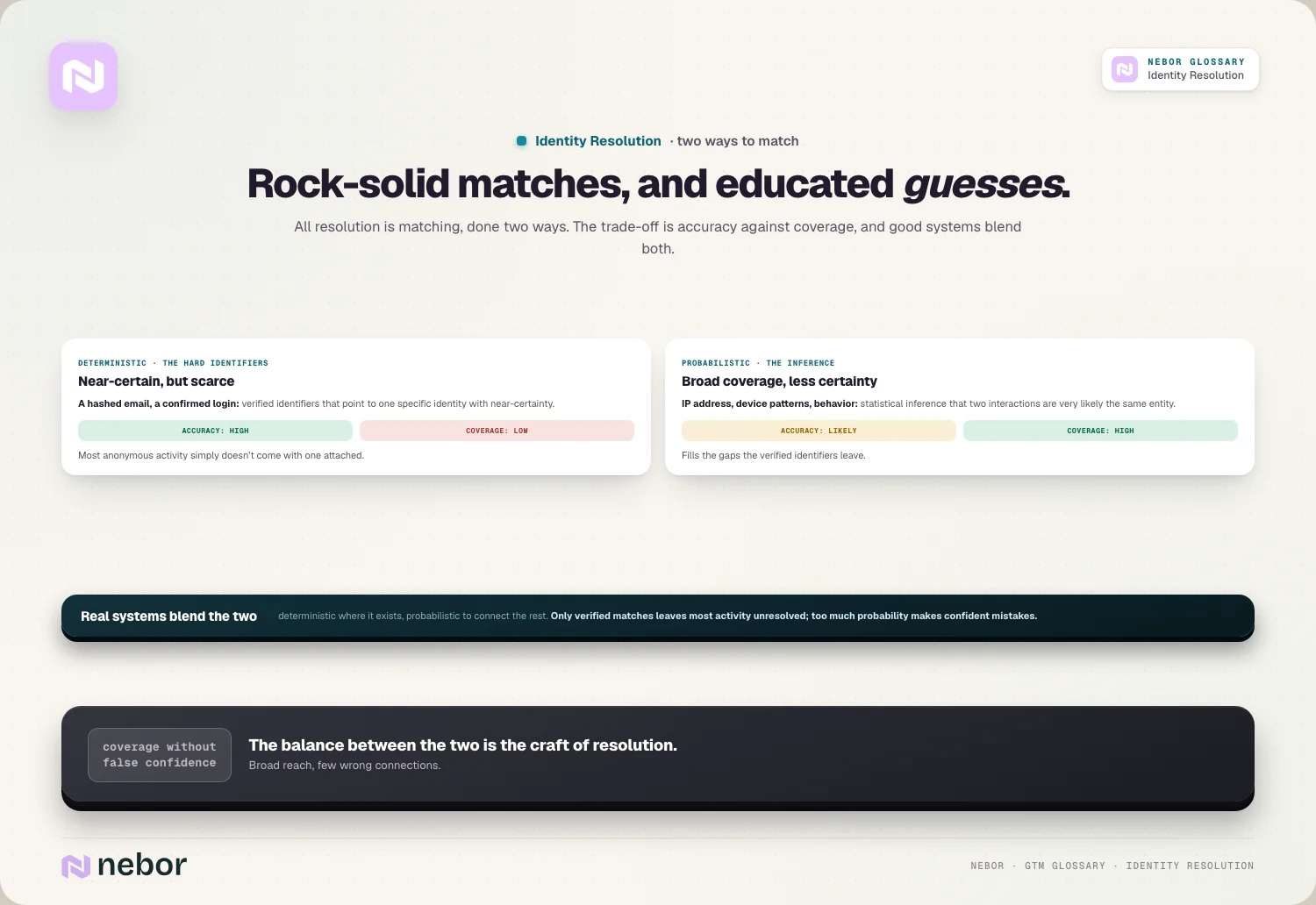
Most of the real systems we work with blend the two, using deterministic matches where they exist and probabilistic ones to connect the rest.
The trade-off is accuracy against coverage, because leaning only on verified matches leaves most activity unresolved, while leaning too hard on probability risks wrong connections.
A good identity resolution approach balances them, getting broad coverage without making too many confident mistakes.
How is B2B identity resolution different from the B2C version?
Identity resolution works differently in B2B than in consumer marketing, and the distinction matters for what you can do with it, because the unit of identity is different.
In B2C, identity resolution is usually about the individual person, stitching one shopper's activity across devices into a single consumer profile.
In B2B, the focus is the account, because what you mostly care about is which company is showing interest, without needing to pin down one specific individual.
This makes B2B identity resolution more about resolving anonymous activity to a business than to a named person, which is also why it can lean heavily on company-level signals like IP address.
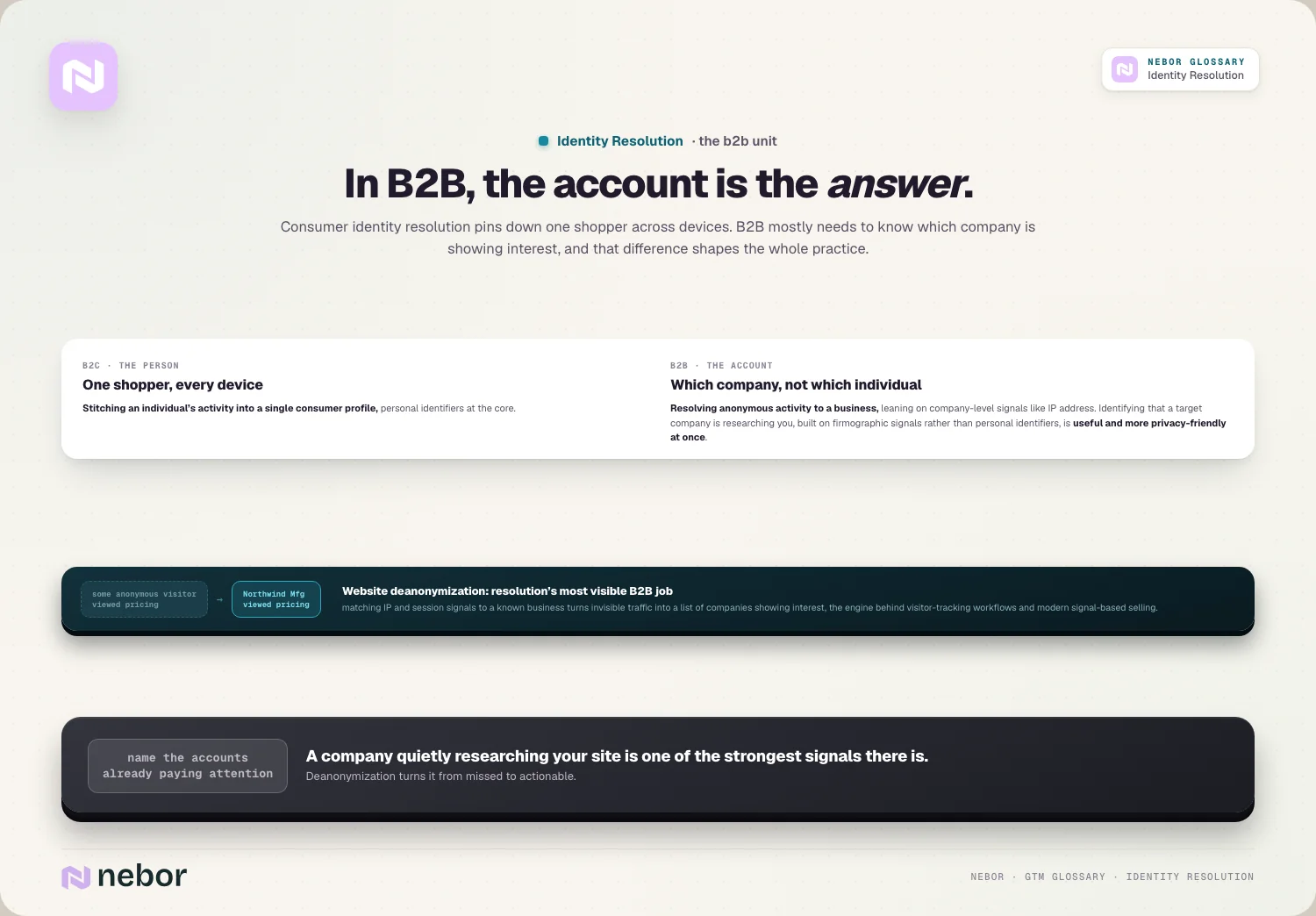
This account-level focus is what makes B2B deanonymization both useful and more privacy-friendly.
Identifying that a target company is researching you, built around firmographic signals rather than personal identifiers, gives sales and marketing something to act on without resolving down to an individual's private identity.
The account is usually the right and sufficient unit for B2B, which shapes how the whole practice is built.
What is website deanonymization, and how does it fit in here?
Website deanonymization is the most common and visible use of identity resolution in B2B, so it deserves a section of its own. It's identity resolution pointed at one specific problem.
Deanonymization is the process of identifying the companies visiting your website even when they never fill out a form, by matching their IP address and other session signals to a known business.
Instead of seeing that some anonymous visitor looked at your pricing page, you see that a specific target account did, which turns invisible traffic into a list of companies showing interest.
This is exactly the engine behind the website visitor tracking workflow we build for clients, where anonymous sessions become named accounts you can act on.
The value is obvious once you see it, because a company researching your site on its own initiative is one of the strongest signals you can get.
Deanonymization turns that signal from something you miss into something you can follow up on, and that's the reason it's become a core part of modern signal-based selling.
It's identity resolution doing the specific job of naming the accounts already paying attention to you.
How does identity resolution power personalization and outreach?
Identity resolution isn't just about seeing who's there, it's what makes relevant, timely outreach possible. You can't personalize for someone you can't identify.
Once you've resolved an anonymous visitor to a real account, you can act on what they actually did, like reaching out about the specific solution they were researching or tailoring a follow-up to the pages they viewed.
That's the difference between a generic message and one that lands because it reflects real behavior, which is the heart of signal-based selling and timely follow-up. The resolved identity is what connects the behavior to a buyer you can reach.
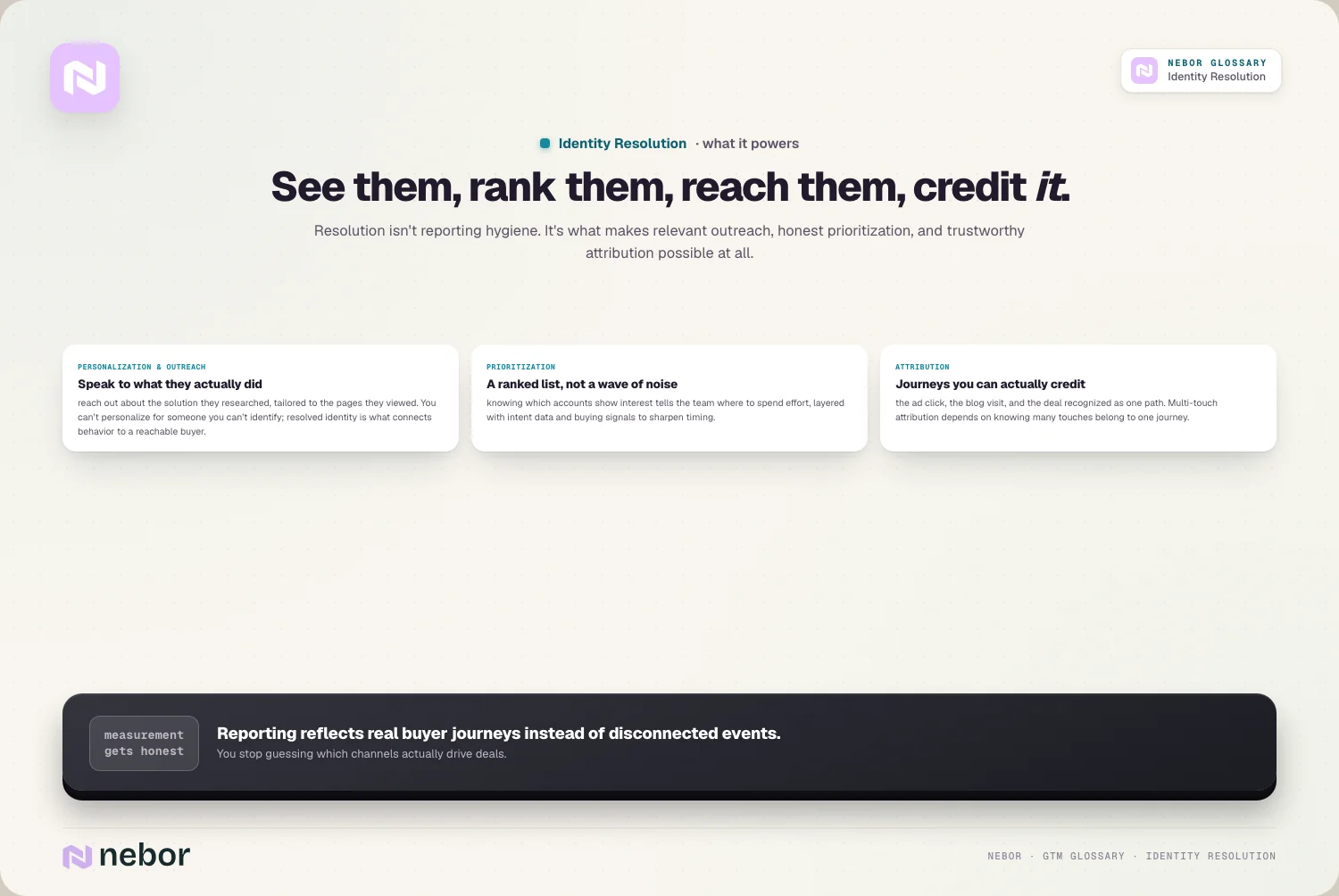
This also feeds your prioritization, because knowing which accounts are showing interest tells your team where to spend their effort.
Identity resolution turns a wave of anonymous activity into a ranked list of real accounts to pursue, often layered with intent data and buying signals to sharpen the timing.
Without it, you'd be personalizing into the dark, and with it, your outreach can reflect what buyers are really doing.
How does identity resolution improve attribution and measurement?
There's a quieter benefit to identity resolution that often gets overlooked, which is that it makes your measurement honest. You can't measure a journey you can't connect.
When a buyer's touchpoints are scattered and anonymous, your attribution breaks, because you can't tell that the ad click, the blog visit, and the eventual deal were all the same account.
Identity resolution stitches those touchpoints to one identity, so you can finally see the path a buyer took and credit the things that influenced them.
This is what makes multi-touch attribution possible, because it depends on knowing that many touches belong to a single journey.
Better measurement leads to better decisions, because you stop guessing which channels and content drive deals.
With identities resolved, your reporting reflects real buyer journeys instead of disconnected events, which tells you where to invest. Identity resolution is the foundation underneath trustworthy attribution instead of being a separate nice-to-have.
How does identity resolution relate to your first-party data?
Identity resolution and first-party data are tightly linked, and the connection matters more as third-party data gets harder to rely on. Each one feeds and strengthens the other.
Every anonymous interaction you resolve to a real account becomes part of your own first-party data, the information you collect directly from your buyers' real behavior with you.
Identity resolution is how you convert the raw, fragmented activity on your own properties into a connected, owned asset, which is increasingly valuable as privacy changes erode third-party tracking.
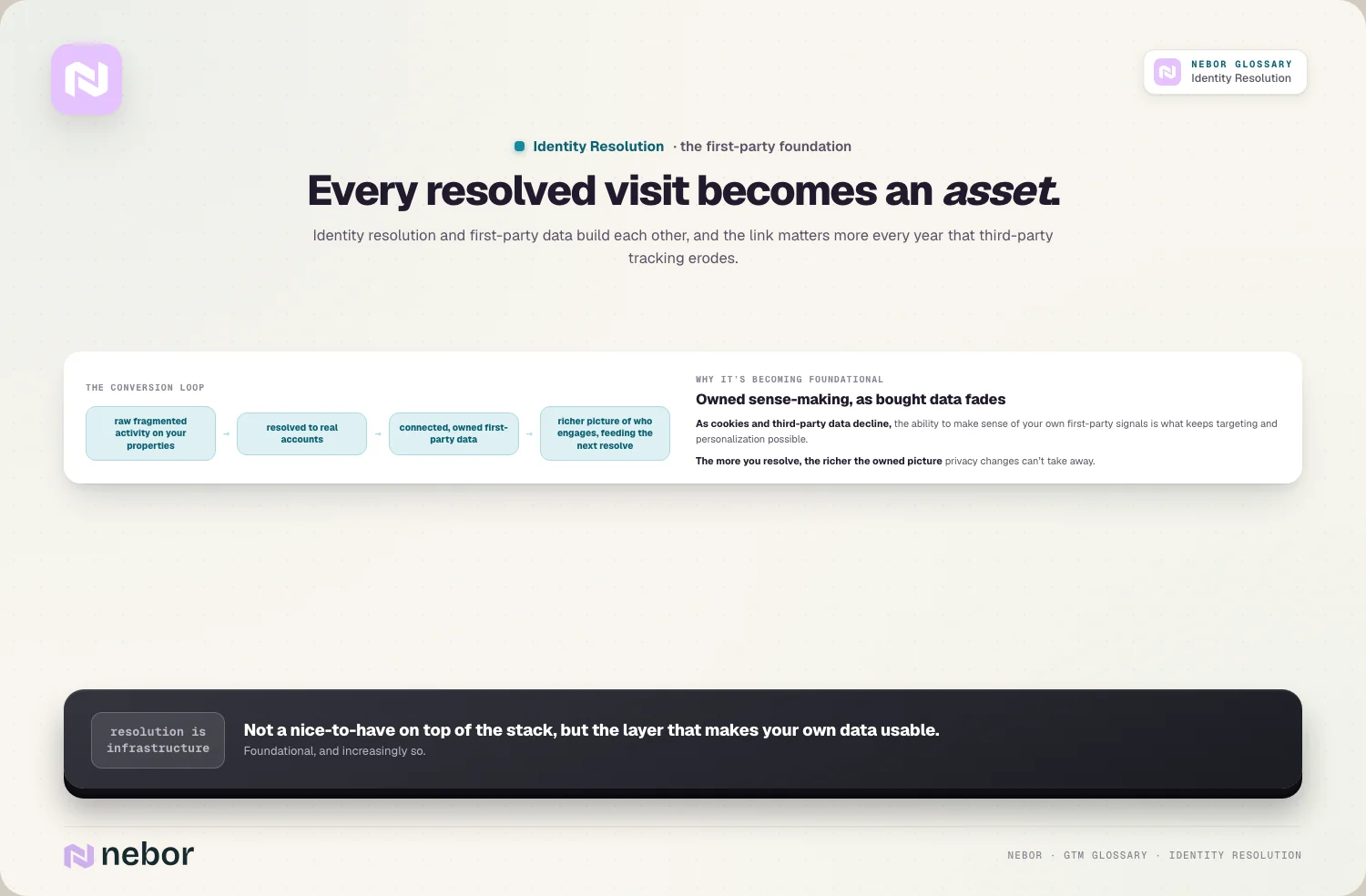
The more you can resolve, the richer your first-party picture of who's engaging with you. This is why identity resolution is becoming foundational instead of optional.
As cookies and third-party data decline, the ability to make sense of your own first-party signals is what keeps you able to target and personalize, and identity resolution is the engine that turns those signals into something usable.
It's how you build a durable, owned understanding of your buyers rather than renting one from data brokers.
Where does identity resolution fit with enrichment and your account data?
Identity resolution and data enrichment often get mentioned together, and they work as neighbors in the same system, doing related but clearly distinct jobs.
Identity resolution figures out who an anonymous interaction belongs to, resolving activity to a specific account. Data enrichment then fills in the details about that account, like its size, industry, and the right contacts, once you know which company it is.
So resolution answers who this is, and enrichment answers what we know about them, and the two together turn an anonymous session into a fully understood, actionable account.
This pairing is what makes a resolved identity genuinely useful. Knowing that a company visited your site matters far more once enrichment tells you it's a perfect-fit account in your target market, which connects directly to your ideal customer profile.
Resolution finds the buyer in the noise, and enrichment makes the buyer worth acting on, and that's the reason serious teams do both.
What are the limits and risks of identity resolution to keep in mind?
Identity resolution is powerful, but it isn't magic, and being honest about its limits keeps you from trusting it too much. It comes with real constraints you should know going in.
The biggest is accuracy, because probabilistic matches are educated guesses that can be wrong, and acting confidently on a misidentified account leads to awkward, off-target outreach.
Coverage is also incomplete, as not every visitor can be resolved, so you'll always see only a portion of your anonymous traffic instead of all of it.
And the practice bumps up against privacy expectations, and that's a big part of why the B2B, account-level approach built on business signals instead of personal identifiers is the responsible way to do it.
The practical takeaway is to treat resolved identities as strong signals instead of certainties, especially the probabilistic ones.
When you use it well, identity resolution gives you a huge edge in seeing your buyers, but treating every match as gospel, or pushing it toward invasive personal tracking, undermines both accuracy and trust.
The discipline is to act on it confidently where it's solid and cautiously where it's inferred.
What are the common identity resolution mistakes teams fall into?
A few mistakes show up when teams adopt identity resolution, and most come from misunderstanding what it can and can't do. Naming them helps you use it well.
The biggest is over-trusting probabilistic matches, treating a statistical guess as a certain fact and reaching out as if you're sure who's behind the activity.
Another one we see constantly is resolving identities but doing nothing with them, paying to deanonymize traffic and then never acting on the accounts it surfaces.
Then there's expecting full coverage and being disappointed that you can't resolve everyone, when partial visibility is still a huge gain over none.
There's also the mistake of treating it as a standalone tool instead of part of a system, so resolved identities never connect to enrichment, scoring, and outreach.
The same habits cure all of them. You act on resolved accounts promptly, trust solid matches more than inferred ones, accept that coverage is partial, and wire resolution into the rest of your motion so the identities you uncover drive action.
Why identity resolution is the difference between seeing buyers and seeing noise
Identity resolution, at bottom, solves a basic problem, that your buyers leave a trail of scattered, anonymous signals that mean little until something connects them.
By stitching those signals into real accounts, it turns a sea of unknown traffic into a clear view of the companies paying real attention to you.
The teams that get value from it use it to bring their dark funnel into the light, resolving anonymous activity into named accounts, then acting on those accounts quickly with relevant outreach and honest attribution.
They build it into their first-party data, pair it with enrichment, and treat strong matches as signals to act on instead of guesses to ignore.
The mindset that works is to stop accepting that most of your funnel has to stay invisible. The buyers are already there, researching you anonymously, and identity resolution is how you finally see them.
That visibility is the difference between marketing into the dark and reaching the real accounts that were interested all along.
Deel dit bericht
Intent
Data
Begrippenlijst
Gerelateerde begrippen
De basis GTM-concepten begrijpen




Klaar om je pipeline te bouwen