

In this post:
Most CRMs are full of half-empty records. A name with no title, an email with no company, an account with no industry or size attached. Data enrichment is how you fill those gaps.
Data enrichment is the process of adding missing or updated information to your contact and account records, pulled from outside sources. It turns a thin record into a complete one, with verified emails, job titles, company details, and more.
It's one of the most foundational things in go-to-market, because almost everything else, your targeting, your scoring, your personalization, depends on the quality of the data underneath it.
TL;DR
Data enrichment means filling in and updating your records with data from outside sources, so a sparse contact becomes a full, usable profile. You start with something you already know, like an email or a domain, and enrichment fills in the rest.
Everything downstream in your motion depends on this data. If your records are thin or wrong, your targeting misses, your personalization falls flat, and your automations act on bad information.
The best enrichment pulls from several sources to maximize coverage, verifies what it finds, and keeps going continuously rather than once. It's the unglamorous foundation that decides how well everything built on top of it performs.
So what is data enrichment actually, and what problem does it solve for you?
Data enrichment is the process of enhancing your existing records with extra, verified information from outside sources. You take what you already have, a partial contact or a bare account, and you complete it.
The problem it solves is simple but expensive. The data you collect yourself is almost always incomplete. A form gives you a name and an email, a list gives you companies with no contacts, and your CRM slowly fills with gaps that make the records hard to use.
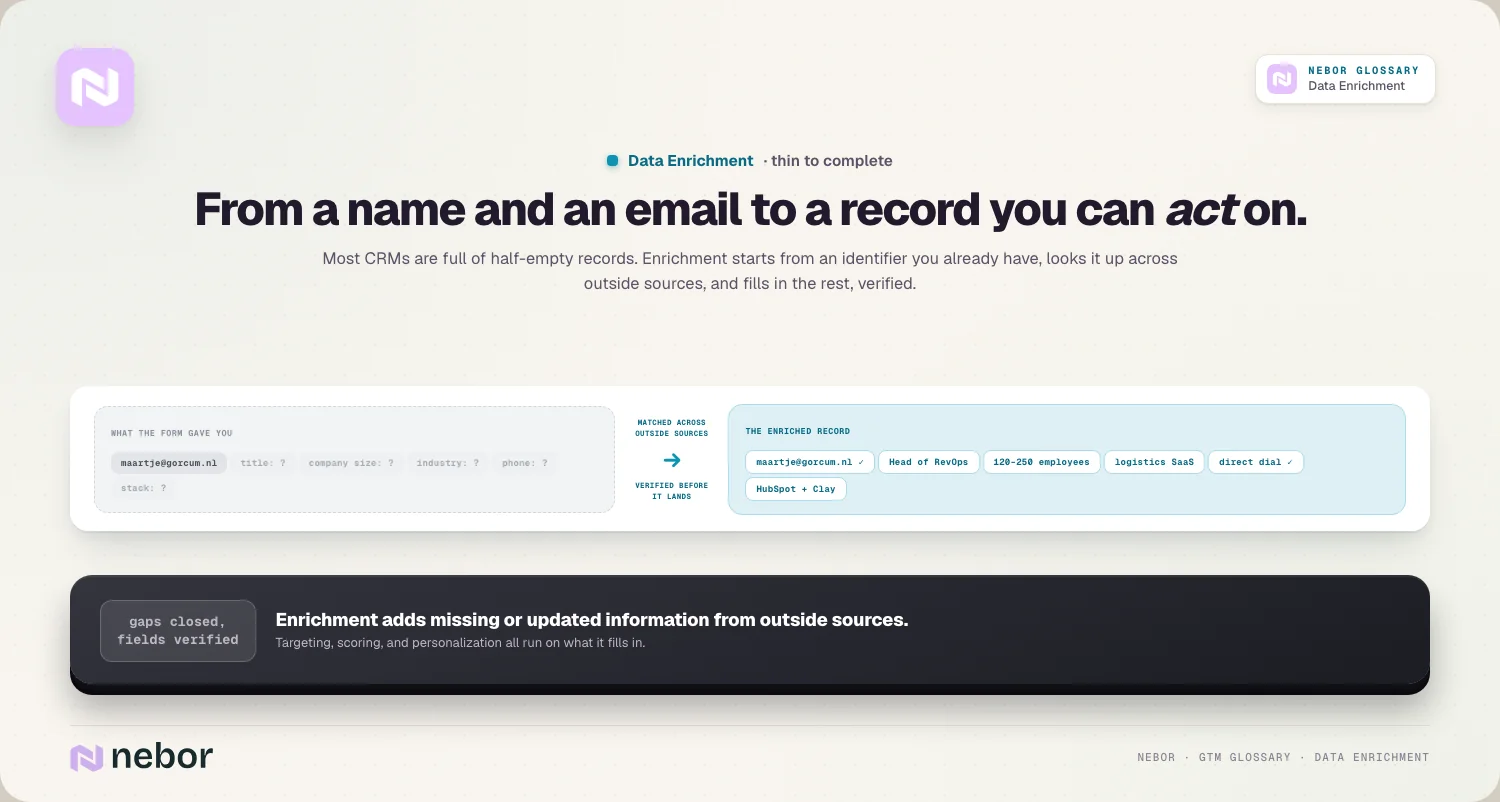
Enrichment closes those gaps one by one. It adds the missing job titles, phone numbers, company sizes, and industries, and it corrects the fields that have gone out of date, so each record is genuinely good enough to act on.
Here's how data enrichment works under the hood, step by step
Under the hood, enrichment is a matching process. It starts with a known identifier you already have, usually an email, a domain, a company name, or a CRM record.
The enrichment service takes that identifier and looks it up across its data sources. When it finds a match, it pulls back the fields you asked for, like a verified email, a direct dial, a job title, or a company's revenue, and writes them onto your record.
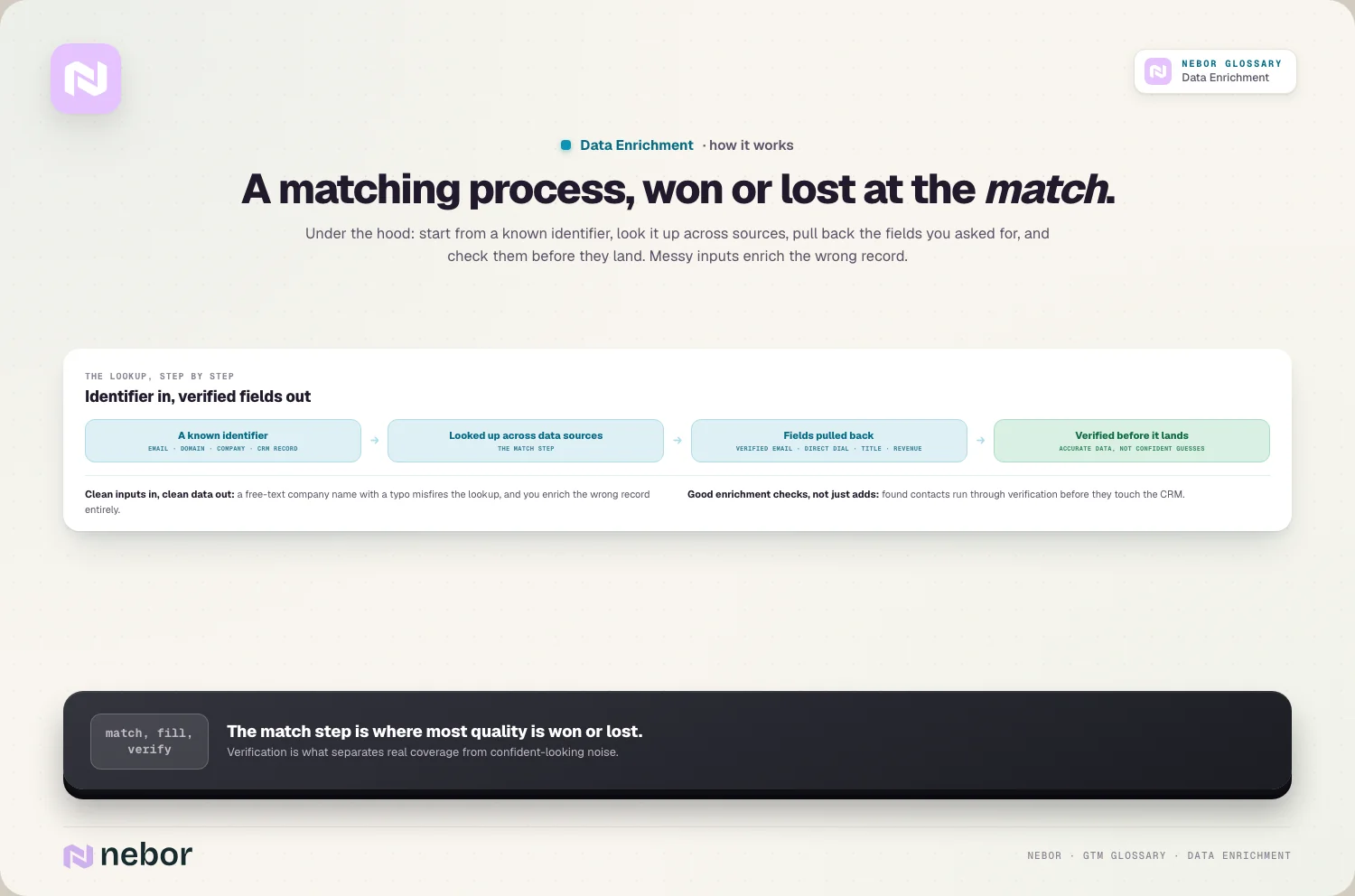
Good enrichment doesn't just add data, it checks it. A solid setup puts the found data through contact verification before it lands in your CRM, so you're completing records with accurate information instead of filling them with confident guesses.
The match step is where most quality is won or lost. If the identifier you start with is messy, like a free-text company name with a typo, the lookup misfires and you enrich the wrong record. The cleaner the inputs, the cleaner the data that comes back.
Let's break down the different types of data you can enrich a record with
Enrichment isn't one kind of data, it's several, and strong programs use a mix depending on what they're trying to do. Each type answers a different question about a contact or an account.
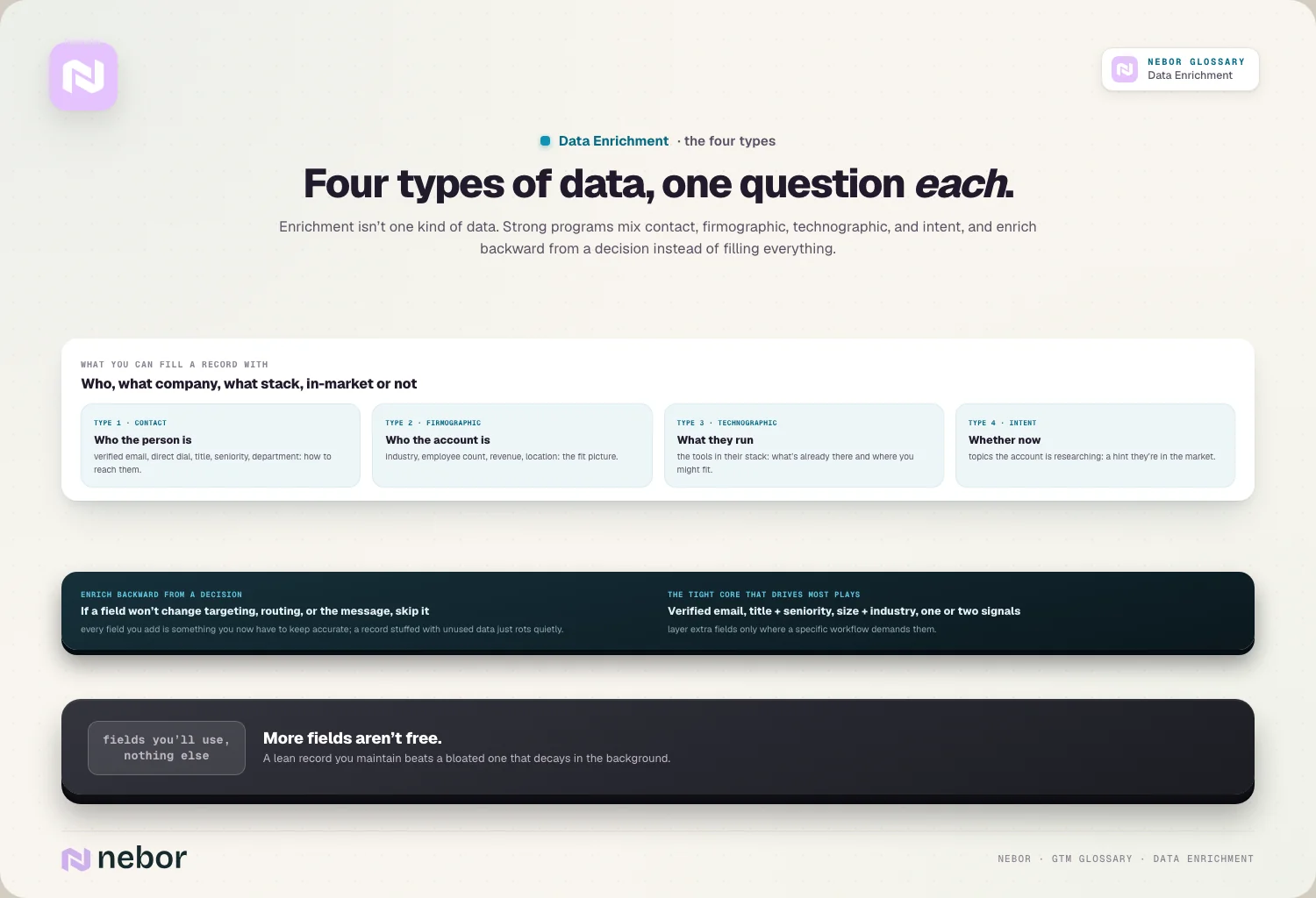
Contact data is person-level information, like a verified email, a direct dial, a job title, seniority, and department. It tells you who the person is and how to reach them.
Firmographic data is company-level information, like industry, employee count, revenue, and location, and this layer defines who the account is.
Technographic data is the set of tools and platforms a company uses, so this layer tells you what's already in their stack and where you might fit.
Intent data is behavioral, like the topics an account is researching, so this layer hints at whether they're in the market right now.
Most real use cases combine several of these. You might enrich an account with firmographics to check fit, then enrich the contacts with verified details so you can reach the right people.
How do you decide which fields are truly worth enriching at all?
It's tempting to enrich everything, but more fields aren't free. Every field you add is something you now have to keep accurate, and a record stuffed with data you never use just rots in the background.
The better approach is to enrich backward from a decision. Ask what you'll do with a field before you fill it. If a value won't change your targeting, your routing, or your message, you probably don't need it.
For most teams, a tight core does the heavy lifting. A verified email, a title and seniority, the company size and industry, and one or two intent or technographic signals will drive almost every play you build.
Then layer extra fields only where a specific workflow demands them. A play that personalizes on tooling needs technographics, a play that routes by region needs location, and everything else can wait until a use case calls for it.
Why does waterfall enrichment beat relying on a single provider?
No single data provider has everything you need. Each one has gaps, and the contact one source is missing is often the exact one another source has. If you rely on a single provider, you inherit all of its blind spots.
Waterfall enrichment solves this by querying multiple providers in sequence. It asks the first source, and if that source can't fill the field, it moves to the next, and the next, until it finds the data or exhausts the options.
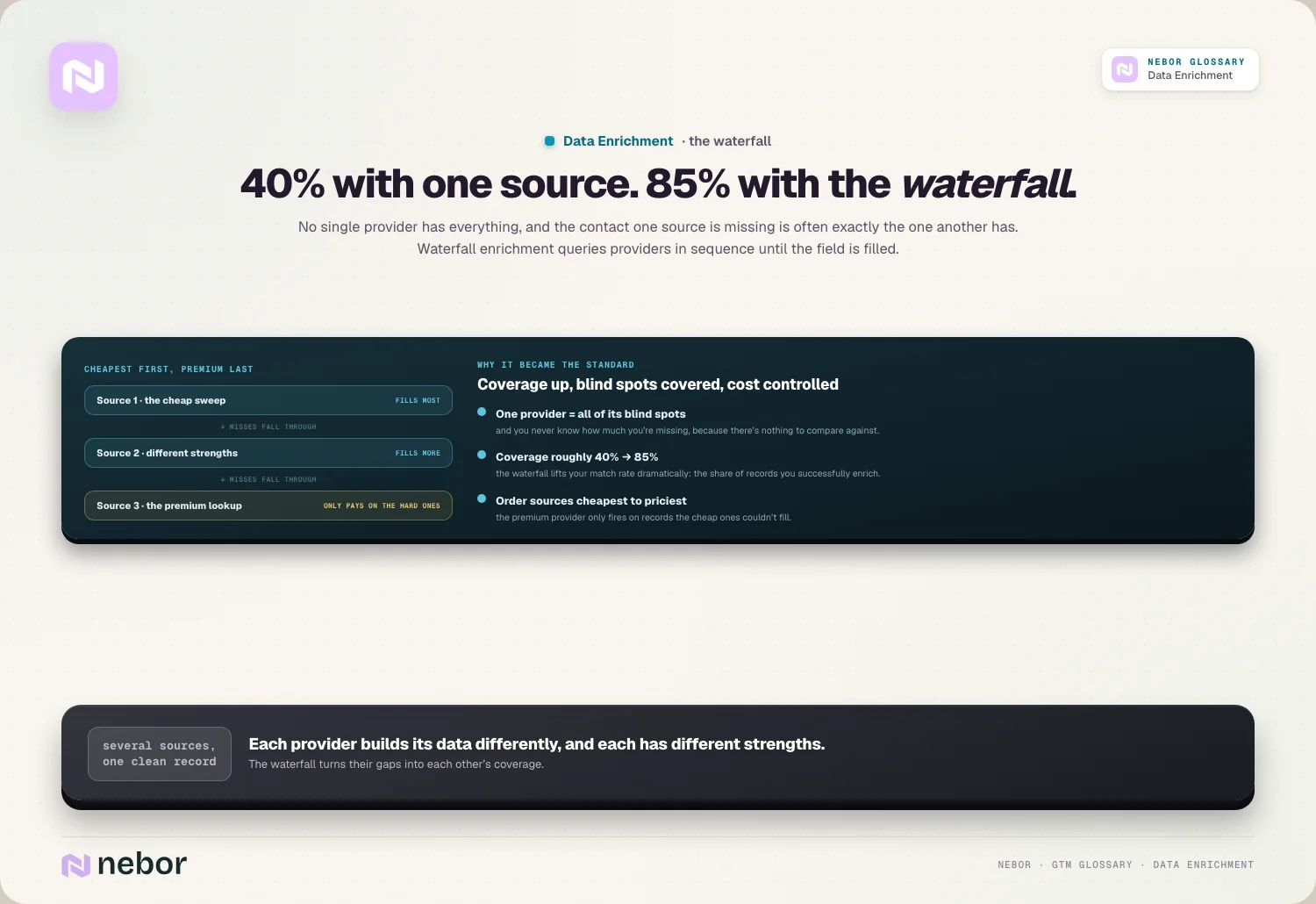
Passing each record through several sources this way can lift coverage from roughly 40% with one provider to around 85% across the full waterfall.
This is also where your match rate comes from, the share of records you successfully enrich. A waterfall raises that number dramatically, and that's what made it the standard way serious teams enrich, instead of betting everything on one database.
There's a cost angle in the design as well. A waterfall lets you order sources from cheapest to most expensive, so you only pay for the pricey provider on the records the cheaper ones couldn't fill. You get higher coverage without paying premium rates on every single lookup.
Where does all of this enrichment data really come from in the end?
Where all this data originates shapes how good it is, so the sourcing deserves a look. Enrichment data is pulled together by a data provider, a company that maintains a large database of contacts and accounts.
These providers build their data from public sources, partnerships, web crawling, user contributions, and their own research. Each one has different strengths, which is exactly why a waterfall across several of them works better than any single database alone.
You can also enrich from your own first-party data, like product usage and form fills, which is often your most accurate source of all. In practice, finding and completing the right contacts at an account, the way we do in our decision-maker workflow, blends external providers with your own signals.
What can you do with enriched data, on both inbound and outbound?
Enrichment is only worth it because of what it unlocks downstream, and the use cases touch both inbound and outbound. On the targeting side, complete firmographic data lets you check fit against your ICP and feed accurate lead scoring, so you spend time on the right accounts.
On the outbound side, enriched contact and company data is what makes personalization at scale possible. You can't write a relevant message to someone whose role and company you don't actually know, so the enrichment is the raw material the personalization depends on.
It powers your inbound side just as much. When a lead fills in a short form, enrichment instantly fills in the rest, so you can route and qualify them properly without forcing them through a fifteen-field form. The same enrichment that fuels cold outreach also makes your inbound faster and smarter.
The automation story rests on it as well. A lot of the work we do in automating sales prospecting is really just enrichment plus logic, where you complete a record, read the new fields, and let a rule decide the next step. Without the enrichment, the automation has nothing to act on.
How do you measure whether your enrichment is any good at its job?
Enrichment is easy to do badly and look busy, so you need a couple of numbers to tell whether it's working for real. The first is coverage, the share of records where you filled the fields you wanted. Low coverage means thin records and plays that can't happen.
The second is accuracy, which is different and more important. A provider can return a value for 90% of your records and still be wrong on a chunk of them, so you want to know how often the data it returns is correct.
You protect accuracy by verifying instead of just filling, a line we hold on every build. Passing found contacts through verification before they land tells you the difference between real coverage and confident-looking noise. High coverage on unverified data is a trap.
Watch cost per usable record instead of cost per lookup. A cheap provider that misses half your list and returns stale values can easily cost more per truly good record than a pricier one with a high hit rate.
What are the most common mistakes teams make with data enrichment?
Enrichment goes wrong in a handful of predictable ways, and almost all of them come from treating it as a one-time purchase instead of a process. The first is enriching everything indiscriminately, which fills your CRM with fields nobody uses and steadily inflates your bill.
The second is trusting a single source for everything. One provider feels simpler, but you inherit all its blind spots, and you'll never know how much you're missing because you have nothing to compare it against.
The third is skipping verification to save a step. Filling a field with an unconfirmed value feels like progress, but you've really just added a guess that misfires the moment a rep acts on it.
The fourth is enriching once and walking away. A perfectly completed database in January is a partly wrong one by summer, so the teams that win treat enrichment as a standing habit rather than a project they finished.
So how do you choose an enrichment setup that fits your team?
There's no single best provider, only the best fit for what you're trying to do, so we always start with the use case instead of a vendor's feature list. A team chasing a narrow vertical needs depth in that vertical, while a broad outbound motion needs wide coverage across many industries.
Match the data types to your plays first. If your edge is personalizing on tooling, you need strong technographics, and if it's reaching the right person fast, you need accurate direct dials and verified emails above all else.
Then favor a setup you can layer over a single locked-in source. A waterfall across a few providers almost always beats betting everything on one database, because it lifts coverage and lets you control cost at the same time.
And insist on a test before you commit. Push a sample of your real records through any provider and measure both coverage and accuracy on data you can independently check, because a slick demo tells you nothing about how it performs on your own list.
Why is enrichment never a one-time job you can finish and forget?
It's tempting to enrich your database once and call it done, but that never holds. The data you so carefully completed starts going out of date the moment you finish, because of data decay.
People change jobs, companies restructure, and emails die, so a record that was perfect last quarter is partly wrong this quarter. A single enrichment is a snapshot, and snapshots age.
That's why enrichment works best as a continuous process. Re-enriching on a regular cadence, and re-checking records right before you use them, keeps your data fresh enough to trust, instead of letting it rot between cleanups.
Why does enriching at the right moment beat enriching everything upfront?
Timing turns out to matter as much as coverage, because data is freshest the moment before you use it rather than the moment you bought it. Enriching a giant list in advance means most of it just decays before anyone touches it.
A smarter pattern is to enrich on a trigger, right when a record becomes relevant. A new form fill, a website visit, or an account entering a sequence is the cue to complete and verify that record, so the data is current exactly when it drives a decision.
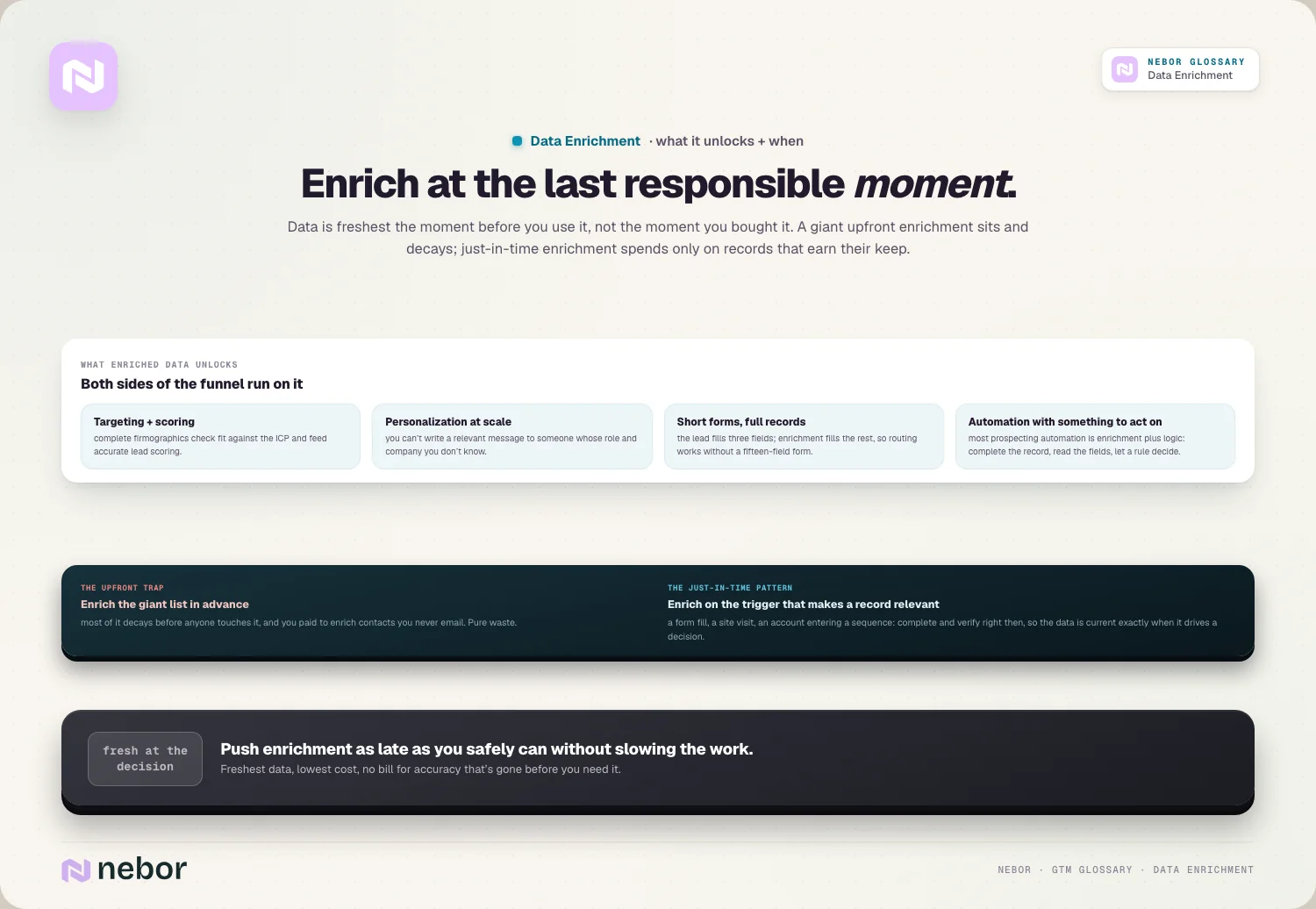
This also saves money, since you only pay to enrich the records you work. A huge upfront enrichment bill on contacts you never email is pure waste, while just-in-time enrichment spends only on the records you put to work.
The habit to build is to push enrichment as late as you safely can without slowing the work. Complete the record at the last responsible moment, and you get both the freshest data and the lowest cost, instead of paying early for accuracy that's gone by the time you need it.
Why your enrichment quality sets the ceiling for everything above it
Here's the bigger truth about enrichment work. It is underneath almost everything else in go-to-market, which means its quality sets a ceiling on all of it.
Your scoring is only as good as the firmographics it reads, your personalization is only as good as the contact data it pulls from, and your automations are only as smart as the records they read.
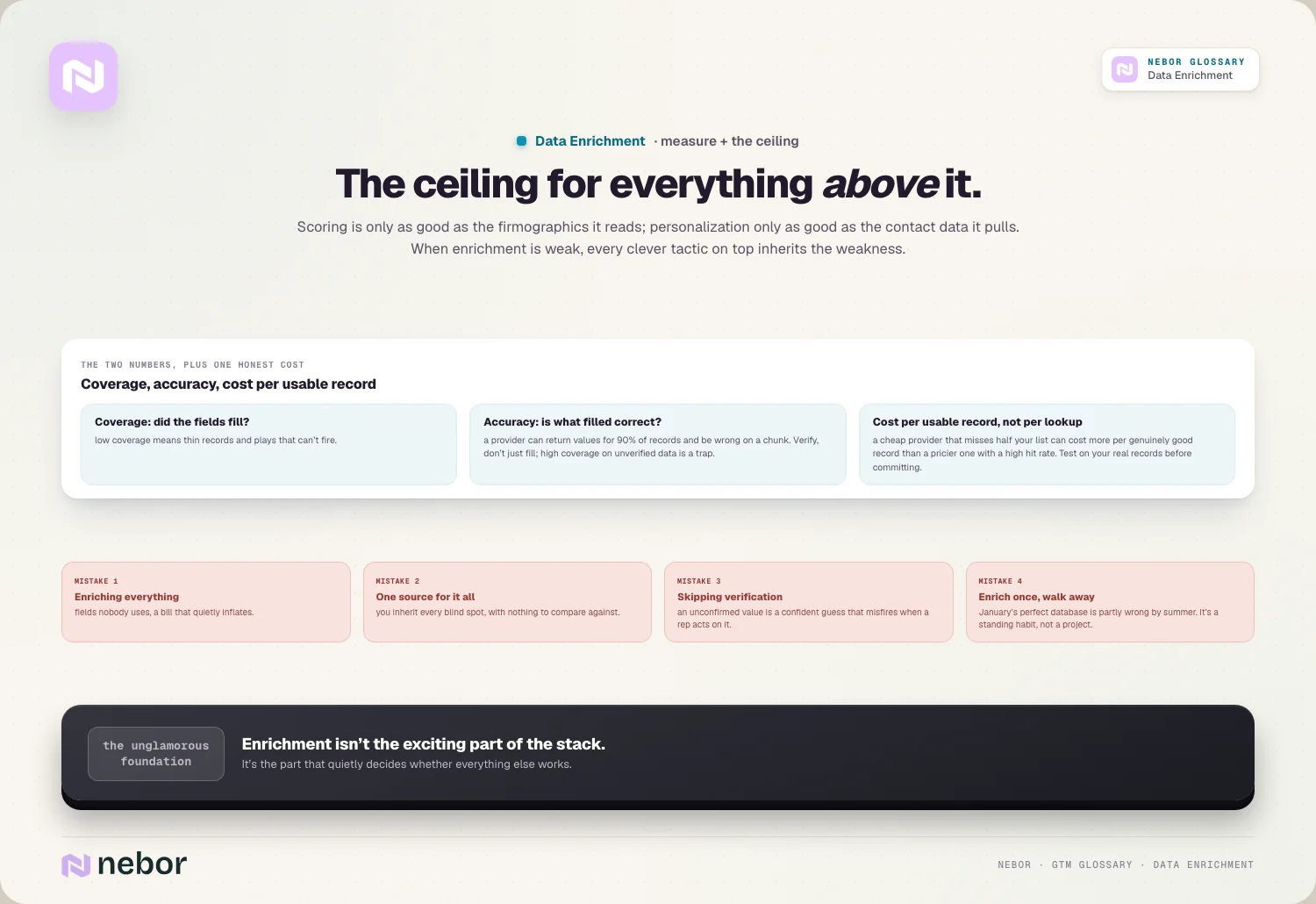
When the enrichment underneath is weak, every clever tactic on top inherits that weakness, which is a big part of why so many Clay builds disappoint even with a great tool.
Enrichment rarely gets the attention it deserves, because it isn't the exciting part of the stack. But it's the part that quietly decides whether everything else works. Treat it as the foundation it really is, and the rest of your go-to-market gets noticeably easier.
Deel dit bericht
Enrichment
Data
Begrippenlijst
Gerelateerde begrippen
De basis GTM-concepten begrijpen




Klaar om je pipeline te bouwen