

A sales CRM with the dialer, the SMS thread and email sequencing built into the lead record, aimed at small teams that create and close pipeline on the phone.
What is
Close
Close is the CRM you buy when the phone is the job. Calling, SMS and multi-step email sequences are built into the lead record rather than bolted on, so a rep works a list of numbers without a dialer, a texting app and a sequencer open in three other tabs. The engine is Smart Views, a saved query that refreshes itself every few minutes and feeds the dialer. The Power Dialer works down that list while recordings, notes and outcomes land on the record, and the Predictive Dialer on the top plan dials several numbers at once and connects a rep only when a human picks up. Chloe, launched in 2026, is an AI voice agent inside the same CRM that answers inbound leads, handles a discovery call and books the meeting, logging everything as it goes. Behind that are a REST API with webhooks, a 30-day event log, an MCP server and roughly 150 listed integrations. Close fits a sales team of two to twenty reps whose pipeline is created and closed on the phone, and it stops fitting the moment marketing needs a seat at the table. There is no marketing automation in it, so nurture, lifecycle scoring and campaign reporting live somewhere else. We build on HubSpot, Salesforce and Pipedrive.
Integrations and the modern GTM stack
Close treats integration as an API problem before a marketplace problem, so the directory is modest at roughly 150 apps while the REST API, webhooks and MCP server carry most of the weight. The consequence is that a team with a builder gets a lot out of it and a team without one leans on Zapier or Make.
Twilio | The telephony under the whole product. Close's help centre states that calls are charged per minute and numbers monthly according to Twilio pay-as-you-go voice pricing, with SMS billed per 140-character unit rather than per message, so your calling bill is a Twilio bill with Close's interface on top. |
HubSpot | A two-way sync built by HubSpot that moves contacts, leads mapped to HubSpot companies, opportunities, calls, emails and tasks between the two. This is the usual shape for teams that want Close's dialer on the sales floor while HubSpot keeps the marketing automation Close does not have. |
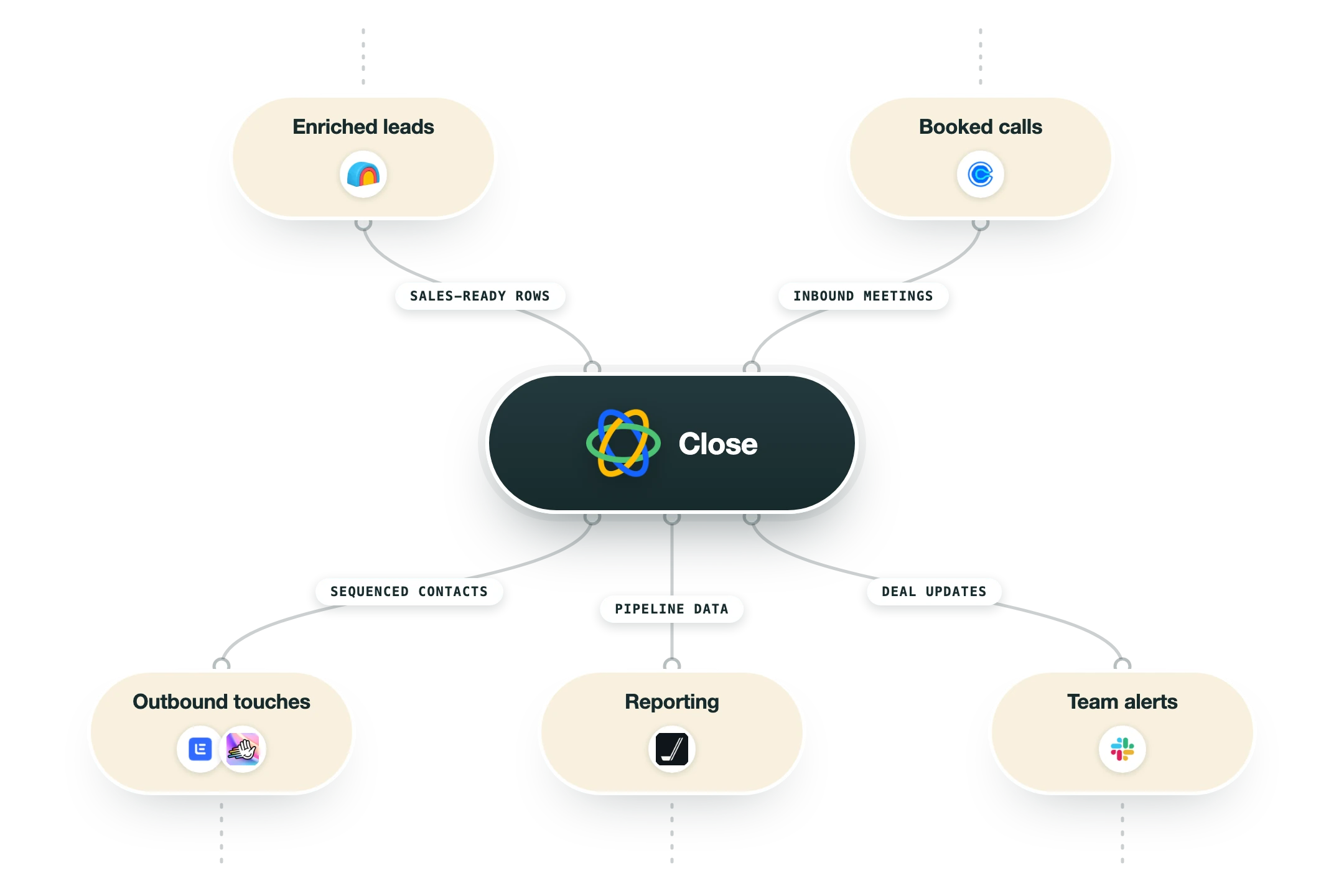
Clay | Works in both directions. From a Clay table you can look up existing Close records, create or update leads and contacts, and enroll a prospect into a Close sequence, which means an enrichment and scoring workflow can decide who lands in the dialer queue tomorrow. |
Zapier, Make, Latenode and Integrately | The no-code layer Close points non-technical teams at, covering the connectors the native directory skips. Fine for record creation and notifications, and expensive per task once a high-volume calling team is pushing thousands of events a day through it. |
REST API and webhooks | API keys for scripts and OAuth 2.0 for user-facing apps, with access to leads, contacts, activities, custom data, sequences, reporting metrics and pipeline data. Webhooks give real-time event notifications backed by a 30-day event log, and bulk actions cover programmatic email and SMS. |
MCP server, Claude and ChatGPT | Close ships a Model Context Protocol server, so Claude or ChatGPT can read and act on Close data without anyone writing code. Useful for ad-hoc pipeline questions and record cleanup, and it is one of the few CRMs at this price that publishes one. |
n8n | There is no official node. A community package, n8n-nodes-close-crm, covers leads, contacts, custom fields and full sequence control including subscribing contacts and pausing or resuming subscriptions. It works, and you are depending on a maintainer rather than on Close. |
What is missing | No native Salesforce connector on close.com, which matters if Close is working alongside an enterprise system of record. There is also no built-in enrichment beyond the per-field credit charge and no intent or visitor data, so signals have to arrive from Clay or another provider. |
Pro’s
The dialer, the texting and the sequence all live on the lead record, so a rep making eighty calls a day never leaves the CRM to log what happened.
Smart Views work as live queries that rebuild the call list every few minutes, so the person starting a calling block is always working the accounts that qualify today.
Close holds a 4.7 on G2 across more than 2,000 reviews with over 11,500 teams on the product, and reviewers keep naming setup speed and support quality as the reasons.
The developer surface is stronger than the price suggests, with OAuth, webhooks backed by a 30-day event log, bulk actions, community SDKs in six languages and an MCP server.
Clay's integration works in both directions and can create leads, update fields and enroll a contact in a Close sequence, so an enrichment table can feed the dialer queue directly.
Telephony ships with the product, so a five-person team gets numbers, recording, transcription and a texting channel without a second vendor and a second contract to manage.
Cons
The seat price leaves out the part you bought it for, since minutes, SMS and phone numbers bill through at Twilio pay-as-you-go rates on top of the subscription, and a floor of heavy dialers pays well above the sticker.
There is no marketing automation in the product at all, so nurture campaigns, lead scoring and anything inbound past a basic form need a second platform and a sync between them.
Workflows and the Power Dialer only start at Growth on $99 a seat annually and the Predictive Dialer waits until Scale at $139, which puts the automation most buyers come for on the expensive half of the menu.
Reporting is the complaint that repeats across G2 and Capterra, and a revenue team that wants cohort views or multi-touch attribution ends up exporting data to build them elsewhere.
The directory stops at roughly 150 apps against HubSpot's thousands, close.com publishes no native Salesforce connector, and the n8n route is a community node rather than an official one.
Pricing
Solo
$9/user/mo billed annually, or $19 monthly, one user only
Built-in calling, email and SMS
Up to 10,000 leads and 250 custom fields
500 AI credits a month
API access and mobile app
30-day call recording retention
Essentials
$35/user/mo billed annually, or $49 monthly, unlimited users
Unlimited leads and contacts
Team collaboration and shared inbox
Email open tracking and follow-up reminders
1,000 AI credits per user, pooled to 10,000 a month
No workflows, no Power Dialer
Growth
$99/user/mo billed annually, or $109 monthly
Automated workflows and Chloe inside them
Power Dialer, bulk email and SMS in workflows
Custom activities and AI Email Rewrite
Workflow and email template performance reports
1,500 AI credits per user, pooled to 15,000 a month
Scale
$139/user/mo billed annually, or $149 monthly
Predictive Dialer and live call coaching
Unlimited call recording retention
Role-based permissions and lead visibility rules
Custom objects and Explorer graphs
2,000 AI credits per user, pooled to 20,000 a month
How it fits your stack
Alternatives




At a glance
Calling, SMS and email in the record
Smart Views that refresh themselves
Power Dialer from the Growth plan
Predictive Dialer on Scale
Multi-step workflows and email sequences
Chloe AI voice agent for inbound
REST API, webhooks and MCP server
14-day trial, no credit card
Read some of our client stories





GTM Workflows
Learn how to use GTM tools in workflows
Guides and tutorials to get the most from your workflows


Ready to get started?




By clicking Sign Up you're confirming that you agree with our Terms and Conditions.








