

Dealfront names the companies on your site and pairs that with a 60 million company European database, with every record processed inside the EU. The brand became Leadfeeder in March 2026.
What is
Dealfront
Dealfront does two jobs from one login. It names the companies browsing your website, and it holds a European B2B database of 60 million companies and 400 million verified contacts you can search when you want to build a target list instead of waiting for someone to show up. The Dealfront brand is on its way out. Echobot in Karlsruhe and Leadfeeder in Helsinki merged in 2022, launched Dealfront in April 2023, and on 24 March 2026 the company folded everything back under the Leadfeeder name. Pricing and features carried over, dealfront.com redirects, and logins moved to app.leadfeeder.com. The four modules are Web Visitors for your site, Companies for database search and enrichment, Campaigns for B2B display advertising, and Lists for saved segments. The tracker matches a visitor's IP address to a company, so someone who refuses your cookie banner still lands in the feed as a named account with the pages they read. We would put a European client on this ahead of a US-first visitor tool, because processing happens on AWS in Ireland and the contract runs through a German GmbH that a procurement team can look up. We have not run it on a Nebor account, and Leadinfo stays our default until a buyer needs the database as well.
Integrations and the modern GTM stack
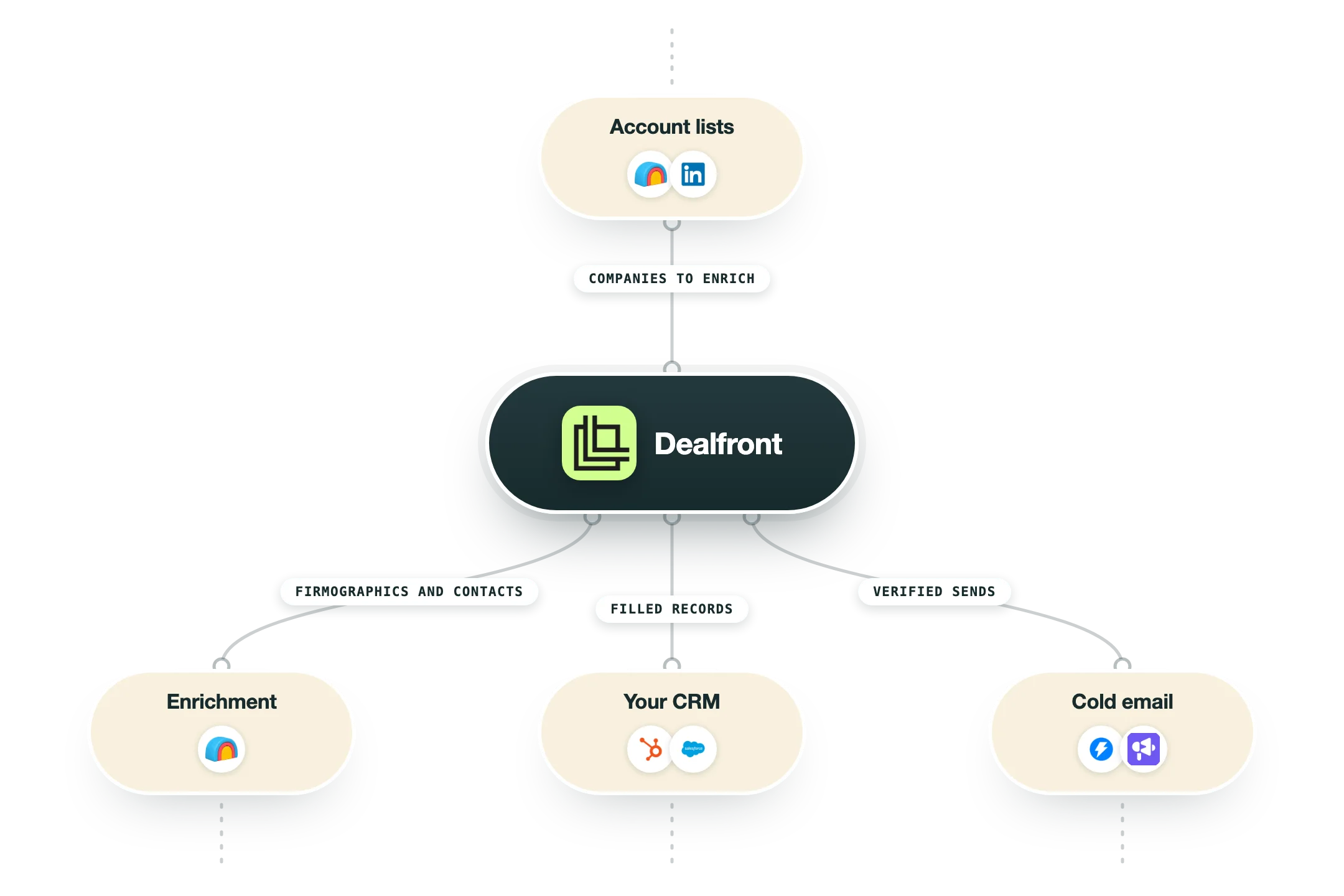
Dealfront's integrations are built around one move, getting an identified company out of the dashboard and onto a record someone already works in. CRM writeback is the deep end of it, and everything else is either a notification channel or a pipe you build yourself.
HubSpot, Salesforce, Pipedrive, Zoho, Dynamics 365 and webCRM | The six native CRM connections push identified companies and revealed contacts onto accounts and leads, keep fields current with auto-update, and embed a company profile view inside the CRM record through an iFrame so a rep reads the visit history without changing tabs. Salesforce carries the deepest setup, including tasks and opportunities. |
Slack, Microsoft Teams and Google Chat | Feeds are routed to a channel or a person so a named account arrives while the visit is still fresh. Slack is the most documented of the three and is the usual home for an ICP-filtered feed, since sending every identified company into a channel is how teams learn to mute it. |
Google Analytics and Google Ads | Leadfeeder ran on Google Analytics data before it shipped its own first-party tracker, and the Google connections now sit alongside it. Ads data ties an identified company back to the campaign and keyword that brought it in, which is the closest thing here to paid attribution at account level. |
Looker Studio | A dedicated connector pulls identified companies, sources and behaviour into a Looker Studio dashboard, so visitor data can be reported next to the rest of your marketing numbers rather than living in a vendor UI that only two people log into. |
Clay | Clay lists Dealfront as a data provider that enriches an IP address into a company with firmographics, and the vendor publishes its own playbook for pushing identified companies into a Clay table over a webhook. That is the route we would take, letting Clay handle contact discovery, scoring and routing on top of the reveal. |
Mailchimp, ActiveCampaign and LinkedIn | Email marketing connections match identified companies against your list activity, and the LinkedIn side supports audience work off the back of visitor data. These are lighter than the CRM connections and are documented in a handful of help articles rather than a full setup guide. |
Zapier, webhooks and the API | Zapier carries anything without a native connector, webhooks fire on new leads, and the platform API covers programmatic access. Naming here needs care after the rebrand, since the old Leadfeeder API is now the Legacy Leadfeeder API and what used to be the Dealfront API took the Leadfeeder API name. |
What is missing | There is no native n8n node and no direct connection to Instantly, Smartlead, Lemlist or the cold email infrastructure most outbound now runs on. Reaching a sequencer means a webhook, a Zap, or a stop in Clay first, so budget the wiring rather than assuming a dropdown exists. |
Pro’s
The tracker keeps naming companies when a visitor declines your cookie banner, because an IP-to-company match does not need consent, so a strict European consent setup does not blank the feed.
Visitor identification and a 60 million company database sit behind one login, so the list your site hands you and the list you build by search use the same filters and the same records.
Processing happens inside the EU on AWS in Ireland, the group runs a named data protection officer, and the contracting entity stays Dealfront Group GmbH, which gives a European procurement review something it can check.
Credits are spent on enrichment and activation such as revealing an email or pushing a record to the CRM, and identifying the companies on your site never touches them.
The free Lite plan shows your last 100 identified companies with seven days of history, which is enough to measure the match rate on your own traffic before anyone signs an annual deal.
Native CRM writeback covers HubSpot, Salesforce, Microsoft Dynamics 365, Pipedrive, Zoho and webCRM, so an identified account lands on a record a rep already opens every morning.
Cons
Two rebrands in three years have split the documentation and the reviews across two names, and the old Leadfeeder API is now the Legacy Leadfeeder API while the Dealfront API took over the Leadfeeder name.
Buyers report renewal quotes 30 to 60 percent above year one once traffic grows, and annual plans auto-renew on a 30-day cancellation window.
Contact data accuracy sits at 7.4 on G2 and reviewers describe thin firmographics on smaller European companies, where headcount, industry or a named decision maker is missing from the record.
Dealfront's own figure for company matching is up to 45 percent of website visitors, so more than half of your traffic stays anonymous whatever tier you buy.
The bill moves on two axes at once, the companies you identify each month and the credits you burn on reveals, so a busy month can push you over on either one.
Pricing
Lite
EUR 0/month Free forever
Last 100 identified companies per month
Seven days of visitor history
20 credits per month
Unlimited users
Discover
from EUR 79/month Billed annually, EUR 113 month to month
Company reveal with unlimited history
Real-time alerts and custom feeds
CRM push and automated outreach
Entry tier reported at 50 companies and 50 credits
Activate
from EUR 369/month Billed annually, EUR 527 month to month
Everything in Discover
Verified contact details and job titles
Intent signal filtering and CRM automations
B2B display campaigns and AI prospect lists
Scale
from EUR 599/month Annual billing only
Everything in Activate
Free company data exports
Automatic CRM record updates
Dedicated customer success manager
Enterprise
Custom Quote based
Custom identified company volume
Custom credit volume
Dedicated team support
How it fits your stack
Alternatives


At a glance
Names the companies visiting your site
60M companies and 400M verified contacts
All data processed inside the EU
Web Visitors, Companies, Campaigns, Lists
40+ real-time buying signals
100+ search and targeting filters
HubSpot, Salesforce, Dynamics, Pipedrive, Zoho
Free Lite plan and a 14-day trial
Read some of our client stories





GTM Workflows
Learn how to use GTM tools in workflows
Guides and tutorials to get the most from your workflows










Ready to get started?




By clicking Sign Up you're confirming that you agree with our Terms and Conditions.








