

A developer-first automation platform where any step can be real Node, Python, Go or Bash, plus an SDK and hosted MCP servers that put 3,000 integrations inside your own product.
What is
Pipedream
Your Clay table has finished enriching, the record needs to reach HubSpot with three fields reshaped on the way, and the prebuilt connector does not expose the one field you care about. Pipedream is the automation platform built for that gap, because any step in a workflow can be real Node, Python, Go or Bash. Workflows fire from a webhook, a schedule, an inbound email or an app event, then run through steps you either pull from a source-available registry covering 3,000 apps or write yourself. Code steps reach most npm and PyPI packages, and a single run can hold 10 GB of memory. Two newer surfaces sit next to the builder. Connect is an SDK that drops those 3,000 integrations into software you ship, handling OAuth and token storage for your own customers, and the hosted MCP server exposes roughly 10,000 tools from the same registry to an agent you are building. We would reach for Pipedream when the integrations are going inside software you ship, and we keep client GTM plumbing on n8n and Make. Pipedream runs cloud only, so a client cannot own the runtime the way a self-hosted n8n gives them, and Workday now owns the company and is pointing it at enterprise agents.
Integrations and the modern GTM stack
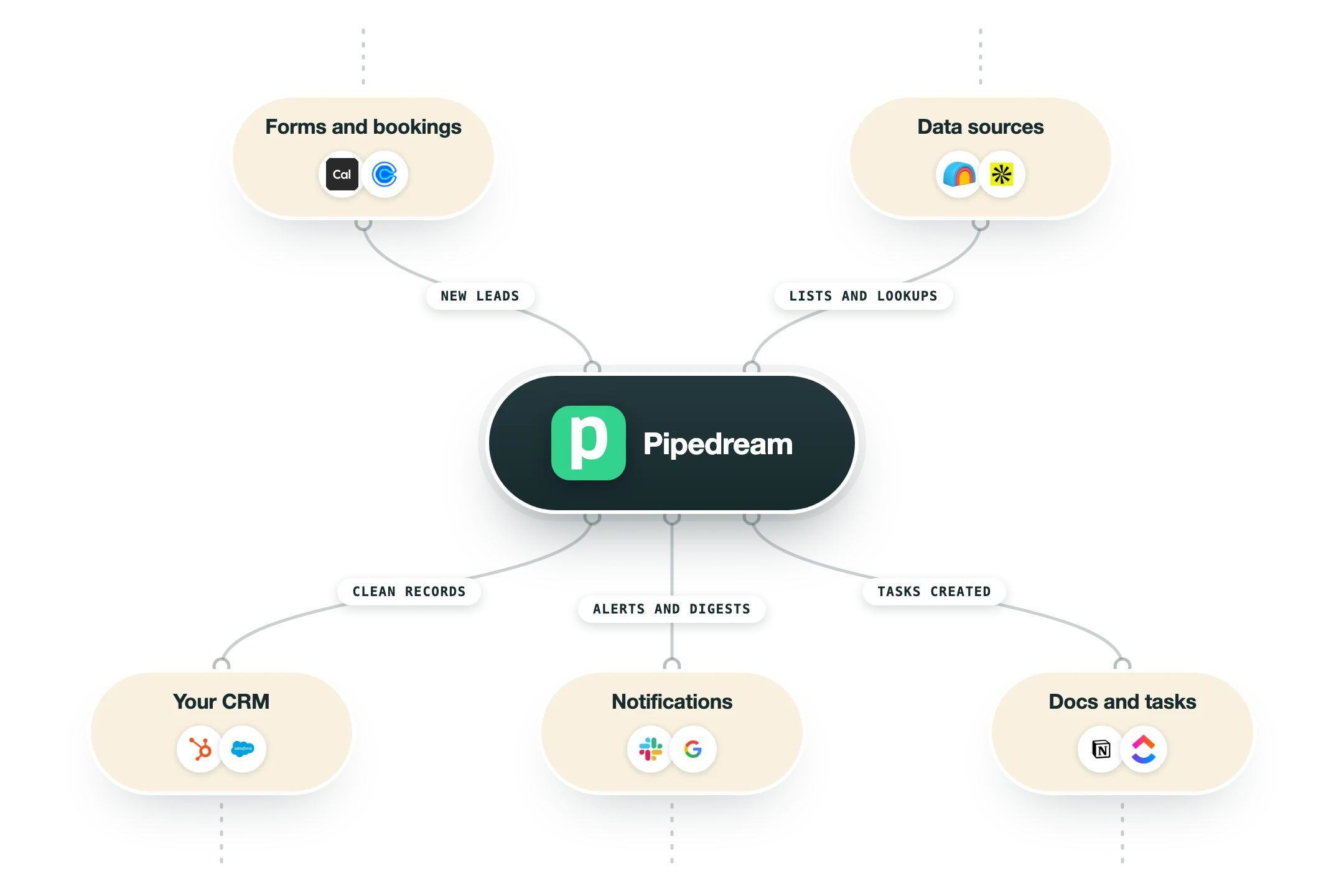
Pipedream's integrations come in two shapes. There is the component registry your own workflows call, and there is Connect, which hands the same 3,000 apps to your customers inside software you ship. Both draw on one source-available registry published on GitHub.
The component registry | Triggers and actions for more than 3,000 apps, all source-available at github.com/PipedreamHQ/pipedream. You can drop a component in as a no-code block, scaffold code from it, or fork it when the prebuilt action misses a field, and contributions go back through pull requests. |
HubSpot and Salesforce | Both have full component folders in the registry with triggers and actions, and Pipedream handles the OAuth so no API key sits inside your workflow. On a GTM build these are usually the last hop, taking a cleaned record and writing it to the CRM. |
Instantly, Smartlead, Lemlist and Apollo | We checked the registry directly on 2026-08-14 and all four have their own component folders, alongside Attio and Clearbit. A cold email stack is better covered here than the developer-first positioning would lead you to expect. |
Clay | There is no Clay component in the registry under any name we could find, so the connection is manual. You send Clay a webhook from a Pipedream step and catch Clay's HTTP API call on the way back. That works, though you build and maintain the handoff yourself. |
MCP servers | Pipedream hosts a remote MCP server at remote.mcp.pipedream.net/v3 exposing roughly 10,000 tools drawn from 3,000 APIs, over SSE and HTTP transports. Each app gets its own server, your application authenticates with client-credential OAuth, and end users connect their accounts separately. |
Connect SDK | Managed OAuth and key-based auth for 3,000 APIs inside your own app, through a client SDK or a hosted Connect Link. Credentials are encrypted at rest, and the API Proxy calls a customer's account without those credentials touching your infrastructure. Development and testing cost nothing. |
GitHub | Bi-directional sync that puts workflows in a repo with branches, diffs, changelogs and pull requests, plus local editing and a setting that requires sync before a change ships. This is the clearest version control story we found in this category. |
Databases | Connected accounts for MySQL, PostgreSQL and Snowflake, queried from inside a workflow through an SQL proxy on a shared static IP block (44.223.89.56/29) that a DBA can allowlist. Business plans swap that for a VPC with dedicated egress IPs. |
What is missing | No self-hosted edition, so everything runs on Pipedream's cloud and any data with residency rules stays an open question. Workspace users and unlimited workflows only arrive on Advanced, and the free plan caps you at three active workflows and three connected accounts, which is enough to prototype and little more. |
Pro’s
Billing runs on compute time rather than task count, so a workflow moving twenty fields costs the same as one moving two as long as the segment finishes inside its thirty-second window.
Any step can be real Node, Python, Go or Bash with most npm and PyPI packages available, so you stop hunting for a connector that happens to expose the one field your CRM mapping needs.
The component registry is source-available on GitHub, so when a prebuilt action behaves oddly you can read what it does and fork it instead of filing a ticket and waiting for a fix.
Connect hands you managed OAuth across 3,000 APIs, and for a team shipping software that needs customer integrations that is months of authentication work you never have to write.
The hosted MCP server exposes about 10,000 tools from the same registry, so an agent gets authenticated access to real business apps without you wrapping every API by hand first.
Bi-directional GitHub sync with branches, diffs and pull requests puts workflows through the same review as the rest of your code, and very few automation tools offer that.
Cons
It wants someone who writes code, because a marketer comfortable in Zapier or Make will stall the first time a step returns a raw payload and the fix is a JavaScript expression.
The free plan gives 100 credits a month against a hard usage cap, roughly fifty minutes of compute, so the docs still promising a generous free tier are describing an older version of the product.
Basic at $29 and Advanced at $49 a month both include the same 2,000 credits, so the extra $20 buys unlimited workflows, one-second schedules and thirty-day history rather than more volume.
There is no self-hosted edition, so workflows run on Pipedream's cloud and a client who wants to own the runtime the way n8n Community Edition allows will never get that here.
Workday now owns the company after a deal signed in November 2025, and the stated aim is powering enterprise AI agents across Workday, so a small GTM team is no longer the customer this roadmap is written for.
Pricing
Free
$0/month No credit card required
100 credits a month with a hard 100 usage cap
3 active workflows and 3 connected accounts
1M AI tokens and 300 second max run duration
7 day event history, 5 minute minimum schedule
Community forum and public Slack support
Basic
$29/month Billed annually at $348, or $45 month to month
2,000 credits a month and 20M AI tokens
10 active workflows and 5 connected accounts
750 second max run duration
1 minute minimum schedule interval
Email support
Advanced
$49/month Billed annually at $588, or $74 month to month
2,000 credits a month and 50M AI tokens
Unlimited active workflows and connected accounts
30 day event history and 10,000 max queue size
1 second minimum schedule interval
Bi-directional GitHub sync and custom webhook domains
Connect
$99/month Billed annually at $1,188, or $150 month to month
10,000 credits a month and 50M AI tokens
Managed authentication for your end users
Custom OAuth clients and API Proxy
Deploy MCP servers to your own product
Billed per unique end user on top of credits
Business
Custom Contact sales, annual contract
Custom credit volume and event history
SSO, SCIM provisioning and required 2FA
HIPAA, SLA and data retention controls
VPCs with unique egress IPs and peering
Dedicated Slack Connect channel and success engineer
How it fits your stack
Alternatives




At a glance
Code steps in Node, Python, Go and Bash
3,000-plus integrated apps
Credits bill compute time rather than step count
Source-available component registry on GitHub
Connect SDK for embedded customer integrations
Hosted MCP servers with 10,000-plus tools
Bi-directional GitHub sync with branches and diffs
Free plan with 100 credits a month
Read some of our client stories





GTM Workflows
Learn how to use GTM tools in workflows
Guides and tutorials to get the most from your workflows











Ready to get started?




By clicking Sign Up you're confirming that you agree with our Terms and Conditions.








