

One shared link per deal holding the proposal, the recordings, the pricing and a mutual action plan, with tracking on every click and the activity pushed back into your CRM.
What is
trumpet
A buyer opens your proposal PDF, forwards it to two colleagues you have never met, and the thread goes quiet for nine days. trumpet replaces that attachment with a Pod, a shared web page per deal holding the proposal, call recordings, pricing and a mutual action plan behind one link the seller can update after sending. The mutual action plan is the part that does the work, giving both sides dated steps with named owners so the deal has a visible spine. Reps build Pods from templates with CRM fields auto-filled, embed Loom videos and interactive demos, collect signatures through DocuSign or PandaDoc, and book the next meeting inside the page. Every click inside the Pod is instrumented, and that is the other half of the pitch. You see who opened it, which sections they read, how long they stayed, and which new stakeholder appeared when your champion forwarded the link. All of it syncs back to Salesforce, HubSpot, Pipedrive or Dynamics. trumpet earns its seats on committee deals with four or more people involved and a cycle long enough that content gets re-read between meetings. On a two-call transactional sale it is one more surface to maintain, and Flowla's study of 30,000 rooms found 48 percent were never opened by a buyer. We have not run it at Nebor.
Integrations and the modern GTM stack
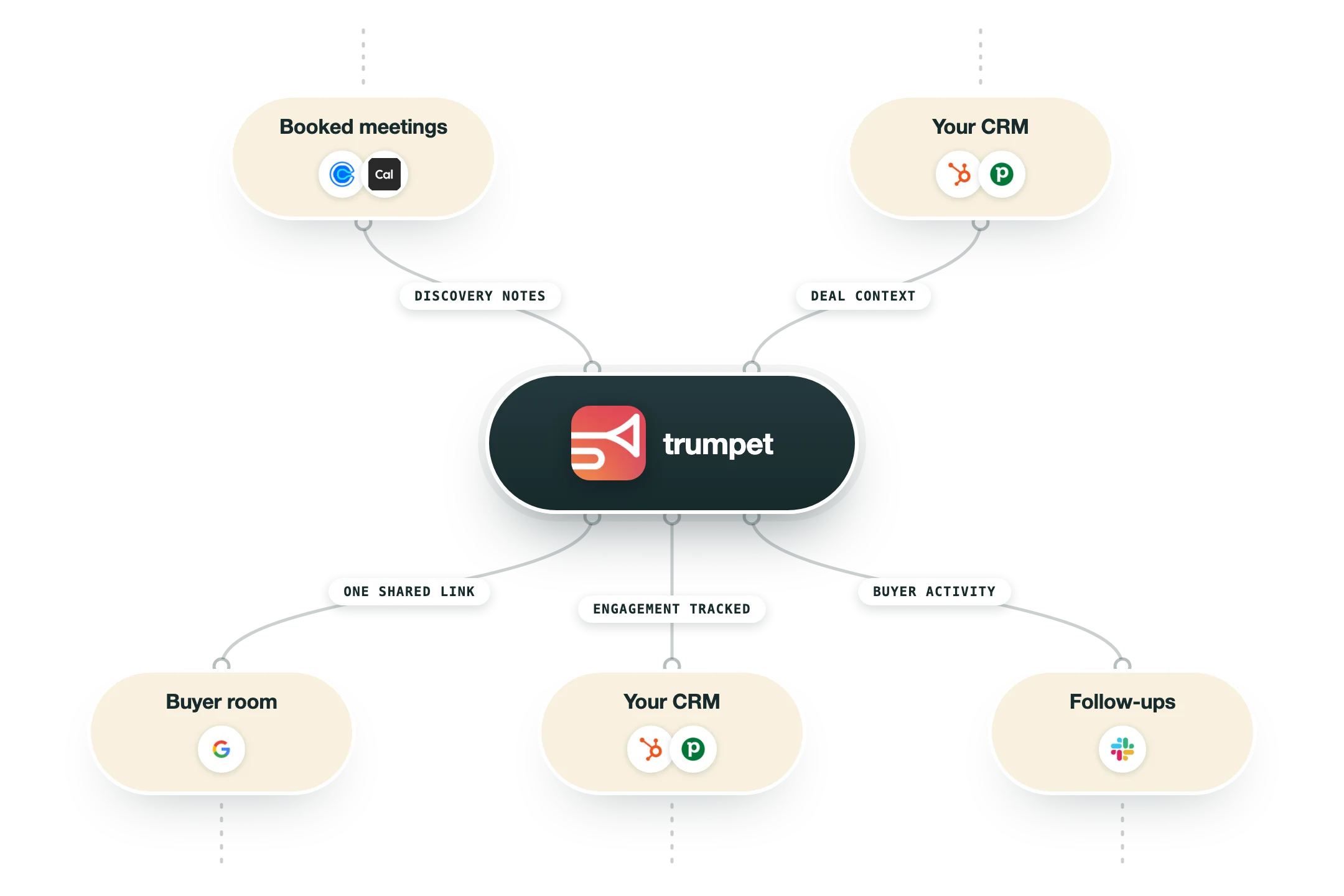
trumpet counts 40+ integrations, and they split into two jobs. One set pulls deal data in so a Pod builds itself from the CRM record, and the other pushes buyer engagement back out so the activity shows up where your team already looks. The embeds are the third group and they are mostly iframes, so they are as easy to add as they are to leave out of date.
Salesforce | This is the deepest connection trumpet offers anywhere on the list. You create a Pod from inside an opportunity with dynamic fields auto-populated from that deal, and Pod activity flows back the other way, including document views and downloads, comments and mutual action plan step completions. |
HubSpot, Pipedrive, Microsoft Dynamics, Close and ActiveCampaign | The same pattern carried over with less depth. Deals, contacts and pricing pull through when a Pod is created, and buyer intent plus any new stakeholder who appears in the room syncs back into the record. Dynamics is the one trumpet describes in stakeholder terms specifically. |
Gong, Outreach and Salesloft | Pod insights and prospect interactions push into Gong so call data and room data sit together, and engagement lands in Salesloft Rhythm as a signal a rep can act on. The Gong connection needs the Scale plan or above. |
DocuSign and PandaDoc | Signature without leaving the room, plus redlining and tracked changes on the PandaDoc side. Both arrive on Scale, so anyone pricing trumpet as a way to retire a separate signing tool should budget for the $100 seat rather than the $45 one. |
Slack and Microsoft Teams | Channel notifications when a Pod is opened and when it gets shared onwards. This is the cheapest way to make the tracking useful, because a forward to a new stakeholder is worth knowing about the same day rather than at the weekly pipeline review. |
Calendly, Chili Piper, Cal.com and Google Calendar | Booking the next meeting from inside the Pod. Given that a room only earns its keep when the deal keeps moving, having the calendar in the same page as the proposal removes the most common reason a follow-up stalls. |
Loom, Vidyard, Wistia, Zoom, Walnut, Navattic, Storylane and Arcade | Embedded video and interactive product demos, so a buyer can rewatch the demo or click through a sandbox without a rep in the room. Figma, Canva, Pitch, Miro, Airtable and Typeform cover decks, whiteboards and forms in the same way. |
Zapier | 13 triggers covering New Pod, Pod Is Viewed, Pod Is Shared, New Stakeholder, Mutual Action Plan Is Updated, Form Submitted and file or video events, against exactly one action, Create Pod From Template. Reading trumpet events into another system is easy and driving trumpet from one is close to a single move. |
What is missing | No public API documentation we could find, and no native n8n or Make app, so anything beyond the Zapier triggers needs a webhook and your own glue. Notetaker coverage is thin outside Gong, which is a recurring complaint from reviewers who want Pods generated automatically after a call. |
Pro’s
The mutual action plan gives both sides dated steps with named owners, and that is the one feature buyers thank reps for because it answers what happens next without another call.
Engagement data lands per stakeholder, so when your champion forwards the link you see the new name appear before the next meeting rather than in the room on the day.
Salesforce, HubSpot, Pipedrive and Dynamics all take Pod activity back into the deal record, so a forecast review can read real buyer behaviour rather than a rep's optimism.
The free plan gives unlimited users 10 Pods, so you can find out whether your buyers click a room before anyone signs a contract for seats.
Templates with auto-filled CRM fields cut the build time per deal, and G2 reviewers consistently single out how fast a branded room comes together once the template exists.
Scale bundles e-signature, proposals and quotes alongside DocuSign and PandaDoc, so a deal can travel from demo recap to signature inside the same link.
Cons
Every bit of the value depends on the buyer clicking a link, and Flowla's analysis of more than 30,000 deal rooms put the share that never received a single view at 48 percent.
Pro caps at five users, so a team of twelve jumps straight to Scale at $100 per user per month, which is $1,200 a month before a single deal moves.
E-signature, the Gong connection and advanced analytics all sit on Scale or above, so the tiers that make the tracking story work cost more than double the Pro price.
A Pod is another surface with its own templates and content library, and rooms go stale the moment pricing or the deck changes unless one person owns the upkeep.
G2 reviewers repeatedly describe the builder as glitchy and hard to navigate without support, and the Zapier app ships 13 triggers against a single write action, so deep automation stays shallow.
Pricing
Free
$0/month Unlimited users, no card required
10 Pods per account in total
Mutual Action Plans
40+ integrations
Basic analytics and version control
Pro
$45/user/month $450/user/year on annual billing, hard cap of 5 users
Unlimited Pods, content uploads and templates
Pro Analytics and AI engagement score
CRM integrations
Content Management System
Scale
$100/user/month $1,000/user/year on annual billing
Everything in Pro
E-signature, proposals and quotes
DocuSign, PandaDoc and Gong integrations
Video and screen recording, surveys and forms
Advanced analytics, template analytics and management dashboard
Elite
$160/user/month $1,600/user/year on annual billing
Everything in Scale
AI Copilot, AI Org Charts and recommended stakeholders
SSO, SCIM and multi-team workspaces
White labelling, custom domains and white-labelled emails
Global analytics and white-glove customer success
How it fits your stack
Alternatives




At a glance
One Pod per deal, one shared link
Mutual action plans with owners and dates
Per-stakeholder tracking and AI engagement score
Two-way sync with Salesforce and HubSpot
E-signature, proposals and quotes from Scale up
40+ embeds including Loom, Gong and Calendly
Free plan capped at 10 Pods per account
Zapier app with 13 triggers and 1 action
Read some of our client stories





GTM Workflows
Learn how to use GTM tools in workflows
Guides and tutorials to get the most from your workflows








Ready to get started?




By clicking Sign Up you're confirming that you agree with our Terms and Conditions.








