

An open source CRM under AGPL that you self-host or run on Twenty's cloud, with a data model you define, a TypeScript apps framework and REST, GraphQL and MCP access.
What is
Twenty
Twenty fits the team that treats its CRM as software it maintains, and it disappoints the team that wants a sales suite working on day one. It is an open source CRM released under AGPL, run on your own Postgres or on Twenty's cloud, built as the Salesforce and Attio alternative whose source you can read. You define the data model yourself with unlimited custom objects, fields and views on every tier, and the interface reads like Notion. Gmail or Microsoft 365 sync drops threads and calendar events onto the matching records, and a no-code builder runs workflows with branches, loops and HTTP calls. Version 2 turned the product into a developer platform. The Apps framework ships custom objects, server-side logic functions, sandboxed React components and AI skills as TypeScript packages you scaffold with npx create-twenty-app. REST and GraphQL endpoints regenerate from your schema, webhooks fire on record changes, and every cloud workspace carries an MCP server for Claude or ChatGPT. We would run Twenty as the system of record for a technical or internal business, and we would keep an outbound team off it. There are no sequences, no dialer and no marketing automation, and Clay ships no native connector, so every enrichment loop you build rides on the REST API and your own glue.
Integrations and the modern GTM stack
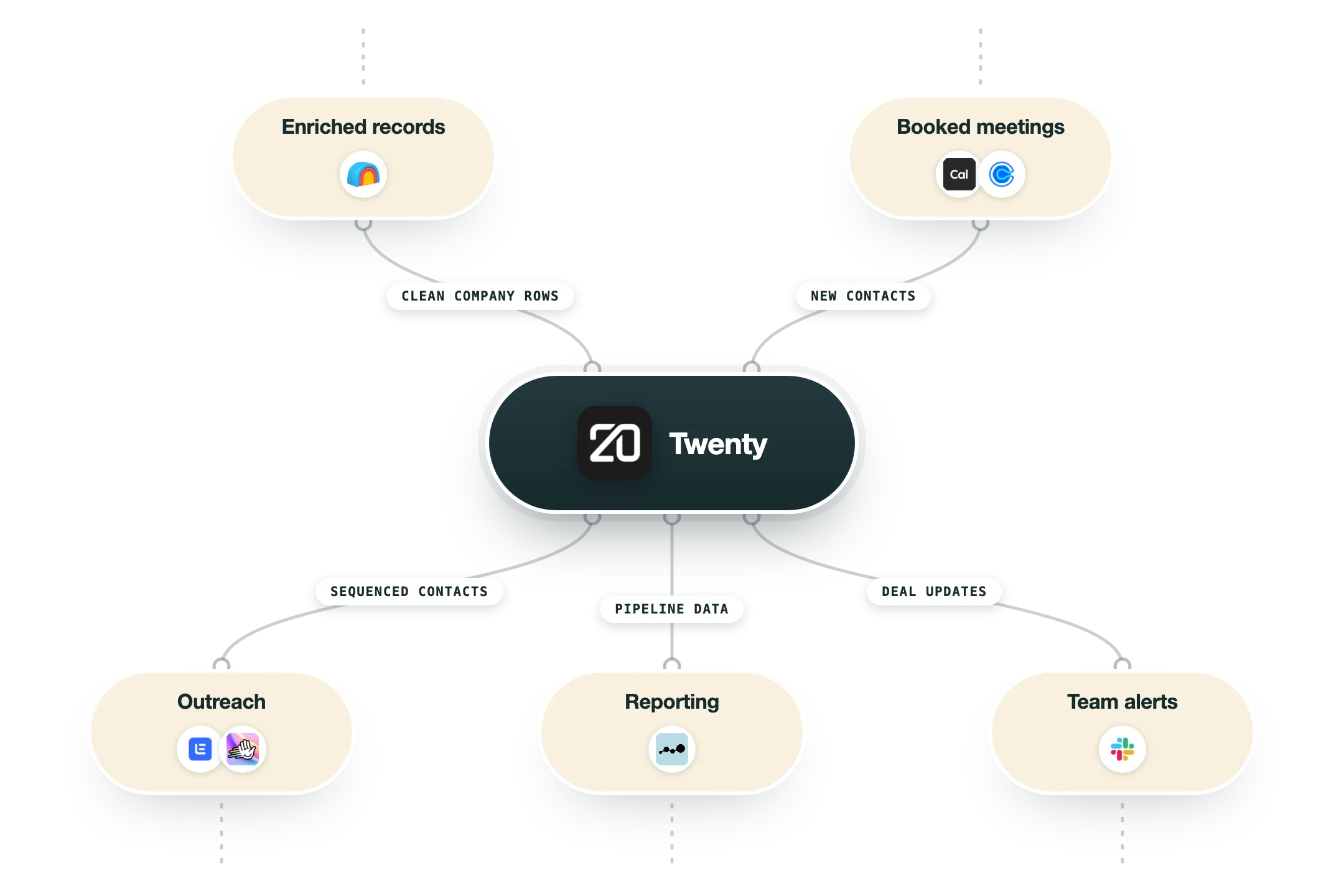
Twenty connects to the rest of your stack through its own API far more than through packaged connectors. The API surface is strong and documented, the marketplace of ready-made integrations is young, and the sales tools most GTM teams expect to plug in are absent.
Google Workspace and Microsoft 365 | Connect a mailbox and Twenty links threads and calendar events to the matching Company and People records, with multiple mailboxes per user and filters that limit the import by date range or sender. You can send email from a record and from a workflow. |
REST and GraphQL APIs | Each workspace generates its own schema, so a custom object called Invoice gets REST and GraphQL endpoints under its real name. A separate metadata API creates objects, fields and relations in code. Keys are role-scoped, batches cap at 60 records, and the limit is 50 calls a minute on Pro and 100 on Organization. |
Webhooks and workflow HTTP actions | Webhooks push record create, update and delete events to any endpoint, and the workflow builder has an HTTP request action plus a webhook trigger. This pair is how most teams wire Twenty to n8n, Make or an internal service without waiting for a native app. |
Zapier | The official Zapier app reaches about 5,000 other tools, but it is thin. One trigger fires on a record being created, updated or deleted, and one action creates, updates or deletes a record. Anything shaped more precisely than that goes back through the API. |
n8n and Make | Neither has an official node. n8n users rely on the community node at github.com/shodgson/n8n-nodes-twenty, which its author tested against Twenty v1.0.3, so expect to check it against your version. Make has no listed app, leaving the generic HTTP module. |
MCP server | Every cloud workspace ships a native MCP server. You connect Claude, ChatGPT or Cursor over OAuth and the assistant reads and writes CRM data in plain language, inside the same permission model that applies to the user it authenticated as. |
Apps framework and marketplace | An app is a TypeScript package built with twenty-sdk that can define objects, server-side logic functions on HTTP routes or cron, sandboxed React components, AI skills and agents. The CLI live-syncs it to a running server, then publishes it privately or to the marketplace. |
Salesforce and HubSpot migration | Twenty imports through CSV with column to field mapping including relations, or through the API for larger moves, and its own material cites over 50,000 records. Certified partners run full migrations, and one published case study used agentic AI to compress a Salesforce move. |
What is missing | Clay lists no Twenty integration, so enrichment loops run through Clay's HTTP request against the REST API. There is no native Slack app, no dialer, no sequencer and no marketing automation, so an outbound stack around Twenty is a set of webhooks you build and maintain. |
Pro’s
The AGPL core runs on your own Postgres, so the records, the schema and the history stay in a database you can query and back up without asking a vendor for an export.
Twenty publishes case studies of teams that moved to a self-hosted instance after a CRM vendor shut down, including AC&T, who were left with a CSV file and rebuilt on Twenty for a reported 90 percent lower cost.
The API is first class, with REST and GraphQL endpoints generated per workspace, a separate metadata API for creating objects in code, webhooks on record changes and OAuth with PKCE.
Cloud Pro at $9 a seat carries unlimited seats, records, custom objects and dashboards, which puts a ten-person team near $1,100 a year against several times that on HubSpot or Salesforce.
Development moves fast, with roughly 55,000 GitHub stars, 466 contributors and cross-version upgrades supported since v1.23 so a stale instance can jump straight to the latest tag.
Extending it looks like normal software work, since an app is a TypeScript package the CLI live-syncs to a running server and publishes privately or to the marketplace.
Cons
Free applies to the licence and nothing else, because you own Postgres, Redis, the worker, the backups and every upgrade, and a lost ENCRYPTION_KEY takes every stored OAuth token and secret with it.
Workflow credits follow the billing cycle rather than the plan, at 5 a month or 50 a year, and a single Delay node burns one credit per run, so a wait step in an automation eats the allocation fast.
Nothing here serves an outbound motion, with no sequences, no dialer, no marketing automation and reporting that stops at aggregate, bar, line and pie widgets on a dashboard.
The connector ecosystem is thin, since the Zapier app exposes one record trigger and one create-update-delete action, n8n has only a community-maintained node, and Clay lists no Twenty integration at all.
SSO, row-level permissions, audit logs and encryption key rotation all sit on the $19 Organization tier, and Pro is rate limited to 50 API calls a minute against 100 on Organization.
Pricing
Community
$0 self-hosted AGPL core on your own infrastructure
Full CRM with custom objects, fields and views
Workflows, REST and GraphQL APIs and webhooks
Community support only
You run Postgres, Redis, the worker and the backups
Pro
$9/user/mo billed yearly, unlimited seats and records
Full customization and custom apps
AI agents with custom skills
50 workflow credits a year
50 API calls a minute
Standard support
Organization
$19/user/mo billed yearly
Everything in Pro
Row-level permissions and audit logs
SAML and OIDC single sign-on
Custom domain and encryption key rotation
100 API calls a minute and priority support
Enterprise
from $50k/year billed annually
Single-tenant isolation
IP allow-listing and SCIM provisioning
Security review and DPA
Dedicated support with an SLA
How it fits your stack
Alternatives




At a glance
AGPL source, self-hosted or cloud
Unlimited custom objects, fields and views
Gmail and Microsoft 365 sync
No-code workflow builder with branches
AI chat and AI agents
REST, GraphQL, webhooks and MCP
TypeScript Apps framework and SDK
Cloud from $9 per user a month
Read some of our client stories





GTM Workflows
Learn how to use GTM tools in workflows
Guides and tutorials to get the most from your workflows











Ready to get started?




By clicking Sign Up you're confirming that you agree with our Terms and Conditions.








