
Top 8 Grow Surely Alternatives for B2B teams that want to own the Clay system, not rent the meetings

by

In this post:
So, you’re looking for Grow Surely alternatives, and you got here. Good.
When you work with Grow Surely, you only get the output of their system. You get the meetings on your calendar, the SQLs in your CRM, and the reports showing campaign performance. The engine that produces those results stays in their accounts, not yours.
This pattern is not unique to Grow Surely. It is how most done-for-you lead generation agencies operate. They invest in building real systems using modern tools like Clay, n8n, Instantly, and Smartlead.
Then they reuse those systems across many clients in parallel, charging monthly retainers for access to the results. The model works for them at scale, because they build once, deploy many times, and earn recurring revenue from every client.
The question is not whether Grow Surely delivers results, because they probably do. The real question is whether you are building an asset or renting someone else's.
When agencies keep their methods proprietary, you cannot learn from what is actually working in your own campaigns. You cannot iterate on the playbook because you never see the playbook.
The result is that you build no institutional knowledge about your market and stay dependent on the agency forever.
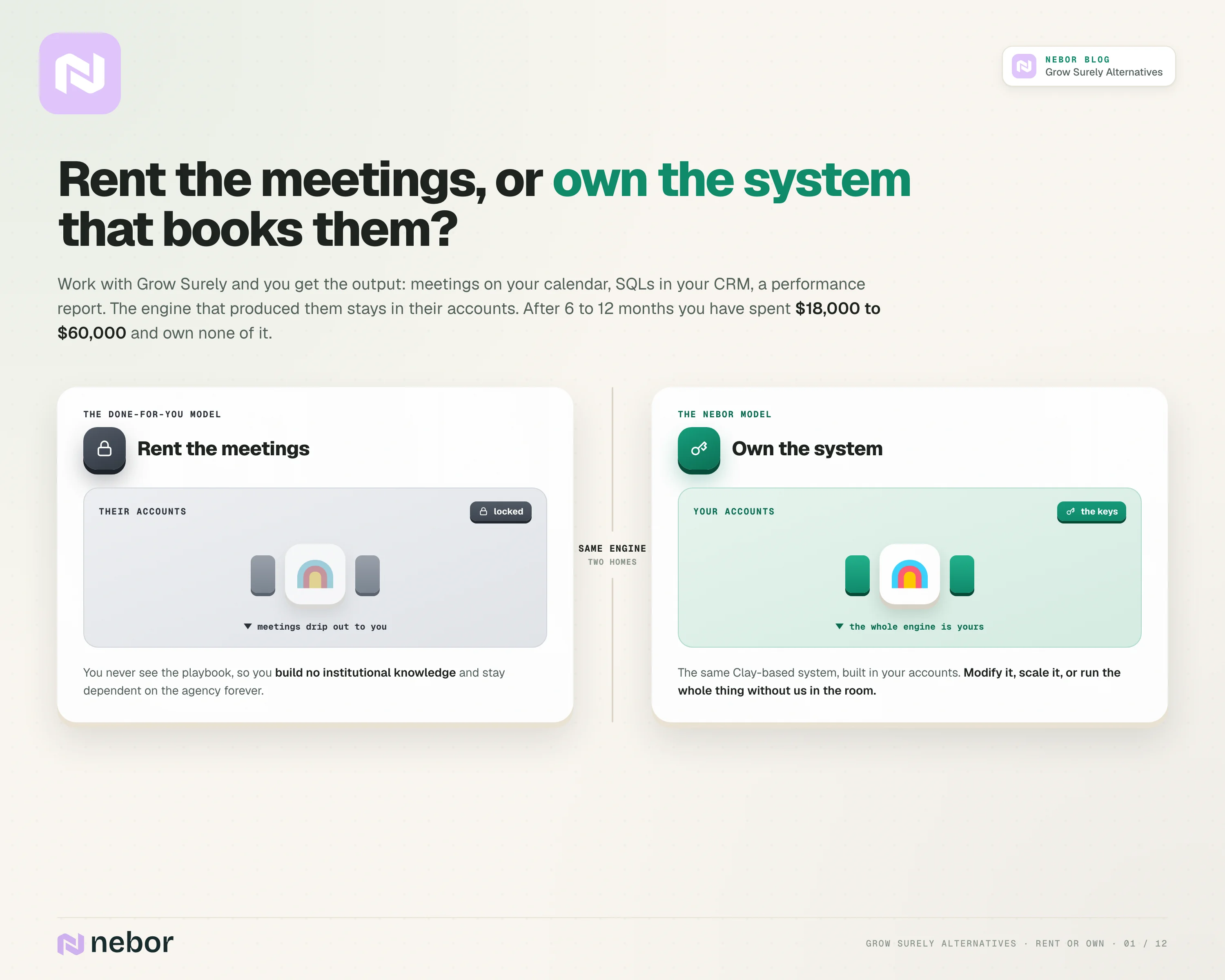
That arrangement creates a structural problem for you. After 6 to 12 months of paying $3,000 to $5,000 per month, you have spent $18,000 to $60,000 and you do not own the infrastructure that produced any of it.
We get why some teams sign up for that model anyway. You pay, the meetings hit your calendar, and you stop thinking about how the sausage gets made.
The thing is, the same tech stack could be doing a lot more for you. It could lift your closing rate, speed up inbound response, keep your CRM clean, and watch intent triggers across your whole TAM. We will get into all of that later in the post.
That model made sense five years ago, when building these systems took deep technical expertise. The tools have changed since then, and AI is now part of the workflow.
Clay, n8n, and modern automation platforms have made it possible for companies to own their lead generation infrastructure without needing a team of engineers in-house.
At Nebor, we took a different approach to all of this. We build the same Clay-based systems that agencies like Grow Surely use internally, but everything lives in your accounts. Here’s what the entire ecosystem looks like:
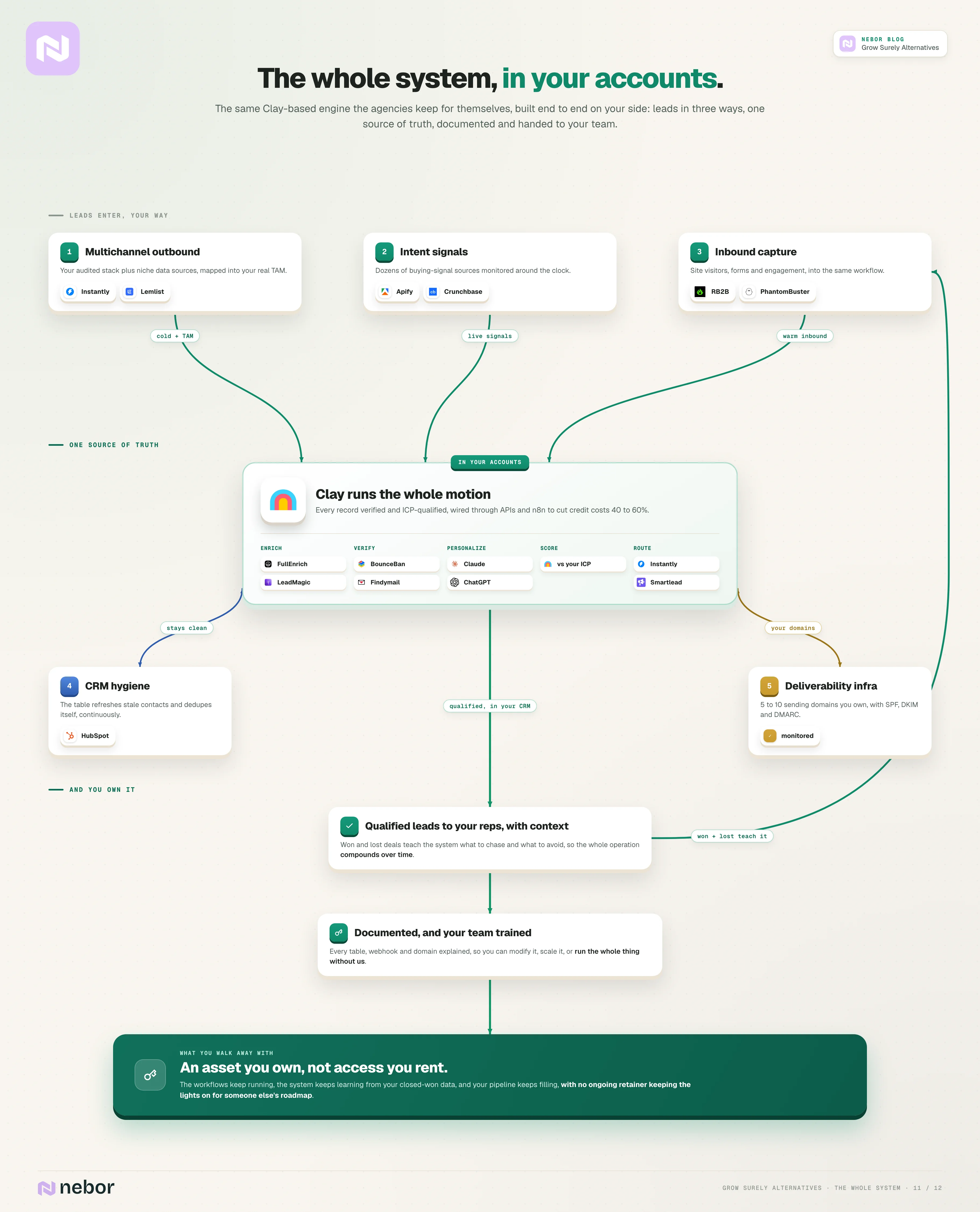
The workflows are yours, and you can modify them, scale them up, or eventually operate the whole system without us in the room.
This post breaks down 8 alternatives to Grow Surely, from traditional done-for-you services to automation-first agencies like ours.
We will explain what each one does well, how each one makes money, and where each one falls on the rental-versus-ownership spectrum.
Let’s get started.
Why Nebor solves the structural problems baked into agencies like Grow Surely
The cold email agency model has a structural problem that most clients don't see until they are 12 months into a contract.
When you hire an agency like Grow Surely, you are paying for their team's time and expertise. They build lead lists, write sequences, manage deliverability, and book meetings. They get the work done and the meetings show up on your calendar.
But their business model requires them to serve many clients in parallel to be profitable. That means they cannot build custom infrastructure for each client.
They use templates and apply proven playbooks across multiple industries because custom work does not scale when you are serving 50 clients with the same workflows.
Even when you get good results from that setup, you do not own anything you can keep, modify, or hand to your in-house team.
We built Nebor around a different philosophy. We take on fewer clients, charge more upfront, and build custom infrastructure that lives in your accounts from day one.
No templates, no generic databases, no monthly retainers keeping the lights on for someone else's roadmap.
Here's what that looks like across six parts of the system.
We build a multichannel outbound stack around your business needs and the tools you already use
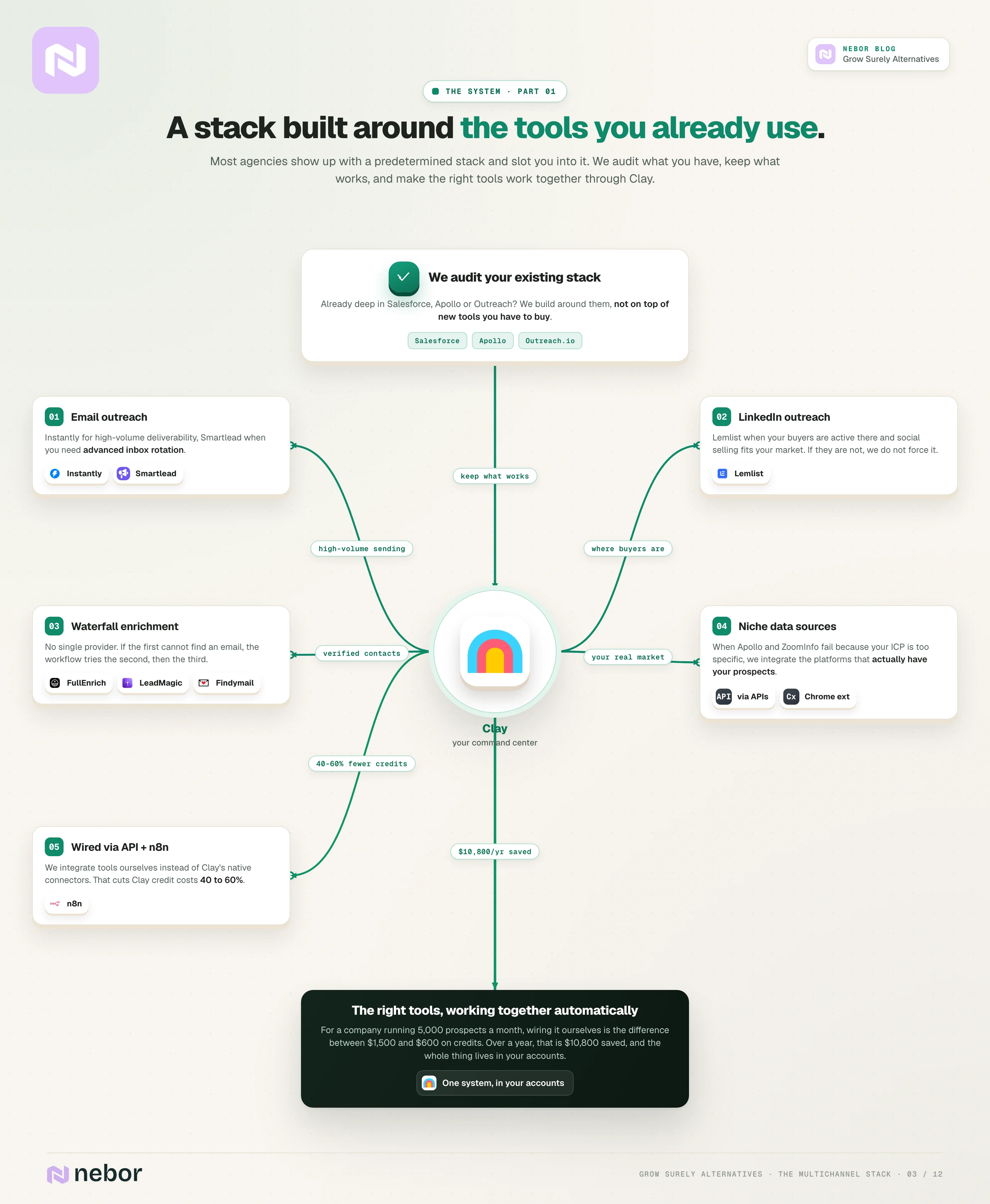
Most agencies show up with a predetermined stack and slot you into it. We start every engagement by auditing what you already have and which parts of it are worth keeping.
If you are already invested in Salesforce and your team knows it inside out, we are not telling you to migrate to HubSpot just because we prefer HubSpot.
If you have Apollo licenses and they are working for your ICP, we will integrate Apollo into Clay rather than making you buy new data sources. If your sales team is comfortable with Outreach.io for sequencing, we will build around Outreach.
The point of this is not to accumulate tools. It is to build a system where the right tools for your team work together automatically.
Clay becomes your command center, and everything else flows through it. What connects to Clay depends on your ICP, your sales process, and what you are actually trying to accomplish.
For email outreach, we use Instantly.ai when you need high-volume sending with strong deliverability, or Smartlead when you need advanced inbox rotation. We will keep your existing tool in place if it is already working.
For LinkedIn outreach, we integrate Lemlist when your buyers are active there and social selling makes sense for your market. If LinkedIn is not where your ICP lives, we do not force it.
For data enrichment, we do not rely on a single provider. We build waterfall enrichment using FullEnrich, LeadsFactory.io, LeadMagic.io, Findymail, BuiltWith, and others.
If the first provider cannot find an email, the workflow automatically tries the second, then the third. You end up with the most verified contact data possible without manual work.
For niche data sources, we integrate whatever actually has your prospects.
When standard databases like Apollo and ZoomInfo fail because your ICP is too specific, we find the platforms where your prospects actually exist and integrate them through APIs or Chrome extensions (more on that in the next section).
The multichannel orchestration happens because everything connects through Clay.
Email sequences go out through your email platform.
LinkedIn outreach goes out through your LinkedIn tool.
Phone numbers land in your CRM enriched and ready with conversation starters.
All of it works together without your team touching anything manually.
The detail that most agencies skip is that we integrate tools ourselves using APIs and n8n rather than relying on Clay’s native integrations. That cuts your Clay credit costs by 40 to 60%.
For a company processing 5,000 prospects monthly, that is the difference between spending $1,500 on credits and spending $600. Over 12 months, that is $10,800 in savings just from how the integrations are wired.
The infrastructure does not freeze the moment we finish building it. As your business evolves, you can add new tools, swap providers, or modify workflows yourself, because the integration logic lives in your accounts and we make sure your team understands how every piece connects.
We integrate niche, industry-specific data sources that most agencies cannot reach, so you target the actual market and not a generic LinkedIn pull
Here is one example that shows why this matters in practice.
We worked with a client selling event management software. Standard databases like Apollo and LinkedIn Sales Navigator were useless to them, because they needed companies actively hosting events, not companies that might host an event at some point.
Most traditional agencies would have scraped LinkedIn for "Event Manager" titles and called it a day. That is what most services do, because they cannot afford to build custom data integrations for every client.
We integrated 10times and Cvent, platforms that specialize in tracking event listings and registrations. Their Clay table now pulls in companies hosting events as those events go public. That is real-time data on companies actively in-market.
It is not a one-time data pull either. It is a permanent data pipeline feeding fresh prospects into their system every day.
Standard databases never capture this kind of data. Companies hosting events do not advertise that fact on Apollo, but industry publications report it constantly, and we built automated scrapers that monitor those publications around the clock.
For your business, we find the data sources that matter to your ICP and bring them together into a single live workflow that becomes your total addressable market. The workflow can live in your Clay table or push directly into your CRM.
That gives you a clear picture of the market size you actually have to work with. You can plan campaigns against that picture and cover your real TAM, while your competitors are still working off random lists pulled from a single database.
This level of customization is impossible at scale. Agencies serving 50 clients with the same workflows cannot build custom scrapers for your industry. They use what works for everyone, which means they use what works for no one in particular.
When you own the system, you can build for your industry specifically, and that targeting precision converts into higher response rates and better-fit meetings.
We engineer intent-based workflows that monitor buying signals across dozens of sources and trigger outreach the moment a prospect enters a buying window
This is where modern lead generation pulls away from traditional cold outreach.
Most agencies still get this part wrong. Their typical approach to intent data is to pay for a tool like Bombora or Cognism that tells you about keyword surges in a particular domain, or pings you when someone reads a blog post on a topic. That signal is too far upstream of an actual buying decision to drive outreach.
Real intent data tells you the exact moment a prospect is actively searching for a solution. It is behavioral signals from in-market buyers, not from lookalikes of buyers, and it is action data instead of interest data.
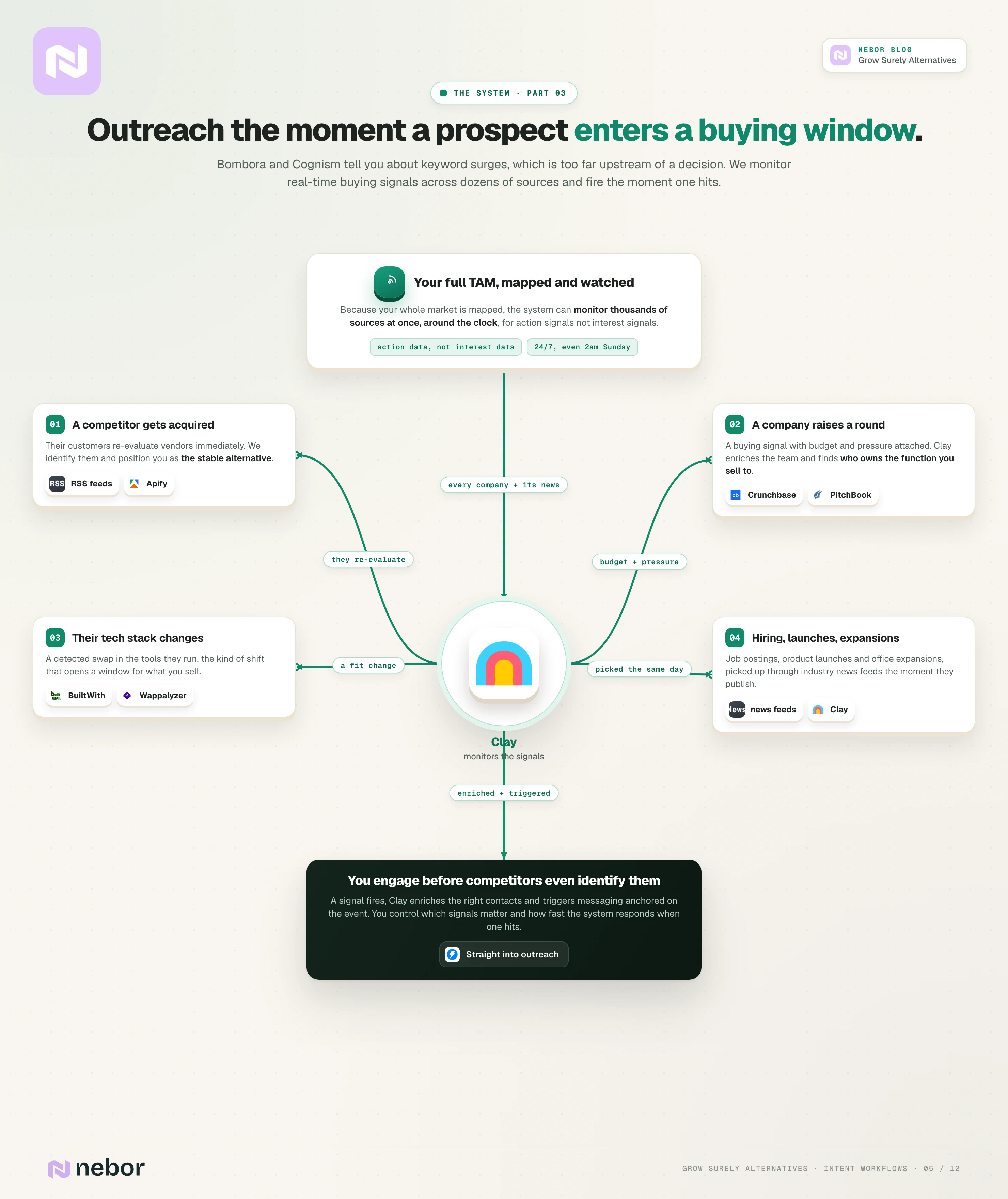
Because we have your full TAM mapped out, with every company in it and every piece of news about each one, we can build automated systems that monitor real-time buying signals across dozens of sources at once.
Job postings, funding announcements, competitor customer acquisitions, tech stack changes, leadership transitions, industry news, product launches, and office expansions are all examples of signals we track depending on the business.
For example, when your competitor gets acquired, their customers are immediately re-evaluating vendors. We set up Clay workflows with RSS feeds and Apify scrapers that track competitor news in real time.
The moment an acquisition happens, the system identifies that competitor's customers from databases and press releases, enriches their contact details, and triggers messaging that positions your solution as the stable alternative.
Funding rounds work the same way as a buying signal. When companies in your market raise, that is a buying signal with both budget and pressure attached.
We monitor Crunchbase, PitchBook, and similar sources for raises that match your ICP filters. The moment a company in your TAM closes a round, Clay enriches the team (not just the CEO), identifies who owns the function you sell to, and triggers outreach about scaling faster.
The specific signals that matter depend on your business.
For some clients, the right signal is a tech stack change detected through BuiltWith or Wappalyzer. For others, it is office expansions scraped from commercial real estate sites, or new product launches picked up through industry news feeds.
The system monitors thousands of data sources at once, around the clock. While competitors using manual processes work 9 to 5, your system captures opportunities at 2 AM on Sunday and queues them for outreach by Monday morning, which means you engage with prospects your competitors have not even identified yet.
Traditional agencies cannot build this level of sophistication for every client they serve. Intent monitoring requires custom infrastructure for each industry and ICP, and you control which signals matter and how quickly the system responds when one appears.
We connect your outbound, inbound, and CRM data into a single source of truth that traditional cold email agencies never touch
Remember when we said in the intro that there was a lot more the same tech stack could be doing for you? This is where we cash that in.
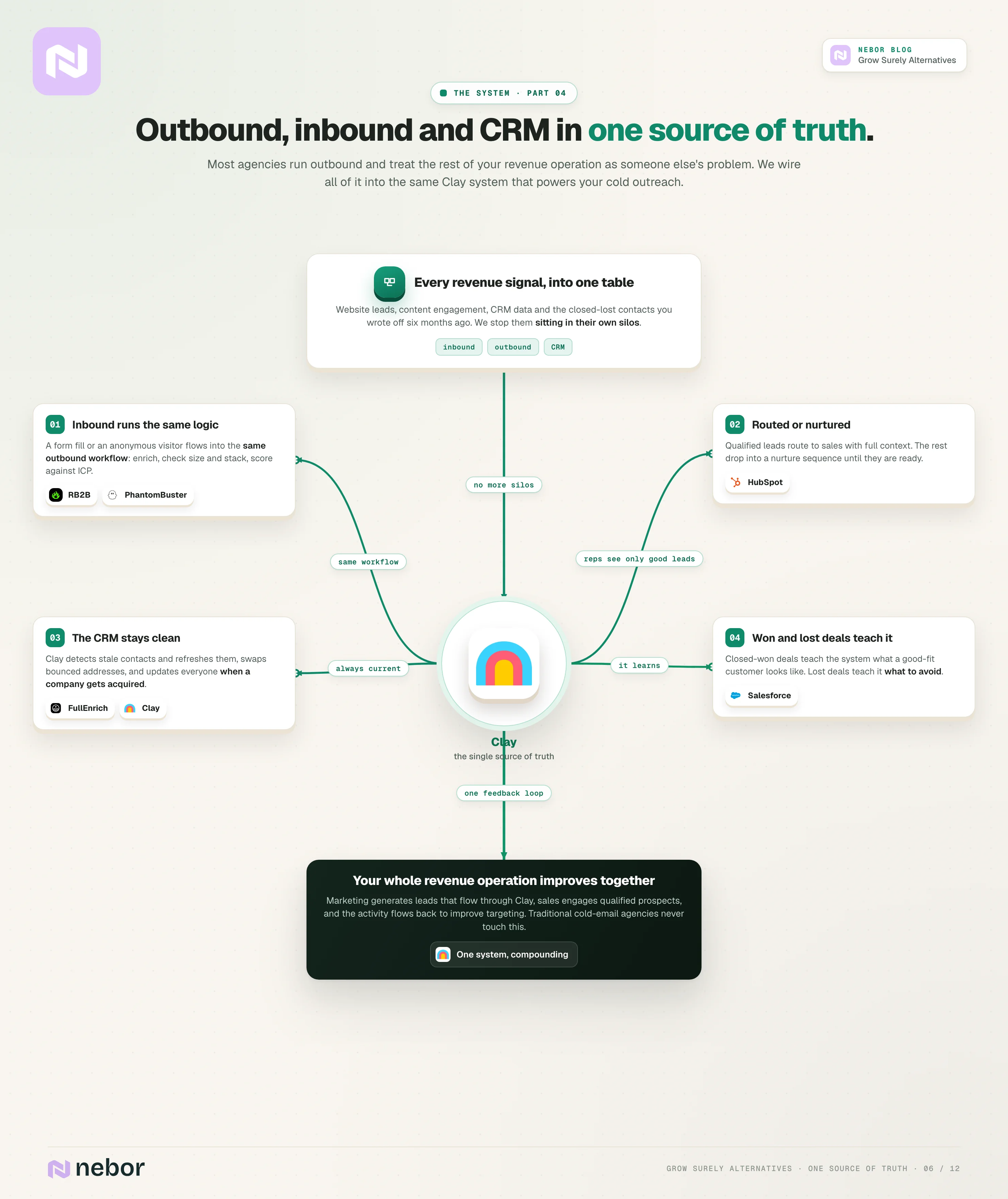
Most agencies focus exclusively on outbound, including Grow Surely. Cold email is their specialty, and they treat the rest of your revenue operation as someone else's problem.
Which leaves a lot of value on the table. The leads coming through your website, the prospects engaging with your content, the data buried in your CRM, and the closed-lost contacts you wrote off six months ago all stay in their own silos.
Companies hire traditional agencies to send outbound campaigns, so that is what those agencies deliver.
Meanwhile, your inbound leads go through a completely different qualification process that weighs on your sales reps and creates even more silos between sales and marketing. Your CRM data stays static because nobody is maintaining it.
We wire all of that into the same system.
Every inbound lead that hits your website flows into the same Clay workflows we built for outbound.
When someone fills out a form, RB2B and Apify push the data into Clay, and the same outbound workflow then enriches the profile, checks company size and tech stack, scores against your ICP, and either routes the lead to sales with full context or drops it into a nurture sequence.
RB2B identifies anonymous website visitors as well, and PhantomBuster tracks LinkedIn engagement on your posts. Both flow into Clay, where they go through the same qualification logic as your outbound pipeline.
The point of this is to plug your inbound traffic and engagement into the same workflow as your cold outreach, so the enrichment and qualification work happens automatically and your sales reps only see leads that are worth their time.
We take the CRM piece a step further. While we are connecting everything, we also build Clay workflows that keep your CRM data clean and continuously updated.
Most CRMs default to static once the data goes in. We make your CRM feed back into the system instead. When contacts go stale, Clay detects it and refreshes their information automatically.
The same logic catches bounced email addresses and substitutes new ones from waterfall enrichment. When companies announce an acquisition, Clay updates all associated contacts with the new parent company.
The result is a continuous feedback loop where your entire revenue operation improves together.
Marketing generates leads that flow through Clay for qualification, sales engages with qualified prospects, and the activity data flows back into Clay to improve targeting.
Closed-won deals teach the system what good-fit customers look like, and lost deals teach it what to avoid.
Traditional agencies cannot build this because they are not inside your full revenue operation. They stand outside as a vendor sending outbound campaigns. We work inside your infrastructure as part of how the revenue engine actually works.
We optimize email deliverability at the infrastructure level on top of the campaign level, so your domain reputation holds up over time
Most lead generation agencies optimize deliverability for their own risk management, not yours because they don’t build one for you.
They operate on their own infrastructure, with their domains and their sending IPs. If deliverability tanks, they switch to new infrastructure and keep going. Your campaigns take the hit while their business carries on without you.
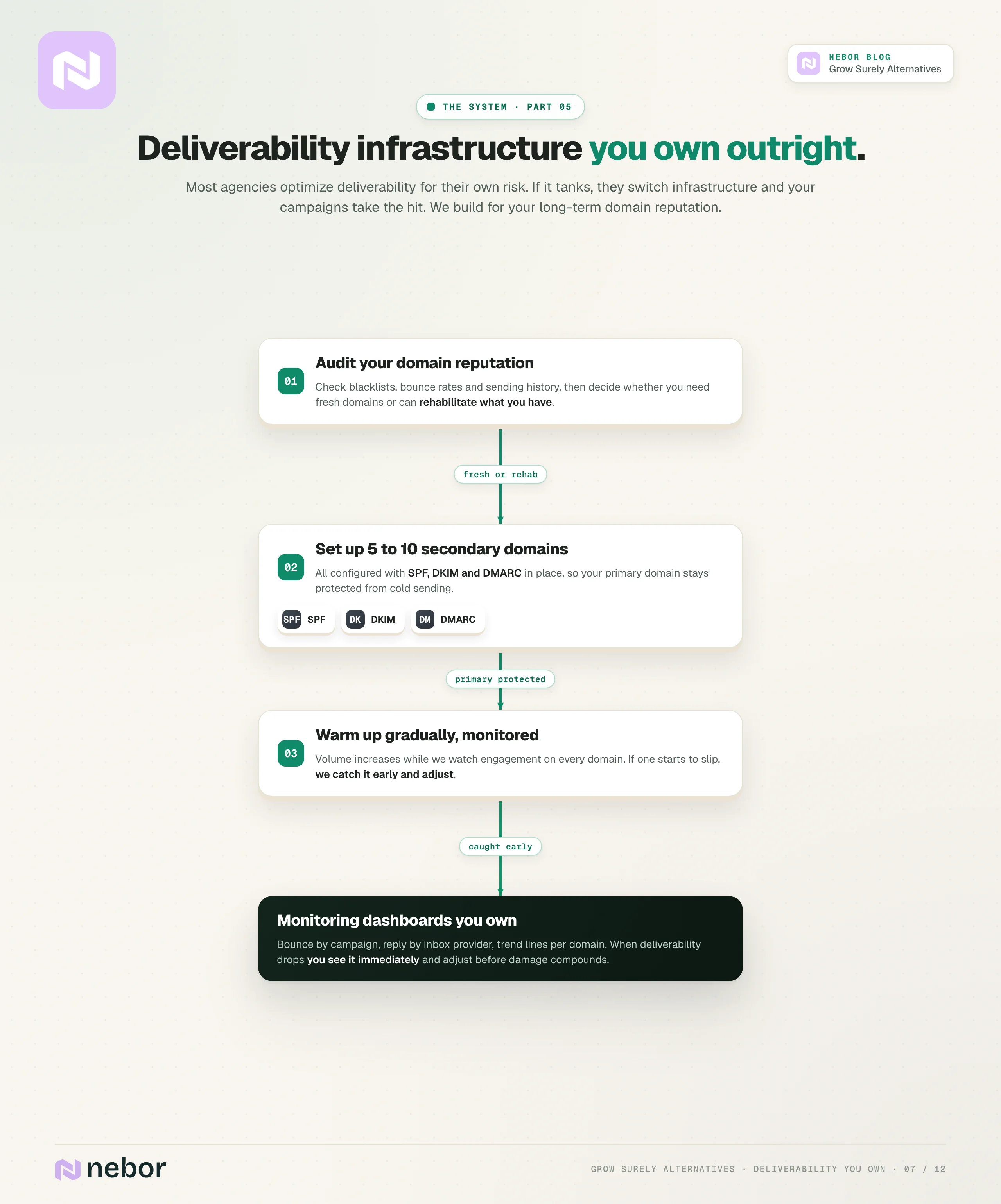
We build email deliverability infrastructure you own outright. That means we optimize for your long-term domain reputation, not for campaign performance in the current month.
We start by auditing your existing domain reputation. If you have been sending cold emails from your main domain, there is a good chance it is already damaged.
We check against blacklists, analyze bounce rates, review historical sending patterns, and decide whether you need fresh domains or whether we can rehabilitate the existing infrastructure.
Then we set up the secondary sending domains properly. We typically configure 5 to 10 domains depending on sending volume, all of them with SPF, DKIM, and DMARC records correctly in place to protect your primary domain.
Our warmup approach gradually increases sending volume while monitoring engagement rates on every domain. If any domain shows declining deliverability, we catch it early and adjust before it becomes a reputation problem.
We also set up monitoring dashboards so you can track deliverability yourself, with bounce rates by campaign, reply rates by inbox provider (Gmail, Outlook, custom domains), and overall trend lines on each sending domain.
When deliverability drops, you see it immediately and you can adjust the campaigns or the infrastructure before damage compounds.
We document everything and train your team to operate the system, so you stop paying agencies forever
We document everything we build, train your team to operate it, and explain the reasoning behind every technical decision. The business model is the reverse of what we call the retainer trap.
We get paid to build infrastructure you own, not to keep you locked into a perpetual contract.
When we set up your Clay workflows, we create documentation that walks through how each table works, which data sources we integrated, why we chose specific enrichment tools, how the filtering logic decides who gets contacted, and what triggers the different outreach sequences.
When we build n8n webhooks connecting platforms, we document the workflow diagrams and explain what each node does, so your team understands how data moves from one system to another.
When we set up your email infrastructure, we explain domain configuration, protocol records, warmup strategies, and deliverability monitoring. If you later want to add more domains or scale sending volume, your team can do it without calling us.
The underlying reason is that we think about time horizons differently from traditional agencies. They optimize their business for monthly recurring revenue. We optimize for infrastructure that generates value for years and an in-house team that can operate it after we are gone.
Some clients work with us for 6 months and then operate the system on their own. Others stay with us ongoing because we keep building new capabilities as their business evolves. Both arrangements work for us, because the point is that you are not locked in by ignorance of your own system.
Top 8 Grow Surely alternatives for B2B lead generation and sales pipeline
The B2B lead generation market has a few distinct flavors right now, and the differences between them matter more than the differences between any two specific vendors.
Full-service appointment-setting agencies that handle everything end to end.
Clay-certified automation shops that build technical workflows for clients.
SDR outsourcing providers that function as virtual sales teams.
Boutique operators that focus on quality of conversation over volume of meetings.
Understanding which category fits your needs matters more than picking a specific vendor. Here are 8 alternatives to Grow Surely across those four categories.
1. Nebor: builds Clay-based outbound systems that live in your accounts, not ours
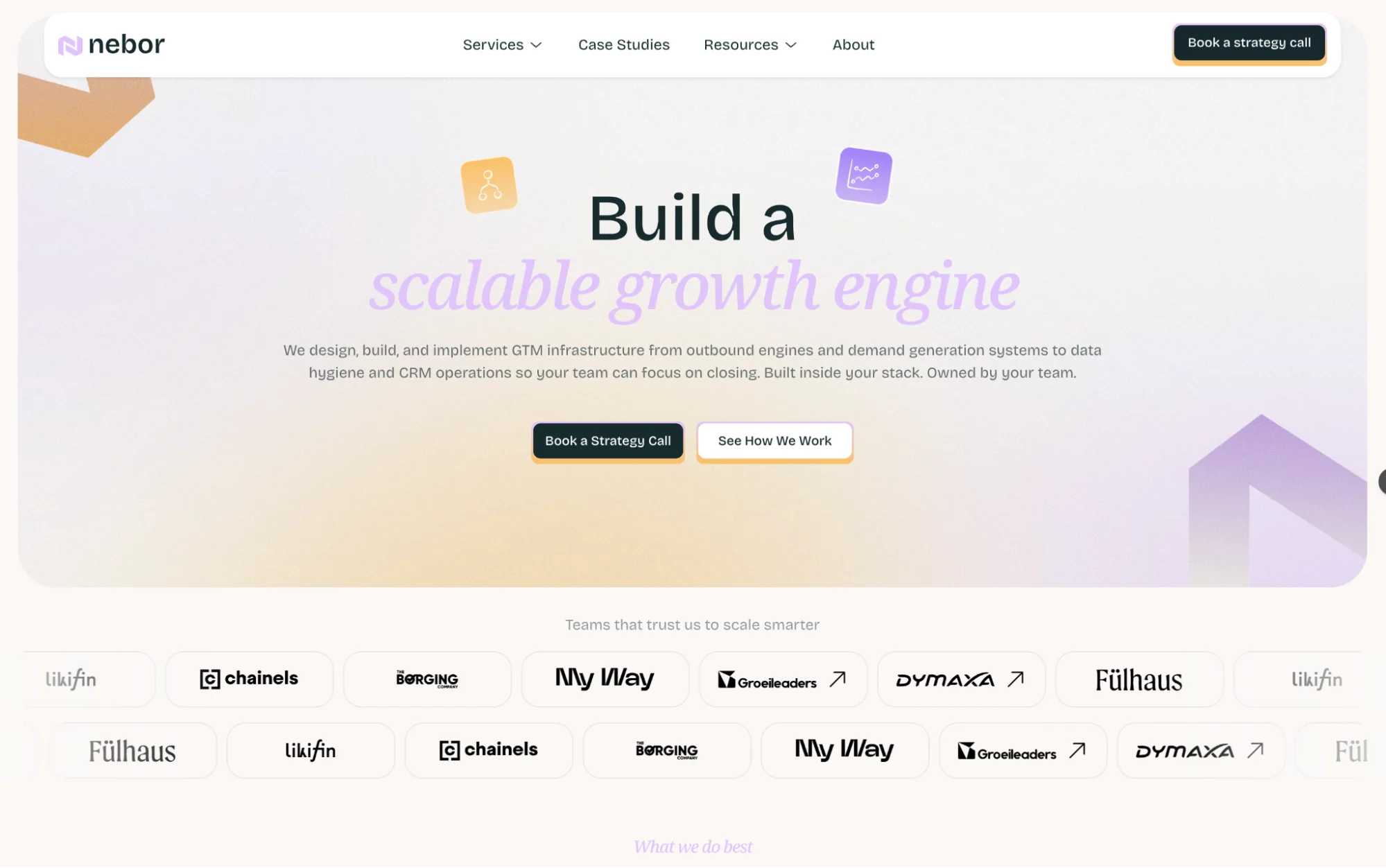
We are a sales automation agency that builds owned lead generation systems using Clay, n8n, Instantly, PhantomBuster, and several other tools.
Our approach is to build custom infrastructure that belongs to you completely. When we are done, the workflows keep going, the system keeps learning from your closed-won data, and your pipeline keeps filling without ongoing retainers.
We focus on three things most agencies skip. The first is intent data monitoring that triggers outreach when prospects enter buying windows.
The second is connecting your outbound, inbound, and CRM data into a single system so your entire revenue operation improves together. The third is documenting everything and training your team so you can eventually operate the system without us.
Where we differ from Grow Surely: Grow Surely delivers meetings on a subscription model using Clay workflows they built and control.
We build the Clay workflows, hand you access, document how they work, and train your team to operate them. It is the difference between owning the asset and renting access to someone else's. Here’s the engine you can get us:
Pricing: Our pricing is custom-based on TAM size, workflow complexity, and whether you want us to send campaigns or just build the infrastructure.
2. Belkins: delivers full-service enterprise outbound for teams that want proven processes and can commit to long contracts
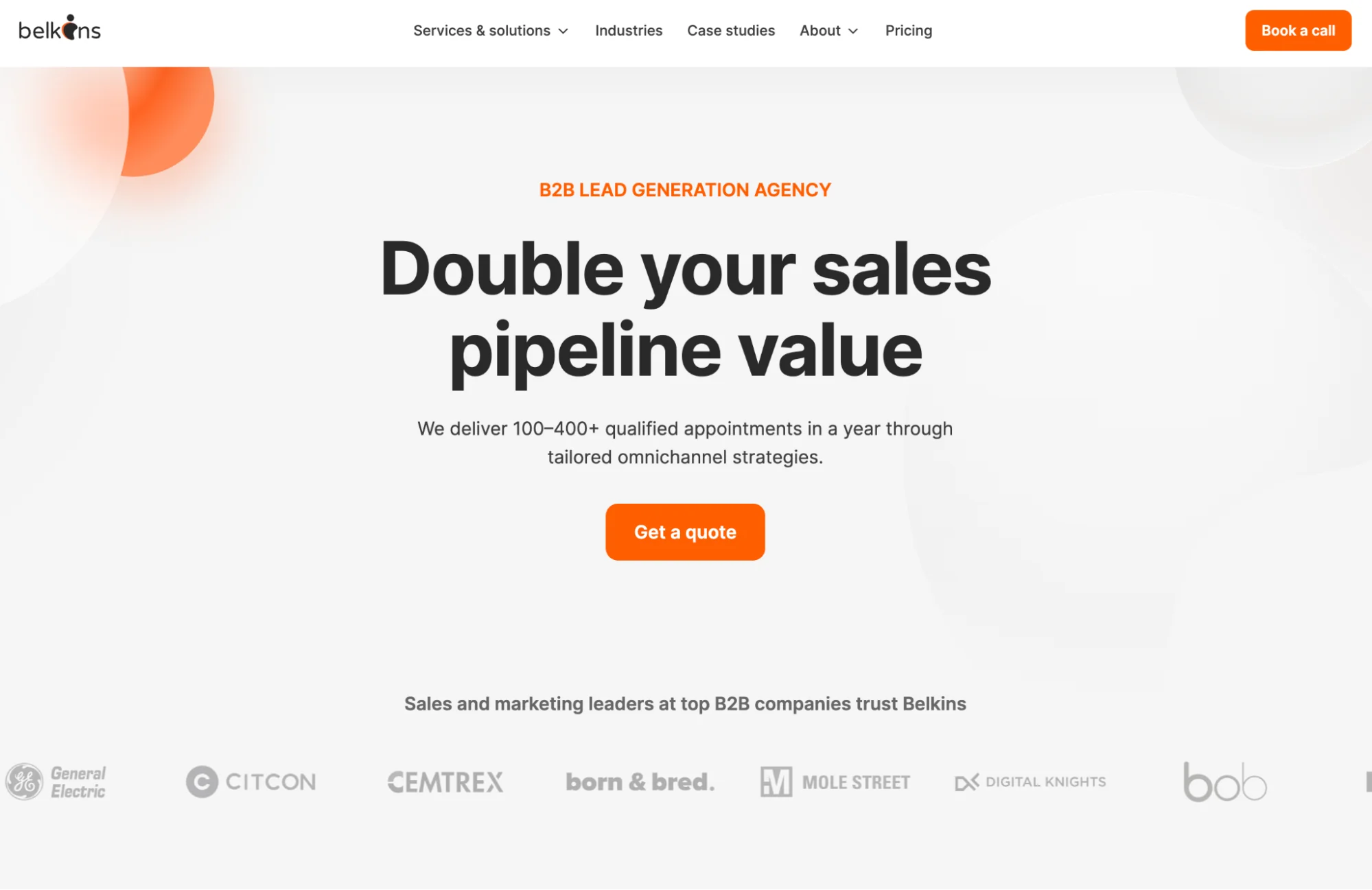
Belkins offers a full omnichannel approach spanning cold email, LinkedIn, cold calling, WhatsApp, and paid advertising.
Each client gets a dedicated team that includes an Account Manager, SDR, Lead Researcher, Copywriter, and Email Tech Expert. Campaign launch happens in 14 days, with first appointments typically landing within 30 days.
Belkins also works on a proprietary tool stack they built in-house. Folderly handles AI-powered email deliverability, Frostbite drives outreach automation, and Charge handles Outlook campaigns.
That stack saves clients roughly $10,000 annually in third-party software costs compared to agencies that buy and stitch together standard tools.
The catch is that they require 12-month commitments and pricing ranges from $3,000 to $25,000+ monthly depending on scale and complexity.
That works out to $36,000 to $300,000+ per year. You are paying for a proven system with serious infrastructure behind it, and you are paying for it on their terms.
Where Belkins differs from Grow Surely: Both Belkins and Grow Surely are full-service done-for-you.
Belkins operates at higher price points and typically works with larger companies, while Grow Surely is more focused on cold email at scale. Belkins offers broader channel coverage across paid, calling, and WhatsApp.
Where Belkins differs from Nebor: Belkins sends campaigns for you indefinitely on their infrastructure. We build infrastructure that lives in your accounts.
After 12 months with Belkins, you have spent at least $36,000 and you do not own any of the infrastructure they built.
After a similar investment with us, we are long gone and you own a working system that handles both inbound and outbound lead generation, while your sales reps spend their time having meetings and winning deals.
3. CIENCE: bills per held meeting if you want incentive alignment without giving up SDR outsourcing
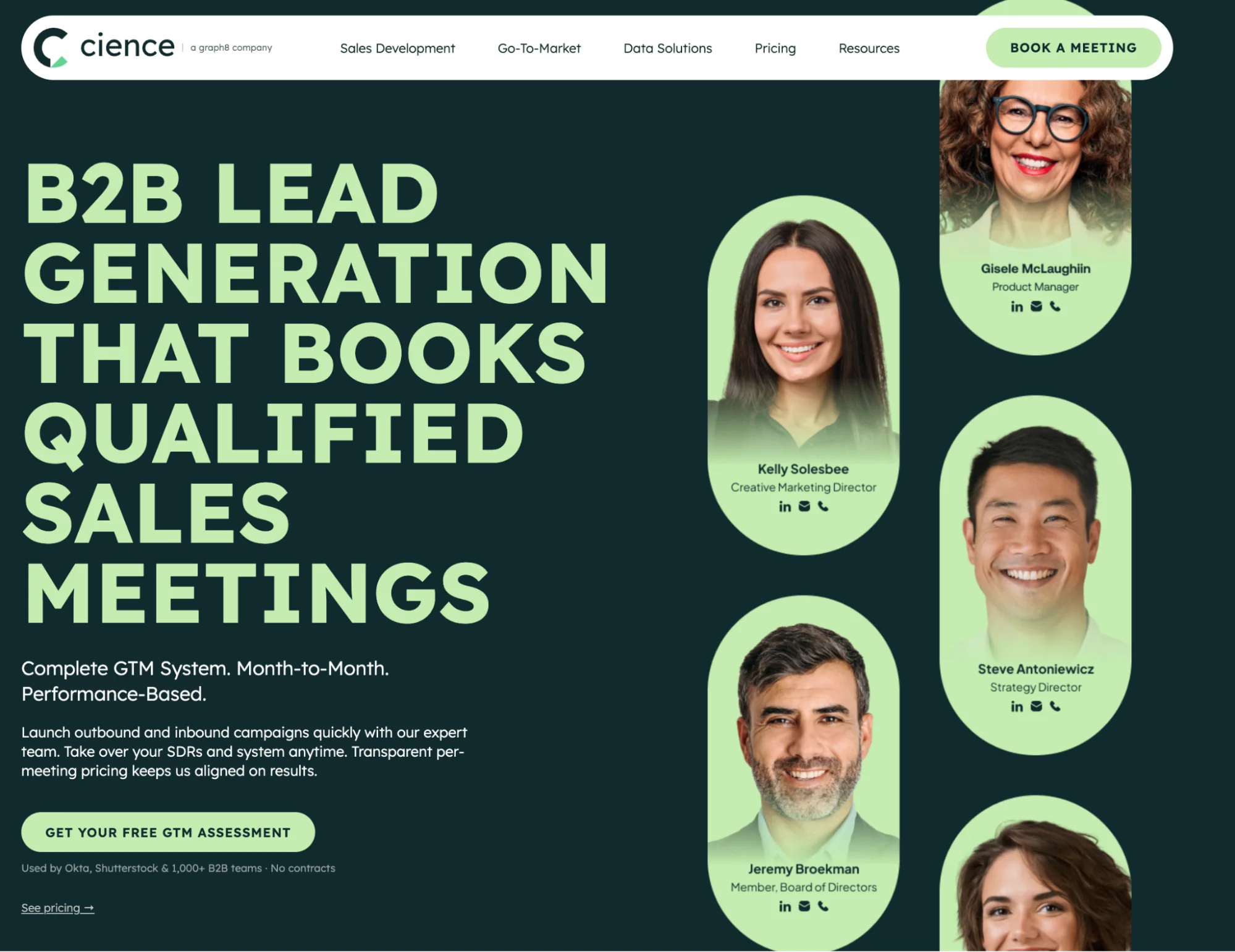
CIENCE pioneered the hybrid SDR model that combines AI automation with human representatives.
Their pricing structure is the part worth understanding in detail, because it works differently from a fixed retainer.
There is a $5,000 one-time GTM setup fee that covers your initial strategy, ICP definition, and campaign architecture.
After that, you pay $250 per held meeting (booked and shown up), plus $1,500 per month for campaign management and $499 per month for platform access.
The math gets interesting once you increase volume. If they book 10 held meetings per month, you are paying $2,500 in meeting fees plus $1,500 in management plus $499 for the platform, which works out to $4,499 monthly.
That keeps you competitive with most fixed-retainer agencies. If they book 20 meetings instead, you are paying $5,000 in meeting fees plus $1,999 in overhead, which is $6,999 monthly.
The platform gives you access to 140M+ B2B contacts with claimed 90%+ accuracy. They deploy campaigns in a 5-day sprint, faster than the typical agency timeline of 2 to 4 weeks.
Their SDR marketplace covers both offshore ($1,000 to $1,600 per month) and US-based ($2,400 to $3,000 per month) representatives.
Where CIENCE differs from Grow Surely: Grow Surely charges fixed monthly retainers regardless of results, while CIENCE's performance component means you pay more when you get more meetings.
The incentive alignment is better, but the bill can climb higher when campaigns perform well.
Where CIENCE differs from Nebor: CIENCE provides outsourced SDRs working your campaigns on their platform, and the cost scales linearly with the number of meetings they book.
We build automation that reduces or eliminates the need for outsourced SDRs entirely, so your in-house team can focus on conversations and your cost curve flattens after the initial build.
4. frontBrick: builds Clay-certified automation but typically keeps operating it for you
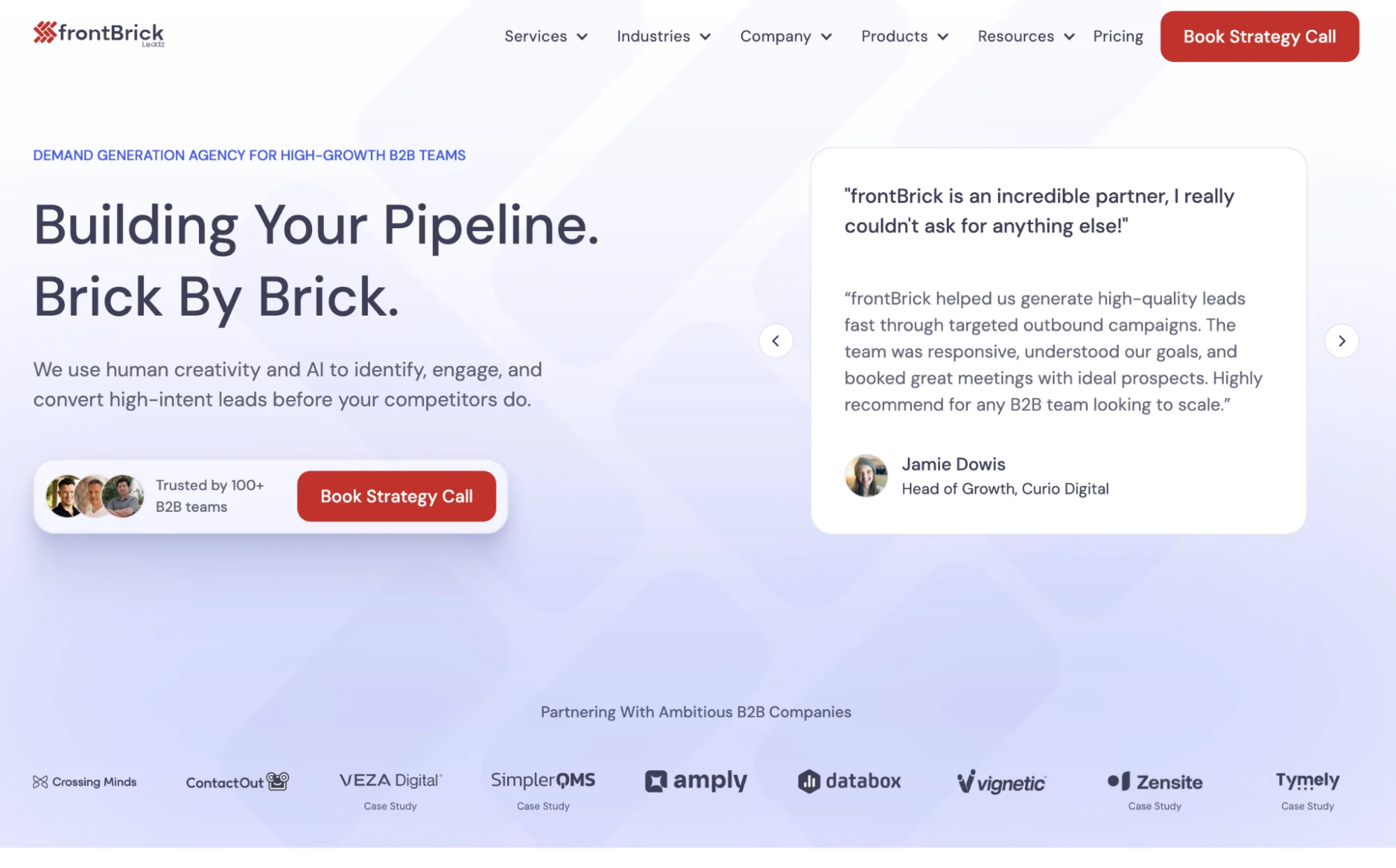
frontBrick positions itself as the technical automation shop for companies that understand modern sales tools. They hold a stack of vendor certifications, includingClay Expert Partner, Instantly Certified, Lemlist Expert, Smartlead Partner, and HeyReach Partner.
Their differentiator from generic agencies is intent-data focus. They monitor 30+ buying signals through Clay workflows, covering leadership changes, funding rounds, job postings, tech stack changes, product launches, office expansions, and M&A activity.
They pull from 105+ data sources and enrich with 250+ data points per prospect.
Where frontBrick differs from Grow Surely: frontBrick is more transparent about methodology, because they will show you the Clay workflows and walk you through the intent data logic.
Grow Surely keeps their Clay work behind the scenes, which means frontBrick works better if you actually want to understand what is happening on your behalf.
Where frontBrick differs from Nebor: frontBrick builds sophisticated Clay systems but typically keeps sending campaigns for clients ongoing, on their infrastructure. We build systems designed for you to operate independently from the start.
Both shops understand modern automation, and the difference is purely about where the system lives at the end of the engagement.
5. ColdIQ: builds and teaches Clay workflows but only takes on companies above $100K monthly revenue
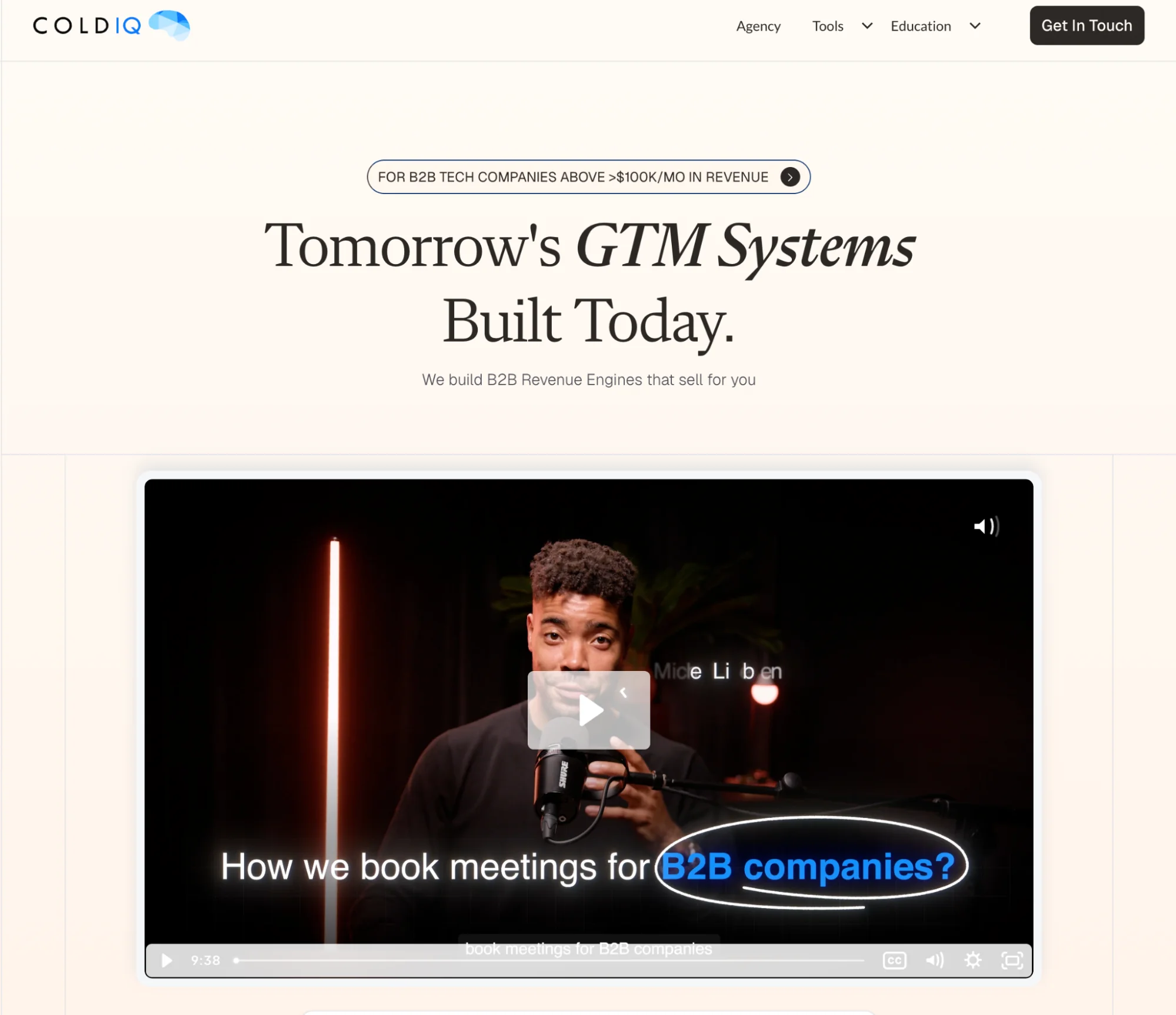
ColdIQ is a team of technical Clay operators who work exclusively with established companies generating $100K+ in monthly revenue.
Their technical stack goes deep, with 57+ data sources integrated, AI personalization powered by GPT-4, Claude, and Gemini, and campaigns live within 2 weeks against an industry standard of 4 to 6 weeks.
They have sent 20M+ emails, generated 100K+ leads for 300+ B2B companies, and scaled their own agency to $6M ARR in 2 years.
The interesting part of ColdIQ is the education focus. They build systems and they teach you how those systems work.
They offer training programs, document their workflows extensively, and want your team to understand the Clay logic so you can eventually send campaigns without them.
Where ColdIQ differs from Grow Surely. Grow Surely delivers campaigns and keeps methods proprietary, while ColdIQ builds systems and actively shares the knowledge behind them. ColdIQ is more technical, works with more established companies, and costs more, but the price tag includes the software stack.
Where ColdIQ differs from Nebor: ColdIQ is philosophically the closest agency to us on this list. They believe in knowledge transfer and technical sophistication, and they design every engagement around making the client's team competent.
The main difference between us is the revenue floor. ColdIQ requires you to be generating $100K in monthly revenue before they will work with you. We only care that you have a real product and a defined ICP.
6. SalesHive: staffs dedicated outsourced SDR teams with transparent monthly pricing
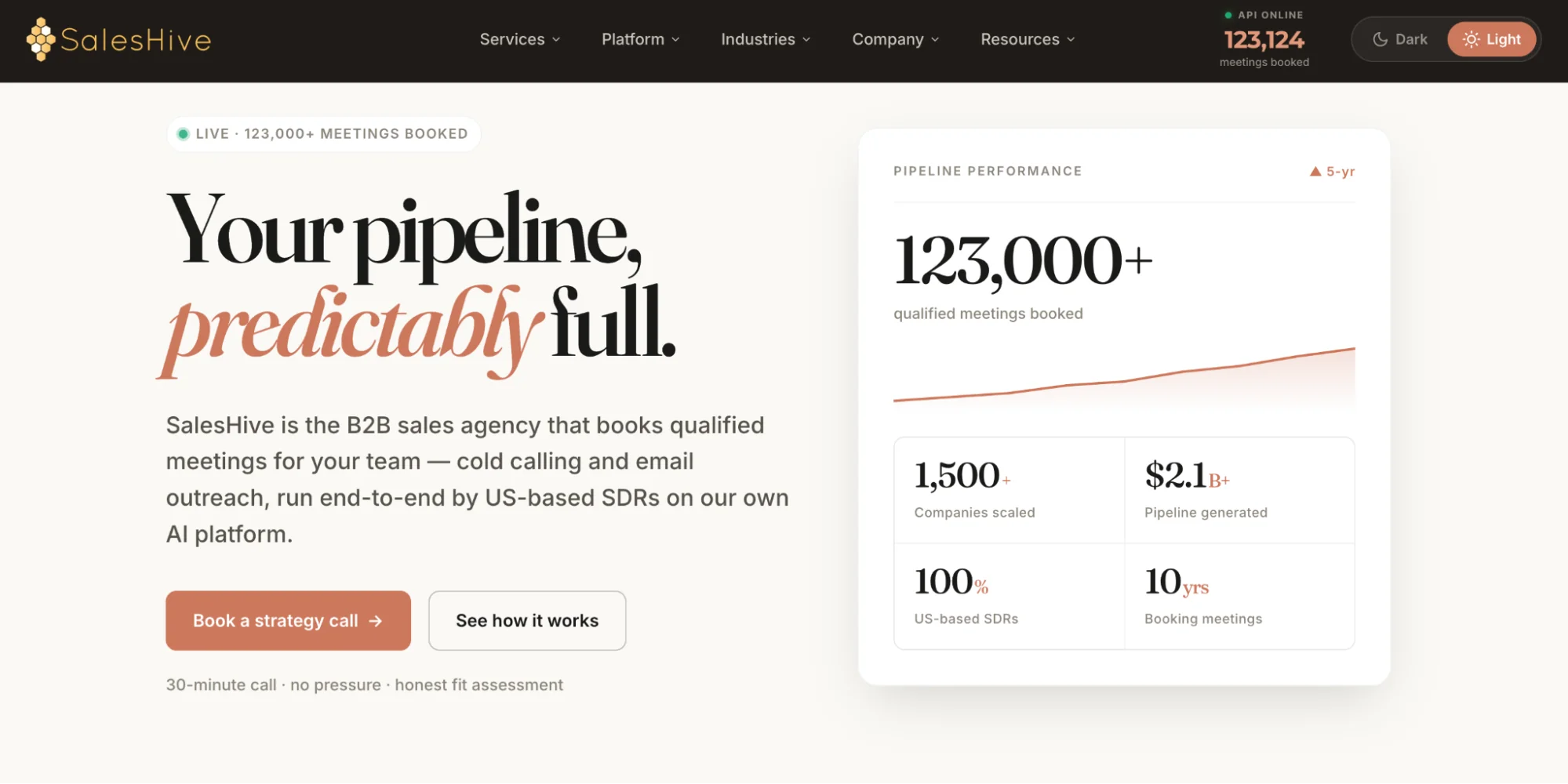
SalesHive is anSDR outsourcing service with a technical layer on top. Their eMod AI Engine researches prospects using public data, then rewrites email templates with relevant context automatically before each send.
They claim 3x higher response rates and 68% average open rates. They have booked 117,000+ meetings for 1,500+ clients including Shopify, Siemens, and Zoho, which has generated $2.1B+ in pipeline across that book of business.
Where SalesHive differs from Grow Surely: Both deliver meetings through campaign execution, but the model is different on each side.
SalesHive structures its business around dedicated SDR teams working your account, while Grow Surely focuses more on campaign automation at scale. SalesHive costs more on a per-month basis but provides more human touch in how the outreach lands.
Where SalesHive differs from Nebor: SalesHive provides outsourced SDR teams and humans managing your outbound, with cost that scales linearly with headcount.
We build automation that reduces or eliminates the need for outsourced SDRs entirely, with an upfront investment and then minimal ongoing costs once the system is live.
7. Cleverly: delivers LinkedIn-only outreach from $397 per month if you want a low-cost single-channel option
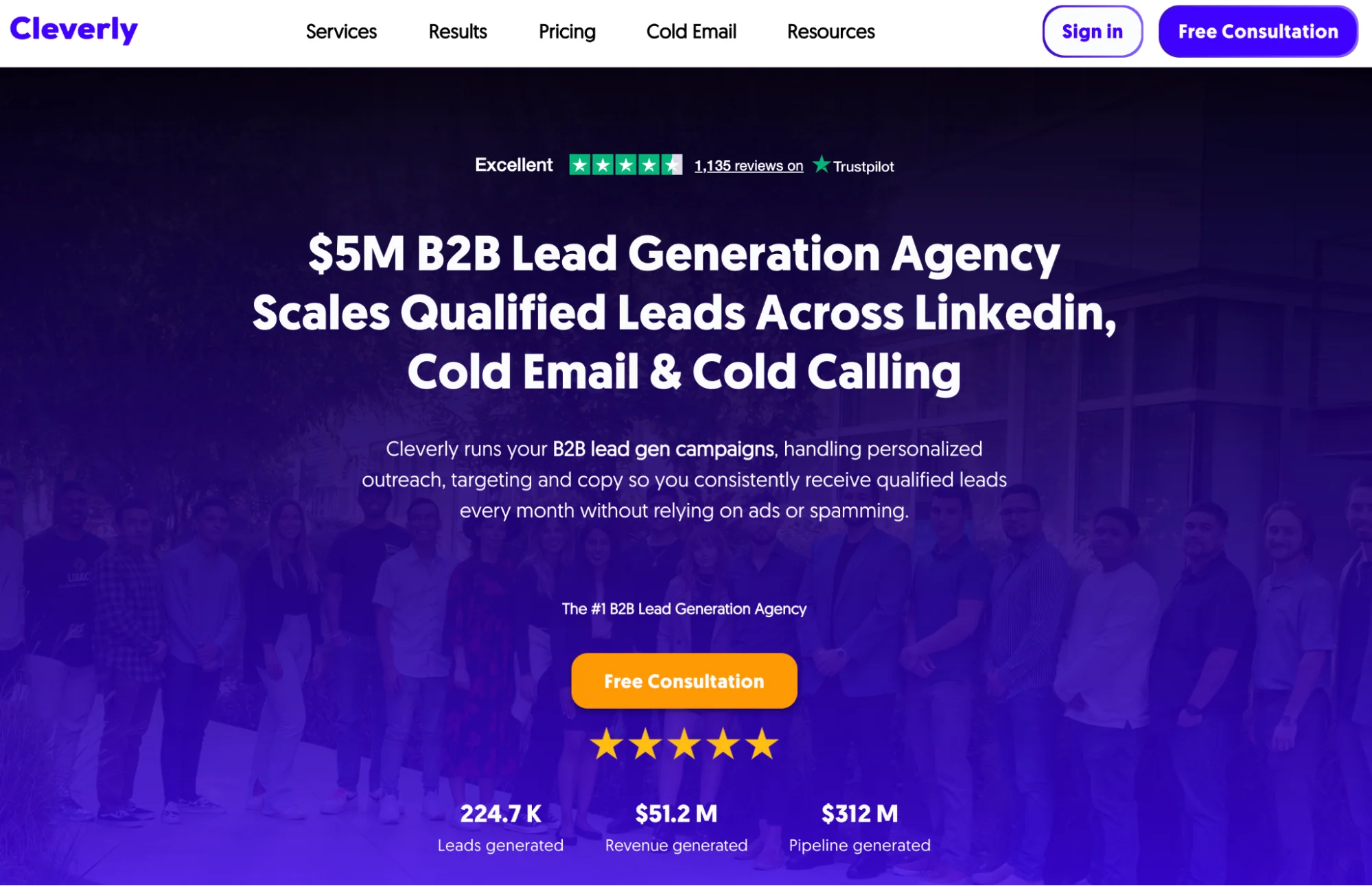
Cleverly has built its business almost entirely around LinkedIn outreach. They do cold email as an add-on, but LinkedIn is the channel they actually own.
They have the lowest entry price point in this analysis, starting at $397 per month for the Silver tier and 500 prospects per month.
Their tier structure comes in three clean steps. Silver at $397 per month covers basic LinkedIn outreach. Gold at $697 per month adds thousands of follow-ups and email integration. Platinum at $997 per month includes a dedicated appointment setter on top of the LinkedIn work. For cold email specifically, they offer a pay-per-meeting-ready-lead model with no contracts required.
Where Cleverly differs from Grow Surely: Grow Surely delivers multi-channel outreach across email, LinkedIn, and phone, while Cleverly is a LinkedIn specialist with email as an add-on. Cleverly costs less in absolute terms but trades that price for a narrower channel focus.
Where Cleverly differs from Nebor: Cleverly is a single-channel specialist sending campaigns for you indefinitely.
We build multi-channel systems that live in your accounts and reach across LinkedIn, email, calls, and any other channel where your buyers actually live.
Cleverly is the cheaper option in the first month. We are the better value over the lifetime of the engagement, because the infrastructure stays with you when we leave.
8. Growth Rhino: delivers boutique-quality engagements with message testing before scaling
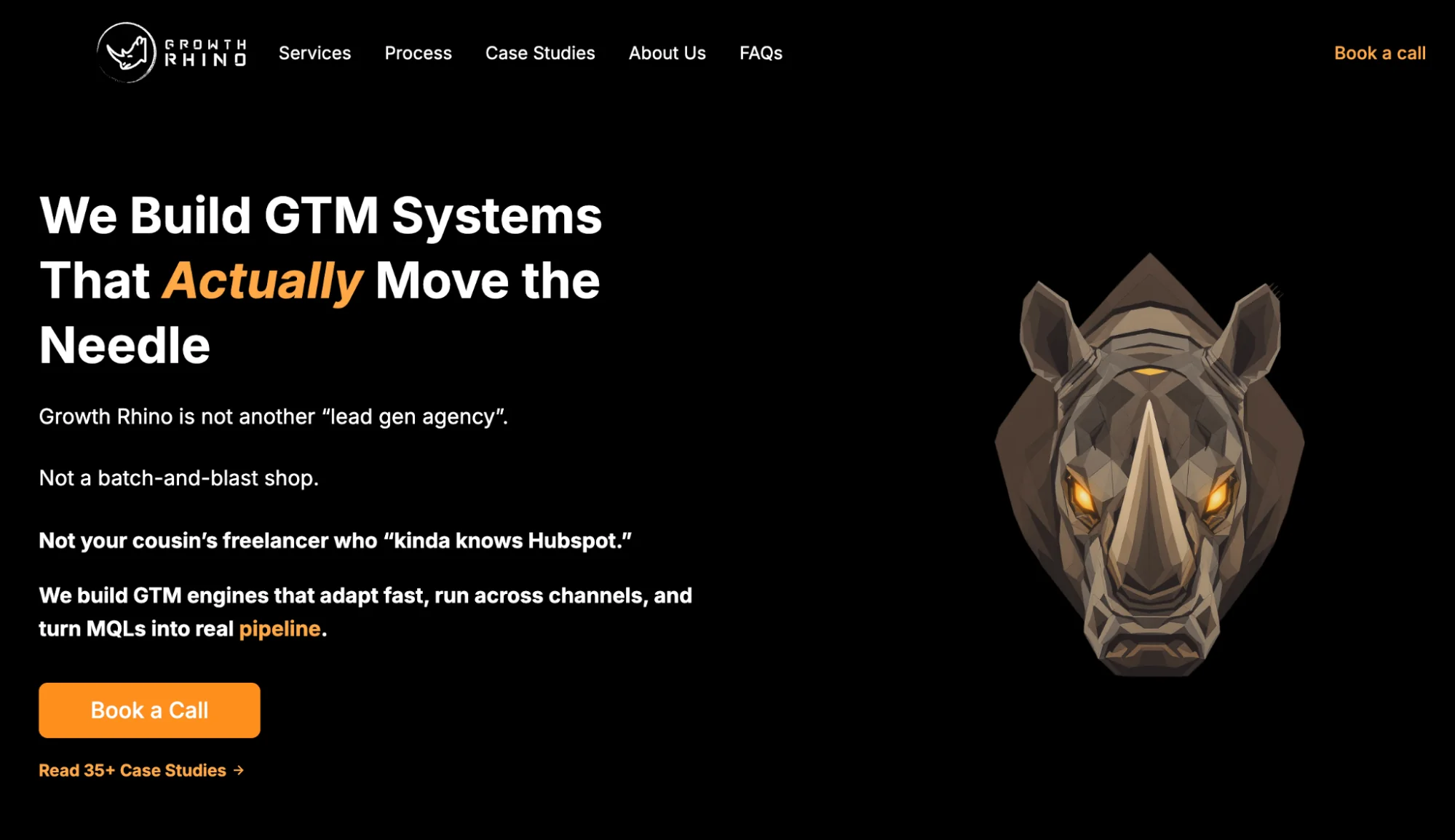
Growth Rhino differentiates through methodology rather than scale. They launch micro campaigns first to qualitatively identify winning messaging, and only then scale volume against the messages that work.
Their approach to outbound is explicitly anti-volume. They focus on building sustainable outbound infrastructure rather than booking maximum appointments per month, which makes them a better fit for teams that care about quality of pipeline over raw meeting count.
Retainers start at $12,000 per quarter, which works out to roughly $4,000 per month, with typical 6 to 9 month engagements. They are philosophically aligned with ownership over rental, although they continue sending campaigns for the duration of each engagement.
Where Growth Rhino differs from Grow Surely: Grow Surely operates at a larger scale with higher volume per account, while Growth Rhino is boutique and message-testing focused.
Grow Surely guarantees meetings through volume, while Growth Rhino optimizes for conversation quality and tries to find the message before pouring sends behind it.
Where Growth Rhino differs from Nebor: Growth Rhino philosophically aligns with us on eventual ownership, but the engagement stays on their team for as long as it lasts.
We build systems designed for independent operation from day one, so the team you hand the keys to is yours rather than ours.
Work with Nebor to build an automated B2B lead gen system you actually own
The agencies in this breakdown land at sharply different points on the spectrum from short-term result delivery to long-term system ownership.
Some optimize their business for scale and recurring revenue, which means they will deliver results as long as you keep paying, but you will never own the infrastructure that produces those results.
Others optimize for boutique quality and specialist expertise, which makes them excellent in narrow domains but limits how far they will go across your full revenue operation.
A third group optimizes for knowledge transfer and eventual independence, on the theory that clients should own their systems even if that costs the agency future retainer revenue.
We are in the third group, by design rather than by accident. We build infrastructure that lives in your accounts because we think that is better for you over the long run, even when it is worse for our business in the short run.
If you would rather own your pipeline than rent it from someone else, book a call with the team. We will walk you through what owning your outbound system actually looks like for your specific stack.


Related Articles


By clicking Sign Up you're confirming that you agree with our Terms and Conditions.