
10 Best Pearl Lemon Leads Alternatives for B2B Pipeline and Lead Generation


In this post:
You signed up with Pearl Lemon Leads to solve a lead generation problem, and maybe they did the job.
But you are here reading Pearl Lemon Leads alternatives.
Maybe because something stopped working, and that tells us a few things about where you actually are.
Either the meetings are happening but your pipeline does not move or the math finally caught up with you. You are paying someone to build a pipeline that disappears the second you stop paying them.
Their team learned a lot about your buyers over the months you worked together. The emails that landed, the angles that got replies, the objections that came up most often.
None of that knowledge transfers to you when the contract ends. They walk out the door with all of it.
Most lead generation companies build their business around people doing the work by hand. They hire teams of SDRs and so-called lead gen specialists, hand them scripts and targets, and send them off to hunt on your behalf.
The model worked well in 2015 when buyers picked up the phone. In 2026, it is a tax on your sales team and a ceiling on your growth.
At Nebor, we are not building a team to work for you. We are building a GTM system you own, one that works largely without human input and lives inside your accounts when the engagement ends.
If your salespeople spend their days copying emails, hunting phone numbers, and updating spreadsheets, you are wasting their talent.
They should be talking to your buyers, working open deals, and closing the ones that are ready to close. The rest of the work is what automation is for.
We put together this list of Pearl Lemon Leads alternatives so you can see what else is out there. Some of these companies work the way Pearl Lemon does. Others work the way we do at Nebor, and a few solve a different problem altogether.
Let’s get started.
Why Nebor is the best alternative to Pearl Lemon Leads
Pearl Lemon Leads and Nebor solve the same surface problem and have almost nothing else in common. Both of us help you put more sales meetings on the calendar.
The mechanism, the ownership model, and what you walk away with at the end all follow different operating systems.
Pearl Lemon registers as a lead generation agency and does that motion well. We are explicitly not a lead generation agency. We build GTM systems, which is a different category of work and produces a different shape of outcome.
Here is how that difference plays out across six points, then a walk-through of the system itself.
With Pearl Lemon Leads, you rent their service. With Nebor, you own the machine
Pearl Lemon Leads delivers the campaigns for you end to end. Their team handles the day-to-day work, their internal processes hold it together, and their reporting tools live inside accounts that belong to them.
You pay every month, the leads land in your inbox, and the work continues for as long as the contract continues. Stop paying and the engine shuts off the same week.
What you keep is whatever leads were already in motion when the contract ended.
At Nebor, we build a system that does the work for you and stays with you when the engagement ends. With a traditional agency, you pay for labor.
Labor means people sending emails, making calls, managing campaigns, and pulling together monthly reports. With us, you pay for infrastructure that works around the clock without anyone touching a keyboard.
When you finish with Pearl Lemon Leads, you keep the leads they generated. When you finish with Nebor, you keep the entire engine.
That includes the Clay tables, the n8n workflows, the routing rules, the CRM build, and the cadence logic that underpins it all. All of it lives inside the accounts you already pay for.
You can operate it yourself, hand it to an in-house RevOps lead, or bring in another agency to maintain it.
We have written more on why you no longer need to outsource lead generation, but the short version is this: the retainer model creates a vendor lock that gets more expensive every year. Owned systems compound.
Open tech stack versus proprietary black box
Pearl Lemon Leads has built their business around proprietary tools, internal systems, and proven playbooks they do not open up to clients. That choice makes sense for them because it is how they keep control and consistency across the book.
The same choice creates a problem for you. You cannot see how the work actually happens day to day. There is no way to pull the parts that work for your team and use them elsewhere, and none of it leaves with you when the engagement ends.
We take the opposite approach with our stack. We always build stacks around tools that make the most sense for your business.
The usual suspects include Clay, n8n, PhantomBuster, Apify, Instantly, Ocean.io, HeyReach, Cal, RB2B, Leadinfo, LeadsFactory.io, FullEnrich, Findymail, LeadMagic, and more.
We did not build any of those tools, and that is the entire point. They belong to the companies that built them, and you can buy a seat on any of them tomorrow without our help.
You are not dependent on Nebor for any of it. Everything we build lives inside your account, on tools you have a login to.
You can watch the machine work in real time, audit the message templates, swap out a tool when a better one comes along, and bring the whole thing in-house when you are ready.
Pearl Lemon can show you a weekly report. We can show you the machine itself and walk you through every piece of it.
Built systems versus people doing the work by hand
Traditional agencies like Pearl Lemon Leads staff up with salespeople. They hire SDRs, train them on your product, hand them scripts, and turn them loose.
When you need more output, they hire more people. When you need to change the playbook, somebody on their side has to update spreadsheets and re-train the team.
The model worked when buyers picked up the phone and bought from cold scripts. In 2026, the choice between scaling with systems and scaling with headcount is no longer a real debate, and the headcount version has become a tax on your sales team.
The same work that used to need a researcher and an SDR can happen inside a Clay table that wakes up every morning.
Here is what that looks like for a client of ours that sells event-management software into trade show hosts. Finding those companies by hand is brutal in practice.
You have to scour event directories, verify the host versus the agency organizing the event, count the exhibitor list, confirm sponsors exist, and filter out attendees who got mistakenly tagged as hosts.
A traditional agency would assign that to a researcher who would build a prospect list over a couple of weeks, miss half the criteria, and hand it over for outreach. Our system does the same job every morning at 9 AM with no human in the loop:
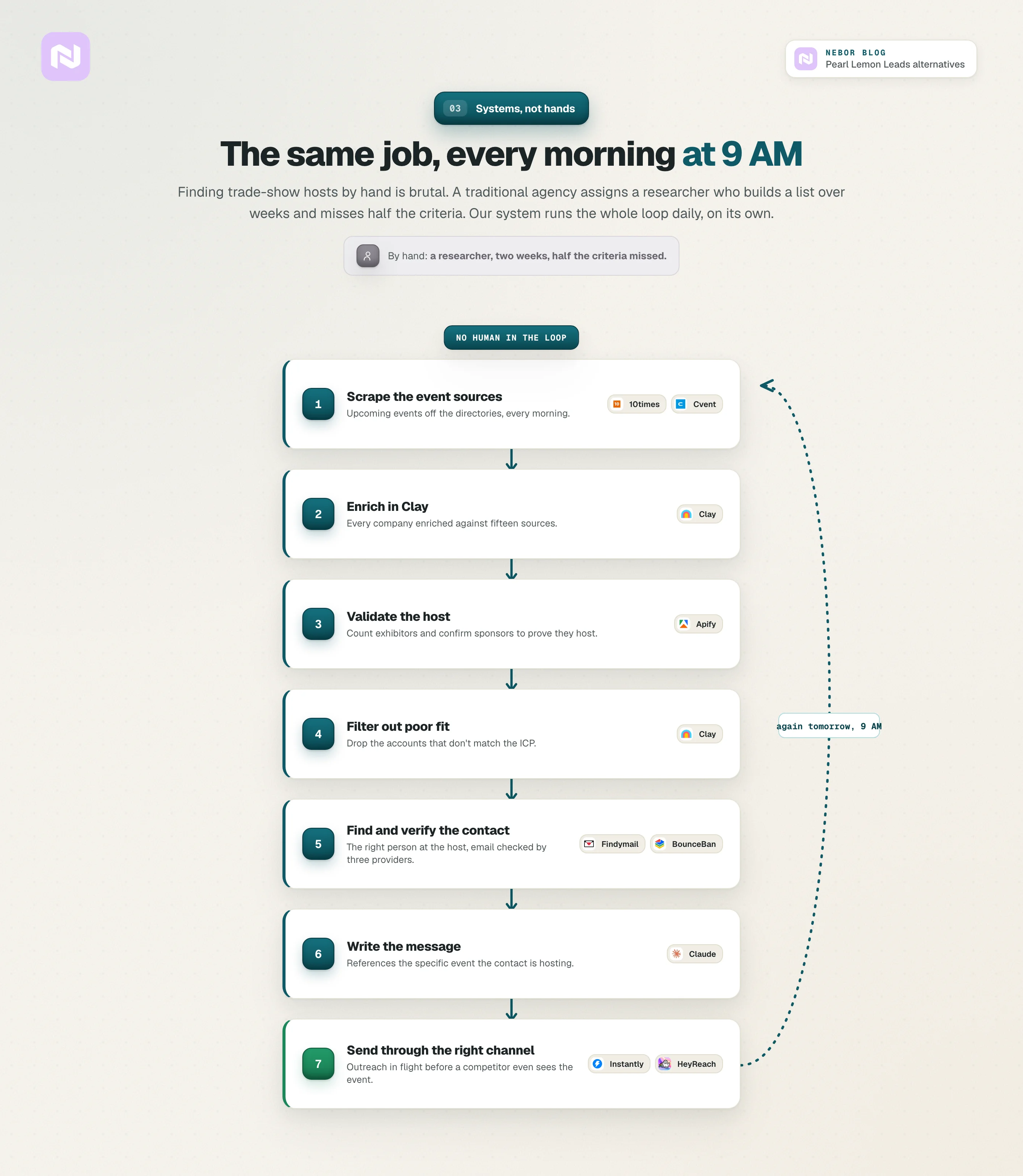
The same loop repeats the next morning with a new set of events, hosts, and outreach in flight. Pearl Lemon would need to staff a research team to keep up. We built a workflow that does the work and keeps going on its own.
Real intent data versus “someone read your blog”
Both Pearl Lemon Leads and Nebor talk about using intent data. We do not mean the same thing by the term.
Traditional agencies use intent data from tools like ZoomInfo, Bombora, and Cognism, which surface things like someone from this company read three articles about your industry or that a certain IP address visited your competitor’s pricing page.
The information is fine, but it is also not predictive of who will actually buy.
Lots of people read articles for reasons that have nothing to do with buying. The signal is too noisy to act on at scale.
Our approach looks for real business events that signal actual need. We monitor four categories that have a track record of preceding a buying decision in our clients' markets, and we build signal-based outbound campaigns around them.
Hiring signals
When a company posts a job for an SDR role, the company is trying to grow pipeline. If you sell something that fills the pipeline that role is about to inherit, that posting is a buying window.
We watch job boards and LinkedIn every day, detect the postings automatically, find the hiring manager, and reach out while the pain is fresh in their head.
Funding announcements
When a company raises money, they are about to spend it on something. If they are in your ICP and just closed a Series A, that is a buying window opening, not a vague signal.
We track funding news, enrich the company in real time, identify the people who hold the budget, and send personalized outreach before your competitors notice the round.
Competitor changes
When a competitor gets acquired, lays people off, or shuts a product line, their customers start looking around. We set up alerts on these events, identify which of the competitor's customers fit your ICP, and reach out positioning you as the stable alternative.
Industry-specific triggers
The first three apply to almost any market. The fourth is custom.
We work with a client that sells AI-powered furnishing into property developers, so we watch real-estate news for new development announcements because new buildings need furniture.
We work with another client in cybersecurity, so we watch IT consultancies raising capital because hiring at those firms drives demand for the security stack their team will recommend.
The triggers are different for every business, and we build the automation around whatever actually predicts buying intent in your world.
The system watches your market continuously, catches these moments as they happen, and starts conversations while the window is open.
Pearl Lemon Leads cannot do this at scale because it requires human researchers to monitor and react. By the time the team sees the signal and reaches out, the buying moment has already moved.
Inbound-led outbound to connect your entire revenue motion
Most companies are generating warm leads every day and ignoring most of them. Someone visits your pricing page three times in a week and never fills out a form. Someone else has liked your last seven LinkedIn posts.
Someone downloaded your guide eight months ago and fell through the cracks. Three people from a competitor connected with your team in the same two weeks.
These people already know who you are, and they are not cold prospects in any meaningful sense. If your only motion is traditional outbound, the system treats them like strangers and the warmth goes to waste.
Pearl Lemon Leads treats outbound as the main motion. They do inbound work too, mostly through SEO and content services.
Their inbound and outbound stay in separate motions and never feed each other. The dots between the two never get connected, so nothing in your inbound activity ever feeds your outbound targeting.
At Nebor we build a motion we call inbound-led outbound.
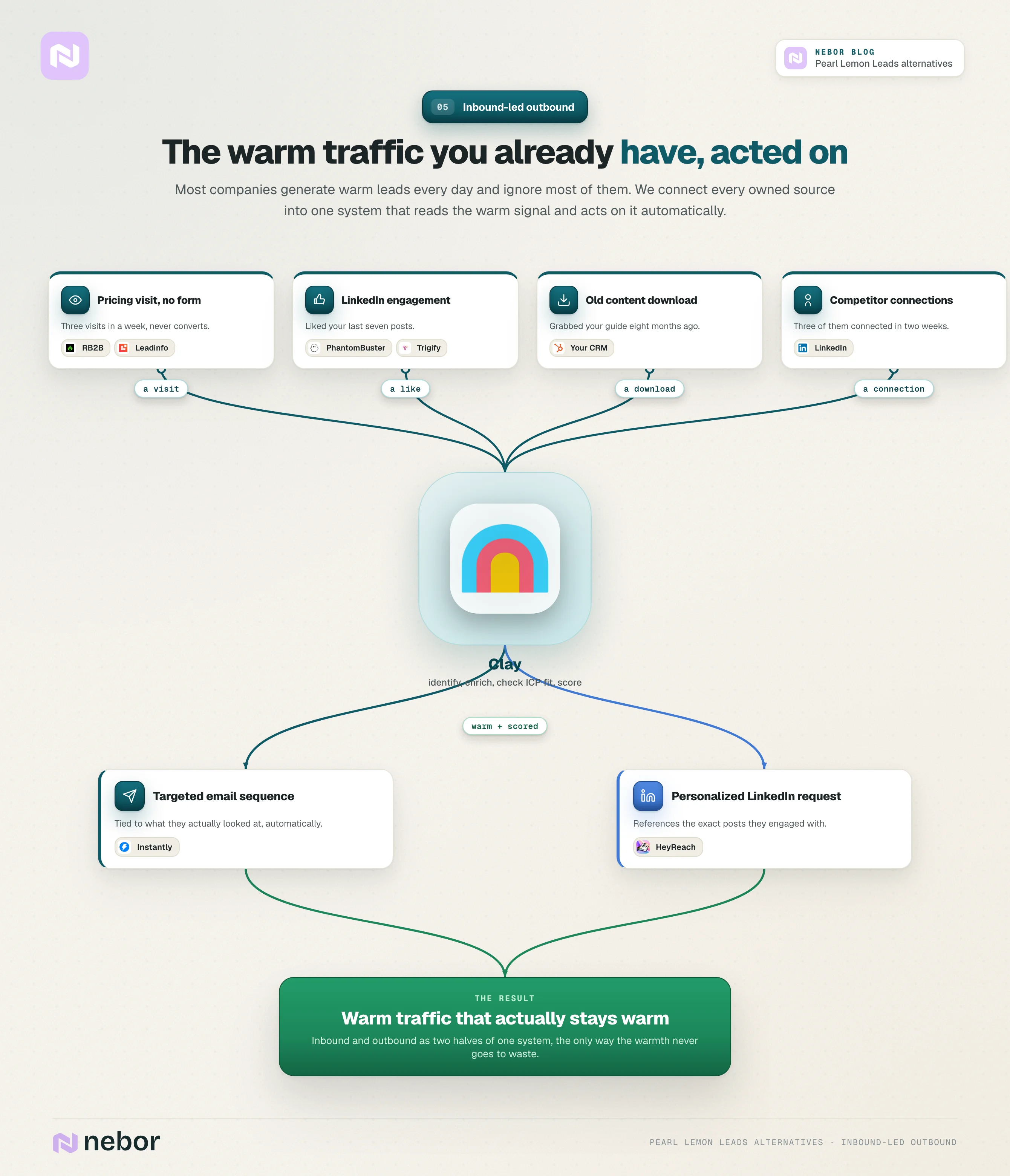
We connect your website, your LinkedIn page, your CRM, and every other source your business already owns into one system. Then we build automation that reads the warm signals and acts on them.
Take the simplest example, a website visit that does not convert. Someone lands on your site, looks at the pricing page, and leaves without filling out a form.
Most companies wait for that visitor to come back. We do not wait around for that to happen.
Our system, built on Clay, RB2B, Apify, Trigify, and n8n, identifies the visitor, enriches their profile with firmographic data, checks ICP fit, pulls their email and LinkedIn, and either drops them into a targeted email sequence or sends a personalized LinkedIn connection request, automatically.
Here is a second example that plays out on LinkedIn. Someone engages with your posts on a regular basis. We scrape that engagement data through PhantomBuster, score the profile in Clay against your ICP, and start a conversation that references the specific posts they engaged with.
The reach-out is warm because the system already knows what made them pay attention.
Pearl Lemon Leads treats inbound and outbound as separate motions. We treat them as two halves of the same system, because that is the only way the warm traffic ever stays warm.
How the full Nebor GTM flywheel works end to end
The six points above describe key points in how we think about GTM. This section is the machine itself, stage by stage. Five stages, each one owned by you, each one feeding the next.
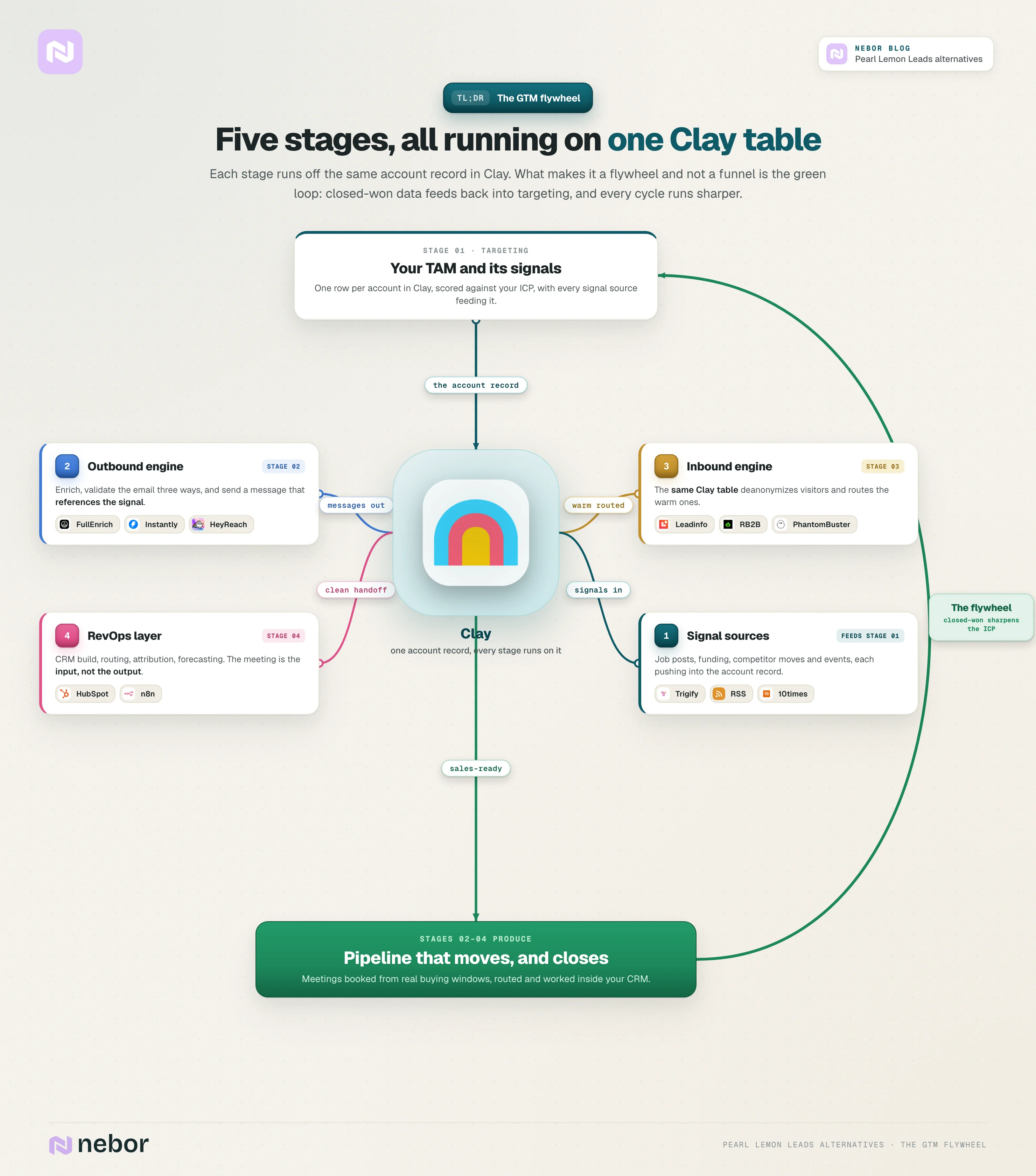
What makes it a flywheel and not a funnel is the feedback. Closed-won data goes back into the targeting layer. Lost-deal reasons feed back into the ICP score.
Every cycle gets sharper because the system keeps learning from what just worked and what just did not.
Stage 1: the targeting layer
This is where most agencies skip the homework. Pearl Lemon Leads will buy a list and start sending. We start with a real TAM build in Clay, one row per account, scored against your ICP.
Then we register the signal sources that matter for your business. Those include job posts that show real hiring intent, funding announcements that signal fresh budget, competitor moves that knock customers loose into a buying window, event hosting on 10times and Cvent if you sell into events, and LinkedIn engagement read through Trigify.
Each source feeds its own Clay table that pushes into one central account record. When a signal appears, we already know which account it belongs to and which contact inside that account we want to reach.
Stage 2: the outbound engine
When a signal lands, the outbound engine takes over. Clay enriches the matched account with firmographic data from FullEnrich, Findymail, LeadsFactory.io, and LeadMagic.
We pull the right contact, validate the email through three providers, and generate a message that references the actual signal behind it.
From there the message routes itself based on channel. Cold email goes through Instantly with rotating sending domains.
LinkedIn outreach goes through HeyReach with profile warming and connection sequences. Phone numbers feed into your dialer if calling is part of the motion, and booking links pull from your calendar app.
If you want the full sequence logic instead of the marketing version, we walk through it in our piece on how to automate sales prospecting from scratch.
Stage 3: the inbound engine
The inbound engine works against the same Clay table, which is the move most agencies miss. We use Leadinfo or RB2B to identify the people on your website. We can deanonymize them and reach out.
Leadinfo also adds a firmographic match for accounts that are not yet in your TAM. We use PhantomBuster to scrape the engagement on your LinkedIn posts and flag accounts that are warming up.
Every one of those signals goes into the same account record we built in Stage 1. If the visitor matches an existing TAM account, we route them as warm.
If they match an ICP profile we have not pursued yet, we add them and start a sequence. Either way, the inbound meeting workflow closes the loop with a personal outreach, not a generic chatbot.
This is what we call inbound-led outbound, one system serving two demand types from the same data.
Stage 4: the RevOps layer
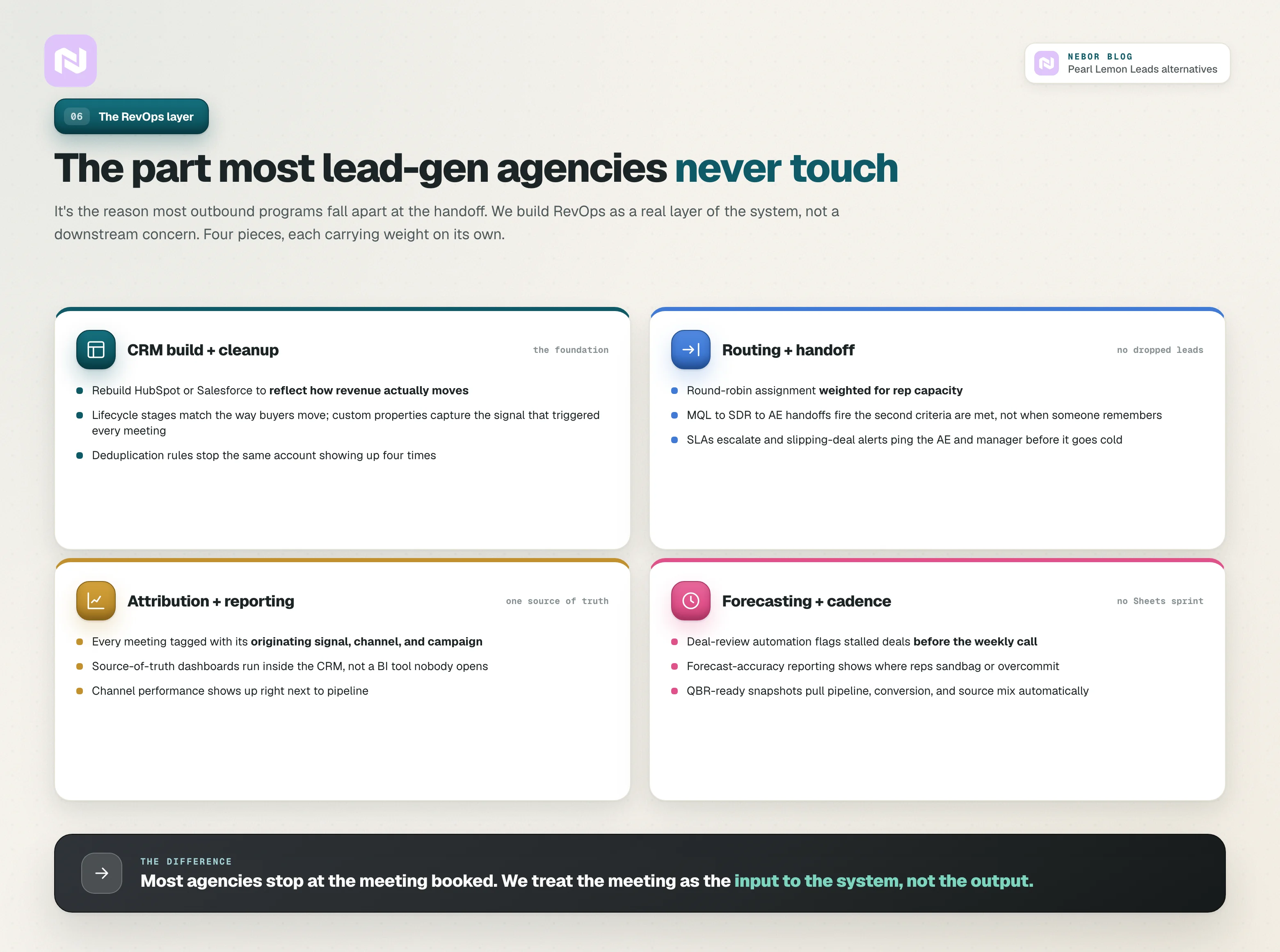
The RevOps layer is the part most lead gen agencies do not touch, and it is the reason most outbound programs fall apart at the handoff. We build it as a real layer of the system, not a downstream concern.
Four pieces make up the layer, each one carrying weight on its own.
CRM build and cleanup forms the foundation of the layer. We rebuild HubSpot or Salesforce so it reflects how revenue actually moves through your business.
Lifecycle stages match the way buyers actually move. Custom properties capture the signal that triggered every meeting. Deduplication rules stop the same account showing up four times in the report.
Routing and handoff automation is the next piece. Round-robin assignment applies weighting for rep capacity. SLAs escalate when a meeting goes unworked for too long.
MQL to SDR to AE handoffs happen the second the criteria are met, not when somebody remembers to check the queue. Slipping-deal alerts ping the AE and the manager before the deal goes cold.
Attribution and reporting come third in the build. We tag every meeting with the originating signal, the channel, and the campaign that drove it.
Source-of-truth dashboards live inside the CRM, not in a separate BI tool that nobody opens. Channel performance shows up next to pipeline so the people managing the program can see what is actually working.
Forecasting and operating cadence rounds out the layer. Deal review automation flags stalled deals before the weekly call.
Forecast accuracy reporting shows where reps are sandbagging or overcommitting. QBR-ready snapshots pull together pipeline, conversion, and source mix without a quarterly Google Sheets sprint. Rep enablement workflows surface the right collateral for the deal stage and the buyer role.
Pearl Lemon Leads and most other agencies stop at the meeting booked. We treat the meeting as the input to the system, not the output.
Stage 5: the feedback loop
The flywheel only spins if the data comes back. Closed-won deals feed into Clay, tagged with which signal source, which message variant, and which sequence drove them.
The ICP score in Stage 1 updates based on which segments are actually closing.
Closed-lost reasons feed in alongside the wins. If we are losing a segment because the product is not a fit, we stop targeting it. If we are losing because of a specific objection, we update the message logic so the objection gets handled earlier in the sequence.
Six months in, you are not working the same playbook you started with. You are working a sharper version of it that learned from every cycle, and the system behind it lives inside your accounts, not ours.
10 best Pearl Lemon Leads alternatives for lead generation in 2026
Beyond our owned-GTM approach, ten other companies show up regularly when buyers compare options to Pearl Lemon Leads.
1. Belkins
Best for companies across diverse industries that want fast launches and ROI-focused service.
Belkins is one of the better-known names in B2B lead generation. Like Pearl Lemon Leads, Belkins handles email and LinkedIn outreach with dedicated teams.
They operate at a much larger scale with more structured processes across fifty-plus industries, and the price reflects the size of the operation.
How Belkins compares to Pearl Lemon Leads.
Belkins operates at larger scale with more polished delivery, but the pricing follows.
Pearl Lemon Leads is more personalized and founder-led, with smaller-team energy.
Belkins suits companies that want proven playbooks at scale.
Pearl Lemon Leads suits startups that want hands-on support without enterprise pricing.
2. Martal Group
Best for enterprise and mid-market companies selling complex, high-ticket solutions.
Martal Group staffs accounts with experienced sales professionals, like former VPs of sales and senior account executives, instead of junior SDRs. They understand complex sales cycles and can hold a real conversation with a C-level prospect.
They focus on quality over quantity, work with companies that have long sales cycles and large deals, and offer multilingual support for international markets. They are particularly strong in tech and SaaS.
How Martal Group compares to Pearl Lemon Leads.
Martal Group costs more, often two or three times more, but staffs the work with senior talent.
Pearl Lemon Leads uses more junior teams that work better for simpler outreach.
Martal Group fits consultative, complex sales motions.
Pearl Lemon Leads fits straightforward, transactional outreach where the message is the same every time.
3. SalesRoads
Best for companies that want US-based SDRs with strong phone prospecting.
SalesRoads operates entirely with US-based reps who average more than fourteen years of experience each. They are particularly strong at phone prospecting, which works better than email for certain industries and complex products.
They handle everything from list building to appointment setting and focus on conversational selling rather than blasting emails out the door. The cost is higher because of US labor, but the call quality is also higher.
How SalesRoads compares to Pearl Lemon Leads.
SalesRoads focuses more on phone outreach, while Pearl Lemon Leads focuses on LinkedIn and email.
SalesRoads works US-only with experienced reps and a higher price tag, while Pearl Lemon Leads works globally with younger teams at a lower price.
4. CIENCE Technologies
Best for mid-market companies that want a proven, full-service solution with a proprietary platform.
CIENCE combines their GO Platform with human SDR teams. They keep a database of 140 million-plus contacts and handle everything from research to multi-channel outreach.
They are one of the biggest names in the category, much larger than Pearl Lemon Leads, with more sophisticated technology and higher costs to match. They work well for companies that want hands-off, scalable campaigns and have the budget for the platform fee on top of the team fee.
How CIENCE compares to Pearl Lemon Leads.
CIENCE is bigger and more expensive, with a proprietary platform doing a lot of the lifting underneath the team.
Pearl Lemon Leads is smaller and more affordable, with personalized service from a tighter team.
CIENCE works well for scaling a proven motion that already converts.
Pearl Lemon Leads works well for testing lead gen affordably before committing to platform-level pricing.
5. Abstrakt Marketing Group
Best for companies that want US-based teams with transparent, tiered pricing.
Abstrakt offers US-based SDRs with tiered pricing that starts at $6,000 a month. The standard package commits to 750 target dials, 75 decision-makers identified, and 38 qualified leads, so you know exactly what you are paying for in advance.
They combine outbound SDR work with inbound marketing and content creation, which fits companies that want both sides of the equation handled by the same vendor.
How Abstrakt compares to Pearl Lemon Leads.
Abstrakt offers more transparent pricing and bundles inbound and outbound under one roof.
Pearl Lemon Leads focuses mainly on outbound lead generation as a standalone service.
Abstrakt is US-based, which costs more but works better for US markets.
Pearl Lemon Leads is UK-based and works globally, which costs less and fits multi-region outbound.
6. Callbox
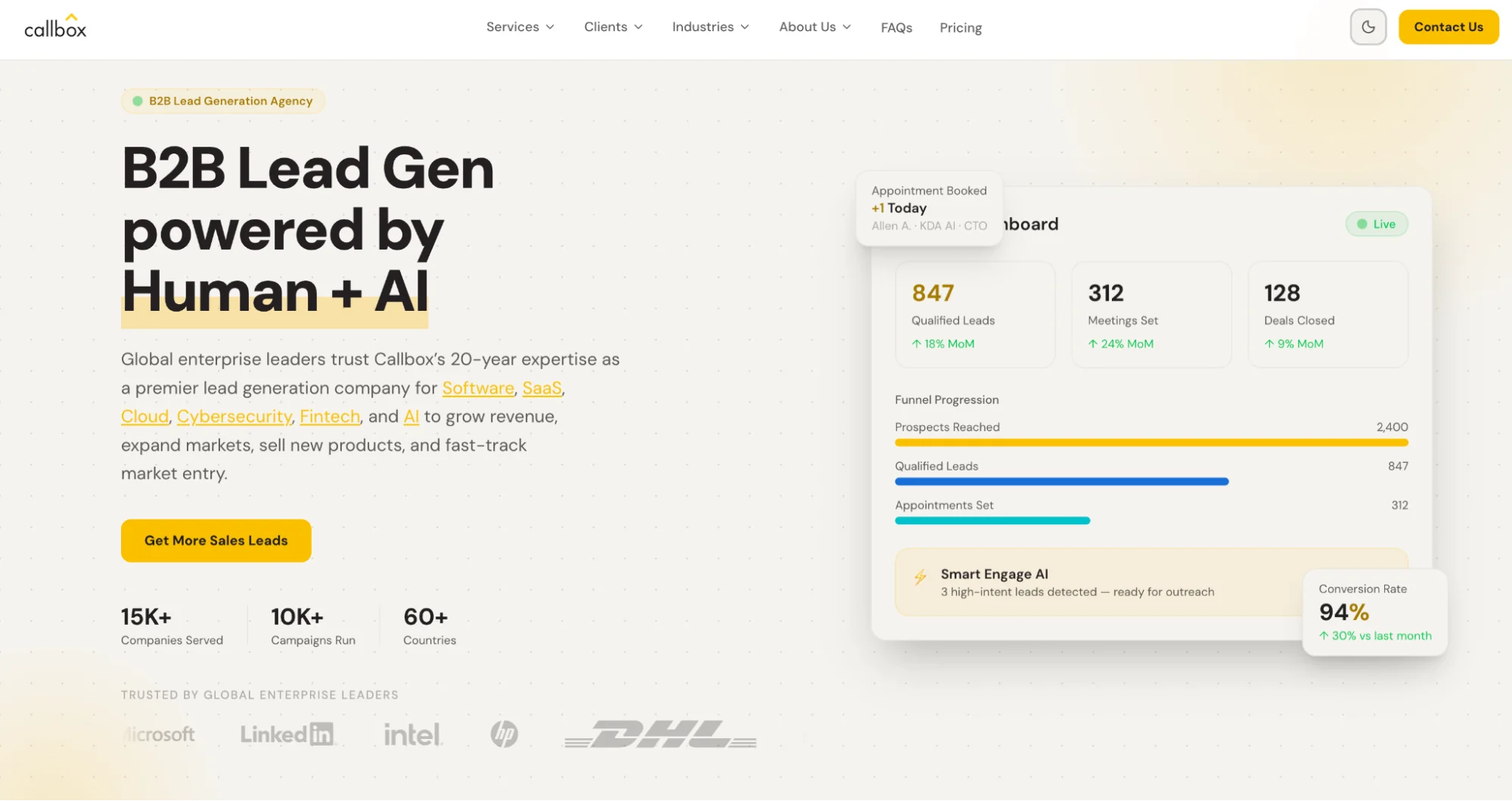
Best for multi-channel campaigns that need to reach across international markets.
Callbox offers lead generation and appointment-setting services across email, phone, social media, and direct mail. They staff teams in North America, Asia-Pacific, and Europe, which makes them a strong fit for international campaigns.
They are a more traditional full-service operation, with global reach and multi-channel capability that suits companies with complex international needs.
How Callbox compares to Pearl Lemon Leads.
Callbox covers more channels and has a stronger international presence.
Pearl Lemon Leads focuses on LinkedIn and email in English-speaking markets.
Callbox fits global, multi-channel campaigns where the message has to land in multiple regions at once.
Pearl Lemon Leads is simpler, more affordable, and easier to start small with.
7. LeadGenius
Best for companies with complex, hard-to-find ICPs that need custom data research.
LeadGenius combines AI with human researchers to build ultra-specific prospect lists and generate high-quality leads. They are strongest when your ICP is niche, complex, or requires deep research to identify in the first place.
The focus is on data quality and customization rather than sending campaigns. They build the lists, and you or another agency do the actual outreach.
How LeadGenius compares to Pearl Lemon Leads.
LeadGenius builds custom data, while Pearl Lemon Leads delivers end-to-end campaigns.
LeadGenius works better for hard-to-find prospects with niche firmographic profiles.
Pearl Lemon Leads works better for full-service campaign execution where the data is more standard.
Many companies use LeadGenius for the data layer and a separate vendor for the outreach layer.
8. Operatix
Best for tech companies expanding into new markets, especially across Europe.
Operatix specializes in helping software and tech companies break into new markets. They are particularly strong in European markets and understand selling across different regulatory environments.
They combine strategic consulting with tactical execution, helping refine the ICP and the positioning before launching the campaigns. Their team includes experienced sales leaders, not just junior SDRs.
How Operatix compares to Pearl Lemon Leads.
Operatix is more consultative and specialized in tech and SaaS only.
Pearl Lemon Leads works across a wider range of industries.
Operatix is the better choice for strategic market entry into Europe.
Pearl Lemon Leads is the better choice for straightforward lead gen execution at a lower price point.
9. SalesHive
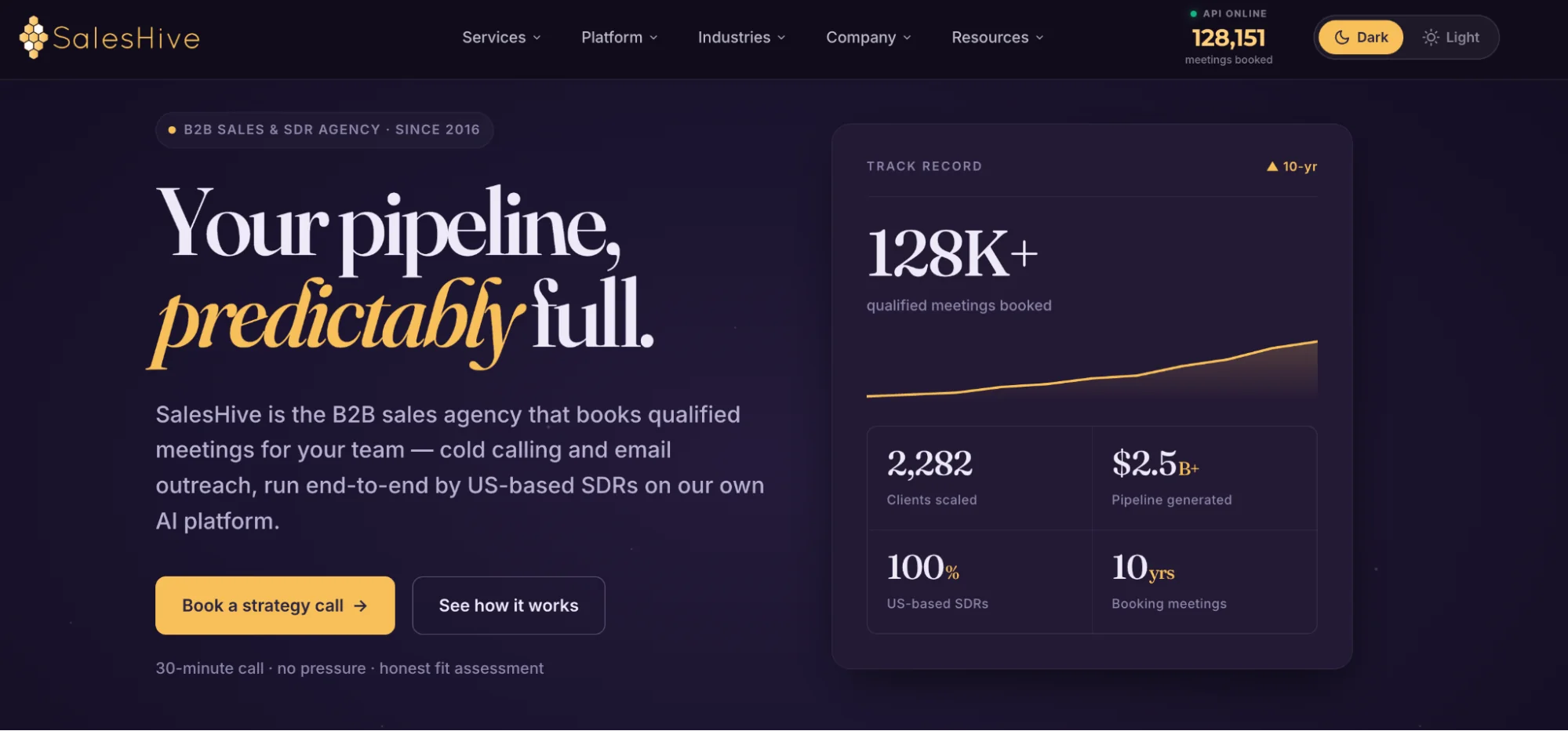
Best for companies that want guaranteed meetings with flexible contracts.
SalesHive offers performance-based pricing with meeting guarantees written into the contract. If they do not deliver the promised number of qualified meetings, you do not pay for the gap.
They deliver multi-channel campaigns across email, LinkedIn, and cold calling, all on month-to-month contracts with no long-term commitments. The reporting comes through real-time dashboards, which makes it good for testing lead gen with limited downside risk.
How SalesHive compares to Pearl Lemon Leads.
SalesHive offers meeting guarantees that Pearl Lemon Leads does not match.
Both vendors offer flexible contracts that do not require long-term commitments.
SalesHive provides more transparent pricing and clearer performance metrics inside the contract.
Both work well for companies that want to test lead gen without committing to a year-long retainer up front.
10. UpLead
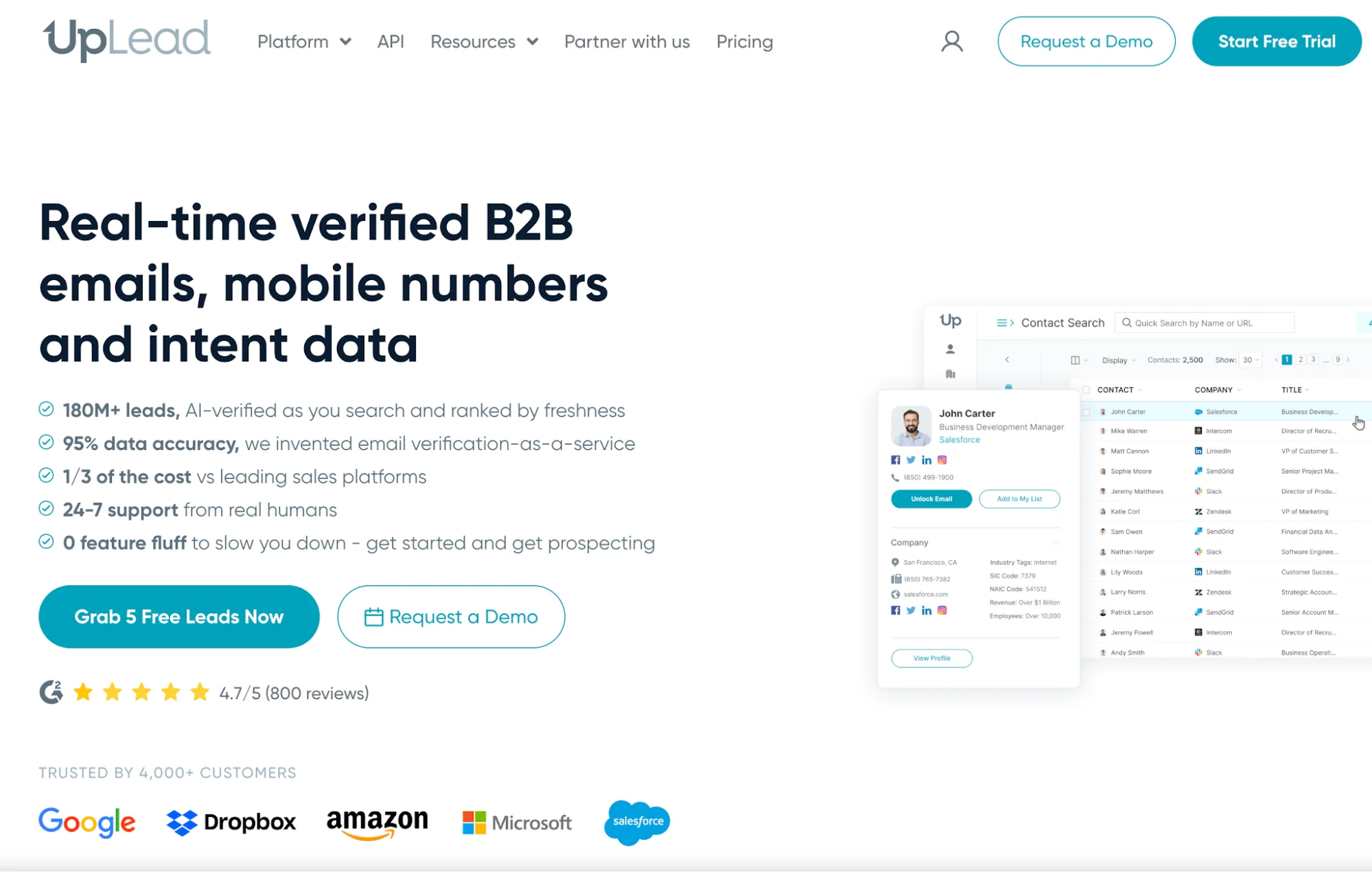
Best for companies with strong sales teams that want a data tool, not agency services.
UpLead is a B2B contact database with 155 million-plus contacts. Instead of an agency sending campaigns for you, you get software to find prospects yourself using advanced lead research filters.
The tool fits companies with experienced sales teams who know how to prospect but need better data underneath the team. The cost is much lower than the agency model, but it requires internal capacity to actually use.
How UpLead compares to Pearl Lemon Leads.
UpLead is a software tool for prospect search and enrichment, while Pearl Lemon Leads is a managed service.
UpLead gives you the data to work with yourself.
Pearl Lemon Leads does the prospecting work for you end to end.
UpLead costs less but requires you to do the work in-house.
Pearl Lemon Leads costs more but handles everything from list to outreach.
Work with Nebor.ai to grow your business and get leads on autopilot
Pearl Lemon Leads works well for a certain kind of business. The team handles LinkedIn outreach well and the service stays personalized through the engagement. Pricing fits a startup budget without much friction.
They are not the right fit for everyone, and most companies that find this article are already past the stage where rented campaigns make sense.
If you have outgrown the managed-service motion, if your in-house team needs the system rather than the leads, or if you have stopped seeing the results you expected from a vendor sending outbound on your behalf, the alternatives in this article cover most of the shapes the next step can take.
CIENCE and Belkins are bigger versions of the same managed-service motion. SalesRoads and Abstrakt move it onshore to US-based teams.
LeadGenius and UpLead solve the data problem instead of sending campaigns at all. Operatix and Martal Group target the high end of the deal-size spectrum where consultative selling matters more.
Nebor is the option that does not look like the others. Where the others build a team for you, we build the system itself.
Everything we set up lives inside your accounts and stays with you when the engagement ends. The flywheel above is what we ship, and the RevOps layer is the part that holds it together when the pipeline starts moving for real.
We have written more about why we set out to be a different kind of growth agency and how to evaluate one without getting burned.
If any of this lands, the easiest next step is a fifteen-minute call. We will look at your current TAM, your existing tech stack, and the gap between where the pipeline is now and where it needs to be.


Related Articles


By clicking Sign Up you're confirming that you agree with our Terms and Conditions.