
50+ Sales Automation Statistics Every RevOps and GTM Team Should Know in 2026

In this post:
$5.44 returned per dollar spent. That is the average ROI on sales automation in 2026, pulled from the body of research that tracks this space.
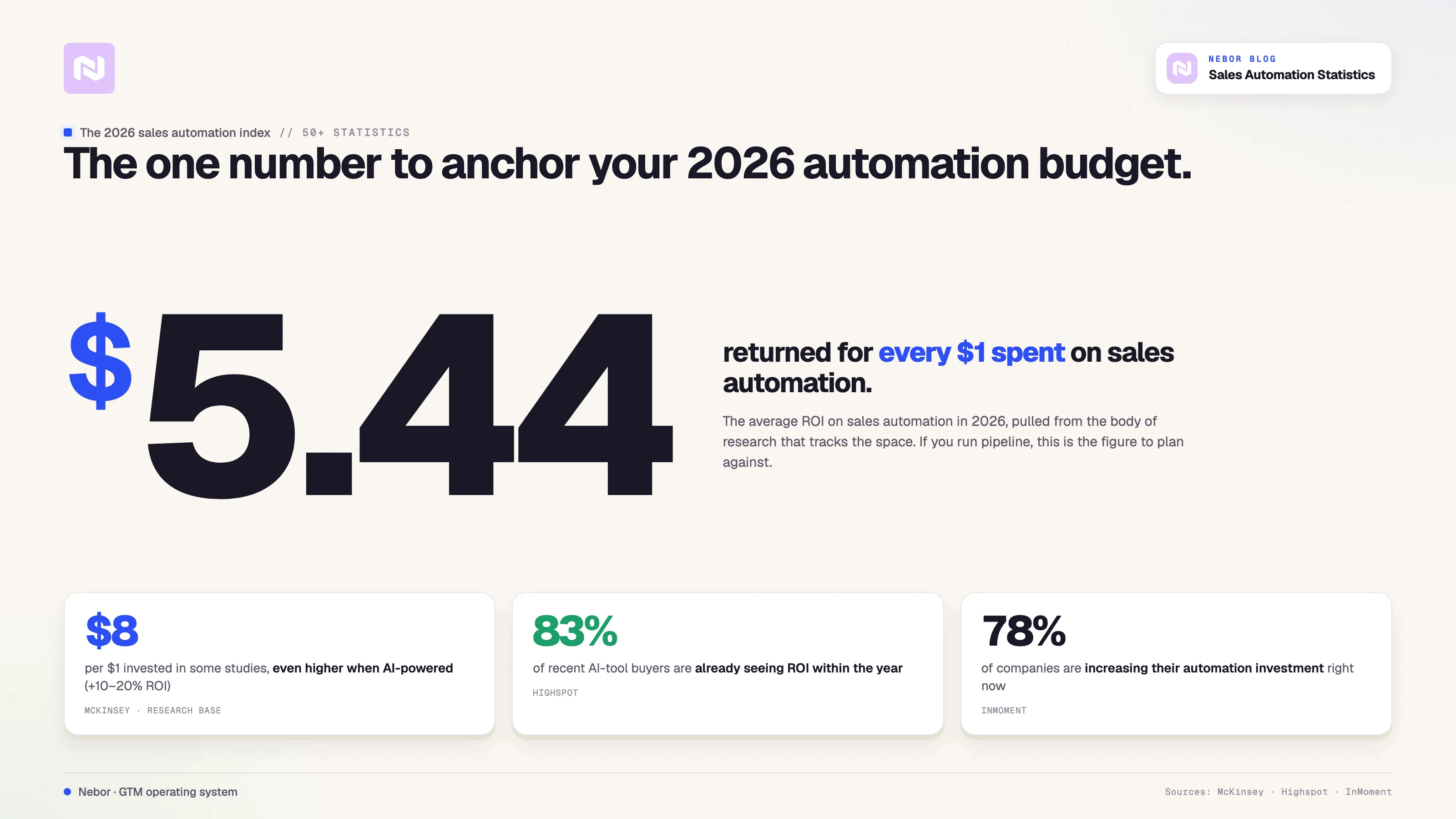
If you are a VP of Sales, a Head of Growth, or a RevOps lead trying to decide how much of your pipeline to automate, this is the number to anchor on.
We pulled together more than 50 statistics on how sales automation is reshaping revenue teams in 2026. The numbers come from McKinsey, Highspot, InMoment, and the broader research base.
This post is a clean read of what the data actually shows. Where automation pays back fastest, what AI is delivering that older workflows could not, and where the early-adopter advantage has started to widen into a real gap between teams.
Let’s get started.
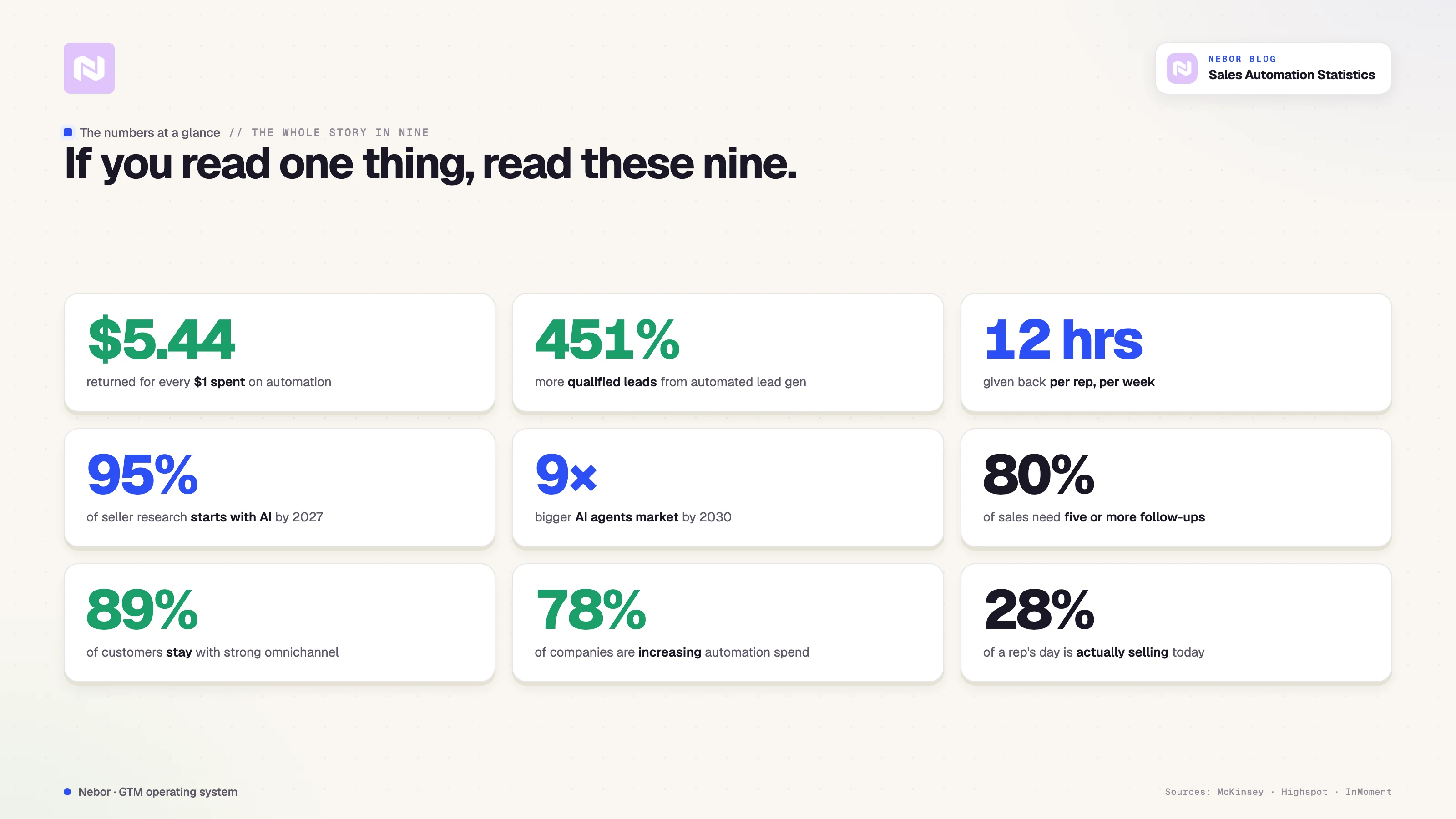
TL,DR: the essential sales automation statistics you need to know
What sales teams should know about the growth of sales automation
As you read this, understand that the headline numbers below are global and macro. They will not tell you what to do tomorrow morning. But they’ll tell you which way the ground is moving and how fast.
Sales automation has stopped being a trend and started becoming the default operating model for revenue teams.
The market data shows where the spend is heading, and how quickly the gap is opening between teams that have built a real GTM system and teams still working off disconnected tools.
The sales automation market is booming
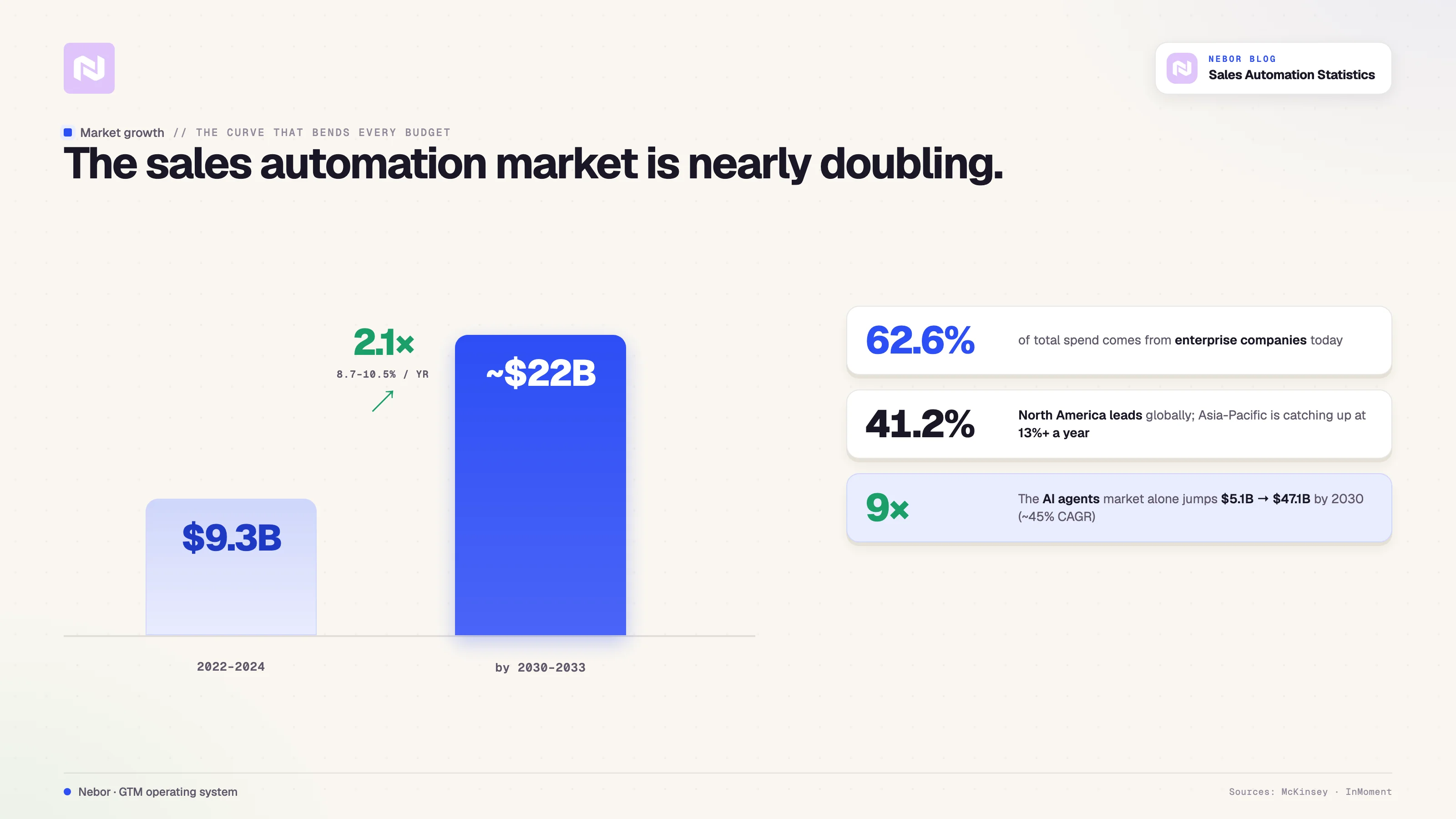
Between 2022 and 2024, the global sales automation market sat at around USD 9.25 to 9.3 billion, according to McKinsey. That number is expected to nearly double, hitting between USD 17.94 and 22 billion by 2030 to 2033, according to InMoment.
That works out to roughly 8.7% to 10.5% growth year over year, which is the kind of curve that bends every adjacent budget line with it.
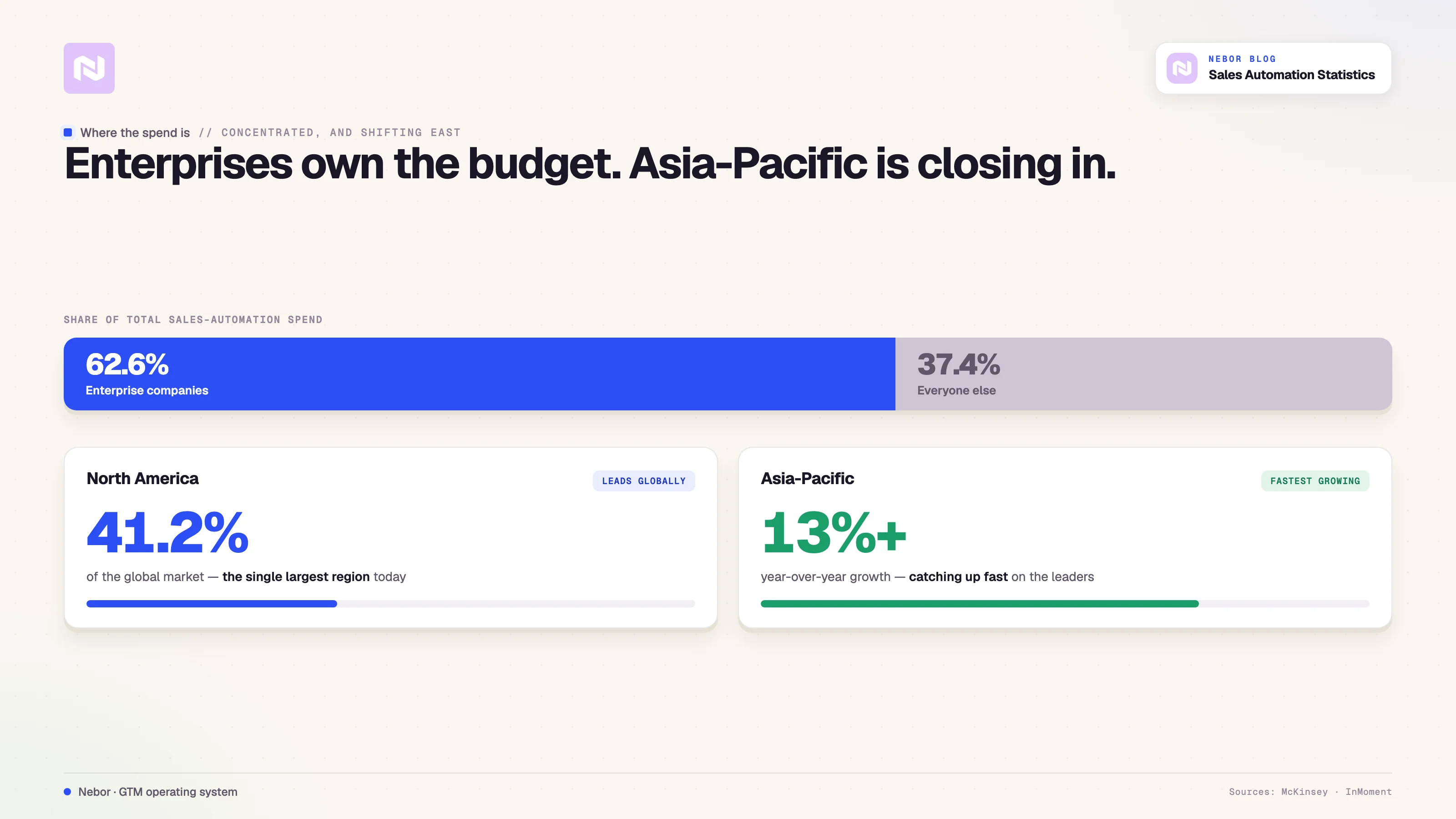
Enterprise companies currently make up the bulk of this market at 62.6% of total spend, and North America leads globally with a 41.2% share. Asia-Pacific is catching up fast, growing at over 13% a year.
Why this growth should matter to you
Growth this fast is not just hype. It reflects real changes in how companies sell. Four shifts are pushing it.
Businesses everywhere are moving faster toward digital
AI and machine learning are now built into sales tools by default
Buyers expect more personalized experiences across every channel
Cloud-based tools make adoption easier for teams of any size
The inflection came during COVID-19, when sales teams were forced to adapt to remote selling, and the shift stuck. Today, 75% of B2B buyers say they prefer remote or digital self-service over face-to-face sales.
It is not just preference either. Companies that embraced automation are operating 10 to 15% more efficiently and pulling in 5 to 10% more revenue.
Automation is both saving cost and boosting revenue
The numbers make a strong business case for adopting sales automation. Research shows that for every dollar invested in automation, companies are seeing an $8 return.
When automation is powered by AI, the return grows even more. Businesses are reporting 10 to 20% increases in ROI.
Early adopters are getting more time with prospects, better customer satisfaction scores, and up to a 10% boost in overall sales performance.
There’s a real-world example that brings this to life.
A company in the advanced industries space cut proposal time from 3 weeks to just 2 hours, and the result was a 5% increase in revenue. Another reduced order processing from days to hours.
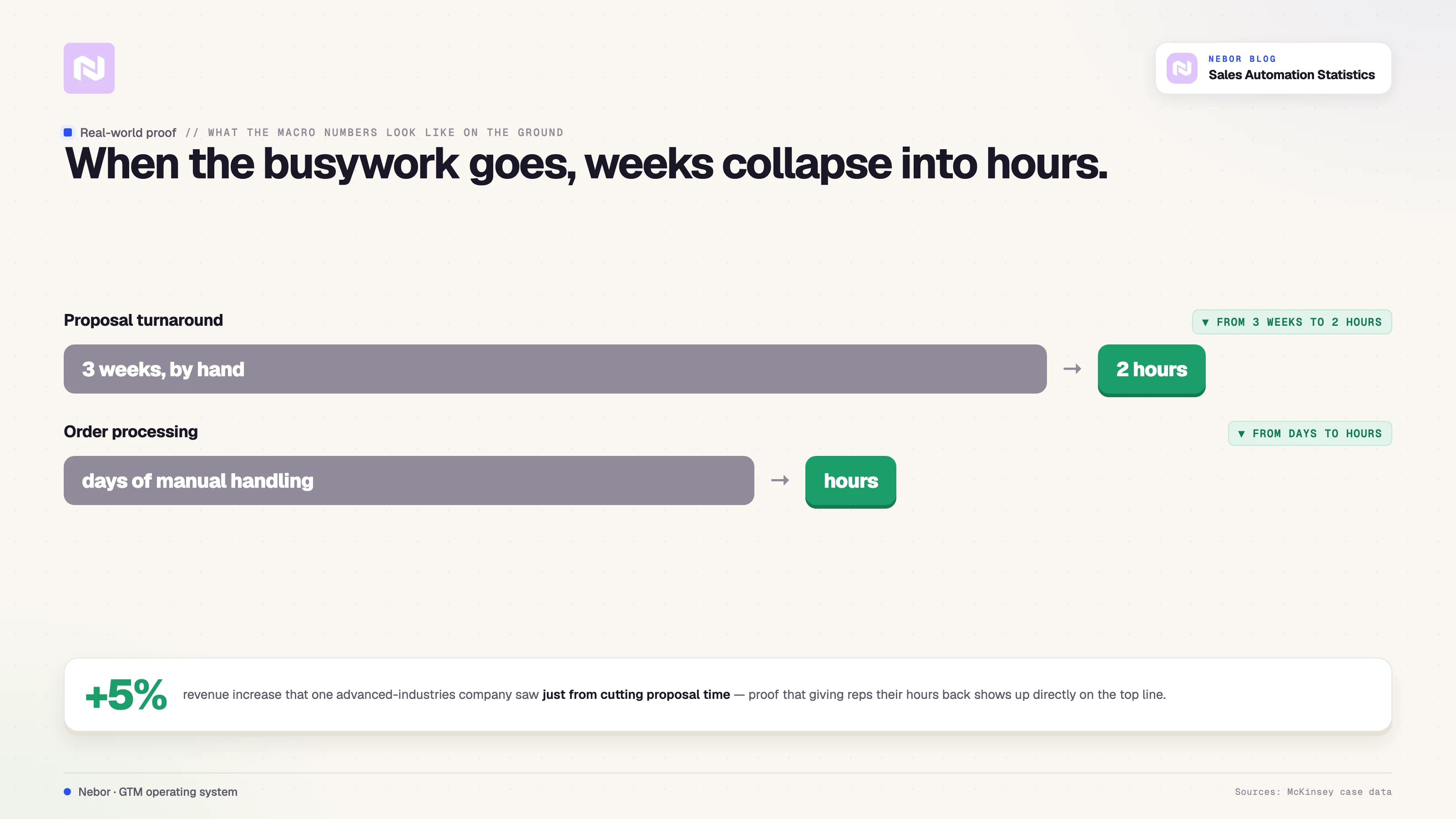
This specific statistic originates from a McKinsey & Company global research study on the impact of AI and digital automation in B2B sales. That kind of impact explains why 78% of companies are increasing their investments in automation right now.
What you need to know about AI adoption
AI has stopped being a buzzword in sales and started becoming a real operating advantage. The gap between teams using AI and teams not using it is widening every quarter.
More sales teams are using AI and they are seeing results
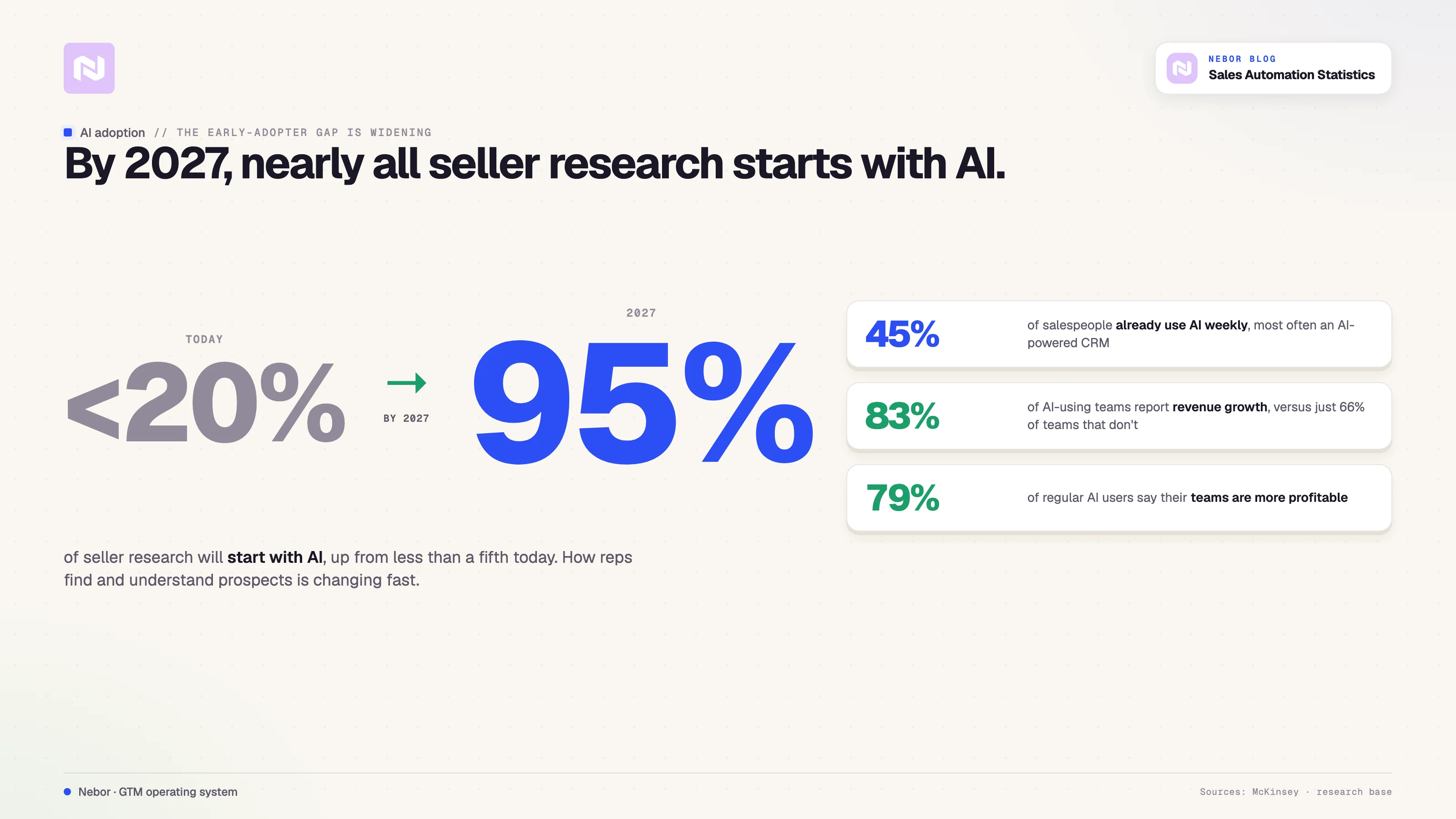
AI is spreading quickly across sales, but adoption is uneven. Right now, about 45% of salespeople use AI at least once a week. The most common use case is the AI-powered CRM.
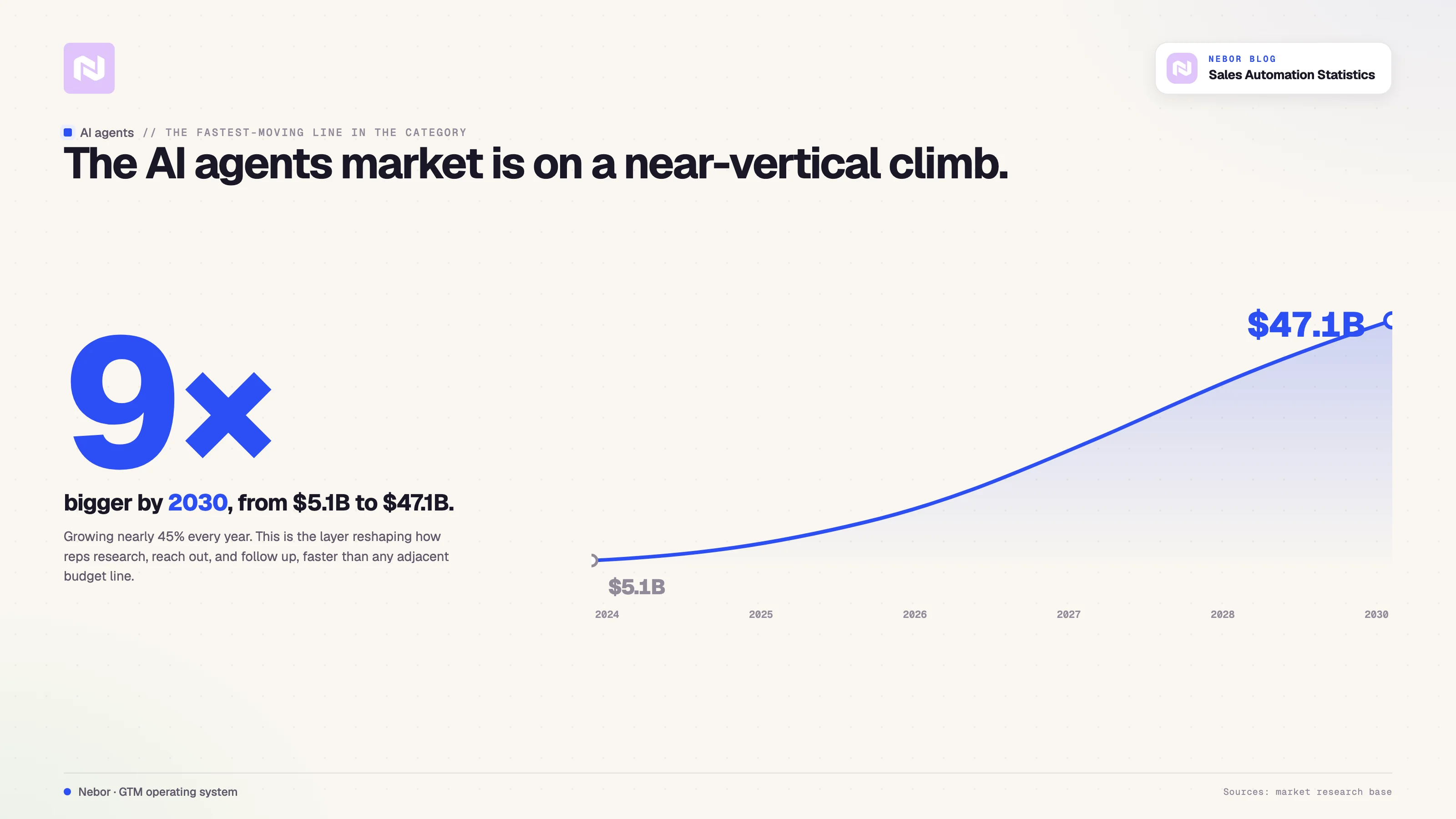
The pace of change is picking up. The global AI agents market is already worth USD 5.1 billion in 2024, and it is expected to hit USD 47.1 billion by 2030, growing at nearly 45% every year.
By 2027, 95% of seller research will start with AI, up from less than 20% today. The way reps find and understand prospects is changing fast.
AI frees up time for the work that matters
Most reps do not get to spend enough time actually selling. They spend about 71% of their day on non-selling tasks.
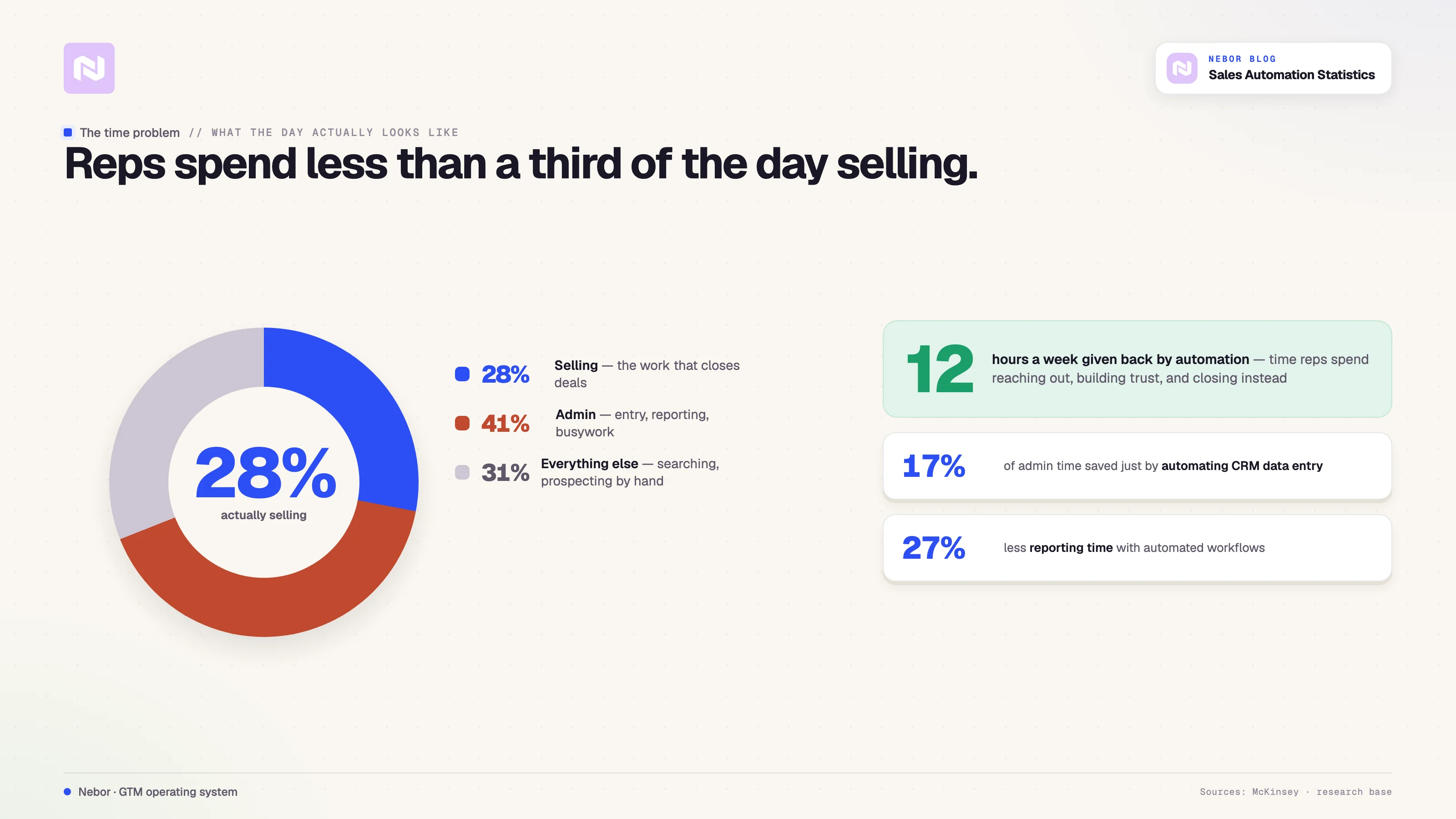
That is where AI steps in. Sales teams using automation save an average of 12 hours every week. That is time they get back to reach out to prospects, build trust, and close deals.
Teams using AI are seeing clear performance lifts.
83% reported revenue growth, compared to 66% of teams not using AI
76% of e-commerce teams say AI directly helped them grow revenue
85% of customer service reps say AI saves them time
87% of businesses believe AI gives them an edge over competitors
AI makes sales teams more efficient and more profitable
Sales teams that use AI consistently are seeing real day-to-day improvements.
78% say their deal cycles are shorter
70% are closing bigger deals
76% are winning more often
All that efficiency adds up. 79% of regular AI users say their teams are more profitable. And 83% of companies that recently bought AI tools are already seeing ROI within the year.
On top of that, companies using AI-powered automation have seen 10 to 15% improvements in efficiency. Salespeople spend less time on repetitive tasks and more time on what actually moves the needle, which is building trust and relationships.
How sales automation gives you back your time
Ask any sales rep and they will tell you there is never enough time in the day. The real problem is not the number of hours. The real problem is how those hours get spent.
Most reps are not spending their day selling. Automation is helping to fix that.
Too much admin work and not enough selling
The data says it all. Sales reps are only spending 28% of their time actually selling. The rest is a huge chunk, with 41% of their day going into administrative tasks that do not bring deals closer to the finish line.
Without automation, you waste hours every week on tasks that could handle themselves. Sales teams that have adopted automation are giving their reps serious time back.
2 hours and 15 minutes per day per rep, which works out to almost three months of work saved every year
6 hours per week on average per rep
4.5 hours a week on tasks that could easily be automated
Even just automating CRM data entry saves 17% of admin time, and automated workflows cut down reporting time by 27%. That is time you can now use to prospect, follow up, or actually close deals.
Why time savings are not just nice to have anymore
It is not just about saving time. It is about changing how your sales team works. 67% of workers say they feel stuck doing repetitive work.
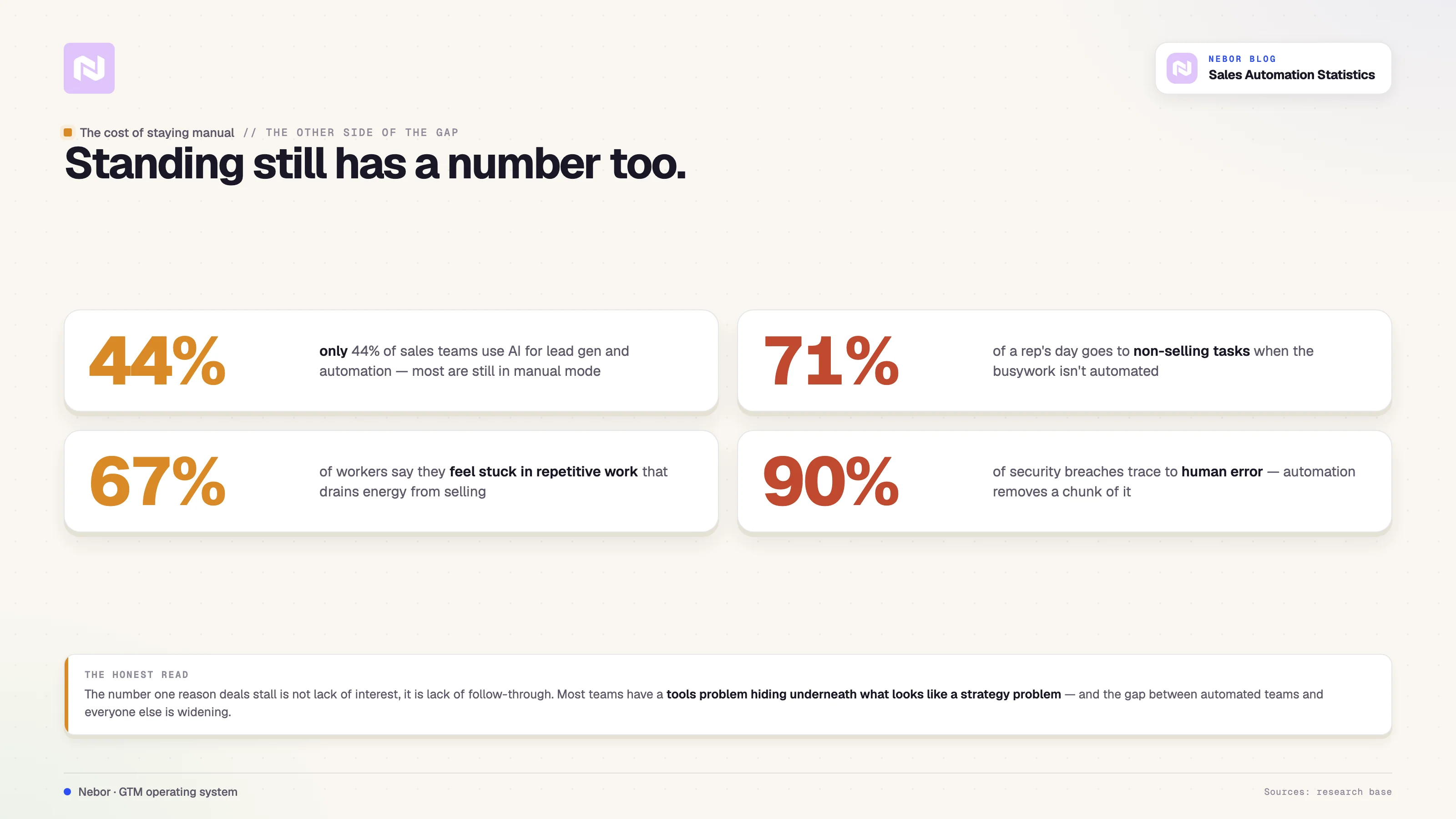
For most people, that is both boring and draining. And it takes energy away from high-value selling activities.
Automation does more than free up your calendar though. It also reduces human error. Human mistakes cause 90% of security breaches, and automation removes a chunk of those mistakes from the equation.
More time means more sales
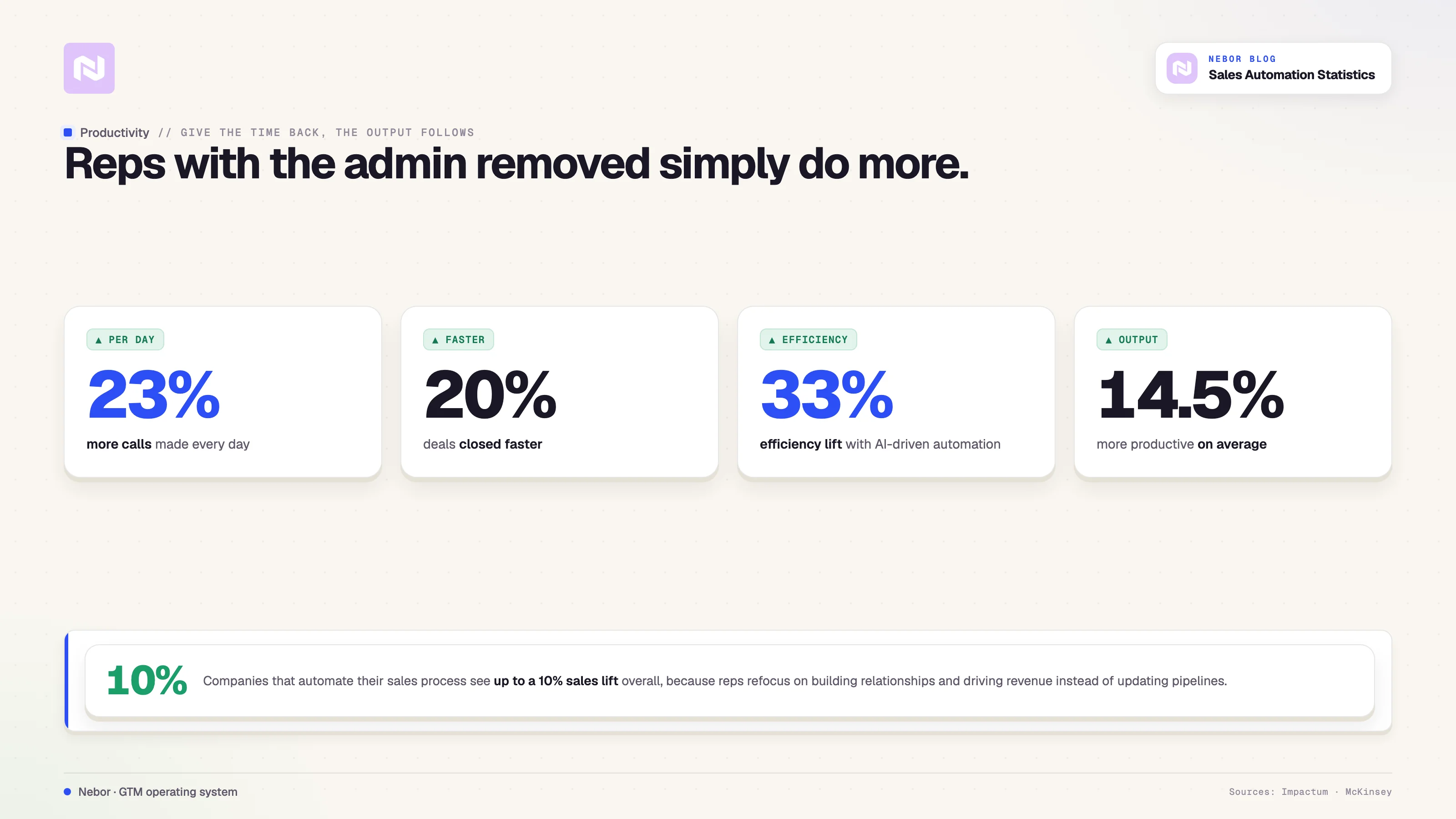
When sales reps have more time, they do more. According to Impactum, teams using automation see three clear gains.
They make 23% more calls a day
They close deals 20% faster
They see a 33% lift in overall efficiency
That productivity translates into business results. Businesses using automation tools report 10 to 20% increases in productivity and up to 5% more revenue.
If there is one stat that sums up why automation matters most, it is this. 74% of professionals say time savings is the biggest benefit. When sales teams have time to focus on selling, everything else gets better.
Why CRM automation matters for sales teams
If you are in sales, your CRM is the engine that powers everything. And when it is automated, it stops being a time sink and starts being a real driver of results.
CRMs are becoming smarter and more essential
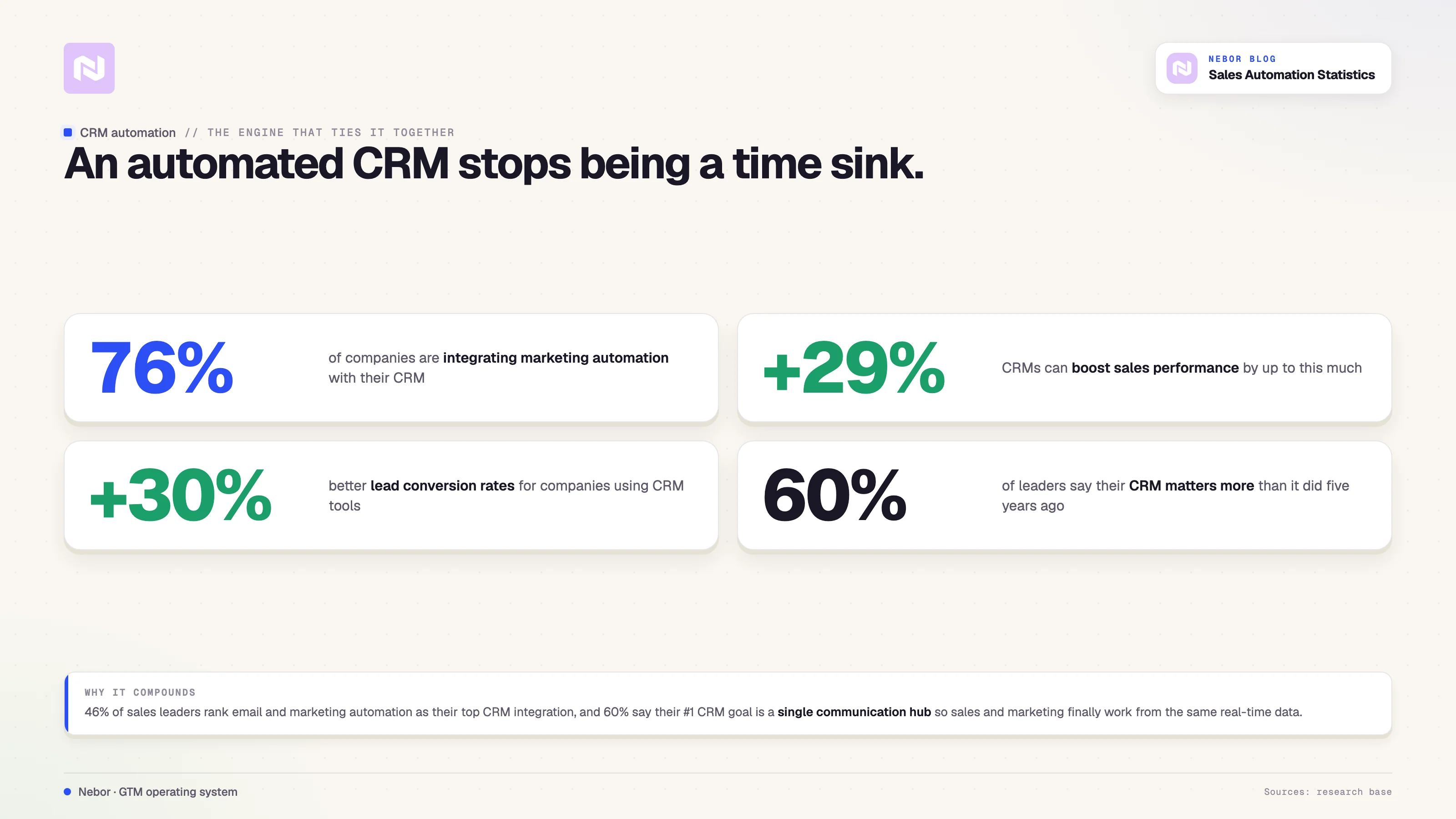
Right now, 76% of companies are integrating marketing automation with their CRM systems. That is more than just convenience. It is a sign of how important CRMs have become in tying everything together across sales, marketing, and service.
Modern CRMs do more than store contact info. They automate the busywork of creating contacts, scheduling meetings, sending follow-up emails, and even generating quotes.
The value of CRMs is only growing. Nearly 60% of business leaders say their CRM is more important now than it was five years ago.
CRM automation helps you sell smarter
Today's CRMs do more than record keeping. They are smart systems that automate key parts of the sales journey.
They auto-fill contact and account info, so your data stays clean and up to date
They trigger personalized drip emails based on customer behavior
They notify you in real time when a lead is ready for outreach
They feed lead scoring with live data, so prioritization is automated too
This kind of automation is a big reason why companies using CRM tools see up to 30% better lead conversion rates.
It is no surprise that 46% of sales leaders list email marketing and marketing automation as their most important CRM integrations. These are the tools that turn insight into action, helping your team respond faster and more effectively.
CRM automation aligns your teams and boosts ROI
CRMs can boost sales performance by up to 29%. The real magic happens when CRMs help align your sales and marketing teams.
60% of companies say their top CRM goal is creating a single communication hub. When everyone is working from the same data in real time, it removes confusion and guesswork.
Marketing sees what messaging actually works during sales calls
Sales knows exactly which leads have engaged and how
That feedback loop leads to smarter targeting, better follow-ups, and more precise lead handoffs.
How sales automation makes sales reps more productive
Sales automation gives your team room to do more of what actually moves the needle. The proof is in the numbers. Teams using automation are consistently more productive, more efficient, and more focused on closing deals.
Sales teams are seeing real efficiency gains
The early adopters of sales automation are seeing the biggest wins. On average, sales teams using automation tools are 14.5% more productive, and high-performing teams report 10 to 15% improvements in efficiency.
When you automate the workflows around them, reps make 23% more calls per day, close deals 20% faster, and see overall efficiency jump by 33% with AI-driven automation in the loop.
These gains come from removing the biggest drag on performance, which is admin work. Right now, sales reps only spend 30% of their time actually selling. The rest gets eaten up by updating pipelines, searching for info, and manually prospecting.
Automation gives that time back. With it, reps refocus on building relationships and driving revenue.
Productivity leads to better outcomes for the business and the team
The impact of automation shows up on the bottom line. Companies that automate their sales processes can see up to a 10% sales lift.
Remember the company we mentioned earlier that cut proposal times from three weeks to just two hours? That alone drove a 5% revenue increase. The math compounds quickly when the savings hit a process that repeats every day.
It is not just about money either. When automation takes the routine work off their plates, reps report feeling better about their jobs. They get to focus on helping customers and closing deals, which is what they actually want to be doing.
How sales automation is improving lead generation
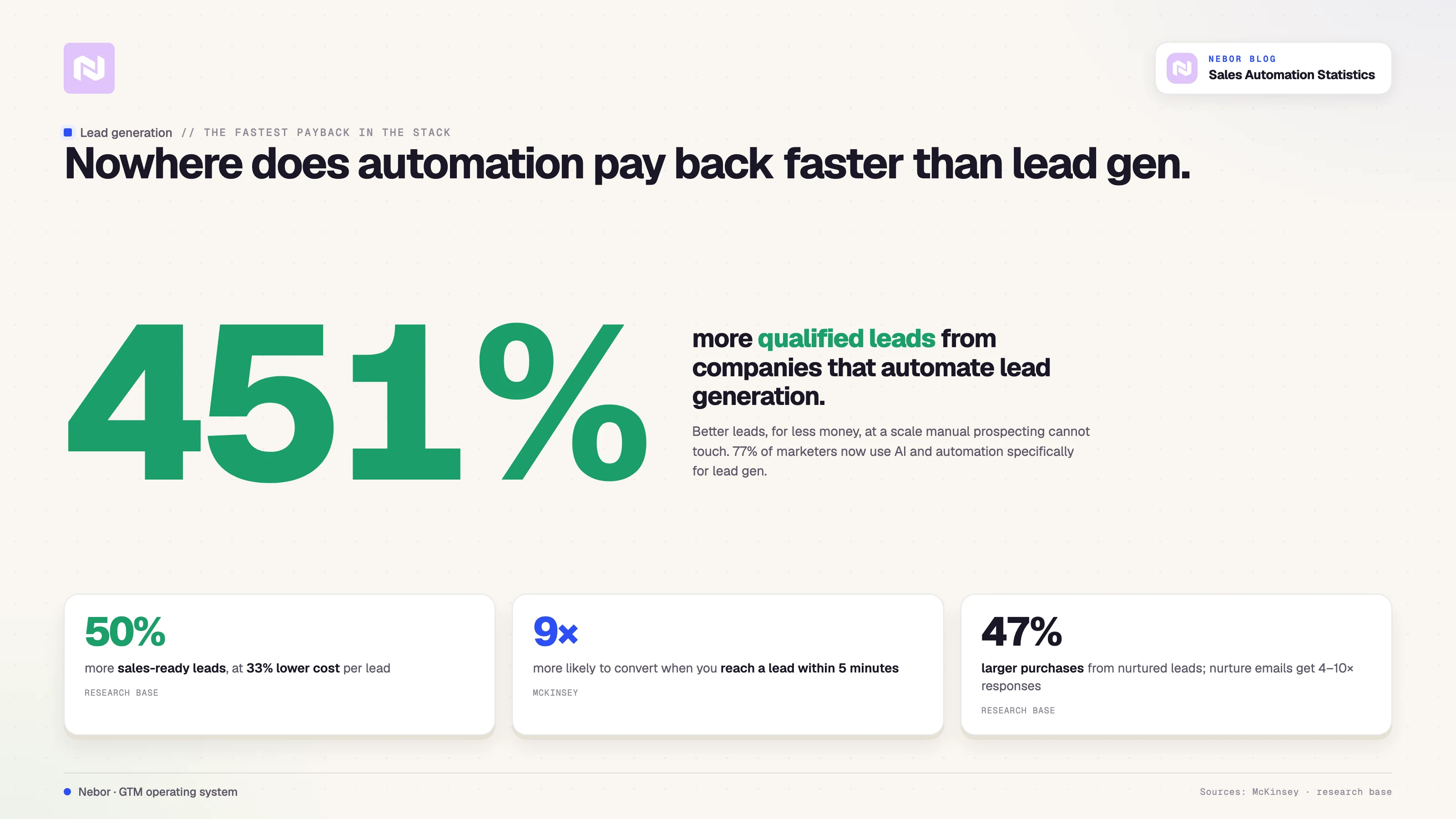
If there is one area where automation delivers almost instant ROI, it is lead generation. The numbers are striking and they explain why more companies are leaning toward lead generation automation to get ahead of their competitors.
The numbers speak for themselves
When companies bring automation into their lead generation processes, the impact is hard to ignore.
451% more qualified leads
50% more sales-ready leads, at 33% lower cost
80% of businesses using automation say they generate more leads overall
77% of marketers are now using AI and automation specifically for lead generation
These stats show what is happening underneath the headlines. Businesses that automate are getting better leads, for less money, and at scale.
Why automation makes lead gen so much better
Automation helps you focus on the right leads, consistently, and at scale. It works through three core mechanics.
Lead scoring gets smarter. Tools assign a value to each lead based on their actions like clicks, visits, replies. Companies using AI-driven lead scoring convert 20% more leads because they know who is ready to buy and who is not.
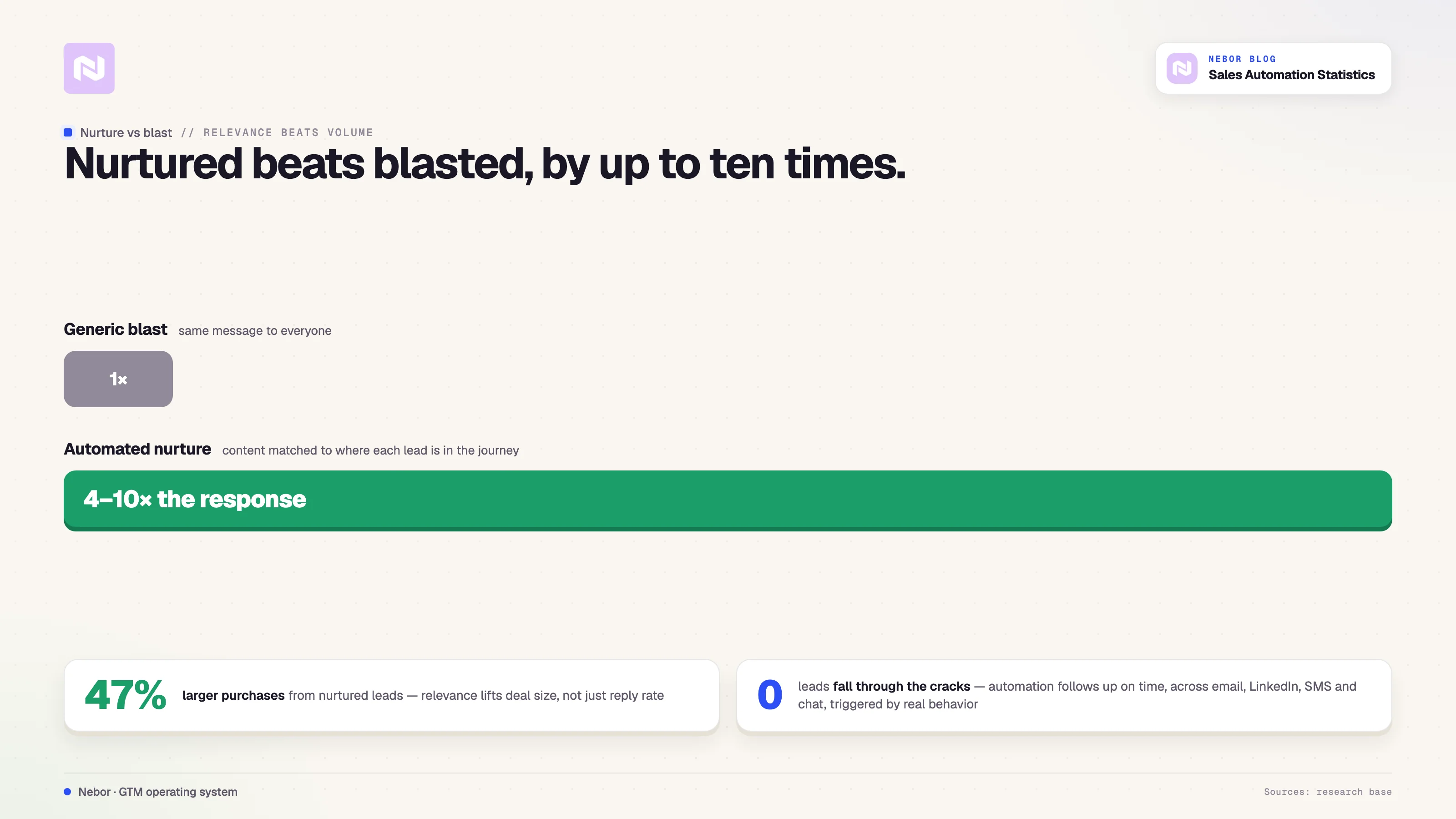
Lead nurturing gets personal. Instead of sending the same message to everyone, you can send content that matches where each lead is in their journey. That is why automated lead nurturing emails perform 4 to 10x better than generic blasts.
No lead falls through the cracks. Automation follows up for you on time, every time, keeping your pipeline warm and your leads moving forward.
It is not just about email either. Automated workflows deliver touchpoints across channels, from LinkedIn to SMS to live chat, all triggered by real behavior.
Conversion rates go up, fast
The faster and more relevant your outreach, the more leads convert. Data from McKinsey shows three results worth pinning to a wall.
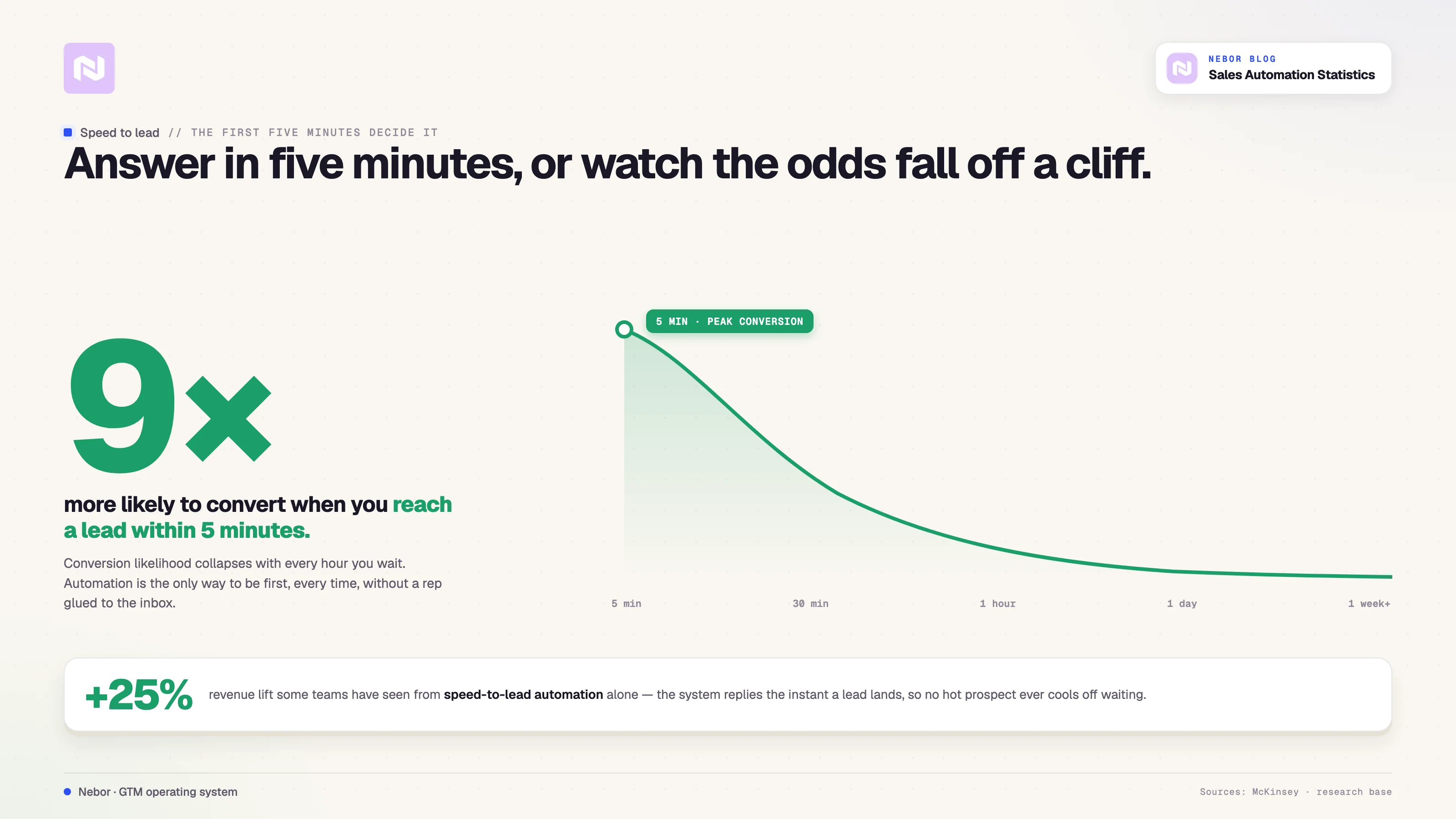
Reaching leads within 5 minutes makes them 9x more likely to convert
Speed-to-lead automation has boosted revenue by up to 25% for some teams
Companies that automate lead gen often see a 10% increase in revenue within 6 to 9 months
It gets better. Nurtured leads tend to make purchases that are 47% larger. Automation does not just bring in more leads. It helps close better deals too.
There is a caveat. Automation is not a silver bullet for every business. If your sales process is long and complex, automation needs to be more thoughtfully implemented or it can feel robotic and generic.
The point of automation is to support human conversations, not replace them. We have written about this in our piece on why most Clay implementations fail and the principle holds across every tool in the stack.
Why automating sales follow-ups wins more deals
Following up is one of the most overlooked parts of the sales process. It is also often the difference between closing the deal or losing it forever. The data tells a clear story.
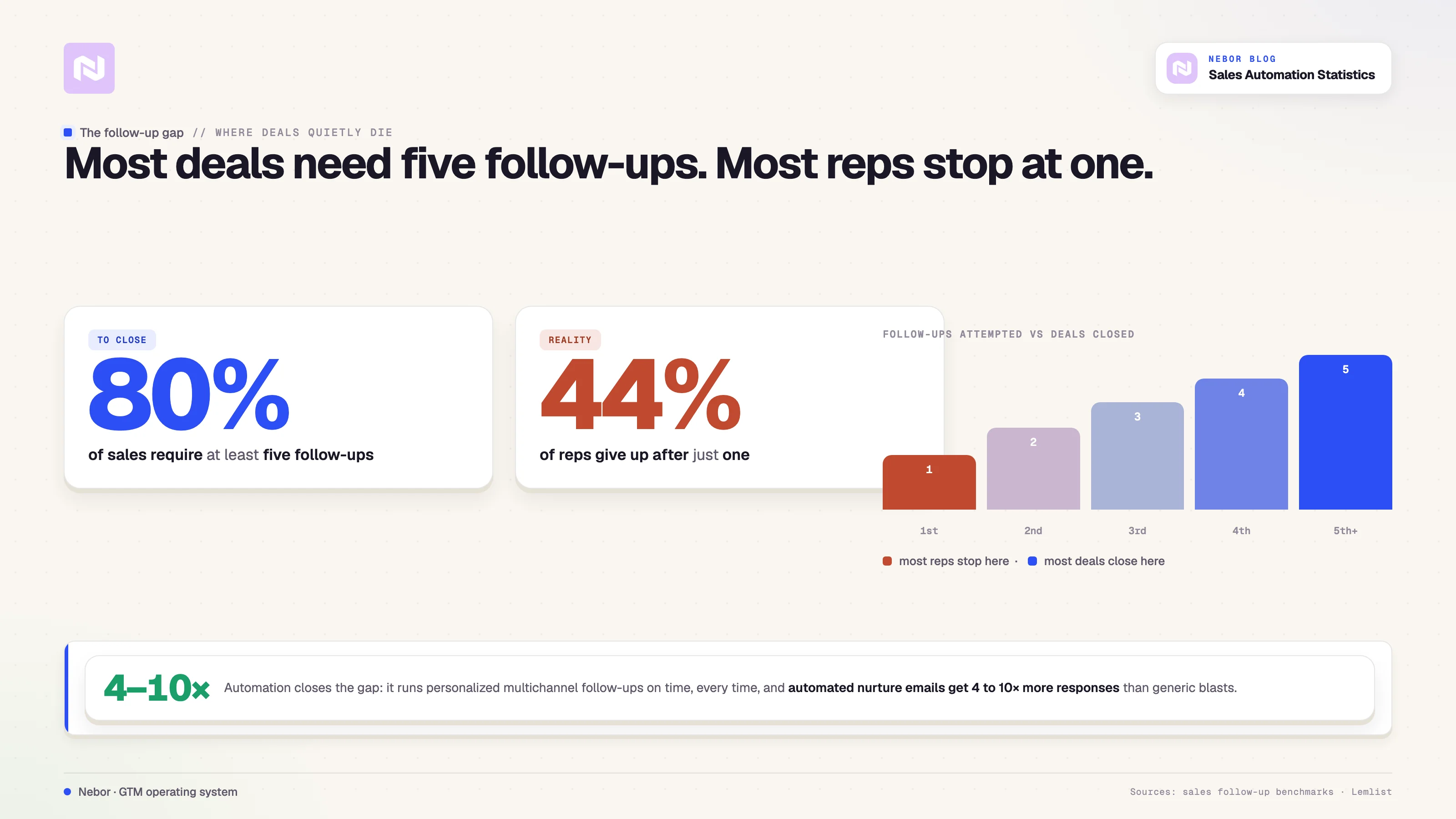
80% of sales require at least five follow-ups to close
44% of sales reps give up after just one follow-up
That is a massive gap, and automation helps you close it.
What sales follow-up automation actually does
Here is how follow-up automation actually plays out in practice.
Automated workflows trigger follow-up emails, calls, or LinkedIn touches after a set number of days with no response
Sequences adjust based on prospect behavior, like opening an email, visiting your site, or ignoring messages
Multichannel outreach workflows combining email, LinkedIn, and calls re-engage leads who have gone cold without manual chasing
For example, if a prospect goes silent for two weeks, the system can automatically push them into a ghosting workflow. First a short re-engagement email, then a LinkedIn message, then a queued call task if there is still no reply.
Tools like Clay help enrich your lead data and automate outbound. Platforms like Lemlist handle the personalized multichannel follow-ups. And with workflow engines like n8n, you can tie it all together so the process works on autopilot.
Despite all of this, only 44% of sales teams currently use AI for lead generation and automation. Most teams are still stuck in manual mode, spending too much time chasing leads and still not following up enough.
The number one reason deals stall is not lack of interest. It is lack of follow-through. Without automation, trying to follow up five or more times on every lead is exhausting and time-consuming. Reps either forget, get distracted, or give up too soon.
Automation closes the follow-through gap in four core ways.
It sends personalized multichannel follow-ups at scale without extra effort
It removes manual tracking and data entry so reps focus on selling
It keeps leads engaged across the entire buying journey
It boosts replies, since automated nurturing emails get 4 to 10x more responses than one-off blasts
Modern systems use AI to analyze behavior and optimize send times, so your messages land when prospects are most likely to open and reply. The result is consistent, timely follow-ups that turn more conversations into deals.
It is not just about time savings either. 61% of reps believe AI helps them send more personalized follow-ups. That means more relevance and a stronger chance of winning the deal on top of better speed.
The ROI from follow-up automation is hard to ignore. Companies using it consistently report higher revenue per rep and better win rates across the pipeline.
How AI is changing sales enablement for good
Sales enablement has come a long way. It is not just onboarding and training anymore. It is now about helping reps sell better every day with the right content, systems, and data.
The average rep only spends 28% of their time actually selling. That is why enablement matters more than ever.
When companies were asked what they wanted out of their enablement programs, the answers tracked closely.
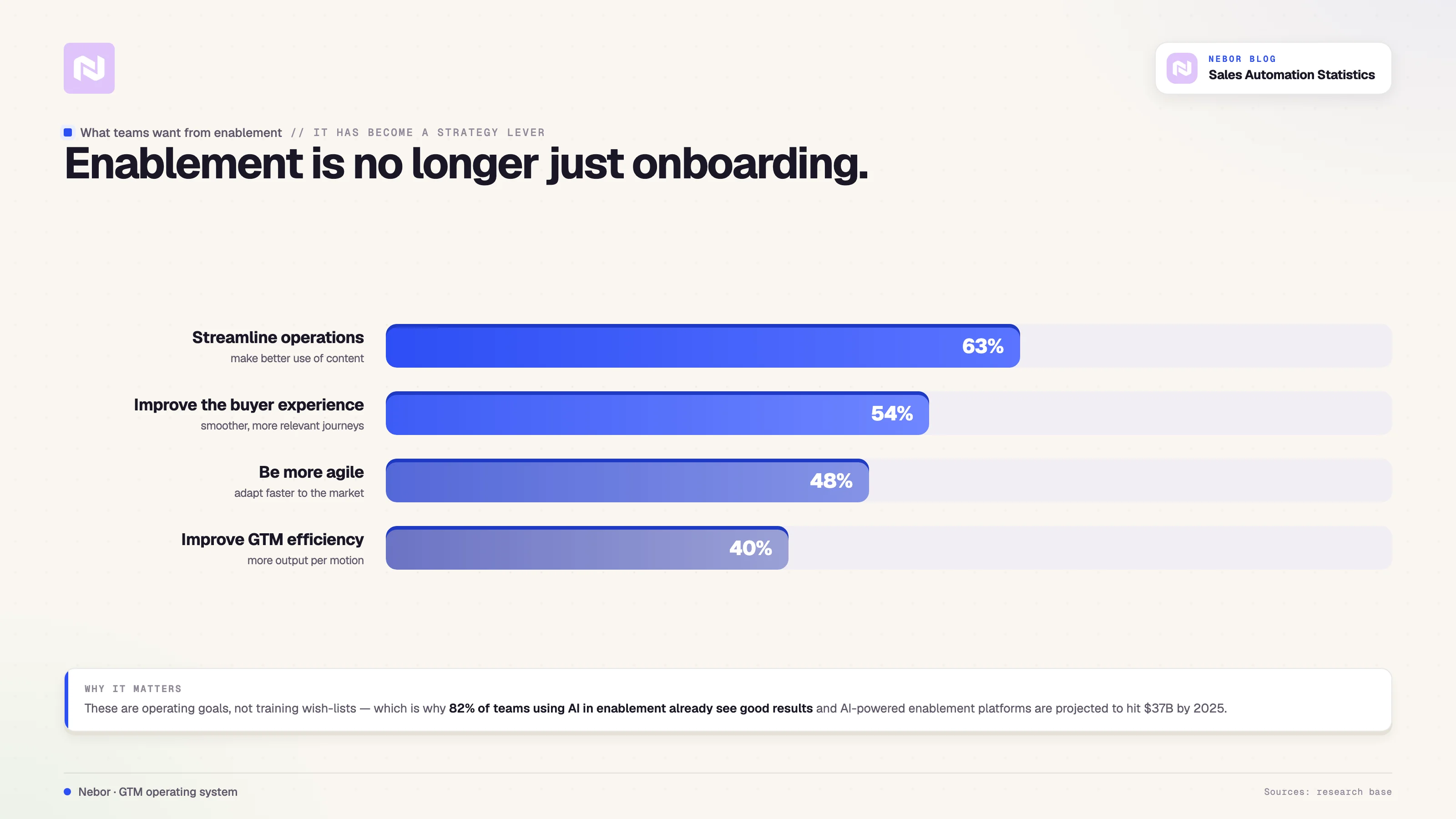
63% want to streamline operations and make better use of content
54% want to improve the buyer experience
48% want to be more agile
40% are focused on improving go-to-market efficiency
These goals show that sales enablement has become a strategic function, not just a support role. It is now central to how modern teams drive performance.
What AI brings to the table
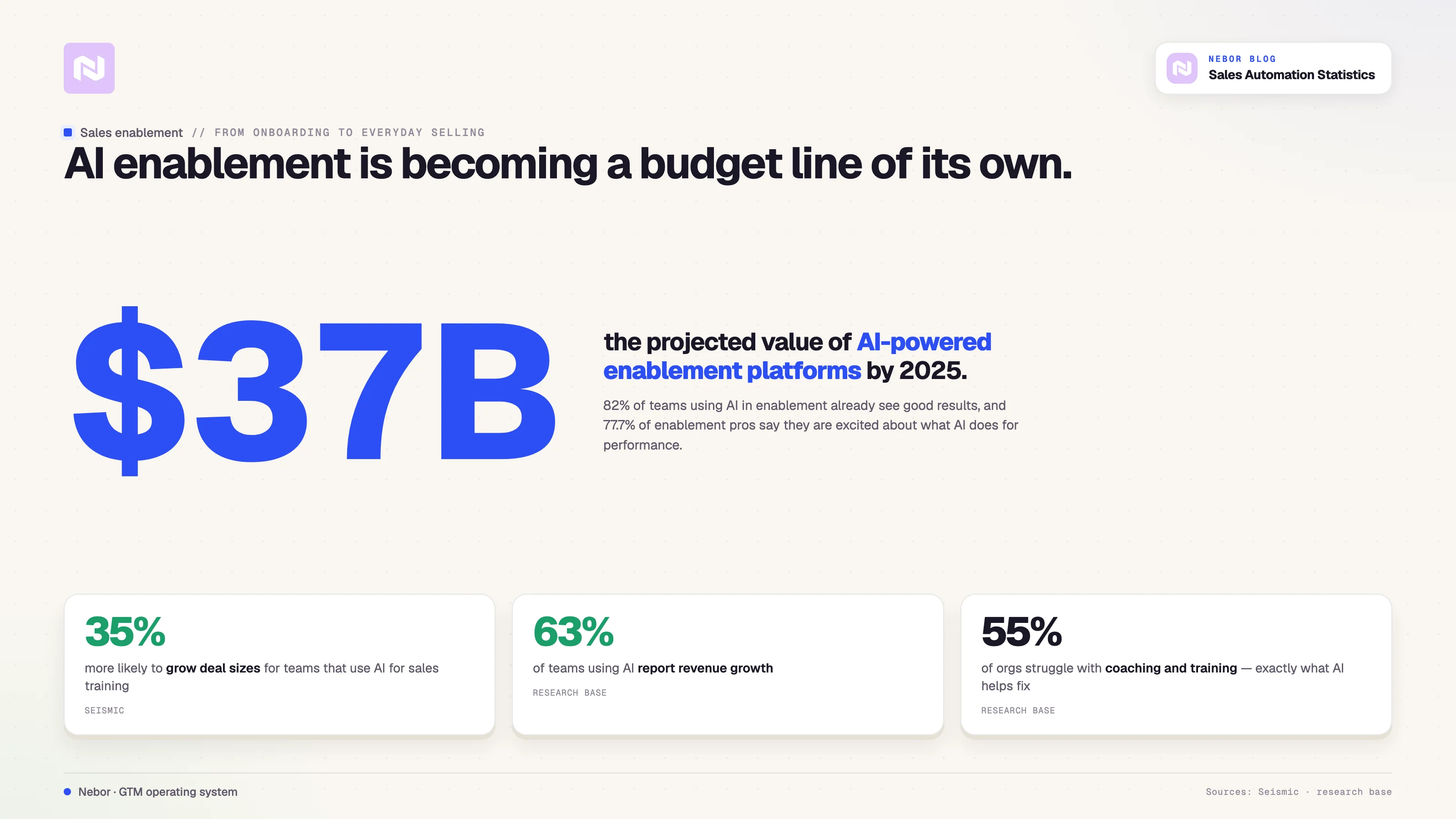
AI is becoming a core part of sales enablement. According to Highspot, 90% of companies have either rolled out AI tools or plan to this year.
Right now, 50% already use AI-powered tools in their enablement process, and 82% of them are seeing good results. Good enough that they plan to expand their use of AI even further.
It is not just hype. 77.7% of enablement professionals say they are excited about what AI can do to improve sales performance.
The market is backing it too. AI-powered enablement platforms are expected to hit $37 billion in value by 2025.
What this means for sales reps and managers
So what is the actual impact on sales performance?
Teams that use AI for sales training are 35% more likely to increase deal sizes, and overall, 63% of teams using AI report revenue growth.
The benefits go beyond numbers. AI helps fix the real-world coaching and training challenges that 55% of organizations struggle with.
With smart tools, sales managers can spot skill gaps, deliver personalized coaching, and build automated learning paths that actually help reps improve without eating up everyone's time.
It is working. Companies that build strong, AI-enhanced enablement programs are seeing 16.7% annual revenue growth.
What sales teams need to know about omnichannel automation
Your buyers are not using one channel. They are jumping from email to LinkedIn, from your website to live chat, sometimes even to in-person meetings.
If your sales process is not keeping up, you are leaving revenue on the table. That is where omnichannel sales automation comes in.
Everything needs to be connected
There is a real difference between having multiple channels and actually connecting them.
Multichannel means you are active on LinkedIn, email, and maybe a chatbot, but each one works separately.
Omnichannel means all of these channels work together, so your messaging stays consistent and your buyer never has to repeat themselves. It connects your website, mobile app, in-store experience, and support teams into one smooth flow.
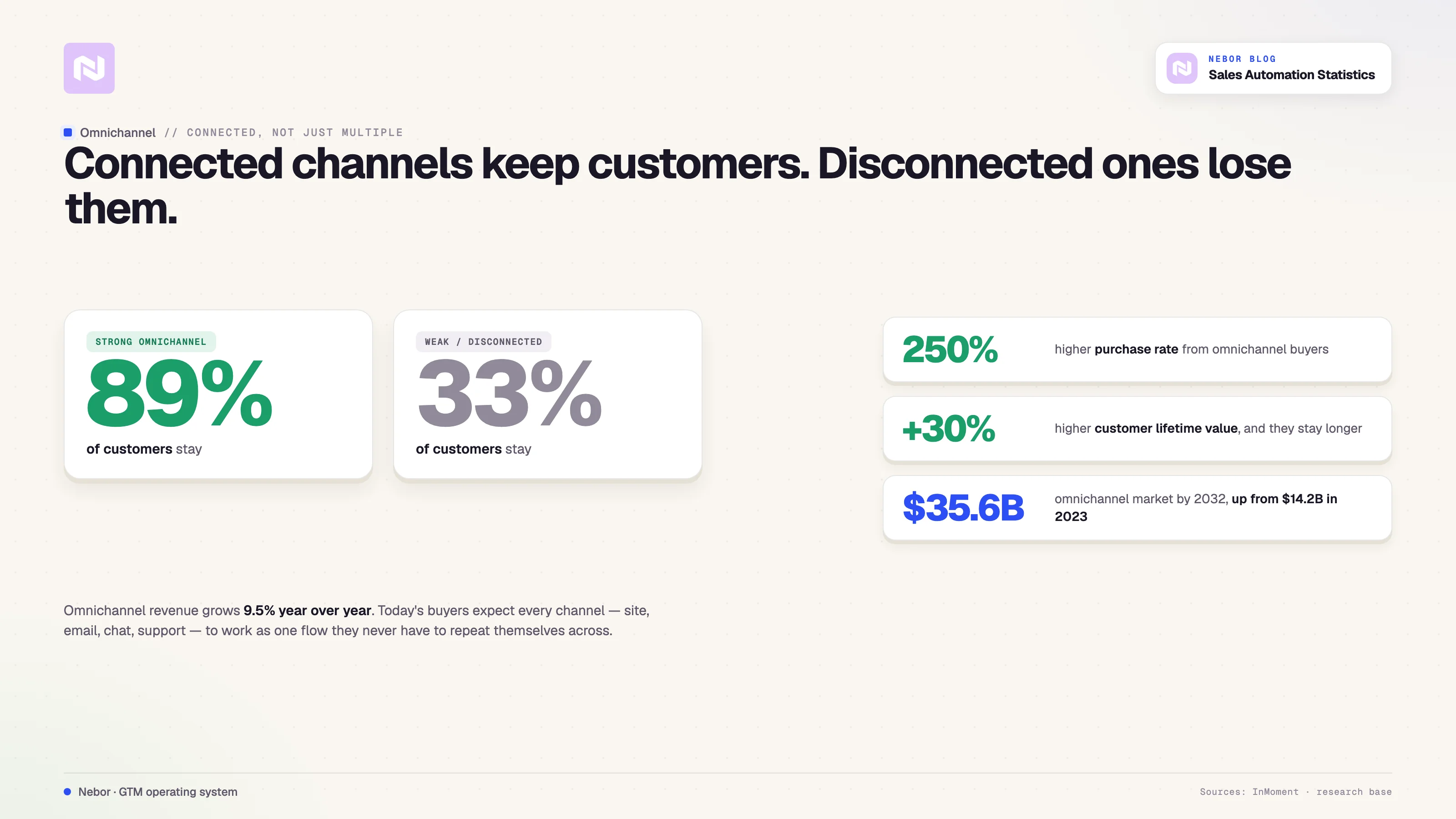
That is what today's buyers expect, and it is why the global omnichannel customer service market is growing fast. It was worth $14.2 billion in 2023 and is expected to hit $35.6 billion by 2032.
This kind of integration creates a single, unified experience across all touchpoints, and that is what buyers remember.
According to InMoment, omnichannel is not just a trend. It is a shift in how people expect to buy and interact with brands. Insider breaks it down further. It is not just about showing up in more places. It is about syncing all those places into one strategy.
The results are real and big
The business impact of getting omnichannel right is clear.
Companies that get omnichannel right are seeing strong revenue growth. 9.5% increase year over year, with 5 to 15% overall revenue growth.
Retention is also better. 89% of customers stay with brands that deliver good omnichannel experiences, compared to just 33% who stay with brands that do not.
Omnichannel buyers are simply more valuable.
They spend more, with a 250% higher purchase rate
They stay longer, with 30% higher lifetime value
If you are in sales or revenue ops, these numbers point to one thing. You need to be building a sales engine that meets buyers wherever they are and moves with them as they switch between channels.
The teams that have done this well typically structured it as part of a wider inbound meeting workflow so that every channel feeds the same source of truth.
What the ROI of sales automation really looks like
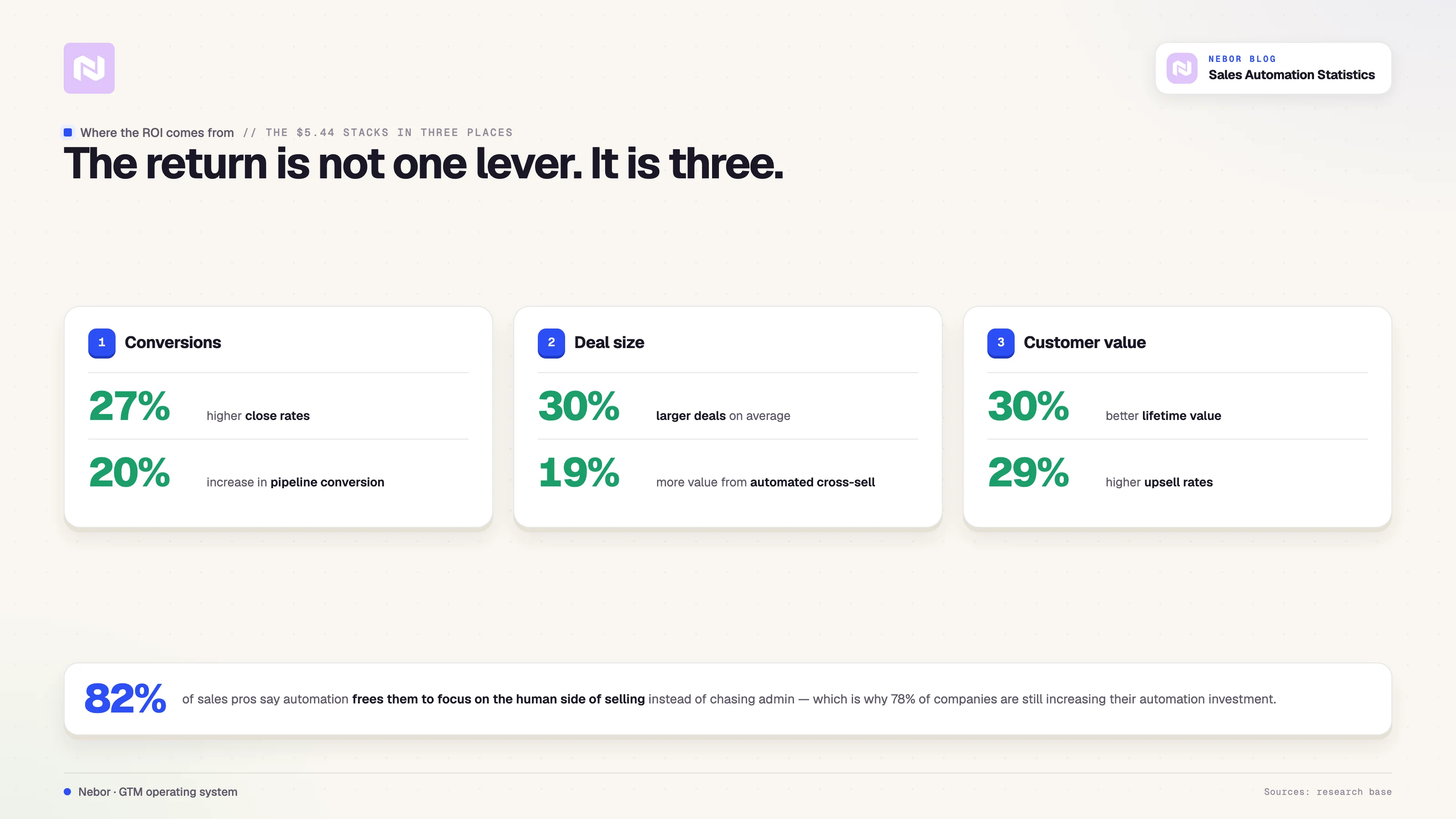
On average, companies are seeing a return of $5.44 for every $1 they spend. That kind of ROI is why more teams are turning to automation to streamline workflows, improve outcomes, and grow revenue.
How quickly does ROI show up?
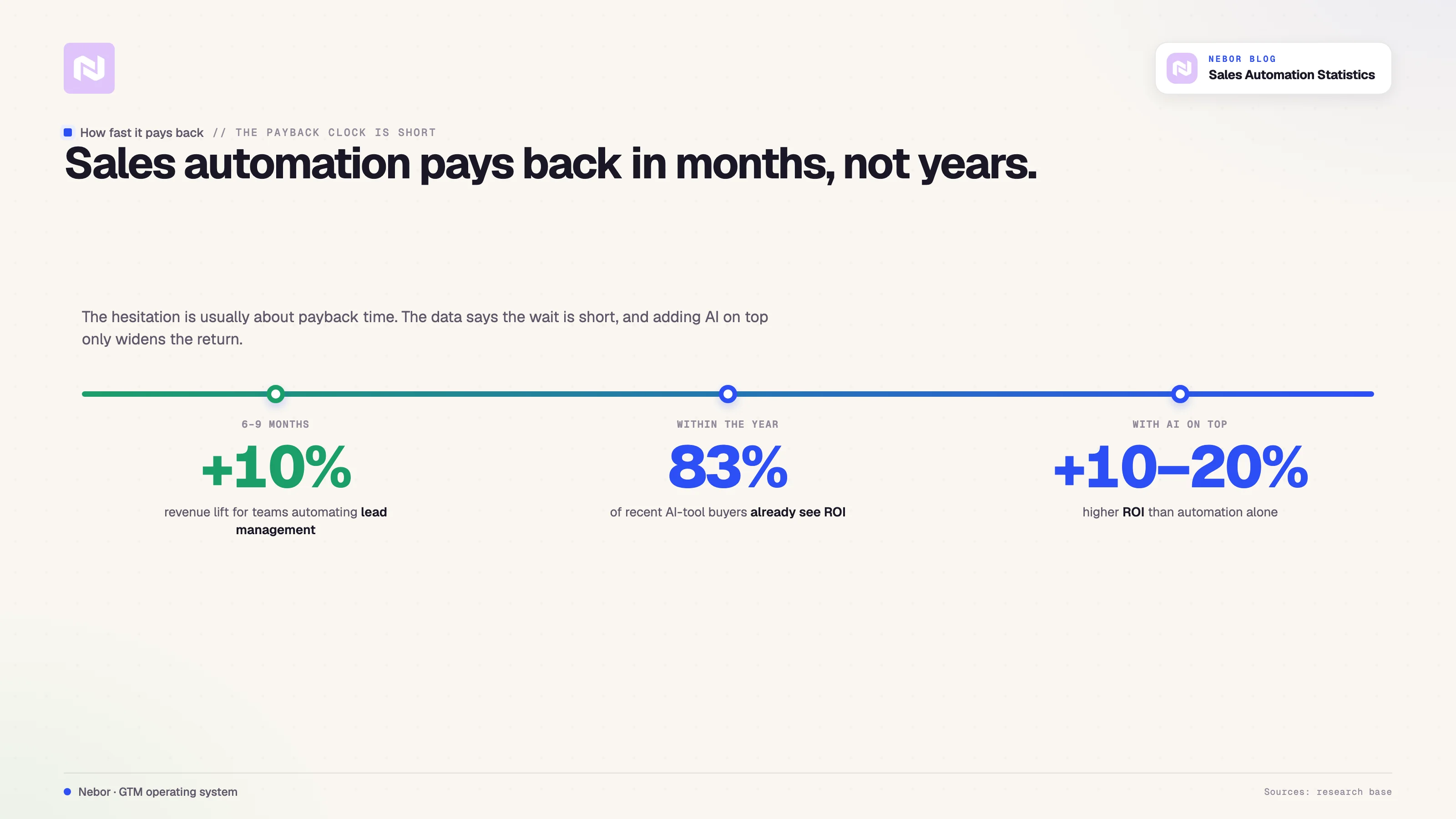
You do not have to wait long to see results.
75% of companies say sales automation directly contributes to revenue growth
76% see ROI within the first year
12% see it in under a month
You are not just making a long-term bet. You are likely to start seeing value in your pipeline and numbers within months.
For most teams using automation in lead management, a 10% or more increase in revenue happens in just 6 to 9 months. When AI is involved, companies report ROI jumps of 10 to 20%.
Where the ROI actually comes from
The gains from sales automation stack across three categories.
Conversions. Sales teams using automation report 27% higher close rates and up to 20% increases in pipeline conversion.
Deal size. Automation can help increase deal value, with 30% larger deal sizes and 19% more value from automated cross-selling.
Customer value. Teams are seeing 30% better customer lifetime value and 29% higher upsell rates thanks to automated follow-ups and smarter outreach.
Those numbers are impressive, but there is something else that matters just as much, which is time. 82% of sales pros say automation frees them up to focus more on the human side of selling instead of chasing admin work.
That is why 78% of companies are increasing their automation budgets right now. If you are still on the fence, these ROI numbers offer a solid benchmark to evaluate what automation could do for your own sales operations.
What comes next for AI, data, and smarter tools
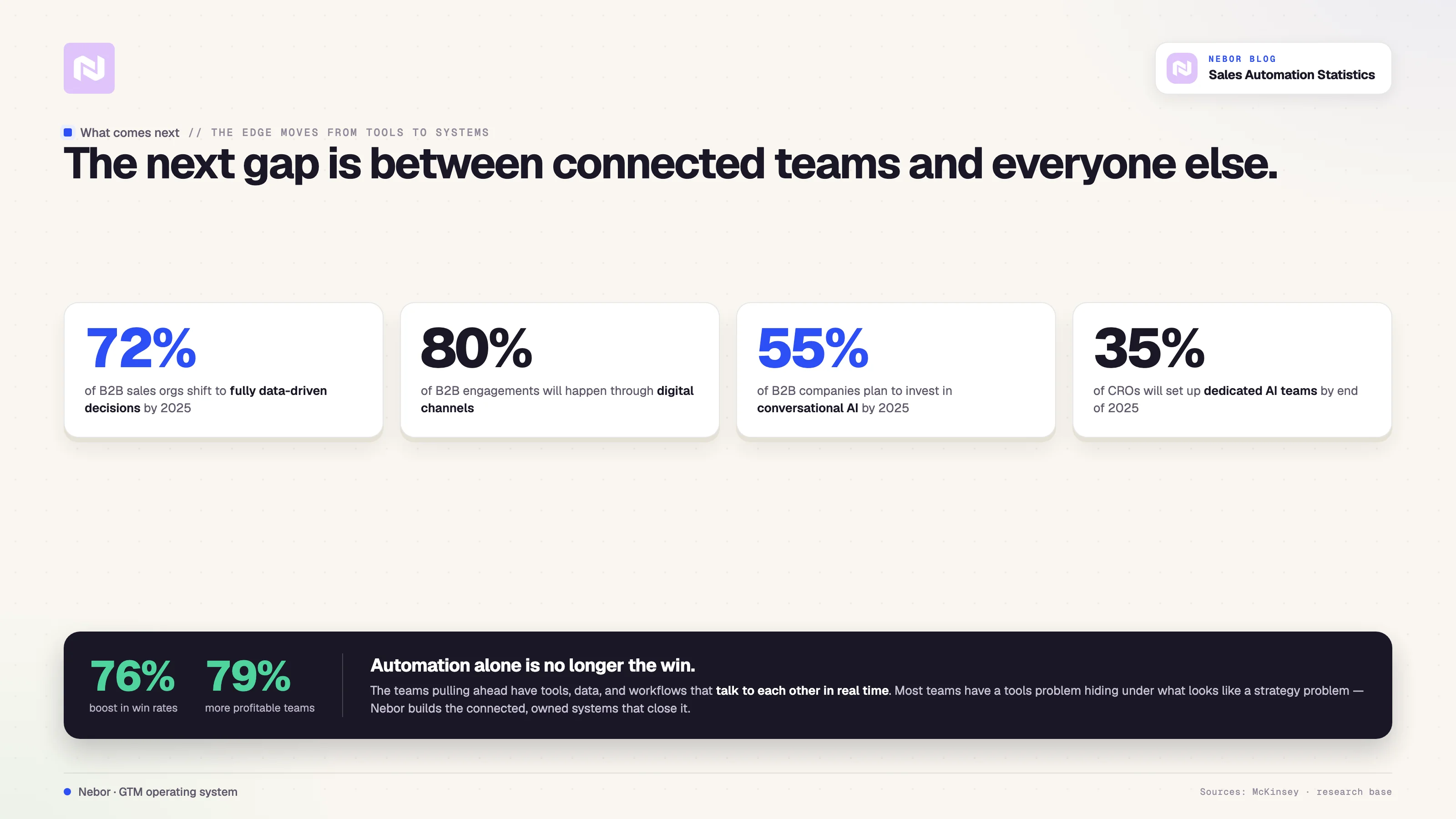
From the work we have been doing with B2B revenue teams in 2026, the pattern is clear. Automation alone is not the win anymore.
The teams pulling ahead are the ones whose tools, data, and workflows actually talk to each other in real time, instead of being stuck in silos that nobody owns.
The broader research data backs the same direction the work shows.
72% of B2B sales orgs will shift from gut-feel selling to fully data-driven decisions by 2025
80% of B2B engagements will happen through digital channels, which means reps will need strong virtual selling systems in place
Some of the emerging tech that will power this shift is already in motion.
AI-powered CRMs that handle scheduling, follow-ups, and meeting notes automatically
Conversational AI tools, with 55% of B2B companies planning to invest in them by 2025
No-code platforms that let sales teams build workflows and automate tasks without needing a developer
The shift is not about more tools. It is about systems that join the dots between the tools you already have. That is the version of automation that compounds over time.
The takeaway for sales and revenue ops leaders
AI will soon handle a large part of the sales process, from lead scoring to follow-ups to pipeline reporting. That frees up reps to focus on the work only humans can do, which is building trust, understanding buyer pain points, and negotiating complex deals.
By the end of 2025, 35% of CROs are expected to set up dedicated AI teams to make sure sales strategy and automation move together.
The forward-looking teams are already doing three things in sequence. They audit their current sales workflows, pinpoint where automation can help most, and then roll out changes in phases with clear goals tied to revenue.
For reps, this does not mean being replaced. It means being augmented. Better data, smarter tools, and more support to focus on the parts of selling that matter most.
The results back it up. Teams that embrace AI-driven automation see a 76% boost in win rates and a 79% improvement in overall team profitability.
If you read this and thought “our automation probably is not pulling its weight”, you are not alone. The honest answer is that most teams have a tools problem hiding underneath what looks like a strategy problem.
Our sales automation statistics references
Sales automation: The key to boosting revenue and reducing costs
Unlocking Sales Success: The Power of Automated Follow-Ups in Your CRM Strategy
The Future of Sales Automation Trends and Predictions for Sales Sequence Tools in the Next 5 Years
The Future of Sales Automation Trends and Predictions for AI Agents in 2025 and Beyond
Why Automated Lead Follow-Up Is Crucial for Closing More Deals
We Measured the ROI of AI in Sales—Here's How It Really Impacts Your Deals
New Competency Required for Sales Leaders – Leading Sales Technology Adoption
How Top Performers Outpace Peers in Sales Productivity (McKinsey)
Use It or Lose It: Master the Art of Seller Adoption of Sales Tech, Pt. 1
How Does ERP Automation Minimize Errors in Complex and Repetitive Tasks?
Measuring the ROI of Order Automation: What to Track and Why
Top SaleTech Predictions and Expectations for 2025 – SalesTechStar


Related Articles

By clicking Sign Up you're confirming that you agree with our Terms and Conditions.