
How to Build Your Ideal Customer Profile From CRM Data in 2026

by

In this post:
We always start building our clients' ICPs from the CRM because the deals they've already won and lost say more about their best customers than any workshop.
A good ICP answers one question: which companies are most likely to buy from you, stay and grow, and you get there by comparing the deals that worked with the ones that didn't.
The first decision is which wins you want more of. Your biggest contracts, your fastest deals, and the customers who stayed longest are usually different companies, so we pick one group with the client before any data moves.
Then we pull those deals, the deals lost in the same period, and the customers who churned, clean them, and fill in what the CRM never captured, like the tools a company uses, funding and hiring, with a waterfall of data providers in Clay.
The comparison is where most ICPs go wrong. Teams look at their won deals and current customers and stop there, but the lost deals show you what separates a win from everything else, especially once you know why you lost them. A deal lost on timing is often a good fit to revisit later, while a deal lost to a competitor points to traits you should avoid.
Whatever keeps showing up becomes a short set of rules and a fit score on the company record in the CRM. We then use the same score to rank lookalike companies you don't know yet, decide which inbound leads go to sales, and pick your ABM accounts, and you check it against real results every quarter.
If you lead sales, marketing, or RevOps at a B2B company with a few years of deals in HubSpot or Salesforce, this post is for you.
We're Nebor, a GTM and RevOps agency started by salespeople, and this is how we build the ICP behind every GTM system we set up. If you'd like us to build yours, you can book a meeting.
TL;DR
Decide which wins you want more of first, like the highest paying, the fastest to close, or the longest retained, because mixing them blurs your ideal customer profile (ICP).
Pull won deals, lost deals with their loss reasons, and churned customers from your CRM, clean the customer data, and enrich the data points your CRM never captured, like the tools they use and funding.
Sort lost deals by why you lost them, because timing losses are often future customers and competitor losses point to traits you should avoid.
Compare winners with losers to find the traits that separate them, then write the ICP down as rules a person and a tool can both apply.
Add negative criteria for the companies you should avoid, and turn the rules into a fit score in your CRM.
Use the ICP to build lookalike lists, score leads, pick accounts for account-based marketing and build ad audiences, and check it against results every quarter.
Nebor builds your ICP from your own CRM data and turns it into a working lookalike and scoring system in your accounts. You can book a meeting to talk it through.
What an ideal customer profile is, and how it differs from a buyer persona
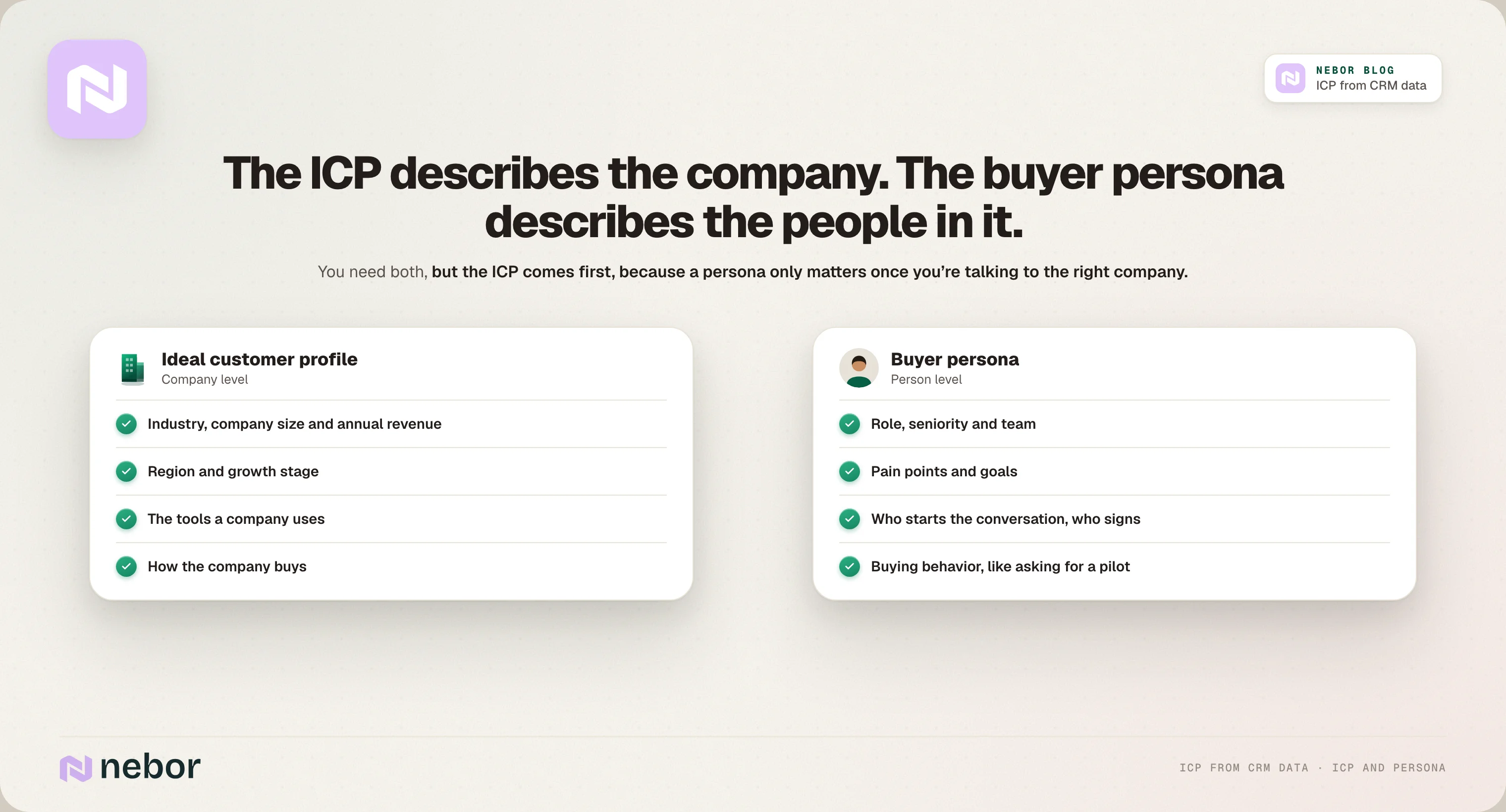
An ideal customer profile (ICP) is a detailed description of the companies that get the most value from what you sell and give you the most value back. It works at the company level, using firmographic and technographic data like industry, company size, annual revenue, region, the tools a company uses, and its growth stage, plus behavioral data on how the company buys.
A buyer persona describes the people at those companies, like the head of sales who feels the problem or the finance lead who signs off. It uses demographic data like role, seniority, and team, along with each person's pain points and goals.
You need both, but the ideal customer profile comes first, because a buyer persona only matters once you're talking to the right company (ICP).
Some teams add psychographic data too, like how open a company is to change, and your call notes and lost-deal reasons are where a CRM keeps it.
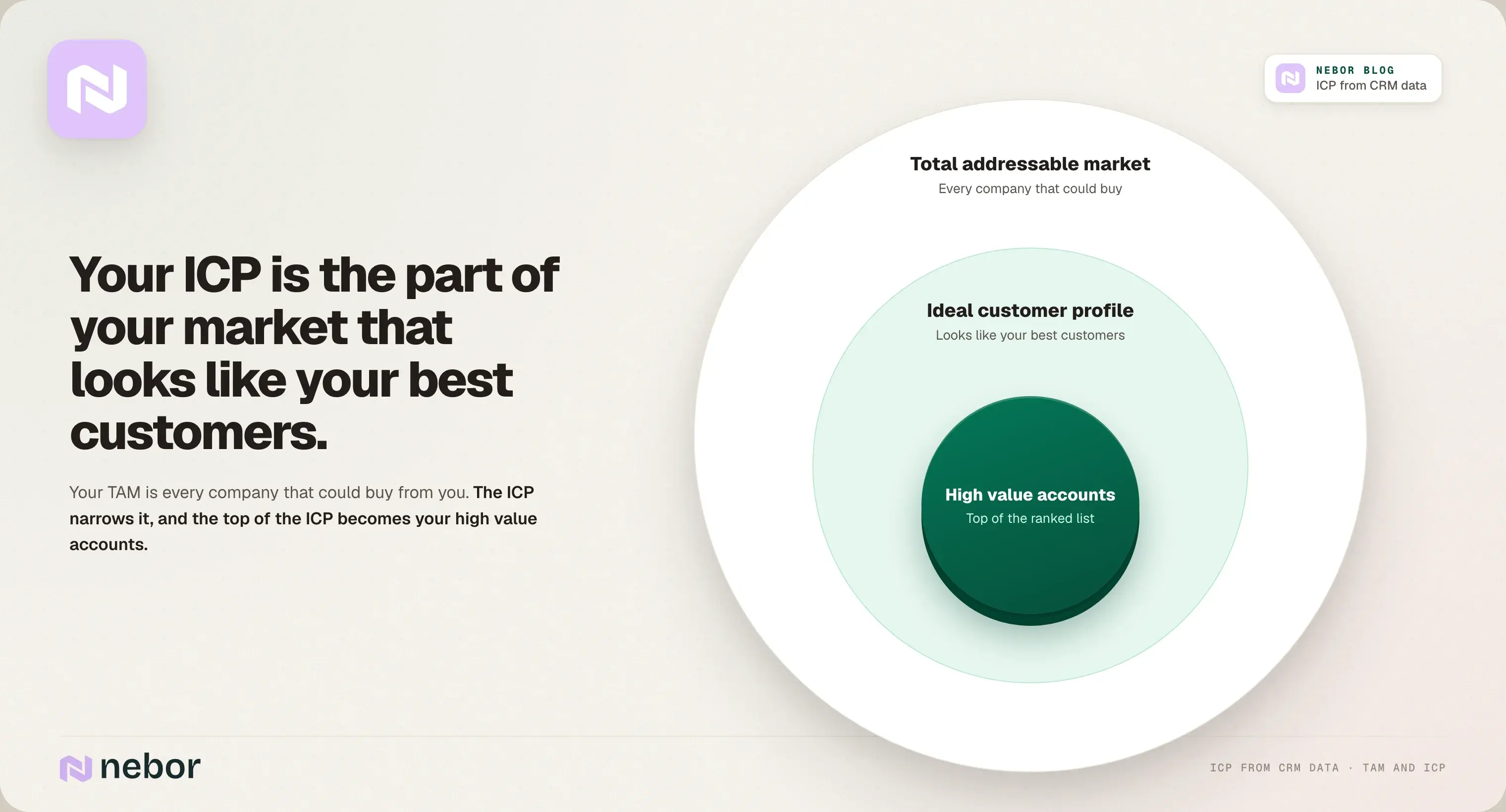
In some engagements, we've also found that it helps to separate the ICP from your total addressable market (TAM). Your TAM is every company that could buy from you, and your ICP is the target market within it that looks like your best customers.
We created a guide to building your TAM that covers this pretty well.
Why an ideal customer profile built from customer data beats one built in a workshop
A workshop ICP describes the target customers your team wants. A CRM ICP describes the customers who said yes, paid and stayed, and our experience has shown us that those two lists often look different.
Most teams picture larger companies than the ones that really close, or a buyer title that rarely signs, or an industry that looks attractive but churns. None of that is visible in a meeting, and neither is customer behavior, like which customers engage with your product, expand and renew. All of it is visible in your won, lost and churned deals.
What we love most is that CRM data also gives you something to test against. Once the ICP is a set of rules, you can check whether matching accounts win more often, stay longer and spend more, and that's the main advantage of a CRM data driven approach to building the ICP.
Choose which of your best customers you want more of before you pull any data
This is the step our closed-won lookalike workflow starts with, because the whole ICP depends on it. Your won deals aren't one group, and you need to decide which wins you want to repeat.
The highest paying. Pick these if you want bigger contracts, and accept longer sales cycles.
The fastest to close. Pick these if you need pipeline this quarter and want shorter sales cycles.
The best retained. Pick these if you care most about retaining customers who expand and bring the highest lifetime value. We'd recommend this group for most companies, and it's the one teams pick least often.
If you can see product usage, look for super users, the accounts whose teams log in every day and invite their colleagues. They're often your most valuable customers even when their first contract was small. Your customer success teams can tell you which accounts are healthy, and their customer feedback often explains why one group stays and another leaves.
You can build more than one ICP if your business has distinct segments, but each customer segment needs its own group of wins. If you mix your biggest enterprise deals with your fastest small deals, the profile ends up describing a company that doesn't exist.
How to build your ideal customer profile from CRM data (from export to scored list)
Once you know which wins you're copying, the work follows a clear order, and each stage builds on the one before it.
Step 1: Pull won deals, lost deals and churned customers from your CRM
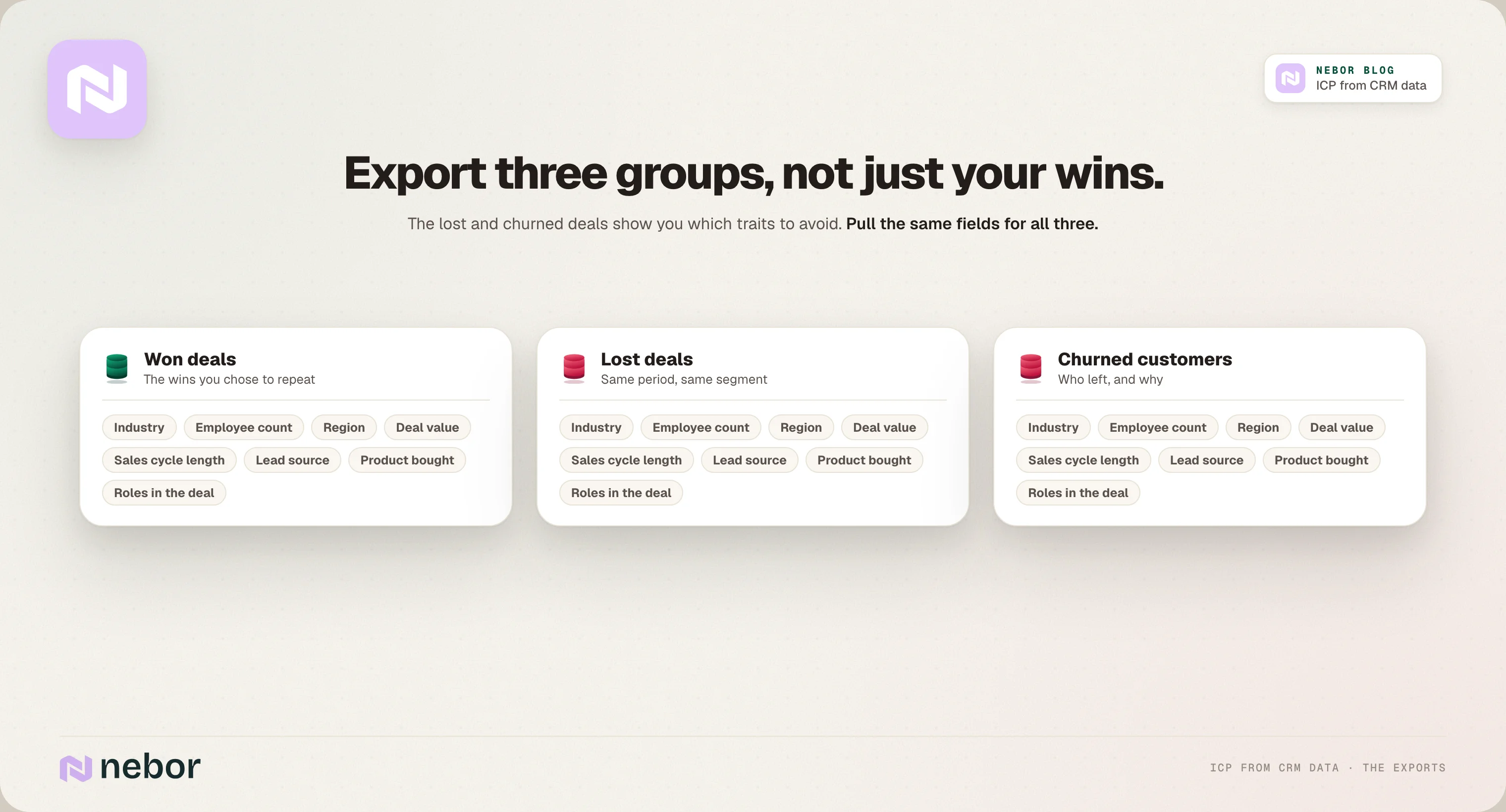
Export three groups from your HubSpot (Salesforce or whichever CRM your team uses): the won deals you chose, the deals you lost in the same period, and the customers who churned. The lost and churned groups matter as much as the wins, because they show you which traits to avoid.
For each company, pull the data points that describe the account and the deal: industry, employee count, region, deal value, sales cycle length, lead source, product bought, the roles involved in the deal and, for lost deals, the loss reason.
HubSpot has a default Closed lost reason property on deals, and in Salesforce most teams add a custom loss reason field to the opportunity. The idea is to use enough history to identify patterns, and agree the time window with your sales and marketing teams so it reflects how you sell today.
Step 2: Clean your customer data and enrich the data points your CRM never captured
CRM data is rarely complete, because industries are typed in different ways, headcounts are years old, and fields like tech stack, funding and hiring are usually empty because no rep ever filled them in.
So you need to clean first and enrich second. Merge duplicates, standardize industry and region values, and fix company sizes. Then fill the gaps with enrichment, which we usually do in Clay through a waterfall of providers that adds technographic data, funding, hiring and intent signals, because doing that by hand means hours of manual research.
We have a list of CRM enrichment and data hygiene agencies that covers the top tools and partners for that step.
Step 3: Compare your winners with your losers
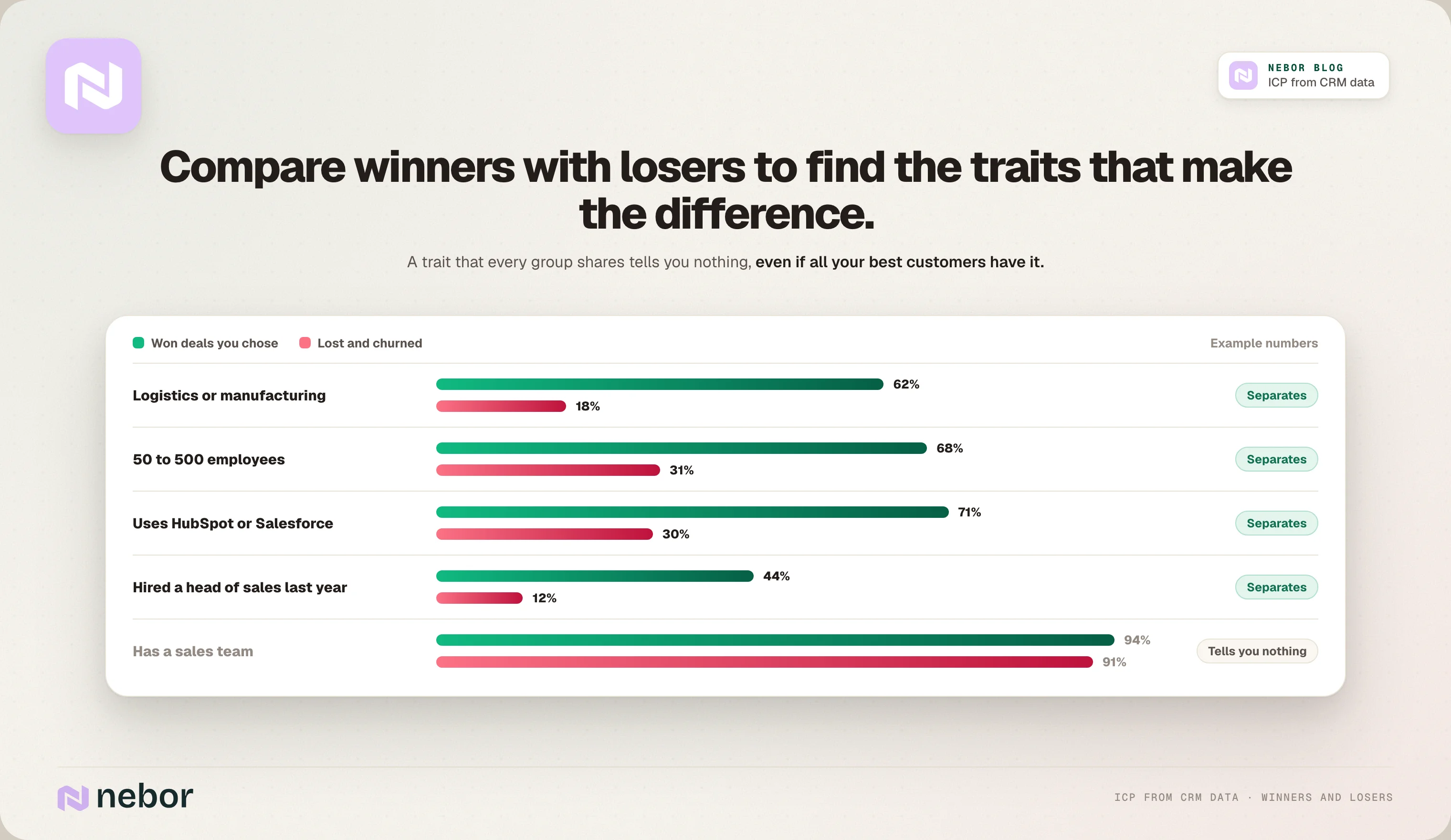
Now look for the data points that show up much more often in the wins you chose than in your losses and churned customers. That contrast is what makes the profile useful. A trait that's common across every group tells you nothing, even if all your most successful customers have it.
Look at data points like company size, industry, region, technographic data and growth stage first, then at how the deals happened, like the lead source, the roles involved and how long they took. Pay attention to surprises, because the trait nobody expected is often the one that sharpens the ICP most.
For retained customers, also check deal size, growth rate and how the company's teams are organized against retention, because all three shape whether a customer succeeds with your product.
Step 4: Sort your lost deals by why you lost them
Your lost deals aren't one group either. Before you compare them with your wins, sort them by the reason you lost them, because each reason tells you something different about your ideal customer profile.
Timing: The company fit, but the moment was wrong, like a budget freeze or a different priority that quarter. These companies often belong in your ideal customer profile, so keep them on a list for later and watch them for intent data and new signals.
Lost to a competitor: Note which competitor won and look for a pattern. If one kind of company keeps choosing the same competitor, that's either a trait for your negative criteria or a gap in your positioning.
Poor fit: The company was too small, in a region you can't serve well or needed something you don't offer. Those traits go straight into your negative criteria.
Price or no decision: Check the company size and who was involved, because these losses often point to the wrong size band or a decision maker who never joined the deal.
If your team never recorded loss reasons, read the deal notes and ask the sales teams who worked those deals. Then make the loss reason a required field whenever a deal is marked as lost, so your next ICP review has the data.
Step 5: Write your ideal customer profile down as rules
Turn what you found into a short list of rules a person and a tool can both apply. A phrase like "mid-market companies" is too vague to act on, while "companies with 50 to 500 employees in logistics or manufacturing, using HubSpot, in the EU" is a much better rule anyone can check.
Add negative criteria as well, like company types that churned, regions you can't serve well or competitors' customers that never switched. Telling your sales teams which accounts to skip saves as much time as telling them which ones to chase.
Step 6: Fill in an ideal customer profile template with your rules
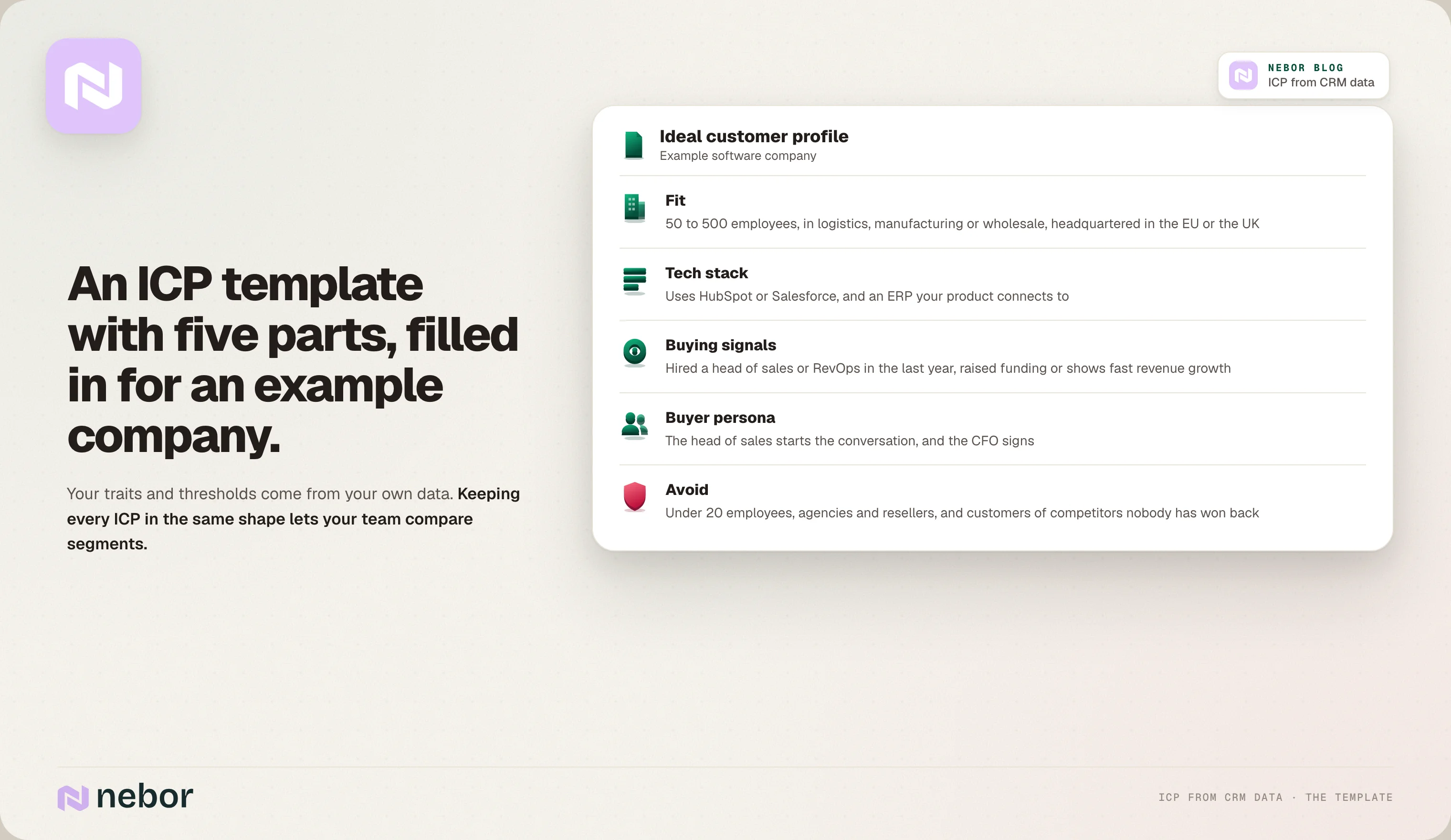
A template keeps every ICP your team writes in the same shape, so your sales and marketing teams can compare segments and spot gaps. Here's our ideal customer profile template (example) with its five parts, filled in for an example software company. Your traits and thresholds will come from your own data.
Fit: 50 to 500 employees, in logistics, manufacturing or wholesale, headquartered in the EU or the UK.
Tech stack: uses HubSpot or Salesforce, and an ERP your product connects to.
Buying signals: hired a head of sales or RevOps in the last year, raised funding or shows fast revenue growth.
Buyer persona: the head of sales starts the conversation, and the CFO signs.
Avoid: companies under 20 employees, agencies and resellers, and current customers of the two competitors nobody has ever won back.
These signals tell you when to reach out. Identifying buying triggers like a new leader, a funding round or intent signals like repeat visits to your pricing page helps you predict which matching companies will buy soon, so add them to every ideal customer profile template you write.
Step 7: Score your open accounts and your wider market
Rules on a page don't change what your team does, so you need to turn them into a fit score. Give points for each trait in the profile, subtract points for each negative criterion, and store the score on the company record in your CRM.
Then score two lists against it, the existing customers and open accounts already in your CRM, and the potential customers you don't know yet.
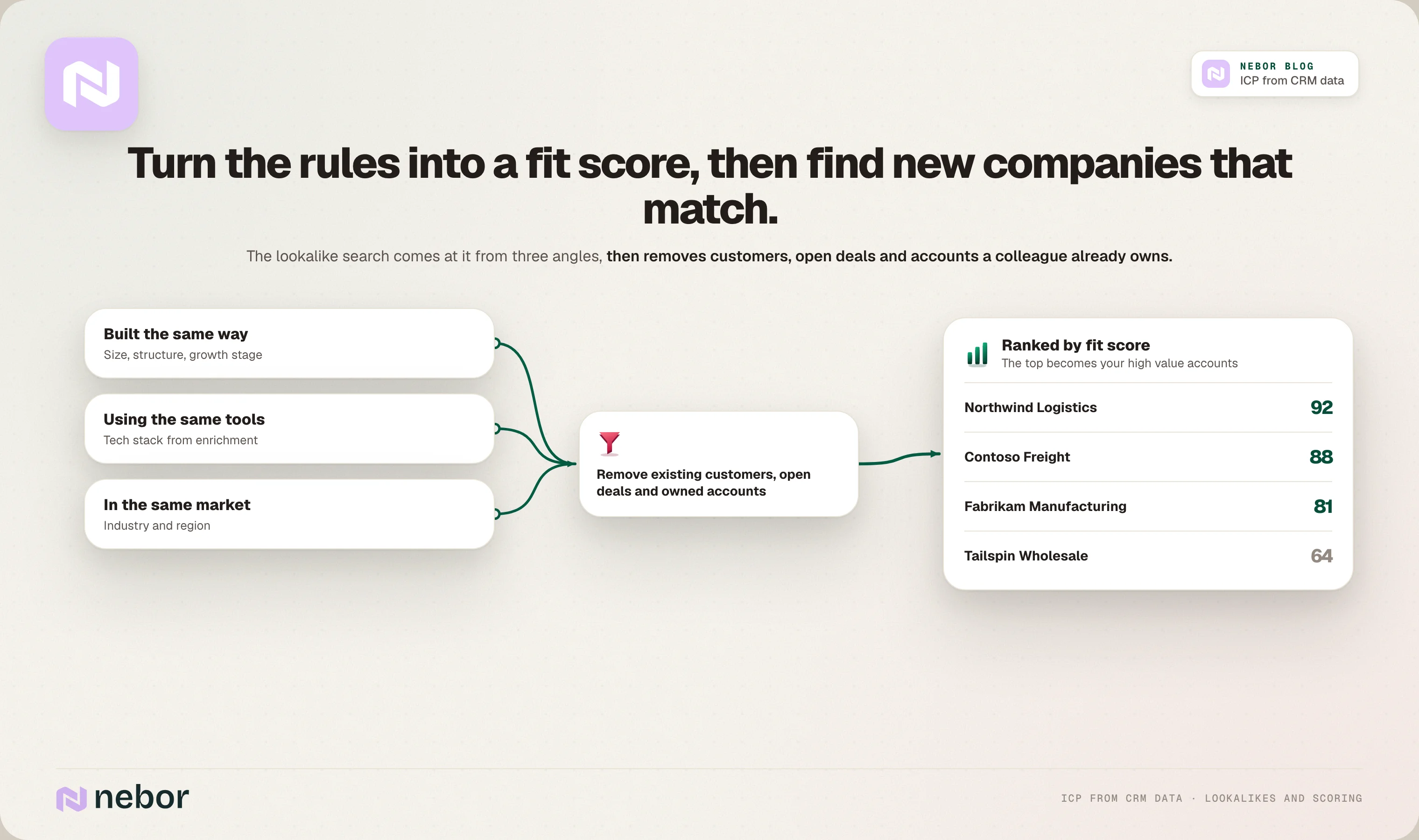
Our lookalike workflow searches for new matches from three angles, companies built the same way, using the same tools and in the same market, then removes existing customers, open deals and accounts a colleague owns before ranking the rest.
The top of that ranked list becomes your high value accounts. The rest stay in a lower tier until intent data shows they're researching a problem you solve.
Step 8: Check your ICP against customer retention and real results every quarter
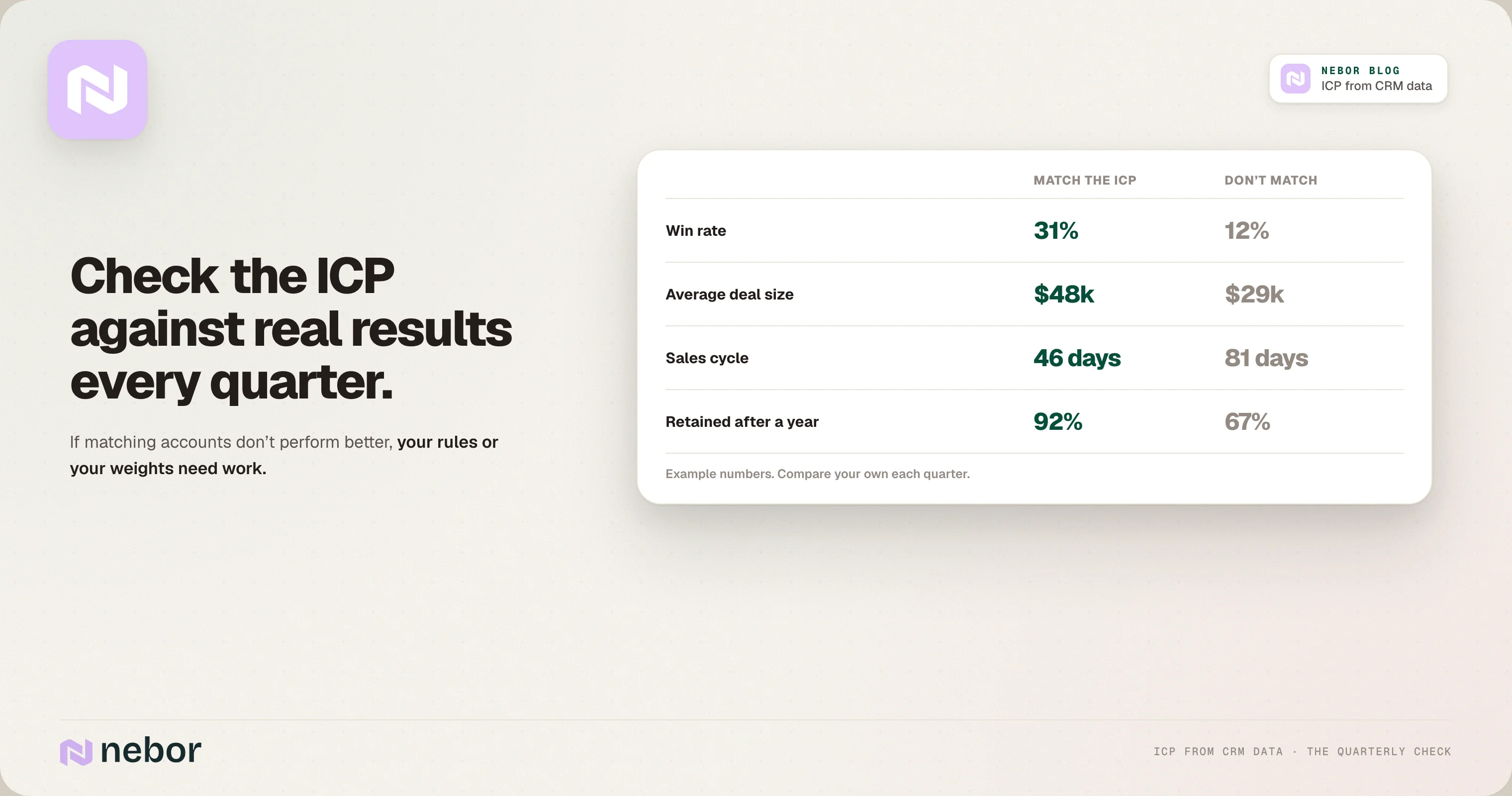
Even a well defined ICP is a hypothesis until results back it up. Every quarter, compare win rate, deal size, sales cycle, engagement and conversion rates, and customer retention for accounts that match the profile against accounts that don't.
If high-scoring accounts don't perform better, your rules or your weights need work. A static ICP slowly loses its edge, and you'll usually see it first as falling conversion rates on leads from accounts that should be a perfect fit.
Markets, products and pricing change, so your ideal customer profile needs to change with them, and your customer success teams can tell you which matching accounts struggle after they sign.
How to do ICP analysis, with the data points to compare between winners and losers
Here are the data points we compare between winners and losers when we build an ideal customer profile, and the questions each trait answers.
Trait | What to compare | What it tells you |
|---|---|---|
Industry | Win rate and retention by industry | Where you have a real right to win |
Company size | How many employees and how much annual revenue winners have compared with losers | The size band you serve best |
Region | Win rate and deal size by country | Where your sales motion works |
Tech stack | Tools used by winners vs losers | Which setups make your product easier to adopt |
Growth stage | Funding, hiring and age of the company | Whether timing or budget drives buying |
Lead source | Which channels brought the wins with the highest lifetime value | Where to find more of them |
Roles in the deal | Titles involved in won vs lost deals | Who to target and who signs |
Sales cycle | Time to close by customer segment | Which segments move fast enough for your team |
Customer behavior | Product usage, support tickets and renewals | Which customers engage and stay |
Loss reasons | Why you lost, by customer segment, like timing, competitor or fit | Which companies to revisit later and which to avoid |
Churn reasons | Why customers left | Which traits belong in your negative criteria |
You don't need every row on day one. Start with the four or five traits your data is good enough to support, and add more as your CRM data improves.
How to turn your ICP into buyer personas and a full buying committee
Once you know which companies to target, you need to know which people at them make up your target audience. According to Gartner, the typical buying group for a complex B2B solution involves 6 to 10 decision makers, so one contact per account is rarely enough.
Your CRM shows you who those people are. Look at the contacts on your won deals and note which roles appear most often, which one usually starts the conversation and which one signs. Then compare that with your lost deals, where you'll often find that the right person was never involved.
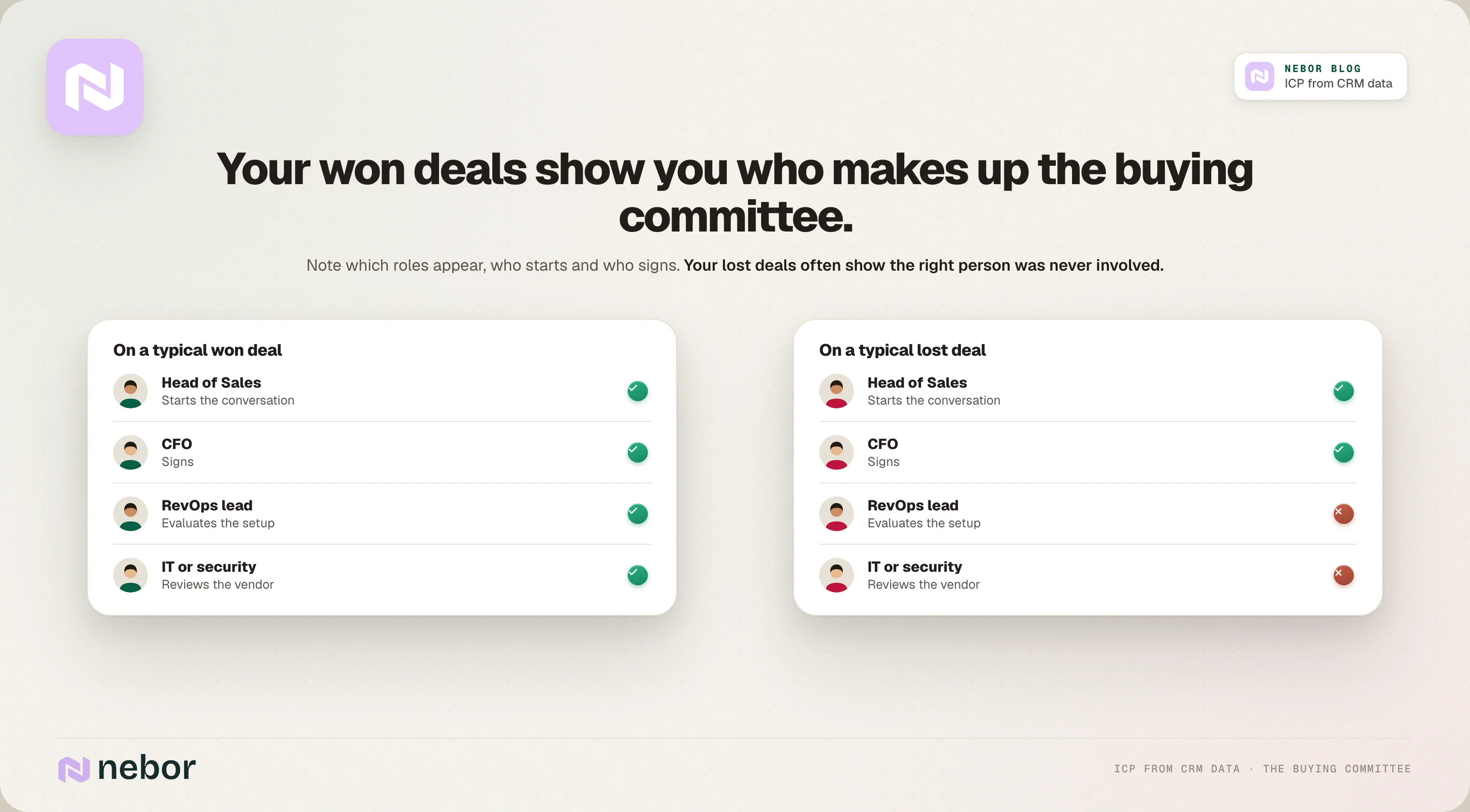
It helps if your CRM records who played which part, through opportunity contact roles in Salesforce or association labels on deals in HubSpot. If neither is filled in today, start capturing it now so your next ICP review is sharper.
Write a short buyer persona for each role that matters: what they're responsible for, what pain points they feel and what they need to see from you. Then use those personas to decide who your sales teams target first at each matching account.
Your customer support teams and sales call recordings are the best source for those pain points, because the champion on a won deal usually told you the customer pain points your messaging should lead with. A good buyer persona also records buying behavior, like whether the person brings in finance early or asks for a pilot first.
How to put your ideal customer profile to work across sales and marketing efforts
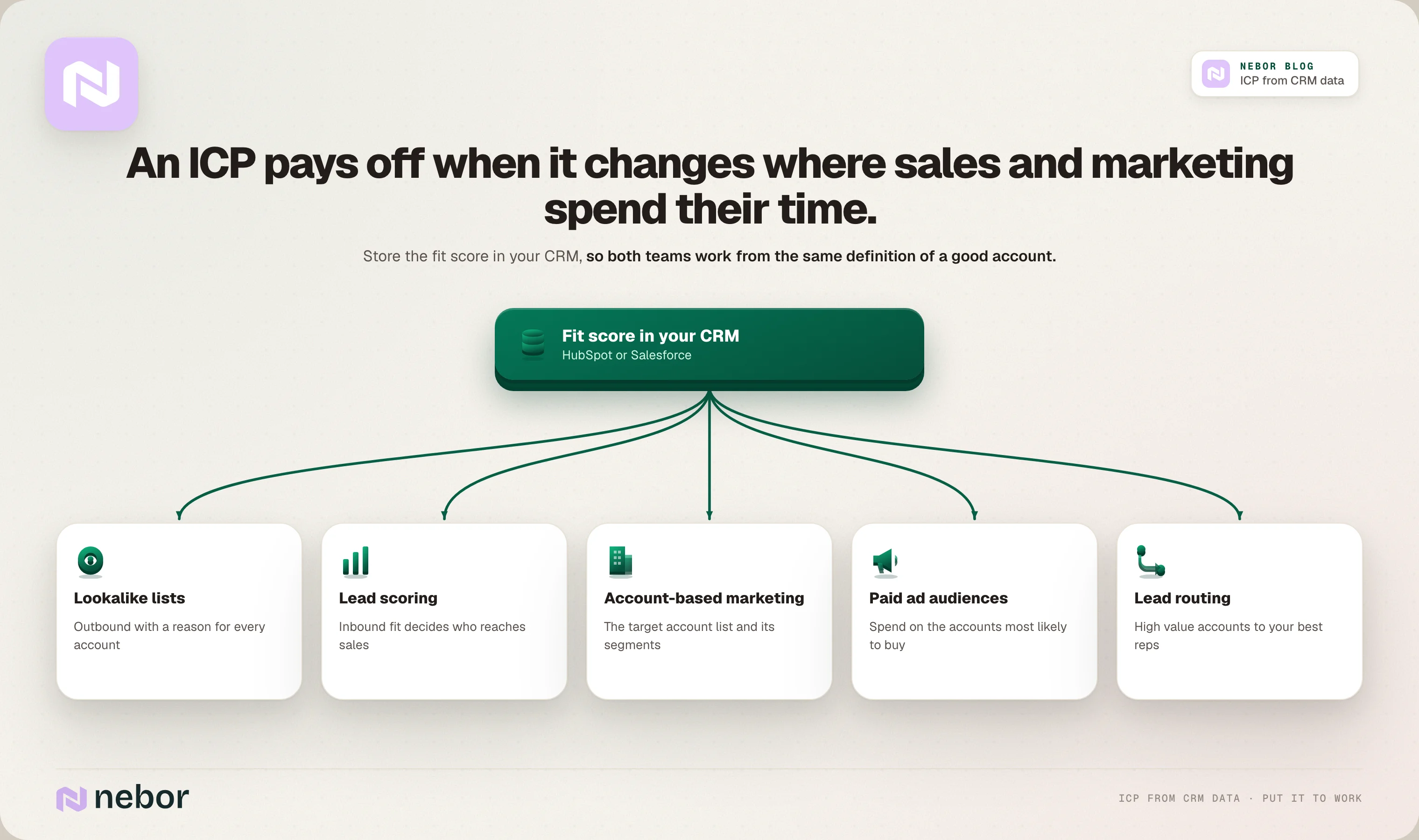
An ideal customer profile only pays off when it changes where your sales and marketing efforts go. These are the five places we connect it.
Lookalike lists for outbound
Your fit score ranks target companies that look like your best customers, and each one comes with a reason, like which customer it resembles and the pain points that customer had. That reason gives your reps a real opening line, so your outreach efforts stop sounding generic.
Lead scoring for inbound
The same traits become the fit part of your lead scoring. Inbound leads from matching companies reach sales faster, and leads from poor-fit companies stay with your marketing teams, so lead generation stays focused on high potential leads.
Target account selection for account-based marketing
Your highest-scoring accounts become your target account list, grouped into segments with account plans and targeted campaigns tailored to each one. A segment of logistics companies on HubSpot, for example, gets different messages from a segment of manufacturers on Salesforce.
Paid ad audiences
Matching accounts become the target audience for your ads, so your spend reaches the potential customers most likely to buy. Your marketing teams and your outbound then point at the same companies, which keeps your marketing strategies and sales efforts aligned.
Lead routing
High value accounts go to your most experienced reps, and low-fit leads go into nurture. Routing on fit means your sales efforts go to the accounts most likely to close.
When the score lives in your CRM, sales and marketing work from the same definition of a good account. An effective ICP ends most arguments about lead quality before they start.
The profile building mistakes we see when teams build their ICP from CRM data
These are the mistakes that make a CRM-based ideal customer profile less useful than it should be.
Mixing different kinds of wins into one profile
When you combine your biggest deals with your fastest ones, the profile describes a perfect customer who doesn't exist. You need to pick one group of wins per ideal customer profile.
Looking only at the wins and skipping customer feedback from lost deals
Traits that all your customers share can also be true of your losses. Without comparing against lost and churned deals, and reading why those buyers said no, you can't tell which traits make the difference. And a lost deal on timing means something very different from one lost to a competitor, so lumping them together hides both lessons.
Relying on demographic data and ignoring behavioral data
Job titles, firmographics and other demographic data tell you who a company is. Behavioral data tells you how it acts, like whether it uses your product, asks for demos or comes back after a lost deal, and that buying behavior often predicts more than the company's profile does.
Hire Nebor to build your ideal customer profile and find more best fit customers
Nebor is a GTM and RevOps agency started by salespeople, and we build your ideal customer profile (ICP) around the deals your team already won.
We agree with you which wins to copy, clean and enrich your CRM data and compare winners with losers. Then we write the ICP as rules, turn it into a fit score in HubSpot or Salesforce, and build the lookalike workflow that finds new companies that match.
Everything stays in your own accounts, and every build comes with a runbook, so your sales and marketing teams can change the rules as your market changes, which matters more for long-term success than the first version. Across the systems we build, clients save more than 20 hours a week of manual work, and the ICP becomes the list source your sales and marketing teams rely on for outbound and account-based marketing.
If your team is still targeting accounts from a workshop slide, book a meeting and we'll look at what your CRM says about your best customers.
Ideal customer profile questions teams ask us before they start
Should you include lost deals when you build an ideal customer profile (ICP)?
Yes, and you should look at why you lost them. Deals lost on timing are often good-fit companies to revisit, while deals lost to a competitor or on fit show you which traits to avoid. Without them, you can't tell which traits separate your wins from everything else.
How much CRM data do you need to build an ideal customer profile?
You need enough won and lost deals to see patterns instead of one-offs. If you only have a handful of customers, start with interviews and your best guesses, then rebuild the ICP from CRM data once you have more deals to compare.
Which CRM fields matter most for an ICP besides company size and industry?
Employee count, region, deal value, sales cycle, lead source and the roles involved in the deal. Add the tools they use, funding and hiring through enrichment, because most CRMs don't capture them.
How do you build an ICP if your CRM data is messy?
You need to clean it first by standardizing industries and regions, merging duplicates and refreshing company sizes, then enrich the gaps before you compare anything.
How often should you update your ideal customer profile?
Check it against results every quarter, and rebuild it when something big changes, like a new product, new pricing or a new market.
How do buying signals and your ICP connect to lead scoring?
The ICP traits become the fit part of your lead score, and intent signals like a new sales leader or a funding round add timing on top. A lead from a company that matches your ideal customer profile gets fit points, and its engagement decides when it's ready for sales.
How long does it take to build an ICP from CRM data?
It depends mostly on how clean your CRM is and how quickly your team agrees on which wins to copy. The analysis itself is quick once the data is clean, while cleanup and enrichment usually take the longest.
Do you need Clay to build ICP from CRM data?
No, you can do the analysis with exports and a spreadsheet. Clay makes the enrichment and the ongoing scoring much faster, so we use it for the lookalike workflow.


Related Articles


By clicking Sign Up you're confirming that you agree with our Terms and Conditions.








