

In this post:
Ask a marketing team which campaign won them a deal and you'll usually get a confident answer. Ask how they know, and the confidence tends to wobble.
The honest truth is that most deals are won by a chain of touches instead of a single one. A buyer reads a blog post, sees an ad, gets an email, joins a webinar, and talks to a rep, all before they convert.
Multi-touch attribution is the practice of spreading credit across all the touchpoints in a buyer's journey, instead of handing it all to one. It's a way to see how every interaction contributed to the sale.
The alternative, single-touch attribution, gives one moment all the glory. That's simple, but it hides most of what really drove the deal, which leads teams to fund the wrong things.
TL;DR
Multi-touch attribution assigns credit to multiple touchpoints across the buyer's journey instead of crediting a single email, ad, or call for the whole conversion.
B2B buying is long and involves many touches across many channels, so if you credit only the first or last one, you misjudge what's working and pour budget into the wrong places.
There are several models for splitting that credit, from simple equal-weighting to machine-learning approaches. Custom algorithmic models tend to measure ROI 15 to 25% more accurately than rule-based ones.
The humility required is that real journeys are messy and partly invisible. A lot of influence happens in places you can't track, so attribution works as a useful guide and never becomes a perfect ledger.
So what does multi-touch attribution actually do for your budget?
Multi-touch attribution answers one question above all. When a deal closes, which of the many things you did helped, and by how much?
A typical B2B journey isn't one click. It's a dozen or more touches spread over weeks or months, across email, ads, content, events, and sales conversations.
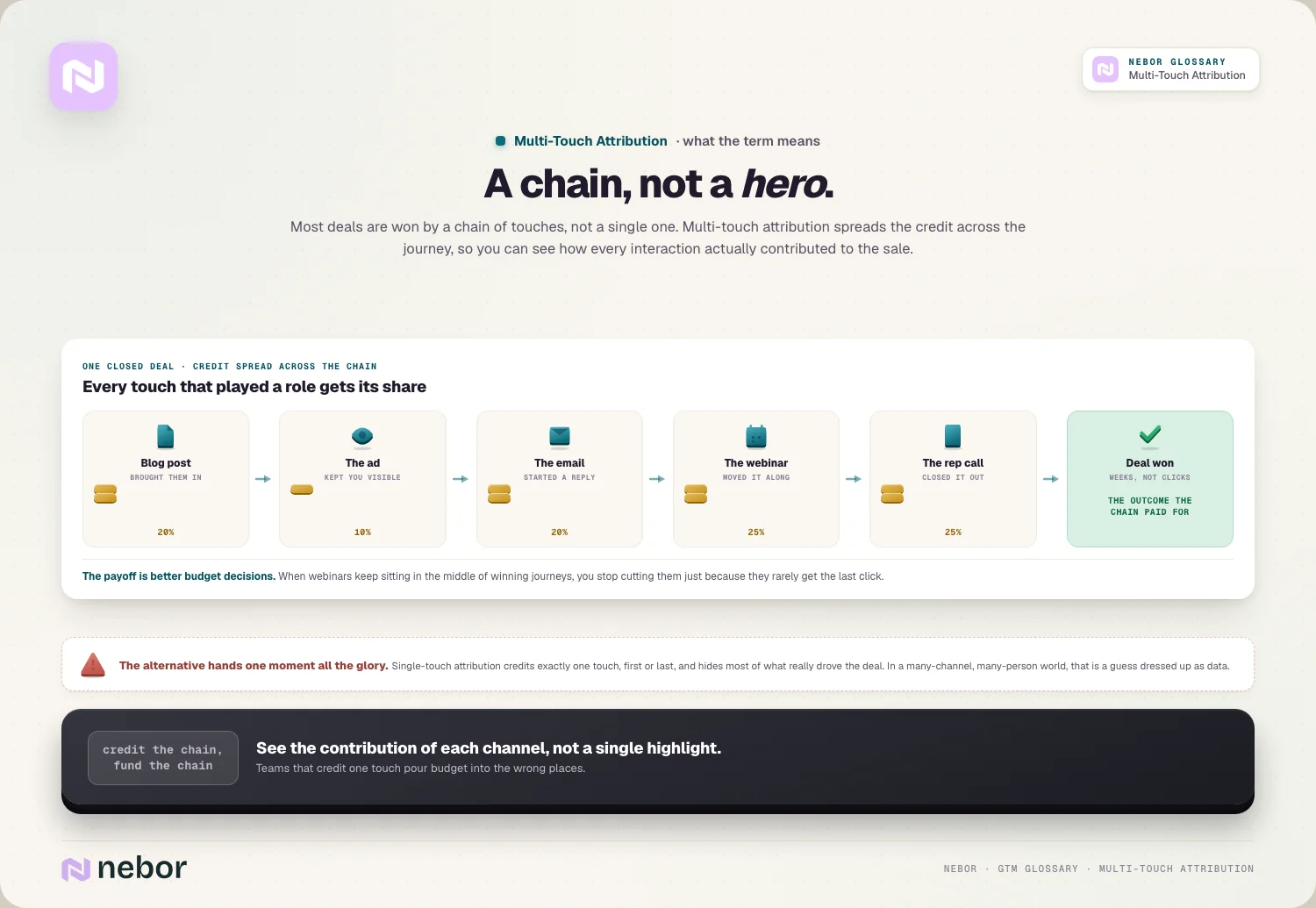
Single-touch attribution looks at that whole journey and credits exactly one moment. First-touch credits whatever started it, last-touch credits whatever closed it, and both ignore everything in between.
Multi-touch attribution refuses to pick just one. It distributes the credit across the touches that played a role, so you can see the contribution of each channel instead of a single highlight.
The practical payoff is better budget decisions. If you can see that webinars consistently appear in the middle of winning journeys, you stop cutting them just because they rarely get the last click.
Why does single-touch attribution mislead you quite so badly?
It helps to see exactly how single-touch goes wrong, because the failure is subtle and expensive. The numbers look clean while quietly pointing you in the wrong direction.
Imagine a deal where a blog post brought the buyer in, a webinar moved them along, and a sales email closed it. Last-touch attribution credits the email with the entire win.
Act on that and you'd pour money into sales emails and starve the blog and webinar that did the heavy lifting. You'd be optimizing for the closer while defunding the setup.
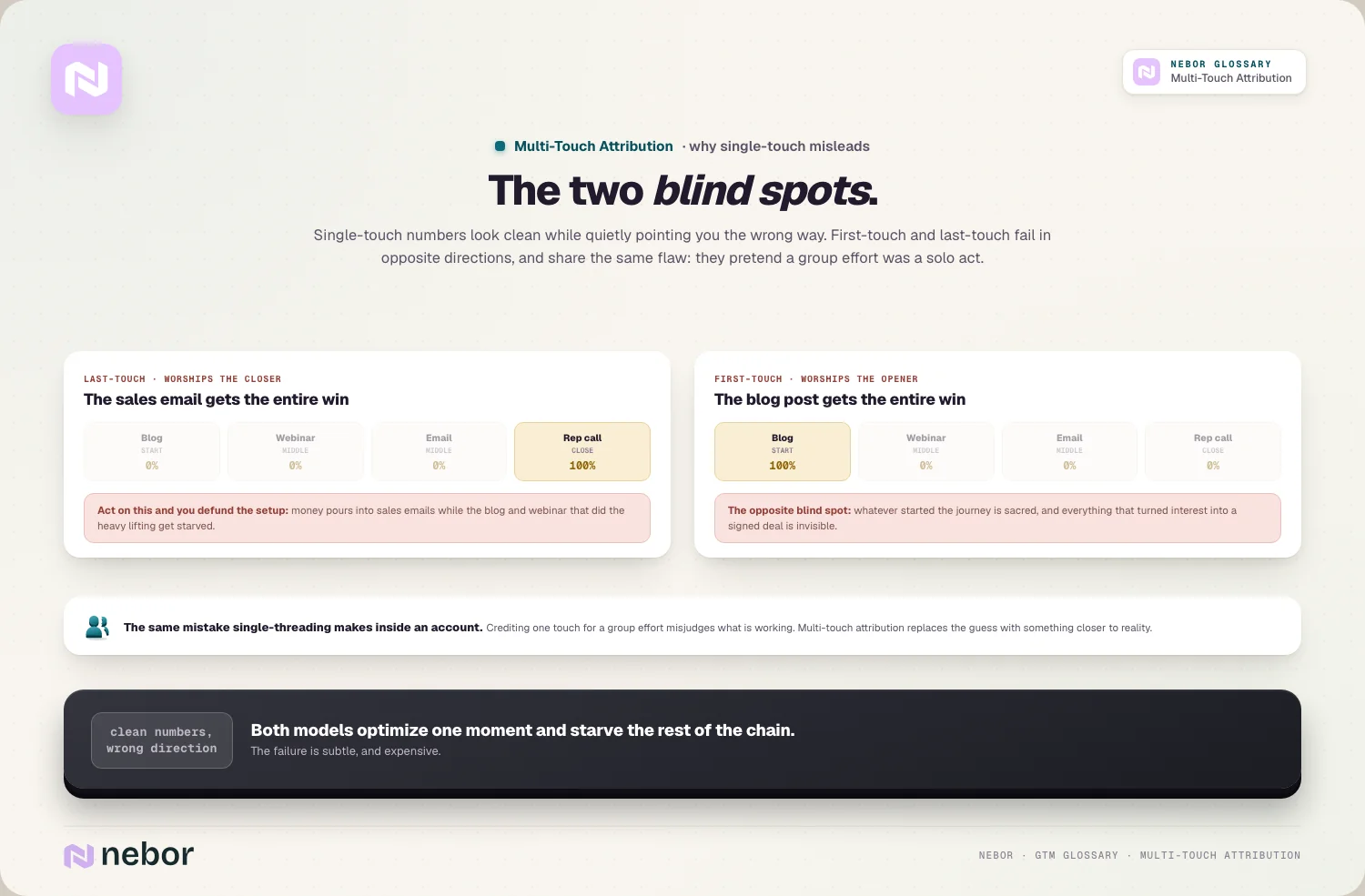
First-touch has the opposite blind spot, worshipping whatever started the journey and ignoring everything that turned interest into a signed deal.
Both models share the same flaw, pretending a group effort was a solo act, which is the same mistake that single-threading makes inside an account, the subject of multi-threading.
In a world where deals involve many channels and many people, crediting one touch is a guess dressed up as data. Multi-touch attribution exists to replace that guess with something closer to reality.
What are the main multi-touch attribution models to pick from?
There isn't one multi-touch model, there's a family of them, and they mostly differ in how they split the credit. Picking one is really a choice about what you believe matters.
The linear model is the simplest of the family, giving every touch in the journey equal credit, which is fair, easy to explain, and the most common starting point for B2B teams.
The U-shaped, or position-based, model weights the ends, giving big credit to the first touch and the touch that created the lead, with the rest shared among the middle.
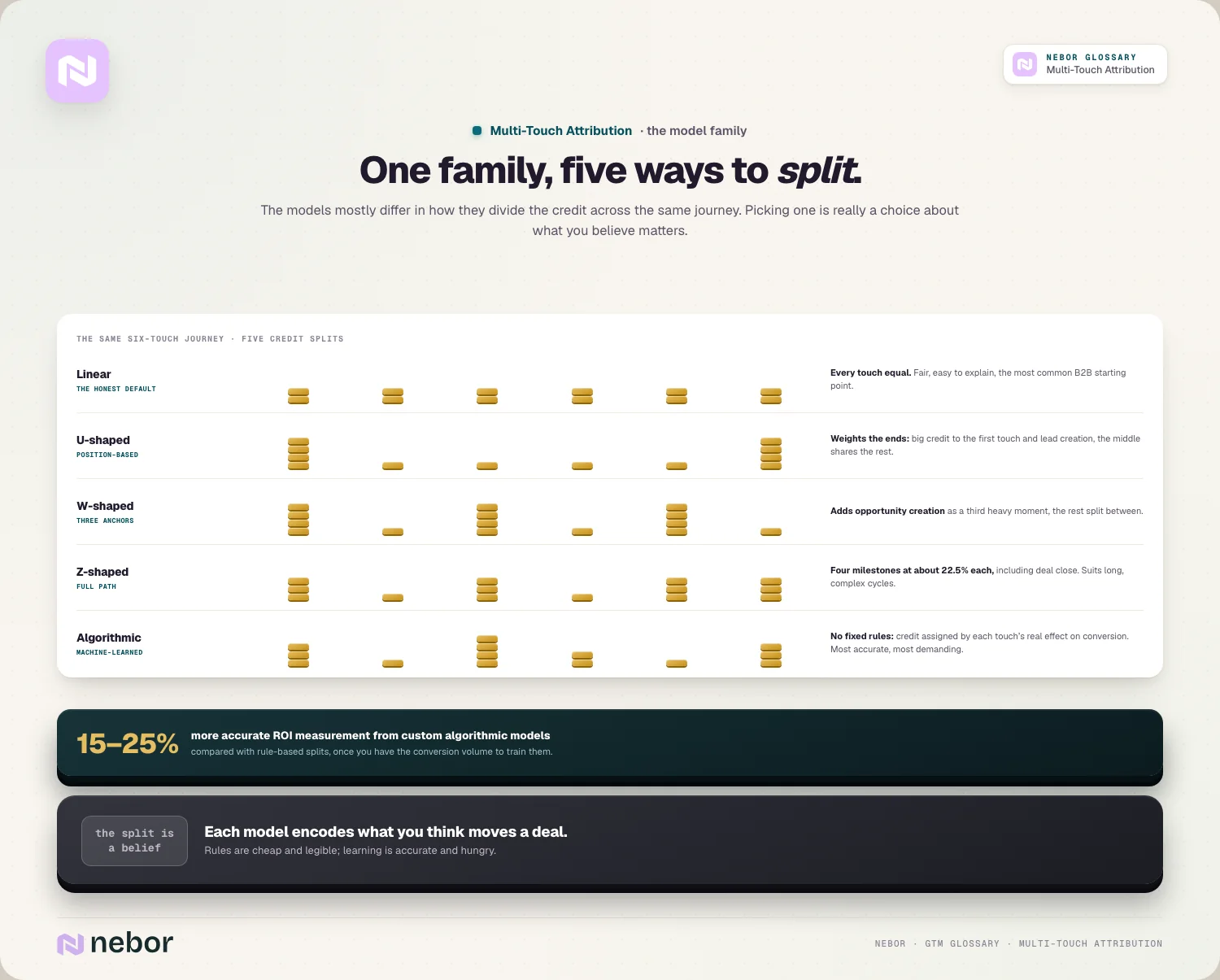
The W-shaped model adds a third anchor, putting heavy credit on first touch, lead creation, and the moment an opportunity is created, splitting the rest among the other touches.
The Z-shaped, or full-path, model goes further still. It adds deal close as a fourth milestone, giving about 22.5% each to four key moments and spreading the remainder, which suits long, complex sales cycles.
And then there's the algorithmic model, which drops fixed rules and uses machine learning to assign credit based on each touch's real effect on conversion, making it the most accurate and the most demanding to build.
So which attribution model should you use for your own pipeline?
The instinct is to chase the most sophisticated model, but that's usually the wrong way to choose. The right model depends on your sales cycle and your data instead of what sounds advanced.
If you're just starting, we point clients at the linear model as the default. It's honest about the fact that the whole journey mattered and it's easy for everyone to understand and trust.
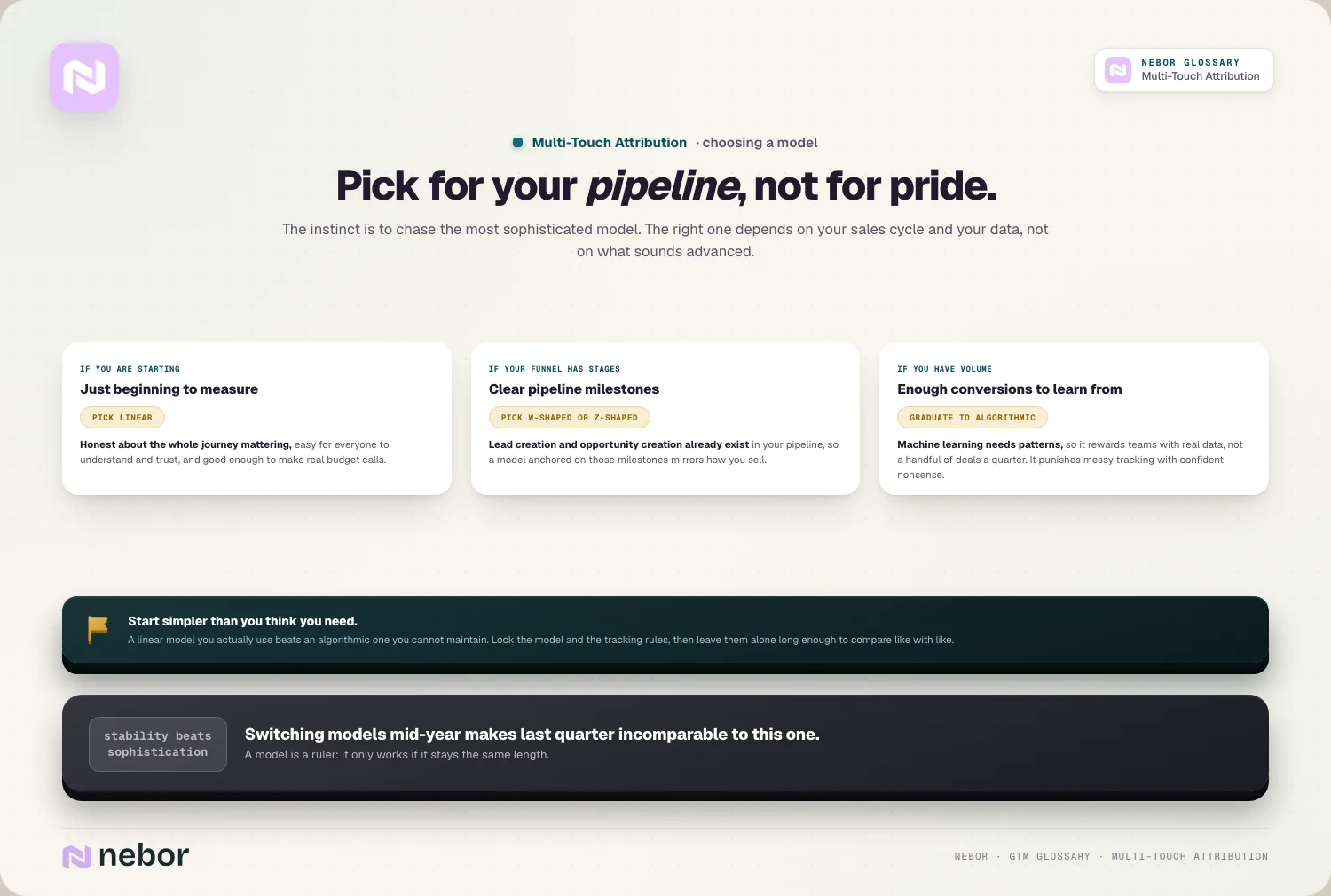
If your deals have clear stages, like lead creation and opportunity creation, a W-shaped or Z-shaped model fits better. It mirrors the milestones your pipeline already tracks.
The algorithmic model makes sense once you have real volume. Machine learning needs enough conversions to find patterns, so it rewards teams with a lot of data over those with a handful of deals a quarter.
The bigger principle is to start simpler than you think you need. A linear model you actually use beats an algorithmic one you can't maintain, and you can always graduate later.
How does attribution connect to the channels and motions you use?
Attribution isn't an abstract reporting exercise, it's the scoreboard for everything you do across channels. It only makes sense in the context of the outreach and marketing it measures.
Take multi-channel outreach as the clearest case, because the whole reason to send email, LinkedIn, and calls together is that they assist each other, and only multi-touch attribution can show that teamwork.
The same goes for demand generation work, because content, ads, and events rarely convert on their own, so judging each by last-click alone undervalues the ones that warm buyers up.
It's also how you defend the slow, compounding stuff. A blog rarely gets the closing click, but if attribution keeps showing it early in winning journeys, you have the evidence to keep investing in it.
This is why attribution belongs inside a broader go-to-market system instead of off to the side. It's the feedback loop that tells the whole engine which parts to feed.
Why is B2B attribution so much harder than the demos suggest?
B2B attribution carries a reputation for being painful, and in our experience that reputation is earned. A few features of B2B buying make it genuinely hard to pin down.
The long cycle comes first, because when a deal takes six or nine months and dozens of touches, stitching that whole path together accurately is a real data challenge.
The buying committee doubles the tangle, because several people from one account each have their own journey, so you're tracking a knot of paths instead of one.
The offline and dark influence hides from you entirely, like a Slack recommendation or a hallway chat, which is the heart of the dark funnel.
And data quality caps everything, because attribution is only as good as the tracking underneath it, and broken UTMs or missing fields corrupt the whole model unseen.
There's a fifth issue too, which is consistency over time. If you switch models or fix your tracking mid-year, last quarter's numbers stop matching this quarter's, and trends get muddy.
The fix is to lock your model and your tracking rules, then leave them alone long enough to compare like with like. Stability is worth more than constant tinkering when you're trying to read a trend.
None of this means attribution is useless. It means you should treat it as a strong directional signal instead of a precise audit, and pair it with judgment rather than trusting it blindly.
What about all the touches your attribution can never even see?
This deserves its own moment, because it's where teams either stay humble or fool themselves. A meaningful share of buyer influence simply never shows up in your tracking.
Someone hears about you on a podcast, reads a review, or gets a recommendation in a private community. None of that lands in your attribution tool, yet it can be the real reason a deal happened.
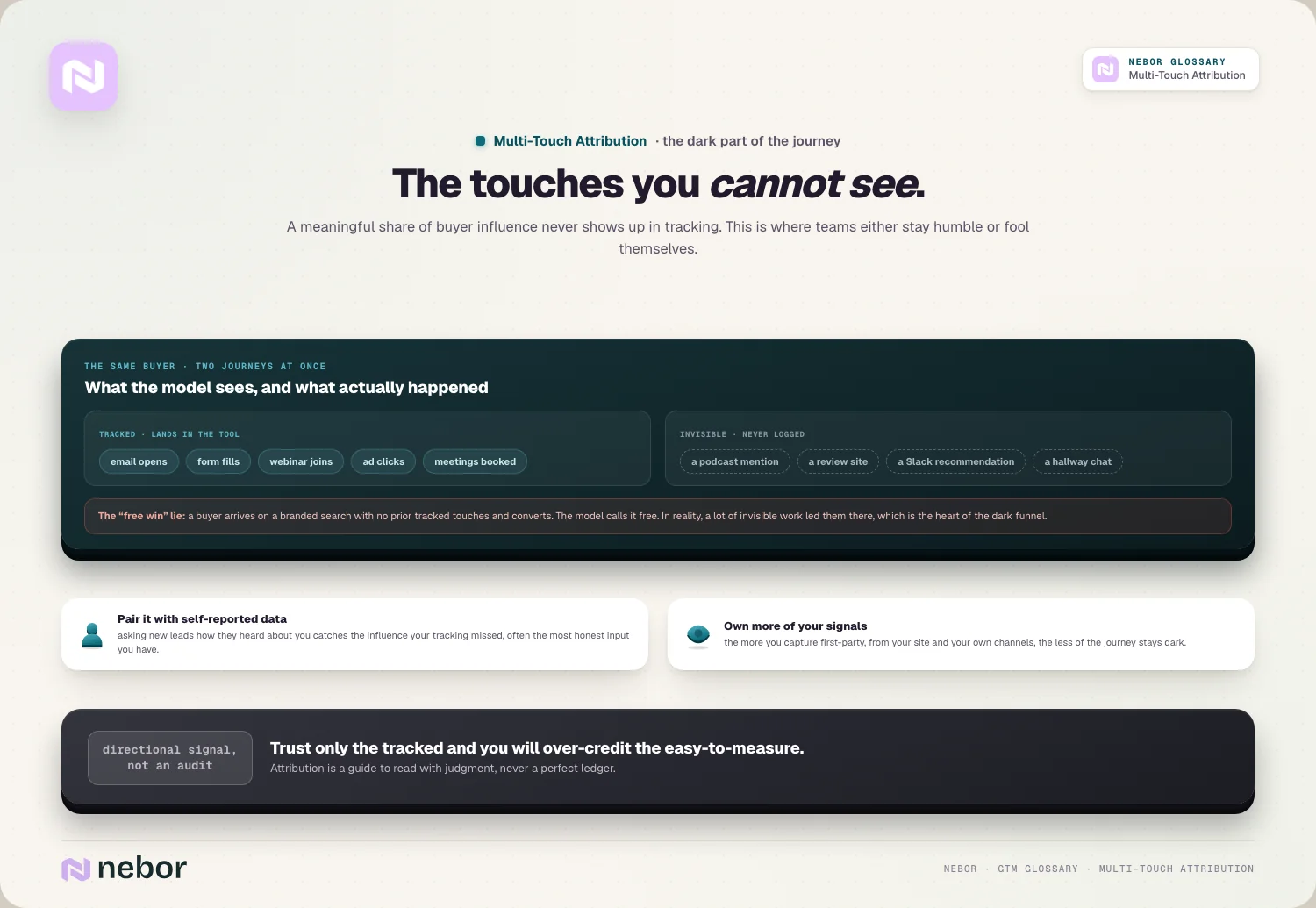
So when a buyer arrives and converts on a branded search with no prior tracked touches, the model calls it a free win. In reality, a lot of invisible work led them there.
The practical move is to combine attribution with self-reported data. Asking new leads how they heard about you catches influence your tracking missed, which is often the most honest input you have.
It also argues for owning your own signals. The more you capture through first-party data and tools like a website visitor tracking workflow, the less of the journey stays dark.
How do attribution and lead scoring work together in one loop?
People mix these up, so let's separate them clearly. Attribution and lead scoring both watch touches, but they answer different questions and point in opposite directions in time.
Attribution looks backward, because after a deal closes, it asks which touches deserve credit, so you can decide where to invest next.
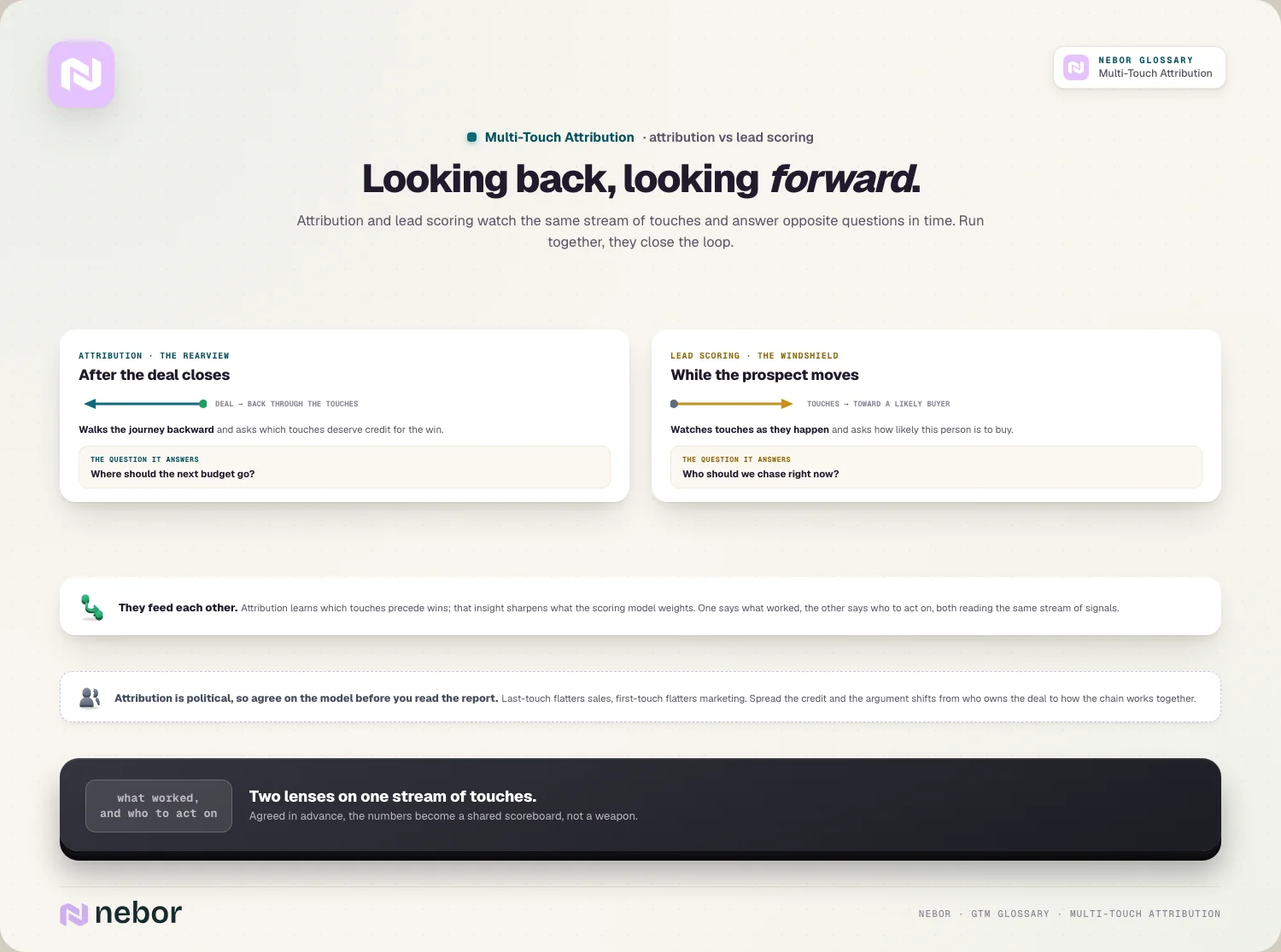
Lead scoring looks forward instead, watching a prospect's touches as they happen and asking how likely this person is to buy, so you can decide who to chase now.
The two feed each other neatly, because attribution tells you which touches tend to precede wins, and that insight can sharpen which actions your scoring model weights most heavily.
When you use them together, they close the loop. One tells you what worked, the other tells you who to act on, and both rely on capturing the same stream of buying signals cleanly.
How do you start with attribution without a giant data project?
The mistake teams make is treating attribution as a giant data project to be perfected before it's useful. You can get value far faster than that.
You start by tracking the touches you already capture well, like email opens, form fills, and meetings booked, because a partial picture beats no picture, and it surfaces patterns immediately.
A simple model comes first, almost always linear, and the discipline of using it to make one or two budget calls matters more than the math.
From there you improve the inputs over time, cleaning up your tracking, adding self-reported sourcing, and connecting the channels you use, the same kind of plumbing behind any effort to automate sales prospecting.
Only once that foundation holds should you reach for algorithmic models. They reward good data, and they punish messy data by giving you confident, wrong answers.
How do you keep attribution from starting an internal turf war?
Attribution is rarely just a math problem inside a company. It's also political, because the model you pick decides who gets credit, and credit is tied to budget and headcount.
A last-touch model tends to flatter sales, because reps usually own the closing touch. A first-touch model tends to flatter the top-of-funnel marketers who started the journey.
That's exactly why multi-touch attribution is healthier for the whole team. When everyone can see that the win took a chain of touches, the argument shifts from who owns the deal to how the chain works together.
It pairs naturally with an inbound-led outbound mindset, where marketing's signals and sales' follow-up are obviously two halves of one motion. Attribution that spreads credit makes that partnership visible instead of contested.
The practical advice is to agree on the model before you read the report. If both teams sign off on how credit is split in advance, the numbers become a shared scoreboard rather than a weapon.
What are the common multi-touch attribution mistakes to dodge?
Even teams that adopt multi-touch attribution manage to undercut it, usually in the same few ways we keep seeing. Knowing them helps you get real value instead of a false sense of precision.
Treating the output as exact truth tops the list, because attribution is directional, and acting like a 3% shift in credit is gospel leads to overconfident, jumpy decisions.
Ignoring the dark and offline touches comes next, because trusting only what's tracked means you systematically over-credit the easy-to-measure channels and starve the ones driving demand out of sight.
Confusing correlation with cause is the subtle statistical one, since a touch that shows up in many winning journeys might be a symptom of intent rather than a driver of it, and pairing attribution with intent data helps you read it correctly.
And there's over-engineering too early, because a complex model on thin or messy data produces confident nonsense, and a simple model on clean data beats it every time.
Why attribution is a directional read, and that's exactly enough
This loops back to where we started, because the reason multi-touch attribution exists is that confident, single-touch answers about what won a deal are usually wrong.
Multi-touch attribution makes you less wrong, replacing a flattering story about one heroic touch with a fuller, messier picture of the whole journey, and that picture leads to smarter spending.
But the goal isn't a perfect map. The goal is to stop overpaying for closers, stop starving the channels that set up wins, and stop crediting one touch for a job that took many.
When you hold it that way, attribution becomes what it should be, a steady, directional read on what moves buyers through the long, shared journey of a B2B deal, instead of a courtroom verdict on every dollar.
Share this post
Analytics
Marketing
Glossary
Related glossary items
Understanding the core GTM concepts




Ready to build your pipeline











