
In this post:
A great lead is worthless if it lands on the wrong desk or waits in a queue for a day. The work of generating it, the cost of acquiring it, all of it is wasted if the lead doesn't reach a rep who can act on it quickly.
Lead routing is what prevents that waste. It's the system that decides which rep gets each lead and how fast, so a good lead reaches the right person while their interest is still fresh instead of going cold in a pile.
Lead routing is the automated process of assigning each incoming lead to the right salesperson, team, or queue based on rules you define. It decides who owns a lead the moment it arrives, so nothing falls through the cracks.
Speed and fit both decide whether a lead converts. Research shows 78% of deals go to the first responder, so routing a lead to the right rep instantly is often the difference between winning and losing it.
TL;DR
Lead routing automatically assigns each incoming lead to the right rep, team, or queue based on rules, so leads reach someone who can act on them fast.
This is important because speed and fit drive conversion. The first responder wins most deals, so getting a lead to the right rep instantly is often what closes it.
It uses models like round-robin, territory, account-based, and score-based, often layered in priority order with a fallback.
The dependency underneath is your data, because without clean, enriched lead records, even perfect rules send leads to the wrong place.
What is lead routing, and what happens the moment a lead arrives?
Lead routing is the system that assigns each new lead to an owner automatically. The moment a lead comes in, routing decides who handles it.
It works entirely from rules you define. You set the logic, like who covers which territory or which accounts, and the routing engine applies it to every incoming lead without manual sorting.
It assigns an owner and alerts them at once. The lead gets written to a rep's name, and that rep gets an instant notification, so they know to act right away.
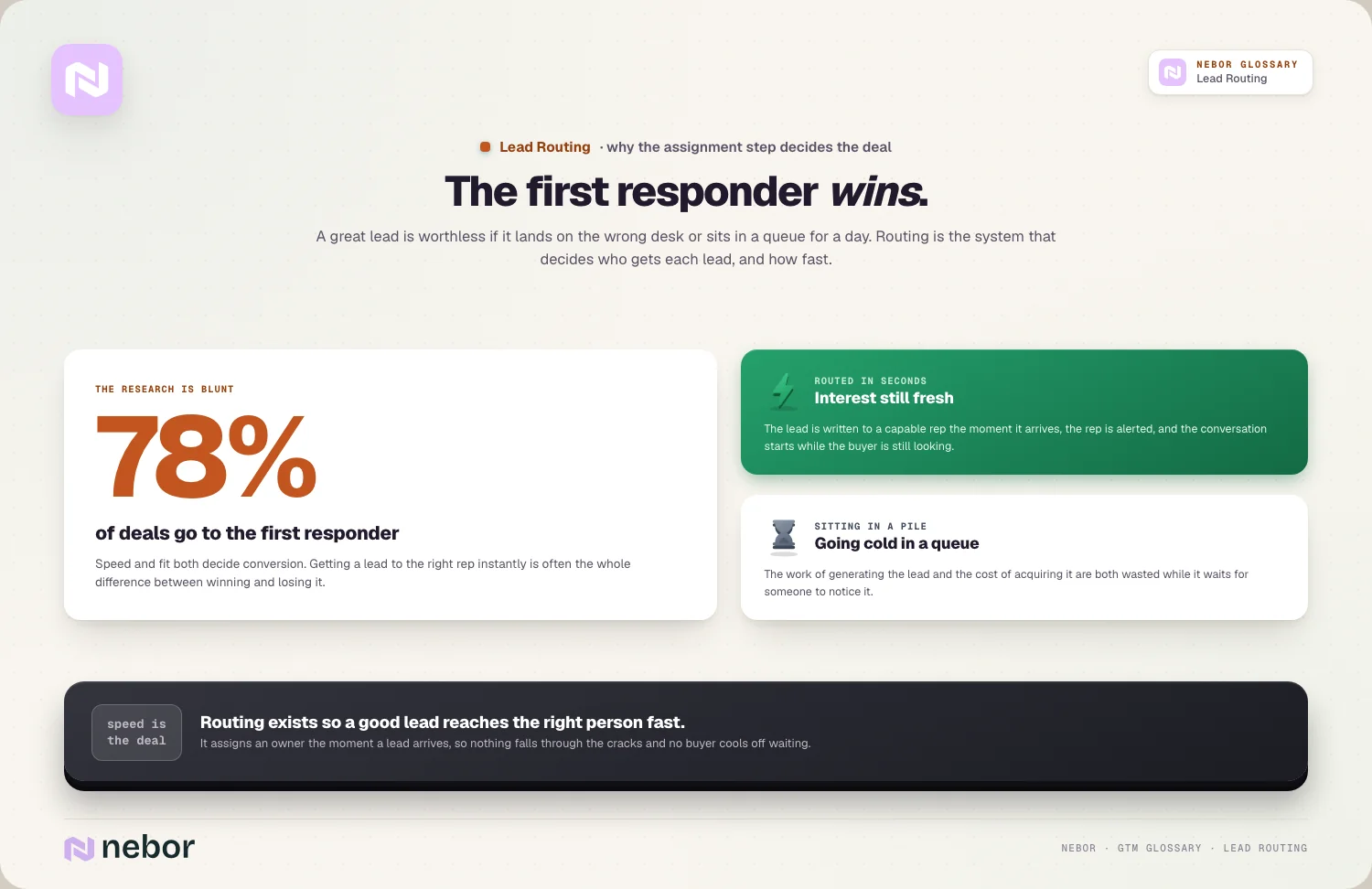
It often has a timer as well. Many setups start an SLA clock when a lead is assigned, and if the rep doesn't act in time, the lead re-routes to someone who will.
So lead routing works as the traffic control between lead capture and a rep. It makes sure every lead reaches the right person fast, and that handover is what turns a captured lead into a real conversation.
The reason it's automated comes down to volume. Sorting leads by hand works for a trickle, but breaks the moment leads arrive faster than a person can assign them, so routing has to be rule-driven.
Why does lead routing matter so much for your response speed?
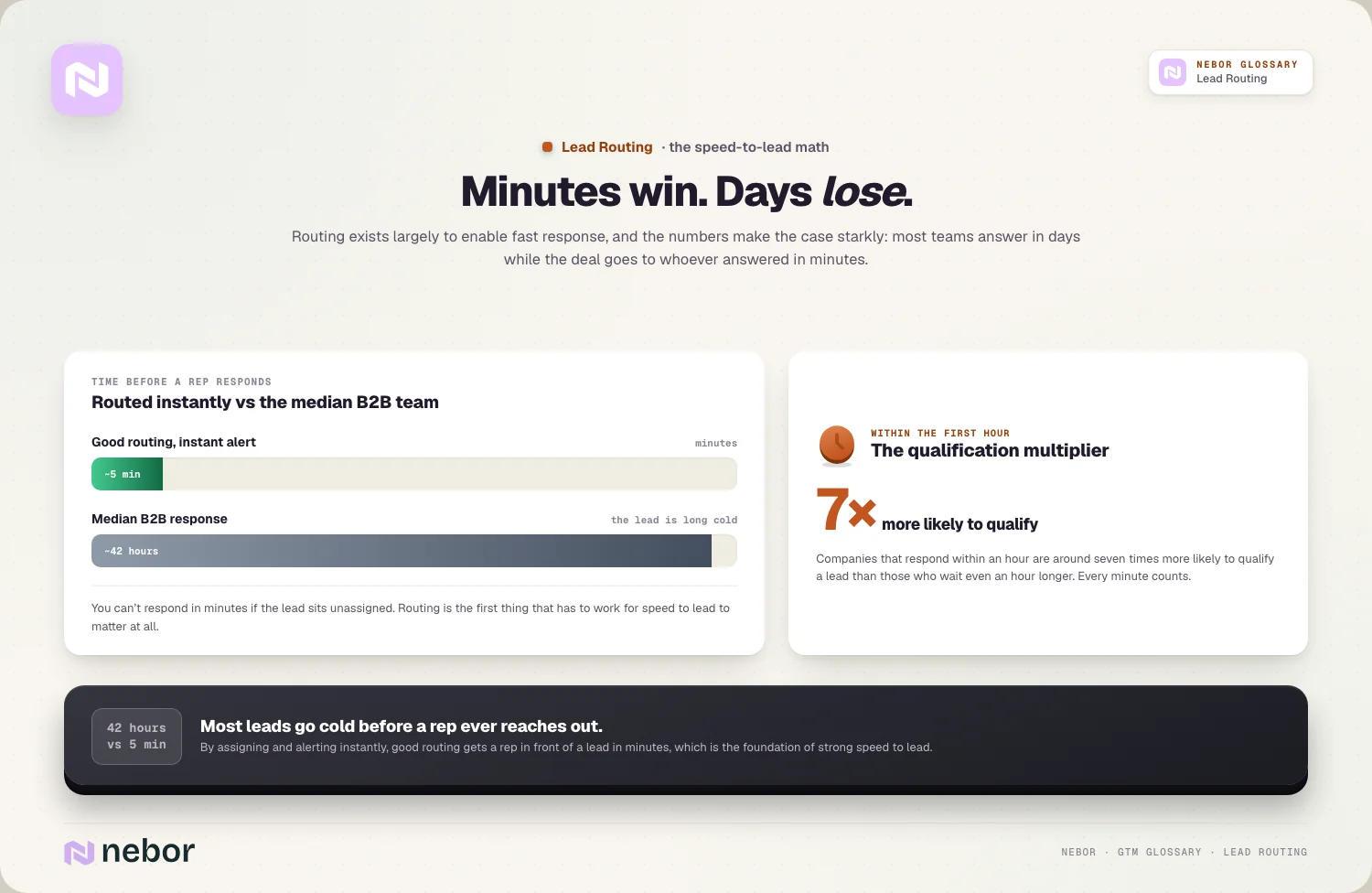
Routing exists largely to enable fast response, and the numbers make the case bluntly.
Speed decides more than almost anything else. Companies that respond within an hour are around 7 times more likely to qualify a lead than those who wait even an hour longer, so every minute counts.
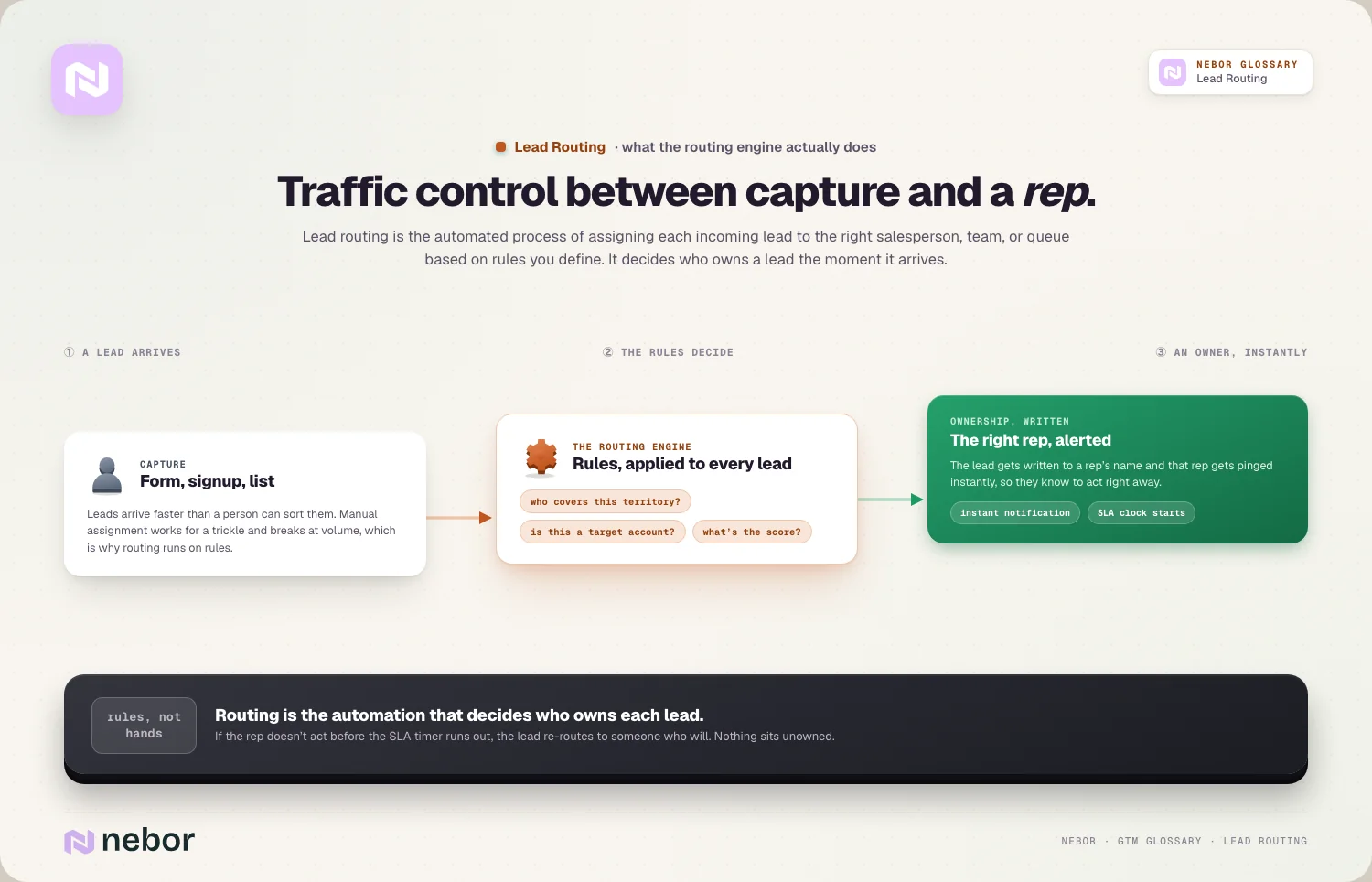
The typical team is far too slow. The median B2B response time is around 42 hours, which means most leads go cold before a rep ever reaches out.
Routing is what closes that response gap. By assigning and alerting instantly, good routing gets a rep in front of a lead in minutes, which is the foundation of strong speed to lead.
So routing is the machinery behind fast response. You can't respond in minutes if a lead waits unassigned, so routing is the first thing that has to work for speed to lead to matter.
What are the main lead routing models and how does each assign?
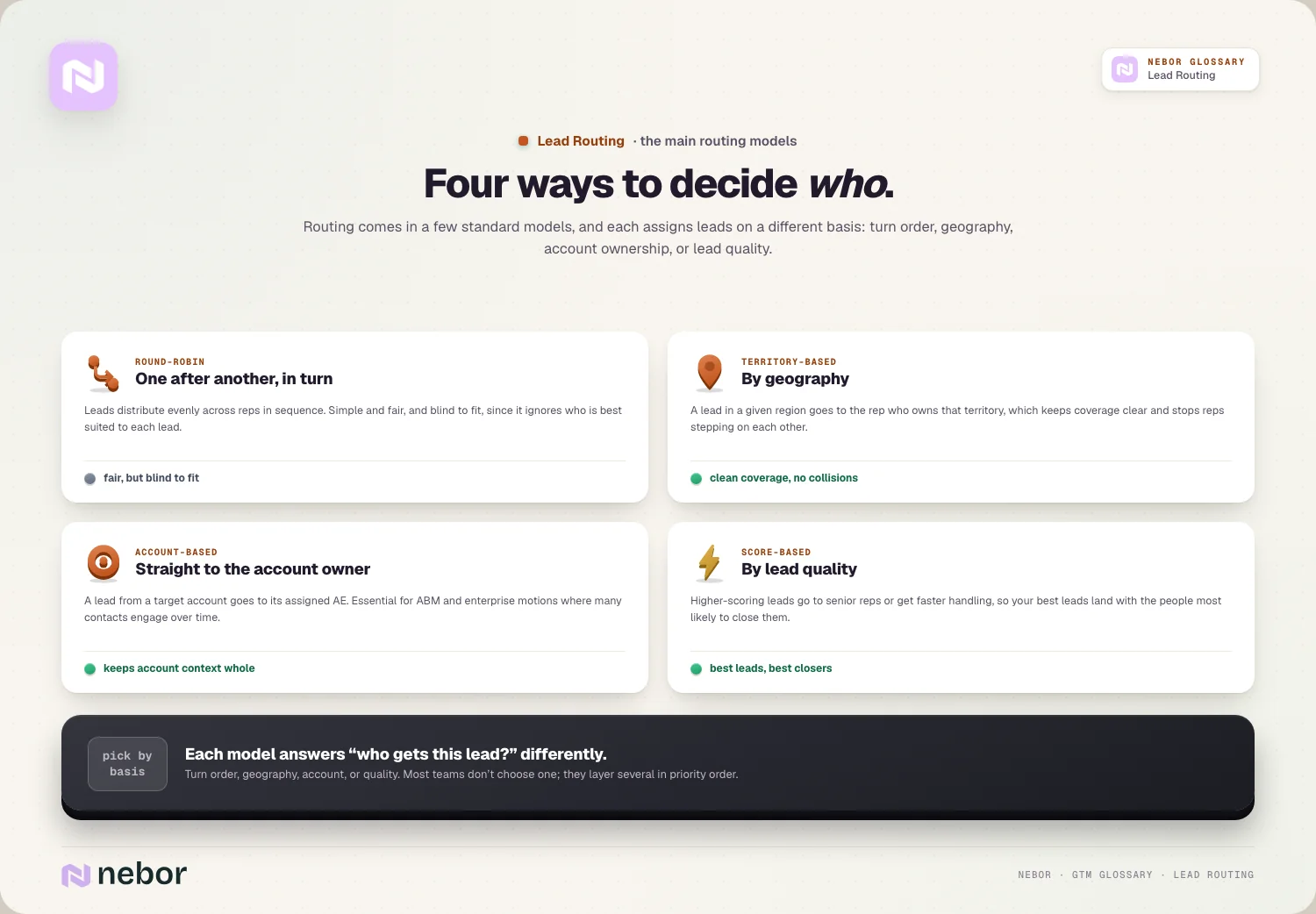
Routing comes in a few standard models, and the strongest setups we build combine them, because each assigns leads on a different basis.
Round-robin distributes leads evenly across the team. They go to reps one after another in turn, which is simple and fair, but blind to fit because it ignores who's best suited to each lead.
Territory-based routing follows the map of your regions instead. A lead in a given region goes to the rep who owns that territory, which keeps coverage clear and avoids reps stepping on each other.
Account-based routing follows the relationship with the account. A lead from a target account goes straight to the assigned account executive, which is essential for ABM and enterprise motions where many contacts engage over time.
Score-based routing follows the quality of the lead. Higher-scoring leads can go to senior reps or get faster handling, which sends your best leads to the people most likely to close them.
How do you combine routing models into one layered rule set?
Strong setups layer several models in priority order instead of picking one, and combining them is where routing gets powerful.
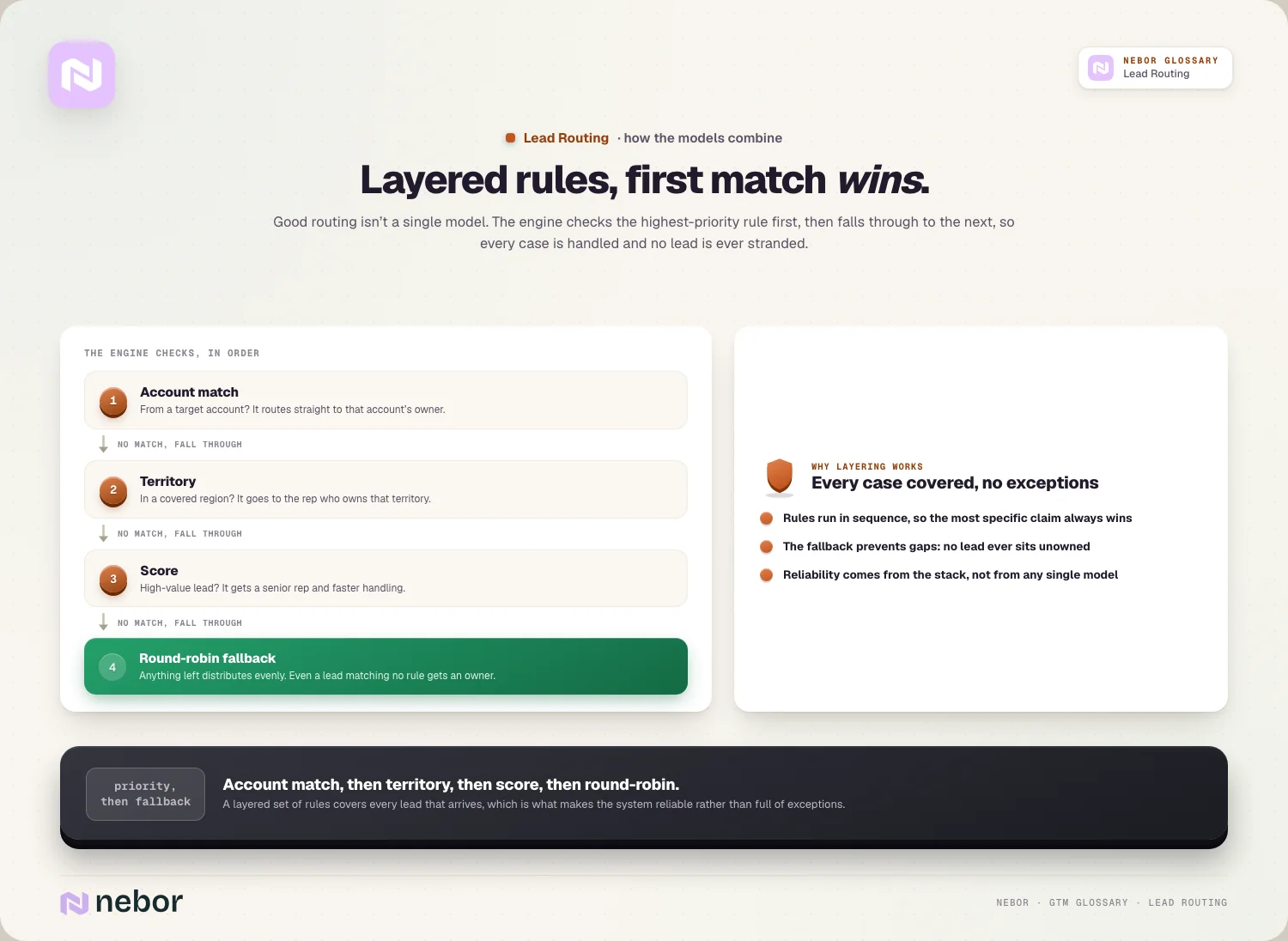
Rules apply in a set order of priority. The engine checks the highest-priority rule first, then falls through to the next, so a typical order is account match, then territory, then score, then round-robin as a fallback.
This layering handles every case that arrives. A lead from a target account routes to its owner, a lead in a territory routes to that rep, and anything left over distributes evenly, so no lead is ever stranded.
The fallback at the bottom prevents any gaps. Round-robin as the last rule ensures that even a lead matching no specific rule still gets assigned to someone rather than staying unowned.
So good routing is a layered set of rules instead of a single model. Applying them in priority with a fallback covers every lead, and that coverage is what makes the system reliable instead of full of exceptions.
Why is your data the real bottleneck in most routing systems?
A hard truth about routing, and one we keep proving in the setups we audit, is that the rules are rarely the problem. The data they read usually is.
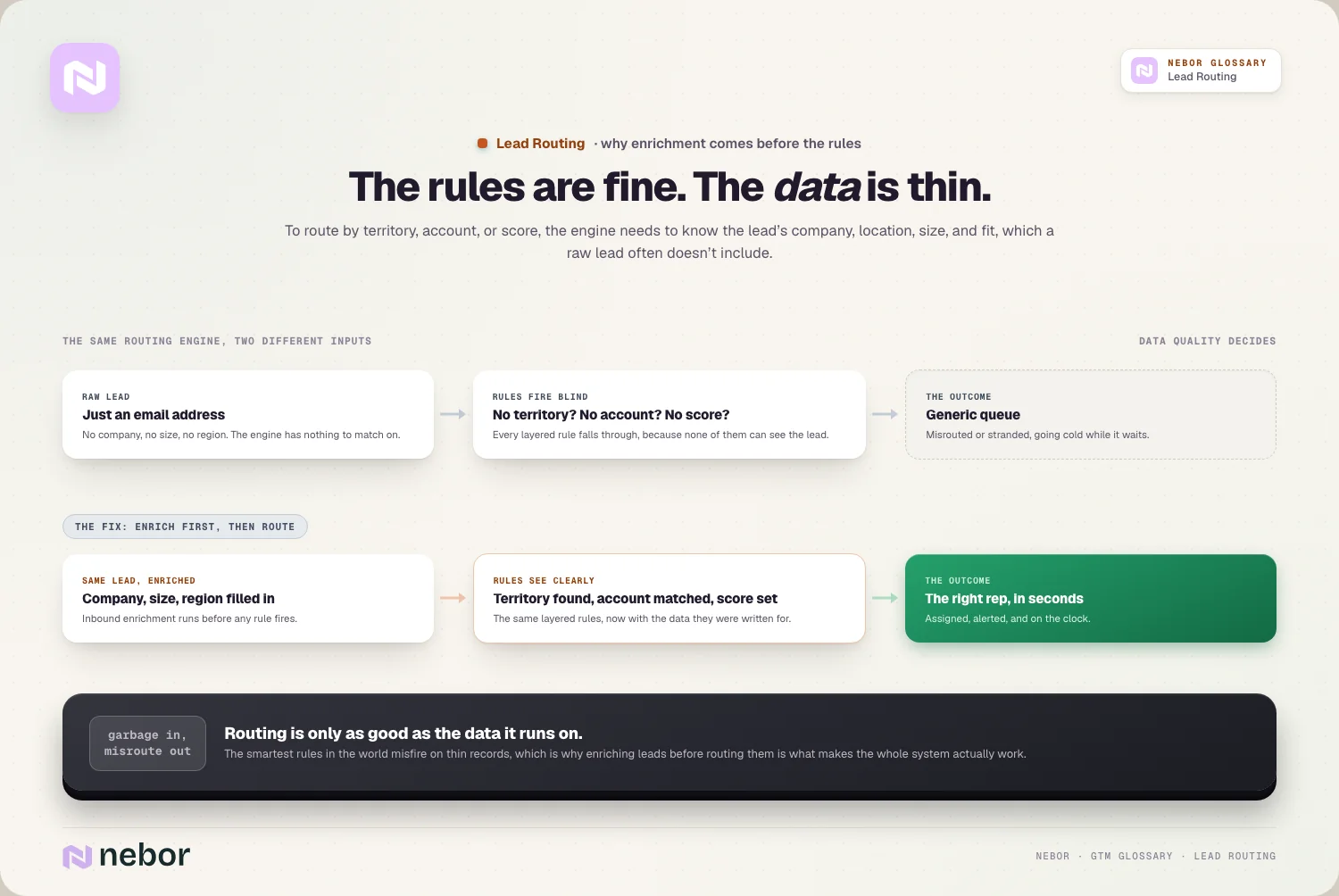
Routing rules need data to work at all. To route by territory, account, or score, the engine needs to know the lead's company, location, size, and fit, which a raw lead often doesn't include.
Thin data breaks the rules without warning. If a lead comes in with just an email, the routing engine can't tell which territory or account it belongs to, so it misroutes or falls to a generic queue.
Enrichment fixes it before the rules apply. Adding inbound enrichment up front fills in the company and firmographics, so routing has the data it needs to assign correctly.
So routing quality depends on data quality. The smartest rules in the world misfire on thin data, so enriching leads before routing them is what makes the whole system deliver.
How does routing connect to the scoring and qualification before it?
Routing works hand in hand with scoring and qualification, because they feed each other, and we tell clients to design the three as one flow.
Scoring informs where each lead should route. A lead's lead scoring result can decide where it goes, so high-value leads route to senior reps and lower ones to a nurture track.
Routing follows right behind the qualification step. Once a lead clears lead qualification, routing sends it to the right person to pursue, so qualification decides whether to route and scoring decides where.
Account scoring shapes the routing at the account level. Ranking accounts with account scoring lets you route leads from your best accounts to your strongest reps automatically.
So routing is the action step after scoring and qualification. They decide whether and how much a lead matters, and routing turns that judgment into a specific rep getting a specific lead to work.
Without routing, all of that careful judgment stalls. A perfectly scored and qualified lead still does nothing until someone owns it, so routing is the bridge that turns analysis into action.
How does routing handle fit as well as the speed of assignment?
Getting a lead to the right rep, and never just any rep, is where routing proves its value, because fit matters as much as speed.
Wrong-rep routing wastes leads that deserved better. Handing an enterprise lead to a rep who only closes small deals, as blind round-robin does, can squander a valuable opportunity.
Fit-based routing prevents exactly that kind of waste. Sending leads to reps suited to them, by segment, industry, or deal size, means each lead gets handled by someone equipped to win it.
It depends on knowing the lead well. Routing for fit needs to know whether a lead matches a given rep's strengths, which again traces back to enriched data and the ideal customer profile.
So routing is about matching as much as speed. Getting a lead to a rep who can truly close it is as important as getting it there fast, and good routing does both.
How does routing fit into the wider automated system around it?
Lead routing operates as one step in a larger automated flow, connecting to everything around it.
It's part of the wider orchestration layer. Routing is one piece of broader workflow orchestration, where capture, enrichment, scoring, routing, and follow-up work as one connected flow.
It leans on automation under the hood. Assigning and alerting instantly is exactly the kind of work you can automate sales prospecting around, so leads route in seconds without anyone sorting them.
It depends on clean records just as much. Routing writes ownership into your CRM, so good CRM hygiene keeps assignments accurate rather than scattered or duplicated.
So routing is one link in a chain that starts at capture and ends at a conversation. It works best as part of a connected system instead of a bolt-on, woven into the broader flow.
What does a routing flow look like from capture to conversation?
It helps to see the steps a lead moves through, because routing is a sequence that finishes in seconds.
A lead comes in at the top. Someone fills a form, signs up, or gets captured, and the routing engine picks it up the instant it arrives.
Enrichment fills in the gaps right after that. Before any rules apply, the lead gets enriched with company, size, and location, so the engine has the data it needs to decide.
The rules then apply in their order. The engine checks account match, then territory, then score, then round-robin, and writes the lead to the first matching rep's name.
The rep gets alerted and put on the clock. An instant notification goes out and an SLA clock starts, so the rep knows to act and the lead re-routes if they don't.
So a routing flow is capture, enrich, apply rules, assign, alert, and time. Each step takes moments, which is how a lead can go from submission to an engaged rep in minutes.
How does routing differ from the broader sales automation category?
Routing is often bundled with broader automation, but it's one specific function inside that category.
Sales automation is the wide umbrella category. It covers everything from sequencing emails to logging activity, of which routing is one focused piece.
Routing is the assignment step alone within it. It does one job well, deciding who owns each lead, instead of handling the whole sales process.
The two work together without stepping on each other. Routing assigns the lead, then automation handles the follow-up sequence and tracking, so they complement instead of compete.
So routing is a specialized slice of sales automation. It's the part that answers who gets this lead, which then hands off to the rest of the automated motion.
How do you measure whether your lead routing is genuinely working?
Measuring routing tells you whether it's paying off, and the metrics that matter focus on speed and accuracy.
Response time is the headline number to watch. How fast a routed lead gets a rep's attention shows whether routing is delivering the speed it's meant to enable.
Routing accuracy matters just as much as speed. What share of leads land with the right rep the first time, without manual reassignment, shows whether your rules and data are sound.
Conversion is what ties the whole picture together. Watching whether routed leads convert at a healthy conversion rate shows whether getting them to the right rep fast is truly paying off.
So measure routing by speed, accuracy, and conversion together. Fast routing to the wrong rep or accurate routing that's slow both underperform, so the full picture is what tells you it's working.
What are the common mistakes teams make with their lead routing?
Lead routing goes wrong in a few predictable ways, and in our experience the same short list covers most broken setups. Avoiding them keeps leads flowing to the right reps fast.
Routing on thin data breaks the rules from the start, because rules that apply before enrichment misassign leads, so skipping the data step undermines even well-designed routing.
Blind round-robin wastes your best leads, because distributing every lead evenly regardless of fit hands valuable opportunities to reps who can't close them.
Having no fallback or SLA lets leads vanish, because without a catch-all rule and a re-route timer, leads that match no rule or go untouched simply disappear into a queue.
And set-and-forget drifts into misrouting, because territories, teams, and segments change, so rules that aren't updated fall out of sync over time.
Why the first minutes of a lead's life decide most of its value
A lead is only as good as how fast it reaches the right rep. The first responder wins most deals, so routing instantly to a capable rep is often what decides whether a lead converts.
The deeper point is that routing balances speed and fit. Getting a lead to someone fast is half of it, and getting it to someone equipped to win it is the other half, and layered rules beat any single model at doing both.
The honest caveat is that routing lives or dies on data. The smartest rules misfire on thin records, so enriching leads before the rules apply is what makes routing deliver.
So if good leads keep going cold or landing on the wrong desks, routing is usually the gap. Building a layered, data-driven routing system that assigns every lead to the right rep in seconds is one of the highest-return pieces of a modern go-to-market system.
Deel dit bericht
CRM
Automation
RevOps
Begrippenlijst
Gerelateerde begrippen
De basis GTM-concepten begrijpen


Klaar om je pipeline te bouwen