

In this post:
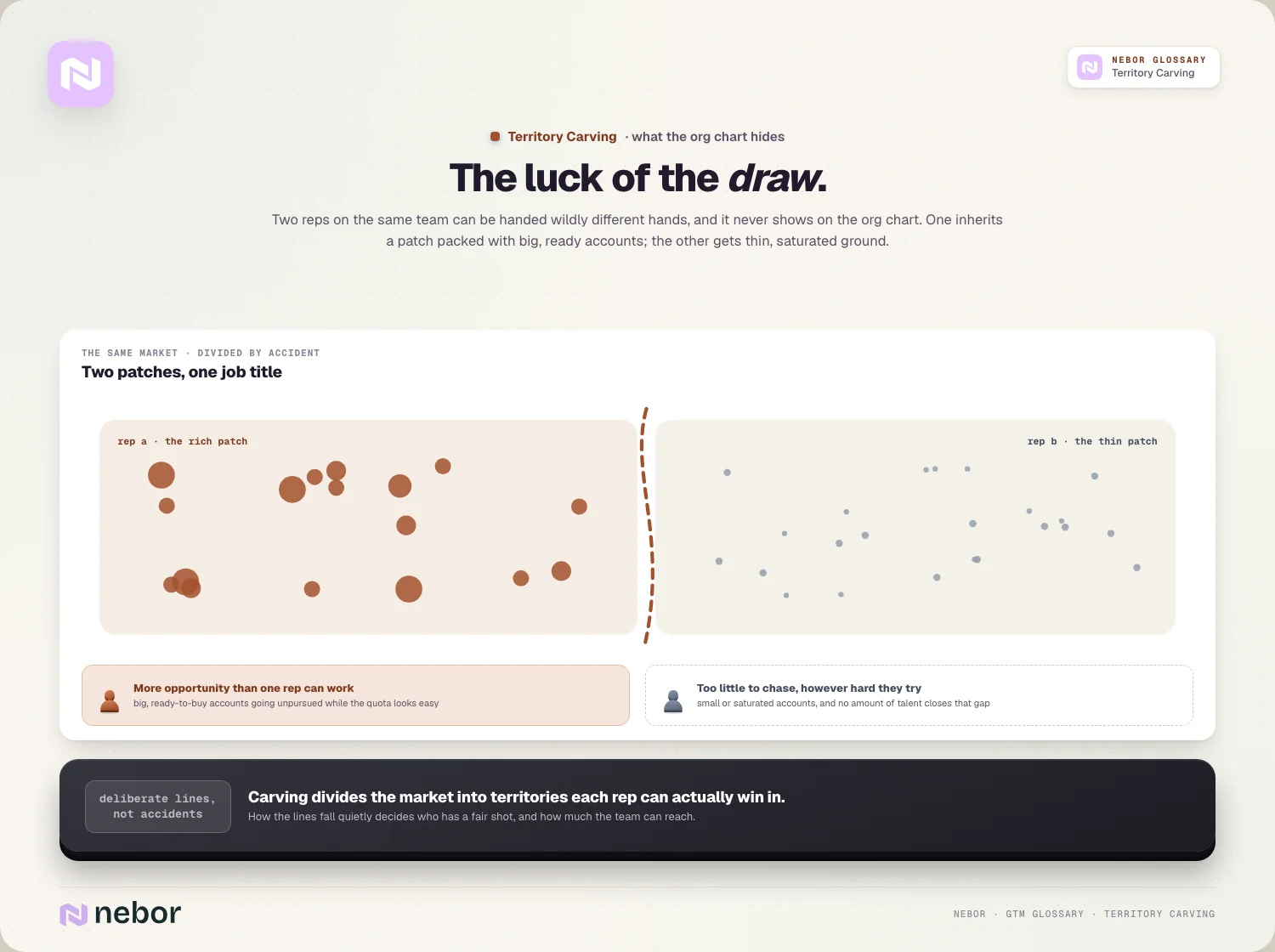
Two reps on the same team can be given wildly different hands to play, and it rarely shows up on the org chart. One inherits a region packed with big, ready-to-buy accounts, while the other gets a thin patch of small or saturated ones, and no amount of talent closes that gap.
How a company divides its market among reps decides, long before anyone makes a call, who has a fair shot and how much revenue the whole team can realistically reach.
Territory carving is the act of making those divisions deliberately instead of by accident. It's how a company splits its market into territories and assigns them to reps, and doing it well means every rep gets a fair, workable share of the opportunity instead of the luck of the draw.
Territory carving is the process of dividing a company's total market into defined sales territories and assigning them to reps, ideally so that each territory holds a fair and balanced amount of revenue opportunity. It's the one-time design act that sets up how the whole sales team covers the market.
It matters so much because unbalanced territories waste both revenue and talent. When some reps are handed far more opportunity than others, coverage gets lopsided and quotas become unfair, so the company leaves money on the table in the thin territories while overloading the rich ones.
TL;DR
Territory carving is the process of dividing a company's market into sales territories and assigning them to reps, so each one holds a fair share of opportunity.
The goal is balanced opportunity rather than equal account counts, because fairness comes from giving reps comparable revenue potential instead of the same number of accounts.
Getting it right lifts productivity and morale, while unbalanced territories waste revenue in the thin ones and overload the rich ones.
It's a design decision that needs ongoing maintenance, because markets shift and territories that were balanced at launch drift out of balance over time.
What territory carving involves when a company actually does it
Territory carving is the exercise of taking a company's addressable market and splitting it into distinct chunks that individual reps or teams will own. Each territory becomes a defined slice, drawn by geography, industry, account size, or a combination, and each rep owns the accounts inside theirs.
The core of the work is deciding where the lines fall and who gets what. A company weighs how to group accounts so that each resulting territory is a sensible, coverable unit, then assigns those units to reps in a way that gives each a workable book of business.
Done deliberately, this turns a chaotic pile of accounts into an organized coverage model. Instead of reps overlapping, competing, or leaving gaps, territory carving gives everyone a clear domain, so the whole market gets covered without confusion about who owns which accounts.
Why balancing opportunity beats simply dividing accounts equally
The most important principle in territory carving is that fairness comes from balancing opportunity instead of from handing every rep the same number of accounts.
A territory with two hundred tiny, saturated accounts holds far less potential than one with fifty large, growing ones, so equal counts are often deeply unequal.
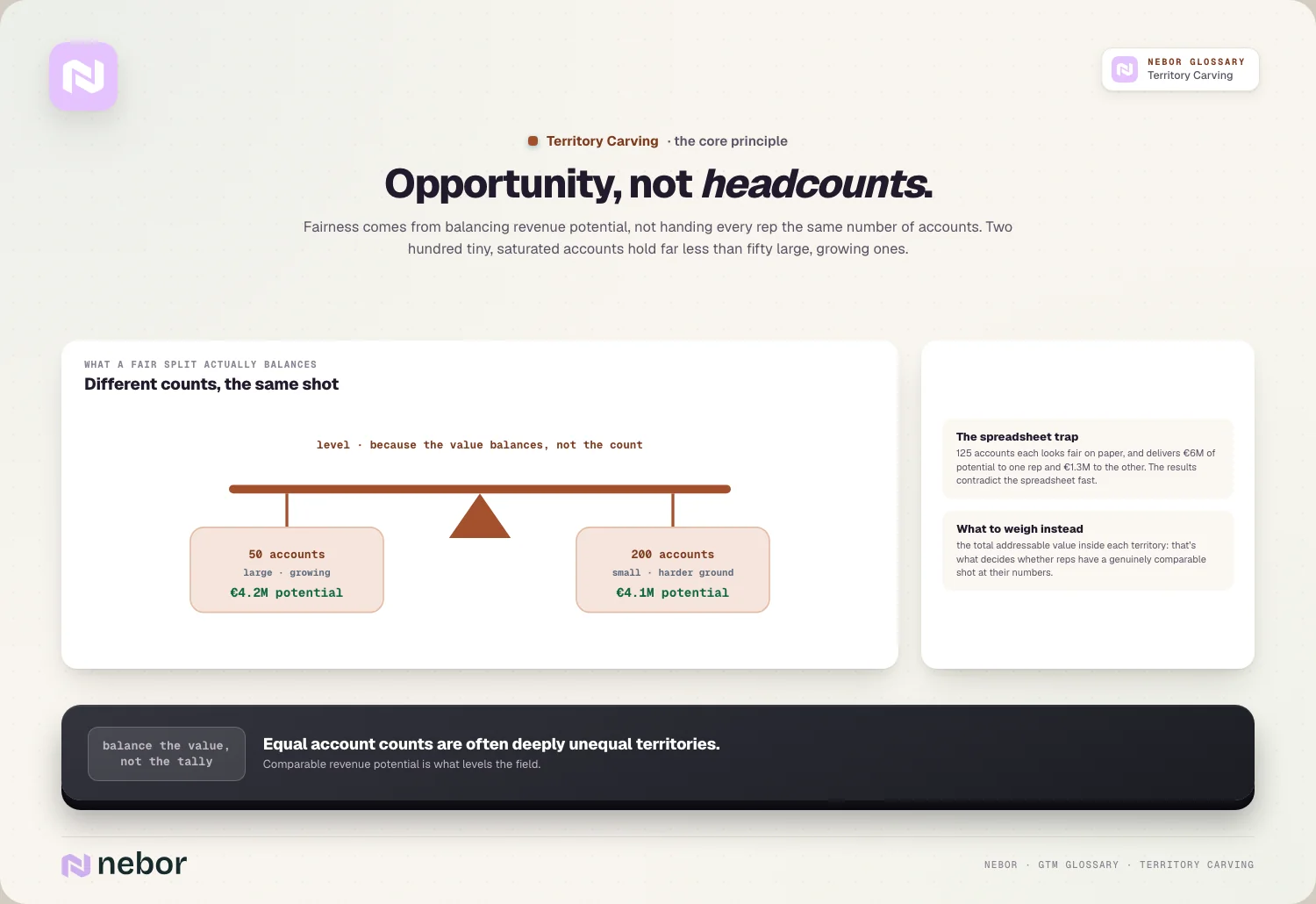
What needs to be balanced is the revenue potential each territory contains. Weighing the total addressable value inside a territory, instead of the raw account count, is what determines whether reps have a truly comparable shot at hitting their numbers.
This distinction is where most carving succeeds or fails. A company that splits its accounts evenly by number can still end up with wildly unfair territories, while one that balances by opportunity gives its reps a level playing field even when the account counts differ.
Why unbalanced territories cost a company real revenue every quarter
Poorly balanced territories don't just feel unfair, they measurably drain revenue in ways that are easy to miss. When one rep is overloaded with more opportunity than they can work, deals go unpursued in that territory, while a rep in a thin territory has too little to chase no matter how hard they try.
The lost revenue hides on both sides of the imbalance. The rich territory leaves money on the table because a single rep can't cover it all, and the poor one underperforms because there isn't enough there, so the company loses at both ends with no single obvious failure to blame.
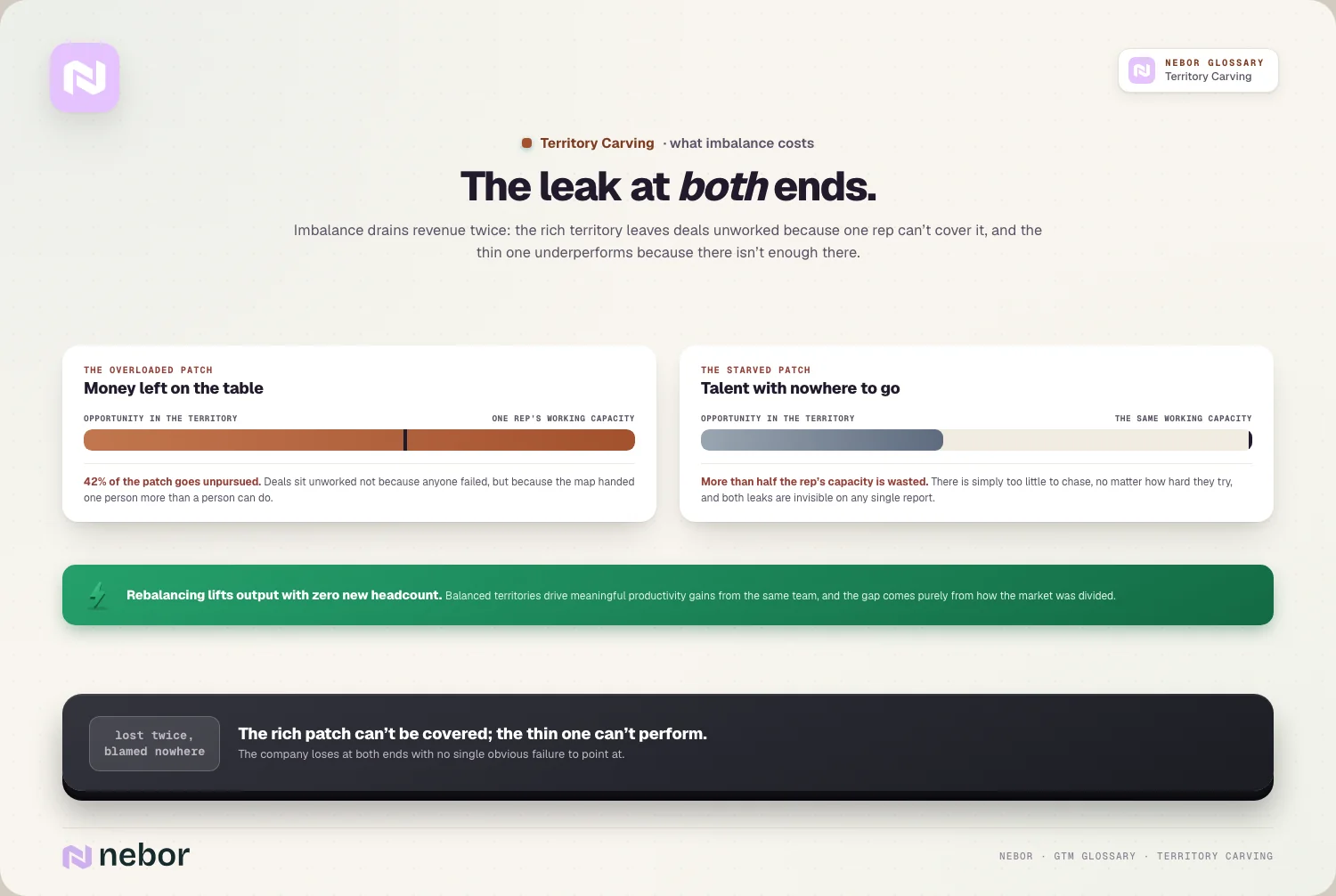
The scale of this waste is larger than most teams assume. Balanced territories can drive meaningful productivity gains without adding headcount, which is the flip side of how much unbalanced ones cost without anyone noticing, and that gap comes purely from how the market was divided.
How companies tend to draw the lines between their sales territories
Geography is the oldest and simplest basis for carving, where each rep owns a region and covers the accounts within it. It's easy to understand and administer, but on its own it often produces unbalanced territories, because some regions naturally hold far more opportunity than others.
Other methods slice the market along different dimensions entirely. A company might carve by industry, so reps develop deep expertise in a vertical, or by account size, so different reps handle enterprise and smaller accounts, each of which suits a different kind of selling.
The strongest carving usually combines methods instead of relying on one. Pairing geography with account size, or industry with revenue potential, lets a company balance workload and coverage in ways a single dimension can't, adding both fairness and flexibility to the division.
Why good territory carving has become a data-driven exercise
Modern territory carving relies far more on data than the gut-feel line-drawing of the past, and in our experience that shift is what separates fair maps from lucky ones.
Rather than splitting a map by eye, companies now weigh metrics like market share, industry trends, and the size and potential of the customers in each area to draw lines that are both fair and rich with opportunity.
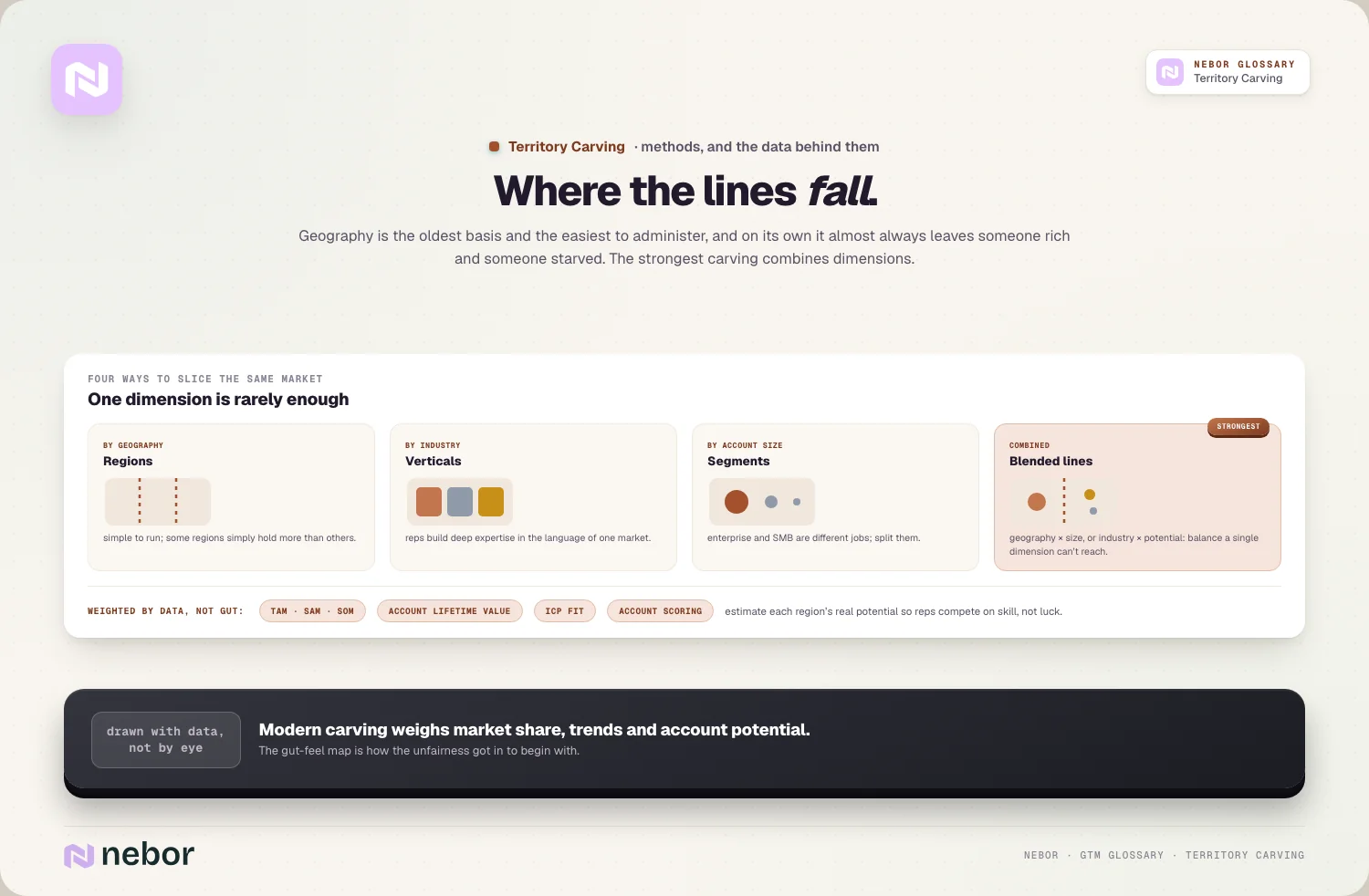
The data is what makes true balance possible in the first place. Estimating the revenue potential of each account and region, drawing on your TAM, SAM, and SOM and the lifetime value of the accounts within it, lets a company weight territories by opportunity instead of guessing.
This is also where signals sharpen the design. Weighting territories by real indicators of potential, including which accounts fit your ideal customer profile and how they rank in account scoring, produces divisions with genuinely comparable opportunity so reps compete on skill instead of luck.
How territory carving connects directly to quota fairness for reps
Territory carving and quota setting are tightly linked, because a rep's quota only makes sense against the opportunity in their territory. Assigning the same quota to reps with very different territories is a recipe for unfairness, so the carving has to come first and the quotas follow the opportunity it distributes.
When territories are balanced, quotas can be fair and motivating instead of arbitrary, and each rep can carry sensible pipeline coverage. A rep with real potential can be given a stretching but achievable number, whereas one in a thin territory handed the same quota is set up to fail.
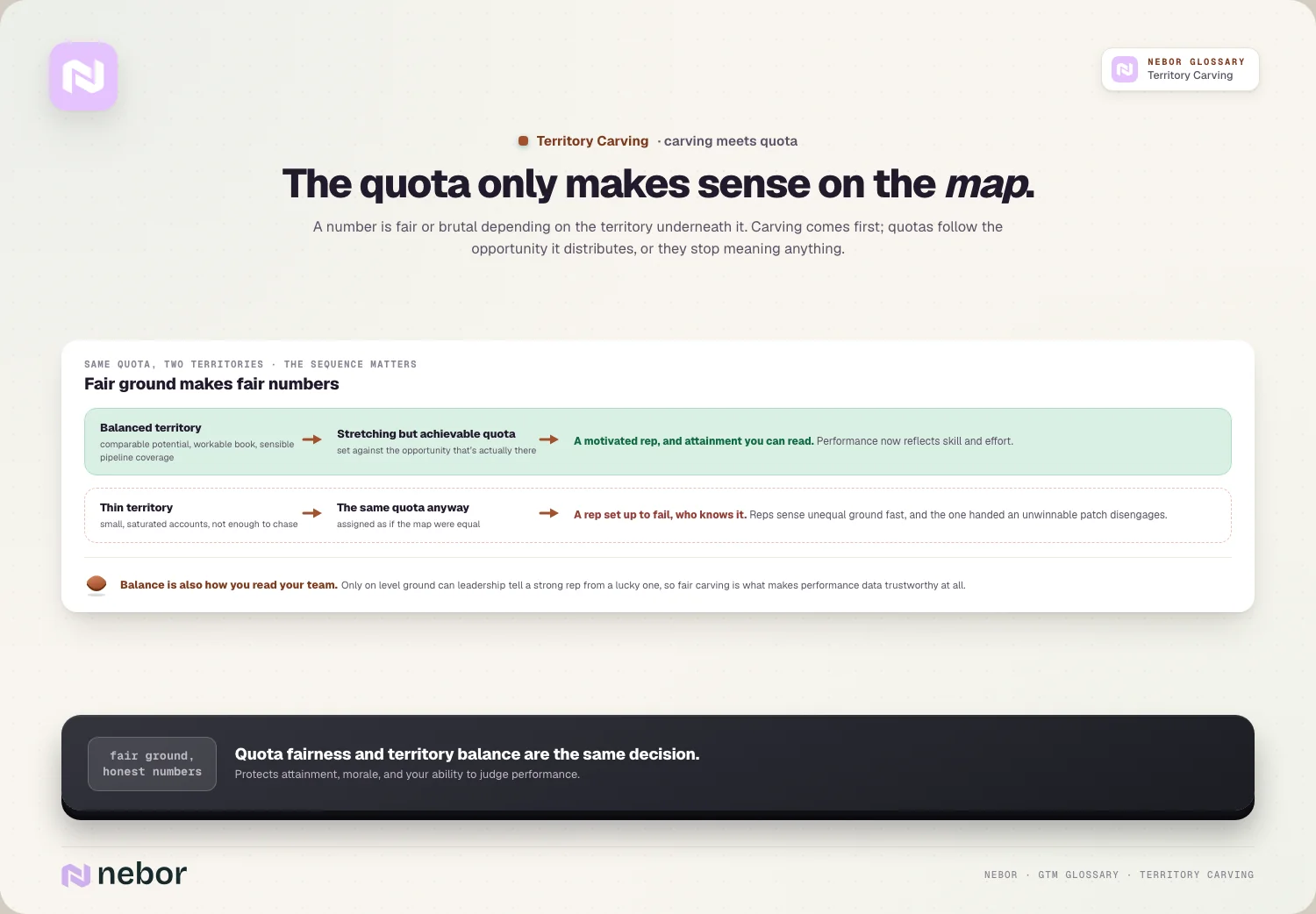
This connection is why carving affects morale as much as revenue. Reps quickly sense when territories are unequal, and a rep who believes they were handed an unwinnable patch disengages, so fair carving protects both quota attainment and the team's motivation to chase it.
Why territory carving is a design act that needs ongoing upkeep
Carving a market is a one-time design decision, but the balance it creates doesn't last on its own, because markets never stay still. Your accounts grow, shrink, and change hands, new companies appear, and industries shift, so territories that were balanced at launch gradually drift out of balance over time.
We tell clients that carving is only the first half of the job, with ongoing management being the second. The initial design divides the market and assigns reps, but keeping those territories fair requires monitoring them and rebalancing as conditions change, instead of treating the original lines as permanent.
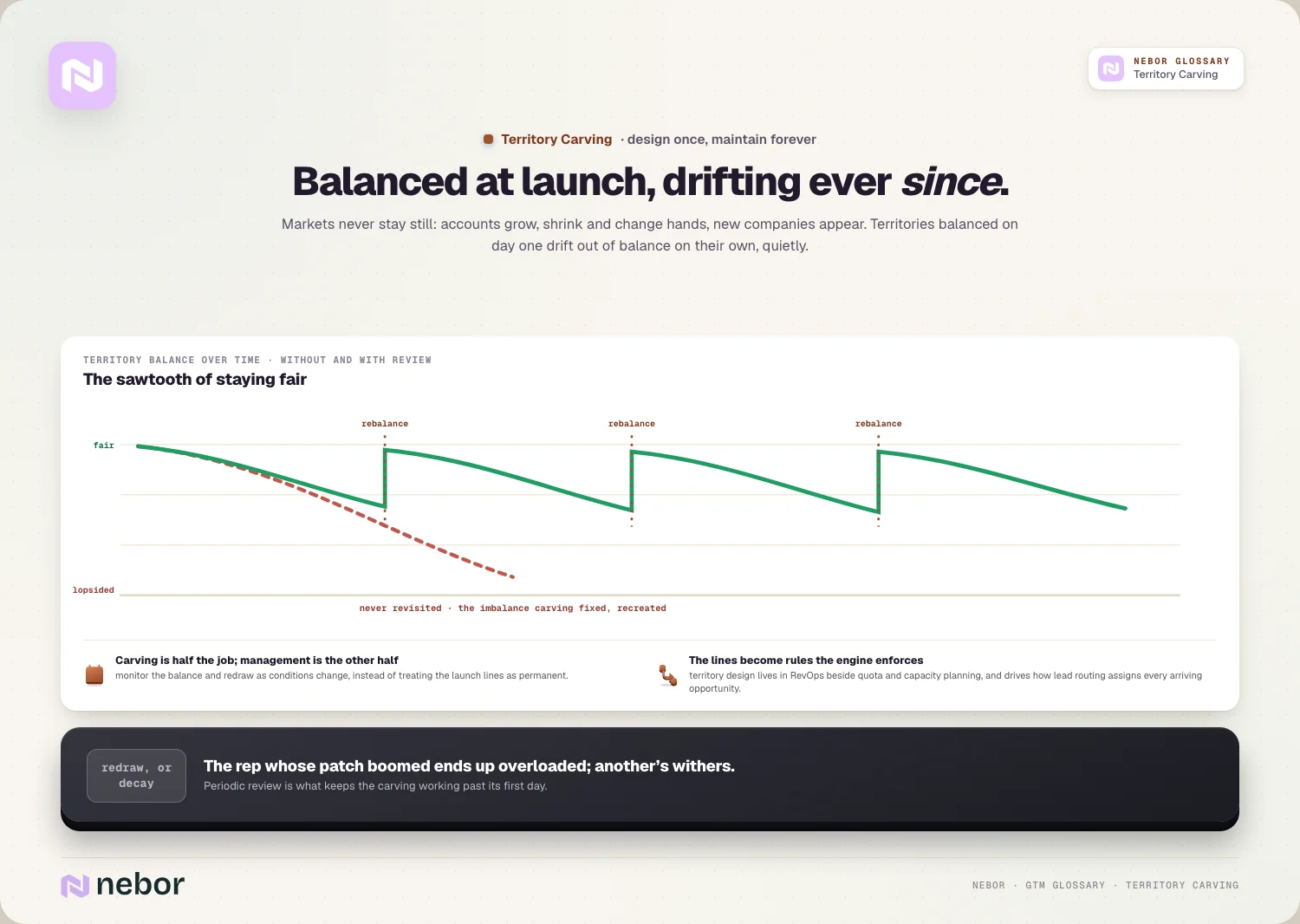
Companies that skip the maintenance slowly recreate the very imbalance carving was meant to fix. Without periodic review, the rep whose territory happened to boom ends up over-rewarded and overloaded while another's withers, so the discipline of revisiting the design is what keeps carving working past its first day.
How territory carving fits within your broader revenue operations
Territory carving is one of the planning responsibilities that usually lives inside the revenue operations function, because it requires the data, tooling, and cross-functional view that RevOps provides. It belongs alongside quota setting and capacity planning as part of designing how the go-to-market motion is structured.
It also depends on and feeds the systems behind daily selling. Clean account data is what makes accurate carving possible, and once territories are set, they drive how lead routing assigns incoming opportunities, so the territory design becomes a rule the routing engine enforces every time a lead arrives.
Seen this way, carving is less a standalone task than a foundational input to the whole engine. The lines it draws shape who works which accounts, how quotas are set, and how leads flow, so getting the carving right ripples through everything downstream.
Why balanced carving lifts the productivity of the whole team
The payoff of good territory carving shows up as higher output from the same set of reps, because balance lets each one work a territory suited to their capacity. When no rep is overloaded and none is starved, more of the total opportunity gets pursued at all, which raises the productivity of the team as a whole.
This efficiency is largely free in the sense that it requires no new headcount. Rebalancing existing territories can lift performance simply by matching opportunity to reps more sensibly, making carving one of the highest-return planning exercises a sales organization can do.
The effect compounds with the rest of the motion too. Reps working well-matched territories tend to post better win rates and stronger sales velocity, so good carving strengthens not just coverage but the quality of selling across the whole team.
The common mistakes companies make when they carve territories
The most common mistake, and the one we keep seeing when leaders show us how their patch was divided, is splitting accounts by count instead of by opportunity, which produces territories that look fair on a spreadsheet but aren't.
The imbalance surfaces fast once your reps start working the patches, so equal account numbers give a false sense of fairness that the actual results contradict.
Another frequent error is relying on a single dimension like geography alone. Carving purely by region ignores that some areas hold far more potential than others, so a one-dimensional split almost always leaves some reps with much richer territories than their peers.
Treating carving as permanent is the third big mistake. Companies that draw territories once and never revisit them let the design decay as the market moves, so the map your team started with becomes unfair over time simply because no one maintained it.
Why territory carving is really about giving every rep a fair shot
The deepest purpose of territory carving is to make sure a rep's success depends on their effort and skill instead of the luck of which patch they were handed. When territories hold comparable opportunity, the field is level, and performance differences reflect the reps themselves instead of an uneven start.
That fairness is also what lets a company read its own team accurately. Only when territories are balanced can leadership tell a strong rep from a lucky one, so good carving is what turns performance data into something trustworthy instead of a reflection of who inherited the best accounts.
Within a modern go-to-market system, thoughtful territory carving is what lets a whole sales team cover its market fairly and fully.
It sets the structure that everything else is built on, so the opportunities you automate sales prospecting to generate land in territories where a rep has a fair chance to win them.
Deel dit bericht
RevOps
Begrippenlijst
Gerelateerde begrippen
De basis GTM-concepten begrijpen




Klaar om je pipeline te bouwen