
In this post:
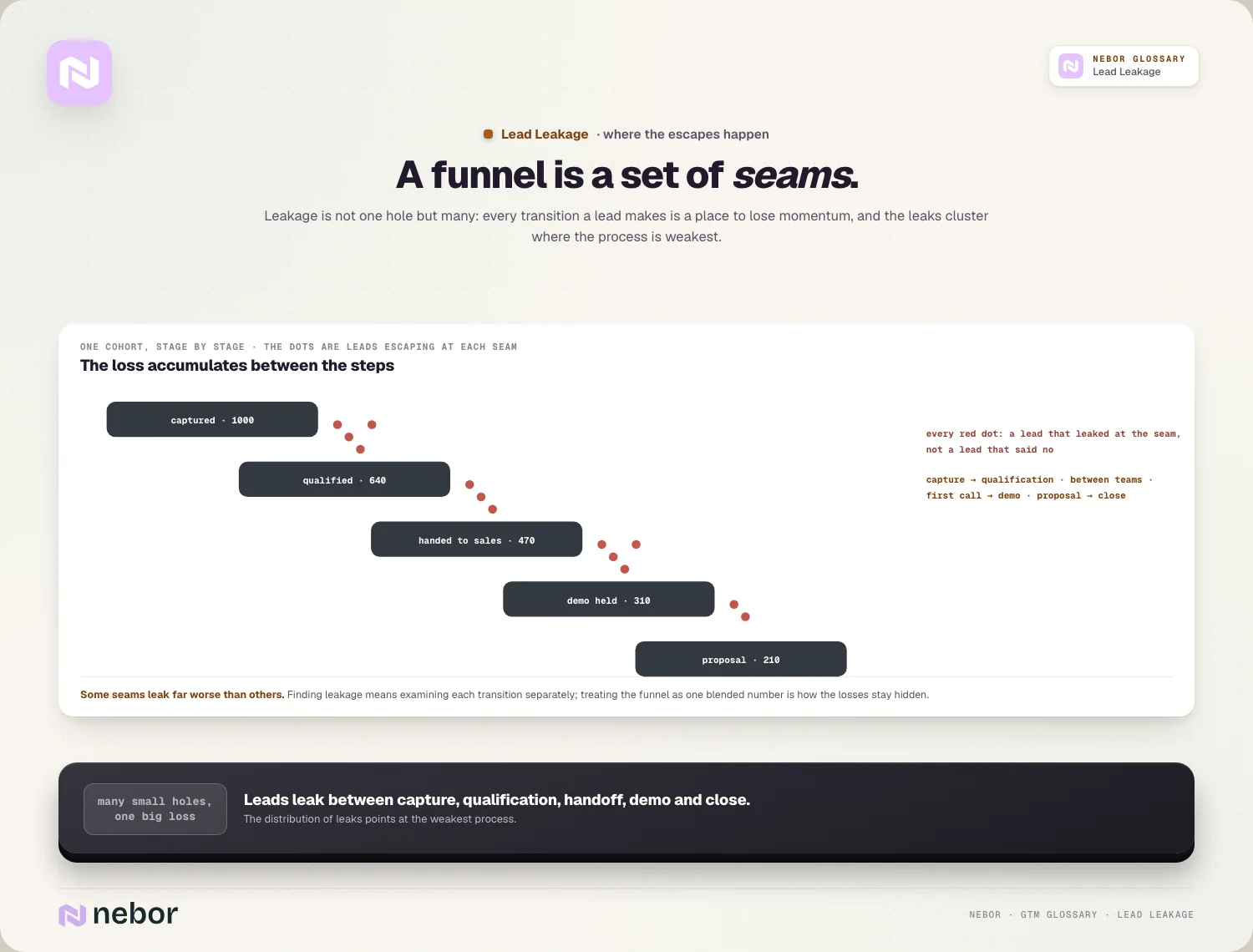
You generated a thousand leads last quarter and closed twenty, and the easy explanation is that the other nine hundred and eighty were junk. The uncomfortable truth is that many were real, interested people who slipped away not because they said no, but because nobody followed up, the data was wrong, or routing failed.
That silent loss has a name, and it's called lead leakage. It's what happens when leads enter your funnel and then disappear for operational reasons instead of genuine disinterest, usually draining more revenue than anyone realizes because the losses never announce themselves.
Lead leakage is the loss of leads as they move through your funnel due to process failures like slow follow-up, bad data, or broken routing, instead of because the leads were unqualified. These are prospects who could have converted but were lost to the gaps in your system instead.
What makes leakage so costly is that you already paid to acquire every lead that leaks. Recovering even a portion of them is far cheaper than generating new volume, so plugging leaks is often the highest-return move a revenue team can make, and yet it stays invisible until someone goes looking for it.
TL;DR
Lead leakage is when interested leads escape your funnel for operational reasons like slow follow-up, messy data, or broken routing rather than because they were bad leads.
It's expensive precisely because the leads were real and already paid for, so every one that leaks is wasted acquisition spend on a prospect who might have bought.
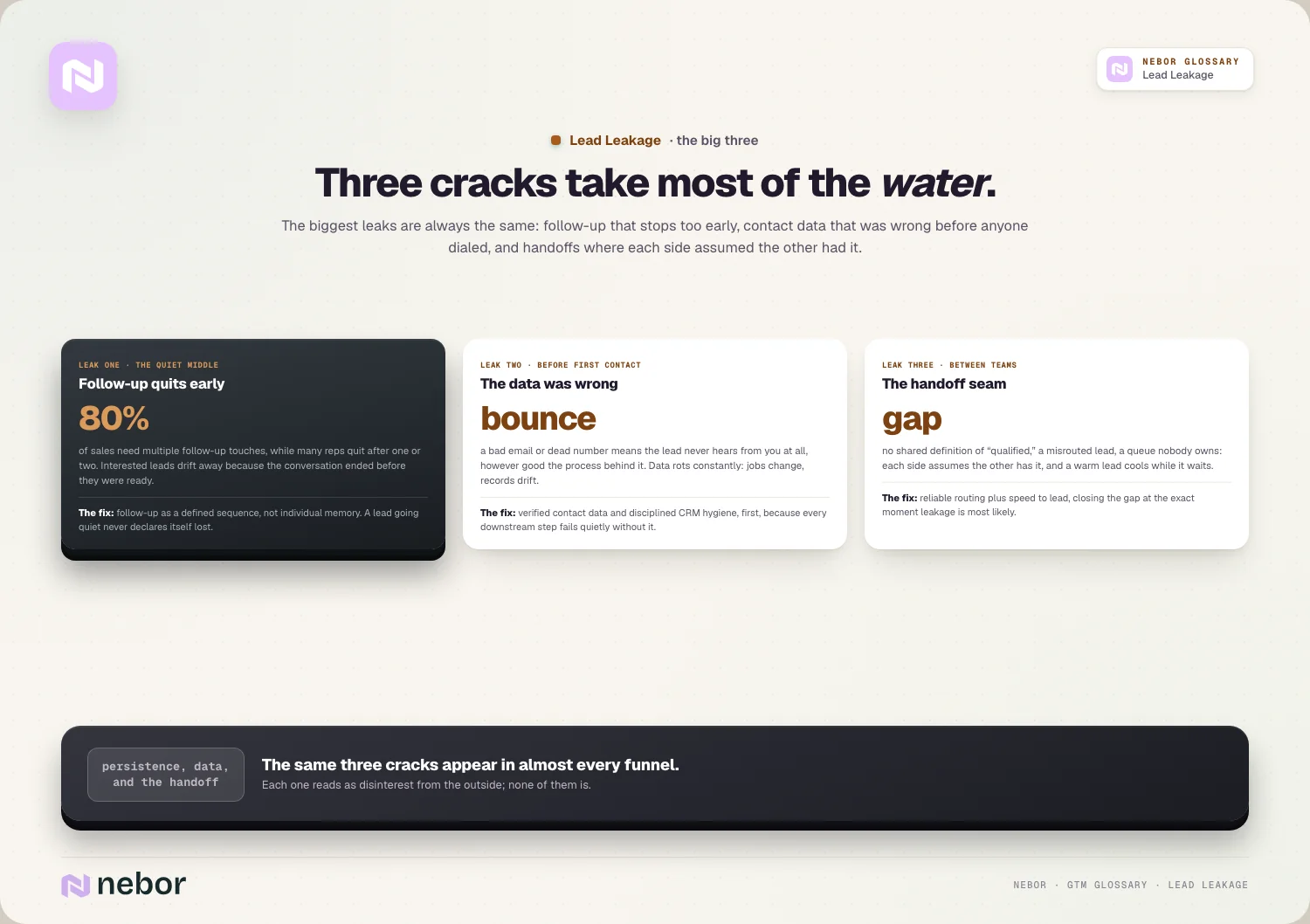
It happens at every stage, but the biggest leaks are usually mid-funnel follow-up that stops too early, contact data that's wrong before anyone reaches out, and handoffs where leads fall between teams.
You find it by drilling into stage-by-stage conversion instead of aggregate totals, then fix it in priority order, usually starting with data quality and speed to lead before routing and alignment.
What lead leakage means and why it differs from losing bad leads fairly
The key distinction is between a lead you lose and a lead that leaks. Losing a lead means a real prospect evaluated you and chose not to buy, which is a normal outcome of selling, while a leaked lead never got the chance because a process failure ended their journey before a real decision was ever made.
Leakage is a process problem wearing the disguise of a conversion problem. When leads leak, it looks like your funnel simply has low conversion, so teams respond by demanding more leads, when the real issue is that a share of the leads they already have keep slipping away for operational reasons.
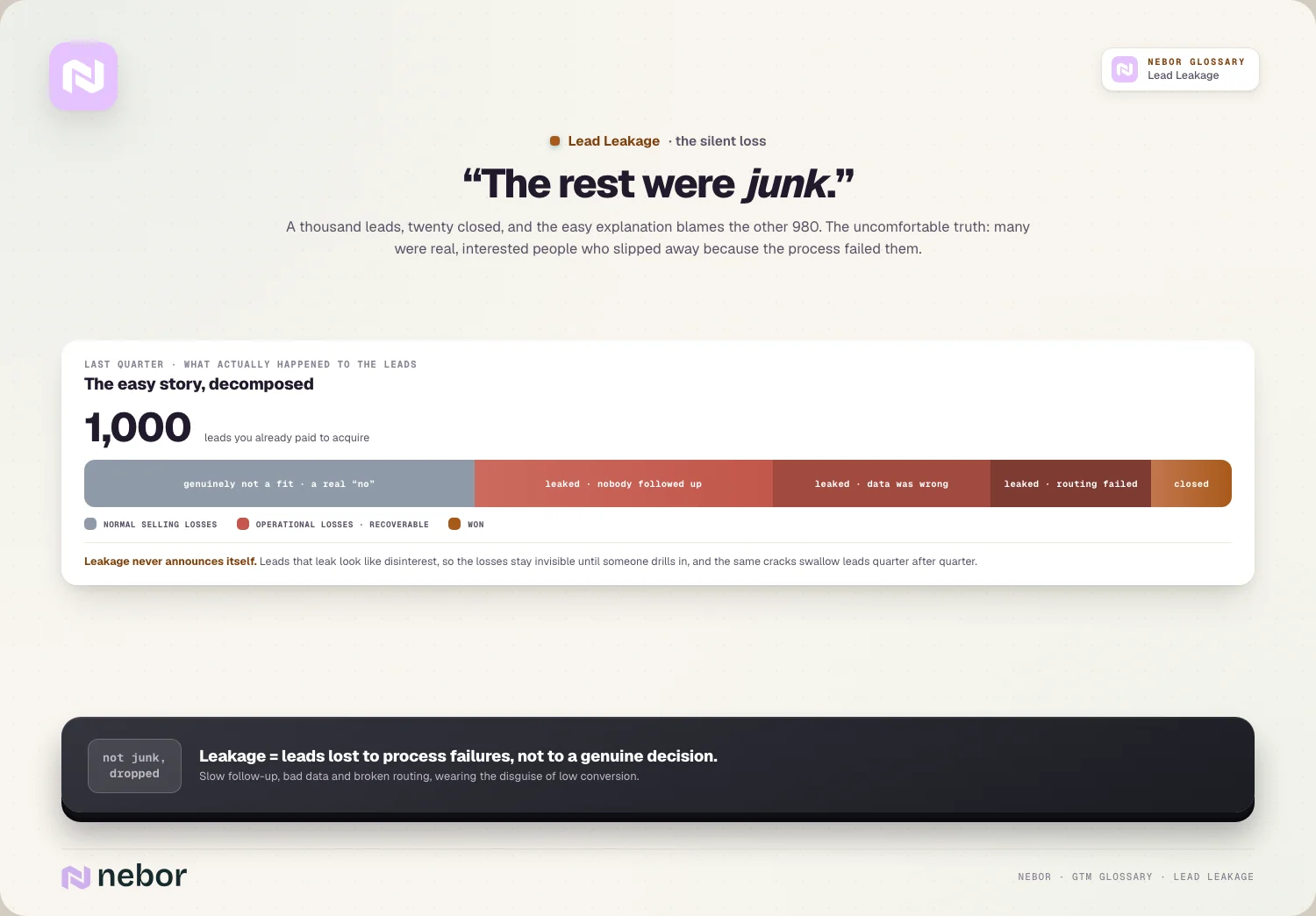
This is why leakage is fixable in a way that lost deals aren't. You can't win every genuine competition, but you can stop leads from vanishing to a missed follow-up or a wrong phone number, which means leakage represents recoverable revenue trapped inside a funnel that looks like it's just underperforming.
Where in the funnel leads tend to leak as they move stage by stage
Leakage isn't one hole but many, and it happens at every transition a lead makes. Leads leak between capture and qualification, between marketing and sales, between a first call and a demo, and between a proposal and a close, so the funnel is less a smooth slide than a series of seams where prospects can slip out.
Each stage transition is a place to lose momentum. A lead captured on a form can leak before anyone qualifies it, a qualified lead can leak in the handoff to sales, and an active opportunity can leak when follow-up stops mid-cycle, so the loss accumulates across the whole journey instead of at one point.
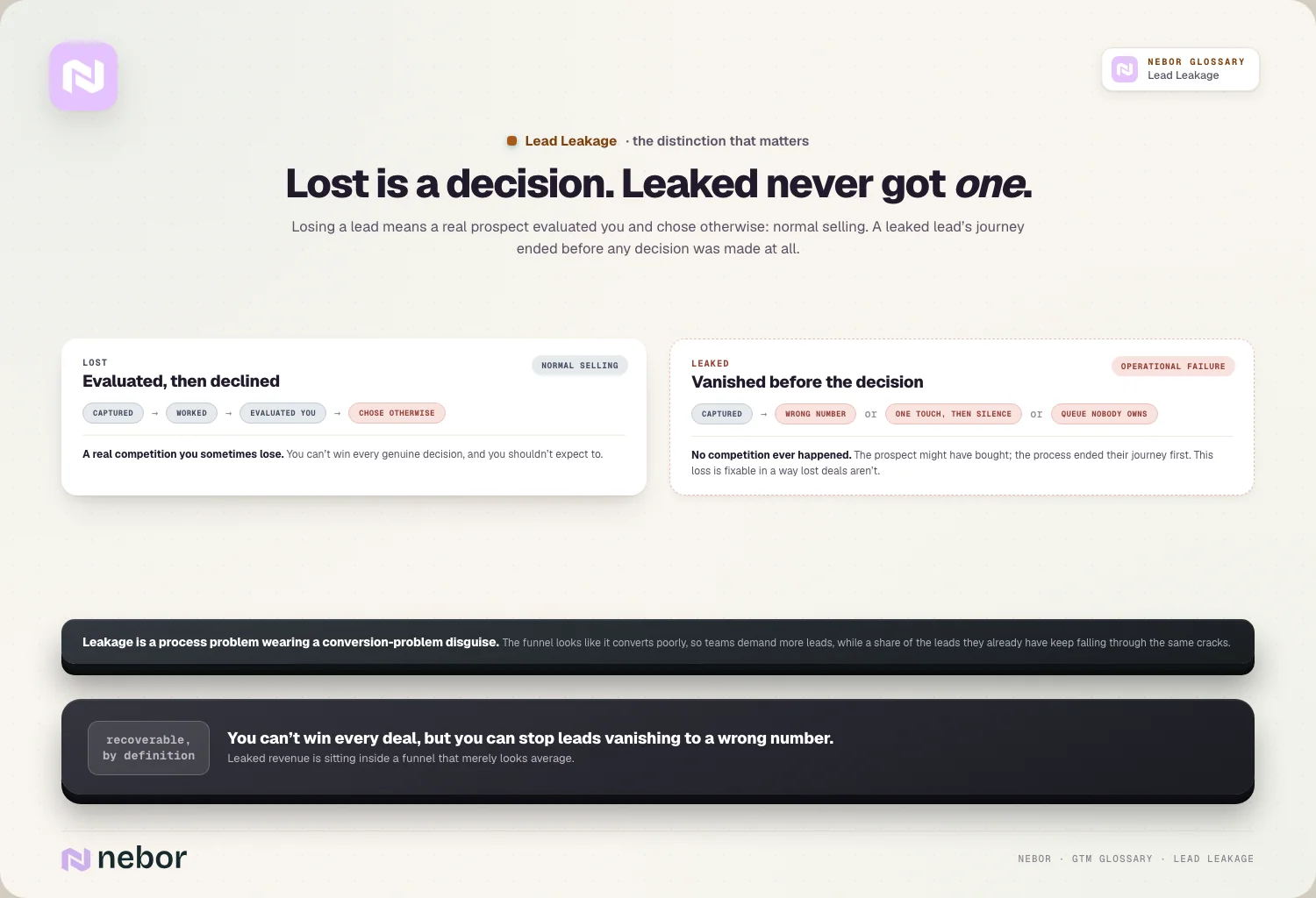
Seeing the funnel this way reframes the problem from a single leak to a distribution of them. Some stages leak far worse than others, and the leaks cluster where the process is weakest, so finding leakage means examining each transition separately instead of treating the funnel as one number.
Why slow and abandoned follow-up is the single biggest place leads leak
The largest source of mid-funnel leakage is follow-up that simply stops too soon. Most deals need several touches, but 80% of sales require multiple follow-up interactions while many reps quit after one or two, so a huge share of interested leads leak purely because nobody kept reaching out.
This leak is invisible because a lead going quiet never declares itself lost. It just stops responding, and without a system ensuring persistence, a genuinely interested prospect drifts away simply because the conversation ended before they were ready, which reads as a cold lead when it was really an abandoned one.
Closing this leak means making follow-up a defined process instead of a matter of individual memory. When a structured follow-up sequence ensures the later touches truly happen, the deals that used to vanish in the quiet middle of the funnel keep moving toward a decision instead of leaking out of it.
How messy data leaks leads before anyone ever gets a chance to reach them
A subtler leak happens before the first contact is even attempted, when the lead's own data is wrong. If an email bounces or a phone number is disconnected, the lead never hears from you no matter how good your follow-up process is, so the prospect leaks silently at the very top of the funnel.
Data rot makes this worse over time because contact information decays constantly. People change jobs, emails go stale, and records drift, so a lead captured months ago may already be unreachable by the time anyone works it, which turns weak data hygiene into a steady drain on otherwise valid leads.
Fixing this leak is why we point clients at data quality first in any leak-plugging effort.
Clean, verified contact data and disciplined CRM hygiene are what make every downstream step possible, because routing, follow-up, and nurture all fail without a sound when the underlying record can't reach the person it describes.
Why broken routing and unclear handoffs drop leads between your teams
Every handoff is a seam where a lead can tear loose, and the marketing-to-sales handoff is the classic example. When there's no shared definition of a qualified lead and no agreed process for who acts, leads fall into the gap between teams, with each side assuming the other has it.
Routing failures compound this by sending leads to the wrong place or nowhere at all. A lead misrouted to the wrong rep, or dropped into a queue nobody owns, leaks just as surely as one no one follows up, making reliable lead routing a core defense against leakage instead of a mere convenience.
Speed makes the handoff leak worse, because a lead's interest fades fast. A slow handoff lets a warm lead cool before anyone reaches them, so strong speed to lead closes the gap at the exact moment leakage is most likely, catching the prospect while they still remember reaching out.
How to find the leaks in your own funnel using stage conversion data
You can't plug leaks you can't see, so finding leakage starts with drilling into stage-by-stage conversion instead of aggregate totals. Pulling the conversion rate for each transition, from capture to qualified and onward, reveals exactly where prospects lose momentum instead of hiding it inside one blended number.
A stage where many leads enter but few advance is a leak you've located. When you see a sharp drop at a particular transition, that gap points straight at the process failing there, so the diagnostic work is about isolating the weak seam instead of concluding the whole funnel underperforms evenly.
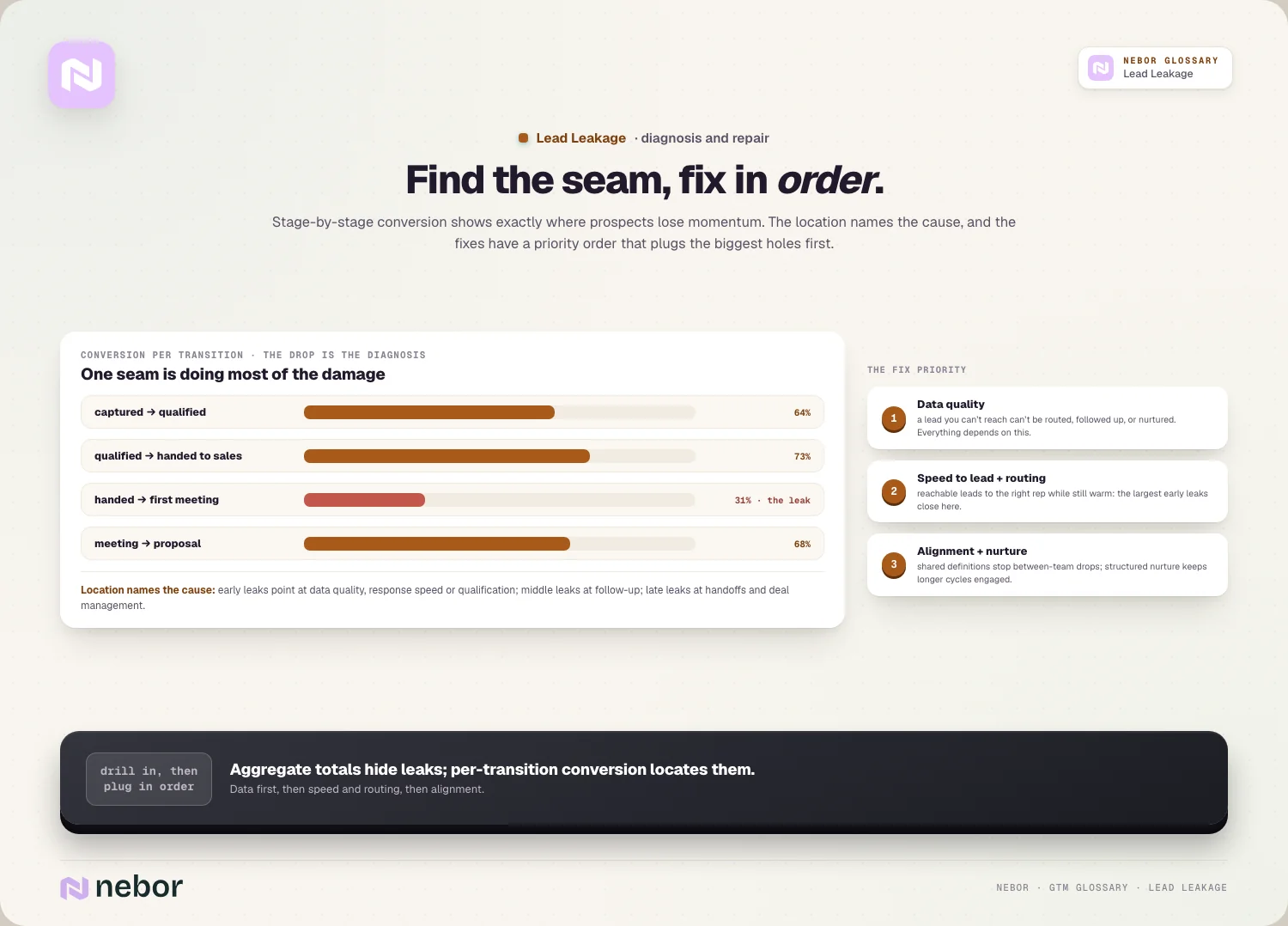
The location of the leak tells you its likely cause. An early leak points at data quality, response speed, or lead qualification, a middle leak at follow-up, and a late leak at handoffs or deal management, so reading the conversion rate at each step turns a vague sense of loss into a specific problem to fix.
The fix priority order that plugs your biggest leaks before the small ones
Not all leaks are equal, and in our experience the order you fix them in matters as much as the fixing itself. Data quality usually comes first, because a lead you can't reach can't be routed, followed up, or nurtured, so cleaning the underlying records is the foundation every other fix depends on.
Speed to lead and routing come next, because they govern whether a reachable lead gets to the right person while still warm. Getting fresh leads to the correct rep in your team quickly closes the largest early leaks, so tightening response time and routing logic tends to recover more leads than any later-stage fix.
Alignment and nurture round out the sequence. Shared definitions and clear handoffs stop leads falling between teams, and structured nurture keeps longer-cycle leads engaged, so working the priorities in order, backed by solid workflow orchestration, plugs the biggest holes first.
Why the warmest, most expensive leads are the ones you can least afford to leak
Not every leaked lead costs the same, and the most painful losses are usually the warmest ones. An inbound lead who requested a demo has shown real intent and cost real money to generate, so when that lead leaks to slow follow-up, you lose a prospect who was closer to buying than almost anyone else in your funnel.
High-intent leads also leak fastest because their interest is the most time-sensitive. Someone actively comparing options expects a quick response, so a lead left unworked for a day can be gone by the time you reach them, which makes leakage at the top of an inbound funnel especially unforgiving.
This is why matching and routing inbound leads instantly matters so much. Connecting a fresh lead to the right account and rep through reliable lead-to-account matching is what keeps your most valuable, most fragile leads from leaking before anyone even knows they arrived.
What lead leakage costs you beyond the leads you can see disappearing
The direct cost of leakage is wasted acquisition spend, because every leaked lead is money you paid to generate and then let slip away. When a share of your leads leak, you're effectively throwing out part of your marketing budget, and that waste makes your cost per acquired customer worse than it looks.
The competitive cost is even sharper, because a leaked lead often doesn't disappear so much as go elsewhere. The classic finding that only about one in three leads buys from the company that first received their inquiry means a slow or broken process hands your interested prospects to whoever responds better.
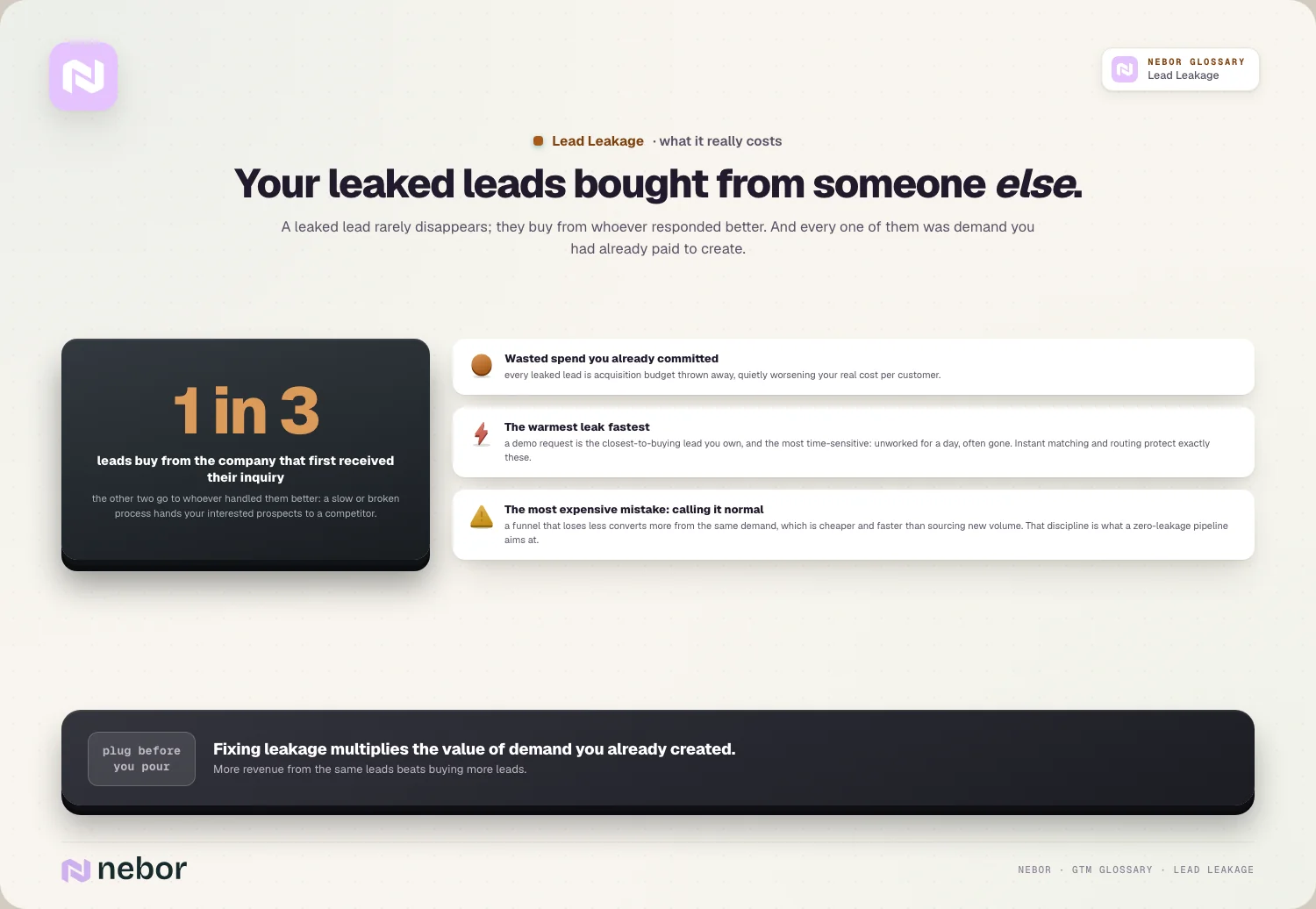
There's also a compounding cost to the rest of the engine. Leakage lowers the return on everything upstream, so the leads you automate sales prospecting to generate produce less than they should, which makes fixing leakage a multiplier on the value of demand you're already creating instead of a separate project.
Why treating lead leakage as normal is the most expensive mistake of all
The deepest mistake teams make with leakage, and we see it constantly, is accepting it as an unavoidable fact of the funnel.
Because the losses are invisible and easy to write off as attrition, most organizations never measure them, which lets the same weak joints keep draining the funnel while everyone assumes the numbers are normal.
Treating leakage as a solvable operational problem changes the economics of growth. A funnel that loses less converts more from the same leads, which is usually cheaper and faster than sourcing new volume, so a team that hunts leaks systematically gets more revenue from demand it has already paid to create.
That discipline is exactly what a zero-leakage pipeline aims at, and it's a core habit of any go-to-market system built to grow efficiently.
When you keep finding and closing the seams where leads escape, the whole funnel tightens over time, and the prospects you worked hard to attract make it all the way to a real decision.
Deel dit bericht
RevOps
CRM
Begrippenlijst
Gerelateerde begrippen
De basis GTM-concepten begrijpen




Klaar om je pipeline te bouwen