

In this post:
Most companies spend their lives fighting for a slice of a market someone else defined. They benchmark against the same competitors, get compared on the same features, and win by being a little cheaper or a little faster in a race everyone else is also stuck in, which is a hard way to build something that lasts.
Category design is the strategy of refusing to play that game. Instead of competing to be the best in an existing category, you create a new category, define the problem in a way only you solve, and become the obvious leader of a market you designed, where the comparison to old alternatives works in your favor.
Category design is a business strategy for creating and leading an entirely new market category instead of competing within an existing one. The company that designs the category defines the problem, sets the rules, and positions itself as the default answer, capturing most of the value the new category creates.
The reason it's so powerful is that the designer of a category tends to dominate it. When you create the category, you write the rules in your own favor, and competitors who arrive later must build what you already have while you're cemented as the leader, making it an unusually high-return move.
TL;DR
Category design is the strategy of creating and leading a brand-new market category instead of fighting for share in an existing one, so you compete against a status quo instead of direct rivals.
It's a business strategy rather than a marketing tactic, because it reshapes what problem you solve and how the market thinks, and the marketing only comes after the category is defined.
The payoff is enormous, because the company that designs a category, the Category King, tends to capture the large majority of the economic value the category creates.
It's also a big, risky bet that most companies shouldn't make, because creating a category demands educating a market from scratch, and owning a sharp segment is often the wiser move.
What category design is at its full scope and why it goes deeper than marketing
Category design starts from a different question than normal competition, asking not how to win an existing market but how to create a new one. Rather than positioning as a better version of what exists, you define a new problem and a new way of solving it that reframes what buyers should even look for.
This is why category design is a business strategy instead of a marketing one. It shapes what you build, who you hire, how you price, and what problem you claim to solve, so it stands above marketing entirely, and the campaigns only begin once the category itself has been designed.
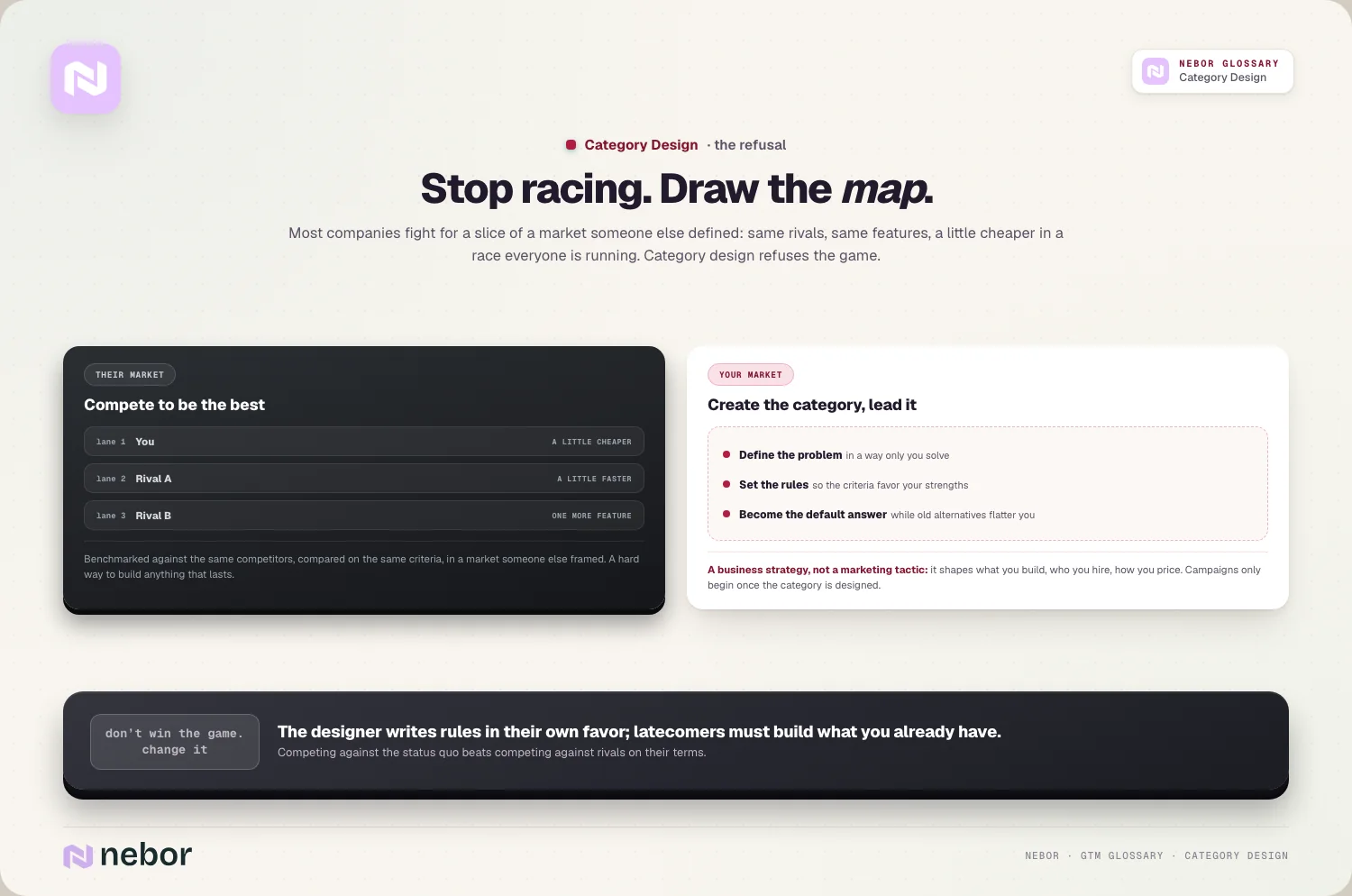
The distinction is important because treating category design as marketing dooms it. A clever campaign around a category that the actual product and company don't embody rings hollow, so the whole organization has to live the category, and that lived commitment is what separates a real category play from a slogan.
Why the Category King captures most of the value a category creates
The core economic argument for category design is that categories tend to be winner-take-most. Research from the firm Play Bigger found that Category Kings capture around 76% of the total market value in their category, leaving the remaining fraction to be split among everyone else.
This lopsided outcome happens because the designer defines the terms of competition. The company that creates a category gets to make the rules, and those rules naturally favor its own strengths, so later entrants are measured against a standard the leader already meets while they scramble to catch up.
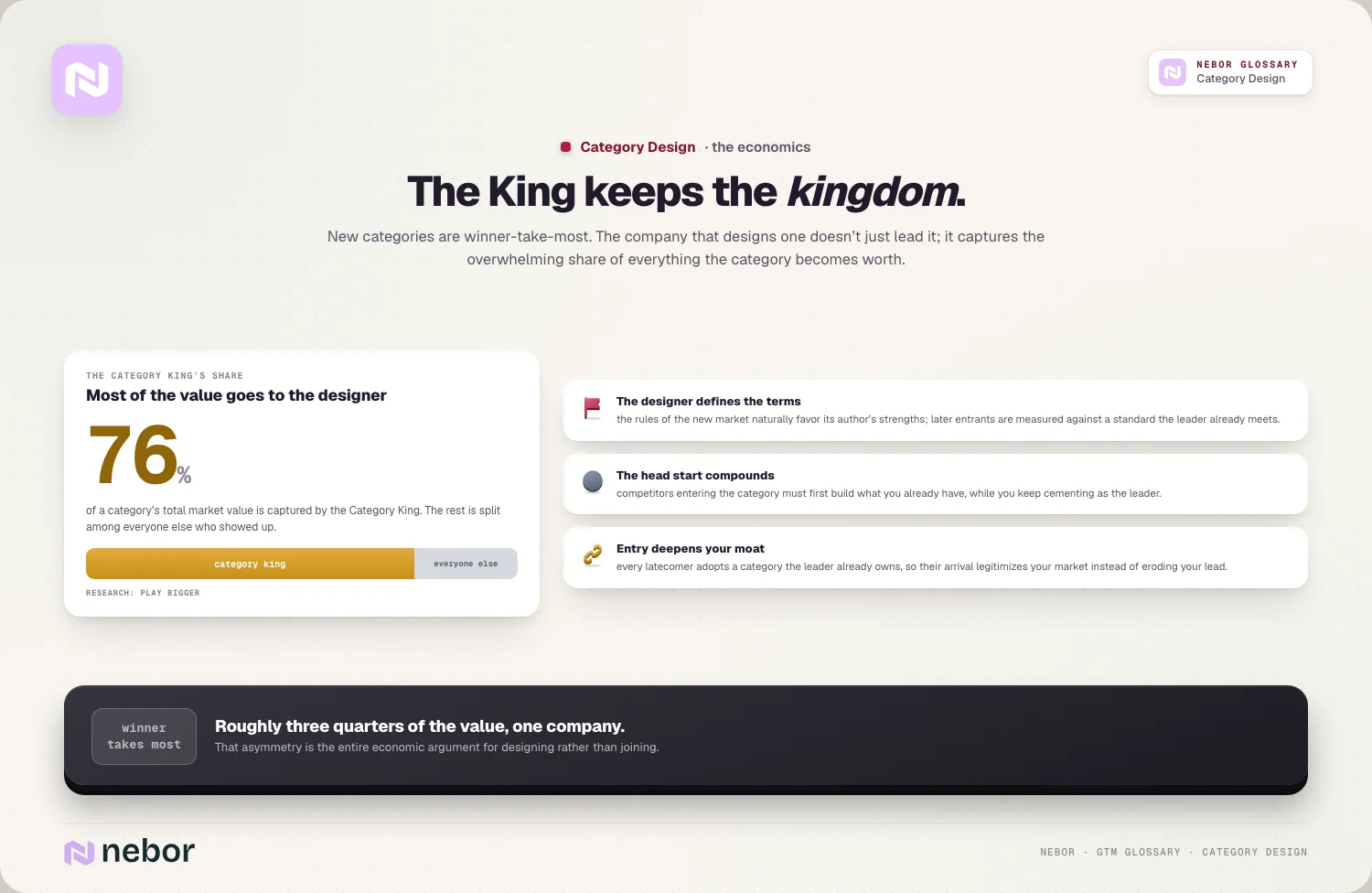
That head start compounds into durable dominance. When competitors jump into the new category, they have to develop what the designer already built and become associated with a category the leader already owns, which entrenches the Category King further instead of eroding its lead.
Why a point of view is the beating heart of any category design
A category doesn't come to life through a product alone, it comes to life through a story, and that story is a point of view. A point of view articulates a problem or opportunity the market hasn't properly named, explains why the old way is broken, and frames the new category as the answer.
This point of view usually takes a concrete form the company publishes consistently. A manifesto, a research report, or a founder essay lays out what's wrong with the current approach and why a fundamentally different one is needed, giving the market language for a problem it felt but couldn't articulate.
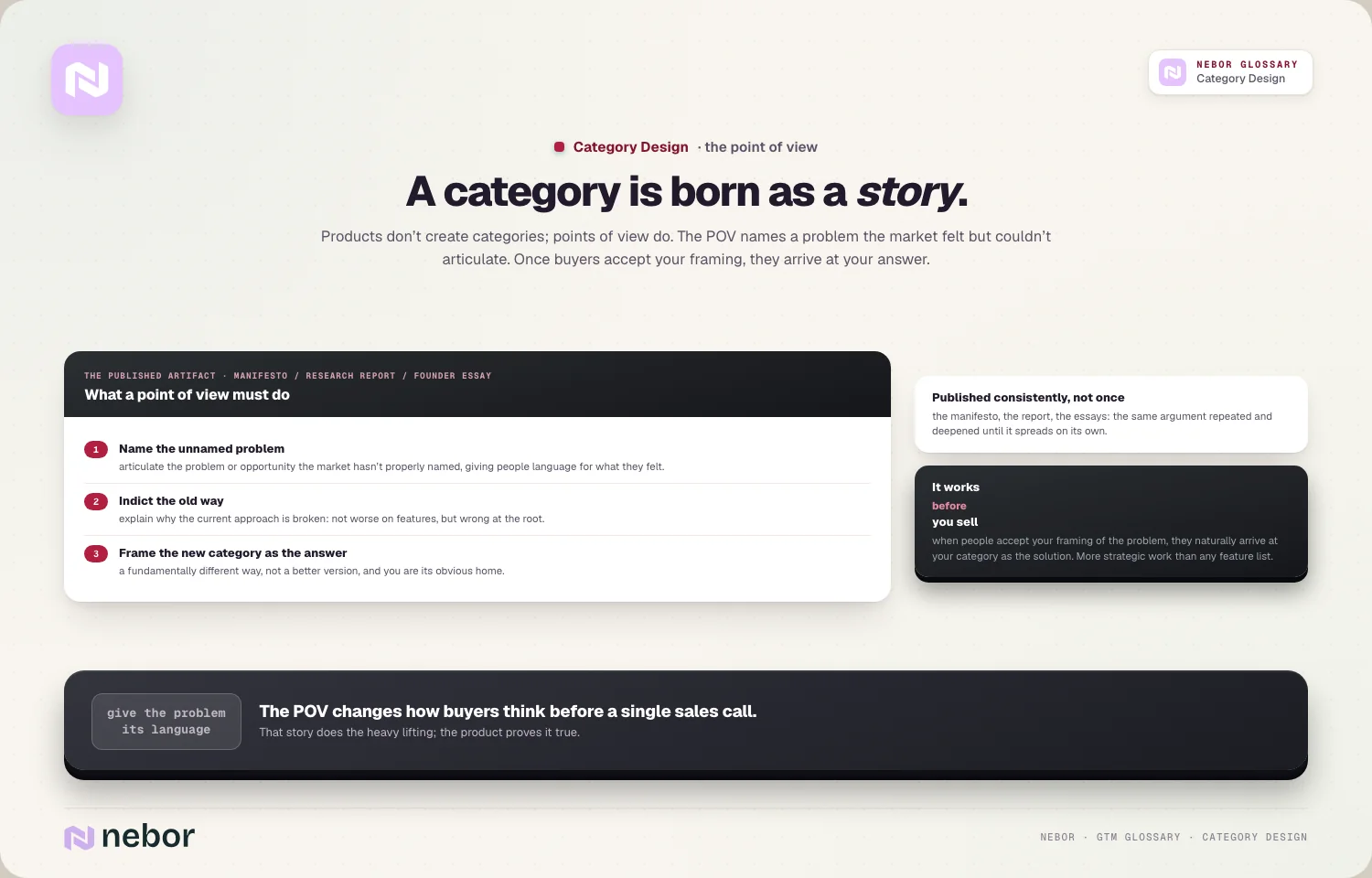
The power of a strong point of view is that it changes how buyers think before you ever sell to them. When people accept your framing of the problem, they naturally arrive at your category as the solution, so the point of view does more strategic work than any feature list ever could.
How category design differs from ordinary positioning and differentiation
Category design is often confused with positioning, but they operate at different levels. Positioning is how you differentiate within an existing category, arguing you're the best choice among known alternatives, while category design changes the category itself so the old alternatives stop being relevant.
The difference shows up in who you compete against. Differentiation pits you against named rivals on shared criteria, whereas category design pits you against the status quo, the old way of doing things, so your real competitor becomes inertia and habit instead of another vendor.
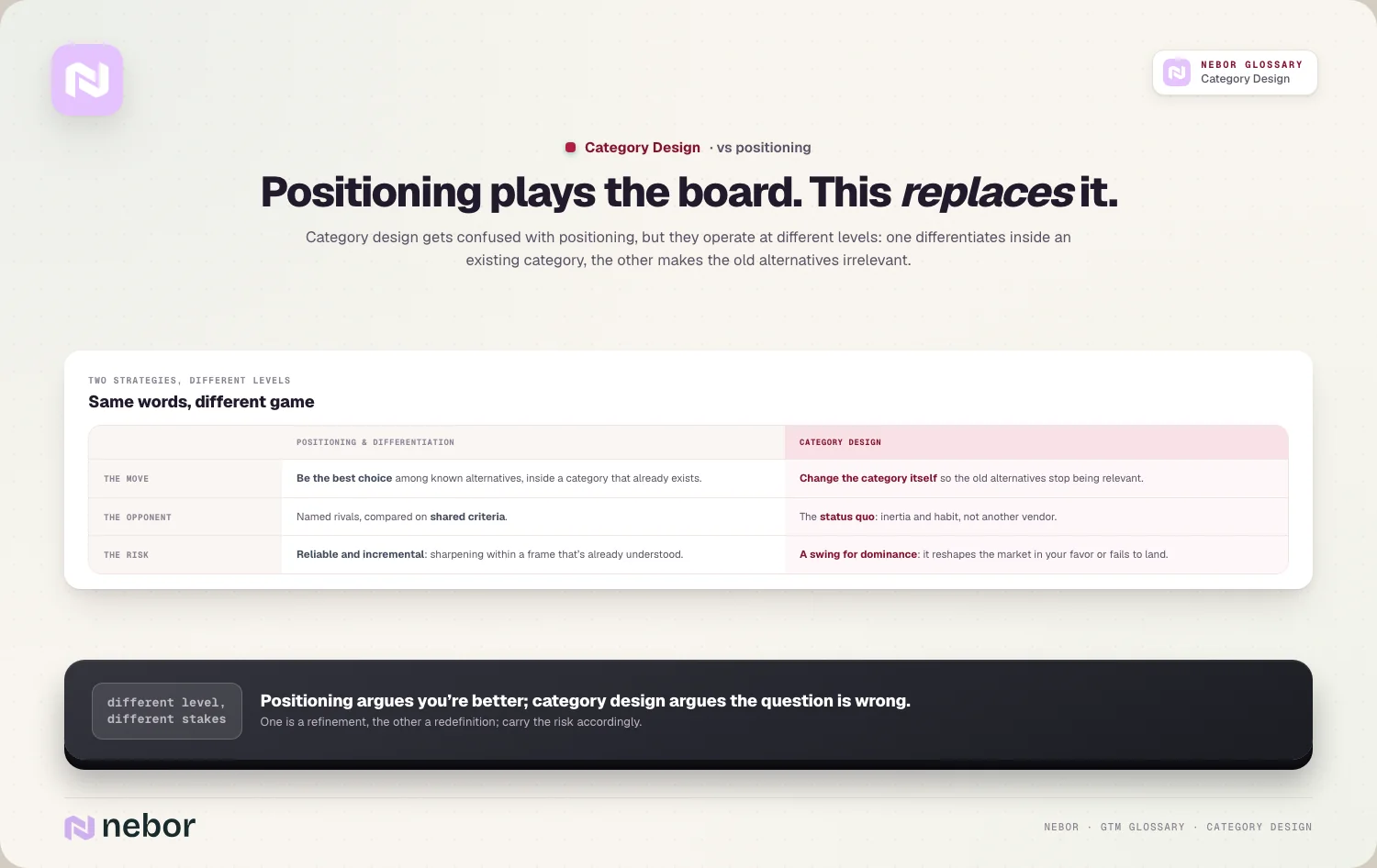
This is a more ambitious and more fragile move than positioning. Sharpening your position within a category is reliable and incremental, while designing a category is a swing for dominance that either reshapes the market in your favor or fails to land, so the two strategies carry very different risk.
Why category design is a huge bet instead of a simple go-to-market tactic
The romance of category design hides how hard and expensive the real thing is. Creating a category means educating an entire market on a problem they may not know they have, which takes years of sustained investment in content, evangelism, and patience before the category takes hold.
That burden is why category design is the least understood strategy in B2B and the most often botched. Many companies declare a new category in a press release without doing the deep work of reframing the market, so they get the risk of an unproven category without the reward of owning one.
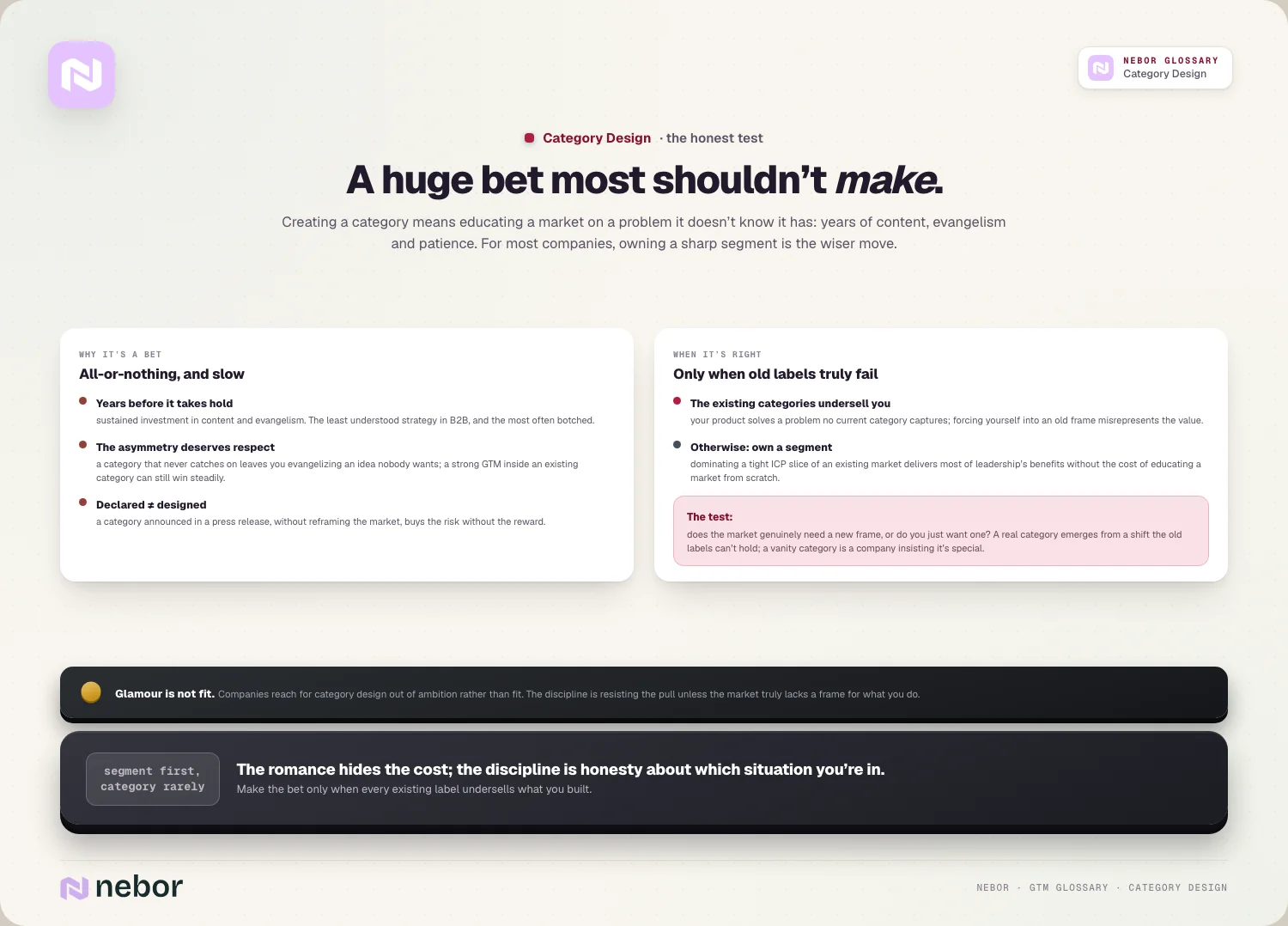
The bet is also all-or-nothing in a way normal go-to-market isn't. A category that never catches on leaves you evangelizing an idea nobody wants, whereas a strong go-to-market strategy within an existing category can still win steadily, so the asymmetry of the wager deserves real respect before making it.
When category design makes sense and when you should own a segment instead
For most companies we meet, the honest answer is that category design is not the right move, and owning a sharp segment beats inventing a category.
Dominating a specific slice of an existing market, defined by a tight ideal customer profile, delivers many of the benefits of leadership without the enormous cost of category creation.
Category design makes sense only when the existing categories truly fail to describe what you do. If your product solves a problem no current category captures, forcing your pitch into an old one undersells you, so designing a new category becomes worth the cost because the alternative misrepresents your value.
The test we advise applying is whether the market truly needs a new frame or you just want one. A genuine category emerges from a real shift the old labels can't hold, whereas a vanity category is a company insisting it's special, so the discipline is being honest about which situation you're in.
How category design connects to demand creation and thought leadership
Category design lives on the demand-creation side of marketing instead of demand capture, because it creates need that didn't previously exist. It belongs squarely in the demand creation versus demand capture distinction, because you're teaching a market to want something before anyone is searching for it.
Sustained thought leadership is the engine that makes a category real over time. Consistent thought leadership that repeats and deepens the point of view is what gradually shifts how a market thinks, so category design and a serious content strategy are inseparable instead of separate efforts.
When it lands, category design also compounds like a flywheel. As more people adopt your framing, your category gains legitimacy, which draws more attention and adoption, feeding a GTM flywheel where owning the category becomes self-reinforcing and increasingly hard for latecomers to challenge.
How a category gets built in stages from point of view to market leadership
A category doesn't appear overnight, and the work usually starts with a sharp point of view that the company publishes relentlessly. Before any product marketing, the founders and early team have to name the broken status quo and the new way clearly enough that the idea can spread on its own.
From there, the strategy moves into sustained evangelism instead of a single launch. The point of view gets repeated across essays, talks, and research until the language starts appearing in how the market itself describes the problem, which is the real signal that a category is taking hold.
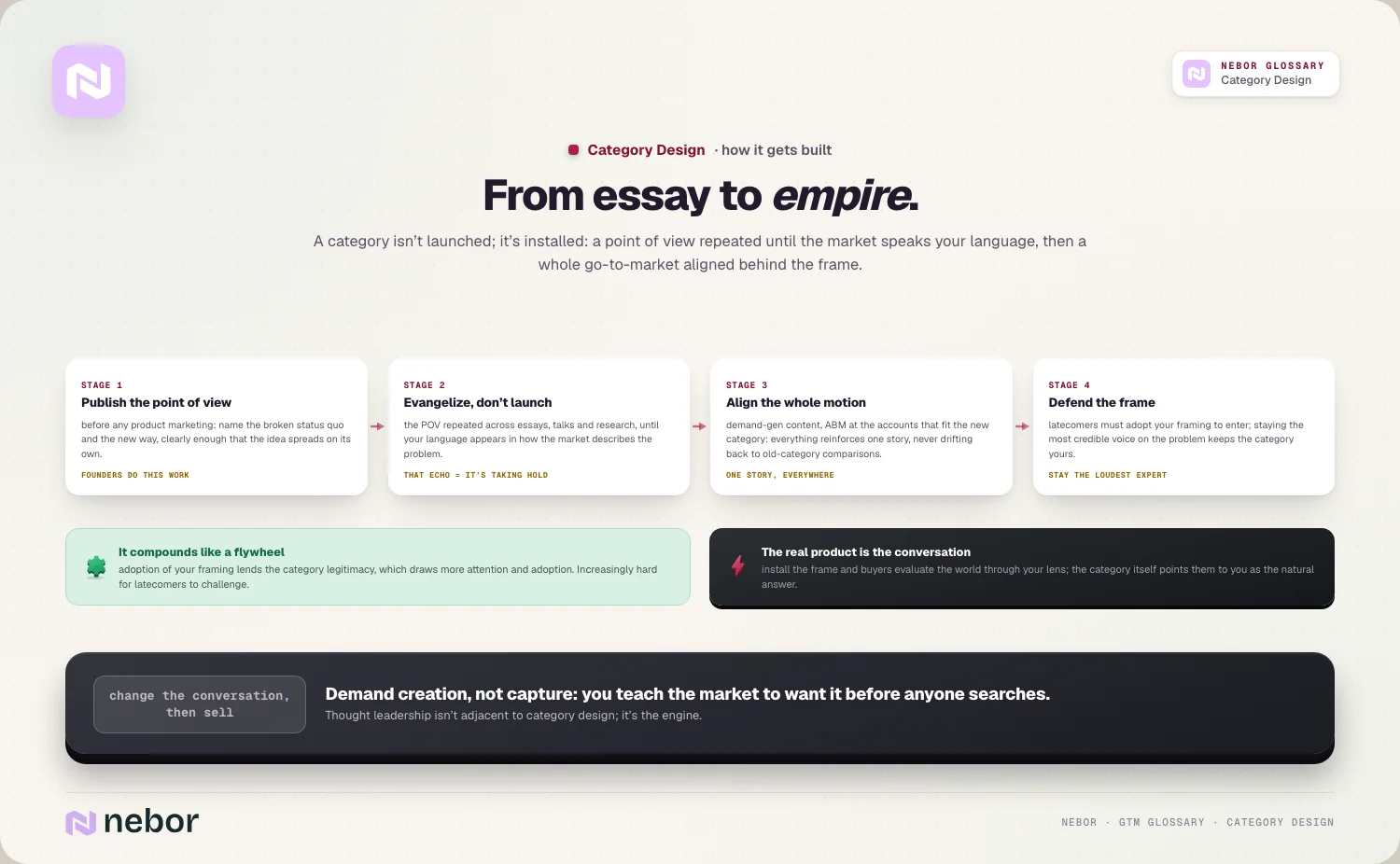
Only once the frame is landing does the rest of go-to-market align behind it. The whole motion, from demand generation content to the account-based marketing aimed at the accounts that fit the new category, has to reinforce the same story instead of drift back into old-category comparisons.
The final stage is defending the leadership you've built as competitors arrive. Because latecomers have to adopt your framing to enter, staying the most credible voice on the problem is what keeps the category yours instead of letting a fast follower redefine it.
The common mistakes teams make when they attempt category design
The most common mistake, and the version we see most, is declaring a category instead of designing one.
Slapping a new label on an old product and announcing a category in a launch doesn't create anything, because a real category requires reframing the problem and backing it with a product and company that embody the new way in earnest.
Another is underestimating the time and commitment it takes. Category design is a multi-year effort to shift how a market thinks, so teams that expect quick results abandon the strategy before it can work, wasting the early investment right before the category might have taken hold.
The subtler mistake is choosing category design when a segment play would serve better. Because the strategy is glamorous, companies reach for it out of ambition instead of fit, so the discipline is resisting the pull of category creation unless the market lacks any workable frame for what you do.
Why category design is really about changing the conversation before you sell
The deepest truth of category design is that it wins the market by winning the way people think about a problem. When you successfully install a new frame, your buyers evaluate the world through your lens, so the selling gets easier because the category itself points them toward you as the natural answer.
That is also why category design is so rare and so valuable, because changing how a market thinks is far harder than building a better feature. The companies that pull it off earn a kind of durable GTM alpha that competitors can't easily copy, because you can't out-feature your way past a category someone else defined.
A go-to-market system built around a well-designed category turns every other effort more efficient, because the framing does persuasive work before any rep gets involved.
When the market already accepts your view of the problem, the outreach your team sends, including what you automate sales prospecting to build lands on buyers primed to see you as the answer instead of one option among many.
Share this post
Marketing
Glossary
Related glossary items
Understanding the core GTM concepts




Ready to build your pipeline











